
User Generated Content Management Software Market Size and Share
Market Overview
| Study Period | 2020 - 2031 |
|---|---|
| Market Size (2026) | USD 1.86 Billion |
| Market Size (2031) | USD 3.49 Billion |
| Growth Rate (2026 - 2031) | 13.41% CAGR |
| Fastest Growing Market | Asia-Pacific |
| Largest Market | North America |
| Market Concentration | Medium |
Major Players *Disclaimer: Major Players sorted in no particular order Image © Mordor Intelligence. Reuse requires attribution under CC BY 4.0. | |
User Generated Content Management Software Market Analysis by Mordor Intelligence
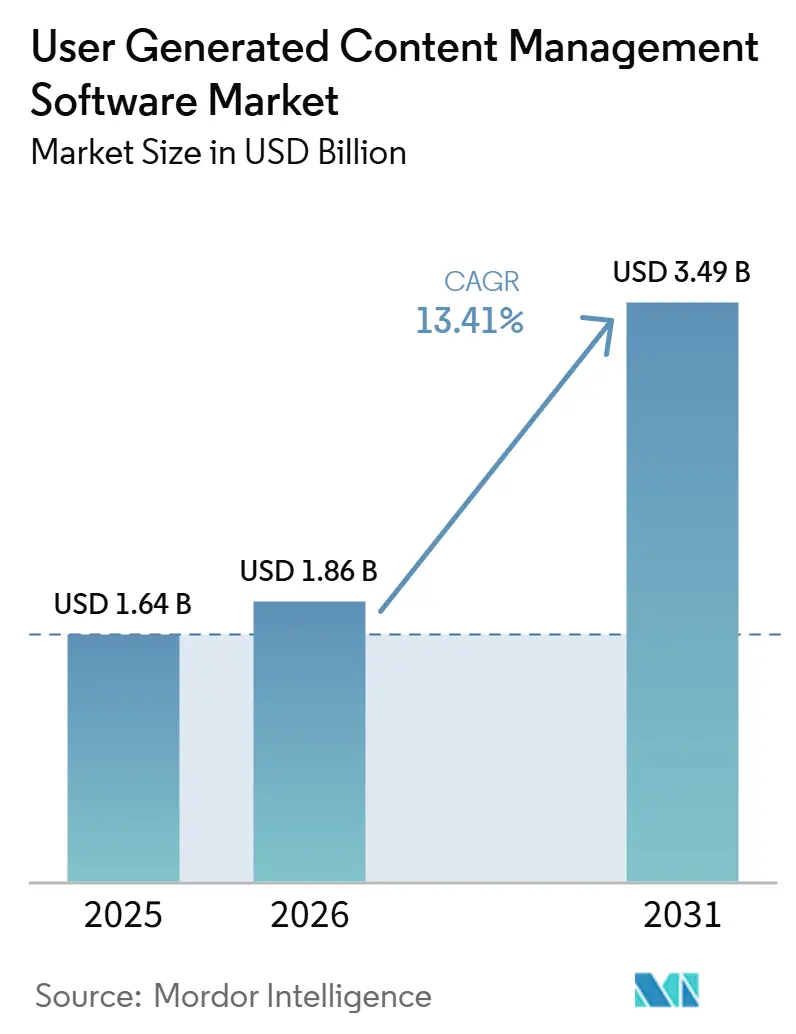
The user generated content management software market size is projected to expand from USD 1.64 billion in 2025 and USD 1.86 billion in 2026 to USD 3.49 billion by 2031, registering a CAGR of 13.41% between 2026 to 2031. Growth is supported by the expanding use of peer-created reviews, images, videos, and creator content in purchase decisions. Brands are shifting from manual content collection toward software that can collect, organize, approve, analyze, and publish consumer content across commerce and social channels. The user generated content management software market also benefits from the increased need for first-party and zero-party data as third-party targeting signals become less available. Larger vendors are broadening their offerings through moderation, analytics, rights management, and commerce integrations, while specialized providers continue to compete on focused workflows. Higher moderation and compliance costs may limit margins, but they also create demand for platforms that can reduce manual review workloads and maintain defensible content records.
Key Report Takeaways
- By deployment mode, cloud-based solutions accounted for 81.43% of revenue in the user generated content management software market in 2025, while on-premises deployment is projected to expand at a 13.98% CAGR through 2031.
- By application, UGC analytics and campaign performance accounted for 28.76% of revenue in 2025, while content moderation and brand safety is expected to grow at a 16.17% CAGR through 2031.
- By enterprise size, large enterprises held 64.81% of revenue in 2025, while SMEs are projected to record the highest CAGR of 15.74% through 2031.
- By end-user industry, retail and e-commerce accounted for 27.91% of the user generated content platform market in 2025, while the consumer goods and brands segment is projected to expand at a 16.78% CAGR through 2031.
- By geography, North America held 36.29% of revenue in 2025, while Asia-Pacific is projected to grow at a 14.32% CAGR through 2031.
Note: Market size and forecast figures in this report are generated using Mordor Intelligence’s proprietary estimation framework, updated with the latest available data and insights as of January 2026.
Global User Generated Content Management Software Market Trends and Insights
Drivers Impact Analysis*
| DRIVER | (~) % IMPACT ON CAGR FORECAST | GEOGRAPHIC RELEVANCE | IMPACT TIMELINE |
|---|---|---|---|
| Rising E-Commerce Review Volume and Social Proof Dependency | +2.1% | Global, with highest intensity in North America and Asia-Pacific | Medium term (2-4 years) |
| GenAI-Assisted Moderation and Metadata Enrichment Adoption | +1.9% | Global | Short term (≤ 2 years) |
| Creator and Influencer Commerce Workflow Expansion | +1.6% | North America and Asia-Pacific | Medium term (2-4 years) |
| Rising Brand Safety Requirements Across Owned and Paid Channels | +1.3% | Global, with the strongest compliance influence in Europe | Short term (≤ 2 years) |
| Zero-Party Data Capture Demand From Privacy-Constrained Personalization | +1.0% | North America and Europe | Medium term (2-4 years) |
| Multi-Format UGC Demand From Short-Form Video and Live Commerce | +0.8% | Asia-Pacific, with spillover into North America and Europe | Short term (≤ 2 years) |
| Source: Mordor Intelligence | |||
Rising E-Commerce Review Volume and Social Proof Dependency
Customer review volumes are increasing faster than traditional teams can manually review, classify, and publish the content. This is increasing demand for the user generated content management software market, as brands need tools to manage content at scale. Research published in 2024 found that user-generated content reduces perceived purchase risk by providing direct peer validation during online shopping.[1]Gaurab Kumar Basyal, Bhagat Regmi, Sunil Palikhe, and Amrit Dhungana, “The Influence of User-Generated Content on E-Commerce Sales: A Meta-Analysis,” International Research Transactions, doi.org As review libraries grow, freshness, relevance, and verification become more important than merely displaying a large number of reviews. Platforms with semantic filtering can help shoppers find product content that better matches their questions, use cases, and purchase intent. Bazaarvoice reported that product pages featuring both photo and text content recorded a median conversion improvement of 17% through its Shopify partner integration in 2026.
GenAI-Assisted Moderation and Metadata Enrichment Adoption
Generative AI is changing moderation economics by helping platforms classify, label, and route large content volumes faster. The user generated content management software market is therefore moving toward tools that support text, image, video, and audio review within one workflow. TikTok reported that its automated systems removed more than 86 million fake accounts during a single quarter, showing the scale of platform integrity work now supported by automated detection. Research presented at CVPR 2025 found that detectors trained on older benchmarks can struggle with newer forms of AI-generated video.[2]Rohan Kundu et al., “Towards a Universal Synthetic Video Detector: From Face or Background Manipulations to Fully AI-Generated Content,” Proceedings of the IEEE/CVF Conference on Computer Vision and Pattern Recognition, thecvf.com This raises the value of moderation systems that can identify synthetic content across multiple formats and changing content patterns. Sprinklr strengthened its video and multimodal intelligence capabilities through the acquisition of ViralMoment in May 2026.
Creator and Influencer Commerce Workflow Expansion
Creator activity is becoming a direct part of sales, product discovery, and customer engagement programs. The user generated content management software market is gaining from this shift because brands need systems that can obtain rights, confirm disclosures, assess content quality, and measure commercial outcomes. Platforms are increasingly expected to support creator content from intake through approval, paid-media use, and performance reporting. Yotpo introduced AI-powered review summaries and loyalty personalization updates in March 2026, reflecting demand for more connected content and retention workflows. Disclosure requirements are also increasing the need for automated approval and recordkeeping processes. The Federal Trade Commission states that material relationships between creators and brands must be clearly disclosed when endorsements are used in marketing.
Rising Brand Safety Requirements Across Owned and Paid Channels
Brand safety has become a procurement requirement for enterprises using consumer content in owned and paid media. The user generated content management software market is responding through audit trails, moderation logs, rights records, and reporting features. The Digital Services Act requires covered services to provide greater transparency around moderation decisions and reporting obligations. European Commission reporting showed that nearly 50 million moderation decisions had been reversed through appeal processes during the first 2 years of Digital Services Act implementation. This level of review places greater importance on documented enforcement processes and explainable content decisions. Vendors that can provide timely reporting and verified approval records are better positioned for enterprise contracts.
Restraints Impact Analysis*
| RESTRAINT | (~) % IMPACT ON CAGR FORECAST | GEOGRAPHIC RELEVANCE | IMPACT TIMELINE |
|---|---|---|---|
| Content Authenticity, Consent, and Disclosure Compliance Burden | -2.1% | Global, with highest impact in Europe and North America | Short term (≤ 2 years) |
| High Moderation Cost for Video, Audio, and Multilingual Content | -1.7% | Global, particularly multilingual markets in Asia-Pacific | Medium term (2-4 years) |
| Native UGC Features Embedded in Large Social and Commerce Platforms | -1.2% | Global | Long term (≥ 4 years) |
| Deepfake and Synthetic Media Detection Gaps | -0.9% | Global | Medium term (2-4 years) |
| Source: Mordor Intelligence | |||
Content Authenticity, Consent, and Disclosure Compliance Burden
Consent, content ownership, and disclosure requirements can slow UGC program deployment for mid-sized brands. The user generated content management software market faces added complexity when brands reuse customer photos, testimonials, contest submissions, and creator posts in advertising. FTC guidance requires clear disclosure where a material relationship exists between an endorser and a brand. Each content format can have different approval, disclosure, and platform requirements. Manual rights clearance can create delays when campaigns involve many creators or multiple markets. Human reviewers also remain necessary for unusual cases that automated systems cannot interpret reliably.
High Moderation Cost for Video, Audio, and Multilingual Content
Video, audio, and multilingual content often require more resources to moderate than written reviews. The user generated content management software market must address this cost pressure as short-form video becomes more common in commerce and community channels. AI tools can reduce repetitive review tasks, but human intervention is still required for context-sensitive brand and safety decisions. Models trained mainly on English-language datasets can deliver less reliable results in languages with different writing systems or local expressions. This can increase false positives, create delays for creators, and enlarge manual review queues. Platforms with language-specific data and regional moderation capabilities may gain an advantage, although these investments raise operating costs.
*Our forecasts treat driver/restraint impacts as directional, not additive. The impact forecasts reflect baseline growth, mix effects, and variable interactions.
Segment Analysis
By Deployment Mode: Cloud Deployment Leads, While Data Sovereignty Supports On-Premises Demand
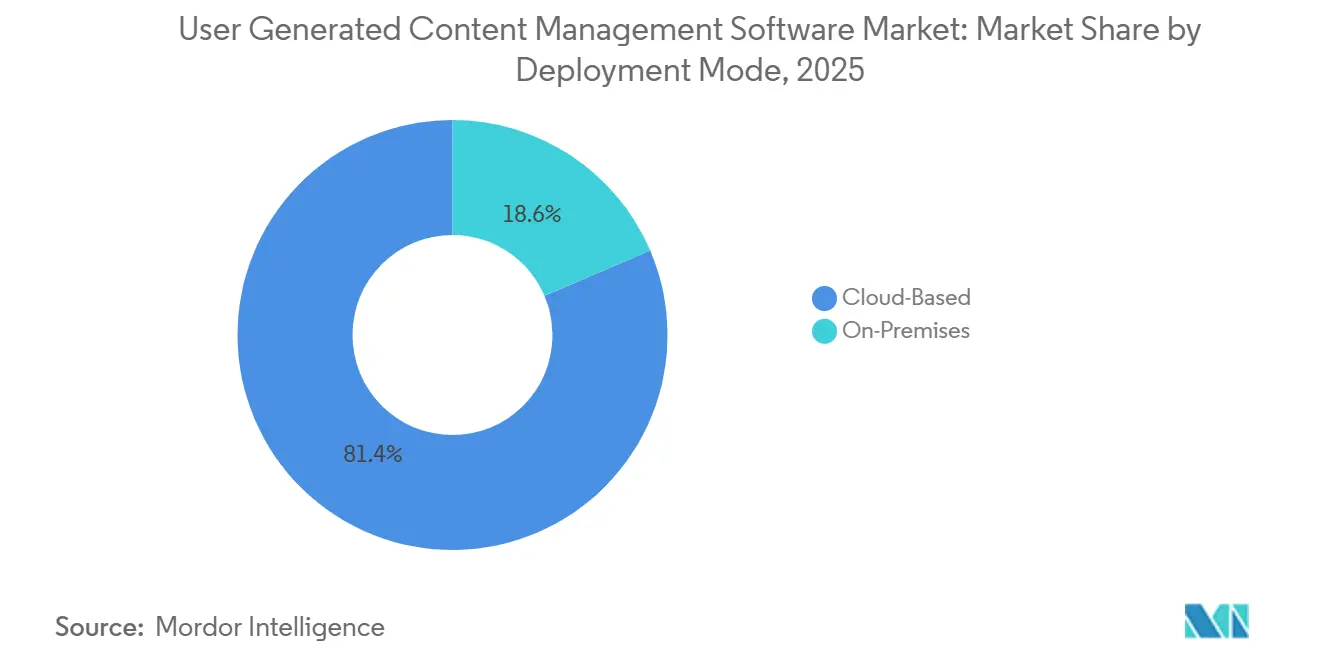
Cloud-based deployment held 81.43% of revenue in 2025, making it the leading deployment approach in the user generated content management software market. Enterprise marketing and e-commerce teams favor cloud delivery because it supports rapid implementation and automatic product updates. Usage-based pricing also fits campaign cycles better than large infrastructure purchases. Cloud systems can scale resources during sudden spikes in reviews, social activity, or viral campaigns. This flexibility helps brands maintain consistent performance when large volumes of customer content arrive at the same time.
On-premises deployment is projected to grow at 13.98% CAGR through 2031. Demand is concentrated in regulated settings where data residency rules and internal security controls restrict the use of public-cloud environments. Financial services, government, and education organizations may require tighter control over customer content records. Hybrid options can allow sensitive metadata to remain within company systems while AI analysis runs through controlled cloud resources. Sprout Social reported 3,803 customers with at least USD 30,000 in annual recurring revenue in its fiscal 2025 annual report, demonstrating demand for premium cloud-delivered social and content management platforms.[3]Sprout Social, Inc., “Annual Report on Form 10-K for the Fiscal Year Ended December 31, 2025,” U.S. Securities and Exchange Commission, edgar-online.com


By Application: Analytics Leads Enterprise Spending, While Moderation Gains Priority
UGC Analytics and Campaign Performance accounted for 28.76% of application revenue in 2025. This leading position reflects enterprise demand for systems that connect consumer content with conversion rates, return on advertising spend, and customer lifetime value. Analytics features help marketing teams demonstrate commercial outcomes during budget reviews. These functions also support contract renewals because they provide evidence of content performance. The user generated content management software market is increasingly shaped by buyers who expect measurable results rather than engagement metrics alone.
Content Moderation and Brand Safety is expected to grow at a 16.17% CAGR through 2031. Content collection and aggregation remain foundational capabilities, but they face pressure as large social platforms improve their native collection tools. Community management also remains important for maintaining customer participation and responding to questions. Rights management is becoming more valuable when brands use consumer content in paid channels and need proof of consent. Bazaarvoice introduced its Authentic Discovery API in April 2026 to make syndicated review content accessible to AI search and shopping tools. This development links rights-managed content, review syndication, and AI discovery within a more unified workflow.
By Enterprise Size: Large Enterprises Hold Revenue Leadership, While SMEs Expand Faster
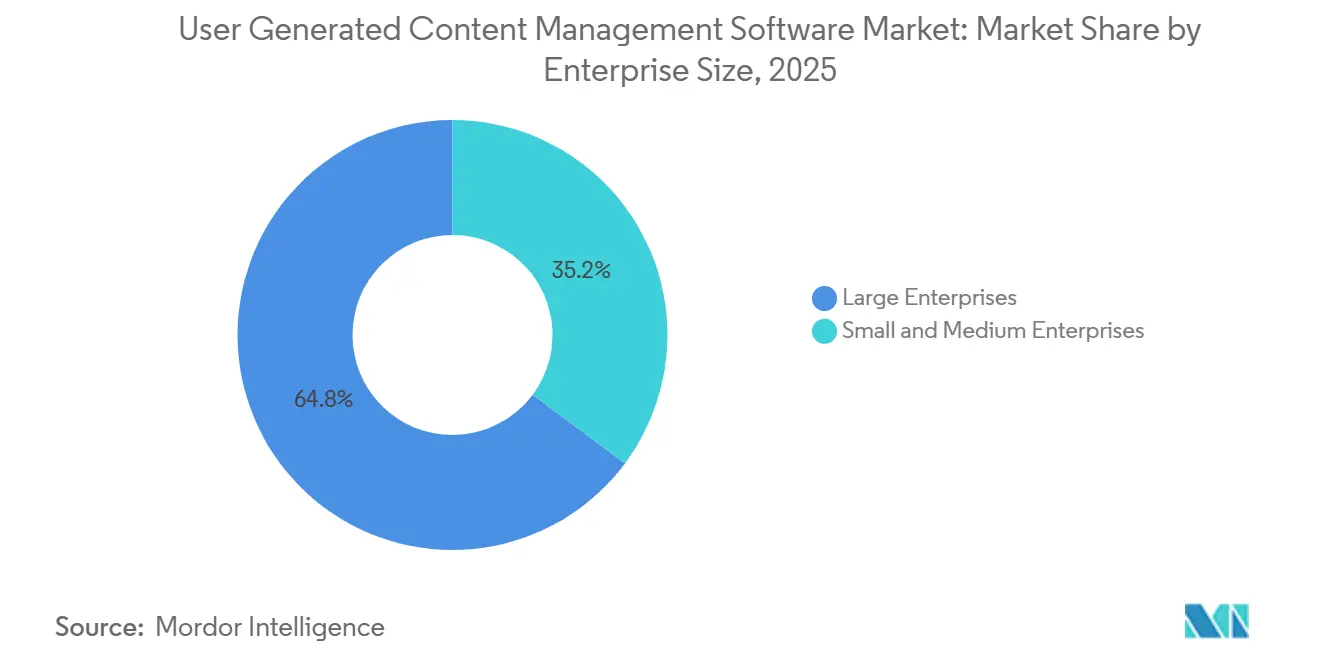
Large Enterprises held 64.81% of revenue in 2025, supported by the high licensing and implementation needs of enterprise platforms. These buyers often connect UGC workflows with enterprise resource planning systems, digital asset management platforms, and customer data environments. They also need multi-brand controls, global rights management, service-level agreements, and consistent moderation standards. Replacing an established platform can involve material integration risk and operational disruption. These conditions create strong retention potential for vendors serving complex enterprise accounts.
SMEs are projected to expand at a 15.74% CAGR through 2031. Freemium plans, Shopify integrations, and API-first tools are making content management systems more accessible to smaller digital businesses. Many smaller brands can use modular features without committing to a broad enterprise suite. Their lower reliance on legacy systems can allow faster testing of AI-enabled reviews, summaries, and recommendation tools. Yotpo stated that it served more than 30,000 brands globally in 2026, with a strong presence among Shopify and BigCommerce businesses. This customer base shows how SME-focused platforms can build a pipeline of future enterprise accounts as brands grow.
By End User Industry: Retail Remains the Largest Buyer, While Consumer Goods and Brands Grow Faster
Retail and e-commerce held 27.91% of end-user revenue in 2025, representing the largest user generated content management software market share among industry groups. Retailers rely on reviews, images, videos, and product questions to reduce shopper uncertainty before purchase. Content performance data is important because merchants want to understand which assets improve product page results. Retail users also need content syndication across brand sites, retailer platforms, and regional storefronts. These requirements make retail and e-commerce a central source of platform demand.
The consumer goods and brands segment is expected to grow at a 16.78% CAGR through 2031. Consumer goods companies are increasing direct customer data collection as third-party targeting becomes less dependable. Product trial feedback, social advocacy, and creator material can support consent-based customer engagement programs. Media and entertainment companies use content to support audience participation and cost-effective production. Financial services organizations need tighter moderation controls for customer commentary and branded communications. Travel and hospitality businesses rely on visual content for destination discovery and booking interest, while education and research institutions remain at an earlier stage of adoption.
Geography Analysis
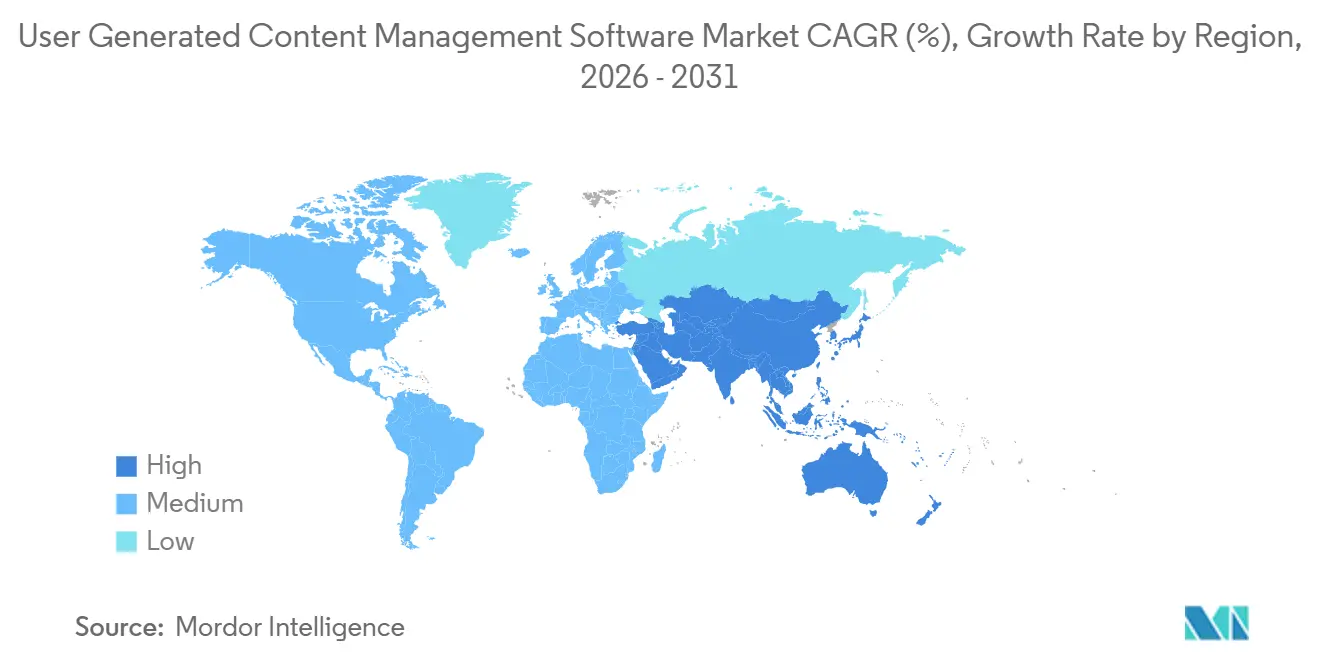
North America held 36.29% of revenue in 2025, representing the largest regional user generated content management software market share. The region benefits from a high concentration of digital-native brands and established software purchasing practices. The United States remains the main source of regional demand because of its large retail, media, and consumer goods sectors. Canada contributes to demand through financial services and e-commerce adoption. Mexico is attracting more mid-market deployments as its creator economy and digital retail infrastructure develop.
Asia-Pacific is projected to expand to a 14.32% CAGR through 2031, making it the fastest-growing regional area. Mobile-first commerce, super-app use, and creator-led selling are supporting adoption across the region. China provides an advanced model where reviews, short-form videos, and community content support in-app purchasing. South Korea, India, Indonesia, and Southeast Asian countries are adapting similar models to local consumer behavior. South Korea also benefits from K-pop communities, content exports, and advanced 5G networks that support frequent video creation.
Europe is shaped by content moderation, transparency, and disclosure requirements under the Digital Services Act. The European Commission reported that 165 million moderation decisions had been appealed, with 30% reversed after Digital Services Act implementation.[4]European Commission, “Two Years of Digital Services Act Allows 50 Million Content Moderation Decisions on Platforms to Be Reversed,” European Commission Digital Strategy, europa.eu The United Kingdom, Germany, France, and Italy are investing in systems that support reporting and rights management. South America offers growth potential through Brazil’s social commerce activity and Argentina’s expanding creator base. The Middle East and Africa remain an emerging area, with early demand in Saudi Arabia, the UAE, and South Africa across travel, retail, and consumer goods.

Competitive Landscape
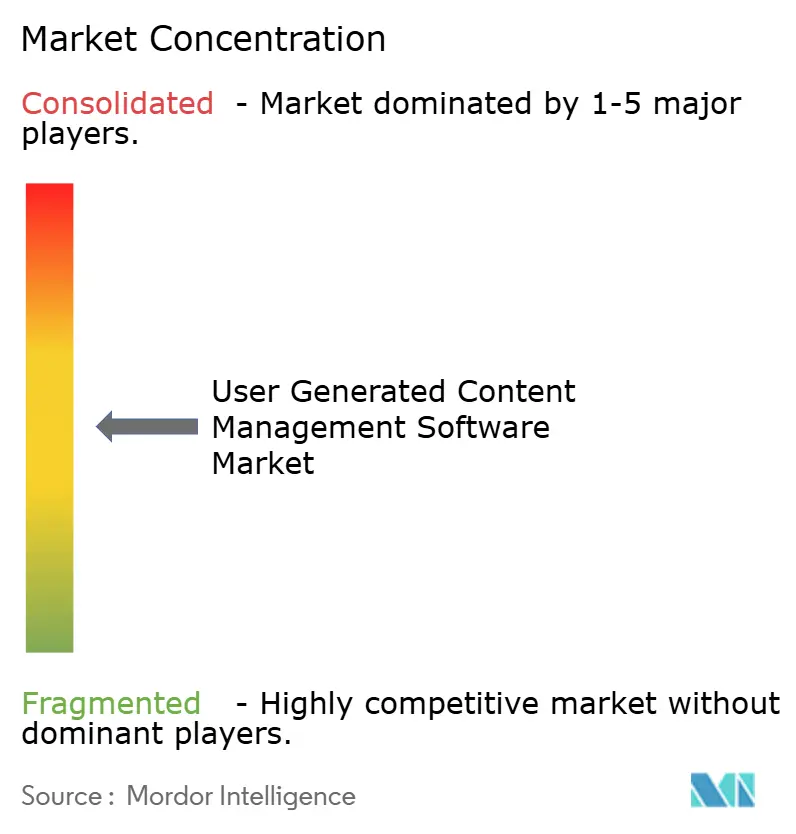
The user generated content management software market has moderate-to-fragmented concentration because no vendor dominates every application category. Bazaarvoice, Yotpo, Taggbox, TINT, and CrowdRiff compete as specialized providers with differing strengths in reviews, visual content, and commerce use cases. Hootsuite, Sprout Social, and Sprinklr offer broader social management systems that increasingly include collection, listening, analytics, and moderation functions. Adobe and Sprinklr also serve enterprise users through larger creative and customer experience software environments. This mix can make supplier selection difficult for buyers who need specialized capabilities and enterprise-level integrations.
Hootsuite launched Wisdom in June 2026, an AI agent built on more than 15 years of proprietary social data and more than 150 million monitored sources. This launch accompanied Social OS, which combines publishing, customer care, employee advocacy, and listening capabilities. Sprinklr acquired ViralMoment in May 2026 to expand multimodal intelligence across text, image, video, and audio.[5]Sprinklr, Inc., “Sprinklr Acquires ViralMoment to Define the Next Era of Multimodal Customer Intelligence,” Sprinklr Investor Relations, barchart.com Bazaarvoice became a Shopify Certified Technology Partner in May 2026, bringing its content network into Shopify storefront workflows.
Opportunities remain in financial services, healthcare, and education, where compliance-focused content tools are less developed. Vendors are competing through AI-assisted moderation, commerce integrations, first-party data tools, and analytics that support business reporting. Sprout Social expanded its Trellis AI engine across publishing, listening, inbox, and reporting workflows in May 2026. Bazaarvoice’s Authentic Discovery API also reflects the growing importance of content formatting for AI-led shopping and search journeys. Vendors that provide verified rights records, moderation documentation, and reliable content analytics are likely to be better positioned for large enterprise procurement processes.
User Generated Content Management Software Industry Leaders
Bazaarvoice, Inc.
Yotpo Ltd.
Emplifi Inc.
PowerReviews, Inc.
Taggbox
- *Disclaimer: Major Players sorted in no particular order

Recent Industry Developments
- June 2026: Hootsuite launched Wisdom, a social-first AI agent built on 15+ years of proprietary social data and more than 150 million monitored sources, alongside Social OS, a unified social operating system integrating publishing, customer care, employee advocacy, and social listening under a shared agentic architecture.
- May 2026: Bazaarvoice became a Shopify Certified Technology Partner, integrating its network of over 16 billion pieces of content across 11,000+ brands into Shopify storefronts via new multi-locale capabilities, enabling enterprise brands to manage localized UGC review content globally within native Shopify architecture.
- May 2026: Sprout Social unveiled its AI-powered Social Intelligence Platform and expanded Trellis, its proprietary agentic AI engine, integrating it across publishing, listening, inbox, and reporting workflows. The release also debuted Trellis Studio, a dedicated environment for building custom AI workflows aligned to specific organizational KPIs.
- January 2026: Hootsuite added LLM Insights to its Listening product, enabling brands to monitor how AI assistants describe and recommend their products, extending UGC analytics into the AI search discovery layer for the first time in the platform’s history.


Global User Generated Content Management Software Market Report Scope
The user generated content management software market comprises platforms that enable organizations to collect, moderate, organize, manage, and analyze user-created content, including reviews, photos, videos, and social media posts. These solutions support content moderation, brand safety, rights management, compliance, and campaign performance analytics. Brands, retailers, and agencies use UGC management software to enhance marketing campaigns, strengthen community engagement, and support commerce integration. The market is driven by the growth of the creator economy, increasing demand for authentic consumer voices, and the need for privacy-compliant, scalable content workflows across digital ecosystems.
The User Generated Content Management Software Market Report is Segmented by Deployment Mode (Cloud-Based, and On-Premises), Application (UGC Collection and Content Aggregation, Content Moderation and Brand Safety, Community and Social Engagement Management, UGC Rights Management and Compliance, UGC Analytics and Campaign Performance, and Other Applications), Enterprise Size (Small and Medium Enterprises, and Large Enterprises), End-User Industry (Retail and E-Commerce, Media and Entertainment, Banking, Financial Services, and insurance (BFSI), Travel and Hospitality, Education and Research institutions, Consumer Goods and Brands (CGP), and Other End User Industries), and Geography (North America, South America, Europe, Asia-Pacific, and Middle East and Africa). The Market Forecasts are Provided in Terms of Value (USD).
| Cloud-Based |
| On-Premises |
| UGC Collection and Content Aggregation |
| Content Moderation and Brand Safety |
| Community and Social Engagement Management |
| UGC Rights Management and Compliance |
| UGC Analytics and Campaign Performance |
| Other Applications |
| Small and Medium Enterprises |
| Large Enterprises |
| Retail and E-Commerce |
| Media and Entertainment |
| Banking, Financial Services, and insurance (BFSI) |
| Travel and Hospitality |
| Education and Research institutions |
| Consumer Goods and Brands (CGP) |
| Other End User Industries |
| North America | United States | |
| Canada | ||
| Mexico | ||
| South America | Brazil | |
| Argentina | ||
| Rest of South America | ||
| Europe | United Kingdom | |
| Germany | ||
| France | ||
| Italy | ||
| Spain | ||
| Russia | ||
| Rest of Europe | ||
| Asia-Pacific | China | |
| India | ||
| Japan | ||
| South Korea | ||
| Australia | ||
| Rest of Asia-Pacific | ||
| Middle East and Africa | Middle East | Turkey |
| Saudi Arabia | ||
| United Arab Emirates | ||
| Rest of Middle East | ||
| Africa | South Africa | |
| Egypt | ||
| Rest of Africa | ||
| By Deployment Mode | Cloud-Based | ||
| On-Premises | |||
| By Application | UGC Collection and Content Aggregation | ||
| Content Moderation and Brand Safety | |||
| Community and Social Engagement Management | |||
| UGC Rights Management and Compliance | |||
| UGC Analytics and Campaign Performance | |||
| Other Applications | |||
| By Enterprise Size | Small and Medium Enterprises | ||
| Large Enterprises | |||
| By End User Industry | Retail and E-Commerce | ||
| Media and Entertainment | |||
| Banking, Financial Services, and insurance (BFSI) | |||
| Travel and Hospitality | |||
| Education and Research institutions | |||
| Consumer Goods and Brands (CGP) | |||
| Other End User Industries | |||
| By Geography | North America | United States | |
| Canada | |||
| Mexico | |||
| South America | Brazil | ||
| Argentina | |||
| Rest of South America | |||
| Europe | United Kingdom | ||
| Germany | |||
| France | |||
| Italy | |||
| Spain | |||
| Russia | |||
| Rest of Europe | |||
| Asia-Pacific | China | ||
| India | |||
| Japan | |||
| South Korea | |||
| Australia | |||
| Rest of Asia-Pacific | |||
| Middle East and Africa | Middle East | Turkey | |
| Saudi Arabia | |||
| United Arab Emirates | |||
| Rest of Middle East | |||
| Africa | South Africa | ||
| Egypt | |||
| Rest of Africa | |||


Key Questions Answered in the Report
What is the projected size of the user generated content management software market?
The user generated content management software market size is projected to expand from USD 1.64 billion in 2025 and USD 1.86 billion in 2026 to USD 3.49 billion by 2031, registering a CAGR of 13.41% between 2026 to 2031.
What is driving demand for UGC platform software?
Higher review volumes, creator commerce, brand safety requirements, and demand for first-party customer data are increasing adoption.
Which deployment model leads UGC platform adoption?
Cloud-based deployment led with 81.43% of revenue in 2025 because it supports fast implementation, scaling, and automatic product updates.
Which application is growing fastest in this sector?
Content Moderation and Brand Safety is expected to grow at a 16.17% CAGR through 2031 as compliance and safety requirements increase.
Which end-user sector is the largest buyer of UGC platforms?
Retail and e-Commerce led end-user demand with a 27.91% revenue share in 2025, supported by its use of product reviews and visual content.
Which region is expected to grow fastest through 2031?
Asia-Pacific is projected to expand at a 14.32% CAGR, supported by mobile commerce, creator activity, and short-form video adoption.
Page last updated on:






