
Urine Collection Devices Market Size and Share
Market Overview
| Study Period | 2022 - 2032 |
|---|---|
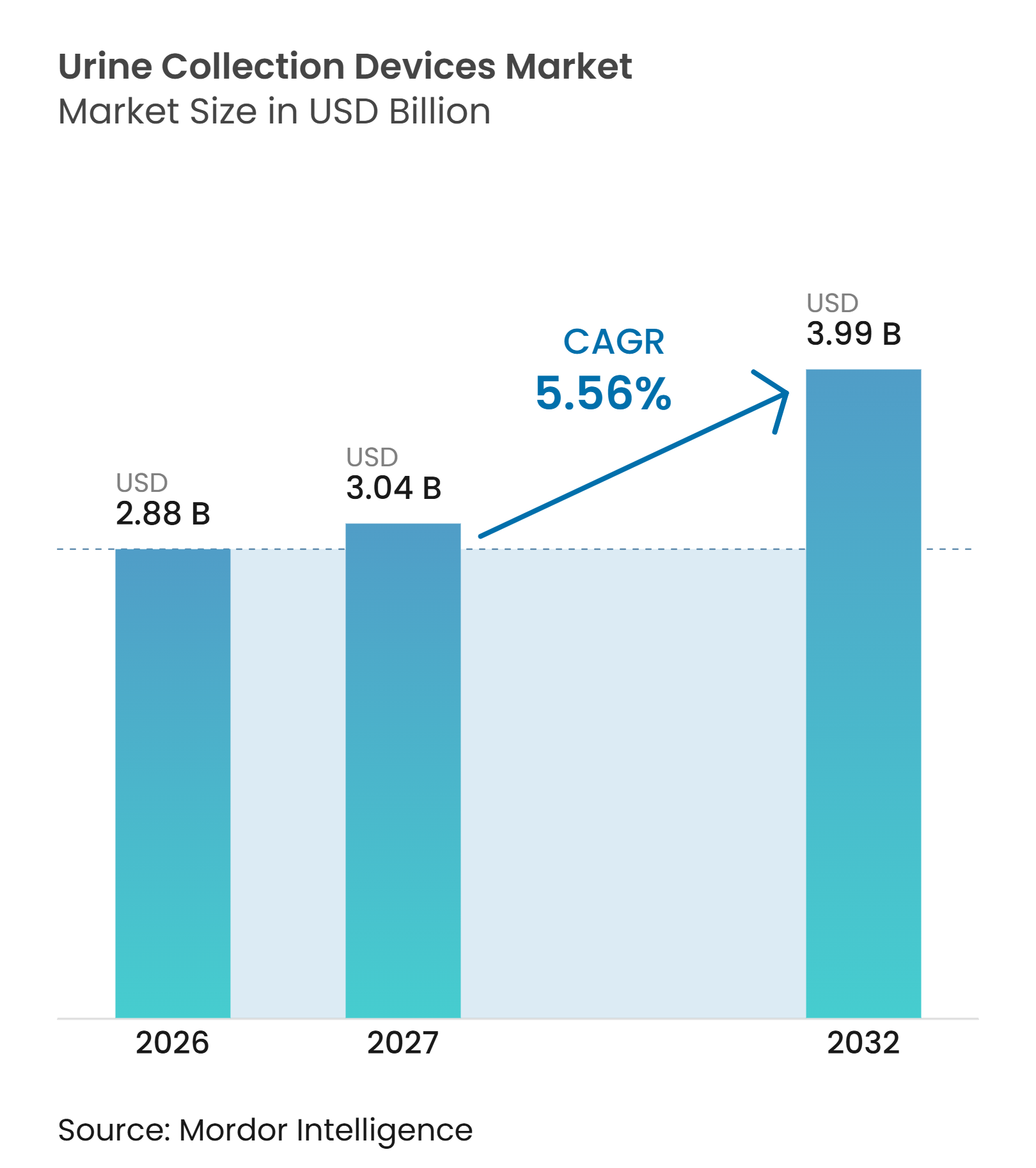
| Market Size (2027) | USD 3.04 Billion |
| Market Size (2032) | USD 3.99 Billion |
| Growth Rate (2027 - 2032) | 5.56 % |
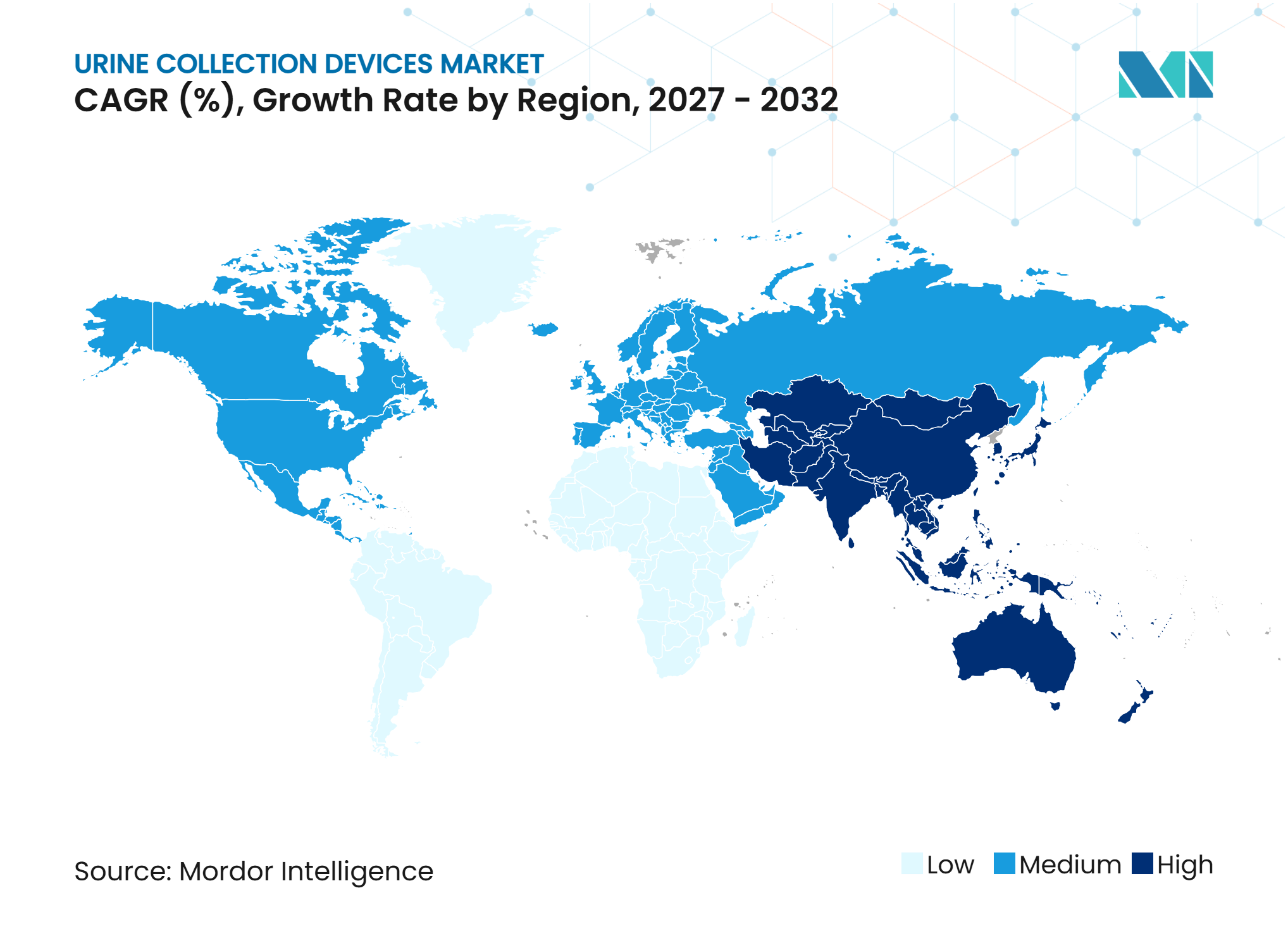
| Fastest Growing Market | Asia-Pacific |
| Largest Market | North America |
| Market Concentration | Medium |
Major Players *Disclaimer: Major Players sorted in no particular order Image © Mordor Intelligence. Reuse requires attribution under CC BY 4.0. | |
Urine Collection Devices Market Analysis by Mordor Intelligence
The Urine Collection Devices Market size was valued at USD 2.88 billion in 2026 and is estimated to grow from USD 3.04 billion in 2027 to reach USD 3.99 billion by 2032, at a CAGR of 5.56% during the forecast period (2027-2032).
The urine collection devices market is supported by rising urinary incontinence, broader urological care needs, and formal infection-prevention practices in hospitals. Demand is also shifting toward home-based care, where portable and self-managed systems are more relevant. Employers are widening urine-based drug screening programs, which raises requirements for secure collection and chain-of-custody features. Product development is moving beyond conventional catheter consumables through stabilization tubes, noninvasive pediatric systems, and point-of-care diagnostic workflows. Cost pressure from PVC and latex supply chains remains a concern, while fit problems and sample contamination can limit consistent use.
Key Report Takeaways
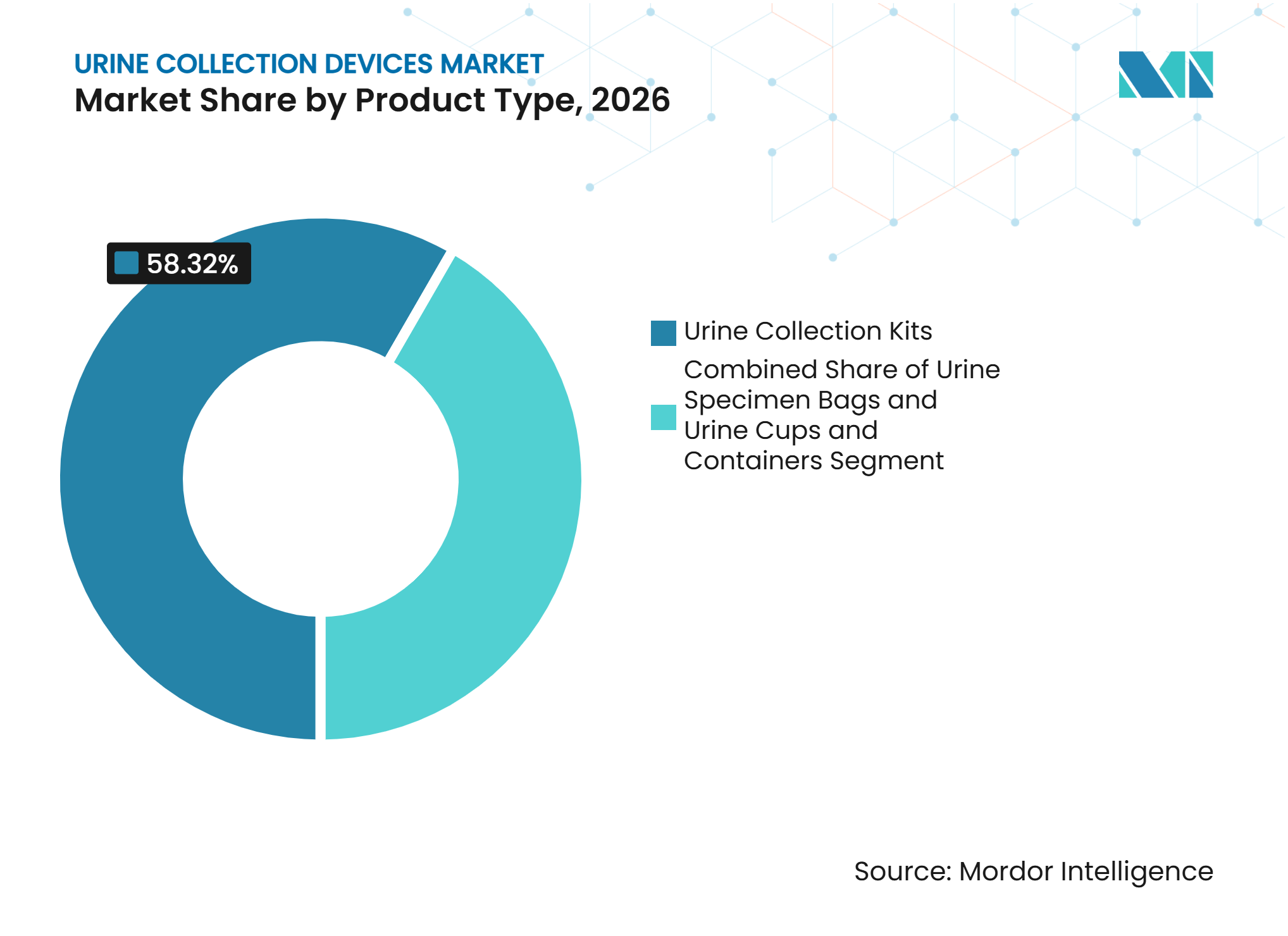
- By product type, urine collection kits held 58.32% of the urine collection devices market share in 2026, while urine specimen bags are forecast to grow at a 7.54% CAGR through 2032.
- By patient, adults held 48.54% share in 2026, while pediatric patients are projected to expand at a 7.89% CAGR through 2032.
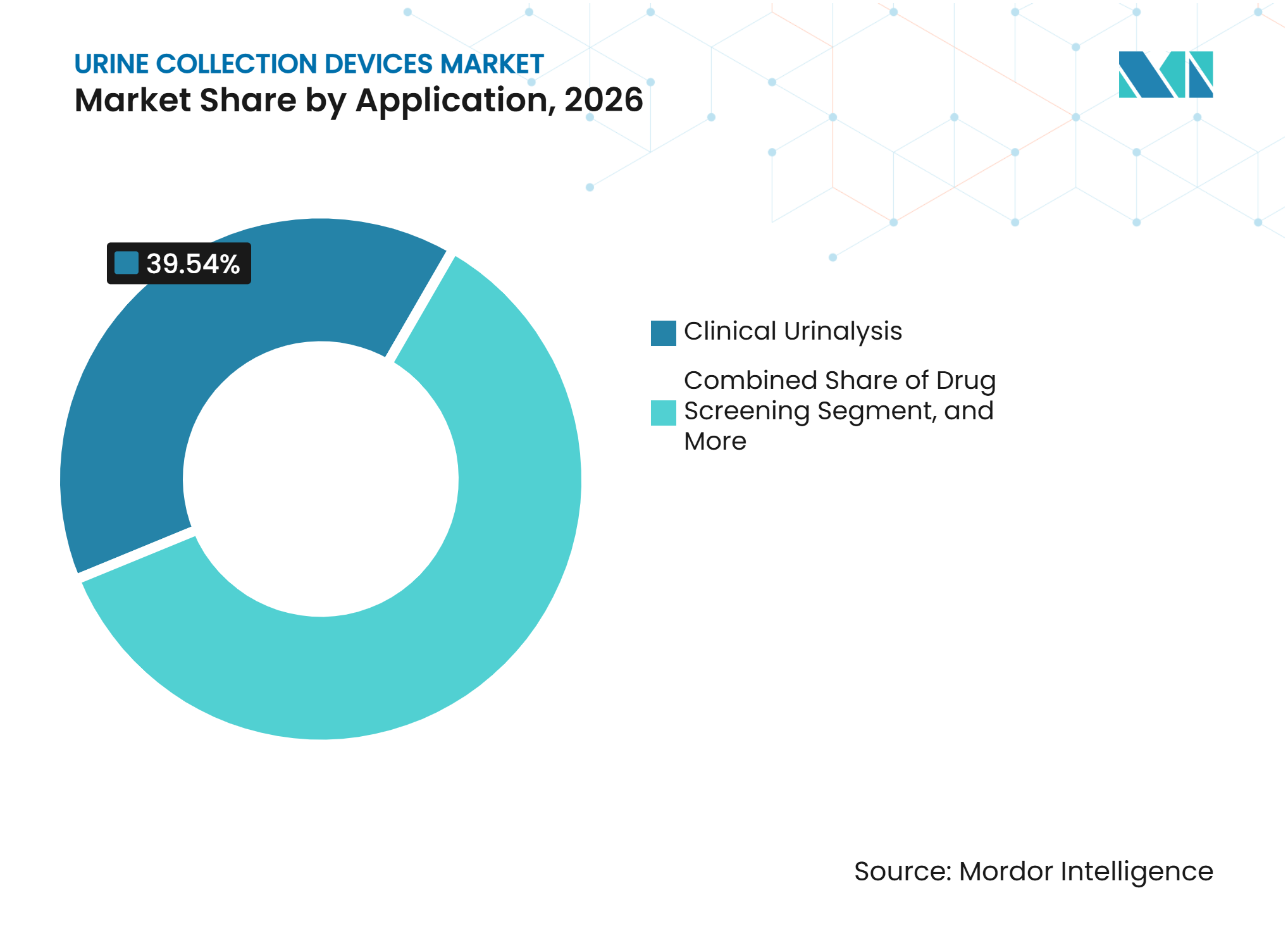
- By application, clinical urinalysis accounted for 39.54% share in 2026, while drug screening is forecast to grow at an 8.54% CAGR through 2032.
- By end user, hospitals and clinics held 55.32% share in 2026, while diagnostic laboratories are forecast to grow at an 8.65% CAGR through 2032.
- By geography, North America held 41.67% share in 2026, while Asia-Pacific is forecast to grow at a 6.54% CAGR through 2032.
Note: Market numbers in this report are based on Mordor Intelligence's proprietary estimation framework, which combines nine months of actuals with Q4 projections for base year 2026.
Market Trends and Insights
Drivers Impact Analysis of Urine Collection Devices Market*
| Driver | (~) % Impact on CAGR Forecast | Geographic Relevance | Impact Timeline |
|---|---|---|---|
| Widespread Urinary Incontinence and Urological Disorder Prevalence | +1.50% | Global, amplified in EU, US, and aging APAC economies | Long term (≥ 4 years) |
| Hospital Catheter-Reduction and CAUTI-Prevention Program Mandates | +0.90% | North America and EU, mandate-led institutional adoption | Medium term (2-4 years) |
| Home Healthcare and Long-Term Care Expansion | +1.10% | North America, APAC core, Japan, Australia, and South Korea | Long term (≥ 4 years) |
| Decentralized Diagnostics and Urine-Based Biomarker Testing | +0.80% | Global, with early gains in US, Germany, and Japan | Medium term (2-4 years) |
| Pediatric and Neonatal Urine Management Needs | +0.50% | APAC and North America | Long term (≥ 4 years) |
| Integrated Closed-Transfer and Sample-Integrity Designs | +0.40% | Global, with early adoption in Western Europe | Short term (≤ 2 years) |
| Source: Mordor Intelligence | |||
Rising Urinary Incontinence and Urological Disorder Burden
Urinary incontinence creates sustained need for collection devices across hospital, residential, and home settings. A 2025 study estimated the European Union's annual economic burden from urinary incontinence at EUR 69.1 billion, equal to USD 73 billion, and projected EUR 100.2 billion by 2030 without preventive action. The same study found that the burden for female patients was 4 times that for male patients. Continence Health Australia reported that 7.2 million Australians aged 15 years and older live with bladder or bowel incontinence, with annual costs of AUD 100.4 billion[1]. The urine collection devices market benefits as benign prostatic hyperplasia, diabetes-linked neurogenic bladder, and post-surgical catheterization increase recurring care needs. Only 12% of affected Australians received treatment in the survey, which points to a large untreated population.
Hospital Catheter-Reduction and CAUTI-Prevention Programs
In the urine collection devices market, CAUTI prevention changes the type of collection device that hospitals procure. The CDC states that urinary catheters are associated with 75% of hospital-acquired urinary tract infections. The agency also states that 15% to 25% of hospitalized patients receive a urinary catheter during their stay[2]. Closed sterile drainage systems, single-use systems, and noninvasive alternatives can therefore replace less controlled approaches. A 2025 intervention study reduced a facility's CAUTI standardized infection ratio from 0.564 in 2021 to 0.168 in 2025. The study also reported that compliant indwelling catheter orders increased from 50% to 85%. Such programs support repeat purchasing of compliant urine collection hardware.
Expansion of Home Healthcare and Long-Term Care
Home care requires devices that patients and caregivers can manage with limited clinical support. The urine collection devices market is responding with portable systems that reduce overnight care needs. In November 2025, BD expanded its PureWick portfolio with a battery-powered portable collection system for wheelchair users. BD stated that more than 55 million PureWick external catheters had been sold and that more than 4,500 US hospitals used the technology. In August 2026, Wellspect completed its US Surity portfolio with an at-home suction-based system aimed at people managing urinary incontinence. FDA Class II requirements and EU Medical Device Regulation requirements influence material choices and certification work. These requirements favor latex-free and DEHP/DINP-free designs but raise development costs.
Decentralized Diagnostics and Urine-Based Biomarker Testing
In the urine collection devices market, urine collection is becoming more important to decentralized testing and biomarker workflows. A 2025 study demonstrated an AI-assisted paper device that measured urinary glucose, creatinine, and uric acid. Machine learning calibration reduced mean absolute error from 30.9% to 6.3% in that study. Quest Diagnostics found that fentanyl positivity in random workforce tests was 707% higher than in pre-employment tests. This pattern supports more frequent urine testing and greater use of tamper-evident containers. Sample labeling, adulterant screening, and chain-of-custody features are becoming more important product requirements. The urine collection devices market therefore gains from collection systems that preserve integrity before analysis.
Restraints Impact Analysis of Urine Collection Devices Market*
| Restraint | (~) % Impact on CAGR Forecast | Geographic Relevance | Impact Timeline |
|---|---|---|---|
| Skin Injury, Leakage, and Anatomical-Fit Variability | -0.50% | Global, with highest clinical significance in home care settings | Long term (≥ 4 years) |
| Contamination and Pre-Analytical Handling Errors | -0.60% | Global, with elevated risk in high-volume laboratory markets | Medium term (2-4 years) |
| Reimbursement, Procurement, and Training Friction | -0.40% | North America and EU, with spillover to MEA and APAC | Medium term (2-4 years) |
| Material, Tariff, and Sustainability Cost Pressure | -0.30% | Global, amplified in price-sensitive APAC and MEA | Short term (≤ 2 years) |
| Source: Mordor Intelligence | |||
Skin Injury, Leakage, and Anatomical-Fit Variability
In the urine collection devices market, leakage, skin injury, and poor anatomical fit can reduce adherence to external collection systems. Continence Health Australia found that 57% of affected people were reluctant to leave home. The survey also found that only 12% received formal care. Female patients represent a large share of urinary incontinence cases, yet many historic designs centered on male anatomy. A 2025 study of an ultrasound-based anti-biofilm device reported an 86% reduction in urinary tract infection incidence. It also reported a 70% reduction in catheter-related pain and 52.3% fewer catheter changes. Unresolved fit problems can cause abandonment, replacement orders, and avoidable diagnostic errors.
Contamination and Pre-Analytical Handling Errors
In the urine collection devices market, contamination, unsuitable transport, and protocol deviations can weaken confidence in urine testing. The 2025 EFLM urinalysis guideline set a quality indicator of less than 15% polymicrobial growth in routine urine specimens. A 2025 hospital study examined 1,343 urine culture specimens. It found baseline contamination of 5.67% and up to 142.9-fold higher odds of turnaround breaches during peak collection windows. Standardized training and scheduling reduced contamination by 59.8% and turnaround breaches by 58.6%. Greiner Bio-One's VACUETTE Urine STB Tube offers 72-hour ambient stability, demonstrating the demand for products that address these workflow problems.
*Our forecasts treat driver/restraint impacts as directional, not additive. The impact forecasts reflect baseline growth, mix effects, and variable interactions.
Urine Collection Devices Market Segment Analysis
By Product Type:
Closed-System Kits Anchor Volume and Bags Support Home CareUrine collection kits held 58.32% of the urine collection devices market share in 2026. The urine collection devices market relies on hospitals that use these kits within CAUTI prevention protocols that call for sterile, closed-transfer, single-use processes. This supports recurring purchasing even when generic products create price pressure. The product category remains closely tied to hospital formularies and institutional infection-control requirements.
Urine specimen bags are forecast to grow at a 7.54% CAGR through 2032. Portable suction-based designs are shifting bags from a bedside role toward home and ambulatory care. BD introduced its battery-powered PureWick portable system in November 2025, while Wellspect added the Surity urinary management system to its US offering in August 2026. Cups and containers serve drug screening, pregnancy testing, and standard urinalysis, while the VACUETTE Urine STB Tube maintains key parameters for up to 72 hours at room temperature. ISO 13485 and FDA quality-system requirements raise the compliance burden across these product categories.



By Patient:
Adult Care Provides Volume While Pediatric Systems ExpandAdult patients held 48.54% of sector revenue in 2026. In the urine collection devices market, stress urinary incontinence, benign prostatic hyperplasia, and post-surgical catheterization support adult demand. These needs occur in hospitals, long-term care facilities, and private homes. Workplace drug testing also requires standardized collection supplies, making adult collection needs central to the urine collection devices industry.
Pediatric patients are forecast to grow at a 7.89% CAGR through 2032. In November 2026, Nuwellis secured exclusive US distribution rights for the Zorro-Flow pediatric system. The FDA-registered Class II device uses soft medical-grade silicone for neonates and young children. A 2026 Pediatric Research study supported the accuracy of the Specturi noninvasive neonatal collector for several urinary measures[3]. India's CDSCO classifies open-ended and closed-ended adhesive infant collection bags as regulated medical devices.
By Application:
Urinalysis Leads While Drug Screening Grows FasterClinical urinalysis accounted for 39.54% of the urine collection devices market size in 2026. It is used frequently in emergency medicine, nephrology, endocrinology, and primary testing workflows. The urine collection devices market depends on standardized containers for consistent handling across laboratories and point-of-care sites. AI-assisted analyzers can measure several metabolic markers from a urine sample and broaden chronic disease monitoring.
Drug screening is forecast to grow at an 8.54% CAGR through 2032. Quest Diagnostics reported much higher fentanyl positivity in random workforce testing than in pre-employment tests. Employers need secure containers for multi-panel testing, including tamper-evident construction, adulterant screening, and chain-of-custody labeling. Pregnancy testing and clinical research remain additional applications, while home-based kits can dispatch preserved samples to central laboratories. The urine collection devices industry is increasingly shaped by these higher-specification requirements.

By End User:
Hospitals Remain Largest While Laboratories Increase DemandHospitals and clinics held 55.32% of sector revenue in 2026. The urine collection devices market in hospitals reflects CAUTI prevention specifications for closed catheter kits and anti-reflux drainage bags. CDC guidance supports careful catheter selection and maintenance practices. The reported CAUTI intervention results show how institutional programs can sustain compliant procurement.
Diagnostic laboratories are forecast to grow at an 8.65% CAGR through 2032. Rising clinical chemistry, microbiology, and drug screening volumes require standardized formats for automated systems. SARSTEDT's NFT needle-free transfer system uses a pierceable membrane that reseals after transfer. Home healthcare also expands as payers reimburse home-use catheterization supplies, while Coloplast reported 5% organic Continence Care growth in FY2026. Ambulatory centers and occupational health clinics add further demand for dedicated collection supplies.
Geography Analysis
North America
North America held 41.67% of regional revenue in 2026. The urine collection devices market in North America is supported by insurance reimbursement, established CAUTI prevention programs, and product development. BD stated that its Broken Bow facility received more than USD 50 million in investment since 2020. The facility produces Vacutainer tubes and urine collection products at high volume. DOT requirements sustain urine testing for safety-sensitive transportation workers. Expanding fentanyl testing also increases interest in secure specimen containers. In November 2025, Hollister announced expanded Medicare access to closed-system intermittent catheters for certain spinal-cord-injury beneficiaries from January 2026. Canada and Mexico add demand through private hospital growth and cross-border distribution networks.
Asia-Pacific
Asia-Pacific is forecast to grow at a 6.54% CAGR through 2032. The urine collection devices market in Asia-Pacific benefits as hospital expansion, aging populations, and public quality programs increase single-use device adoption. India is expanding hospital infrastructure through programs including Ayushman Bharat. People aged 60 years and above are projected to represent 11% of India's population by 2026. India's Medical Devices Rules, 2017, and ISO 13485 alignment shape compliance expectations. China adds demand through hospital buildouts and higher surgical volumes. Japan and Australia support premium devices such as hydrophilic-coated catheters and electronic urine meters. Continence Health Australia reported 7.2 million Australians living with incontinence in 2025. South Korea's medical technology exports broaden the region's supply base.
Europe, Middle East and Africa, and South America
Europe relies on advanced systems in Germany, NHS procurement in the United Kingdom, and EU MDR compliance. The urine collection devices market size in these countries benefits from rising home care budgets and recovering elective procedures. A 2025 study estimated that 55 million to 60 million Europeans live with urinary incontinence. The EU MDR favors products supported by clinical evidence and can raise entry barriers. GCC countries are expanding hospital capacity under national health plans. A 2025 meta-analysis estimated urinary incontinence prevalence among adult women in Africa at 24% across 22 studies. South Africa's private hospital growth adds to the regional demand base. Brazil leads South American demand through expanding private hospital groups and surgical activity. Argentina's device manufacturing base is starting to supply nearby Latin American markets.
Competitive Landscape
Market Concentration
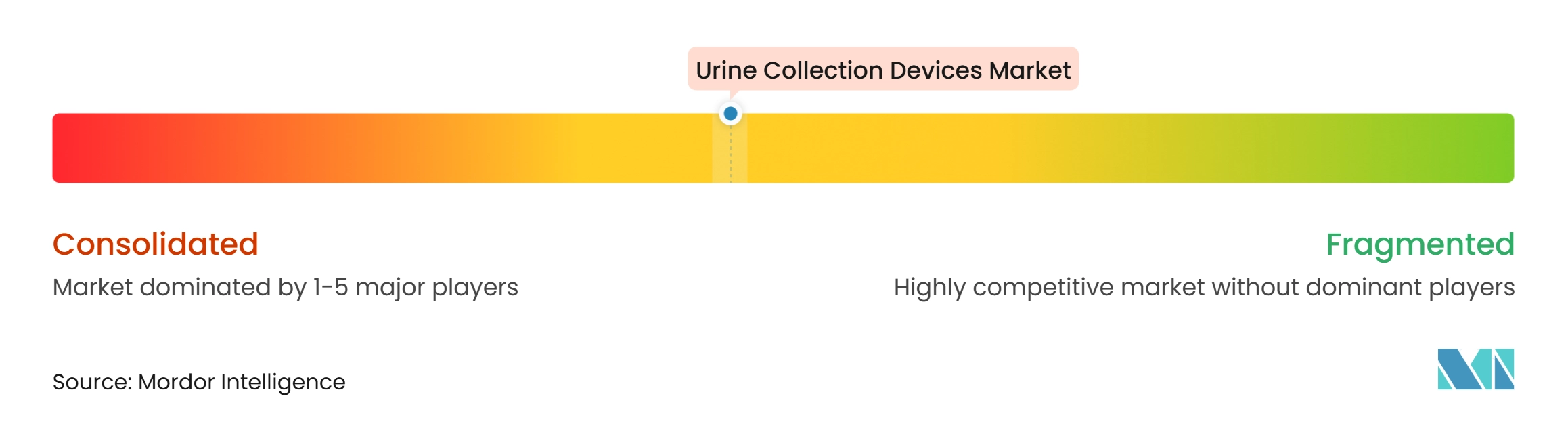
The urine collection devices market is moderately concentrated, with BD, Coloplast, ConvaTec, and Hollister holding established positions in institutional channels. Their positions rest on formulary relationships, distribution reach, and proprietary product platforms. BD stated that PureWick was the leading external catheter used in US hospitals. The company also reported more than 55 million units sold and more than 4,500 hospital accounts. Coloplast reported that its Continence Care business grew 7% organically in FY2026, supported by double-digit growth in the United States. Product differentiation includes hydrophilic surfaces, drainage designs, and no-touch handling.
The urine collection devices market also reflects active competition around closed transfer, sample integrity, and biofilm management. SARSTEDT's NFT Urine Monovette uses a needle-free transfer format aligned with ISO 23908 safety principles. This type of design can create switching costs in laboratories focused on staff safety and contamination reduction. In January 2025, Coloplast launched Luja Female in the United States with Micro-hole Zone Technology. The product uses more than 50 micro-holes to support bladder emptying without catheter repositioning. In September 2025, Coloplast placed Luja at the center of its Impact4 strategy.
Portfolio changes are also creating openings for focused suppliers. Teleflex agreed in December 2025 to sell its Acute Care, Interventional Urology, and OEM businesses for USD 2.03 billion. The OEM divestiture to Montagu and Kohlberg was completed in August 2026 for USD 1.5 billion. Nuwellis used an exclusive distribution agreement to address neonatal collection needs. ConvaTec launched Cure Aqua in September 2026 for female, male, and pediatric users. The product uses DEHP/DINP-free materials and a no-touch sleeve. These moves place greater emphasis on safety, comfort, and coverage across patient anatomies.
Urine Collection Devices Industry Leaders
-
Becton, Dickinson and Company
-
Thermo Fisher Scientific
-
Abbott
-
F. Hoffmann-La Roche Ltd
-
Medline Industries, LP
- *Disclaimer: Major Players sorted in no particular order
Urine Collection Devices Market Companies Covered in this Report
- Abbott Laboratories
- ANGIPLAST PVT. LTD.
- B. Braun
- Beckton Dickinson
- BioDerm Inc.
- Cardinal Health
- Coloplast
- Consure Medical
- Convatec
- Roche
- Greiner Bio-One GmbH
- Hollister
- Medline Industries
- POLYMED
- QIAGEN
- Sarstedt
- Teleflex
- Thermo Fisher Scien
Recent Industry Developments in Urine Collection Devices Market
- November 2026: Nuwellis, Inc. secured exclusive US distribution rights for the Zorro-Flow® pediatric urine collection system, a FDA-registered Class II non-invasive device using soft medical-grade silicone designed for neonates and young children, full US commercialization is planned from Q1 2027. The product eliminates catheterization and suprapubic aspiration in critically ill small babies, directly addressing the neonatal urine collection gap in PICUs and CVICUs where Nuwellis has established relationships at 47 of the top US children's hospitals.
- September 2026: ConvaTec launched Cure Aqua, a ready-to-use hydrophilic intermittent catheter, in the US and Canada. Available in female, male, and pediatric options, requiring no activation step, free from DEHP/DINP and BPA, and featuring a no-touch handling sleeve to reduce contamination risk, additional market launches outside North America are planned.
- August 2026: Wellspect HealthCare completed its US Surity portfolio with the launch of the Surity Urinary Management System, an at-home suction-based external urine collection device targeting over 13 million Americans and their caregivers managing urinary incontinence, with quiet overnight operation designed to minimize caregiver burden.
Global Urine Collection Devices Market Report Scope
According to the report’s scope, urine collection devices are medical products used to collect, contain, and sometimes measure urine from patients. They include urinary catheters, drainage bags, and external collection systems.
The urine collection devices market is segmented into product type, patient, application, end user, and geography. By product type, the market is segmented into urine collection kits, specimen bags, and cups and containers. By patient, the market is segmented into adult and pediatric. By application, the market is segmented into clinical urinalysis, drug screening, pregnancy testing, and clinical research. By end user, the market is segmented into hospitals, diagnostic labs, home healthcare, and others. By geography, the market is segmented into North America, Europe, Asia-Pacific, the Middle East and Africa, and South America. The report also covers the estimated market sizes and trends for 17 countries across major regions globally. The report offers values (USD) for all the above segments.
Segmentation Overview
| Urine Collection Kits |
| Urine Specimen Bags |
| Urine Cups and Containers |
| Adult |
| Pediatric |
| Clinical Urinalysis |
| Drug Screening |
| Pregnancy Testing |
| Clinical Research and Studies |
| Hospitals and Clinics |
| Diagnostic Laboratories |
| Home Healthcare |
| Other End Users |
| North America | United States |
| Canada | |
| Mexico | |
| Europe | Germany |
| United Kingdom | |
| France | |
| Italy | |
| Spain | |
| Rest of Europe | |
| Asia-Pacific | China |
| Japan | |
| India | |
| Australia | |
| South Korea | |
| Rest of Asia-Pacific | |
| Middle East and Africa | GCC |
| South Africa | |
| Rest of Middle East and Africa | |
| South America | Brazil |
| Argentina | |
| Rest of South America |
| By Product Type | Urine Collection Kits | |
| Urine Specimen Bags | ||
| Urine Cups and Containers | ||
| By Patient | Adult | |
| Pediatric | ||
| By Application | Clinical Urinalysis | |
| Drug Screening | ||
| Pregnancy Testing | ||
| Clinical Research and Studies | ||
| By End User | Hospitals and Clinics | |
| Diagnostic Laboratories | ||
| Home Healthcare | ||
| Other End Users | ||
| Geography | North America | United States |
| Canada | ||
| Mexico | ||
| Europe | Germany | |
| United Kingdom | ||
| France | ||
| Italy | ||
| Spain | ||
| Rest of Europe | ||
| Asia-Pacific | China | |
| Japan | ||
| India | ||
| Australia | ||
| South Korea | ||
| Rest of Asia-Pacific | ||
| Middle East and Africa | GCC | |
| South Africa | ||
| Rest of Middle East and Africa | ||
| South America | Brazil | |
| Argentina | ||
| Rest of South America | ||
Key Questions Answered in the Report
What is driving growth in urine collection devices?
Demand is supported by rising urinary incontinence, larger home-care needs, CAUTI prevention programs, and more frequent diagnostic and workforce urine-testing workflows.
How large is the urine collection devices market?
The market is projected to move from USD 3.04 billion in 2027 to USD 3.99 billion by 2032, representing a 5.56% CAGR.
Which product type leads urine collection device demand?
Urine collection kits held 58.32% share in 2026 because hospitals depend on sterile closed-system products within established infection-control protocols.
Which application is expanding fastest for urine collection devices?
Drug screening is forecast to grow at an 8.54% CAGR through 2032. Workplace testing requires tamper-evident containers and clear chain-of-custody handling.
Which end user will grow fastest through 2032?
Diagnostic laboratories are forecast to grow at an 8.65% CAGR as clinical chemistry, microbiology, and drug screening require standardized formats for automation.
Which region has the strongest growth outlook?
Asia-Pacific is forecast to expand at a 6.54% CAGR through 2032, supported by hospital investment, aging populations, surgical volume, and quality-system requirements.