
United States Secure Logistics Market Size and Share
Market Overview
| Study Period | 2020 - 2031 |
|---|---|
| Forecast Data Period | 2026 - 2031 |
| Base Year Market Size (2025) | USD 23.75 Billion |
| Market Size (2026) | USD 24.65 Billion |
| Market Size (2031) | USD 33.73 Billion |
| Growth Rate (2026 - 2031) | 6.47 % |
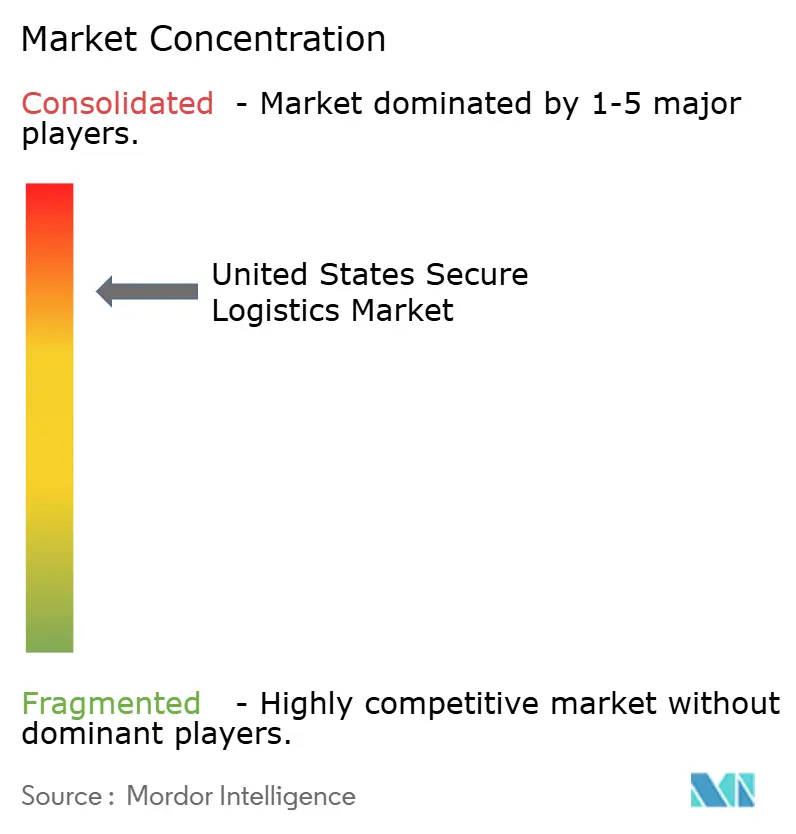
| Market Concentration | High |
Major Players *Disclaimer: Major Players sorted in no particular order Image © Mordor Intelligence. Reuse requires attribution under CC BY 4.0. | |
United States Secure Logistics Market Analysis by Mordor Intelligence
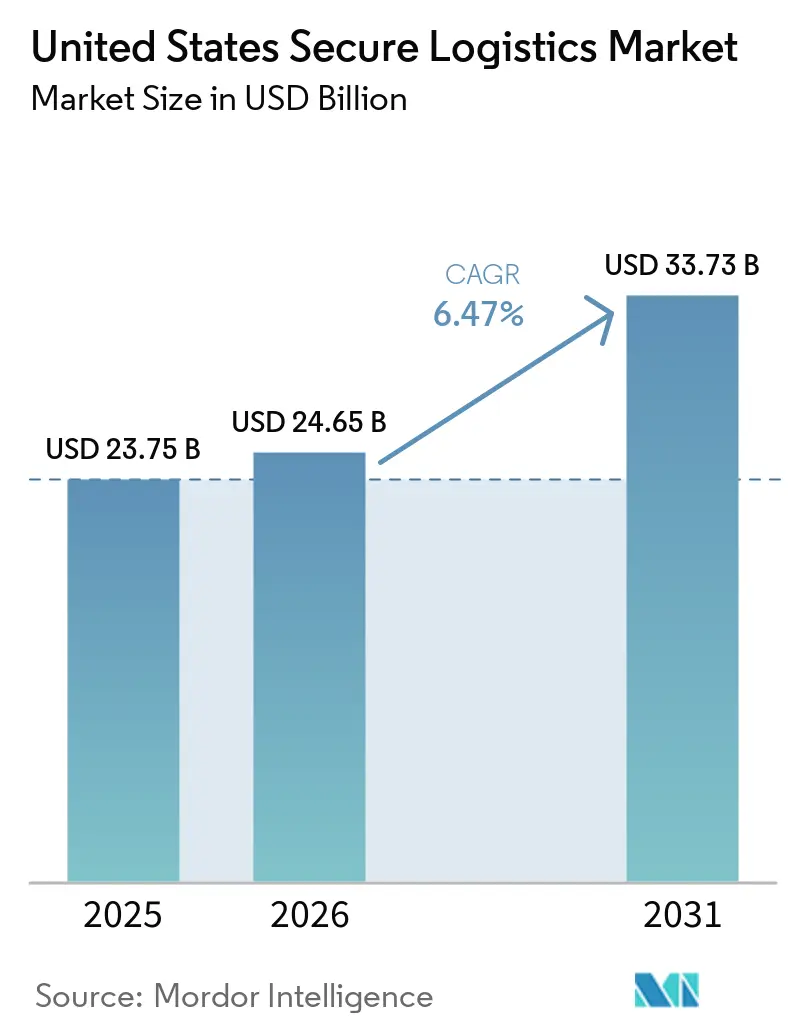
The United States secure logistics market size was valued at USD 23.75 billion in 2025 and is estimated to grow from USD 24.65 billion in 2026 to reach USD 33.73 billion by 2031, at a CAGR of 6.47% from 2026 to 2031.
The United States secure logistics market is expanding because institutions are transferring custody risk to specialist carriers with established insurance, compliance, and operating capabilities. Digital payments have reduced routine cash use in some locations, yet fewer and higher-value cash movements require stronger controls and more precise handling. Financial institutions, retailers, and high-value goods handlers increasingly need documented custody, secure processing, and reliable transport in a single service arrangement. This favors providers that can combine armored transport, vault services, cash processing, and digital visibility tools. Government requirements for mint operations, tax collections, and regulated asset custody provide a stable base of demand, while specialized retail, jewelry, pharmaceutical, and cannabis requirements create additional opportunities.
Key Report Takeaways
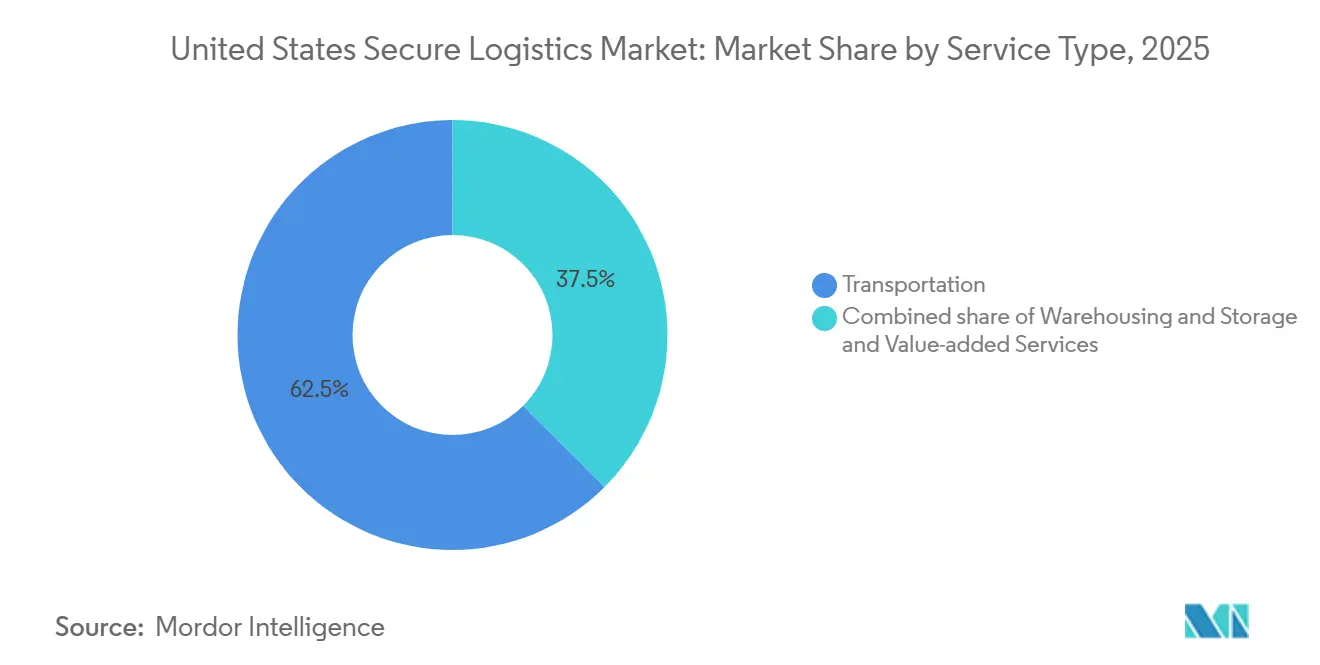
- By service type, transportation held 62.50% of the United States secure logistics market share in 2025, while the value-added services segment is forecast to grow at a 7.70% CAGR through 2031.
- By application, cash management held 48.15% of the United States secure logistics market size in 2025, while the jewelry and precious metals segment is forecast to grow at a 7.80% CAGR through 2031.
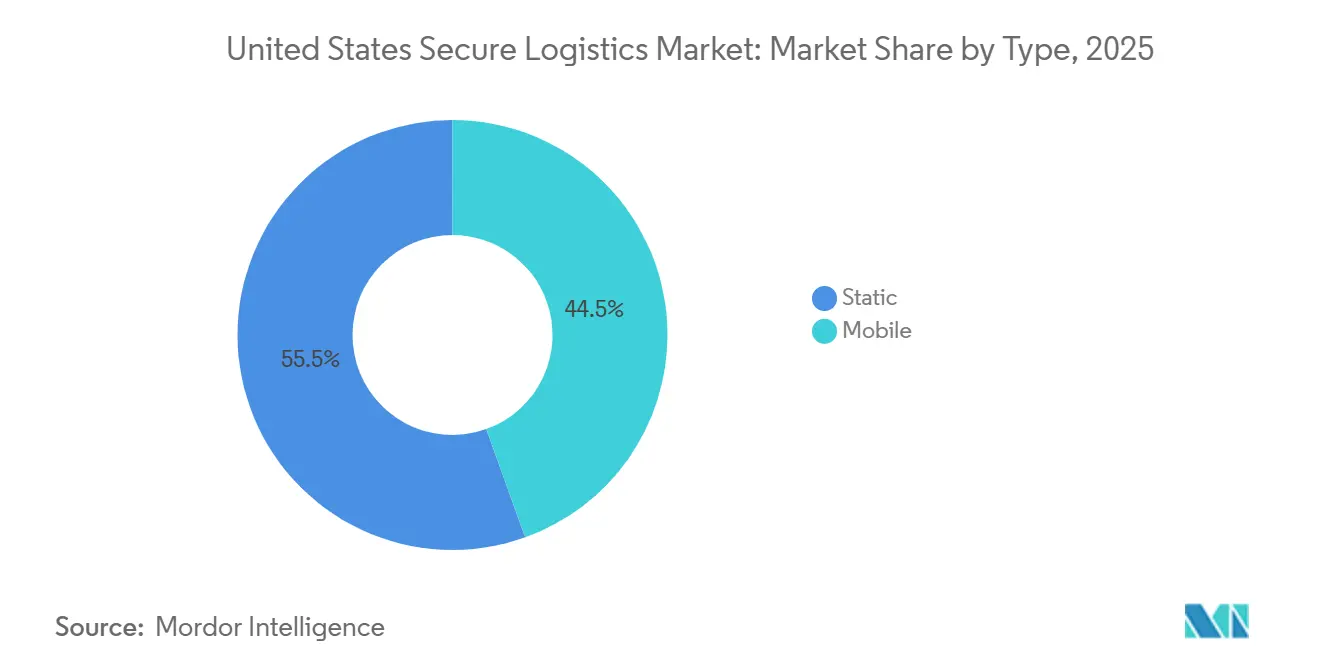
- By type, static secure logistics held 55.50% of the United States secure logistics market share in 2025, while mobile secure logistics is forecast to grow at a 7.20% CAGR through 2031.
- By end user, financial institutions held 44.25% of the United States secure logistics market size in 2025, while the retailers segment is forecast to grow at a 7.25% CAGR through 2031.
Note: Market size and forecast figures in this report are generated using Mordor Intelligence’s proprietary estimation framework, updated with the latest available data and insights as of January 2026.
United States Secure Logistics Market Trends and Insights
Drivers Impact Analysis*
| Driver | (~) % Impact on CAGR Forecast | Geographic Relevance | Impact Timeline |
|---|---|---|---|
| Rising Need for High-Value Goods Protection in Transit and Storage | +1.4% | National, concentrated in New York, California, and Texas jewelry and bullion corridors | Medium term (2-4 years) |
| Expansion of Cash Intensive Retail and Branch Networks Requiring Armored Logistics | +1.1% | National, with early gains in the Southeast and Mountain West | Short term (≤ 2 years) |
| Growth in ATM Replenishment and Cash Vault Outsourcing | +1.3% | National, with dense demand in the Northeast and Midwest banking hubs | Medium term (2-4 years) |
| Increasing Compliance Pressure on Chain of Custody and Asset Accountability | +0.8% | National, influenced by FinCEN, OCC, and state armored-car licensing frameworks | Long term (≥ 4 years) |
| Insurance and Risk Transfer Incentives Favoring Specialized Secure Carriers | +0.7% | National, with early gains in California, Illinois, and Florida freight corridors | Medium term (2-4 years) |
| Adoption of Digitized Route Monitoring and Real-Time Visibility Tools | +0.9% | National, with PCI-DSS and TAPA requirements affecting cash and high-value operations | Short term (≤ 2 years) |
| Source: Mordor Intelligence | |||
Rising Need for High-Value Goods Protection in Transit and Storage
The United States secure logistics market is responding to a greater concentration of value in individual shipments and cash movements. Criminal groups have increasingly targeted high-value loads instead of smaller, opportunistic thefts. The FBI reported nearly USD 725 million in estimated cargo theft losses across the United States and Canada in 2025[1]Federal Bureau of Investigation, “Cyber-Enabled Strategic Cargo Theft Surging,” Internet Crime Complaint Center, ic3.gov. Manufacturers, luxury retailers, and pharmaceutical distributors are therefore placing tighter transport and custody requirements into their procurement contracts. These requirements move secure transport from a cost-control decision toward a liability and risk-management decision. Demand also extends to specialty warehousing, where clients require clear custody records for high-value components and finished goods.
Expansion of Cash-Intensive Retail and Branch Networks Requiring Armored Logistics
The United States secure logistics market benefits when convenience stores, pharmacies, cannabis dispensaries, and quick-service restaurants add locations. Each new outlet can create a recurring cash pickup requirement that is difficult for the operator to manage internally. Scheduled collections also create predictable routes for armored carriers in nearby geographic clusters. Cannabis dispensaries remain a notable opportunity because federal restrictions limit their access to conventional banking. Their point-of-sale revenue can accumulate as physical cash and requires transport under applicable state rules. State armored-car licensing, bonded operations, trained personnel, and licensed vehicles continue to restrict participation by providers that lack the required operating base.
Growth in ATM Replenishment and Cash Vault Outsourcing
ATM replenishment and vault outsourcing are becoming central managed services for the largest providers in the United States secure logistics market. Banks are transferring cash forecasting, denomination balancing, reconciliation, and reporting tasks to external specialists. Brink's announced its agreement to acquire NCR Atleos for USD 6.6 billion in February 2026, and shareholders approved the transaction in June 2026[2]The Brink's Company, “Brink's to Acquire NCR Atleos for USD 6.6 Billion, Creating a Leading Financial Technology Infrastructure Provider,” Brink's Investor Relations, investors.brinks.com. Community and regional banks can gain access to these capabilities without building comparable internal cash operations. Providers that lack managed ATM services face greater pressure as banks favor bundled contracts.
Increasing Compliance Pressure on Chain of Custody and Asset Accountability
The United States secure logistics market is shaped by tighter expectations for recorded custody transfers across financial services, retail, and government work. Institutions need documentation that can support internal audits, contract reviews, and incident investigations. TAPA's 2026 Trucking Security Requirements include GPS tracking, incident reporting procedures, and response requirements for deviations involving high-value loads[3]Transported Asset Protection Association, “Trucking Security Requirements 2026 Standard,” Transported Asset Protection Association, tapaonline.org. These controls are increasingly included in supply-chain contracts as baseline operating requirements. Carriers with suitable tracking, reporting, and certified operating processes can compete on compliance quality rather than price alone. This creates a broader role for secure carriers in pharmaceutical, defense, government, cash, and precious-metal movements.
Restraints Impact Analysis*
| Restraint | (~) % Impact on CAGR Forecast | Geographic Relevance | Impact Timeline |
|---|---|---|---|
| High Labor, Vehicle Hardening, and Insurance Costs | -1.9% | National, most acute in California, New York, Massachusetts, and Washington | Long term (≥ 4 years) |
| Driver Shortages and Workforce Retention Challenges in Armored Operations | -1.2% | National, shaped by background checks and state Guard Card requirements | Medium term (2-4 years) |
| Cash Volume Migration to Digital Payments Reducing Some Legacy Service Demand | -1.5% | National, with earlier effects in urban areas with high mobile-payment use | Long term (≥ 4 years) |
| Exposure to Theft, Fraud, and Liability Risk Increasing Operating Complexity | -1.1% | National, with high exposure in California, Texas, Illinois, Florida, and Pennsylvania corridors | Short term (≤ 2 years) |
| Source: Mordor Intelligence | |||
High Labor, Vehicle Hardening, and Insurance Costs
Armored operations require substantial spending on specialized vehicles, training, protective equipment, and insurance. These costs are especially difficult for regional carriers with small fleets. Smaller operators cannot spread fixed procurement and insurance expenses across the route density available to national providers. Steel and aluminum tariffs raised the cost of body-hardening materials and specialty vehicle modifications by mid-2025. Fleet renewal can therefore add pressure at a time when traditional cash-in-transit activity is growing more slowly. The result can encourage smaller providers to seek acquisition, exit selected routes, or focus on specialized local work.
Driver Shortages and Workforce Retention Challenges in Armored Operations
Armored carriers face a narrower labor pool than general freight operators. Personnel may need commercial driving credentials, armed-guard qualifications, state Guard Cards, firearm permits, and background checks. These requirements can extend hiring timelines and reduce the available workforce in dense urban routes. California requires a Guard Card and a firearm permit, while New York City's permit process can limit the qualified applicant pool. Wage competition from freight, construction, and security roles adds further retention pressure. Providers with formal training programs and predictable wage structures can offer more consistent route coverage than smaller carriers that lack those resources.
*Our forecasts treat driver/restraint impacts as directional, not additive. The impact forecasts reflect baseline growth, mix effects, and variable interactions.
Segment Analysis
By Service Type: Transportation Commands the Revenue Base, but Value-Added Services Lead Growth
Transportation accounted for 62.50% of the United States secure logistics market share in 2025. It remains the core fulfillment layer for cash circulation, ATM replenishment, and high-value asset movement. Road-based armored fleets handle most domestic movements because ATM networks, bank branches, and retailers require frequent scheduled visits. Rail and air services serve more specialized needs, including interstate bullion movements, auction consignments, and time-sensitive pharmaceutical transfers. Sea and inland waterway activity remains limited and is associated mainly with port-linked precious-metal movements. These services require bonded documentation and specialized custody procedures.
The value-added services segment is forecast to grow at a 7.70% CAGR through 2031. This category includes secure processing, cash reconciliation, custody reporting, and tailored compliance documentation. Providers can turn individual transport contracts into longer managed-service arrangements by combining these capabilities. Empyreal Logistics and Paythings announced a partnership in April 2026 to combine smart-safe technology with armored transport and vaulting services. The arrangement provides real-time tracking and reconciliation from deposit through settlement. Warehousing and secure storage also benefit from demand for off-site cash custody and reduced handling risk at branches and stores.



By Application: Cash Management Anchors Volume, Jewelry and Precious Metals Drives Premium Growth
Cash management held 48.15% of the United States secure logistics market size in 2025 and remained the largest application in the United States secure logistics industry. Bank branches, ATMs, credit unions, and large retailers need regular cash collection, processing, and redistribution. This demand remains necessary for deposit-taking institutions and for retailers that handle cash at scale. Manufacturing secure logistics serves a smaller but distinct requirement for high-value components, prototype assets, and regulated materials. These movements may require documented custody alongside export-control obligations. The others category includes cannabis, gaming, and pharmaceutical transport, where cash or asset risks resemble those in banking and jewelry.
The jewelry and precious metals segment is projected to record a 7.80% CAGR through 2031. Higher-value parcels, bullion movements, and cross-border trade create greater demand for specialist handling. The growth of digital fine-jewelry sales adds more high-value shipments to carrier networks. Specialist providers in New York City's diamond district work through established relationships with manufacturers, wholesalers, and auction houses. Bullion reporting obligations and transaction thresholds narrow the pool of compliant carriers for certain movements. Fine art remains a small revenue application, but it requires specialized handling and insurance capabilities that can support premium service terms.
By Type: Static Vaulting Holds the Majority, Mobile Services Capture Structural Tailwinds
Static secure logistics held 55.50% of the United States secure logistics market share in 2025. The segment includes vault storage, cash processing, counting, reconciliation, and longer-term custody in controlled facilities. Financial institutions and retailers use centralized facilities to reduce handling risks at branches and stores. Centralization can also simplify audit records and support a single custody agreement across multiple locations. Facilities near financial centers, ports, and intermodal hubs benefit from access to armored vehicle and bonded air-freight networks. Biometric access controls, RFID inventory tracking, and continuous remote monitoring have become common requirements in major facility requests for proposals.
Mobile secure logistics is projected to grow at a 7.20% CAGR through 2031. Growth is linked to ATM networks in suburban and smaller markets, retail collection routes, and demand from businesses that operate outside standard banking hours. Live GPS monitoring, vehicle video surveillance, and route optimization are changing mobile service expectations. Empyreal Logistics expanded its services in Southern California and Illinois during 2026. The company deployed GPS tracking and client portals as part of its custody offering. TAPA's 2026 requirements also establish minimum tracking and incident-response controls for high-value mobile work.
By End User: Financial Institutions Define the Baseline, Retailers Accelerate the Growth Rate
Financial institutions accounted for 44.25% of the United States secure logistics market size in 2025. Banks, credit unions, and federal savings associations remain the most predictable source of recurring cash logistics contracts. Branch consolidation creates a mixed effect for carriers because contract values can remain stable while route density declines. Fewer branch stops within a geography can increase the cost per stop on fixed routes. GardaWorld completed recapitalization in March 2025 to support investment in cash automation, security technology, and integrated risk management. Government clients provide smaller revenue pools but can offer stable multiyear procurement contracts for custody work.
The retailers segment is forecast to grow at a 7.25% CAGR through 2031. Convenience, pharmacy, and quick-service restaurant expansion can create daily cash accumulation and recurring collections. Cash also remains relevant in tipping economies, informal labor payments, and underbanked communities. Cannabis retailers remain a structurally underserved part of the secure logistics industry because federal restrictions can limit access to FDIC-insured banking. State-licensed carriers can provide necessary cash transport and compliance support to these operators. Gaming, healthcare, stadiums, and event venues add high-frequency demand that often clusters in Nevada, New Jersey, and New York.
Geography Analysis
The United States secure logistics market is domestic, but its operational requirements differ across regions. The Northeast corridor, including New York, New Jersey, and Pennsylvania, has dense demand from bank headquarters, Federal Reserve activity, ATM networks, and the New York jewelry district. New York City's firearm-permit requirements can narrow the available armored workforce and raise local wage costs. Established carriers with licensed personnel can therefore have a meaningful operating advantage in the metro area. California, Texas, and Illinois have substantial cargo-theft exposure, which increases the need for strong in-transit controls while adding to insurance and operating costs.
The Southeast is the fastest-growing regional cluster in the United States secure logistics market. Florida, Georgia, Tennessee, and the Carolinas benefit from population movement, retail expansion, and the development of Atlanta, Miami, and Charlotte as financial and corporate hubs. Florida has durable demand from tourism, hospitality, gaming, and a large retiree population with continued cash use. Miami is a cross-border gateway for jewelry, precious metals, and art movements linked to Latin America. Specialist carriers can combine security, customs, and bonded transport services for these clients. Multi-state operators must still meet different state requirements for licensing, bonding, and training.
The Midwest has mature and steady requirements from manufacturing, regional bank networks, and ATM coverage in suburban and rural communities. Chicago anchors this activity, while Ohio, Michigan, and Minnesota add manufacturing and branch-based demand. The Mountain West and Pacific Northwest provide expansion opportunities, particularly where cannabis retail needs secure cash transport. Empyreal Logistics announced a Southern California full-service branch in June 2026 for armored transport, vaulting, ATM replenishment, and GPS-monitored custody services[4]Empyreal Logistics, “Service Expansion, Southern California,” Empyreal Logistics, empyreallogistics.com. Washington State imposed a sales tax on armored-car services in October 2025, adding a billing and compliance issue for providers.
Competitive Landscape
The United States secure logistics market is consolidated and has a dual-tier structure. National carriers hold multiyear institutional contracts across banking, retail, and government work. They compete on service coverage, compliance processes, technology, and the ability to manage large accounts. Smaller regional carriers compete through local route density, relationships, and flexible pricing. The United States secure logistics market is moving beyond stand-alone cash-in-transit work toward contracts that combine physical transport, monitoring, software, and ATM services. TAPA security certification and C-TPAT enrollment are becoming baseline qualifications for many institutional opportunities rather than optional differentiators.
Brink's agreement to acquire NCR Atleos for USD 6.6 billion is a major strategic move in the United States secure logistics market. The transaction received shareholder approval in June 2026 and is expected to close in the first quarter of 2027, subject to regulatory approvals. Brink's expects the combined organization to link its cash-logistics infrastructure with an approximately 78,000-ATM estate and ATM-as-a-service revenue. GardaWorld's 2025 recapitalization similarly positioned it to invest in cash automation, security technology, and integrated risk management.
Independent providers can develop defensible positions with smart-safe integrations, cash reconciliation tools, and GPS-based custody records. The Empyreal Logistics and Paythings partnership demonstrates this approach by connecting smart-safe data with armored transportation and vault operations. Cannabis cash transport, specialty pharmaceutical custody, fine art, and luxury goods remain areas where specialist operating knowledge matters. These categories require regulatory awareness, tailored processes, and close client relationships. They can offer higher-value contracts than conventional cash transportation when providers meet the required standards. The competitive position of national carriers remains strongest where clients need integrated services across multiple regions.
United States Secure Logistics Industry Leaders
The Brink’s Company
Garda World Security Corporation
Loomis Holding US Inc.
Prosegur Cash, S.A.
Empyreal Enterprises, LLC
- *Disclaimer: Major Players sorted in no particular order

Recent Industry Developments
- June 2026: Brink's shareholders and NCR Atleos stockholders approved Brink's USD 6.6 billion acquisition of NCR Atleos, a pivotal milestone in creating a combined entity with USD 10 billion in anticipated revenue and a 78,000-ATM managed network. The transaction is expected to close in the first quarter of 2027 pending regulatory approvals.
- June 2026: Empyreal Logistics announced the opening of a new full-service branch in Southern California. The branch extends armored cash transportation, secure vaulting, ATM replenishment, and GPS-monitored custody services to financial institutions and retailers. Operations are expected to begin in fall 2026.
- June 2025: Loomis US Holding Inc. completed the acquisition of Burroughs, Inc. for an initial purchase price of USD 72 million. The acquisition aligns with Loomis' strategy to broaden its ATM and Automated Solutions service offerings by acquiring new capabilities.
- March 2025: GardaWorld completed the financial closing of its recapitalization, placing the company under founder-majority ownership alongside HPS Investment Partners, Oak Hill Advisors, and One Investment Management. The company intends to invest in cash automation, AI-enabled security technology, and integrated risk management expansion across North American operations.


United States Secure Logistics Market Report Scope
| Transportation | Road |
| Rail | |
| Air | |
| Sea and Inland Waterways | |
| Warehousing and Storage (including Secure Storage and Vault Services) | |
| Value-added Services |
| Cash Management |
| Diamonds |
| Jewelry and Precious Metals |
| Manufacturing |
| Others |
| Static |
| Mobile |
| Financial Institutions |
| Retailers |
| Government |
| Others |
| By Service Type | Transportation | Road |
| Rail | ||
| Air | ||
| Sea and Inland Waterways | ||
| Warehousing and Storage (including Secure Storage and Vault Services) | ||
| Value-added Services | ||
| By Application | Cash Management | |
| Diamonds | ||
| Jewelry and Precious Metals | ||
| Manufacturing | ||
| Others | ||
| By Type | Static | |
| Mobile | ||
| By End User | Financial Institutions | |
| Retailers | ||
| Government | ||
| Others |


Key Questions Answered in the Report
What is the 2026 value of the United States secure logistics sector?
The United States secure logistics market is estimated at USD 24.65 billion in 2026. It is forecast to reach USD 33.73 billion by 2031.
Which service category generates the largest revenue?
Transportation generated the largest revenue share at 62.50% in 2025.
Which application is growing fastest through 2031?
Jewelry and precious metals is forecast to grow at a 7.80% CAGR through 2031.
Why are banks outsourcing cash and ATM operations?
Banks can use specialists for cash forecasting, replenishment, reconciliation, vaulting, and compliance reporting rather than maintain all capabilities internally.
Why do cannabis retailers require specialist transport providers?
Federal restrictions can limit access to FDIC-insured banking, so point-of-sale cash can require collection by state-licensed armored carriers.
What is driving mobile secure logistics services?
Mobile services are forecast to grow at a 7.20% CAGR through 2031. Growth reflects expanding ATM networks, retail cash collection, and demand for monitored transport beyond standard banking hours, supported by GPS tracking, video monitoring, and route optimization.
Page last updated on:





