
United States Rum Market Size and Share
Market Overview
| Study Period | 2021 - 2031 |
|---|---|
| Forecast Data Period | 2026 - 2031 |
| Base Year Market Size (2025) | USD 3.21 Billion |
| Market Size (2026) | USD 3.32 Billion |
| Market Size (2031) | USD 3.98 Billion |
| Growth Rate (2026 - 2031) | 3.69 % |
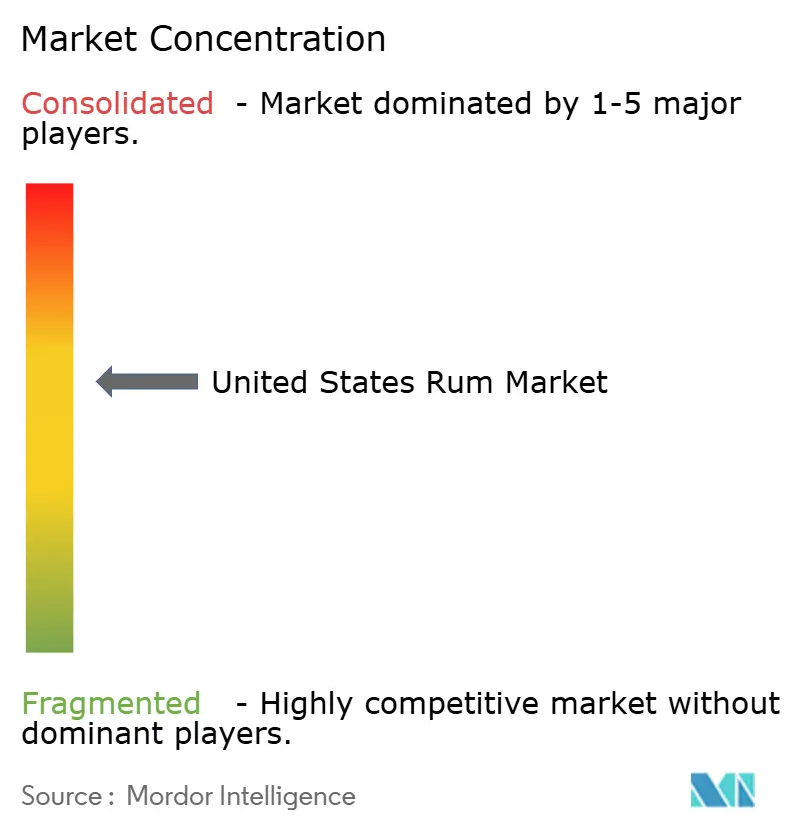
| Market Concentration | Medium |
Major Players *Disclaimer: Major Players sorted in no particular order Image © Mordor Intelligence. Reuse requires attribution under CC BY 4.0. | |
United States Rum Market Analysis by Mordor Intelligence
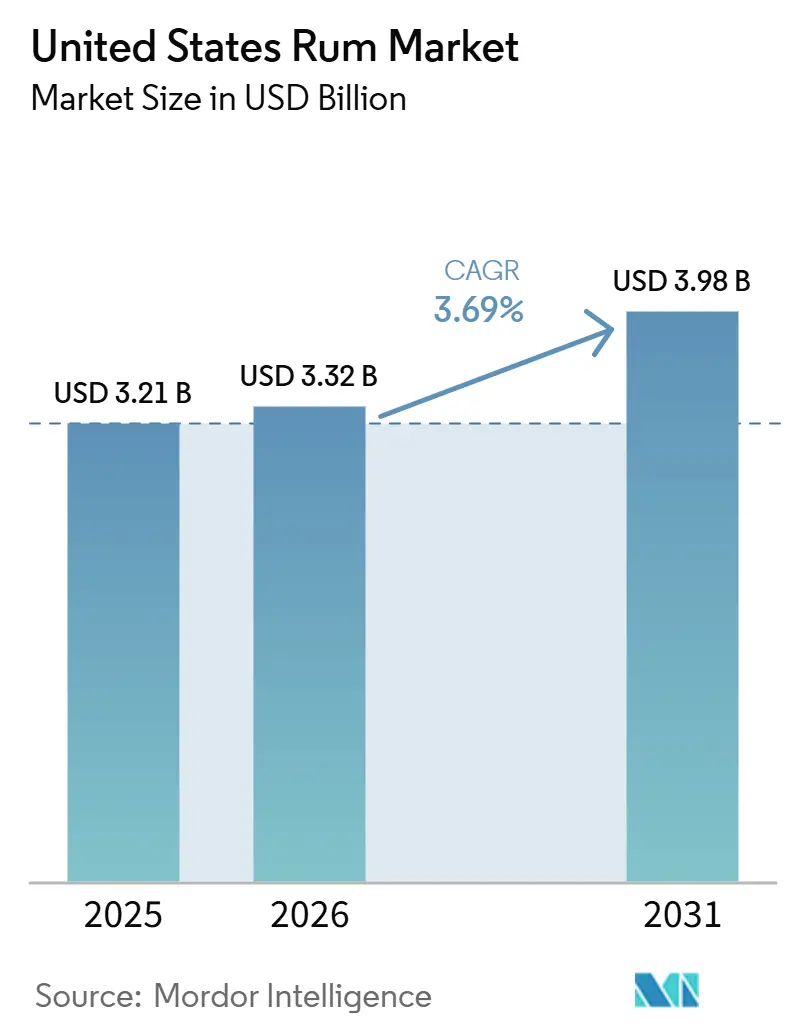
The United States rum market size is projected to be valued at USD 3.21 billion in 2025 and is expected to grow from USD 3.32 billion in 2026 to USD 3.98 billion by 2031, registering a CAGR of 3.69% during the forecast period (2026-2031). The United States rum market is shifting from volume-led growth toward premiumization, even as total rum volume declined from 23 million 9-liter cases in 2021 to 18.2 million cases in 2025. This trend indicates a mature category in which higher-priced aged expressions can support market value despite lower mainstream consumption. According to the Distilled Spirits Council of the United States, spirit-based RTD cocktails generated USD 3.8 billion in revenue in the United States in 2025, marking a 16.4% year-over-year increase and creating more occasions for rum-based mixed drinks in retail and at home[1]Source: Distilled Spirits Council of the United States, “Annual Economic Briefing 2025,” Distilled Spirits Council of the United States, distilledspirits.org. The United States rum market also faces pressure from tequila, American whiskey, moderation trends, and lower replenishment of standard-price products. Puerto Rico’s expanded Rum Tax Cover Over program provides smaller distilleries with additional resources to enter mainland distribution, which could broaden the range of premium offerings available to consumers.
Key Report Takeaways
- By product type, dark rum held 44.71% of the United States rum market share in 2025, while gold rum recorded the highest projected CAGR at 4.96% through 2031.
- By end user, men accounted for 68.72% of the United States rum market share in 2025, while women recorded the highest projected CAGR at 5.01% through 2031.
- By category, flavored rum accounted for 55.81% of the United States rum market size in 2025 and recorded the highest projected CAGR at 5.11% through 2031.
- By distribution channel, off-trade accounted for 75.13% of the United States rum market share in 2025, while on-trade recorded the highest projected CAGR at 5.51% through 2031.
Note: Market size and forecast figures in this report are generated using Mordor Intelligence’s proprietary estimation framework, updated with the latest available data and insights as of January 2026.
United States Rum Market Trends and Insights
Drivers Impact Analysis*
| Driver | (~) % Impact on CAGR Forecast | Geographic Relevance | Impact Timeline |
|---|---|---|---|
| Premiumization through aged and dark rum | +1.1% | National, with concentration in the South and Northeast (Florida, New York, California) | Medium term (2–4 years) |
| Cocktail and mixology occasion expansion | +0.7% | National, with on-premise strength in coastal metros (Miami, New York, Las Vegas, Los Angeles) | Short term (≤ 2 years) |
| Rum-based RTD and convenient serve innovation | +0.6% | National, particularly strong in the West and the Midwest, off-trade channels | Short term (≤ 2 years) |
| Craft, single-estate, and American-origin provenance | +0.4% | Southeast (Georgia, Louisiana), West (Hawaii, California), expanding nationally | Medium term (2–4 years) |
| Relative affordability of high-end rum versus competing dark spirits | +0.3% | National, with the strongest pull in price-conscious urban markets (Atlanta, Denver, Chicago) | Medium term (2–4 years) |
| Puerto Rican and United States Virgin Islands production ecosystem | +0.3% | National; initial United States mainland expansion concentrated in Florida (8 cities) | Long term (≥ 4 years) |
| Source: Mordor Intelligence | |||
Premiumization through aged and dark rum
Dark rum’s shift from cocktail modifier to sipping spirit is redefining category economics in the United States. According to Global Drinks Intel, the “premium-and-above” share of dark rum increased from 11% in 2019 to 17% in 2024, outpacing every other subcategory and indicating that the premiumization runway is strongest where aging traditions and provenance stories are most tangible. Ultra and luxury rum tiers recorded value and volume growth even as the broader category declined, drawing a direct parallel to tequila’s trajectory a decade ago. Bacardi’s aged expressions, Reserva Ocho (USD 32) and Gran Reserva Diez (USD 40), reflect a deliberate move up the price ladder, helping preserve revenue despite volume contraction. The key second-order implication is that rum’s premiumization remains concentrated in dark expressions; white and flavored rum’s combined “premium-and-above” share remains at 4%, leaving most of the category exposed to tequila and American whiskey, which continue to compete more effectively on quality narratives.
Cocktail and mixology occasion expansion
The on-premise cocktail economy increasingly serves as a launchpad for premium rum brands that lack the marketing budgets of top-10 incumbents. Gold and dark rum are expected to gain on-premise value share (+0.5 percentage points and +0.1 percentage points, respectively) in the 52 weeks to mid-2025, while light rum is expected to lose 0.5 percentage points. This shift marks a reversal of the longstanding category hierarchy, driven by bartender advocacy for aged and complex expressions. Rum consumers over-index among Gen Z and report higher monthly on-premise spending and weekly visit frequency than the spirits average, creating a structurally receptive audience for premium storytelling. Campari's Wray & Nephew brand, for instance, built traction among US bartenders in diaspora-heavy markets before expanding to broader on-premise placements. The Bacardi Cocktail Trends Report 2026 identifies hyper-local, culturally rooted cocktail experiences as the defining shift for the year, a theme that disproportionately favors rum's Caribbean and regional provenance stories[2]Source: Bacardi Limited, “Connections, Local Flavors, and Luxurious Experiences Top the 2026 Bacardi Cocktail Trends Report,” Bacardi Limited, bacardilimited.com.
Rum-based RTD and convenient serve innovation
The RTD channel has become the most consequential structural relief valve for the erosion of rum’s mainstream volume. Spirit-based canned cocktails are projected to grow by more than 10 million cases in 2025, reaching nearly 80 million cases in total. The Bacardi–Coca-Cola co-branded RTD, announced in September 2024, directly leverages rum’s cocktail heritage to capture off-premise convenience occasions. Spirit-based RTD cocktails are also on a growth trajectory, reflecting consumer preference for authenticity over malt-based alternatives. The key distinction from earlier RTD waves lies in repeat-purchase behavior: household penetration for RTD cocktails has normalized, with buyers returning to specific formats rather than treating them as novelties. For rum, RTD formats allow mainstream brands to defend volume while repositioning at a meaningfully higher per-unit revenue than traditional bottle formats. This strategy addresses both volume erosion and margin pressure.
Puerto Rican and United States Virgin Islands production ecosystem
Puerto Rico and the United States Virgin Islands form the backbone of the United States rum market by providing a highly developed production ecosystem supported by sugarcane processing, world-scale distilleries, skilled manufacturing, and the federal Rum Cover-Over program, which reinvests federal excise tax revenues into territorial economic development and rum industry expansion. In 2025, bipartisan legislation was introduced to extend the enhanced Rum Cover-Over rate through 2032, reinforcing investment, employment, and production capacity in both territories. In 2025, brands such as Bacardí continued premium portfolio innovation with new flavored and limited-edition rum offerings, strengthening the premium segment. In 2026, the Puerto Rico government expanded Rum Cover-Over incentives to nine emerging distillers, supporting the commercialization of at least 18 Puerto Rican rum brands and their expansion into United States markets, while stimulating production diversity and export competitiveness. These initiatives reinforce the territories' strategic role in ensuring stable supply, encouraging innovation, and sustaining long-term growth in the United States rum market.
Restraints Impact Analysis*
| Restraint | (~) % Impact on CAGR Forecast | Geographic Relevance | Impact Timeline |
|---|---|---|---|
| Category volume erosion and weak mainstream replenishment | -0.5% | National, most acute in South (Florida) and Northeast, where rum's retail share is declining | Medium term (2–4 years) |
| Fragmented quality signaling and additive-transparency concerns | -0.2% | National, most visible in West Coast markets where clean-label consumer preference is strongest | Long term (≥ 4 years) |
| Limited premiumization beyond dark rum | -0.4% | National, particularly limiting in white and flavored subcategories | Medium term (2–4 years) |
| Slow new-brand and new-product pipeline | -0.3% | National, with challenger brands slow to reach shelf-scale in mass off-trade accounts | Long term (≥ 4 years) |
| Source: Mordor Intelligence | |||
Category volume erosion and weak mainstream replenishment
Puerto Rico and the United States Virgin Islands serve as the cornerstone of the United States rum market by providing a well-established production ecosystem supported by large-scale distilleries, a skilled workforce, favorable tax incentives, and extensive export infrastructure. The federal Rum Cover-Over program, which returns excise tax revenues on rum sold in the United States to the two territories, continues to stimulate investment, capacity expansion, and product innovation. In 2025, the Puerto Rico Federal Affairs Administration announced bipartisan legislation to extend the enhanced Rum Cover-Over rate through 2032, strengthening long-term investment certainty for producers in Puerto Rico and the United States Virgin Islands. In 2025, Bacardí expanded its premium portfolio with the Bacardí Reserva Ocho Rye Cask Finish, targeting premium rum consumers, while in 2026, the Puerto Rico government expanded Rum Cover-Over incentives to nine emerging distillers, supporting at least 18 local rum brands and accelerating their commercialization across the United States markets. These policy measures and continuous premium product innovation reinforce supply stability, production diversity, and the long-term competitiveness of the United States rum market.
Fragmented quality signaling and additive-transparency concerns
Fragmented quality signaling and additive-transparency concerns restrain the United States rum market by making it difficult for consumers to distinguish authentic, premium, and naturally produced rums from products containing added flavors, colors, sweeteners, or undisclosed additives. Unlike categories with uniform production standards, labeling practices for rum vary significantly across brands and countries of origin, creating uncertainty regarding age statements, sugar additions, and ingredient transparency. The Distilled Spirits Council of the United States (DISCUS) has consistently emphasized the importance of science-based labeling and transparent regulatory standards to improve consumer confidence and fair competition across the spirits industry. In response to rising demand for authenticity, producers have increasingly highlighted provenance and production methods through product innovation. In 2025, Bacardí introduced Reserva Ocho Rye Cask Finish, emphasizing extended aging and cask-finishing techniques, while in 2026, Puerto Rico expanded incentives to emerging rum producers under the Rum Cover-Over Program, encouraging premium, locally crafted brands with stronger origin credentials and transparent production practices. Nevertheless, inconsistent quality cues and limited disclosure of additives across the broader rum category continue to hinder consumer trust, slowing premiumization and overall market growth.
*Our forecasts treat driver/restraint impacts as directional, not additive. The impact forecasts reflect baseline growth, mix effects, and variable interactions.
Segment Analysis
By Product Type: Dark Rum Commands Value, Gold Leads the Premium Pivot
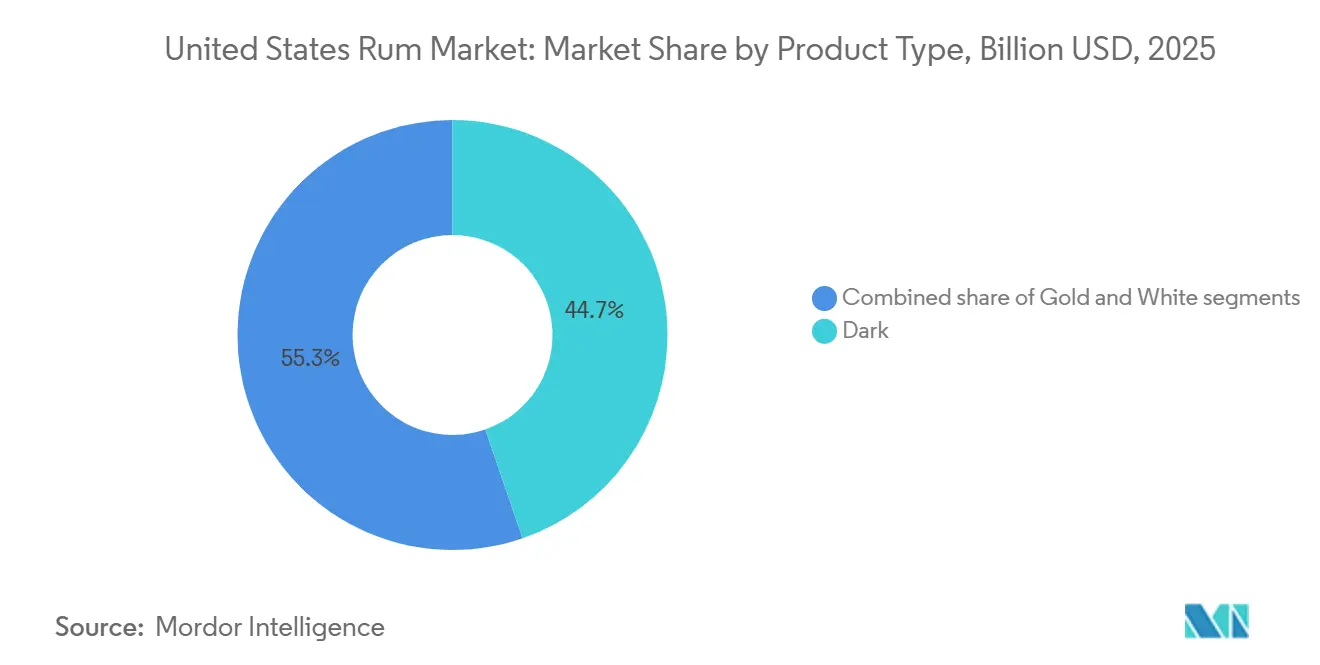
Dark rum is projected to capture 44.71% of the United States rum market value in 2025, reinforcing its position as the category’s premiumization anchor. The premium-and-above tier of dark rum is expected to expand as brands such as Appleton Estate, Ron Diplomático, and Mount Gay reposition aged expressions as sipping spirits comparable to single-malt Scotch, but at price points 20–40% lower for equivalent aging statements. Campari’s Appleton Estate portfolio is projected to grow 17.1% to 245,000 cases in 2025, marking the strongest outperformance among the top 10 US rum brands and validating provenance-led narratives in the dark and aged subcategory. Brown-Forman’s Diplomático is expected to report strong double-digit organic net sales growth in fiscal 2025, with 300,000 9-liter cases sold globally as the brand accelerates its US super-premium push[3]Source: Brown-Forman Corporation, “2025 Integrated Annual Report,” Brown-Forman Corporation, brown-forman.com.
Gold rum is expected to be the fastest-growing product type, registering a 4.96% CAGR from 2026 to 2031. It occupies a strategically important middle position between the commodity associations of white rum and the higher price point of aged dark expressions. Gold rum benefits from both cocktail mixability and sipping credibility, appealing to consumers making their first trade-up from standard light rum. White rum, historically the base for mass-market cocktails such as mojitos and daiquiris, continues to lose on-premise share as bartenders favor more complex base spirits. Its long-term recovery depends on stronger positioning within the RTD format and clean-label craft expressions rather than traditional mixed drink categories. The TTB’s flavor and coloring disclosure standards, while incomplete, are beginning to influence purchase behavior in the premium tier, favoring producers with verifiable aging and additive-free claims.



By End User: Male Dominance Persists, Women Drive Forward Growth
Men are expected to account for 68.72% of the United States rum market value in 2025, reflecting long-standing brand associations with naval heritage, Caribbean culture, and high-proof social occasions. However, this concentration is declining. Women are projected to be the fastest-growing end-user cohort, registering a 5.01% CAGR from 2026 to 2031, as brands reformulate flavors, update packaging, and shift digital media spending toward female-skewing platforms. Pernod Ricard’s Malibu, despite an expected volume decline to 2.084 million cases in 2025, introduced Malibu Pink, a 21% ABV guava-pineapple-coconut blend, to target female consumers seeking lower ABV levels and tropical flavors. Colorado-based Montanya Rum, a women-owned distillery and B Corp, expanded into Texas in August 2025 through Texas Spirits, targeting consumers trading up from tequila and American whiskey and supporting rum’s market-boundary expansion.
The gender gap is narrowing fastest among urban consumers aged 25–40, where RTD cocktails and flavored rum serve as entry points before consumers shift to premium aged expressions. Socialization trends are increasing women’s spirits consumption, and rum’s tropical, spiced, and aged profiles give it an advantage over single-note categories. Brands that acquire female consumers through flavored expressions and encourage trading up to aged products offer the strongest path to sustainable end-user mix improvement. The FTC’s updated digital advertising guidelines are also pushing spirits brands toward more transparent audience targeting, making women-oriented campaigns more accountable and better at identifying flavor innovations that drive sustained purchase intent rather than one-time trial.
By Category: Flavored Leads by Value, Premiumization Testing Its Limits
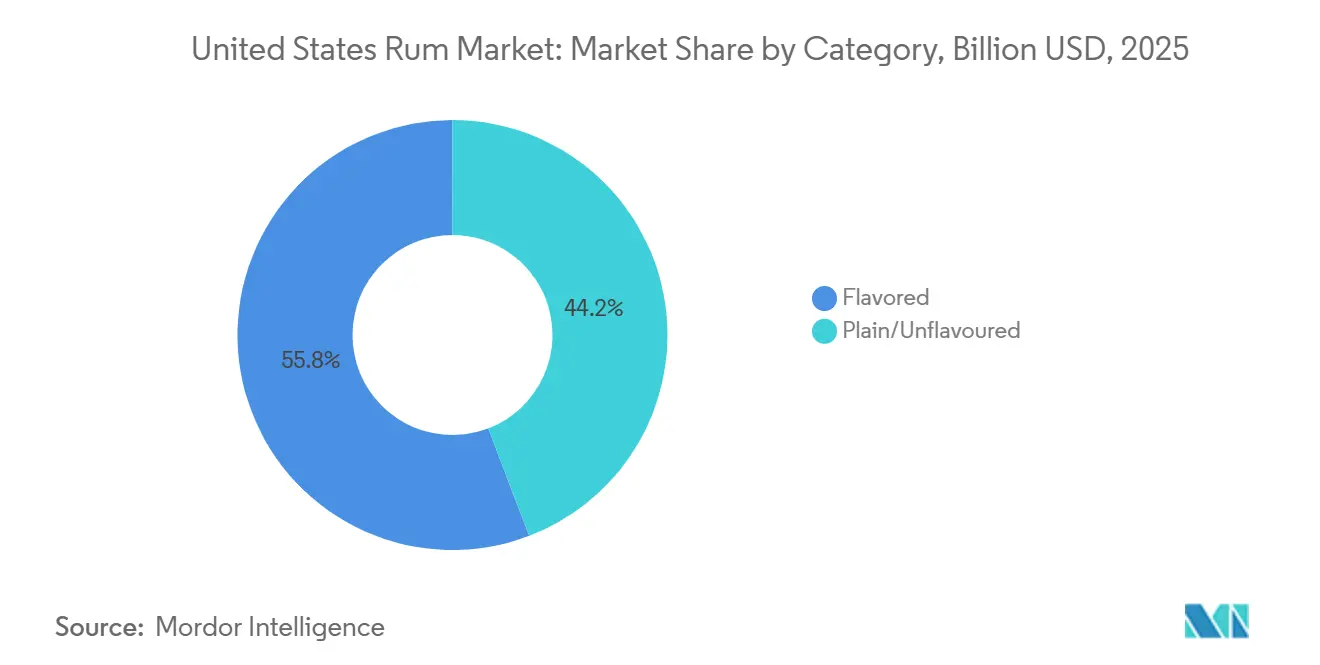
Flavored rum is expected to account for 55.81% of the United States rum market value in 2025. It is also projected to be the fastest-growing category, registering a CAGR of 5.11% from 2026 to 2031. This unusual dual distinction reflects the segment’s dual role as a volume driver for mainstream brands and an innovation platform for emerging premium players. Flavored rum is also expected to account for a prominent share of all rum sold in the United States in 2025 by volume, making its scale a de facto barometer of category health. However, the segment faces a challenge: flavored rum’s premium-and-above share, combined with white rum, stands at only 4%, indicating that flavor innovation has largely remained confined to the standard tier.
Plain/unflavored rum faces structural headwinds in the mainstream channel but maintains its strongest position among bartenders and spirits enthusiasts who prefer clean bases for complex cocktails. The additive-free movement, gaining traction through producers such as Oxbow Rum Distillery (Louisiana) and Kuleana Rum Works (Hawaii), shows that unflavored rum can command a premium when producers emphasize production transparency. Oxbow’s November 2024 e-commerce launch across more than 30 US states through Flaviar.com created a national distribution pathway without the bottlenecks of the conventional three-tier system. Craft producers that struggle to secure premium shelf placement are increasingly adopting this playbook. The long-term dynamic between these two segments will depend on whether natural-flavoring producers can bridge the credibility gap that currently separates flavored rum from unflavored rum in the premium-and-above tier.
By Distribution Channel: Off-Trade Dominates, On-Trade Redefines Value Creation
Off-trade channels, including specialty and liquor stores, grocery stores, and other retail formats, are expected to account for 75.13% of the United States rum market value in 2025. This share is supported by the high-volume presence of Bacardi, Captain Morgan, and Malibu in conventional retail. Within off-trade, specialty and liquor stores are gaining relevance as retailers shift premium shelf space away from mass-channel SKUs and toward aged and craft expressions, responding to consumer trading-up behavior. The click-and-collect channel has recorded growth in spirits, indicating that off-trade digital commerce is creating incremental discovery opportunities for niche rum brands that previously lacked physical shelf presence in non-specialist retailers.
On-trade channels, including bars, restaurants, and clubs, are projected to be the fastest-growing distribution segment, registering a 5.51% CAGR from 2026 to 2031, despite value and volume declines in the 52 weeks ending mid-2025. This trend reflects a structural shift: on-premise consumption serves as a quality-signaling mechanism for rum and supports premium off-premise purchases. Gold and dark rum gained on-premise share, while light rum lost 0.5 percentage points, showing that on-premise consumption is already shifting toward premium-weighted rum, even as overall category volumes in bars decline. Nevada recorded the largest on-premise rum share gain in 2025 (+0.3 percentage points), reinforcing the pattern that high-tourism, cocktail-centric markets are early adopters of premium rum positioning and influence broader consumer behavior.
Geography Analysis
The South is projected to account for 39.46% of the United States rum market size in 2025. Florida maintains a strong connection to Caribbean culture, supported by Puerto Rican and Cuban diaspora communities and outdoor consumption occasions. The state is expected to hold a prominent share of the national on-premise rum share in 2025. Miami’s tiki bars, Cuban-inspired rum venues, and education events continue to build brand awareness. Rones de Puerto Rico is expected to form a partnership with four Major League Baseball teams in 2025, with New York and Florida as priority commercial markets. Texas is also emerging as a premium expansion location, as craft brands enter the Dallas-Fort Worth and Houston corridors.
The West is forecast to grow at a CAGR of 4.82% from 2026 to 2031, the fastest rate among United States regions. Nevada’s Las Vegas corridor is expected to record the largest on-premise rum share gain in 2025, at 0.3 percentage points. Washington State is also expected to record gains, supporting the view that Pacific Coast cocktail programs are becoming more open to rum. Hawaii has a distinct premium proposition based on domestic sugarcane production and tourism. California’s interest in lower-ABV and additive-free products creates demand for craft producers that can leverage the state’s specialty retail base. Palm Republic Rum is expected to enter California and Nevada in July 2026 through Southern Glazer’s Wine & Spirits, highlighting the West’s importance for craft distribution.
The Northeast and Midwest account for the remaining United States rum market demand and have distinct consumption profiles. Caribbean diaspora communities in New York, Massachusetts, and Connecticut support Jamaican-origin and overproof brands. Campari has built bartender recognition for Wray & Nephew in New York and Connecticut before pursuing broader on-premise placement. In Chicago and Minneapolis, bourbon and tequila more strongly shape premium spirits demand. RTD adoption and home cocktail occasions can still add off-trade rum volume in these locations. Ohio is expected to maintain its on-premise rum share in 2025, showing that selective Midwest markets can retain relevance through cocktail programs.
Competitive Landscape
The United States rum market is moderately concentrated in mainstream volume and fragmented in premium rum. Bacardi and Captain Morgan are expected to hold the two largest brand positions in 2025, although both brands are projected to report volume declines. Bacardi is expected to sell 5.636 million cases, while Captain Morgan is expected to sell 4.115 million cases in 2025. Bacardi has invested in premium products and cultural relevance, while Diageo has pursued flavored-rum consumer acquisition alongside its Accelerate restructuring program. Growth opportunities are concentrated in super-premium and ultra-premium products, where the share remains smaller, but demand has held up better than in the wider category.
Campari’s Appleton Estate portfolio is expected to grow by 17.1% to 245,000 cases in 2025, demonstrating the value of Jamaican provenance and aged expressions. Campari is also expected to increase advertising and promotional spending to 17.9% of net sales in 2025, supporting brand investment during a weaker spirits environment. Brown-Forman has supported Diplomático through a new United States distribution structure and a United States agency appointment focused on Hispanic consumers, beginning in Florida. Bacardi’s pre-mixed collaboration with Coca-Cola is another strategic move that connects its rum brand to the growing convenience format. These actions indicate that leading companies are using premium products, distribution changes, and RTD formats to protect brand relevance.
Smaller producers are competing through origin, direct sales, and specialty distribution. Oxbow Rum Distillery is pursuing a geographic indication for Louisiana cane juice rum, which could establish a protected-origin position for its products. Kuleana Rum Works is expected to select Craft & Art Wine and Spirits as its national mainland sales and route-to-market partner in May 2026. Three Hearts Rum is expected to launch a 7-year Dominican Republic expression through direct-to-consumer channels in March 2026. These models reduce dependence on mass retail listings, but they also require sustained consumer interest and access to compliant distribution networks.
United States Rum Industry Leaders
Bacardi Limited
Diageo plc
Pernod Ricard SA
Heaven Hill Brands
William Grant & Sons Ltd.
- *Disclaimer: Major Players sorted in no particular order

Recent Industry Developments
- July 2026: Palm Republic Rum announced strategic distribution agreements with Southern Glazer's Wine & Spirits in California, Florida, and Texas, and expanded into New York, Massachusetts, Nevada, Colorado, Georgia (Empire Distributors), and Pennsylvania, more than doubling its national footprint and giving the brand access to on- and off-premise accounts across 8 major United States markets.
- June 2026: Altamar Brands launched Probitas Green Label Blended Rum, a 57% ABV expression distilled, matured, and blended across Foursquare Rum Distillery (Barbados) and Hampden Estate (Jamaica), available nationally in the United States; the release represented the first higher-proof line extension from Probitas and reinforced the multi-island blending model as a distinct premiumization strategy.
- March 2025: Next Century Spirits (North Carolina) acquired Blue Chair Bay Rum from country music artist Kenny Chesney, entering the premium rum segment with what is described as the world's largest independently owned rum brand; the acquisition positioned Next Century to pursue mainstream United States shelf presence alongside its existing vodka and whiskey portfolio.


United States Rum Market Report Scope
Rum is a distilled alcoholic beverage made from sugarcane byproducts, such as molasses or sugarcane juice, through fermentation and distillation. The United States rum market report is segmented by product type, end user, category, distribution channel, and geography. By product type, the market is segmented into white, gold, and dark. By end user, the market is segmented into men and women. By category, the market is segmented into plain/unflavoured and flavored. By distribution channel, the market is segmented into on-trade and off-trade. The off-trade segment is further sub-segmented into specialty/liquor stores and other off-trade channels. By geography, the market is segmented into Northeast, Midwest, South, and West. The market forecasts are provided in terms of value (USD) and volume (liters).
| White |
| Gold |
| Dark |
| Men |
| Women |
| Plain/Unflavoured |
| Flavored |
| On-Trade | |
| Off-Trade | Specialty/Liquor Stores |
| Other Off-Trade Channels |
| Northeast |
| Midwest |
| South |
| West |
| Product Type | White | |
| Gold | ||
| Dark | ||
| End User | Men | |
| Women | ||
| Category | Plain/Unflavoured | |
| Flavored | ||
| Distribution Channel | On-Trade | |
| Off-Trade | Specialty/Liquor Stores | |
| Other Off-Trade Channels | ||
| Region (VALUE) | Northeast | |
| Midwest | ||
| South | ||
| West | ||


Key Questions Answered in the Report
What is the forecast for the United States rum market through 2031?
The United States rum market is forecast to reach USD 3.98 billion by 2031, expanding at a 3.7% CAGR from 2026.
Which rum product type leads the United States value sales?
Dark rum led with 44.71% of value in 2025, supported by its role in aged and premium offerings.
Which rum category is growing the fastest in the United States?
Flavored rum is projected to grow at a 5.11% CAGR from 2026 to 2031.
Why are RTD products relevant to rum producers?
RTD formats give rum brands access to convenience occasions and can support revenue per serving through pre-mixed cocktails.
Page last updated on:





