
United States Prebiotic Ingredients Market Size and Share
Market Overview
| Study Period | 2021 - 2031 |
|---|---|
| Forecast Data Period | 2026 - 2031 |
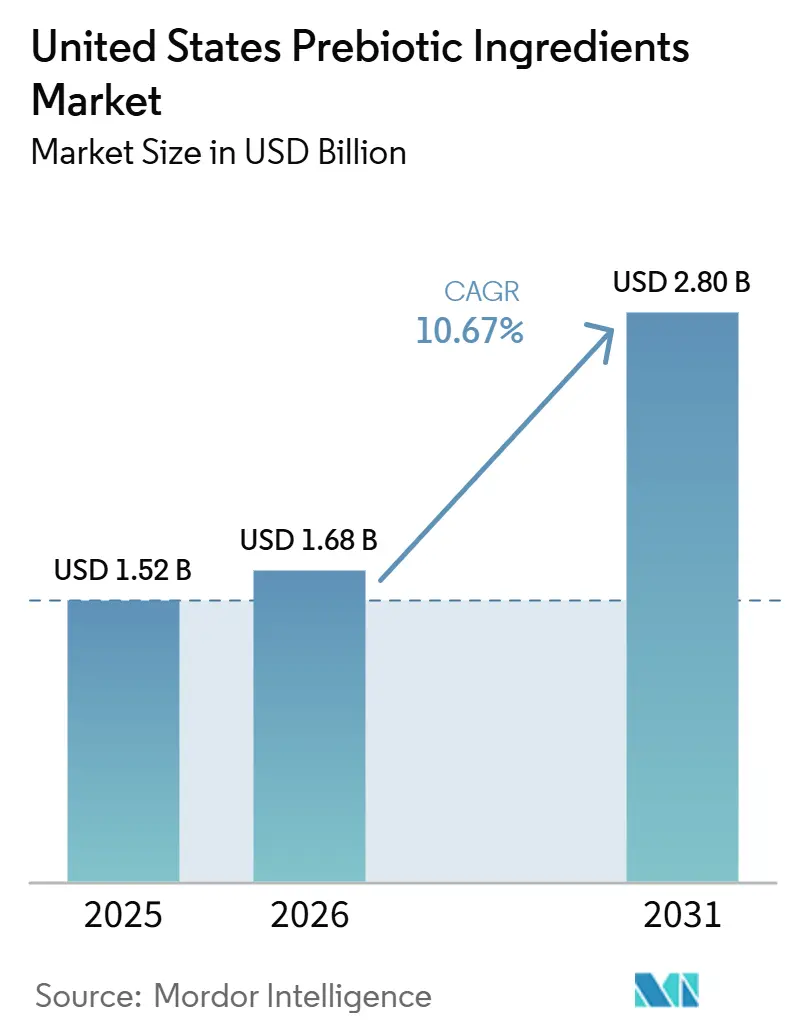
| Base Year Market Size (2025) | USD 1.52 Billion |
| Market Size (2026) | USD 1.68 Billion |
| Market Size (2031) | USD 2.80 Billion |
| Growth Rate (2026 - 2031) | 10.67 % |
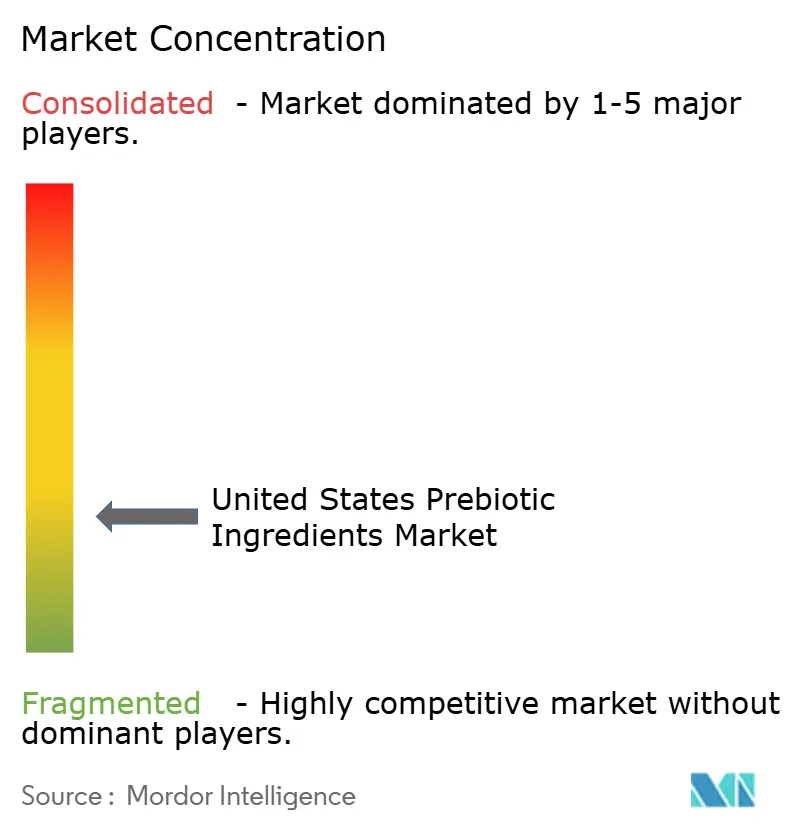
| Market Concentration | Low |
Major Players
*Disclaimer: Major Players sorted in no particular order Image © Mordor Intelligence. Reuse requires attribution under CC BY 4.0. |
|
United States Prebiotic Ingredients Market Analysis by Mordor Intelligence
The US prebiotic ingredients market size is projected to expand from USD 1.5 billion in 2025 and USD 1.7 billion in 2026 to USD 2.8 billion by 2031, registering a CAGR of 10.7% between 2026 to 2031. The US prebiotic ingredients market benefits from rising demand for products that support digestive comfort, metabolic health, weight management, and immune health. Food and beverage companies are incorporating prebiotic fiber into more mainstream formats, while supplement brands are focusing on controlled doses and clinical backing. FDA enforcement discretion for specified nondigestible carbohydrates provides established suppliers with a practical pathway for dietary fiber labeling[1]Source: Food and Drug Administration, "Nutrition, Food Labeling, and Critical Foods", fda.gov. However, dependence on imported chicory-root inulin and uncertainty around a formal prebiotic definition continue to constrain buyers and suppliers. Competition centers on clinical evidence, reliable sourcing, and formulations suitable for beverages, food, infant nutrition, and supplements, as buyers increasingly evaluate suppliers based on documentation, dose support, physical form, and the ability to serve multiple finished-product categories.
Key Report Takeaways
- By type, inulin held the largest 2025 share of the US prebiotic ingredients market, while GOS is projected to grow at the fastest CAGR of 11.5% during 2026-2031.
- By source, plant-based ingredients accounted for the largest share of the US prebiotic ingredients market, at 67.6% in 2025, and are projected to grow at a CAGR of 10.85% during 2026-2031.
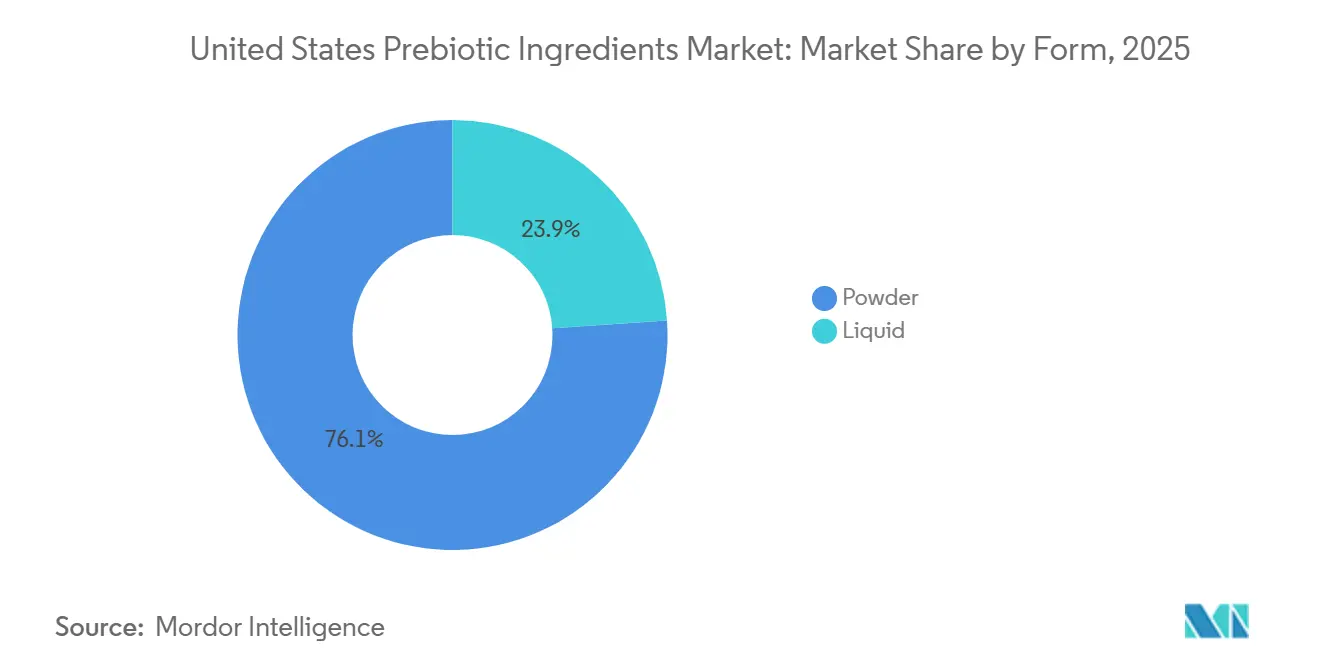
- By form, powder accounted for the largest share of the US prebiotic ingredients market, at 76.1% in 2025, while liquid is projected to grow at the fastest CAGR of 11.4% during 2026-2031.
- By application, functional food and beverage accounted for the largest share of the US prebiotic ingredients market, at 42.4% in 2025, while dietary supplements are projected to grow at the fastest CAGR of 11.7% during 2026-2031.
Note: Market size and forecast figures in this report are generated using Mordor Intelligence’s proprietary estimation framework, updated with the latest available data and insights as of January 2026.
United States Prebiotic Ingredients Market Trends and Insights
Drivers Impact Analysis*
| Driver | (~) % Impact on CAGR Forecast | Geographic Relevance | Impact Timeline |
|---|---|---|---|
| Rising demand for digestive and metabolic health products | +3.0% | National, concentrated in Coastal and Sunbelt metros | Short term (≤ 2 years) |
| Prebiotic fiber expansion in mainstream beverages | +2.0% | National, with early gains in California and New York | Short term (≤ 2 years) |
| Regulatory recognition of select nondigestible carbohydrates as dietary fiber | +1.5% | National | Medium term (2-4 years) |
| Wider adoption in infant and clinical nutrition | +1.2% | National | Medium term (2-4 years) |
| Retail premiumization of clinically positioned gut-health products | +0.8% | National, concentrated in Northeast and West Coast | Medium term (2-4 years) |
| Reformulation demand for sugar reduction and fiber fortification | +0.7% | National | Short term (≤ 2 years) |
| Source: Mordor Intelligence | |||
Rising Demand for Digestive and Metabolic Health Products
The US prebiotic ingredients market benefits from a broader understanding of gut health, which now includes metabolic function, immune response, and body weight. This expanded perspective is driving demand across foods, beverages, and supplements, including products positioned for digestive comfort, weight management, metabolic support, and immune support. Food developers are combining prebiotic fibers with protein-focused formats to address multiple nutrition objectives. BENEO states that its Orafti chicory-root fibers demonstrate a prebiotic effect at intakes starting at 3 grams per day and have support from more than 30 years of human clinical research. Prebiotic fibers are also appearing in nutrition products targeting people using GLP-1 medicines, where satiety, glycemic stability, and gastrointestinal comfort remain key concerns. The wide range of health applications gives suppliers multiple sources of demand, reduces reliance on a single consumer need, and supports product launches across everyday food formats and specialized nutrition products.
Prebiotic Fiber Expansion in Mainstream Beverages
Prebiotic beverages are expanding beyond specialty channels into national retail distribution, creating an additional growth channel for the US prebiotic ingredients market. According to the supplied material, PepsiCo completed its acquisition of Poppi in May 2025 for USD 1.95 billion, bringing a prebiotic soda brand into its large distribution network. The brand had recorded USD 500 million in annual sales before the transaction. Coca-Cola introduced Simply Pop, which contains 6 grams of fiber per can, adding another major beverage company to the category. Bloom Nutrition expanded Bloom Pop into more than 3,000 Walmart stores in July 2025, indicating that prebiotic beverages are reaching mass retail. These launches are increasing demand for water-soluble, low-viscosity, and flavor-neutral fibers that can perform in carbonated beverages without disrupting production speed, product texture, or familiar flavor profiles.
Regulatory Recognition of Select Nondigestible Carbohydrates as Dietary Fiber
FDA rules on dietary fiber provide an important commercial framework for the US prebiotic ingredients market. The FDA allows specified inulin-type fructans and galactooligosaccharides to count toward the dietary fiber declaration under enforcement discretion[3]Source: Food and Drug Administration," Generally Recognized as Safe (GRAS)", fda.gov. This approach allows established fiber types to support familiar high-fiber labeling without relying on a separate prebiotic claim, making product development and consumer communication more straightforward for food and beverage brands. Imported ingredients must also comply with Foreign Supplier Verification Program requirements and current good manufacturing practice rules under 21 CFR Part 117. These requirements favor suppliers with established documentation, supplier verification processes, audited manufacturing systems, and quality teams that can respond to customer requests for compliance records. However, the absence of a final rule that formally adds all relevant ingredients to the dietary fiber definition continues to create uncertainty for long-term sourcing and label planning.
Wider Adoption in Infant and Clinical Nutrition
GOS has an established role in infant formula and is gaining relevance in clinical nutrition, strengthening a specialized demand base within the US prebiotic ingredients market. FrieslandCampina Ingredients reported that 57% of infant formula products expected to launch globally in 2025 contain GOS. In March 2025, the FDA and HHS are expected to launch Operation Stork Speed to review infant formula nutrient requirements, followed by a request for scientific information in May 2025[2]Source: US Department of Health and Human Services, "Make America Healthy Again", hhs.gov. Any future recognition of oligosaccharides in infant formula requirements could shift demand from optional differentiation to a more standardized formulation practice. Clinical nutrition also offers a higher-value channel for enteral feeding, geriatric products, and immune-support products, where clinical evidence can align with hospital and specialized nutrition procurement requirements. Retail demand for clinically positioned gut-health products and reformulation efforts focused on lower sugar and higher fiber further support the use of validated prebiotic ingredients.
Restraints Impact Analysis*
| Restraint | (~) % Impact on CAGR Forecast | Geographic Relevance | Impact Timeline |
|---|---|---|---|
| Consumer sensitivity to gastrointestinal tolerance and dosage | -0.8% | National | Short term (≤ 2 years) |
| Inconsistent fiber labeling and health-claim interpretation | -0.6% | National | Medium term (2-4 years) |
| Supply volatility for chicory, corn, wheat, and specialty feedstocks | -0.7% | National | Medium term (2-4 years) |
| Competition from conventional dietary fibers | -0.5% | National | Long term (≥ 4 years) |
| Source: Mordor Intelligence | |||
Consumer Sensitivity to Gastrointestinal Tolerance and Dosage
Clinically meaningful doses can overlap with the dose range that causes bloating, gas, or loose stools in consumers with high gastrointestinal sensitivity. Long-chain inulin and high-polymerization FOS can ferment rapidly in the proximal colon, creating formulation challenges in bakery, dairy, and beverage applications. As a result, product developers may use fiber levels lower than those associated with the strongest prebiotic effect. This approach can limit premium positioning and weaken the link between a label claim, the amount of prebiotic fiber per serving, and the benefit consumers expect from regular use. The supplied material states that Ingredion acquired Benicaros in June 2026, a carrot-pomace prebiotic that supports gut and immune health at 300 milligrams per day. Blends, such as the 9:1 GOS-to-FOS ratio used in infant formula, can moderate fermentation, but they do not eliminate the tolerance issue in mainstream foods.
Inconsistent Fiber Labeling and Health-Claim Interpretation
The United States lacks a harmonized definition of prebiotic, which can create uncertainty for consumers, retailers, and brands. The FDA regulates products under food additive, GRAS, and dietary supplement frameworks, while the FTC oversees advertising claims. A 2026 review in 3 Biotech noted that inconsistent terminology and definitions have slowed broader prebiotic adoption. This situation benefits established inulin and FOS suppliers, which already have familiarity with dietary fiber labeling. Newer structures may face lengthy evidence-generation and claim-substantiation processes before reaching the same position, especially when a brand seeks claims beyond a standard dietary fiber declaration. Certification programs, including NutraStrong Prebiotic Verified, offer brands an additional route to demonstrate minimum dose, manufacturing quality, and label compliance.
*Our forecasts treat driver/restraint impacts as directional, not additive. The impact forecasts reflect baseline growth, mix effects, and variable interactions.
Segment Analysis
By Type: Inulin Leads Established Value While GOS Has the Fastest Growth
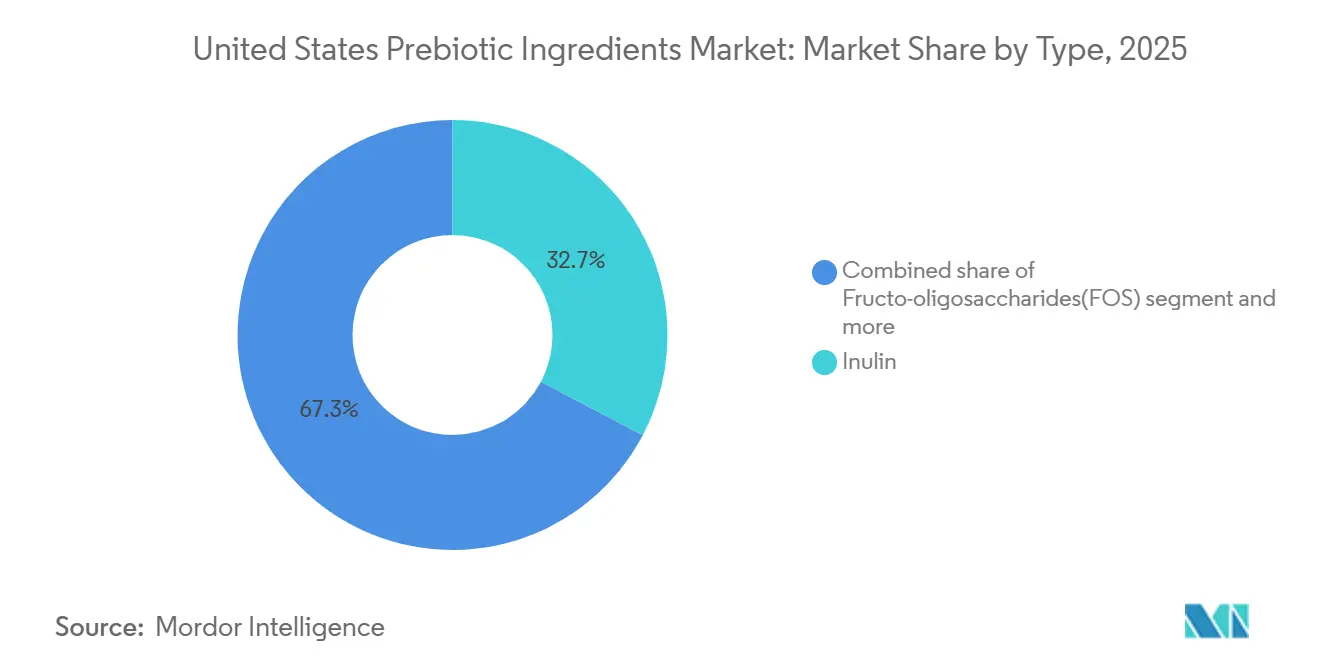
Inulin is expected to hold 32.73% of the US prebiotic ingredients market by type in 2025, although the supplied data does not specify the percentage share. Its scale reflects an established chicory supply chain, a long GRAS history, and its use as both a prebiotic fiber and a fat or sugar replacement ingredient. Bakery, dairy, and beverage manufacturers use inulin because it addresses several formulation needs. FOS supports related applications in infant nutrition and functional beverages, while manufacturers use MOS mainly in animal feed and selected clinical nutrition products. The others category includes developing oligosaccharide structures and HMO analogs produced through precision fermentation.
GOS is the fastest-growing type, with the US prebiotic ingredients market size for GOS projected to record an 11.5% CAGR during 2026-2031. Growth is tied to infant nutrition, synbiotic supplements, and its structural similarity to human milk oligosaccharides. FrieslandCampina Ingredients describes Vivinal GOS as containing 3'-, 4'-, and 6'-galactosyllactose structures found in the human breast milk oligosaccharide pool. The supplied material also identifies FDA GRAS affirmation for GOS use in infant formula in syrup and powder forms. US inulin imports are expected to reach USD 97.8 million in the 12 months ending July 2025, while 2026 certifications are expected to increase the importance of clinical evidence in type-level competition.



By Source: Plant-Based Feedstocks Hold a Broad Lead While Other Sources Build Higher-Value Options
Plant-based sources are expected to account for 67.6% of the US prebiotic ingredients market share by origin in 2025. Chicory root, corn, wheat, agave, cassava, and carrot pomace provide a broad feedstock base for inulin, FOS, and newer prebiotic structures. This diversity supports plant-origin, clean-label, non-GMO, and sustainability positioning. Ingredion is expected to acquire Benicaros in June 2026, adding an upcycled carrot-pomace option to its portfolio. Cosun Beet Company’s Sensus operation has also expanded its portfolio to include agave inulin alongside its chicory-root Frutafit and Frutalose products.
The supplied draft identifies plant-based sources as the fastest-growing source segment but does not provide a forecast CAGR. Dairy-based sources remain important because manufacturers use lactose-derived GOS in infant formula and clinical nutrition, with standard blends delivering 4-6 grams daily to formula-fed infants. Other sources include algae-derived materials and precision-fermentation oligosaccharides, such as HMOs. BENEO and Wacker Chemie are expected to form a partnership in June 2025 to commercialize 2'-fucosyllactose through precision fermentation. These pathways reduce reliance on a single crop and offer distinct positioning options across price and application tiers.
By Form: Powder Provides Most Volume While Liquid Gains From Beverage Demand
Powder is expected to account for 76.1% of the US prebiotic ingredients market share by form in 2025. Its leadership reflects lower logistics complexity, longer shelf life, and broad use in capsules, powdered drinks, dry foods, and industrial baking. Spray-dried inulin and FOS powders remain common in supplement and food fortification applications. Established standards for moisture, density, and particle size also reduce formulation risks for buyers. Powder formats are widely available and remain the default choice when beverage processing requirements are not central.
Liquid is expected to be the fastest-growing format, with the US prebiotic ingredients market size for liquid forms projected to expand at an 11.4% CAGR from 2026 to 2031. Carbonated sodas, dairy shots, ready-to-drink coffees, and prebiotic waters require fibers that dissolve readily and have a limited effect on viscosity and flavor. GOS syrups, liquid inulin concentrates, and soluble FOS solutions command higher per-unit prices due to processing and handling requirements. ADM expanded its soluble dietary fiber portfolio in August 2025 with citrus- and oat-derived fibers for beverage and snack applications. BENEO displayed prebiotic oat lattes and chicory-root fiber beverage solutions at Expo West 2026, while suppliers offering both formats can serve a broader range of customer needs.
By Application: Functional Food and Beverage Has the Largest Base While Supplements Grow Fastest
Food and beverages are expected to account for 42.4% of total US prebiotic ingredient revenue by application in 2025. Yogurt, baked goods, cereals, snack bars, and functional beverages continue to generate steady demand for prebiotic ingredients. These applications use high ingredient volumes and commonly rely on established fiber types. The segment benefits from large food manufacturers’ familiarity with fiber fortification. Its broad presence across everyday formats supports demand across retail channels and eating occasions.
Dietary supplements are expected to be the fastest-growing application, with the US prebiotic ingredients market size projected to register an 11.7% CAGR during 2026-2031. Capsule, gummy, stick-pack, and powder formats appeal to consumers seeking dose-controlled prebiotic delivery. Higher purity requirements and clinical substantiation support premium pricing in this channel. Infant formula and baby food remain significant applications, as 57% of global infant formula launches in 2025 are expected to contain GOS. Animal feed provides a stable outlet for MOS and selected FOS, while other applications include pharmaceutical-grade products, personal care products, and clinical nutrition products.
Geography Analysis
The United States is expected to account for the full geographic scope of the US prebiotic ingredients market in 2025. It represents the largest single-country demand base for prebiotic ingredients, supported by developed functional food, beverage, and dietary supplement channels. California and New York serve as key formulation centers for supplements and premium functional beverages. Contract manufacturers and specialty distributors in these states support new product development, while the FDA GRAS framework remains relevant for developers introducing new fiber types.
The supplied data does not state the geographic market share or CAGR for the fastest-growing US region during 2026-2031. However, prebiotic beverage distribution is broadening across the country through national grocery, convenience, and mass retail channels. PepsiCo's acquisition of Poppi expanded national distribution in May 2025, while Bloom Pop entered more than 3,000 Walmart stores in July 2025. E-commerce also enables supplement brands to reach consumers outside areas with dense specialty retail networks.
The Midwest supports baseline demand for inulin and FOS through dairy and grain processing for yogurt, baked goods, and cereal applications. According to the supplied material, BENEO chicory-root fibers and ADM Fibersol soluble corn fiber have established positions in these applications. The United States relies on Belgium, the Netherlands, and Chile for 65-75% of chicory-root inulin demand, creating exposure to import logistics and potential supply disruptions. Domestic cultivation efforts remain years away from meaningful scale, leaving East Coast and Gulf Coast buyers exposed while they maintain 4-6 weeks of safety inventory. Therefore, the national demand base depends on domestic food production clusters, overseas chicory supply, port logistics, and inventory planning by ingredient buyers that use imported inulin in large-volume food applications.
Competitive Landscape
The US prebiotic ingredients market remains fragmented, with large ingredient companies competing with specialist producers and dedicated distributors. Companies differentiate themselves through clinical data, reliable sourcing, and application-specific formulation support. Leading companies are expanding into newer prebiotic structures while improving ingredient formats for beverages and supplements. Ingredion is expected to announce a recommended all-cash acquisition of Tate & Lyle in June 2026, valuing the transaction at a USD 5.0 billion enterprise value. The transaction is expected to close in the second half of 2027 and would create a USD 10 billion platform spanning texture, starch, fiber fortification, sugar reduction, and mouthfeel.
Ingredion is also expected to acquire Benicaros from NutriLeads in June 2026, including its intellectual property, trademarks, and human clinical trial data. This move would give the company a lower-dose, upcycled prebiotic option designed to address tolerance and formulation limitations associated with traditional fibers. Roquette and Tate & Lyle are expected to receive NutraStrong certification in 2026 for specified fiber ranges, with Roquette's three NUTRIOSE grades supported by more than 26 studies. These certifications are likely to make clinical substantiation more important when large formulators select ingredient suppliers.
Opportunities remain in upcycled prebiotics, beverage-stable liquid fibers, and precision-fermented human milk oligosaccharides. BENEO's expected June 2025 partnership with Wacker for 2'-fucosyllactose would provide an established prebiotic supplier with a route into HMO commercialization. Clinical studies, quality audits, and documentation requirements can challenge smaller suppliers, while conventional fibers and feedstock volatility remain competitive considerations. The fragmented structure leaves room for large ingredient groups and specialists that can demonstrate a clear product or formulation advantage, particularly when customers require evidence for a specific dose, source, or beverage processing requirement.
United States Prebiotic Ingredients Industry Leaders
-
Cargill, Incorporated
-
BENEO GmbH
-
Ingredion Incorporated
-
Tate & Lyle PLC
-
Roquette Frères S.A.
- *Disclaimer: Major Players sorted in no particular order

Recent Industry Developments
- June 2026: Ingredion acquired Benicaros, a patented prebiotic fiber made from upcycled carrot pomace and clinically shown to support immune and gut health at doses as low as 300 milligrams per day. The asset deal included full ownership of intellectual property, trademarks, and human clinical trial data from NutriLeads and addressed tolerance limitations of traditional high-dose prebiotic fibers.
- February 2026: Cargill expanded its capacity with an investment of USD 3.5 million in an infrastructure upgrade at its Cedar Rapids, Iowa, facility to expand postbiotic fermentation capacity within its Micronutrition & Health Solutions portfolio. The investment followed a parallel expansion at Cargill's Engerwitzdorf facility in Austria in late 2025
- May 2025: PepsiCo completed its USD 1.95 billion acquisition of Poppi, a prebiotic soda brand incorporating agave inulin and cassava root fiber. The transaction embedded the brand and its prebiotic fiber inputs within PepsiCo's procurement infrastructure. Poppi had recorded USD 500 million in annual sales before the acquisition.


United States Prebiotic Ingredients Market Report Scope
Prebiotic ingredients are specialized, non-digestible plant fibers, primarily fructans (inulin, FOS) and galactooligosaccharides (GOS), that nourish beneficial gut bacteria. The prebiotic ingredient market is segmented by type, source, form, application, and geography. Based on type, the market is segmented into inulin, fructo-oligosaccharides (FOS), galacto-oligosaccharides (GOS), mannan-oligosaccharides (MOS), and others. Based on the source, the market is segmented into plant-based, dairy-based, and other sources. Based on form, the market is segmented into powder and liquid. Based on application, the market is segmented into functional food and beverage, infant formula and baby food, dietary supplements, animal feed, and others.
| Inulin |
| Fructo-oligosaccharides (FOS) |
| Galacto-oligosaccharides (GOS) |
| Mannan-oligosaccharides (MOS) |
| Others |
| Plant-Based Source |
| Dairy-Based Source |
| Others |
| Powder |
| Liquid |
| Functional Food and Beverage |
| Infant Formula and Baby Food |
| Dietary Supplements |
| Animal Feed |
| Others |
| By Type | Inulin |
| Fructo-oligosaccharides (FOS) | |
| Galacto-oligosaccharides (GOS) | |
| Mannan-oligosaccharides (MOS) | |
| Others | |
| By Source | Plant-Based Source |
| Dairy-Based Source | |
| Others | |
| By Form | Powder |
| Liquid | |
| By Application | Functional Food and Beverage |
| Infant Formula and Baby Food | |
| Dietary Supplements | |
| Animal Feed | |
| Others |


Key Questions Answered in the Report
What is the 2026 value of the US prebiotic ingredients market?
The US prebiotic ingredients market generates USD 1.7 billion in 2026. It is projected to reach USD 2.8 billion by 2031 at a 10.7% CAGR, supported by food, beverage, and supplement demand.
Which prebiotic ingredient type is growing fastest in the United States?
GOS is projected to record the fastest type-level growth at an 11.5% CAGR during 2026-2031. Infant formula, synbiotic supplements, and its relevance to human milk oligosaccharide structures support this position.
Which source has the largest role in US prebiotic ingredients?
Plant-based sources led with 67.6% share in 2025. Chicory root, corn, wheat, agave, cassava, and carrot pomace provide the wide feedstock base behind this lead and support clean-label positioning.
Which application is growing fastest for prebiotic ingredients?
Dietary supplements are projected to grow at an 11.7% CAGR from 2026 to 2031. Capsules, gummies, stick packs, and powder formats meet demand for controlled doses and can support premium product positioning.
Page last updated on:





