
United States Political Risk Insurance Market Size and Share
Market Overview
| Study Period | 2021 - 2032 |
|---|---|
| Forecast Data Period | 2027 - 2032 |
| Base Year Market Size (2026) | USD 2.60 Billion |
| Market Size (2027) | USD 2.70 Billion |
| Market Size (2032) | USD 3.10 Billion |
| Growth Rate (2027 - 2032) | 2.80 % |
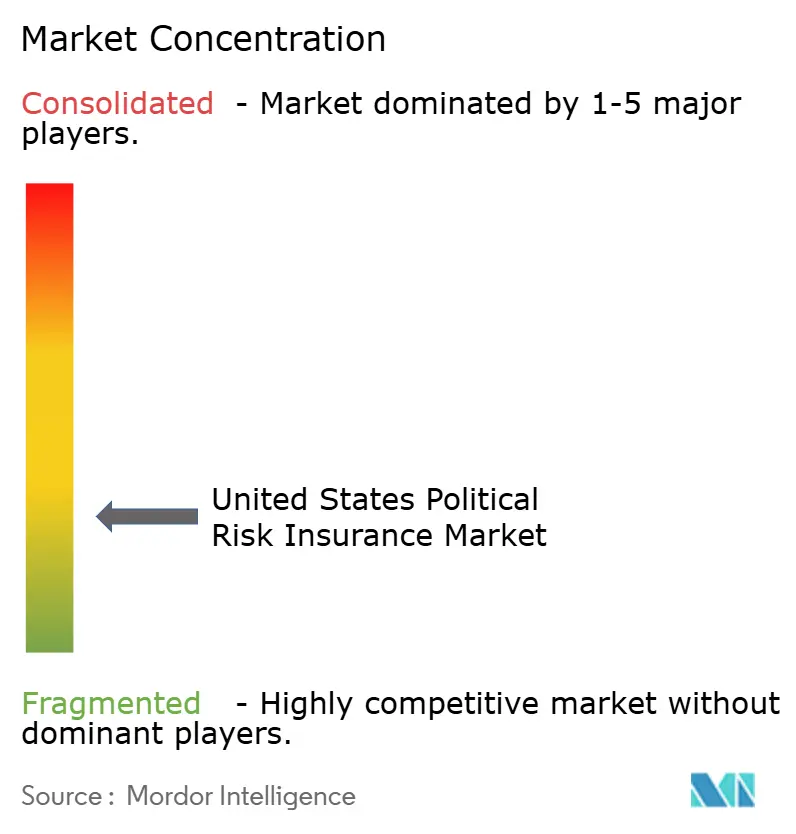
| Market Concentration | Low |
Major Players *Disclaimer: Major Players sorted in no particular order Image © Mordor Intelligence. Reuse requires attribution under CC BY 4.0. | |
United States Political Risk Insurance Market Analysis by Mordor Intelligence
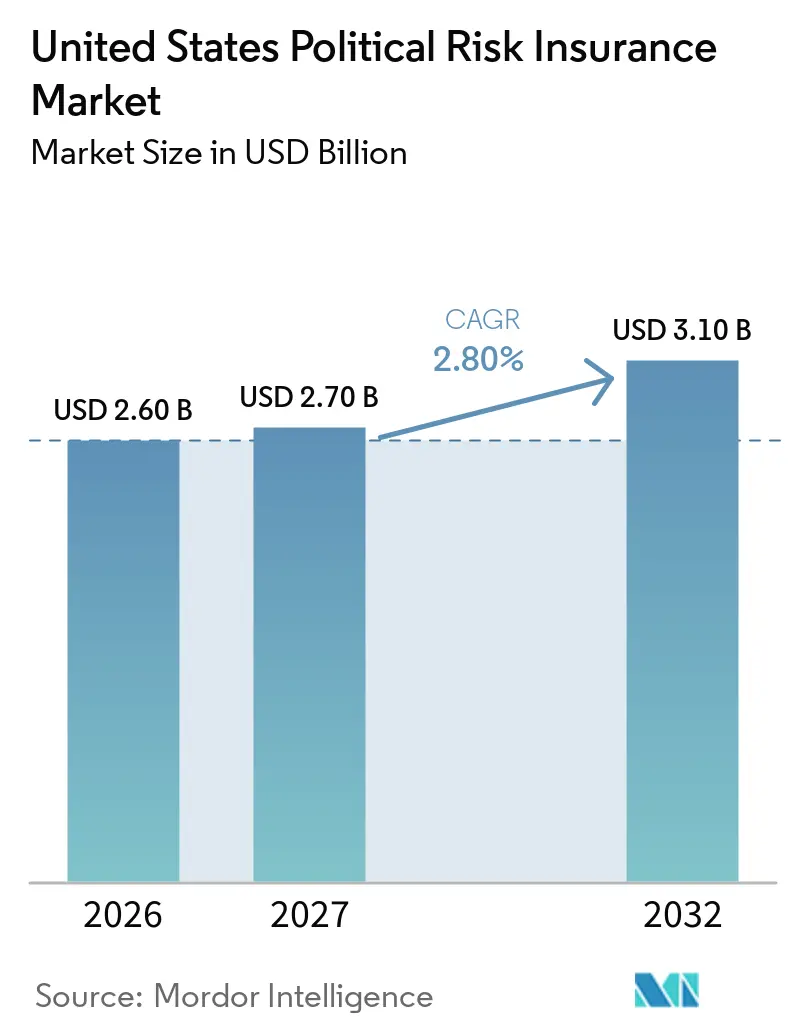
The United States Political Risk Insurance Market size is expected to grow from USD 2.60 billion in 2026 to USD 2.70 billion in 2027 and is forecast to reach USD 3.10 billion by 2032 at 2.80% CAGR over 2027-2032.
The United States political risk insurance market is benefiting from heightened geopolitical tensions, tariff uncertainty, and growing corporate attention to cross-border investment risks. Global equity political risk insurance capacity reached nearly USD 4 billion in 2025, up from USD 3.71 billion in 2024, supported by private insurers and Lloyd’s of London syndicates. Competition among insurers provides buyers with greater choice and more tailored coverage, although pricing varies according to the insured risk and policy structure. Future growth will depend on continued demand for protection against expropriation, political violence, currency transfer restrictions, and government intervention affecting overseas investments. Public-sector guarantees and partnerships between private insurers and multilateral institutions can also support investment in higher-risk markets.
Key Report Takeaways
- By coverage type, political violence captured 34.3% of the United States political risk insurance market share in 2026 and is projected to grow at a 7.4% CAGR through 2032.
- By end user, project developers and sponsors held 29.9% of the United States political risk insurance market share in 2026, while financial institutions are forecast to grow at a 6.8% CAGR through 2032.
- By distribution channel, brokers and intermediaries held 52.8% of the United States political risk insurance market share in 2026, while digital and online platforms are forecast to grow at an 8.5% CAGR through 2032.
- By provider type, export credit agencies accounted for 64.8% of the United States political risk insurance market share in 2026, while multilateral institutions are projected to grow at an 8.1% CAGR through 2032.
- By sector, energy and power held 29.2% of the United States political risk insurance market share in 2026 and are forecast to grow at a 7.8% CAGR through 2032.
- By geography, the South captured 32.1% of the United States political risk insurance market share in 2026, while the West is projected to grow at a 3.8% CAGR through 2032.
Note: Market numbers in this report are based on Mordor Intelligence's proprietary estimation framework, which combines nine months of actuals with Q4 projections for base year 2026.
Market Trends and Insights
Drivers Impact Analysis of United States Political Risk Insurance Market*
| Driver | (~) % Impact on CAGR Forecast | Geographic Relevance | Impact Timeline |
|---|---|---|---|
| Trade Policy Uncertainty, Tariff Volatility, and Government Intervention | +0.9% | Global, concentrated demand in Asia-Pacific, Latin America, and the Middle East and North Africa | Short term (≤ 2 years) |
| Rising Demand for Expropriation and Nationalization Protection | +0.3% | Latin America, Sub-Saharan Africa, and Southeast Asia | Medium term (2-4 years) |
| Cross-Border Investment and Currency Inconvertibility Risk | +0.4% | Emerging markets globally, highest in the Middle East and North Africa and Sub-Saharan Africa | Medium term (2-4 years) |
| Geopolitical Tensions, Sanctions, and Political Violence Exposure | +0.7% | Global, concentrated in the Middle East and North Africa, Eastern Europe, and East Asia | Short term (≤ 2 years) |
| Infrastructure, Energy, and Strategic Investment in Emerging Markets | +0.5% | Global South, Sub-Saharan Africa, Southeast Asia, and Latin America | Long term (≥ 4 years) |
| Demand for Long-Term Investment Protection and Political Risk Mitigation | +0.3% | Global | Long term (≥ 4 years) |
| Source: Mordor Intelligence | |||
Trade Policy Uncertainty, Tariff Volatility, and Government Intervention
Changing trade policies, government intervention, and restrictions on cross-border capital transfers can increase demand for political risk and trade credit insurance among United States companies with overseas investments and supply chain exposure. However, tariffs alone do not typically trigger political risk insurance claims. Coverage depends on the insured risk, policy terms, and whether a government action results in a covered loss, such as expropriation, currency inconvertibility, transfer restrictions, or breach of contract. The United States International Development Finance Corporation (DFC) identifies currency inconvertibility, government interference, and political violence as risks covered under its political risk insurance products. Companies involved in international trade may also require trade credit insurance to protect against nonpayment by overseas buyers.
Geopolitical Tensions, Sanctions, and Political Violence Exposure
Geopolitical conflicts and disruptions to strategic trade routes are increasing the need for political violence, marine war, and other specialized insurance coverage among commercial operations linked to the United States. In March 2026, the United States International Development Finance Corporation (DFC) announced a maritime reinsurance plan that provides approximately USD 20 billion in rolling coverage for eligible vessels operating in the Gulf region. The plan initially focuses on hull and machinery and cargo risks[1]. In April 2026, the DFC and its private-sector partners announced an additional USD 20 billion in reinsurance capacity, increasing the facility’s stated total capacity to approximately USD 40 billion. Separately, the United States House of Representatives passed H.R. 7128, the Terrorism Risk Insurance Program Reauthorization Act of 2026, on June 30, 2026, while the Senate considered its own reauthorization bill, S. 4395. These legislative developments reflect continued attention to the federal terrorism insurance backstop.
Infrastructure, Energy, and Strategic Investment in Emerging Markets
Energy, infrastructure, and strategic investment in emerging markets are important demand drivers for political risk insurance among United States investors, project sponsors, lenders, and development finance institutions. According to UN Trade and Development's World Investment Report 2026, global foreign direct investment rose 6% to USD 1.6 trillion in 2025, although inflows to developing economies increased by only 2% to USD 901 billion, reflecting uneven investment recovery[2]. In May 2026, the International Energy Agency estimated that global energy investment would reach USD 3.4 trillion in 2026, including USD 2.2 trillion for clean energy. In September 2026, the United States International Development Finance Corporation approved a loan and political risk insurance for equity investors in Jordan's National Carrier water infrastructure project, which involves a major desalination plant and water conveyance system. These investments demonstrate the relevance of political risk insurance for projects exposed to government intervention, contractual risks, and political instability, particularly where long-term capital commitments require protection against defined noncommercial risks.
Rising Demand for Expropriation and Nationalization Protection
Expropriation and nationalization protection remains relevant for United States investors and lenders financing overseas projects in sectors such as energy, mining, and infrastructure. Government actions that confiscate assets, transfer ownership, restrict investor rights, or gradually undermine control over an investment can result in losses that appropriately structured political risk insurance may cover. The Multilateral Investment Guarantee Agency (MIGA), a member of the World Bank Group, issued a record USD 9.5 billion in new guarantees across 44 projects in fiscal year 2025[3]. This activity reflects the continued use of guarantees to mobilize private investment and mitigate noncommercial risks. MIGA also reported that 75% of these projects supported at least one of its strategic priority areas. Investors operating in emerging economies may therefore consider political risk protection alongside country risk assessments, contractual safeguards, and financing arrangements. The need for coverage depends on the host government’s conduct, the investment structure, the policy’s defined triggers, and the availability of insurance capacity.
Restraints Impact Analysis of United States Political Risk Insurance Market*
| Restraint | (~) % Impact on CAGR Forecast | Geographic Relevance | Impact Timeline |
|---|---|---|---|
| Restricted Underwriting Capacity for High-Risk Countries and Exposures | -0.6% | Middle East and North Africa, East Asia including China and Taiwan, and parts of West Africa | Short term (≤ 2 years) |
| High Premiums, Deductibles, and Coverage Costs for Smaller Buyers | -0.5% | Global, most acute for middle-market buyers in North America | Medium term (2-4 years) |
| Complex Policy Wordings, Exclusions, and Claims Recovery Processes | -0.2% | Global | Long term (≥ 4 years) |
| Limited Country-Level Information and Uncertainty in Loss Assessment | -0.2% | Frontier markets, Sub-Saharan Africa, and Central Asia | Long term (≥ 4 years) |
| Source: Mordor Intelligence | |||
Restricted Underwriting Capacity for High-Risk Countries and Exposures
Political risk insurance capacity has expanded, but availability varies by country and transaction. Insurers assess geopolitical instability, government intervention, sanctions compliance, country and sector concentration, and risk data before underwriting. China, Taiwan, conflict-affected territories, and parts of West Africa may face tighter terms. WTW's 2025 assessment identified constrained capacity in China and selected West African markets, while its 2026 survey reported strong overall capacity and insurer competition. Private insurers, export credit agencies, and multilateral institutions offer coverage, but terms and eligibility vary. Buyers with complex or concentrated exposures may need lower limits, territorial exclusions, or layered coverage from multiple insurers, which can delay financing or investment decisions.
High Premiums, Deductibles, and Coverage Costs for Smaller Buyers
Political risk insurance costs can limit adoption by companies with overseas investments that cannot absorb additional expenses. Premiums vary by country, insured event, coverage period, transaction structure, and loss risk. The National Association of Insurance Commissioners states that premiums typically cost about 1% of the insured limit annually, although actual pricing varies by risk and policy terms. For example, a policy with a USD 100 million limit may cost about USD 1 million annually, excluding differences in deductibles, exclusions, and other terms. Smaller transactions may incur proportionately higher placement and due-diligence costs due to specialist underwriting, legal review, and broker support. Public export credit agencies and multilateral guarantee providers offer alternatives, but eligibility requirements and country restrictions may limit their suitability. Wider adoption depends on affordable coverage and providers willing to underwrite smaller or complex exposures.
*Our forecasts treat driver/restraint impacts as directional, not additive. The impact forecasts reflect baseline growth, mix effects, and variable interactions.
United States Political Risk Insurance Market Segment Analysis
By Coverage Type:
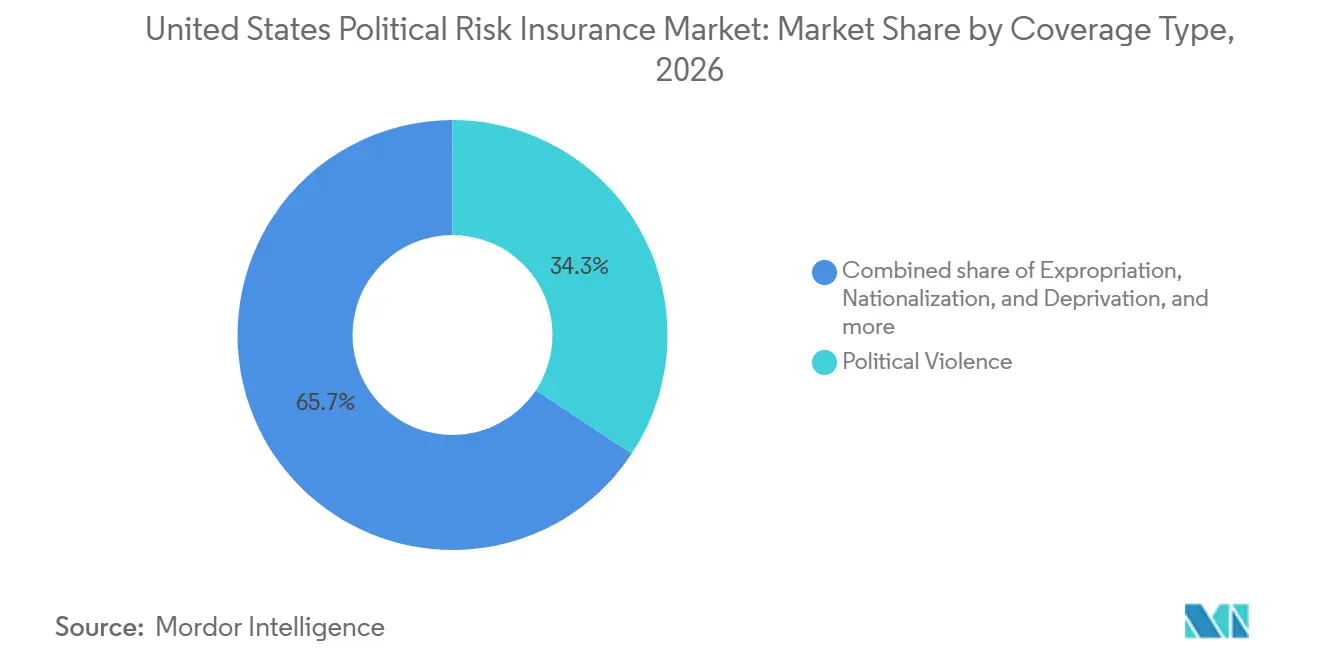
Political Violence Anchors Scale and GrowthPolitical violence accounted for 34.3% of the United States political risk insurance market share in 2026 and is forecast to grow at a 7.4% CAGR from 2027 to 2032. Demand reflects concerns about civil unrest, armed conflict, terrorism, and politically motivated damage to overseas assets. The United States International Development Finance Corporation (DFC) provides political risk insurance covering political violence, expropriation, and currency inconvertibility for eligible overseas investments. Political violence coverage is relevant to investors and lenders seeking protection against specified losses arising from conflict and political disruption.
Expropriation and nationalization coverage protects against specified government actions that deprive investors of ownership, control, or investment rights. Currency inconvertibility cover addresses restrictions on converting or transferring funds, while breach of contract and non-honoring of sovereign obligations cover can protect eligible investments and financing arrangements involving government counterparties. These coverage types are particularly relevant to projects dependent on public-sector contracts, concessions, and long-term payment commitments. The appropriate protection depends on the insured exposure, policy wording, exclusions, and eligibility requirements.
By End User:
Project Developers and Sponsors Lead DemandProject developers and sponsors accounted for 29.9% of the United States political risk insurance market in 2026. Demand is supported by energy, mining, and infrastructure projects in emerging markets, where substantial capital commitments and long development periods create exposure to government intervention, political instability, and contractual risks. Political risk insurance can help sponsors manage specified noncommercial exposures and strengthen risk allocation arrangements required by project lenders. The International Energy Agency's World Energy Investment 2026 report provides context on the scale of global energy investment and infrastructure financing requirements.
Financial institutions are forecast to grow at a 6.8% CAGR through 2032. Banks and other lenders use political risk and related nonpayment protection to manage risks associated with cross-border lending, project finance, and overseas investments. Multinational corporations remain important buyers because of their exposure to foreign subsidiaries, operating assets, and government counterparties. Exporters and importers may use political risk protection or trade credit insurance depending on whether their primary exposure involves overseas investment or buyer nonpayment. Public sector and development institutions also use guarantees and risk-sharing arrangements to support eligible investments in challenging markets.
By Distribution Channel:
Brokers Retain a Central RoleBrokers and intermediaries held 52.8% of the United States political risk insurance market in 2026, making them the leading distribution channel. Political risk placements often require detailed country analysis, negotiation of policy wording, and coordination among multiple insurers. Brokers help buyers compare coverage triggers, exclusions, limits, and conditions while structuring policies around the legal and commercial characteristics of overseas investments. Their advisory role is particularly relevant for complex placements involving political violence, expropriation, and sovereign counterparties.
Digital and online platforms are forecast to grow at a CAGR of 8.5% from 2027 to 2032. Digital tools can streamline submission handling, document exchange, and communication between insurers, brokers, and clients. Direct sales remain relevant for large companies with established relationships with specialist underwriters, while bancassurance and strategic partnerships can help integrate relevant insurance into financing and investment arrangements.
By Provider Type:
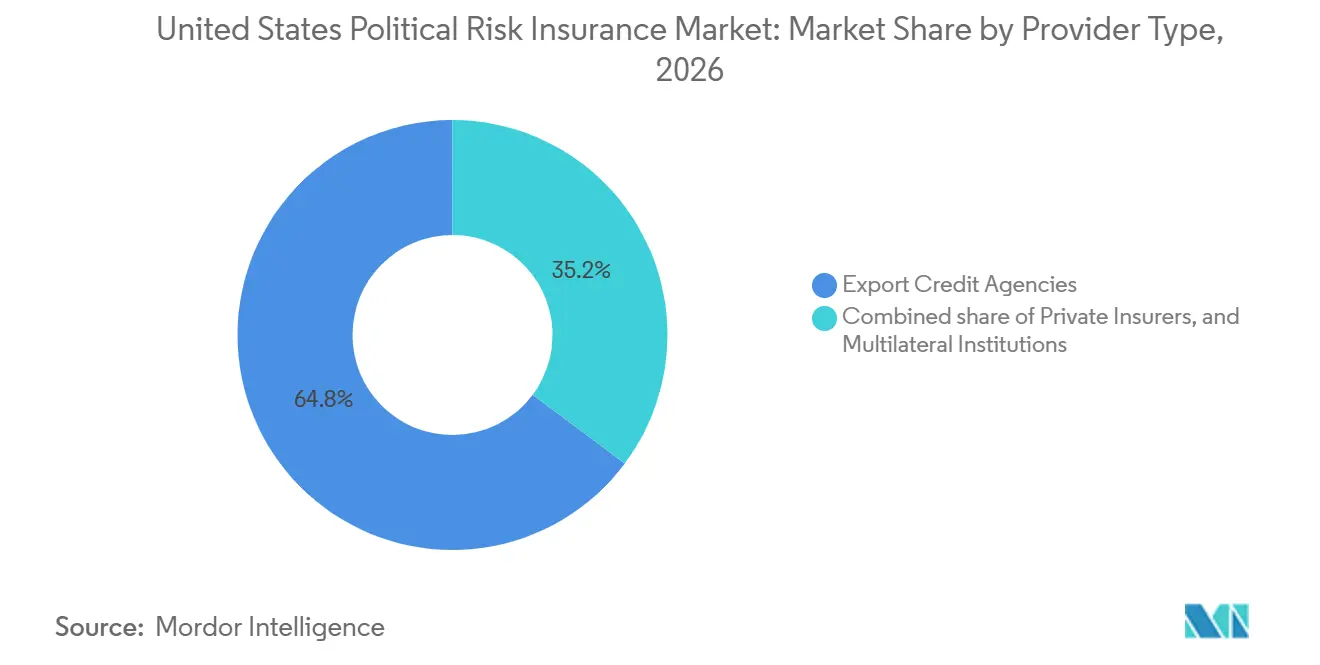
Export Credit Agencies Provide the Largest ShareExport credit agencies accounted for 64.8% of the United States political risk insurance market in 2026. The DFC reports that it has issued more than 3,000 political risk insurance policies in 152 countries, with total coverage exceeding USD 59 billion since 1974. Public-sector providers support eligible United States overseas investments and commercial activities through political risk insurance and related guarantees. Their involvement is particularly relevant to strategic infrastructure, energy, and development projects where private capacity alone may not meet financing requirements.
Multilateral institutions are forecast to grow at a CAGR of 8.1% from 2027 to 2032. Institutions such as the Multilateral Investment Guarantee Agency (MIGA) provide guarantees that help mobilize private investment in markets exposed to political and other noncommercial risks. Private insurers remain essential for customized coverage, specialist underwriting, and placements that do not meet public-sector eligibility requirements. Together, public agencies, multilateral institutions, and private insurers provide different sources of capacity, allowing eligible projects to structure protection according to their risks and financing needs.
By Sector:
Energy and Power Creates Sustained DemandEnergy and power accounted for 29.2% of the United States political risk insurance market in 2026 and is forecast to grow at a CAGR of 7.8% from 2027 to 2032. Power generation, renewable energy, and energy infrastructure projects require substantial capital and often depend on long-term permits, concessions, and payment arrangements. Political risk insurance can help investors and lenders manage specified exposures to government intervention, currency transfer restrictions, and political violence. The International Energy Agency's World Energy Investment 2026 report highlights the continuing scale of global energy investment and the capital requirements associated with energy infrastructure.
Infrastructure and transportation generate demand because ports, roads, logistics facilities, and other assets can depend on government approvals and long-term contractual arrangements. Mining, oil and gas, and natural resources projects may face expropriation, resource nationalism, and changes in government policy. Manufacturing and industrial companies may require protection for overseas facilities and investments, while financial services and banking institutions may seek cover for eligible cross-border lending and investments. Sector-specific underwriting therefore depends on the location, counterparty, investment structure, and political risks covered by the policy.
Geography Analysis
The South accounted for 32.1% of the United States political risk insurance market in 2026. The region includes headquarters and operations for energy, petrochemical, logistics, financial services, and industrial companies with significant overseas activity. The Southern Economic Development Council reported that 41% of United States foreign direct investment originates from Southern states. Companies in Texas, Georgia, Florida, and Louisiana have exposure to Latin America, the Middle East and North Africa, and Asia-Pacific. These overseas activities can support demand for coverage against government intervention, payment disruption, and political violence.
The West is forecast to grow at a CAGR of 3.8% from 2027 to 2032. Technology, aerospace, defense, and investment firms headquartered in California, Washington, and Colorado have international business and investment interests exposed to geopolitical developments. The United States Outbound Investment Security Program took effect on January 2, 2025, and prohibits or requires notification for certain investments involving specified sensitive technologies and countries of concern. The region's technology and investment base may also be affected by changes in China- and Taiwan-related geopolitical risks and insurer underwriting appetite.
The Northeast remains a major center for transaction origination, insurance placement, and financial services activity. New York-based banks and financial institutions may use political risk cover in cross-border lending and investment structures. The Midwest contributes demand through manufacturing companies with overseas supply chains and investments in Mexico and Southeast Asia. All regions face different exposure profiles, but the United States political risk insurance market is shaped by the international footprint of its corporate and financial institutions. Regional growth will depend on investment flows, trade conditions, geopolitical developments, and the availability of insurer capacity for higher-risk territories.
Competitive Landscape
The United States political risk insurance market is fragmented, with capacity distributed across specialist private insurers, Lloyd’s syndicates, government-backed export credit agencies, and multilateral institutions. Participants include AIG, Chubb, Arch Insurance International, Hiscox, Beazley, Markel, Aviva, AEGIS London, the United States International Development Finance Corporation, and the Export-Import Bank of the United States. AIG identifies political risk insurance as part of its specialty offering, covering exposures such as expropriation, currency inconvertibility, political violence, and sovereign non-payment. Chubb also participates in political risk insurance through its specialist underwriting operations. Competition is shaped by underwriting expertise, geographic reach, policy flexibility, claims capabilities, and broker relationships. Public and multilateral institutions complement private insurers by supporting eligible investments and transactions that may require specialized risk-sharing arrangements.
Competition is also supported by product expansion and additional underwriting capacity. In February 2025, AEGIS London launched a political violence consortium at Lloyd’s offering limits of up to USD 100 million per risk, increasing its available capacity from USD 60 million. In the same month, Aviva introduced political violence and terrorism as a new class of business at Lloyd’s through Probitas, broadening its specialty insurance offering.
Underwriting specialization, disciplined capacity management, distribution relationships, and policy customization remain important competitive factors. Digital workflows can improve submission handling and compliance checks, while specialist brokers help clients compare coverage terms, exclusions, and limits across providers. Government-backed and multilateral institutions offer additional channels for eligible investments, creating a market in which private and public providers serve different but sometimes overlapping needs.
United States Political Risk Insurance Industry Leaders
-
AIG
-
Chubb
-
Zurich Insurance Group
-
Lloyd’s of London
-
AXA XL
- *Disclaimer: Major Players sorted in no particular order
United States Political Risk Insurance Market Companies Covered in this Report
- American International Group, Inc. (AIG)
- Zurich Insurance Group
- Lloyd’s of London
- Chubb Limited
- Allianz Trade
- AXA XL
- Liberty Specialty Markets
- Sompo International
- Atradius
- Coface
- Markel International
- Beazley plc
- Starr Insurance Companies
- Tokio Marine HCC
- Sovereign Risk Insurance
- Export-Import Bank of the United States (EXIM)
- U.S. International Development Finance Corporation (DFC)
- Multilateral Investment Guarantee Agency (MIGA)
- Credendo
- Berkshire Hathaway Specialty Insurance
Recent Industry Developments in United States Political Risk Insurance Market
- September 2026: The United States Senate passed the Terrorism Risk Insurance Program Reauthorization Act of 2026 (S. 4395), proposing to extend the federal terrorism insurance backstop through December 31, 2034. The extension aims to provide longer-term certainty for insurers and businesses purchasing terrorism coverage.
- June 2026: The United States International Development Finance Corporation (DFC) and the Multilateral Investment Guarantee Agency (MIGA) signed a cooperation agreement to establish a political risk insurance framework for the United States-Ukraine Reconstruction Investment Fund. The initiative aims to mobilize private investment in Ukraine's reconstruction by improving access to political risk protection for eligible investments in critical infrastructure and other priority sectors.
- March 2026: The DFC announced a maritime reinsurance initiative providing up to USD 20 billion in rolling coverage for eligible vessels operating in the Gulf region. The facility is intended to support maritime commerce by expanding access to war-risk insurance for eligible vessels and cargo amid heightened regional security risks.
- February 2025: Aviva introduced Political Violence and Terrorism as a new class of business at Lloyd's through Probitas, with underwriting available from February 1, 2025. The launch expanded Aviva's specialty insurance offering and provided additional options for businesses seeking protection against terrorism and political violence exposures.
United States Political Risk Insurance Market Report Scope
Segmentation Overview
| Expropriation, Nationalization, and Deprivation |
| Currency Inconvertibility and Non-Transfer Restrictions |
| Political Violence |
| Breach of Contract and Non-Honoring of Sovereign Obligations |
| Multinational Corporations |
| Financial Institutions |
| Exporters and Importers |
| Project Developers and Sponsors |
| Public Sector and Development Institutions |
| Direct Sales |
| Brokers and Intermediaries |
| Bancassurance and Strategic Partnerships |
| Digital and Online Platforms |
| Private Insurers |
| Export Credit Agencies |
| Multilateral Institutions |
| Energy and Power |
| Infrastructure and Transportation |
| Mining, Oil & Gas, and Natural Resources |
| Manufacturing and Industrials |
| Financial Services and Banking |
| Other (e.g., Agribusiness, Healthcare, Technology, etc.) |
| Northeast |
| Midwest |
| South |
| West |
| By Coverage Type | Expropriation, Nationalization, and Deprivation |
| Currency Inconvertibility and Non-Transfer Restrictions | |
| Political Violence | |
| Breach of Contract and Non-Honoring of Sovereign Obligations | |
| By End User | Multinational Corporations |
| Financial Institutions | |
| Exporters and Importers | |
| Project Developers and Sponsors | |
| Public Sector and Development Institutions | |
| By Distribution Channel | Direct Sales |
| Brokers and Intermediaries | |
| Bancassurance and Strategic Partnerships | |
| Digital and Online Platforms | |
| By Provider Type | Private Insurers |
| Export Credit Agencies | |
| Multilateral Institutions | |
| By Sector | Energy and Power |
| Infrastructure and Transportation | |
| Mining, Oil & Gas, and Natural Resources | |
| Manufacturing and Industrials | |
| Financial Services and Banking | |
| Other (e.g., Agribusiness, Healthcare, Technology, etc.) | |
| By Region | Northeast |
| Midwest | |
| South | |
| West |
Key Questions Answered in the Report
What is the projected growth rate for political risk insurance in the United States?
The United States political risk insurance market is projected to grow at a 2.8% CAGR from 2027 to 2032 and reach USD 3.1 billion by 2032.
Which coverage type leads political risk insurance in the United States?
Political Violence leads with a 34.3% share in 2026 and is also the fastest-growing coverage type at a 7.4% CAGR through 2032.
Why do project developers buy political risk insurance?
Project developers use it because lenders may require protection against government action, political violence, payment disruption, and currency restrictions before financing overseas projects.
Which provider type has the largest position in the United States?
Export Credit Agencies hold the largest position with 64.8% share in 2026, supported by the United States International Development Finance Corporation and the Export-Import Bank of the United States.
Which business sector has the strongest demand for political risk protection?
Energy and Power holds 29.2% share in 2026 and is projected to grow at a 7.8% CAGR through 2032 because projects have high capital needs and long exposure to public counterparties.
Which United States region is growing fastest for political risk insurance?
The West is projected to grow at a 3.8% CAGR through 2032, supported by technology, aerospace, defense, and international investment activity.