
United States Natural Insect Repellent Market Size and Share
Market Overview
| Study Period | 2021 - 2031 |
|---|---|
| Forecast Data Period | 2026 - 2031 |
| Base Year Market Size (2025) | USD 315.43 Billion |
| Market Size (2026) | USD 336.42 Billion |
| Market Size (2031) | USD 483.64 Billion |
| Growth Rate (2026 - 2031) | 7.53 % |
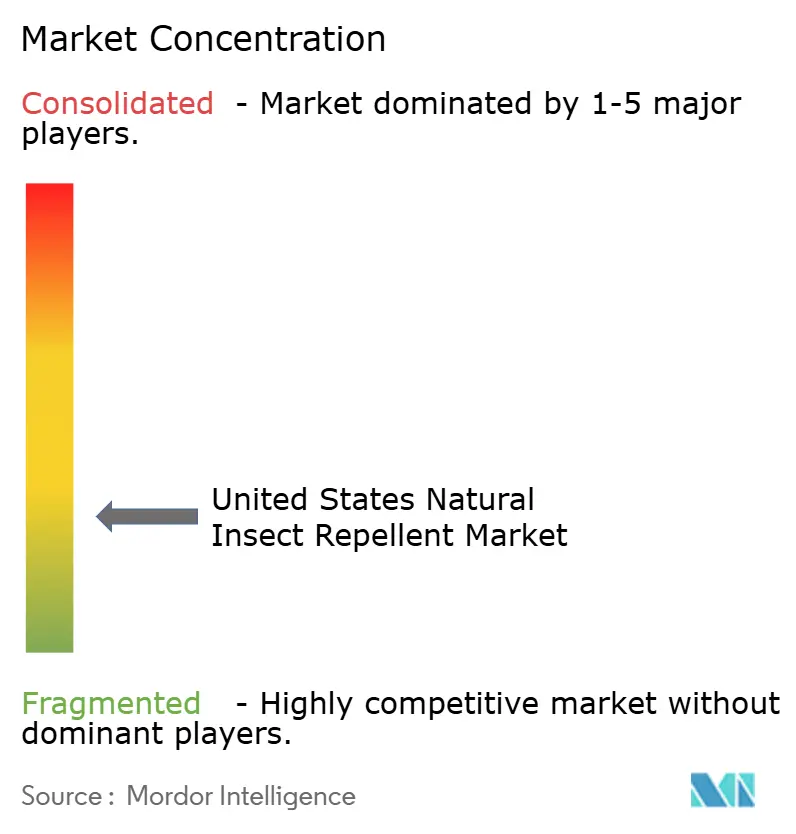
| Market Concentration | Low |
Major Players *Disclaimer: Major Players sorted in no particular order Image © Mordor Intelligence. Reuse requires attribution under CC BY 4.0. | |
United States Natural Insect Repellent Market Analysis by Mordor Intelligence
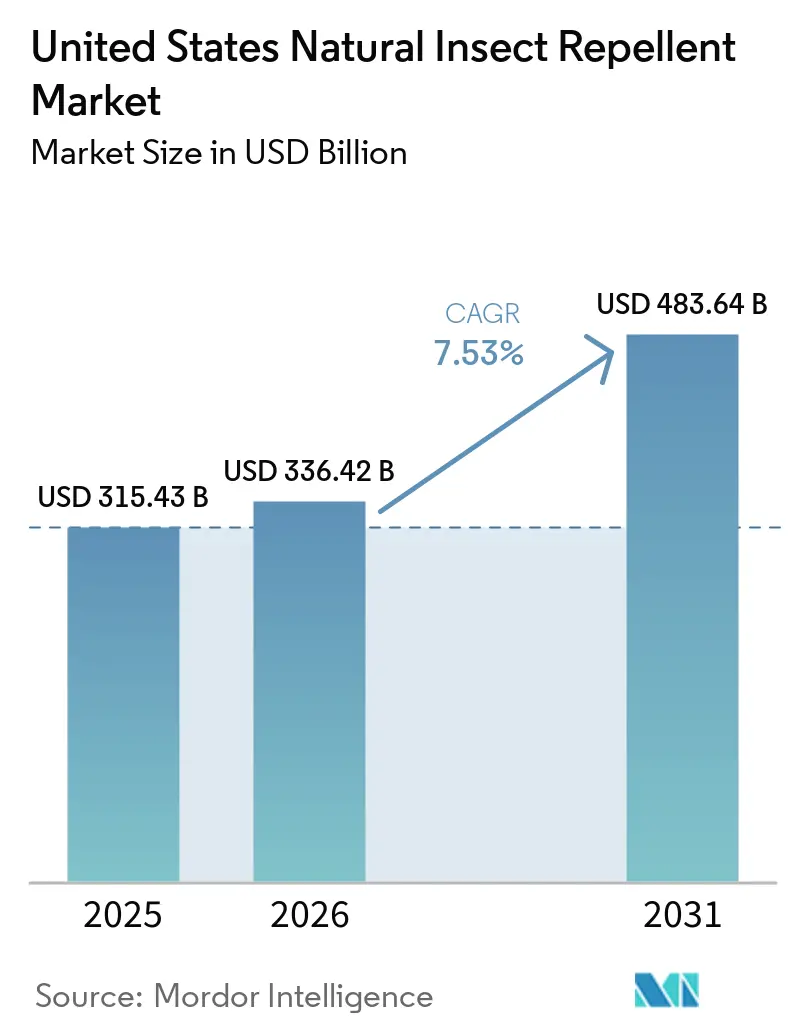
The United States natural insect repellent market size is expected to increase from USD 315.43 million in 2025 to USD 336.42 million in 2026 and reach USD 483.64 million by 2031, registering a CAGR of 7.53% during the forecast period (2026–2031). Increasing consumer preference for plant-based and chemical-free insect protection solutions drives the market, supported by rising awareness of mosquito-, tick-, and other insect-borne diseases. Growing participation in outdoor recreational activities, such as hiking, camping, fishing, and gardening, has increased the demand for effective personal insect protection. Meanwhile, government and public health awareness campaigns continue to promote preventive measures against insect bites.
Key Report Takeaways
- By product type, sprays held 42.37% of the United States natural insect repellent market size in 2025, while wipes are projected to grow at an 8.49% CAGR through 2031.
- By insect type, mosquito-targeted products held 53.32% share in 2025, while bugs are forecast to expand at an 8.56% CAGR through 2031.
- By end-user, adults held 68.91% of the United States natural insect repellent market share in 2025, while kids and children are projected to record the fastest growth at an 8.78% CAGR through 2031.
- By distribution channel, supermarkets and hypermarkets accounted for 32.67% share in 2025, while online retail stores are expected to advance at a 9.11% CAGR through 2031.
Note: Market size and forecast figures in this report are generated using Mordor Intelligence’s proprietary estimation framework, updated with the latest available data and insights as of January 2026.
United States Natural Insect Repellent Market Trends and Insights
Drivers Impact Analysis*
| Driver | (~) % Impact on CAGR Forecast | Geographic Relevance | Impact Timeline |
|---|---|---|---|
| Rising incidence of mosquito- and tick-borne diseases | +2.1% | Southeast United States (Florida, Texas), Northeast (Lyme belt), Nationwide | Short term (≤ 2 years) |
| Expansion of outdoor recreational and adventure activities | +1.8% | Pacific West, Mountain West, Southeast, Nationwide | Medium term (2–4 years) |
| Rapid technological advancements driving innovation | +1.4% | National, early gains in California and Northeast innovation hubs | Long term (≥ 4 years) |
| Government and public health campaigns | +0.9% | National, concentrated in Florida, Texas, and endemic coastal states | Short term (≤ 2 years) |
| Preference for plant-based and chemical-free insect repellents | +1.6% | National, concentrated in Pacific West, Northeast, and Mountain West | Medium term (2–4 years) |
| Demand for convenient multi-format repellent products | +0.8% | National | Medium term (2–4 years) |
| Source: Mordor Intelligence | |||
Rising incidence of mosquito- and tick-borne diseases
The rising incidence of mosquito- and tick-borne diseases is a major factor driving the United States natural insect repellent market, as consumers increasingly prioritize preventive personal protection against insect bites. According to the United States Environmental Protection Agency (EPA), the agency has registered more than 300 products for use against bed bugs, highlighting the growing emphasis on effective insect control and expanding regulatory support for pest management solutions [1]. At the same time, rising public awareness of mosquito- and tick-borne diseases has encouraged consumers to include insect repellents in their daily outdoor protection routines. This trend has accelerated demand for natural formulations containing plant-derived active ingredients that provide effective protection while avoiding synthetic chemicals.
Expansion of outdoor recreational and adventure activities
The expansion of outdoor recreational and adventure activities is significantly driving the United States natural insect repellent market, as increased participation in nature-based experiences raises exposure to mosquitoes, ticks, flies, and other biting insects. According to the Outdoor Industry Association, outdoor recreation in the United States is projected to reach a record 183.2 million participants in 2025, reflecting the growing popularity of activities such as hiking, camping, fishing, trail running, cycling, hunting, and wildlife exploration [2]. As consumers spend longer periods in forests, parks, lakes, and campgrounds, they increasingly need dependable insect protection that remains comfortable during extended use. This trend has encouraged manufacturers to develop lightweight, fast-drying, sweat-resistant, and portable natural repellent formulations suited to active outdoor lifestyles.
Rapid technological advancements driving innovation
Rapid technological advancements in formulation science and botanical ingredient research are driving growth in the United States Natural Insect Repellent Market by improving the performance, stability, and reliability of plant-based repellents. Manufacturers are investing in advanced extraction techniques, optimized combinations of botanical active ingredients, and enhanced delivery systems to extend protection duration while maintaining skin compatibility. For instance, Murphy's Naturals offers its Mosquito & Tick Repellent Spray, an Environmental Protection Agency (EPA)-registered botanical repellent that protects against mosquitoes and ticks using naturally derived active ingredients. These innovations demonstrate how scientific validation and regulatory compliance are increasing consumer confidence in natural alternatives.
Government and public health campaigns
Government and public health campaigns significantly drive the United States natural insect repellent market by increasing awareness of insect-borne diseases and promoting preventive measures against mosquito and tick bites. Organizations such as the Centers for Disease Control and Prevention (CDC) regularly educate the public through nationwide initiatives, seasonal advisories, and awareness campaigns that encourage the use of insect repellents, protective clothing, and other personal protection measures to reduce the risk of vector-borne diseases. State and local health departments further reinforce these efforts by issuing alerts during periods of heightened mosquito and tick activity and providing guidance on effective insect bite prevention. These continuous educational initiatives have strengthened consumer awareness of the importance of routine insect protection and encouraged greater adoption of natural repellents among individuals seeking safer, plant-based alternatives.
Restraints Impact Analysis*
| Restraint | (~) % Impact on CAGR Forecast | Geographic Relevance | Impact Timeline |
|---|---|---|---|
| Seasonal fluctuations in consumer demand | -0.7% | National, more pronounced in Midwest and Northern states | Short term (≤ 2 years) |
| Shorter shelf life of plant-based formulations | -0.5% | National | Medium term (2–4 years) |
| Risk of skin irritation and allergic reactions | -0.4% | National | Short term (≤ 2 years) |
| Stringent regulatory requirements for efficacy | -0.6% | National, with compliance influence from California state standards | Long term (≥ 4 years) |
| Source: Mordor Intelligence | |||
Seasonal fluctuations in consumer demand
Seasonal fluctuations in consumer demand significantly restrain the United States natural insect repellent market. Sales concentrate heavily in the warmer spring and summer months, when mosquito, tick, and other insect activity peaks. Demand typically declines during colder seasons as outdoor activities decrease and insect populations become less active, resulting in uneven sales patterns throughout the year. This seasonality creates challenges for manufacturers and retailers in production planning, inventory management, and distribution, often leading to excess stock during off-peak periods and increasing pressure to optimize supply chains. Companies also tend to concentrate marketing efforts and promotional campaigns around peak insect seasons, which limits consistent year-round product movement.
Shorter shelf life of plant-based formulations
The shorter shelf life of plant-based formulations is a key restraint for the market. Natural active ingredients, such as essential oils, are more susceptible to oxidation, evaporation, and degradation than synthetic chemical compounds. Exposure to heat, light, air, and moisture can gradually reduce the stability and effectiveness of botanical ingredients, making it more difficult for manufacturers to maintain consistent product performance throughout the intended shelf life. Manufacturers must use specialized packaging, stabilizing technologies, and controlled storage conditions, which increases formulation complexity and manufacturing costs. Retailers may also face inventory management challenges due to shorter product longevity, while consumers may be concerned about reduced efficacy if products are stored for extended periods after purchase.
*Our forecasts treat driver/restraint impacts as directional, not additive. The impact forecasts reflect baseline growth, mix effects, and variable interactions.
Segment Analysis
By Product Type: Spray Dominance Intact, Single-Use Formats Redefine On-the-Go Protection
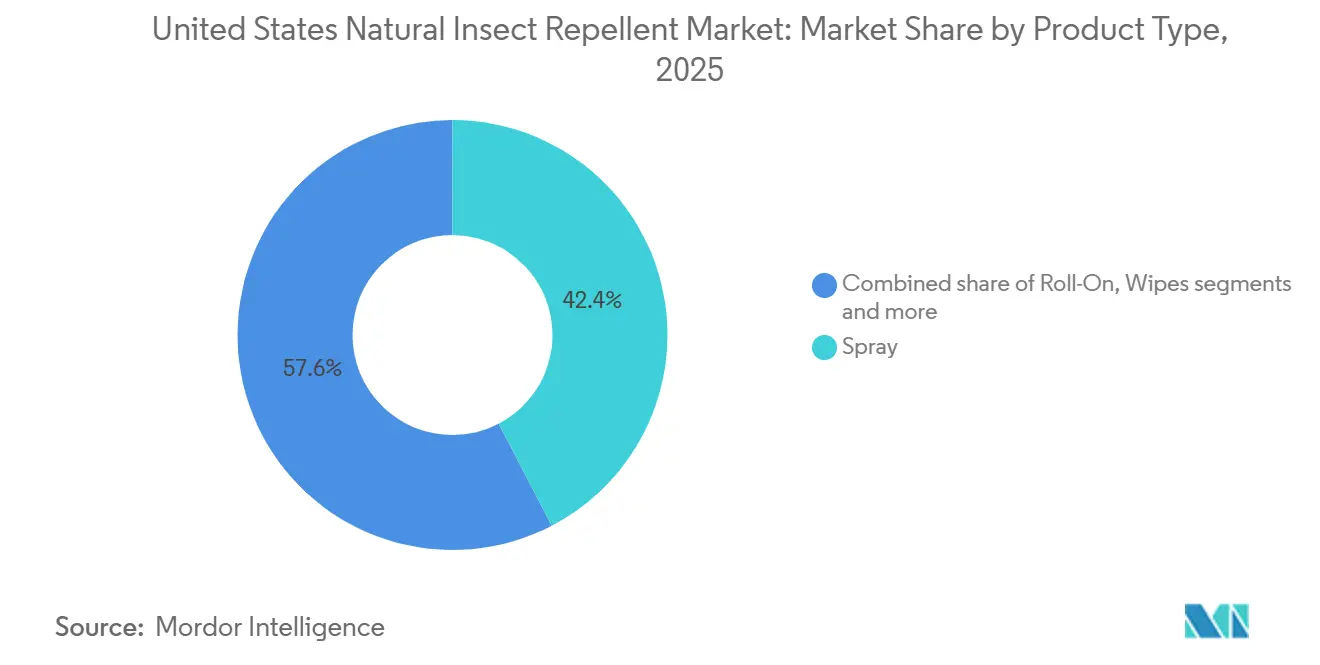
Spray formats are expected to hold 42.37% of the United States natural insect repellent market in 2025. The segment’s leadership stems from its ability to provide rapid, uniform, and convenient coverage over exposed skin while delivering a lightweight and comfortable user experience. Continuous advancements in spray formulations have produced fast-drying, non-greasy, and residue-free botanical products that improve consumer satisfaction during repeated use. Manufacturers are further enhancing product performance with fine-mist dispensing systems, precision spray nozzles, leak-resistant packaging, and aerosol-free pump technologies that enable efficient application with minimal product wastage. The availability of portable travel-size packs and larger family-size variants has improved convenience and encouraged broader usage across different occasions.
Wipes represent the fastest-growing product format and are projected to expand at a CAGR of 8.49% through 2031. The segment is gaining momentum because it offers a precise dosage with each application, reduces overuse, and ensures consistent coverage without requiring consumers to dispense liquids manually. Individually sealed packaging preserves the stability of botanical active ingredients while preventing evaporation and contamination before use. The compact, disposable format also simplifies storage and disposal, making wipes particularly suitable for travel kits, schools, outdoor events, and emergency preparedness packs. Manufacturers are increasingly adopting biodegradable nonwoven fabrics and moisture-retention technologies to keep formulations effective throughout the product’s shelf life.

By Insect Type: Mosquito Volumes Anchored in Disease Awareness, Tick-and-Bug Segment Accelerates
Mosquito-targeted products accounted for 53.32% of the United States natural insect repellent market in 2025. The segment leads the market because mosquitoes remain the most widespread biting insects across the country. The Centers for Disease Control and Prevention (CDC) reports that more than 200 mosquito species inhabit the United States and its territories [3]. This broad species diversity has encouraged manufacturers to formulate mosquito-specific repellents using scientifically validated botanical ingredients, such as oil of lemon eucalyptus and citronella. Product development increasingly focuses on improving mosquito-specific efficacy through optimized active ingredient concentrations, longer-lasting protection, and enhanced formulation stability while maintaining a natural ingredient profile.
The bugs segment is projected to be the fastest-growing insect type, registering a CAGR of 8.56% through 2031. Increasing demand for broad-spectrum natural repellents capable of protecting against a wide variety of nuisance insects beyond mosquitoes, including gnats, beetles, mites, and other crawling or flying bugs commonly encountered during outdoor and household activities, drives the segment’s growth. Consumers increasingly favor versatile formulations that eliminate the need to purchase separate products for different insect types. This preference encourages manufacturers to develop multi-action botanical blends with enhanced repellency against diverse species. Advancements in plant-derived active ingredient combinations and formulation technologies are improving the effectiveness of these broad-spectrum products while maintaining a natural ingredient profile.
By End-User: Adult Revenue Share Holds, Child-Safe Formulations Define the Growth Frontier
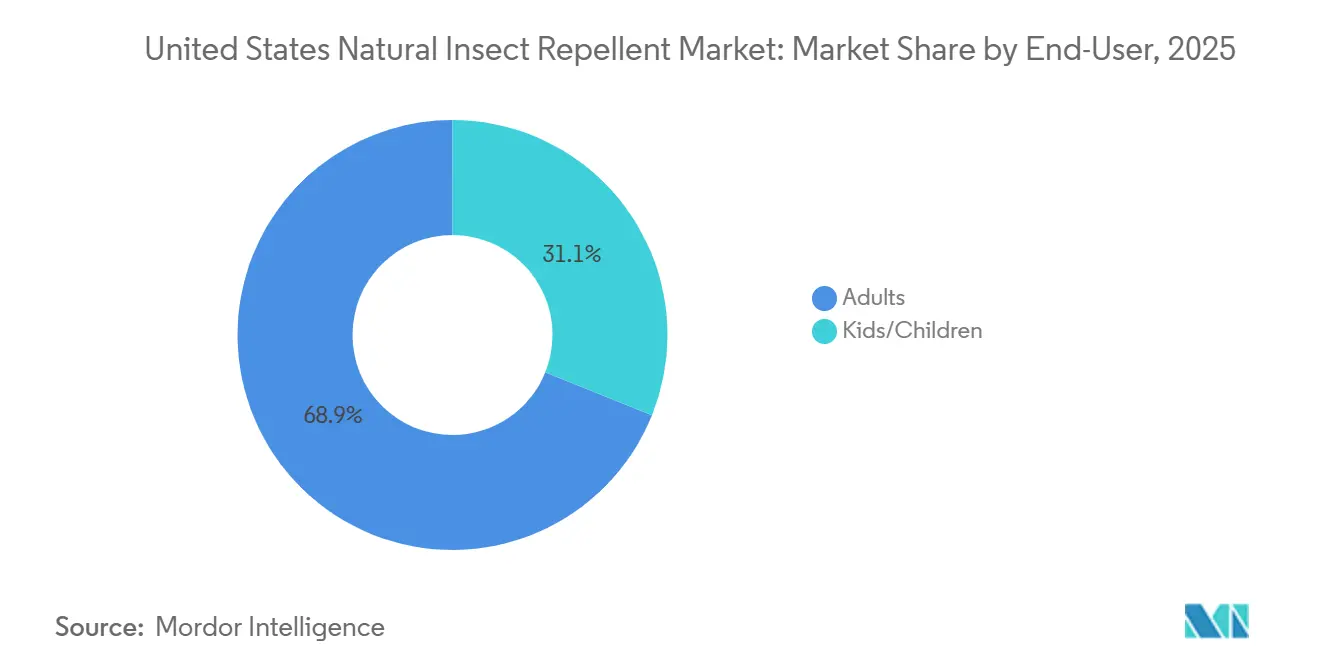
Adults are expected to hold 68.91% of the United States natural insect repellent market in 2025. The segment dominates the market due to frequent participation in outdoor activities, such as hiking, camping, gardening, fishing, and recreational sports, where prolonged insect exposure increases the need for personal protection. Adult consumers also prefer natural repellents that offer effective insect protection, skin-friendly formulations, pleasant botanical fragrances, and lightweight textures suitable for repeated daily use. Manufacturers continue to introduce advanced products with long-lasting botanical actives, quick-absorbing formulations, and sweat- and water-resistant properties to meet the performance expectations of active users. Additionally, diverse product formats and premium natural formulations tailored to adult lifestyles have reinforced the segment's leadership.
The kids/children segment is projected to be the fastest-growing end-user category, expanding at a CAGR of 8.78% through 2031. Increasing product development focused on gentle, pediatric-friendly formulations made with carefully selected botanical ingredients and free from harsh chemicals drives this growth. Manufacturers are introducing hypoallergenic, dermatologist-tested, and fragrance-balanced products designed specifically for children's delicate skin while ensuring ease of application and improved safety. Child-friendly packaging, convenient application formats, and mild formulations have strengthened parental confidence and encouraged greater adoption. Continuous innovation in naturally derived ingredients and skin-compatible formulations designed specifically for younger users is accelerating the segment's growth.
By Distribution Channel: Mass Retail Holds Volume, Online Retail Commands Premium Growth
Supermarkets and hypermarkets are expected to account for 32.67% of the United States natural insect repellent market in 2025. The segment maintains its leadership by offering consumers the convenience of comparing multiple brands, formulations, and product formats in a single shopping trip. Dedicated personal care, outdoor living, and seasonal health sections increase product visibility and encourage impulse purchases during peak insect seasons. Retailers frequently support sales through in-store promotions, bundled offers, end-cap displays, and educational shelf labeling that helps consumers understand the benefits of natural botanical repellents. Immediate product availability, the ability to inspect packaging and ingredients before purchase, and a strong retail shelf presence continue to make supermarkets and hypermarkets the preferred purchasing channel for natural insect repellents.
Online retail stores are projected to be the fastest-growing distribution channel, registering a CAGR of 9.11% through 2031. The segment is growing rapidly due to the extensive product assortment available on digital platforms, which enables consumers to compare ingredients, formulations, certifications, prices, and customer reviews before making purchase decisions. Digital storefronts also allow niche and emerging natural brands to reach a broader customer base without relying on extensive physical retail networks. Subscription purchase options, doorstep delivery, personalized product recommendations, and easy access to detailed product information further improve the online shopping experience. In addition, the increasing use of digital marketing, influencer content, and consumer reviews has strengthened consumer confidence in purchasing natural insect repellents through e-commerce platforms, accelerating channel growth.
Geography Analysis
The Southeast and South Atlantic regions represent the highest-demand geography for the United States natural insect repellent market. Warm temperatures, high humidity, abundant wetlands, and extended mosquito and tick activity throughout much of the year support demand in these regions. States such as Florida, Georgia, North Carolina, South Carolina, Alabama, Mississippi, Louisiana, Tennessee, and Virginia experience prolonged insect seasons, which increase the need for routine personal protection. Frequent outdoor recreation, gardening, camping, and water-based activities further support consistent demand for natural insect repellents. The widespread presence of mosquitoes, ticks, and other biting insects has encouraged consumers across these states to adopt botanical-based repellent products as part of their daily outdoor essentials.
The Northeast and Midwest regions also contribute significantly to market growth, driven by seasonal increases in mosquito and tick populations and rising awareness of tick-borne diseases. States including New York, Pennsylvania, New Jersey, Massachusetts, Connecticut, Ohio, Michigan, Wisconsin, Minnesota, and Illinois have witnessed growing consumer preference for plant-based repellents that provide effective protection while avoiding harsh synthetic chemicals. Hiking, camping, hunting, and park-based recreational activities remain popular across these regions, creating sustained demand for natural repellent products during spring, summer, and early autumn. Product innovation focused on skin-friendly formulations and convenient application formats continues to strengthen consumer adoption.
The Western United States, including California, Washington, Oregon, Colorado, Arizona, Utah, Nevada, and Idaho, is emerging as an important market, supported by expanding outdoor lifestyles and an increasing preference for environmentally responsible personal care products. Consumers in these states show strong interest in botanical formulations made with naturally derived ingredients, reflecting broader sustainability and clean-label purchasing trends. Growing participation in national park tourism, trail running, and camping, along with the expansion of premium natural personal care retail channels and e-commerce availability, supports market penetration. Continuous innovation in eco-friendly formulations and sustainable packaging further enhances the adoption of natural insect repellents across the western region.
Competitive Landscape
The United States natural insect repellent market is fragmented, with established household insect control manufacturers competing alongside specialized natural and botanical personal care brands. Market participants compete by expanding their portfolios with plant-based formulations, scientifically validated botanical active ingredients, and products that comply with regulatory standards while addressing evolving consumer preferences for naturally derived insect protection. Companies use innovation in formulation performance, longer-lasting efficacy, skin-friendly ingredients, and sustainable packaging as key competitive differentiators to strengthen their market presence. Major players in the market include Spectrum Brands Holdings Inc., S. C. Johnson & Son Inc., Reckitt Benckiser Group plc, Murphy's Naturals, and The Procter & Gamble Company.
Manufacturers increasingly focus on research and development to improve the efficacy, stability, and user experience of botanical insect repellents through advanced formulation technologies and naturally derived active ingredients. Companies achieve product differentiation through innovations such as water-resistant formulations, fast-drying textures, residue-free application, dermatologist-tested products, biodegradable packaging, and multifunctional repellent formats. They also expand their product portfolios with sprays, wipes, lotions, roll-ons, and family-oriented solutions to address diverse consumer preferences and enhance brand competitiveness in the natural insect repellent category.
Extensive retail distribution, direct-to-consumer e-commerce platforms, digital marketing initiatives, and strategic collaborations with retailers and outdoor lifestyle channels further support competitive strategies by improving product accessibility and brand visibility. Companies increasingly leverage sustainability commitments, clean-label positioning, third-party certifications, and transparent ingredient sourcing to strengthen consumer trust and brand loyalty. Continuous investment in product innovation, premium botanical ingredients, regulatory compliance, and omnichannel distribution is expected to intensify competition and drive further market development over the forecast period.
United States Natural Insect Repellent Industry Leaders
-
Spectrum Brands Holdings, Inc.
-
S. C. Johnson & Son, Inc.
-
Reckitt Benckiser Group plc
-
Murphy’s Naturals
-
The Procter & Gamble Company
- *Disclaimer: Major Players sorted in no particular order
Recent Industry Developments
- May 2026: SC Johnson, the United States Department of State, and the Global Fund to Fight AIDS, Tuberculosis and Malaria signed a new partnership to expand access to a spatial repellent aimed at preventing malaria.
- April 2026: NATPAT expanded its product line with the launch of Baby Buzz Spray, its first spray-format repellent. The product is formulated with all-natural ingredients and is free from DEET and synthetic chemicals.
United States Natural Insect Repellent Market Report Scope
A natural insect repellent is a product formulated with plant-based, naturally occurring active ingredients designed to deter insects without relying on synthetic chemicals. The United States natural insect repellent market is segmented by product type, insect type, end-user, and distribution channel. Based on product type, the market is segmented into spray, lotion and cream, roll-on, wipes, and others. Based on insect type, the market is segmented into mosquitos, bugs, fly insects, ants, and others. Based on end-user, the market is segmented into adults and kids/children. Based on distribution channel, the market is segmented into supermarkets/hypermarkets, convenience stores, online retail stores, and other distribution channels. For each segment, the market sizing and forecast have been done based on the value (in USD million).
| Spray |
| Lotion and Cream |
| Roll-On |
| Wipes |
| Others |
| Mosquitos |
| Bugs |
| Fly Insects |
| Ants |
| Others |
| Adults |
| Kids/Children |
| Supermarkets/Hypermarkets |
| Convenience Stores |
| Online Retail Stores |
| Other Distribution Channels |
| By Product Type | Spray |
| Lotion and Cream | |
| Roll-On | |
| Wipes | |
| Others | |
| By Insect Type | Mosquitos |
| Bugs | |
| Fly Insects | |
| Ants | |
| Others | |
| By End-User | Adults |
| Kids/Children | |
| By Distribution Channel | Supermarkets/Hypermarkets |
| Convenience Stores | |
| Online Retail Stores | |
| Other Distribution Channels |
Key Questions Answered in the Report
What is the 2031 outlook for natural insect repellents in the United States?
The United States natural insect repellent market is projected to reach USD 483.64 million by 2031 from USD 336.42 million in 2026, growing at a 7.53% CAGR.
Which product format leads sales today?
Sprays led the category with 42.37% share in 2025 because they remain familiar, widely available, and easy for households to use across different outdoor settings.
Which product format is growing the fastest?
Wipes are the fastest-growing format, with an 8.49% CAGR through 2031, helped by portability and simpler application during travel, school, and outdoor recreation.
Which buyer group is expanding fastest?
Kids and children are the fastest-growing end-user group, with an 8.78% CAGR through 2031, as households increasingly prefer gentler and easier-to-apply formulations.