
United States-Mexico Industrial Rail Freight Transport Market Size and Share
Market Overview
| Study Period | 2020 - 2031 |
|---|---|
| Forecast Data Period | 2026 - 2031 |
| Base Year Market Size (2025) | USD 3.65 Billion |
| Market Size (2026) | USD 3.92 Billion |
| Market Size (2031) | USD 5.5 Billion |
| Growth Rate (2026 - 2031) | 7.01 % |
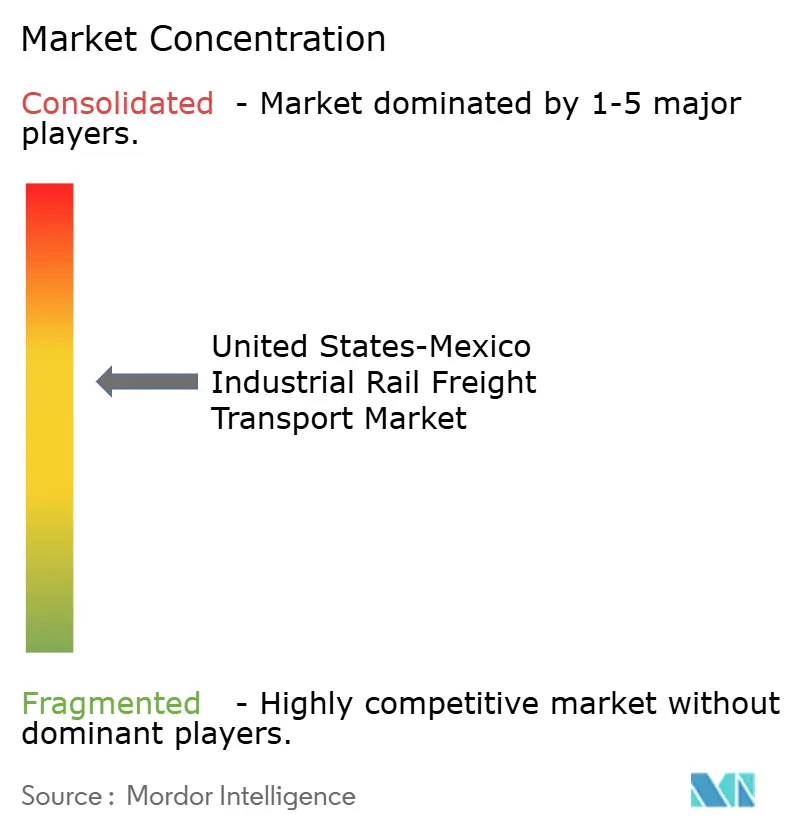
| Market Concentration | Medium |
Major Players
*Disclaimer: Major Players sorted in no particular order Image © Mordor Intelligence. Reuse requires attribution under CC BY 4.0. |
|
United States-Mexico Industrial Rail Freight Transport Market Analysis by Mordor Intelligence
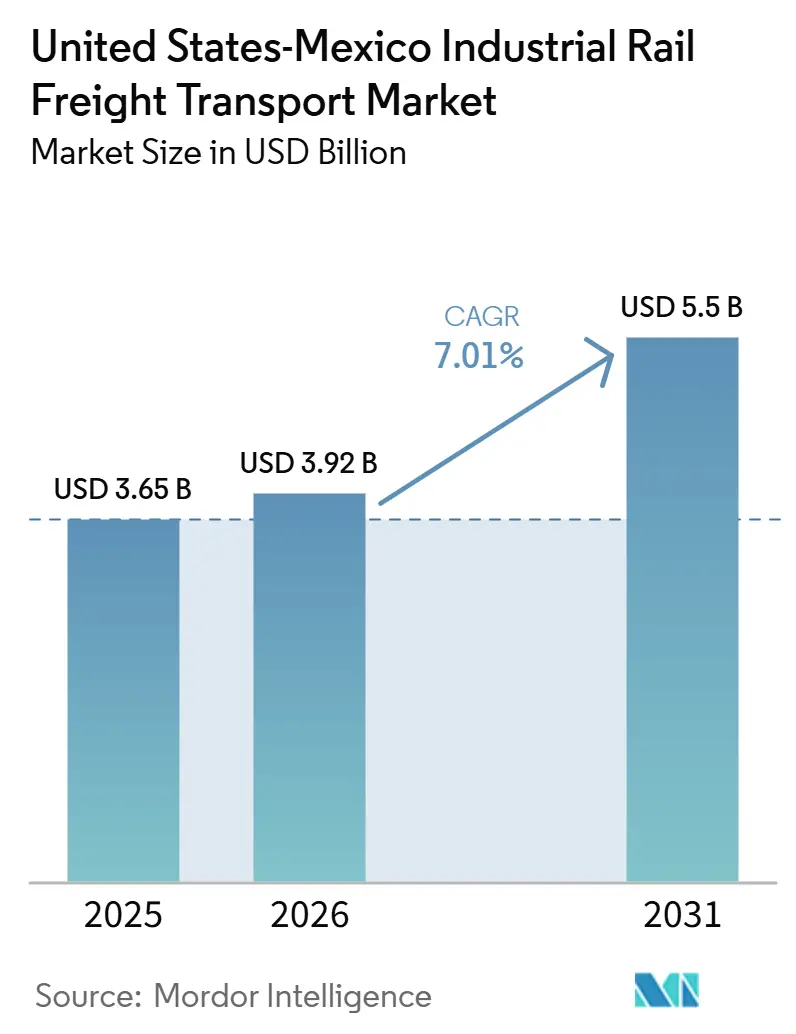
The United States-Mexico industrial rail freight transport market size was valued at USD 3.65 billion in 2025 and is projected to reach USD 3.92 billion in 2026 and to USD 5.50 billion by 2031, growing at a CAGR of 7.01% during 2026-2031.
The United States-Mexico industrial rail freight market is performing steadily, driven by strong cross-border movement of industrial goods, auto parts, appliances, and other manufacturing-linked cargo across key trade corridors. Recent conditions suggest that while overall volumes can be affected by economic uncertainty and policy shifts, the cross-border and intermodal segments remain active and operationally important. The market benefits from improving terminal efficiency, smoother customs handling, and the strategic role of rail in linking production hubs with border gateways and export routes. Looking ahead, the outlook remains constructive as industrial trade between the two countries continues to rely on rail for reliable, scalable, and cost-effective transport. Growth is likely to be supported by deeper intermodal integration, better corridor performance, and continued investment in border logistics and network capacity. Even with short-term volatility, the long-term direction points toward a more connected and more efficient cross-border rail freight system.
Key Report Takeaways
- By cargo type, bulk industrial freight held 38.71% of the United States-Mexico industrial rail freight transport market share in 2025, while containerized industrial freight is projected to grow at a 10.06% CAGR through 2031.
- By shipment distance, long-haul accounted for 46.08% of the United States-Mexico industrial rail freight transport market size in 2025, while medium-haul is forecast to expand at a 10.26% CAGR through 2031.
- By trade flow direction, the United States-to-Mexico held 54.93% of the United States-Mexico industrial rail freight transport market share in 2025, while Mexico-to-United States is projected to record the highest CAGR at 9.93% through 2031.
- By end user, automotive captured 23.77% of the United States-Mexico industrial rail freight transport market size in 2025, while consumer and industrial manufactured goods are expected to advance at a 10.05% CAGR through 2031.
Note: Market size and forecast figures in this report are generated using Mordor Intelligence’s proprietary estimation framework, updated with the latest available data and insights as of January 2026.
United States-Mexico Industrial Rail Freight Transport Market Trends and Insights
Drivers Impact Analysis*
| Driver | (~) % Impact on CAGR Forecast | Geographic Relevance | Impact Timeline |
|---|---|---|---|
| Nearshoring of Industrial Supply Chains | +2.3% | United States-Mexico borderlands, Bajío region, northern and central Mexico manufacturing corridors | Medium term (2-4 years) |
| USMCA Rules of Origin Reinforcing Regional Sourcing | +1.2% | North American corridor, especially automotive-intensive northern Mexico states | Long term (≥ 4 years) |
| Digital Customs Clearance and Pre-Arrival Data Integration | +0.8% | Laredo-Nuevo Laredo, Eagle Pass-Piedras Negras, Nogales border corridors | Short term (≤ 2 years) |
| Growth of Cross-Border Intermodal and Bonded Cross-Dock Networks | +1.0% | Texas border gateways, Midwest-Mexico corridors, and major inland intermodal hubs | Medium term (2-4 years) |
| Rail Capacity Expansion at Key Border Corridors | +0.9% | Laredo-Nuevo Laredo, Eagle Pass, Monterrey metropolitan area | Medium term (2-4 years) |
| Short-Haul Intermodal Share Gains from Truck Capacity Tightness | +0.6% | United States-Mexico cross-border lanes in the 550-1,500-mile range, especially Laredo-Midwest | Medium term (2-4 years) |
| Source: Mordor Intelligence | |||
Nearshoring of Industrial Supply Chains
Nearshoring remains the clearest growth engine for the United States-Mexico industrial rail freight market, as new factories continue to add freight origins on both sides of the border. Mexico attracted a record USD 40.87 billion in foreign direct investment during 2025, representing a 10.8% year-on-year increase and reinforcing investor confidence in the country’s manufacturing base. As production clusters deepen in Nuevo Leon, Querétaro, and Guanajuato, rail-linked industrial parks are seeing greater terminal utilization and stronger demand for regular component flows. In 2026, Plan Mexico has activated 20 industrial parks across 10 states, adding more production nodes that need rail access to ports, border gateways, and inland hubs. This shifts the focus from simply adding track to improving yards, terminals, and border transfer capacity. The United States-Mexico industrial rail freight transport market is likely to benefit most when rail operators align service design with the geography of new industrial investment[1]FreightWaves. "Mexico FDI Ranking Jumps in 2026 as Nearshoring Boosts Investment." FreightWaves, 2025–2026. .
USMCA Rules of Origin Reinforcing Regional Sourcing
USMCA rules continue to support the United States-Mexico industrial rail freight market by making regional sourcing more important for manufacturers serving North America. The automotive content rule under USMCA requires 75% regional value content, up from 62.5% under NAFTA, which has pushed more sourcing toward the United States and Mexican suppliers. Mexico also sources a large share of its intermediate goods imports from the United States, which means northbound finished goods often create matching southbound flows of inputs and components. This two-way structure supports steadier rail demand than one-direction trade models. The scheduled USMCA review in July 2026 introduces uncertainty because stricter treatment of steel and aluminum documentation could slow movements or change sourcing patterns. A favorable review outcome would reinforce another investment cycle for the United States-Mexico industrial rail freight transport market, while a tougher outcome would raise planning risk for shippers[2]Cross-Border Transit MX. "USMCA 2026 Review: Critical Border Compliance Stakes for North America." Cross-Border Transit MX, 2026. .
Digital Customs Clearance and Pre-Arrival Data Integration
Digital customs reform is improving the operating environment for the United States-Mexico industrial rail freight transport market, especially at high-volume border crossings. Mexico’s 2026 General Foreign Trade Rules require real-time interoperability with ANAM systems, which raises the importance of clean, timely shipment data. Rail has a practical advantage in this setting because one train can move a large volume under a consolidated customs process, while truck movements are filed load by load. United States Customs and Border Protection allows pre-arrival entry filing through ACE up to 15 days before arrival, helping compliant rail shipments clear faster than older border workflows allowed. The main limitation remains document quality, as many border delays are tied to paperwork rather than physical capacity alone. Mexico’s MVE requirement, with full enforcement in June 2026, adds another compliance layer that rewards shippers and carriers with stronger data processes.
Growth of Cross-Border Intermodal and Bonded Cross-Dock Networks
Intermodal network design is becoming a stronger differentiator in the United States-Mexico industrial rail freight market as shippers seek greater flexibility for shipments of varying sizes. U.S.–Mexico cross-border intermodal traffic reached 396,545 53-foot containers in 2025, equivalent to approximately 1.05 million TEUs and 51% of Mexico’s total intermodal volume. This scale indicates sustained shipper adoption of rail-based cross-border services and supports further premium-service launches centered on faster transit, reliability, security, and truck-to-rail conversion. Bonded cross-dock models help carriers and logistics providers consolidate in-bond freight, reduce empty repositioning, and make smaller shipments more rail-friendly. In September 2025, C.H. Robinson launched a United States-Mexico freight consolidation service through its 400,000 square-foot Laredo facility and cited cost reductions of up to 40% for LTL shipments. Rail also remains attractive for large-volume corridors because a single intermodal train can replace 240-300 trucks, reducing carbon emissions by 65% compared to road transport. As a result, the United States-Mexico industrial rail freight market is moving toward a structure in which network quality matters as much as linehaul pricing.
Restraints Impact Analysis*
| Restraint | (~) % Impact on CAGR Forecast | Geographic Relevance | Impact Timeline |
|---|---|---|---|
| Border Infrastructure Congestion and Crossing Delays | -1.2% | Laredo-Nuevo Laredo, Eagle Pass, high-volume truck and rail gateway corridors | Medium term (2-4 years) |
| Tariff Volatility and Trade Policy Uncertainty | -1.5% | North American corridor, especially automotive and industrial manufacturing zones | Medium term (2-4 years) |
| Security Risks and Cargo Theft Corridors in Mexico | -0.7% | Coahuila, Sonora, Guanajuato, Jalisco, and the surrounding corridors | Long term (≥ 4 years) |
| Cross-Border Driver Shortages and Equipment Imbalances | -0.5% | Laredo-Nuevo Laredo and other border gateway regions | Medium term (2-4 years) |
| Source: Mordor Intelligence | |||
Border Infrastructure Congestion and Crossing Delays
Border congestion remains one of the clearest operational restraints on the United States-Mexico industrial rail freight transport market because rail and truck systems depend on the same gateway ecosystem. The Laredo-Nuevo Laredo corridor processes an average of 12,000 trailers per day and can reach 21,000 on peak days, keeping pressure high on customs, drayage, and interchange capacity. Rail loses part of its time advantage when inspection queues and terminal congestion spill over into the border-handling process. In February 2025, Mexico’s VUCEM digital customs outage caused delays of up to 3 days at major crossings, which showed that digital systems can also become failure points when backups are weak. In April 2026, CBP revised commercial crossing hours at Eagle Pass to more tightly manage flows, but this was a traffic management step rather than a full-capacity solution. Until border infrastructure expands more broadly, the United States-Mexico industrial rail freight transport market will continue to face service friction at its busiest nodes.
Tariff Volatility and Trade Policy Uncertainty
Tariff volatility constrains the United States-Mexico industrial rail freight market by altering shipment timing, sourcing plans, and carrier planning cycles. Through 2025, tariff announcements did not simply reduce freight; they also caused pull-forward surges in automotive and industrial goods that were often followed by weaker periods. This pattern disrupts service consistency and makes equipment planning more difficult for rail carriers and logistics providers. FreightWaves also noted that VAT collected on Mexican imports fell 22.6% through early 2025, despite relatively stable freight levels, suggesting companies were adjusting classifications and routing to manage tariff exposure. In March 2025, CANACAR warned that United States tariffs and potential retaliation could reduce freight volumes while raising operating costs, favoring larger operators with greater network depth. If policy risk remains elevated, the United States-Mexico industrial rail freight market may still grow, but growth will likely remain lower across cargo types and corridors.
*Our forecasts treat driver/restraint impacts as directional, not additive. The impact forecasts reflect baseline growth, mix effects, and variable interactions.
Segment Analysis
By Cargo Type: Containerized Freight Challenges Bulk’s Structural Lead
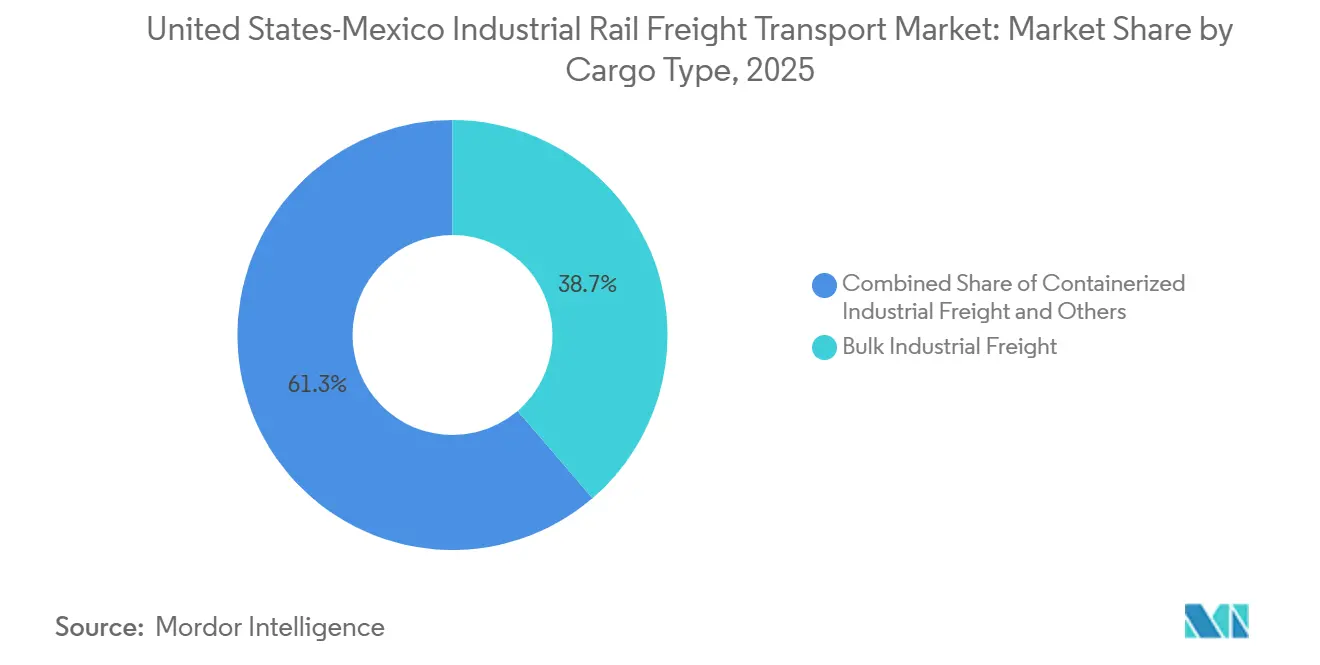
Bulk industrial freight accounted for 38.71% of the United States-Mexico industrial rail freight transport market share in 2025, while containerized industrial freight is projected to grow at a 10.06% CAGR through 2031. Bulk remains important because metals, minerals, steel products, and construction inputs are still well matched to rail economics on long cross-border lanes. These shipments usually move in larger lot sizes and fit the established carload and unit-train structure that rail operators have built over decades. Containerized freight is growing faster as manufacturers move more automotive parts, electronics, and industrial assemblies in standardized containers. That shift makes it easier to connect plants, border terminals, and inland distribution centers without adding as much manual handling.
The cargo mix is changing the commercial profile of the United States-Mexico industrial rail freight transport industry, as rail is becoming more relevant for freight that once defaulted to truck. In March 2025, intermodal container movements reached 81,598 units, which supports the view that containerized flows are becoming a structural part of the corridor rather than a temporary spike. Breakbulk, wagonload, and less-than-trainload freight still play a clear role in energy projects, chemicals, machinery, and oversized industrial equipment. Those smaller segments may not lead to growth, but they broaden the revenue base and keep rail relevant across many industrial shipping patterns. Equipment standards and cross-border interchange rules also matter more as carriers handle a wider range of container and wagon configurations within the United States-Mexico industrial rail freight transport market.



By Shipment Distance: Medium-Haul Corridors Expand Rail’s Reach
Long-haul represented 46.08% of the United States-Mexico industrial rail freight transport market size in 2025, while medium-haul is forecast to expand at a 10.26% CAGR through 2031. Long-haul lanes remain the largest part of the market because rail has long held a cost and capacity advantage on routes such as Chicago to Monterrey and Los Angeles to Mexico City. These corridors support dense industrial volumes and justify the fixed handling steps that rail requires. Medium-haul growth is stronger because the Bajío manufacturing cluster sits within a range that is becoming more workable for intermodal rail. As truck costs rise and capacity tightens, rail is becoming more competitive in lanes that were once considered too short for reliable conversion.
This shift is gradually redefining the service boundary of the United States-Mexico industrial rail freight transport market. C.H. Robinson noted in February 2026 that rail spot prices were moving close to truck prices and that the gap should widen again as truckload conditions tightened later in the year. That creates a better opening for rail in the 300-700 km and 550-1,500 mile bands where shippers balance time, cost, and reliability very carefully. Short-Haul remains the smallest segment because terminal handling and drayage costs are still too high for many sub-300 km moves. Even so, the United States-Mexico industrial rail freight transport industry is becoming less dependent on only the longest lanes as network design improves and medium-haul economics strengthen.
By Trade Flow Direction: Northbound Growth Gains Speed
The United States-to-Mexico accounted for 54.93% of the United States-Mexico industrial rail freight market share in 2025, while Mexico-to-United States is expected to grow at a 9.93% CAGR through 2031. Southbound traffic remains larger because the United States continues to supply raw materials, intermediate goods, and industrial inputs to Mexican manufacturing clusters. That structure reflects Mexico's long-standing role as a production base closely connected to United States suppliers. Northbound traffic is growing faster because Mexico is exporting a broader mix of finished and semi-finished industrial goods than before. This change supports a more balanced use of rail across the corridor, even if directional imbalances remain.
The faster northbound trend also exposes equipment imbalances, as containers and flatcars can accumulate on the United States side, raising repositioning costs. Rail operators are responding by building services that create more usable southbound flows, including refrigerated and premium intermodal products. If those balancing efforts succeed, the United States-Mexico industrial rail freight market will achieve higher asset productivity and more consistent service in both directions.
By End User: Automotive Leads While Industrial Consumer Goods Drive Growth
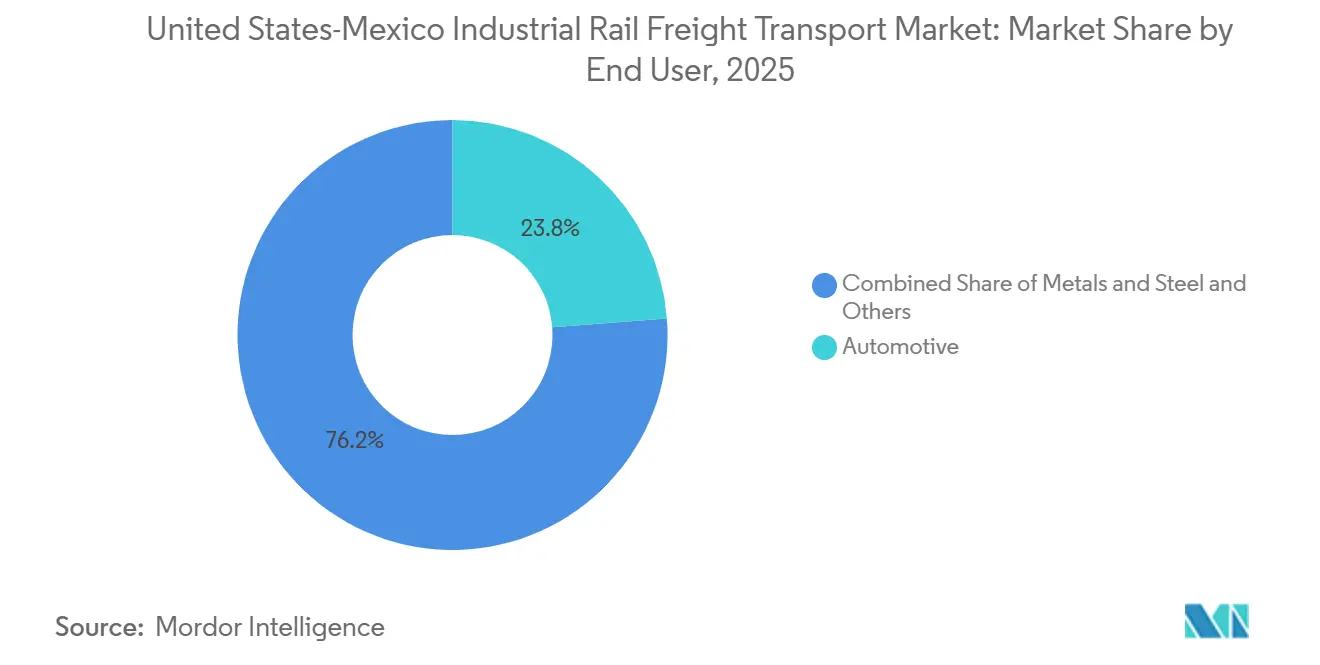
Automotive accounted for 23.77% of the United States-Mexico industrial rail freight transport market size in 2025, while consumer and industrial manufactured goods are projected to grow at a 10.05% CAGR through 2031. Automotive remains the largest end-user segment because OEM and Tier 1 plant networks across Nuevo Leon, Guanajuato, Sonora, and Coahuila still rely on rail for components, finished vehicles, and major industrial inputs. The segment benefits from established production clusters and regular freight flows that suit scheduled rail operations. Consumer and industrial manufactured goods are growing faster as Mexico expands in electronics, home appliances, and industrial equipment. This gives rail access to a wider customer base than the corridor had when automotive alone carried a larger share of the growth story.
The end-user mix is therefore becoming more diverse across the United States-Mexico industrial rail freight transport market. Metals and steel, chemicals and petrochemicals, machinery and industrial equipment, construction and building materials, and paper and packaging continue to provide a large and stable revenue base for carload and bulk services. Agricultural processors remain smaller, but they still benefit from specialized cross-border offerings such as GMXT and CN’s America’s Harvest service, which gives some lanes a routing option that a truck cannot easily replicate. The broader end-user spread reduces dependence on a single sector. It makes the United States-Mexico industrial rail freight transport market more resilient to demand changes within any single industrial vertical.
Geography Analysis
Laredo handles 46% of the value of truck-transported bilateral trade, and rail activity at the same gateway has risen with the broader nearshoring cycle[3]CXTMS. "US-Mexico Laredo Corridor Freight Hits Record Volume: How the Busiest Land Port Needs Billions in Expansion." CXTMS, 2026. . The February 2025 opening of CPKC’s double-track bridge doubled potential interchange capacity at that crossing and improved the physical base for future train growth. On the United States side, Texas gateways, including Laredo, Eagle Pass, and El Paso, remain the main entry and exit points for cross-border industrial rail traffic. Kansas City, Chicago, and Atlanta continue to shape the economics of inland distribution by connecting cross-border freight with large domestic industrial and consumer networks.
On the Mexican side, Nuevo Leon remains the anchor geography for the United States-Mexico industrial rail freight transport market because Monterrey combines manufacturing density, rail access, and direct links to the border. GMXT’s 2026 capital plan continues to support the Monterrey and Celaya bypass work, which is important because these nodes are expected to absorb growing industrial volume this year. The Bajio cluster, including Guanajuato, Querétaro, and San Luis Potosí, is now a major growth geography because it sits within the range that supports faster medium-haul expansion. Central Mexico still generates significant freight demand, but a greater distance from the border can make trucks more attractive for time-sensitive moves.
The Southeast remains a smaller part of the United States-Mexico industrial rail freight market, but it is becoming increasingly relevant as corridor development advances. The Interoceanic Corridor’s Line Z is already operational, and Line K had reached 87.7% completion by June 2026, which supports the long-term buildout of new freight patterns in southern Mexico. Pacific corridors tied to Manzanillo and Lázaro Cardenas continue to support automotive and industrial commodity flows, and Grupo Mexico ratified a USD 3 billion rail infrastructure investment in June 2026 to strengthen mining and agricultural corridors. Geography will continue to favor the corridors that combine border access, industrial clustering, and better terminal capacity.
Competitive Landscape
The United States-Mexico industrial rail freight transport market has a medium-concentrated infrastructure. CPKC, Union Pacific, BNSF, and GMXT control the main physical corridors and border assets that define network access for most industrial freight. CPKC holds a strong strategic position because it is the only single-line carrier that directly links Canada, the United States, and Mexico via a single rail system. Its Mexico Midwest Express corridor recorded growth in 2025, showing how single-line service can attract freight when reliability and reach improve. In May 2026, CPKC and CSX upgraded the Southeast Mexico Express with a dedicated train and faster schedules, strengthening one of the corridor's most important premium services.
Union Pacific’s proposed USD 85 billion acquisition of Norfolk Southern is the largest structural event currently under review, as it could reshape eastbound routing options from Mexico into the United States network. GMXT is also investing to prepare for higher demand, including plans to expand its locomotive fleet and modernize its domestic and cross-border operations. Among logistics integrators, competition is moving toward premium products that combine rail cost with truck-like consistency. J.B. Hunt, BNSF, and GMXT launched Quantum de Mexico in May 2025 with a stated on-time target of 95%+, which directly addresses service-sensitive freight that has often stayed on the truck[4]Source: J.B. Hunt Transport Services, “J.B. Hunt, BNSF Railway and GMXT Launch Quantum de México,” J.B. Hunt Newsroom, jbhunt.com. Werner is also expanding asset-based intermodal capacity in Mexico, including 800 53-foot containers planned for deployment by the end of 2026.
The commercial fight within the United States-Mexico industrial rail freight transport market is therefore centered on transit reliability, border handling, equipment availability, and service design rather than simple access to track. DSV’s April 2025 acquisition of DB Schenker created a larger logistics platform with broader United States-Mexico reach, although tariff uncertainty has kept investment pacing selective in some areas. Schneider and other providers are also pushing premium intermodal offerings, indicating that value-added services are becoming more important than basic capacity alone. Even with more logistics brands participating, control of the core rail infrastructure means competitive power in the United States-Mexico industrial rail freight transport market still sits mainly with the major railroads and their closest interline partners.
United States-Mexico Industrial Rail Freight Transport Industry Leaders
-
Canadian Pacific Kansas City Ltd. (CPKC)
-
Union Pacific Railroad Co.
-
BNSF Railway Co.
-
Grupo México Transportes, S.A.B. de C.V. (GMXT)
-
Ferromex
- *Disclaimer: Major Players sorted in no particular order

Recent Industry Developments
- May 2026: CPKC and CSX upgraded the Southeast Mexico Express by adding a dedicated intermodal train and a premium service schedule. The upgrade reduced transit times to three days between Atlanta and Monterrey and four days between Atlanta and central Mexico. It followed capital investments in track, bridge, and signal infrastructure along the former Meridian & Bigbee Railroad corridor across Alabama, Mississippi, Louisiana, and Texas.
- April 2026: Werner Enterprises announced the deployment of 800 53-foot containers into Mexican cross-border intermodal lanes by the end of 2026. The rollout started in Monterrey and Silao, with Mexico City coverage planned for the second half of 2026.
- January 2026: CPKC and Americold opened a new refrigerated intermodal service for Mexico. A refrigerated terminal in Kansas City and a new double-track rail bridge in Nuevo Laredo supported the service, enabling joint United States-Mexico customs inspections.
- September 2025: C.H. Robinson launched a United States-Mexico freight consolidation service, citing cost reductions of up to 40% for LTL cross-border shipments through AI-guided routing and bonded warehousing at its 400,000 ft² Laredo facility.


United States-Mexico Industrial Rail Freight Transport Market Report Scope
| Containerized Industrial Freight |
| Bulk Industrial Freight |
| Breakbulk Freight |
| Wagonload Freight |
| Less-than-Trainload Freight |
| Short-Haul (Less than 300 km) |
| Medium-Haul (300-700 km) |
| Long-Haul (more than 700 km) |
| United States to Mexico |
| Mexico to United States |
| Automotive |
| Metals and Steel |
| Machinery and Industrial Equipment |
| Chemicals and Petrochemicals |
| Construction and Building Materials |
| Paper, Pulp, and Packaging Materials |
| Consumer and Industrial Manufactured Goods |
| Other Agricultural Processors |
| By Cargo Type | Containerized Industrial Freight |
| Bulk Industrial Freight | |
| Breakbulk Freight | |
| Wagonload Freight | |
| Less-than-Trainload Freight | |
| By Shipment Distance | Short-Haul (Less than 300 km) |
| Medium-Haul (300-700 km) | |
| Long-Haul (more than 700 km) | |
| By Trade Flow Direction | United States to Mexico |
| Mexico to United States | |
| By End User | Automotive |
| Metals and Steel | |
| Machinery and Industrial Equipment | |
| Chemicals and Petrochemicals | |
| Construction and Building Materials | |
| Paper, Pulp, and Packaging Materials | |
| Consumer and Industrial Manufactured Goods | |
| Other Agricultural Processors |


Key Questions Answered in the Report
What is driving growth in cross-border rail freight between the United States and Mexico?
Nearshoring, regional sourcing under USMCA, digital customs improvements, and broader intermodal adoption are the main growth drivers. The sector is projected to grow from USD 3.65 billion in 2025 to USD 5.50 billion by 2031 at a 7.01% CAGR.
Which cargo segment is growing fastest in the United States-Mexico rail freight?
Containerized industrial freight is the fastest-growing cargo segment, with a projected 10.06% CAGR through 2031, as more manufacturers shift components and finished goods into intermodal containers.
Why does long-haul still lead this corridor?
Long-haul moves held 46.08% share in 2025 because rail still performs best on dense, cross-border lanes where distance supports handling costs and scheduled train economics.
Which trade direction is expanding faster?
Mexico-to-United States is growing faster, with a projected 9.93% CAGR through 2031, supported by stronger exports in electronics and advanced manufacturing.
Which end-user segment matters most today?
Automotive remains the largest end-user at 23.77% share in 2025, but consumer and industrial manufactured goods is growing faster at a 10.05% CAGR through 2031.
What are the biggest risks for rail operators in this corridor?
Border congestion, customs delays, tariff volatility, and policy uncertainty around the 2026 USMCA review remain the main risks because they affect service consistency, costs, and carrier planning.
Page last updated on:





