
United States Hydraulic Presses Market Size and Share
Market Overview
| Study Period | 2020 - 2031 |
|---|---|
| Forecast Data Period | 2026 - 2031 |
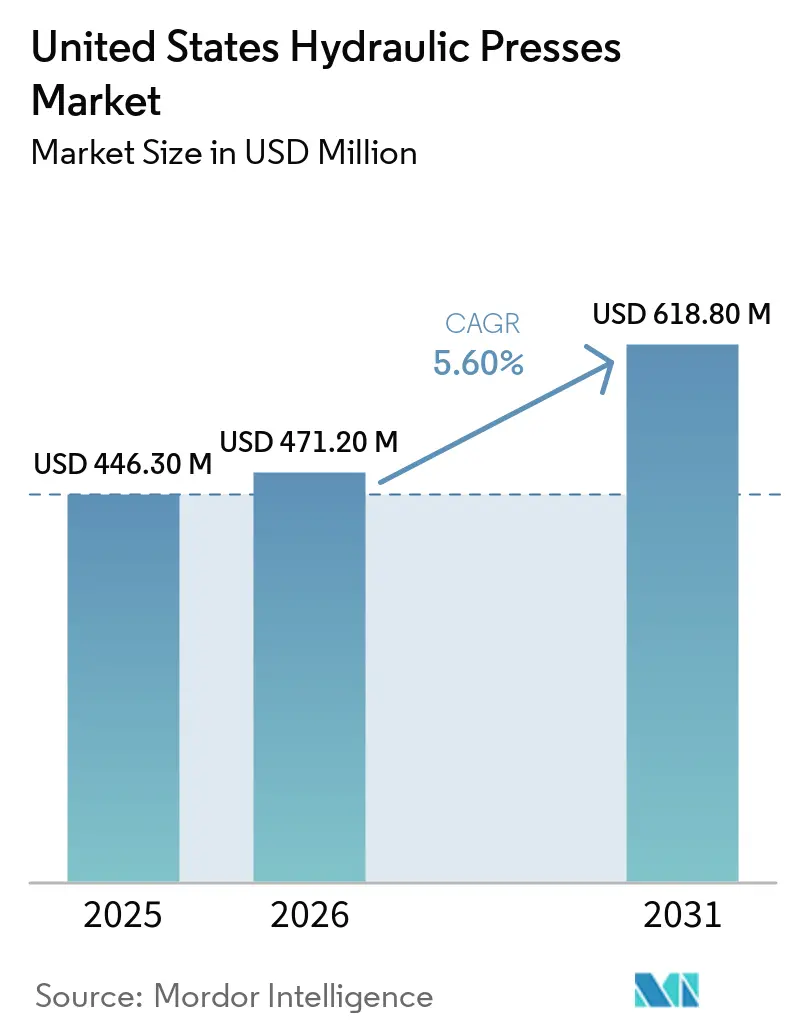
| Base Year Market Size (2025) | USD 446.30 Million |
| Market Size (2026) | USD 471.20 Million |
| Market Size (2031) | USD 618.80 Million |
| Growth Rate (2026 - 2031) | 5.60 % |
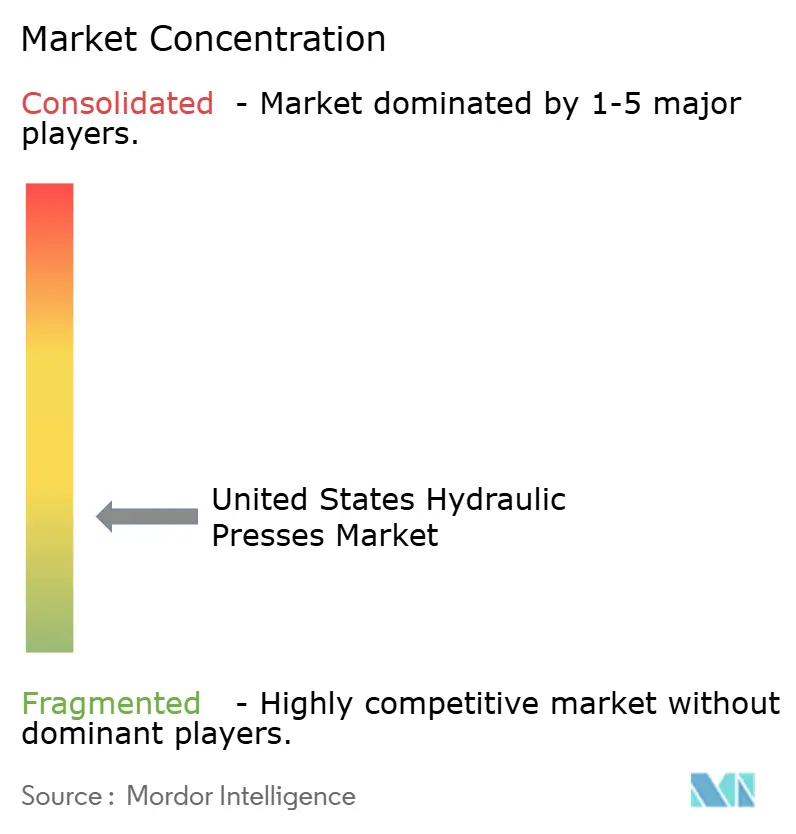
| Market Concentration | Low |
Major Players *Disclaimer: Major Players sorted in no particular order Image © Mordor Intelligence. Reuse requires attribution under CC BY 4.0. | |
United States Hydraulic Presses Market Analysis by Mordor Intelligence
The United States hydraulic presses market size was valued at USD 446.3 million in 2025 and is estimated to grow from USD 471.2 million in 2026 to reach USD 618.8 million by 2031, at a CAGR of 5.6% during the forecast period 2026-2031.
Reshoring, factory investment, and aerospace and defense production are supporting demand for new forming and forging capacity. Manufacturers are also replacing aging equipment and adding servo-hydraulic controls to improve energy management and process control. Automation is changing buying decisions in the United States hydraulic presses market because press buyers increasingly need robotic handling, monitoring, and flexible tooling integration. Steel costs and limited technician availability can delay purchases and commissioning, while tax expense can improve the financial case for qualifying equipment buyers. The United States hydraulic presses market, therefore, draws demand from both large new programs and practical modernization work across established plants.
Key Report Takeaways
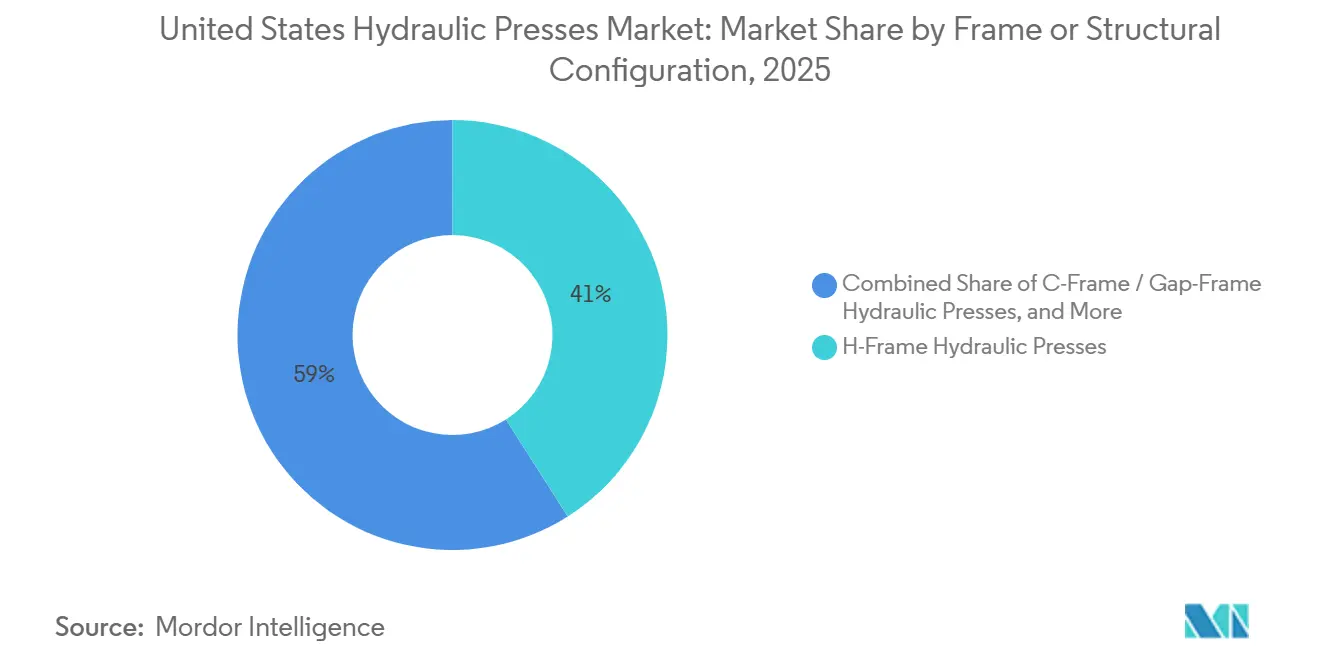
- By frame and structural configuration, H-frame and straight-side hydraulic presses held 41% of the United States hydraulic presses market share in 2025, while C-frame and gap-frame hydraulic presses are forecast to expand at an 8.05% CAGR through 2031.
- By tonnage and press force, the 101-500 tons band held 46% of revenue in 2025, while above 2,000 tons is forecast to grow at a 6.67% CAGR through 2031.
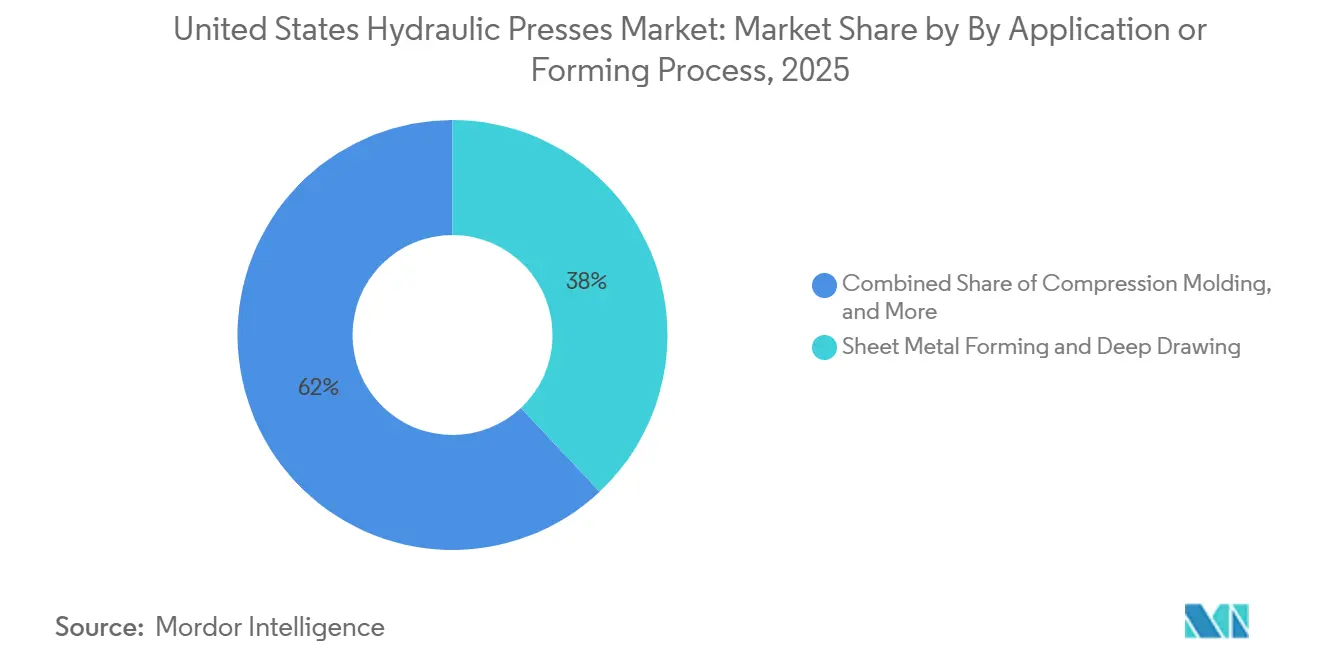
- By application and forming process, sheet metal forming and deep drawing accounted for 38% of the United States hydraulic presses market size in 2025, while compression molding is forecast to grow at an 8.25% CAGR through 2031.
- By end-use industry, automotive and transportation held 30% of revenue in 2025, while electrical and electronics is forecast to advance at a 7.85% CAGR through 2031.
Note: Market size and forecast figures in this report are generated using Mordor Intelligence’s proprietary estimation framework, updated with the latest available data and insights as of January 2026.
United States Hydraulic Presses Market Trends and Insights
Drivers Impact Analysis*
| Driver | (~) % Impact on CAGR Forecast | Geographic Relevance | Impact Timeline |
|---|---|---|---|
| Reshoring and Domestic Capacity Expansion | +2.2% | National, with activity in Michigan, Ohio, Texas, and the Southeast manufacturing corridors | Medium term (2-4 years) |
| Automation, Robotics, and Smart-Press Integration | +1.8% | National, with concentration in the automotive Midwest and aerospace Southeast | Long term (≥ 4 years) |
| High-Force aerospace and defense Forming Demand | +1.5% | National, with activity in Alabama, Georgia, Connecticut, and Texas defense corridors | Long term (≥ 4 years) |
| Automotive Lightweighting and Advanced-Material Forming | +1.2% | National, with high activity in Michigan, Tennessee, and South Carolina, automotive clusters | Medium term (2-4 years) |
| Retrofit Demand from Installed Press Bases and Local Service Requirements | +0.9% | National, with retrofit activity in the Midwest and Mid-Atlantic industrial belts | Short term (≤ 2 years) |
| Energy-Efficient Servo-Hydraulic and Hybrid Press Upgrades | +0.7% | National, with early adoption in energy-cost-sensitive manufacturing states | Medium term (2-4 years) |
| Source: Mordor Intelligence | |||
Reshoring and Domestic Manufacturing Capacity Expansion
Domestic capacity expansion is increasing the need for hydraulic presses across stamping, forming, and forging operations. The 2026 Reshoring Survey found that 63% of original equipment manufacturer respondents planned capital expenditures in 2026 or 2027 for reshoring or domestic expansion. Tariffs were identified by 65% of respondents and geopolitical risk by 60% as major catalysts for those plans. NIST reported that supply chain resilience and proximity between manufacturing and engineering operations were among the leading reshoring considerations for original equipment manufacturers.[1]Harry Moser and Pete Anemogiannis, “Annual Report on the United States Manufacturing Economy 2025,” National Institute of Standards and Technology, nist.gov These priorities suit equipment with long operating lives, including presses that can be rebuilt or upgraded as production programs change. The United States hydraulic presses market benefits when both replacement projects and new capacity projects proceed at the same time.
Automation, Robotics, and Smart-Press Integration
Automation is changing the value placed on the press system rather than the press frame alone. Greenerd presented automated multi-station hydraulic press systems that combine straightening, shearing, dimpling, hole formation, chamfering, and shuttle transfer for an output of 60 parts per minute. Integrated cells often need larger beds for robotic end effectors, coil feed systems, and multi-die layouts. That requirement can favor H-frame and four-post equipment even when a smaller standalone press could form the part. Macrodyne supplied automated hydraulic press lines for UNION’s 155mm artillery shell factory in Texas, showing the increasing importance of turnkey systems in defense production. Connected force and displacement monitoring can also support quality control and maintenance planning over the life of the asset.
Demand for High-Force Forming in Aerospace and Defense
Aerospace and defense programs are creating long-cycle demand for high-tonnage press equipment. In February 2026, Pratt & Whitney announced a USD 200 million investment to add a seventh isothermal forging press in Columbus, Georgia. The investment targets a 30% increase in compressor and turbine disk output for GTF and F135 engine programs. Beckwood received a contract from the United States Army Natick Soldier Research, Development, and Engineering Center for a custom 1,000-ton press used in ballistic composite consolidation. Machine guarding requirements under 29 CFR 1910.212 apply to machinery and shape equipment sourcing and commissioning requirements.[2]“Machine Guarding, 29 CFR 1910.212,” Occupational Safety and Health Administration, osha.gov These programs support the United States hydraulic presses market because specialized equipment is tied to qualified production processes and multi-year output commitments.
Automotive Lightweighting and Advanced Material Forming
Vehicle producers are using advanced high-strength steel, aluminum, magnesium, and composite materials in structural and electric vehicle applications. These materials require controlled force, dwell time, and ram speed, which hydraulic press systems can provide. Oak Ridge National Laboratory stated that 3D-printed metal molds can lower tooling costs for large automotive composite components made through compression molding.[3]“3D-Printed Metal Molds Poised to Accelerate United States Auto Manufacturing,” Oak Ridge National Laboratory, ornl.gov Department of Energy documentation also described artificial intelligence-supported stamping work intended to reduce springback and die wear in advanced high-strength steel parts. Schuler North America installed a 5,000-ton hydroforming press in Canton, Michigan, in 2025 for electric vehicle front-structure production. The United States hydraulic presses market gains from these material changes when producers need adaptable press cycles and reliable forming control.
Restraints Impact Analysis*
| Restraint | (~) % Impact on CAGR Forecast | Geographic Relevance | Impact Timeline |
|---|---|---|---|
| High Initial Investment and Long Equipment Payback | -1.2% | National, especially for small and mid-size fabricators in the Midwest and Mid-Atlantic | Short term (≤ 2 years) |
| Skilled Workforce Shortage and Technician Availability Constraints | -0.8% | National, with particular pressure in nonmetropolitan industrial areas | Long term (≥ 4 years) |
| Hydraulic Component, Steel, and Energy Cost Volatility | -0.5% | National, especially for import-dependent hydraulic cylinder and valve sourcing | Medium term (2-4 years) |
| Alternative Technologies and Substitution by Servo-Electric and Mechanical Presses | -0.3% | National, with pressure in automotive sheet metal and electronics forming below 500 tons | Long term (≥ 4 years) |
| Source: Mordor Intelligence | |||
High Initial Investment and Long Equipment Payback
Production-grade hydraulic press systems require significant initial capital, which can limit orders from smaller manufacturers. Equipment loans and leases are common funding methods for firms buying major machinery.[4]“Buy Assets and Equipment,” Small Business Administration, sba.gov The Internal Revenue Service allows qualifying businesses to claim a Section 179 deduction of USD 1.2 million for 2026, which can reduce after-tax equipment costs. The benefit is less useful for buyers with limited taxable income or limited access to credit. Lockout and machine guarding requirements can add engineering, installation, and commissioning costs to projects. These factors may postpone replacement decisions, especially when firms can extend the life of an existing press through service work.
Skilled Workforce Shortage and Technician Availability Constraints
Limited technician availability can slow installation, maintenance, and utilization of press equipment. The Bureau of Labor Statistics identified manufacturing production and maintenance occupations as major sources of job opportunities through 2033. The 2026 Reshoring Survey found that 66% of combined original equipment manufacturers and contract manufacturers considered technician roles very difficult to fill or a crisis. The same survey found that 60% of respondents reported similar difficulty in maintenance and repair technician positions. The National Association of Manufacturers projected that 1.9 million of the 3.8 million required manufacturing jobs could remain unfilled through 2033. The United States hydraulic presses market faces longer commissioning cycles when plant operators and qualified service personnel are unavailable.
*Our forecasts treat driver/restraint impacts as directional, not additive. The impact forecasts reflect baseline growth, mix effects, and variable interactions.
Segment Analysis
By frame and structural configuration: H-frame retains its base as C-frame automation expands
H-frame and straight-side hydraulic presses held 41% of revenue in 2025, giving them the largest position by frame type. Their guided ram design supports precision progressive-die stamping, aerospace sheet forming, and heavy forging where parallelism is important. Automotive Tier-1 stampers and aerospace forming shops have a large installed base of these presses. Long service lives create a recurring need for rebuilding, control upgrades, and hydraulic system replacement. This established installed base gives H-frame equipment a durable role in the United States hydraulic presses market.
C-frame and gap-frame hydraulic presses are forecast to grow at an 8.05% CAGR through 2031. Their front-access arrangement supports robotic loading, coil feeding, and work in job shops where production layouts need flexibility. Four-post presses remain important for rubber-pad forming, wide-panel composite molding, and deep drawing because they distribute force over a larger bed area. Two-post and benchtop presses serve maintenance, laboratory, and light assembly work that needs lower force and a smaller footprint. Greenerd’s multi-station systems presented at FABTECH 2025 combined different ram and tonnage configurations in a single production cell.



By tonnage and press force: mid-range systems anchor revenue while ultra-high tonnage grows
The 101-500 tons band held 46% of revenue in 2025, the largest share of the United States hydraulic presses market size by press force. This range covers general metal stamping, automotive blanking, rubber compression molding, and Tier-2 aerospace subassembly. It is also common in established fabricating plants across the Midwest and Southeast. Many units installed from the 1990s through the 2010s are approaching the point where original hydraulic systems require major work. The wide application range keeps this band central to the United States hydraulic presses market.
Above 2,000 tons presses are forecast to grow at a 6.67% CAGR through 2031. Demand is tied to aerospace forging, defense contracts, naval propulsion work, and turbine-shaft forming for energy infrastructure. Scot Forge commissioned a 5,000-ton open-die hydraulic press in Spring Grove, Illinois, with in-line ultrasonic inspection and naval propulsion orders extending through 2029. The 501-1,000 tons and 1,001-2,000 tons ranges serve aerospace bulkhead forming, hydroforming, and structural composite molding. Up to 100 tons presses continue to support press fitting, composite repair, research, and development work.
By application and forming process: sheet metal forming leads, while compression molding advances
Sheet metal forming and deep drawing held 38% of application revenue in 2025, the leading position by forming process. Automotive body-in-white stamping, appliance production, and heating, ventilation, and air conditioning component manufacturing support this demand. The large automotive stamping base reflects many years of capital investment and established tooling programs. Tooling qualification and part-program requirements can make a change in press technology costly for manufacturers. The application remains a volume foundation for the United States hydraulic presses market.
Compression molding is forecast to grow at an 8.25% CAGR through 2031. Electric vehicle battery enclosure production, sheet molding compound components, and ballistic composite consolidation support this growth. Beckwood’s 1,000-ton press contract for composite consolidation shows the role of defense procurement in this application. Forging also receives support from domestic aerospace and defense capacity programs. Hydroforming, powder compaction, bending and straightening, punching and blanking, and assembly press fitting provide stable demand across general manufacturing and maintenance channels.
By end-use industry: automotive supports demand while electronics records the fastest growth
Automotive and transportation held 30% of end-use revenue in 2025, making it the largest end-use base for the United States hydraulic presses market. Original equipment manufacturers and Tier-1 suppliers use presses for stamping, hydroforming, forging, and compression molding. Electric vehicle platforms need battery enclosures, motor housing, and aluminum structural components. These applications require programmable motion and controlled force. Hydraulic systems remain relevant where a fixed mechanical stroke does not provide enough flexibility.
Electrical and electronics are forecast to expand at a 7.85% CAGR through 2031. Motor core production, power module presses fitting, printed circuit board lamination, and connector manufacturing require repeatable force cycles. Semiconductor manufacturing investment supported by the CHIPS Act can extend demand into related precision forming and assembly operations. Aerospace and defense have some of the highest average selling prices per press because programs need specialized equipment and full qualification records. Pratt & Whitney’s forging expansion and Beckwood’s orders illustrate the multi-year character of that demand.
Geography Analysis
The Midwest remains the largest regional concentration of the United States hydraulic presses market because it has a dense base of automotive stamping, metal fabricating, and forging operations. Michigan, Ohio, Indiana, and Illinois contain a large installed press base and substantial new-equipment demand. Detroit-area original equipment manufacturers support networks of stamping, forging, and hydroforming suppliers across the Great Lakes region. Schuler installed a 5,000-ton hydroforming press at its Canton, Michigan, production center in 2025 for electric vehicle front structures.
The Southeast supports expanding automotive, aerospace, and defense programs in Alabama, Georgia, Tennessee, South Carolina, and Texas. Pratt & Whitney’s USD 200 million press investment in Columbus, Georgia, underscores the region’s importance for high-value aerospace components. Macrodyne supported automated hydraulic press lines at UNION’s artillery shell factory in Texas. IperionX installed a SACMI hydraulic press for titanium powder compaction under its expansion program for defense and aerospace end markets. Foreign direct investment in United States manufacturing reached USD 121.8 billion in 2025, supporting the broader setting for factory investment.
The Northeast and Mid-Atlantic support specialized demand for aerospace, defense, and precision manufacturing equipment, including Connecticut’s aircraft engine ecosystem for precision tooling and titanium-forming systems. Massachusetts, New York, Pennsylvania, and New Jersey add defense, advanced manufacturing, and fabricating activity. California and Washington support demand through commercial and defense airframe production, satellite structures, and semiconductor-related assembly. Arizona and Texas each attracted more than USD 1.5 billion in greenfield foreign direct investment in 2025, partly linked to semiconductor manufacturing projects. This regional mix supports premium demand in aerospace and defense centers, while the Midwest provides the broadest volume base for the United States hydraulic presses market.
Competitive Landscape
Beckwood Press Company, Greenerd Press and Machine Company, French Oil Mill Machinery, and HPM North America compete through customization, local service, and application knowledge. Customers in aerospace and defense may require months or years of press qualification and documentation. Schuler, Siempelkamp, and Fagor Arrasate compete for large-format and high-tonnage projects with broad product portfolios and production capability. Dake Corporation, Carver Inc., and Multipress Inc. serve benchtop and workshop applications with standardized configurations and short delivery needs.
Competition is increasingly based on automation, digital monitoring, and service access. Beckwood completed a 40% manufacturing capacity expansion in 2025 and launched a Service Department to expand retrofit, rebuild, and field service capability. The move addresses customers who cannot justify a new greenfield press but need to extend the useful life of installed equipment. Enerpac announced a definitive agreement in July 2026 to acquire Specialized Fabrication Equipment Group for USD 472 million in cash. The transaction is expected to broaden its fabrication-equipment portfolio and close in the first quarter of fiscal year 2027, subject to approval.
Local heavy-tonnage service coverage remains a potential area of competition in the Gulf Coast energy corridor. Defense composite manufacturing also needs integrated press, automation, and documentation systems. Suppliers that provide force-displacement monitoring, energy recovery, and active leveling can differentiate their offering where forming quality is critical. OSHA machine-guarding requirements and ANSI B11.2 documentation needs can raise the qualification threshold in program-grade aerospace and defense work.
United States Hydraulic Presses Industry Leaders
ANDRITZ Schuler Group
Macrodyne Technologies Inc.
Beckwood Press Company
Greenerd Press & Machine Company, Inc.
French Oil Mill Machinery Co.
- *Disclaimer: Major Players sorted in no particular order

Recent Industry Developments
- July 2026: Enerpac Tool Group Corp. signed a definitive agreement to acquire Specialized Fabrication Equipment Group LLC (SFE Group) for approximately USD 472 million in cash. The transaction is expected to expand Enerpac's addressable market by approximately USD 1 billion and close in Q1 of Enerpac's FY2027, pending regulatory approvals, adding a complementary portfolio of specialized fabrication and material-handling equipment.
- May 2026: Beckwood Press Company was awarded a United States Army–Natick Soldier Research, Development and Engineering Center (NSRDEC) contract to manufacture a custom 1,000-ton hydraulic press for consolidation of ballistic composites in a compression molding application, featuring programmable Active Leveling Control, a 36" × 36" forming area, and quick die-change capability for multi-program R&D flexibility.
- February 2026: Pratt & Whitney (RTX) announced a USD 200 million investment to add a seventh isothermal forging press at its Columbus, Georgia, facility, targeting a 30% increase in output of rotating compressor and turbine disks for GTF and F135 engine programs, with the press expected to be operational by 2028 following an earlier USD 70 million MRO expansion at the same campus.
- December 2025: Beckwood Press Company received an order to build a 1,500-ton four-post hydraulic press for a leading defense and commercial shipbuilder, with a working area of 142" × 183", planned for delivery in late 2026 or early 2027, coinciding with the customer's new facility construction for long-duration vessel production programs.


United States Hydraulic Presses Market Report Scope
| C-Frame / Gap-Frame Hydraulic Presses |
| H-Frame / Straight-Side / Gib-Guided Hydraulic Presses |
| Four-Post / Four-Column Hydraulic Presses |
| Two-Post / Column Hydraulic Presses |
| Benchtop / Workshop Hydraulic Presses |
| Other Specialized Hydraulic Press Configurations |
| Up to 100 Tons |
| 101–500 Tons |
| 501–1,000 Tons |
| 1,001–2,000 Tons |
| Above 2,000 Tons |
| Sheet Metal Forming and Deep Drawing |
| Forging |
| Bending and Straightening |
| Punching, Blanking and Coining |
| Compression Molding |
| Powder Compaction |
| Hydroforming |
| Assembly, Press-Fitting and General Pressing |
| Other Specialized Applications |
| Aerospace and Defense |
| Industrial Machinery and General Manufacturing |
| Electrical and Electronics |
| Plastics, Rubber and Composites |
| Construction and Heavy Equipment |
| Energy and Power Equipment |
| Rail and Marine |
| Powder Metallurgy, Ceramics and Advanced Materials |
| Other End-Use Industries |
| By Frame / Structural Configuration | C-Frame / Gap-Frame Hydraulic Presses |
| H-Frame / Straight-Side / Gib-Guided Hydraulic Presses | |
| Four-Post / Four-Column Hydraulic Presses | |
| Two-Post / Column Hydraulic Presses | |
| Benchtop / Workshop Hydraulic Presses | |
| Other Specialized Hydraulic Press Configurations | |
| By Tonnage / Press Force | Up to 100 Tons |
| 101–500 Tons | |
| 501–1,000 Tons | |
| 1,001–2,000 Tons | |
| Above 2,000 Tons | |
| By Application / Forming Process | Sheet Metal Forming and Deep Drawing |
| Forging | |
| Bending and Straightening | |
| Punching, Blanking and Coining | |
| Compression Molding | |
| Powder Compaction | |
| Hydroforming | |
| Assembly, Press-Fitting and General Pressing | |
| Other Specialized Applications | |
| By End-Use Industry | Aerospace and Defense |
| Industrial Machinery and General Manufacturing | |
| Electrical and Electronics | |
| Plastics, Rubber and Composites | |
| Construction and Heavy Equipment | |
| Energy and Power Equipment | |
| Rail and Marine | |
| Powder Metallurgy, Ceramics and Advanced Materials | |
| Other End-Use Industries |


Key Questions Answered in the Report
What is the expected value of the United States hydraulic presses market by 2031?
The report projects USD 618.8 million by 2031, increasing from USD 471.2 million in 2026 at a 5.6% CAGR.
Which hydraulic press frame type has the largest revenue position?
H-frame and straight-side hydraulic presses led frame revenue with 41% in 2025.
Which press force range generates the most revenue?
The 101-500 tons range held 46% of revenue in 2025 because it serves a broad set of forming and stamping applications.
Which forming process is expected to grow fastest through 2031?
Compression molding is expected to grow at an 8.25% CAGR, supported by battery enclosures, structural composites, and defense applications.
Which end-use sector grows fastest for hydraulic presses?
Electrical and electronics are forecast to grow at a 7.85% CAGR through 2031, supported by motor cores, power modules, and electronics assembly.
What limits hydraulic press equipment purchases?
High initial costs, financing needs, required safety and commissioning work, and shortages of qualified technicians can delay equipment orders.
Page last updated on:





