
United States Frozen Snacks Market Size and Share
Market Overview
| Study Period | 2021 - 2031 |
|---|---|
| Forecast Data Period | 2026 - 2031 |
| Base Year Market Size (2025) | USD 26.92 Billion |
| Market Size (2026) | USD 28.17 Billion |
| Market Size (2031) | USD 37.31 Billion |
| Growth Rate (2026 - 2031) | 5.78 % |
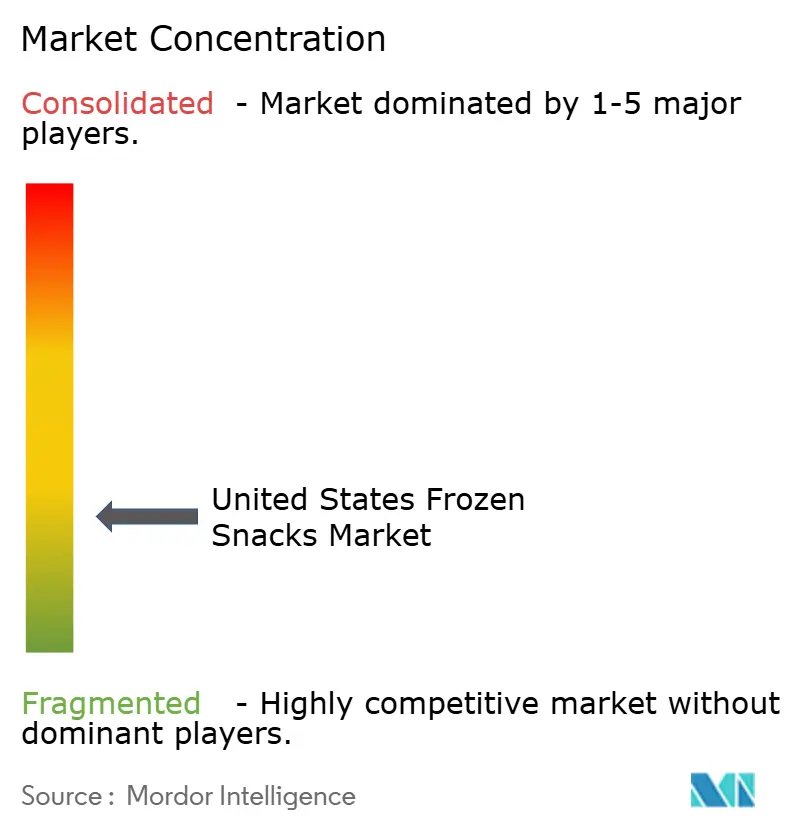
| Market Concentration | Low |
Major Players
*Disclaimer: Major Players sorted in no particular order Image © Mordor Intelligence. Reuse requires attribution under CC BY 4.0. |
|
United States Frozen Snacks Market Analysis by Mordor Intelligence
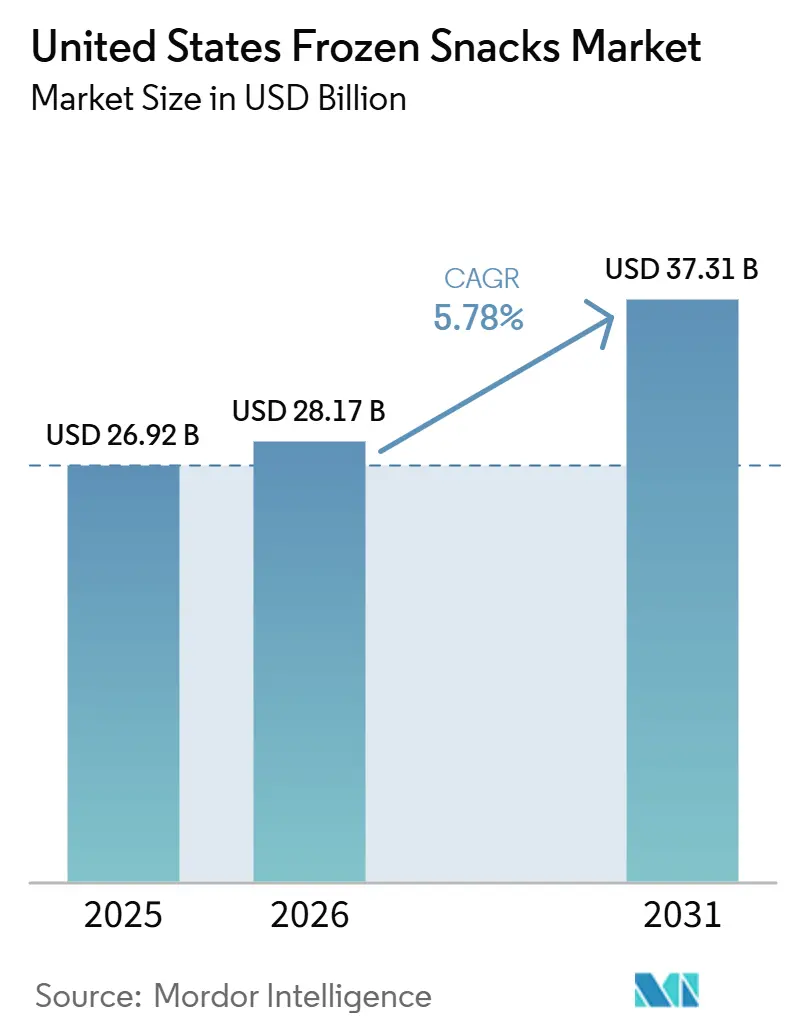
The United States frozen market size is expected to grow from USD 26.92 billion in 2025 to USD 28.17 billion in 2026, and is forecast to reach USD 37.31 billion by 2031 at a 5.78% CAGR over 2026-2031. The United States frozen snacks market benefits from a shift toward planned frozen food purchases rather than purchases driven only by convenience. According to the American Frozen Food Institute and the Food Industry Association, 77% of shoppers purchased frozen food for a specific meal or day in 2026, compared with 71% in 2023, supporting more predictable demand for ready-to-heat formats [1]Source: American Frozen Food Institute, "Power of Frozen in Retail," affi.org. Product design is gaining importance as consumers look for frozen snacks that perform well in air fryers and suit short meal occasions. Manufacturers are also balancing demand for global flavors and protein-focused products with pressure to improve formulations. The United States frozen snacks market, therefore, offers manufacturers opportunities to serve planned meals, family occasions, and foodservice menus while managing formulation and distribution costs.
Key Report Takeaways
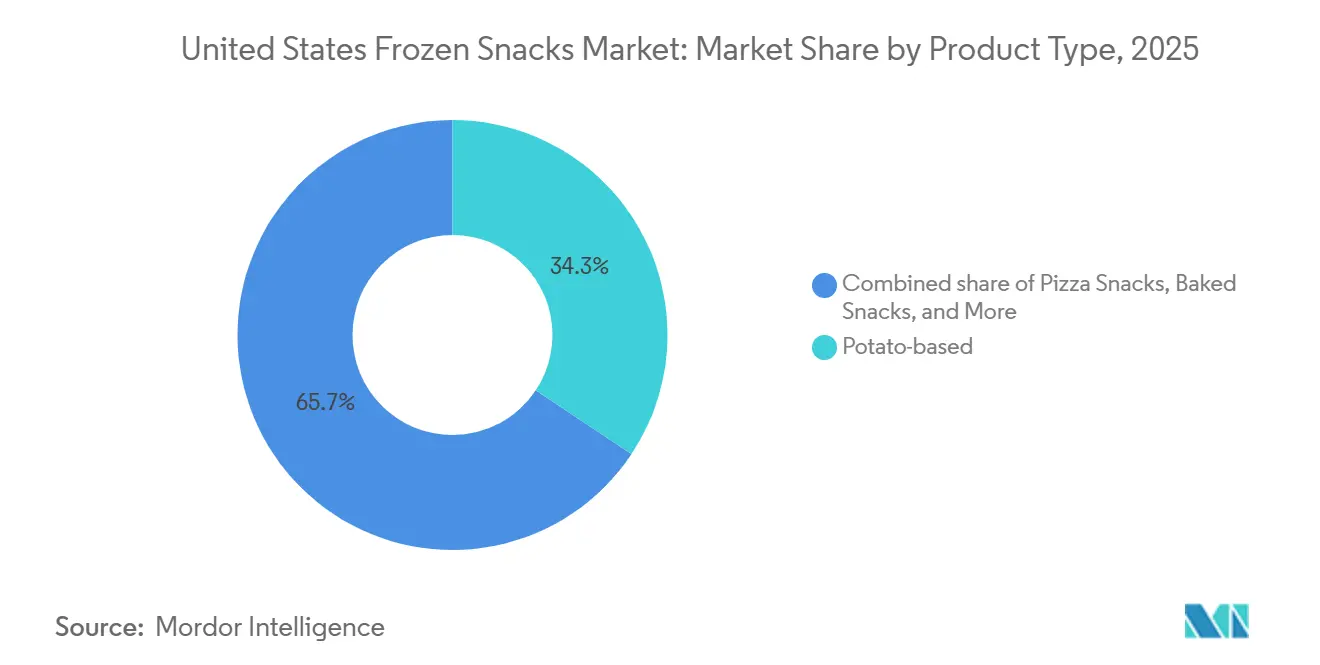
- By product type, potato-based led the United States frozen snacks market with a share of 34.34% in 2025, while plant-based snacks is anticipated to register the fastest CAGR of 7.21% during 2026-2031.
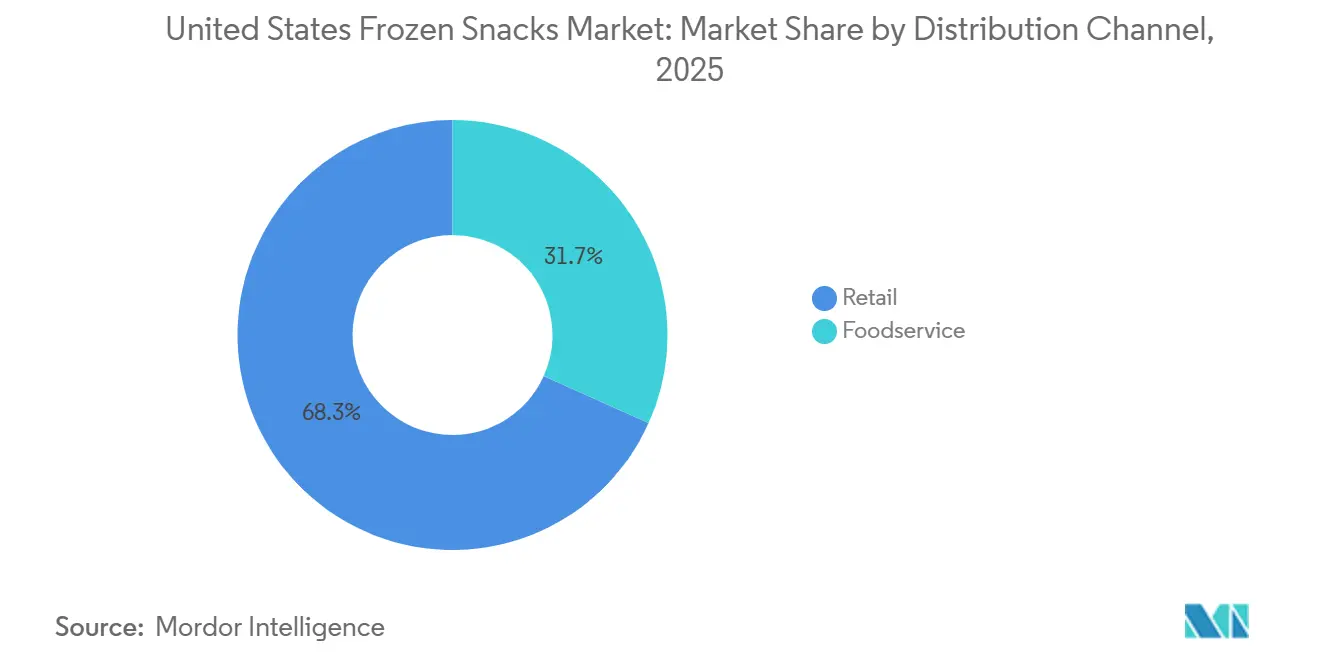
- By distribution channel, retail stores led the market with a share of 68.28% in 2025, while foodservice is anticipated to register the fastest CAGR of 6.43% during 2026-2031.
Note: Market size and forecast figures in this report are generated using Mordor Intelligence’s proprietary estimation framework, updated with the latest available data and insights as of January 2026.
United States Frozen Snacks Market Trends and Insights
Drivers Impact Analysis*
| Driver | % Impact on CAGR Forecast | Geographic Relevance | Impact Timeline |
|---|---|---|---|
| Rising demand for convenient heat-and-eat snack solutions | +1.3% | National, strongest in urban metros | Short term (≤ 2 years) |
| Product innovation in global and ethnic-inspired frozen snack varieties | +1.0% | National, with early gains in coastal metros and Sun Belt cities | Medium term (2-4 years) |
| Rising hispanic cuisine adoption fuels category growth | +0.7% | South, Southwest, and urban metros with large Hispanic populations | Medium term (2-4 years) |
| Premium ingredient formulations elevate consumer value perception | +0.5% | National, with stronger penetration in high-income suburban markets | Long term (≥ 4 years) |
| Busy dual-income households favor frozen snack purchases | +0.8% | National, with concentration in Northeast and Midwest dual-income markets | Short term (≤ 2 years) |
| Strong growth of quick-service restaurants and foodservice | +0.6% | National, including suburban and exurban quick-service restaurants corridors | Medium term (2-4 years) |
| Source: Mordor Intelligence | |||
Rising demand for convenient heat-and-eat snack solutions
The United States frozen snacks market benefits from consumers who frequently use frozen food and plan meals. American Frozen Food Institute and Food Industry Association reported that 40% of shoppers used frozen foods daily or every few days in 2026, compared to 35% in 2019 in the United States. The same research found that 30% of shoppers planned to increase their frozen food purchases. This trend positions frozen snacks as a practical option for households seeking quick preparation without relying on restaurant visits or scratch cooking. Air fryer compatibility further supports purchase frequency, as it reduces preparation time and can improve texture. Manufacturers are responding by enhancing coatings and moisture retention to ensure products perform consistently in home appliances.
Product innovation in global and ethnic-inspired frozen snack varieties
Rising consumer demand for convenient and diverse meal solutions is driving manufacturers to expand their frozen snack portfolios with globally inspired and ethnic flavors tailored to United States preferences. Companies are strengthening their product pipelines with offerings inspired by Mexican, Korean, Japanese, and Mediterranean cuisines, as well as fusion formats, to engage multicultural consumers and younger demographics seeking restaurant-style experiences at home. For instance, Ajinomoto Foods North America offers Japanese-inspired gyoza and ramen-based frozen snacks, while Nestlé offers Hot Pockets in globally inspired flavors, such as Chicken Bacon Ranch and Spicy Pepperoni Pizza. Similarly, Feel Good Foods offers a frozen snack portfolio with globally influenced products, including gluten-free potstickers and egg rolls, supporting category innovation and premiumization in the United States frozen snacks market.
Busy dual-income households favor frozen snack purchases
The growing number of dual-income households and increasingly hectic work schedules in the United States are driving demand for frozen snacks that offer convenience, quick preparation, and minimal cleanup. Consumers increasingly choose heat-and-eat products, such as chicken bites, mozzarella sticks, pizza snacks, and breakfast sandwiches, as convenient meal or snack options during busy weekdays. The rising adoption of microwave- and air fryer-compatible frozen snacks further supports demand, as these products reduce cooking time while maintaining taste and texture. Additionally, hybrid work arrangements and on-the-go snacking habits are encouraging consumers to stock frozen snacks for flexible consumption throughout the day. Reflecting this trend, Tyson Foods launched Tyson Chicken Cups in September 2025. The first-to-category frozen, microwave-ready snack will be available in varieties such as Grilled Boneless Chicken Bites and Popcorn Chicken and is designed to provide a portable, high-protein snack for busy lifestyles.
Strong growth of quick-service restaurants and foodservice
Foodservice provides the United States frozen snacks market with an additional expansion route beyond grocery retail. Restaurants and institutional operators use frozen appetizers and snacks to diversify menus while managing labor requirements. Operators can prepare potato products, pizza snacks, chicken formats, and globally inspired appetizers using standardized procedures across locations. The foodservice channel also favors products that retain crispness during delivery and takeout. McCain Foods United States is set to launch SureCrisp Seaside Fries for the foodservice channel in June 2026, featuring a coating designed to maintain crispness during delivery and takeout. Suppliers with reliable food safety, allergen, and sodium-management programs are better positioned to retain institutional accounts.
Restraints Impact Analysis*
| Restraint | (~) % Impact on CAGR Forecast | Geographic Relevance | Impact Timeline |
|---|---|---|---|
| Rising cold chain logistics costs pressure profitability | -0.6% | National, most acute in Northeast and West Coast high-cost corridors | Short term (≤ 2 years) |
| Health concerns over highly processed frozen snacks | -0.5% | National, with greater sensitivity in health-conscious coastal markets | Medium term (2-4 years) |
| Premium pricing limits value-conscious consumer adoption | -0.3% | National, most pronounced in price-sensitive middle-income markets | Short term (≤ 2 years) |
| Stringent sodium reduction regulations challenge formulations | -0.3% | National, across food categories covered by FDA targets | Long term (≥ 4 years) |
| Source: Mordor Intelligence | |||
Rising cold chain logistics costs pressure profitability
Cold-chain requirements limit flexibility in the United States frozen snacks market, as products require temperature-controlled storage and transportation from the plant to the customer. These costs affect manufacturers, distributors, retailers, and foodservice operators simultaneously. The burden is particularly challenging for smaller manufacturers seeking to enter distant regions without established distribution contracts. The Environmental Protection Agency's hydrofluorocarbon phase-down rules also require refrigerated transport operators to adapt equipment and operating practices over time. Lineage, a temperature-controlled warehousing and logistics company, reported that 73% of North American food and beverage supply-chain leaders expected tariffs to negatively affect financial performance in 2026. The article, updated in August 2024, by United States Department of Agriculture states food stored at 0°F (-18°C) remains safe indefinitely when properly frozen, supporting consumer confidence in frozen food quality and encouraging long-term freezer stocking of frozen snacks [3]Source: United States Department of Agriculture, "Freezing and Food Safety," fsis.usda.gov.
Premium pricing limits value-conscious consumer adoption
Premium frozen snacks made with organic ingredients, restaurant-style recipes, or high-protein formulations often carry significantly higher retail prices than conventional frozen snacks, limiting their appeal among budget-conscious households. Persistent food inflation has made consumers increasingly price-sensitive, encouraging a shift toward private-label and value-priced alternatives. In April 2026, the United States Department of Agriculture reported that United States food-at-home prices in 2025 were 2.3% higher than in 2024, maintaining pressure on household grocery budgets [2]Source: United States Department of Agriculture, "U.S. food-at-home prices," ers.usda.gov. This pricing pressure reduces sales momentum for premium frozen snacks, particularly in mass retail channels where affordability remains a key purchase criterion.
*Our forecasts treat driver/restraint impacts as directional, not additive. The impact forecasts reflect baseline growth, mix effects, and variable interactions.
Segment Analysis
By Product Type: Potato-Based Scale and Plant-Based Growth Broaden the Product Mix
Potato-based snacks accounted for 34.34% of the category in 2025, making them the largest product type. Their strong presence in retail freezers and foodservice menus reflects established supply relationships and broad consumer familiarity. French fries, beer-battered products, seasoned cuts, and shaped potato items remain compatible with common preparation methods. The growing use of air fryers supports this segment, as consumers can prepare potato snacks quickly while maintaining a crisp exterior. Companies such as McCain Foods and Lamb Weston have built strong supply capabilities in potato products. McCain expanded its foodservice offering in April 2026 with Brew City Beer Battered Potato Waves for chefs and restaurants in the United States and Canada.
Plant-based snacks are forecast to grow at a CAGR of 7.21% through 2031, the fastest rate among product types in the United States frozen snacks market. Demand for protein-focused, gluten-free, and vegetable-based products is supporting the United States frozen snacks market size for this segment. Cauliflower-crust bites, edamame snacks, and chickpea-coated items are examples of products aligned with this trend. Smaller portions and higher nutrient density make these formats relevant to consumers adjusting their eating patterns. Pizza snacks, meat-based snacks, baked snacks, and dairy-based snacks add variety across entertainment occasions, family meals, and protein-led consumption occasions. Dairy formats, such as mozzarella sticks and cheese bites, maintain a stable position in appetizer assortments because consumers recognize them across retail and restaurant menus.



By Distribution Channel: Retail Retains Scale While Foodservice Adds Momentum
Retail accounted for 68.28% of the category in 2025, making it the primary route to consumers. Supermarkets, hypermarkets, convenience stores, online grocery services, discounters, and club stores support retail availability. Large packs are particularly relevant for households that stock freezers for multiple meal occasions. Online grocery services can change how consumers discover products, as search, recommendations, and repeat ordering play a larger role than shelf browsing. Retailers can use private-label products to offer lower-priced alternatives and protect their margins. As a result, manufacturers need clear differentiation in flavor, nutrition, preparation performance, or cultural relevance. The United States frozen snacks industry remains dependent on retail execution, as freezer placement, promotional support, and replenishment directly influence trial and repeat purchases.
Foodservice is forecast to register a 6.43% CAGR through 2031, outpacing other distribution channels in the United States frozen snacks market. Quick-service restaurants, full-service restaurants, campuses, and health-care foodservice programs use frozen formats to ensure consistent preparation. The channel requires products that perform well during holding, takeout, and delivery. Frozen appetizers also allow operators to offer broader menus without preparing every item from raw ingredients. McCain's SureCrisp Seaside Fries illustrate how manufacturers address this requirement through coatings that preserve crispness after preparation.
Geography Analysis
The United States frozen snacks market has a national scope, but regional demand varies by household structure, local food preferences, and distribution economics. The South and Southwest are expected to remain important growth areas, supported by population growth, strong quick-service restaurant activity, and large Hispanic communities. Texas, California, and Florida generate meaningful demand for frozen Mexican-style products such as burritos, taquitos, and tamales. Brands such as Ruiz Foods' El Monterey and CJ CheilJedang's Bibigo can leverage regional cultural familiarity to drive repeat purchases. Hispanic-inspired flavors also have an opportunity to reach households beyond their original cultural base when retailers provide visibility in mainstream freezer sections. This trend supports a broader product mix in areas where shoppers expect familiar and global flavors to sit together.
The Midwest remains a major volume center for the United States frozen snacks market due to its dense grocery coverage, strong club-store penetration, and access to manufacturing. The region's retail infrastructure helps suppliers reach many households through established frozen-food networks. The Midwest also plays an important role in private-label production, enabling retailers to serve value-conscious shoppers. Multigenerational and larger households support demand for multi-serve packs across the Midwest and Northeast. These households do not necessarily view frozen snacks as occasional purchases, as they can use these products for meals, school-day eating, and shared gatherings. As a result, freezer stocking behavior, along with single-occasion purchases, shapes the United States frozen snacks market size.
The West Coast serves as an early testing ground for plant-based, globally inspired, and better-for-you frozen products. California and the Pacific Northwest often provide new formats with access to consumers interested in gluten-free and vegetable-based options. CAULIPOWER expanded from California-focused specialty retail into national chains before Urban Farmer's acquisition of the company, which is expected in November 2025. Mountain and Plains states may offer further distribution opportunities as population inflows and grocery fulfillment networks develop. Digital-first distribution can help brands reach secondary markets without building their own cold-chain networks. Regional growth will depend on suppliers' ability to maintain reliable frozen delivery while tailoring product choices to local demand.
Competitive Landscape
The United States frozen snacks market has a fragmented competitive structure, with large manufacturers, private-label manufacturers, and smaller specialized brands operating across product types. No manufacturer holds a decisive position across the full category. Established manufacturers compete through broad retail distribution, foodservice relationships, manufacturing capacity, and brand recognition. Smaller brands typically compete through focused product formats or distinct flavor positioning. This structure creates opportunities for companies that can combine cultural credibility, high-protein nutrition, and convenient air fryer preparation. The United States frozen snacks market also rewards suppliers that maintain reliable freezer distribution, as product availability remains critical to repeat sales.
Conagra is strengthening manufacturing control to support its refrigerated and frozen portfolio. In March 2026, the company plans to commit USD 220 million to expand its Fayetteville, Arkansas, facility, increasing chicken production capacity for Hungry-Man, Banquet, Healthy Choice, Gardein, and Evol products. The investment shows how major manufacturers use production capacity to support service levels and manage input costs. Conagra is also using inventory management and demand forecasting to reduce out-of-stocks, which can be especially damaging in frozen categories. These capabilities are becoming increasingly important as manufacturers expect dependable replenishment.
Acquisitions and product launches show how other companies are building positions in the United States frozen snacks market. In February 2026, CAULIPOWER plans to introduce high-protein single-serve pizzas and bowls. These moves reflect competition across scale, private-label capability, and better-for-you product development. Companies with clear positions in protein-rich or culturally specific formats may find opportunities where larger portfolios have less focus.
United States Frozen Snacks Industry Leaders
-
Unilever PLC
-
Nestlé S.A.
-
General Mills Inc.
-
Conagra Brands, Inc.
-
Kraft Heinz
- *Disclaimer: Major Players sorted in no particular order

Recent Industry Developments
- June 2026: McCain Foods United States launched SureCrisp Seaside Fries for the foodservice channel. The lightly coated, pre-seasoned fries are engineered to retain crispness during delivery and takeout, directly addressing the needs of delivery-focused restaurants, where conventional fries often lose quality.
- April 2026: McCain Foods introduced Brew City Beer Battered Potato Waves for chefs and restaurants across the United States and Canada, expanding its premium frozen potato snack line for foodservice.
- January 2026: Rich Products Corporation acquired Great Kitchens Food Company, adding three manufacturing facilities, 1,000 employees, and deep-dish and handheld pizza capabilities to Rich's portfolio. This acquisition helped the company expand capabilities in fully topped, take-and-bake frozen pizzas.
- November 2025: Paine Schwartz Partners-backed Urban Farmer completed the acquisition of CAULIPOWER, creating a vertically integrated platform in the better-for-you frozen category.


United States Frozen Snacks Market Report Scope
Frozen snacks are ready-to-eat or ready-to-cook food products preserved through freezing to extend shelf life while maintaining quality, taste, and texture.
The United States frozen snacks market is segmented by product type and distribution channel. By product type, the market is segmented into potato-based snacks, pizza snacks, meat-based snacks, baked snacks, dairy-based snacks, plant-based snacks, and others. By distribution channel, the market is segmented into retail (supermarkets/hypermarkets, convenience stores, online retail stores, discounters and club stores, and others) and foodservice (quick-service restaurants, full-service restaurants, institutional catering). The market forecasts are provided in terms of value (USD) and Volume (Tonnes).
| Potato-based snacks |
| Pizza Snacks |
| Meat-based snacks |
| Baked Snacks |
| Dairy-based snacks |
| Plant-based snacks |
| Others |
| Retail | Supermarkets/Hypermarkets |
| Convenience Stores | |
| Online Retail Stores | |
| Discounters and Club Stores | |
| Others | |
| Foodservice | Quick-service Restaurants |
| Full service Restaurants | |
| Institutional Catering |
| By Product Type | Potato-based snacks | |
| Pizza Snacks | ||
| Meat-based snacks | ||
| Baked Snacks | ||
| Dairy-based snacks | ||
| Plant-based snacks | ||
| Others | ||
| By Distribution Channel | Retail | Supermarkets/Hypermarkets |
| Convenience Stores | ||
| Online Retail Stores | ||
| Discounters and Club Stores | ||
| Others | ||
| Foodservice | Quick-service Restaurants | |
| Full service Restaurants | ||
| Institutional Catering | ||


Key Questions Answered in the Report
What is the current and forecasted size of the United States frozen snacks market?
The United States frozen snacks market is valued at USD 26.92 billion in 2025 and is projected to reach USD 37.31 billion by 2031, growing at a CAGR of 5.78% during 2026–2031.
Which product type holds the largest share of the United States frozen snacks market?
Potato-based frozen snacks represent the largest product segment, accounting for 34.34% of the market in 2025.
Which distribution channel dominates the United States frozen snacks market?
The retail channel is the leading distribution channel, holding 68.28% of the market share in 2025.
Which distribution channel is projected to grow the fastest?
The foodservice channel is expected to be the fastest-growing distribution channel, with a CAGR of 6.43% between 2026 and 2031.
Which product type is expected to grow the fastest during the forecast period?
Plant-based snacks are expected to be the fastest-growing product type, registering a CAGR of 7.21% from 2026 to 2031.
Page last updated on:





