
United States Frozen Food Market Size and Share
Market Overview
| Study Period | 2021 - 2031 |
|---|---|
| Forecast Data Period | 2026 - 2031 |
| Base Year Market Size (2025) | USD 55.47 Billion |
| Market Size (2026) | USD 57.94 Billion |
| Market Size (2031) | USD 74.78 Billion |
| Growth Rate (2026 - 2031) | 5.24 % |
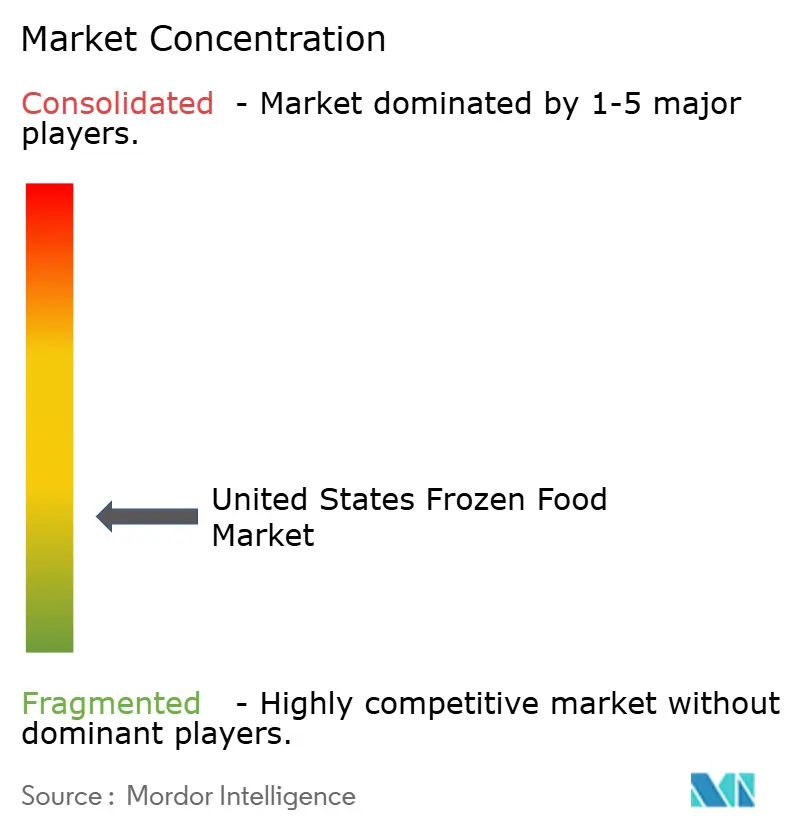
| Market Concentration | Low |
Major Players
*Disclaimer: Major Players sorted in no particular order Image © Mordor Intelligence. Reuse requires attribution under CC BY 4.0. |
|
United States Frozen Food Market Analysis by Mordor Intelligence
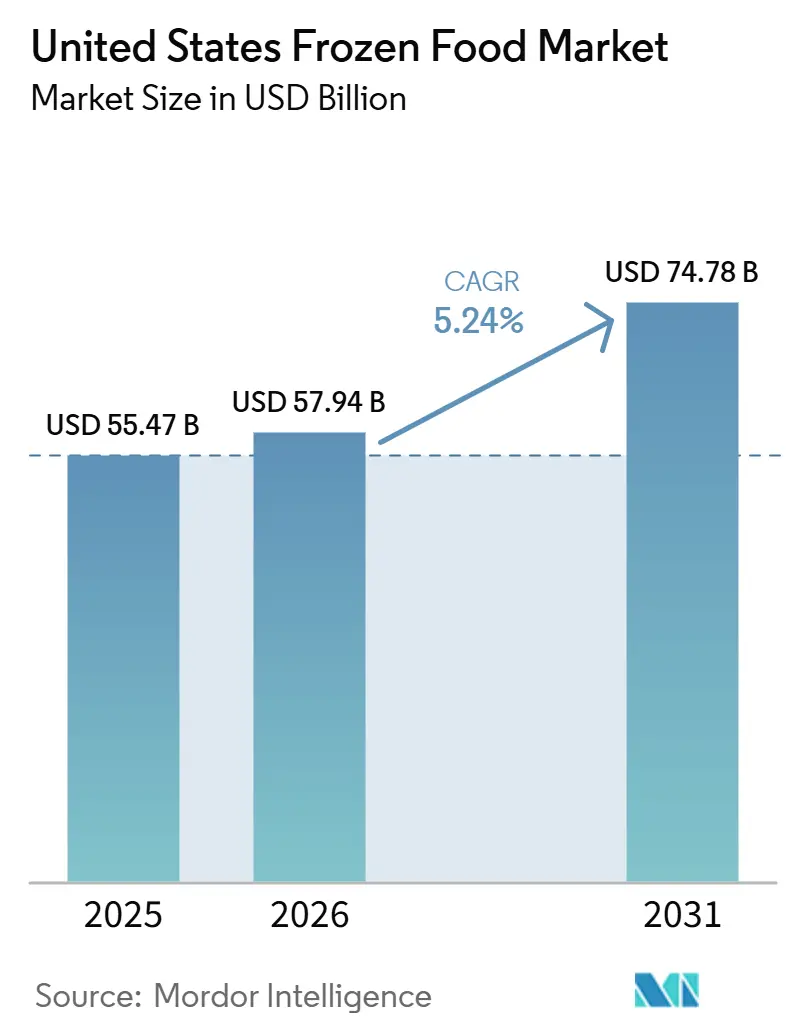
The United States frozen food market size is expected to grow from USD 55.47 billion in 2025 to USD 57.94 billion in 2026, and is forecast to reach USD 74.78 billion by 2031 at a 5.24% CAGR over 2026-2031. The United States frozen food market is supported by household demand for convenient meal options that can replace select restaurant occasions. Retail sales are expected to reach USD 87 billion in the 52 weeks ending September 2025, indicating that frozen food is becoming part of regular meal planning rather than a reserve purchase, stated by American Frozen Food Institute [1]Source: American Frozen Food Institute, "Power of Frozen in Retail report" affi.org. The United States frozen food market also benefits from premium product development, online grocery access, and nutrition-focused formats. However, higher refrigerated transport costs and stricter labeling requirements remain material constraints. The competitive environment remains fragmented, with giant manufacturers maintaining broad shelf presence while retailers and newer brands expand their premium and protein-focused offerings.
Key Report Takeaways
- By product type, frozen ready meals led the United States frozen food market with a share of 34.34% in 2025, while frozen meat and seafood is anticipated to register the fastest CAGR of 6.16% during 2026-2031.
- By category, ready-to-cook led the market with a share of 68.28% in 2025, while ready-to-eat is anticipated to register the fastest CAGR of 6.02% during 2026-2031.
- By distribution channel, off-trade led the market with a share of 81.47% in 2025, while on-trade is anticipated to register the fastest CAGR of 5.89% during 2026-2031.
Note: Market size and forecast figures in this report are generated using Mordor Intelligence’s proprietary estimation framework, updated with the latest available data and insights as of January 2026.
United States Frozen Food Market Trends and Insights
Drivers Impact Analysis*
| Driver | % Impact on CAGR Forecast | Geographic Relevance | Impact Timeline |
|---|---|---|---|
| Growing consumer preference for high-protein frozen foods | +0.9% | National, strongest in Pacific West and Northeast urban markets | Short term (≤ 2 years) |
| Busy dual-income households favor frozen snack purchases | +0.8% | National, with suburban markets outpacing urban cores | Short term (≤ 2 years) |
| Continuous innovation in premium frozen meal offerings | +0.7% | National, with early acceleration in upper-income suburban clusters | Medium term (2-4 years) |
| Strong growth of quick-service restaurants and foodservice | +0.7% | National, with highest QSR density in the Southeast and Midwest | Medium term (2-4 years) |
| Expansion of plant-based and clean-label frozen products | +0.5% | National, with the West Coast and Northeast leading adoption | Medium term (2-4 years) |
| Increasing focus on food waste reduction and shelf life extension | +0.4% | National, with cold chain investment benefiting all United States regions | Long term (≥ 4 years) |
| Source: Mordor Intelligence | |||
Growing consumer preference for high-protein frozen foods
The growing focus on protein-rich diets for weight management, muscle maintenance, and overall wellness is accelerating demand for high-protein frozen foods in the United States. Consumers are increasingly choosing frozen meals that combine convenience with nutritional value, encouraging manufacturers to expand protein-rich offerings across meat, seafood, and plant-based categories. In 2026, the United States Department of Agriculture and the United States Department of Health and Human Services progressed with the development of the 2025-2030 Dietary Guidelines for Americans, reinforcing their focus on evidence-based dietary guidance to support healthy food choices across the country. The guidelines advise consumers to avoid “hyperprocessed” foods while recommending higher overall protein intake, primarily from animal sources[3]Source: United States Department of Agriculture, "Dietary Guidelines for Americans " cdn.realfood.gov. This continued federal emphasis on nutrition is reinforcing demand for protein-focused frozen food products.
Busy dual-income households favor frozen food purchases
Dual-income households continue to support demand for frozen snacks and prepared meal formats, as these products reduce the time required for routine cooking. The United States frozen food market serves households that need flexible options for workdays, school schedules, and informal family meals. Frozen snacks can function as quick meal replacements or indulgent options, broadening the reasons for consumers to visit the freezer aisle and enabling manufacturers to target daytime, evening, and informal gathering occasions. Family-size ready meals also address demand from multigenerational households and at-home social occasions. This demand pattern benefits manufacturers that offer both single-serve and multi-serve formats without compromising preparation convenience, as the same household may need a quick individual option on one occasion and a family meal on another.
Continuous innovation in premium frozen meal offerings
Premium frozen meals are strengthening the value proposition of the United States frozen food market. Demand for restaurant-style flavors at home is increasing rapidly in America. Kroger is expected to expand its Private Selection line in March 2026 with more than 20 premium frozen and refrigerated options based on globally inspired flavors. Retailers are helping shape demand for premium frozen food while retaining a larger share of the margin that previously went to branded manufacturers. As a result, store brands are becoming more direct competitors in restaurant-inspired meal formats. Manufacturers are using culinary cues, health credentials, portion formats, and appliance compatibility to differentiate their offerings. This trend is pressuring mid-tier brands that lack a clear value position or differentiated product benefit, as they must compete with private labels on price and with premium lines on culinary and nutrition attributes.
Strong growth of quick-service restaurants and foodservice
Quick-service restaurants and institutional kitchens generate steady demand for frozen fries, breaded proteins, buns, appetizers, and sauce components. The United States frozen food market serves foodservice operators that require consistent portions and reduced dependence on back-of-house preparation. Frozen products also help operators manage uneven ingredient supply and labor cost pressures by enabling kitchens to use standardized inputs that can be stored until needed for service. The National Restaurant Association projects United States restaurant industry sales to reach USD 1.55 trillion in 2026 [2]Source: National Restaurant Association, "State of the Restaurant Industry " restaurant.org. Growth in quick-service restaurants is especially relevant in the Southeast and Midwest, where restaurant density supports regular commercial demand. Foodservice suppliers can benefit from formats that combine simple preparation with reliable quality across multiple locations, particularly when operators need consistent results across kitchens with varying staffing levels and local supply conditions.
Restraints Impact Analysis*
| Restraint | (~) % Impact on CAGR Forecast | Geographic Relevance | Impact Timeline |
|---|---|---|---|
| Rising cold chain logistics costs pressure profitability | -0.7% | National, with Eastern United States freight lanes most affected by capacity tightening | Short term (≤ 2 years) |
| Health concerns over highly processed frozen foods | -0.5% | National, with strongest resistance in West Coast and Northeast urban markets | Medium term (2-4 years) |
| Stringent food safety and labeling compliance requirements | -0.4% | National, with greater multi-state complexity for large distributors | Medium term (2-4 years) |
| Stringent sodium reduction regulations challenge formulations | -0.3% | National, affecting commercially packaged frozen foods | Long term (≥ 4 years) |
| Source: Mordor Intelligence | |||
Rising cold chain logistics costs pressure profitability
Cold chain costs pose an immediate restraint for the United States frozen food market. According to the Cold Chain Insights Survey by Lineage found that 73% of North American cold chain decision-makers expect tariffs to hurt their supply chain finances in 2026. The same survey found that 57% believe tariff effects on 2025 costs have exceeded expectations. The Environmental Protection Agency’s phase-down of hydrofluorocarbon refrigerants also requires fleet operators to plan changes in refrigeration equipment, adding another planning requirement for carriers that transport frozen products across national freight lanes. Manufacturers with national distribution needs must carefully manage transport, equipment, and input costs, as these costs can be harder to absorb across products that require continuous temperature control from the plant to the retail outlet.
Health concerns over highly processed frozen foods
Health concerns related to highly processed foods create a reputational constraint for the United States frozen food market. Consumer skepticism remains strongest among urban, higher-income, and health-focused shoppers, who also represent a key target audience for premium frozen food innovation. Frozen meals and snacks face added scrutiny because sodium supports taste and product stability, making it more difficult for manufacturers to balance nutrition objectives with established product expectations. In August 2024, the Food and Drug Administration issued Phase II voluntary sodium reduction guidance for 163 food categories. The guidance aims to reduce average sodium intake from 3,400 milligrams per day to 2,750 milligrams per day. Companies that reformulate before stricter market expectations take hold can strengthen their position with retailers and consumers, particularly as premium retail accounts assess nutrition credentials alongside convenience and flavor.
*Our forecasts treat driver/restraint impacts as directional, not additive. The impact forecasts reflect baseline growth, mix effects, and variable interactions.
Segment Analysis
By Product Type: Diversified Portfolio With Protein Formats Outpacing the Mix
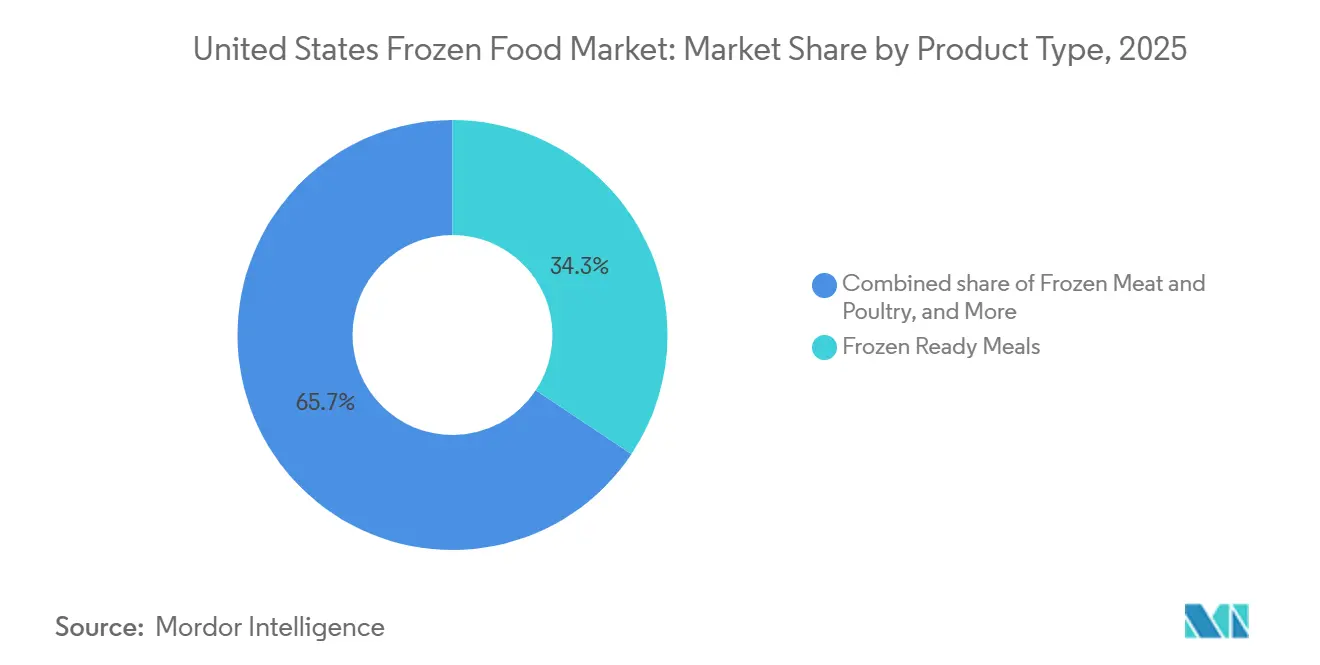
Frozen ready meals accounted for 34.34% of the United States frozen food market share in 2025, making them the leading product type. Restaurant-inspired formats, flexible portions, and multi-serve family options support the segment’s growth. Frozen fruits and vegetables, frozen bakery and desserts, and frozen snacks address frequent everyday consumption needs across the United States frozen food market. Frozen snacks also benefit from their use in meal replacement and indulgence occasions, which may increase the frequency of freezer aisle purchases.
Frozen meat and seafood is expected to be the fastest-growing product type in the United States frozen food market, forecasted to register a CAGR of 6.16% from 2026 to 2031. Growth is shifting beyond basic protein purchases toward marinated, value-added, and format-ready products. High Liner Foods is set to introduce Sea Cuisine Skillet Meals in July 2026, including Mediterranean-Style Sole, Thai Red Curry Salmon, and Chili Garlic Shrimp. The launch targets a ready-to-cook, complete-meal occasion rather than a protein-only purchase. The others category continues to include ethnic foods, dietary formats, and newer functional products, where smaller brands have room to enter.



By Product Category: Ready-to-Cook Scale Meets Ready-to-Eat Momentum
Ready-to-Cook accounted for 68.28% of the United States frozen food market share in 2025. Consumers value the ability to customize meals while using pre-seasoned or pre-portioned products that reduce cooking time. Air fryers and other high-heat appliances further support this segment, as frozen proteins and vegetables can include preparation instructions for meals ready in under 15 minutes. Ready-to-Cook products provide a middle ground between scratch cooking and fully prepared meals.
Ready-to-Eat is expected to be the fastest-growing product category, with the United States frozen food market size projected to expand at a CAGR of 6.02% from 2026 to 2031. The category benefits from demand for products that eliminate meal preparation steps. Smaller, nutritionally complete portions also suit consumers seeking flexible meal timing and controlled serving sizes. Nearly 90% of online grocery shoppers in America purchased frozen food through digital channels in the last six months before October 2025, according to an American Frozen Food Institute and Food Industry Association survey. Digital search, repeat ordering, and home delivery favor ready-to-eat products that are easy to understand and replenish. Brands that protect product quality during delivery can benefit from this shift in purchasing behavior.
By Distribution Channel: Off-Trade Dominance With Foodservice Narrowing the Gap
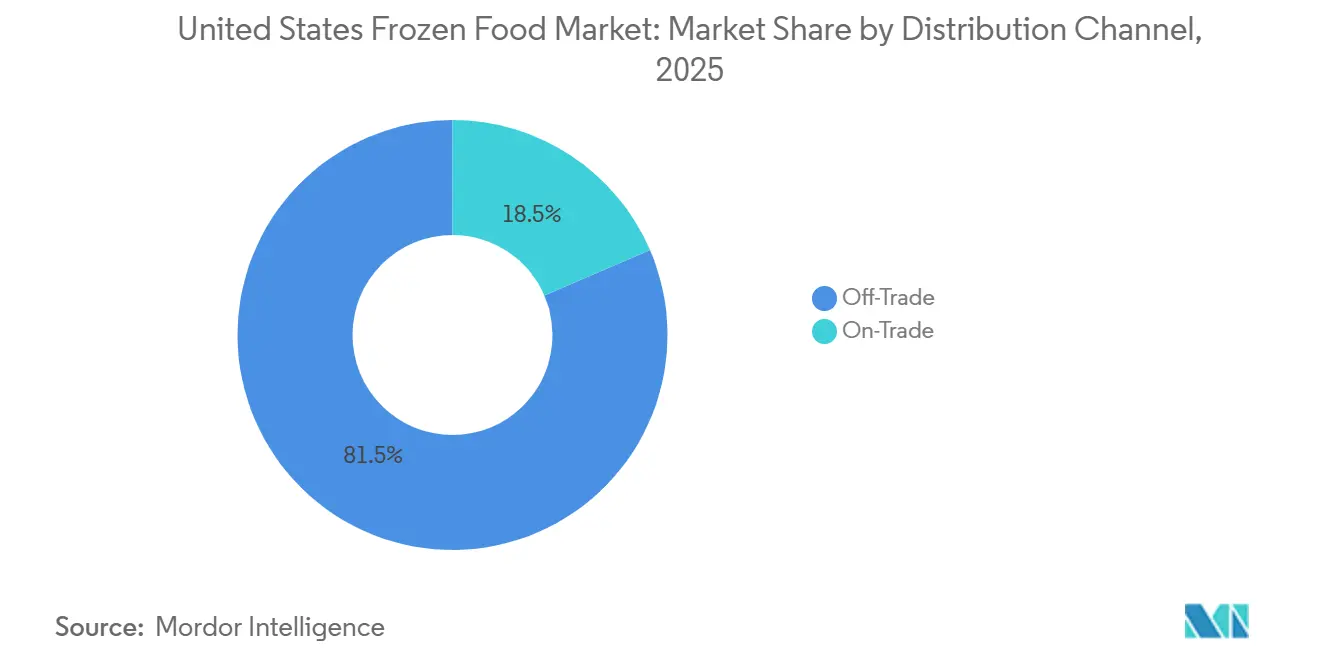
Off-Trade accounted for 81.47% of the United States frozen food market share in 2025, with supermarkets and hypermarkets serving as the primary route to consumers. Online stores are the fastest-growing off-trade sub-channel, as grocery delivery services expand frozen product offerings. The United States frozen food market benefits as online grocery platforms help premium and health-positioned products reach consumers beyond the constraints of physical shelf space. Convenience stores also serve as an important outlet for single-serve meals and frozen food.
On-trade is forecast to grow at a CAGR of 5.89% from 2026 to 2031, making it the fastest-growing distribution channel. Quick-service restaurants, cafeterias, healthcare facilities, and hospitality operators use frozen products to reduce preparation time and maintain portion consistency. Frozen food also helps commercial kitchens manage labor availability and fluctuations in food prices. As a result, the United States frozen food industry has a commercial opportunity in products that improve speed and consistency in high-volume kitchens. Foodservice growth does not replace retail demand; instead, it broadens purchasing occasions for suppliers.
Geography Analysis
The United States frozen food market demonstrates strong regional demand dynamics influenced by population density, income levels, lifestyle trends, retail infrastructure, and consumer preferences. The Southern United States accounts for the largest share of the frozen food market, supported by a large consumer base, expanding metropolitan areas, and a strong network of mass retailers, warehouse clubs, and supermarket chains. Sustained demand for convenient meal solutions and frozen snacks among working families continues to drive market growth across states such as Texas, Florida, and Georgia.
The Western United States, led by California, remains a key market for premium frozen foods, including organic, plant-based, high-protein, and internationally inspired products. The region’s diverse population, higher disposable incomes, and strong preference for health-focused products support manufacturer investments in innovative frozen meals, vegetables, and snack offerings.
The Midwest and Northeast are mature frozen food markets supported by advanced cold chain infrastructure, high household freezer penetration, and well-established retail networks. States such as Illinois, Ohio, New York, and Pennsylvania continue to record stable demand for frozen pizzas, vegetables, breakfast foods, and ready meals. Increasing adoption of online grocery and home delivery services further supports growth in these regions.
Competitive Landscape
The United States frozen food market remains fragmented. Conagra Brands, Tyson Foods, Nestlé, General Mills, and Kraft Heinz maintain major branded retail footprints. These companies are focusing investments on higher-growth frozen categories while reviewing slower-growth portfolio assets. Conagra Brands’ USD 220 million investment in its Fayetteville, Arkansas, chicken facility in March 2026 reflected a strategic shift away from mature shelf-stable brands and toward capacity expansion for core frozen protein products.
Kroger planned to add more than 20 premium frozen and refrigerated Private Selection products in March 2026, including globally inspired options and restaurant-style entrees. CJ CheilJedang uses Bibigo dumplings and Korean-inspired formats to compete for premium freezer space at major United States retailers. High Liner Foods is repositioning frozen seafood through skillet-ready complete meals instead of commodity-style protein offerings. Its planned acquisition of the Mrs. Paul’s and Van de Kamp’s brands from Conagra in June 2025 is expected to strengthen its United States seafood manufacturing position.
The Food and Drug Administration proposed front-of-package labeling that would make nutrition information more visible. Brands with cleaner nutritional profiles may convert this requirement into a commercial advantage. Ethnic frozen food, premium single-serve products, and protein-focused smaller meals remain areas where no single supplier has established broad control. Bellisio Foods and Applegate Farms maintain positions in budget meals and natural or organic protein offerings.
United States Frozen Food Industry Leaders
-
Nestlé S.A.
-
General Mills Inc.
-
Conagra Brands, Inc.
-
Tyson Foods, Inc.
-
Smithfied Foods, Inc
- *Disclaimer: Major Players sorted in no particular order

Recent Industry Developments
- June 2026: Conagra Brands launched an extensive summer frozen product lineup across its Banquet Mega, P.F. Chang’s, and Birds Eye brand portfolios. The lineup includes chicken tenders, multi-serve meals, protein bowls, and flash-frozen vegetable innovations.
- June 2026: High Liner Foods Incorporated introduced Sea Cuisine Skillet Meals at Seafood Expo North America. The lineup includes Mediterranean-Style Sole, Thai Red Curry Salmon, and Chili Garlic Shrimp, with national United States distribution.
- March 2026: B&G Foods, Inc. completed the sale of its Green Giant United States frozen vegetable product line to Seneca Foods Corporation, continuing its multiyear portfolio exit from the Green Giant brand.


United States Frozen Food Market Report Scope
Frozen food refers to food products preserved by freezing at low temperatures to maintain freshness, nutritional value, texture, and shelf life. It includes products such as ready meals, fruits and vegetables, meat and poultry, seafood, bakery products, desserts, and snacks, among others, that require minimal preparation before consumption.
The United States frozen food market is segmented by product type, product category, and distribution channel. By product type, the market is segmented into frozen fruits and vegetables, frozen meat and seafood, frozen ready meals, frozen bakery and dessert, frozen snacks, and others. By product category, the market is segmented into ready-to-eat and ready-to-cook. By distribution channel, the market is segmented into on-trade and off-trade (supermarkets/hypermarkets, convenience stores, online retail stores, and others). The market forecasts are provided in terms of value (USD) and volume (tonnes).
| Frozen Fruits and Vegetables |
| Frozen Meat and Seafood |
| Frozen Ready Meals |
| Frozen Bakery and Dessert |
| Frozen Snacks |
| Others |
| Ready-to-Eat |
| Ready-to-Cook |
| On-Trade | |
| Off-Trade | Supermarkets/Hypermarkets |
| Convenience Stores | |
| Online Retail Stores | |
| Others |
| By Product Type | Frozen Fruits and Vegetables | |
| Frozen Meat and Seafood | ||
| Frozen Ready Meals | ||
| Frozen Bakery and Dessert | ||
| Frozen Snacks | ||
| Others | ||
| By Product Category | Ready-to-Eat | |
| Ready-to-Cook | ||
| By Distribution Channel | On-Trade | |
| Off-Trade | Supermarkets/Hypermarkets | |
| Convenience Stores | ||
| Online Retail Stores | ||
| Others | ||


Key Questions Answered in the Report
What is the current and projected size of the United States Frozen Food Market?
The United States frozen food market was valued at USD 55.47 billion in 2025 and is estimated to grow to USD 74.78 billion by 2031, registering a CAGR of 5.24% during 2026–2031.
Which product type held the largest share of the United States Frozen Food Market in 2025?
Frozen ready meals was the largest product type segment, accounting for 34.34% of the market in 2025.
Which category dominated the United States Frozen Food Market in 2025?
The ready-to-cook category dominated the market, holding a 68.28% share in 2025.
Which category is expected to witness the highest growth during 2026–2031?
The ready-to-eat category is projected to be the fastest-growing category, expanding at a CAGR of 6.02% during the forecast period.
Which distribution channel accounted for the largest market share in 2025?
The off-trade distribution channel led the market with an 81.47% share in 2025.
Which distribution channel is expected to grow the fastest from 2026 to 2031?
The on-trade distribution channel is expected to be the fastest-growing channel, recording a CAGR of 5.89% between 2026 and 2031.
Page last updated on:





