
United States-Europe Ro-Ro Ocean Freight Transport Market Size and Share
Market Overview
| Study Period | 2020 - 2031 |
|---|---|
| Forecast Data Period | 2026 - 2031 |
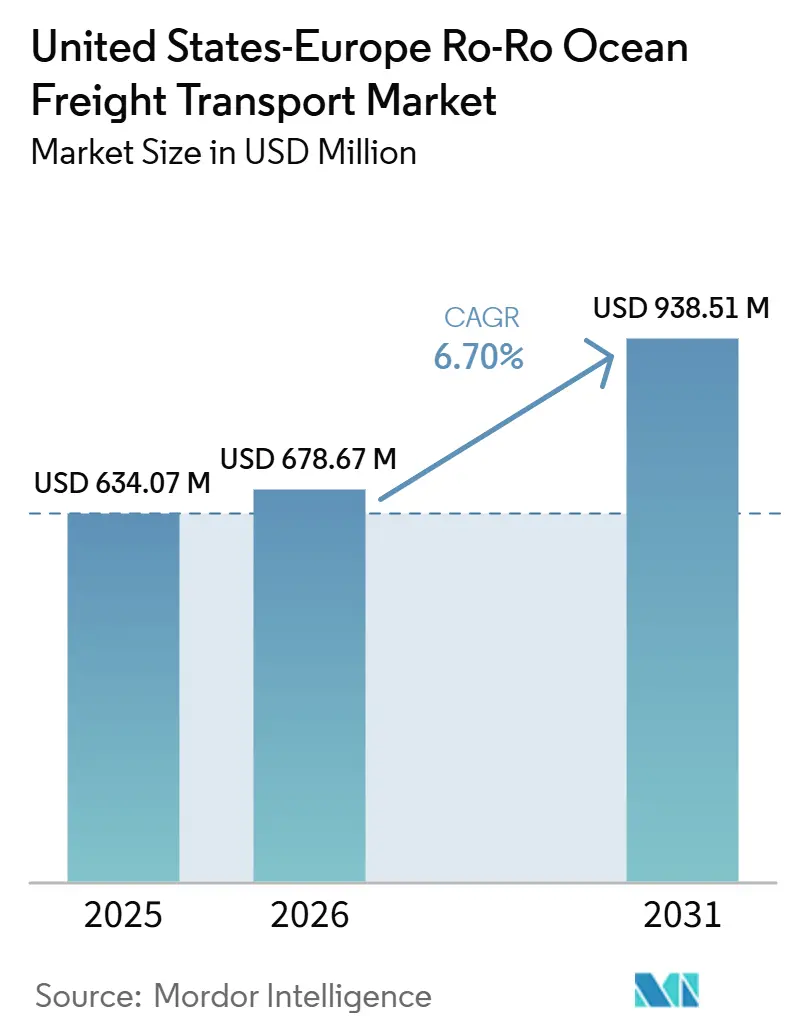
| Base Year Market Size (2025) | USD 634.07 Million |
| Market Size (2026) | USD 678.67 Million |
| Market Size (2031) | USD 938.51 Million |
| Growth Rate (2026 - 2031) | 6.70 % |
| Market Concentration | Medium |
Major Players *Disclaimer: Major Players sorted in no particular order Image © Mordor Intelligence. Reuse requires attribution under CC BY 4.0. | |
United States-Europe Ro-Ro Ocean Freight Transport Market Analysis by Mordor Intelligence
The United States-Europe Ro-Ro ocean freight transport market size was valued at USD 634.07 million in 2025 and is estimated to grow from USD 678.67 million in 2026 to reach USD 938.51 million by 2031, at a CAGR of 6.70% during the forecast period 2026-2031.
The United States-Europe Ro-Ro ocean freight transport market is advancing on the back of durable automotive trade links between North America and Europe, even as tariff changes continue to disrupt planning across the corridor. The market also remains shaped by operational shocks that began in 2024, including the Francis Scott Key Bridge collapse and Red Sea rerouting, both of which tightened vessel deployment and raised cost pressure on carriers. Fleet renewal is becoming a central competitive factor in the United States-Europe Ro-Ro ocean freight transport market because larger and more efficient pure car and truck carriers are reducing unit transport costs for operators that can fund modern tonnage. At the same time, smaller carriers face a tougher margin environment as bunker cost pass-through, schedule reliability, and compliance needs are becoming more demanding across transatlantic sailings. The United States-Europe Ro-Ro ocean freight transport market is therefore growing in a setting where demand remains structurally strong. Still, profitability increasingly depends on fleet quality, route access, and long-term contracts.
Key Report Takeaways
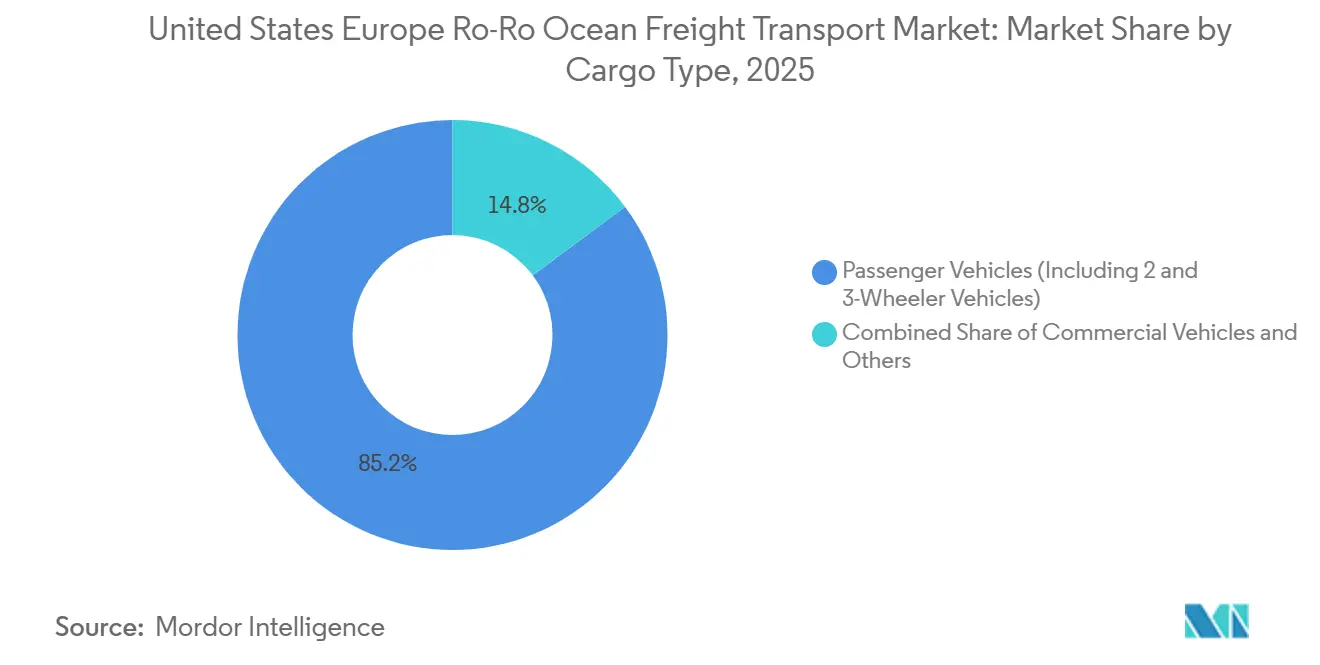
- By cargo type, passenger vehicles held 85.18% of the United States-Europe Ro-Ro ocean freight transport market share in 2025, while commercial vehicles are projected to expand at 8.39% CAGR through 2031.
- By vessel-size, large vessels accounted for 64.93% of the United States Europe Ro-Ro ocean freight transport market size in 2025, while mid-size vessels are forecast to record the fastest CAGR at 8.76% through 2031.
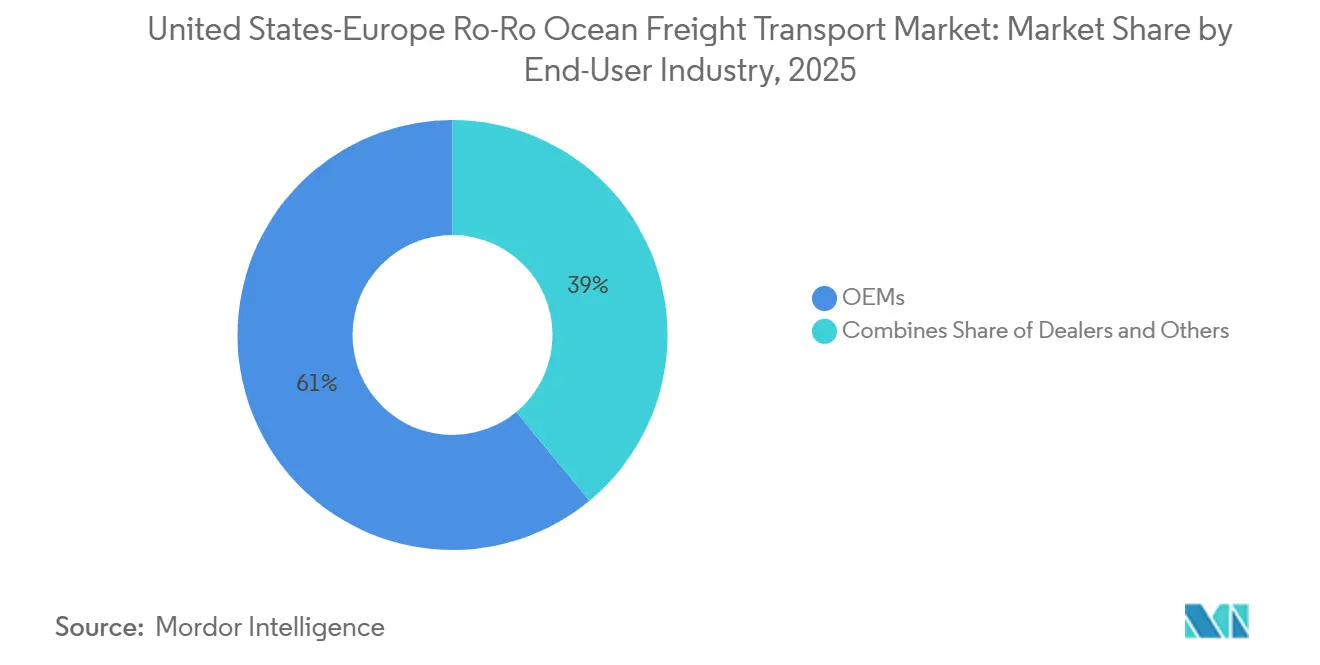
- By end-user industry, OEMs held 61% of the United States-Europe Ro-Ro ocean freight transport market share in 2025, while the others segment is expected to grow at 9.18% CAGR through 2031.
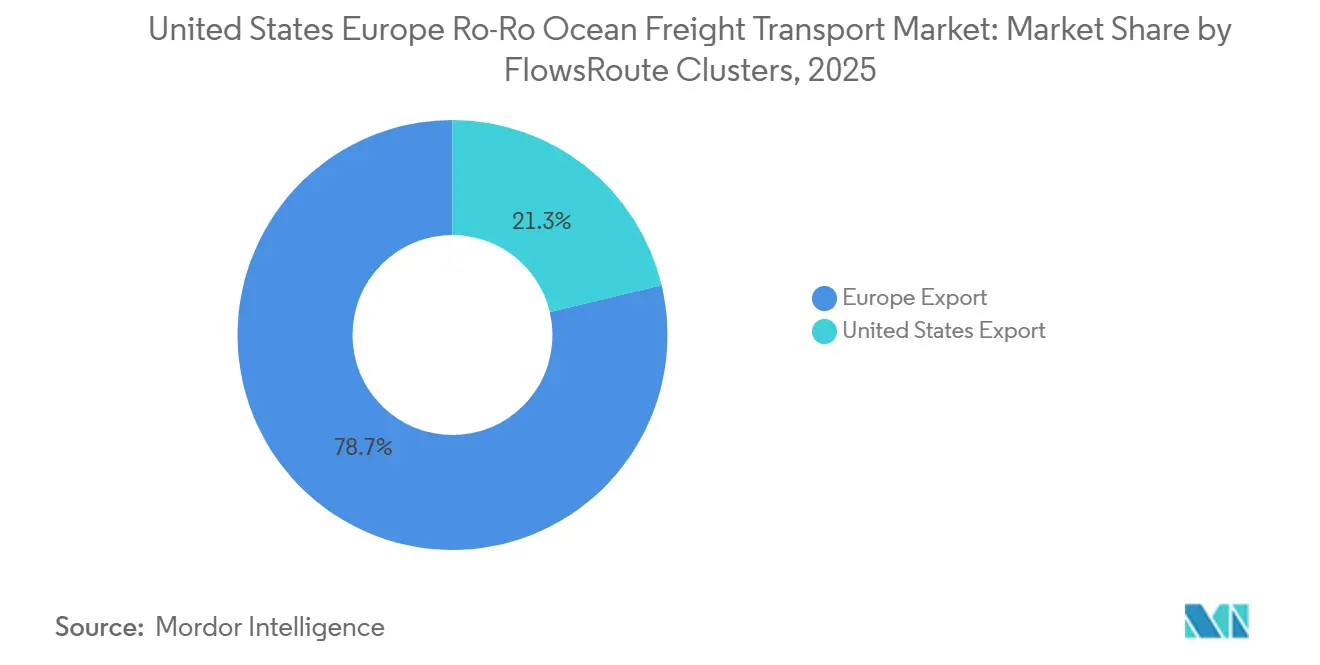
- By flows and route clusters, Europe exports captured 78.71% of the United States Europe Ro-Ro ocean freight transport market size in 2025, while the United States export is projected to expand at 7.06% CAGR through 2031.
Note: Market size and forecast figures in this report are generated using Mordor Intelligence’s proprietary estimation framework, updated with the latest available data and insights as of January 2026.
United States-Europe Ro-Ro Ocean Freight Transport Market Trends and Insights
Drivers Impact Analysis*
| Driver | (~) % Impact on CAGR Forecast | Geographic Relevance | Impact Timeline |
|---|---|---|---|
| Rising Finished Vehicle Trade Between the United States and Europe | +1.5% | United States East Coast ports and Northern European automotive hubs | Medium term (2-4 years) |
| Fleet Renewal Toward Larger, More Fuel-Efficient PCTCs | +1.2% | Europe's export and the United States export corridors | Long term (≥ 4 years) |
| Expansion of EV and Premium Vehicle Logistics Demand | +1.0% | North America and Europe | Medium term (2-4 years) |
| Port Infrastructure Upgrades at Key Atlantic Gateway Terminals | +0.8% | United States East Coast and Northern European gateways | Medium term (2-4 years) |
| Nearshoring and Intra-Alliance Automotive Trade Reconfiguration | +0.7% | North America and Europe | Long term (≥ 4 years) |
| Stricter Cargo Damage and Chain-of-Custody Requirements Favor Ro-Ro | +0.5% | Premium transatlantic vehicle flows | Short term (≤ 2 years) |
| Source: Mordor Intelligence | |||
Rising Finished Vehicle Trade Between the United States and Europe
The United States-Europe Ro-Ro ocean freight transport market is tied closely to the two-way finished vehicle trade between the United States and Europe. European automotive groups already produce around 830,000 vehicles per year in the United States, and 50-60% of that output is exported, which keeps transatlantic vehicle shipping strategically important for both sides of the corridor. Total bilateral trade in goods between the European Union and the United States reached EUR 910.6 billion (USD 1.04 trillion) in 2025, underscoring the scale of the commercial relationship that supports finished vehicle movements within a broader trade system. This trade depth means the United States-Europe Ro-Ro ocean freight transport market keeps demand even when policy shifts create short periods of disruption. It also means carriers with contract-heavy books are better placed than operators that depend on spot demand when tariffs or trade rules change without much warning.
Fleet Renewal Toward Larger, More Fuel-Efficient PCTCs
Fleet renewal is becoming one of the clearest long-term supports for the United States-Europe Ro-Ro ocean freight transport market. Hoegh Autoliners continued delivery of its Aurora-class program through 2025 and 2026, and the final 4 vessels in the series are set to become the first pure car and truck carriers designed to run on zero-carbon ammonia from delivery[1]Source: Everllence, “Höegh Autoliners Orders First-Ever Ammonia Engines for Pure Car and Truck Carriers,” Everllence, everllence.com. This matters because larger and cleaner vessels improve slot economics and lower emissions intensity per vehicle moved across the Atlantic. The market is, therefore, rewarding carriers that can modernize capacity early and align with tightening customer and regulatory expectations. Older vessels still have a role, but their cost position is weakening as newbuild performance standards rise.
Expansion of EV and Premium Vehicle Logistics Demand
The United States-Europe Ro-Ro ocean freight transport market is also gaining from the steady expansion of electric and premium vehicle logistics. The electric vehicle trade landscape remains shaped by changing tariff policy and production location choices, which are redirecting investment toward manufacturing bases that can better serve Europe and other major import markets. That shift supports future vehicle exports from European production centers and keeps the Atlantic corridor relevant for higher-value finished vehicles. Premium and battery-electric units also raise the commercial importance of low-damage transport and reliable delivery windows. As a result, the United States-Europe Ro-Ro ocean freight transport market benefits not only from volume growth but also from the higher logistics sensitivity of the cargo mix moving on this route.
Port Infrastructure Upgrades at Key Atlantic Gateway Terminals
Port investment is improving the operating base of the United States-Europe Ro-Ro ocean freight transport market. The Port of Baltimore recovered to a record 2,223 cargo vessel visits in 2025, as the state continued work to restore and strengthen cargo connectivity after the bridge disruption[2]Source: Governor Wes Moore, “Governor Moore Announces New Port of Baltimore Records Continuing Historic Recovery Following Key,” Governor of Maryland, maryland.gov. On the European side, Hyundai Glovis, the Port of Amsterdam, and Koopman Logistics Group agreed in 2026 to develop a 480,000-m² finished vehicle logistics hub with 3 PCTC berths and storage for 20,000 vehicles, with an opening scheduled for January 2027. These investments improve berth access, storage, and inland links for large volumes of heavy vehicles. The United States Europe Ro-Ro ocean freight transport market stands to benefit because larger vessels and more concentrated trade flows increasingly favor ports that can handle scale without service disruption.
Restraints Impact Analysis*
| Restraint | (~) % Impact on CAGR Forecast | Geographic Relevance | Impact Timeline |
|---|---|---|---|
| Geopolitical Trade Frictions and Tariff Volatility | -1.2% | United States-EU corridor, with the highest near-term exposure in Europe's export | Short term (≤ 2 years) |
| Limited Vessel Availability on Peak Transatlantic Sailings | -0.6% | North Atlantic corridor, especially peak seasonal windows | Medium term (2-4 years) |
| Port Congestion and Terminal Slot Constraints | -0.5% | United States East Coast and Northern European automotive ports | Medium term (2-4 years) |
| High Capital Intensity for New PCTC Orders | -0.4% | Global, with smaller operators most exposed | Long term (≥ 4 years) |
| Source: Mordor Intelligence | |||
Geopolitical Trade Frictions and Tariff Volatility
Geopolitical trade friction remains the largest near-term restraint on the United States-Europe Ro-Ro ocean freight transport market. EU vehicle exports to the United States fell 21.7% in value to EUR 31 billion (USD 35.4 billion) in 2025, and unit volumes declined to 667,794 cars, thereby reducing freight demand on the Europe export lane. Tariff changes and vessel-related port fee measures also created another layer of uncertainty for carrier planning and contract pricing across the corridor. The problem for operators is that demand can weaken quickly when trade rules change, while recovery usually depends on negotiation cycles that move much more slowly. That makes the United States Europe Ro-Ro ocean freight transport market more exposed to policy timing than many domestic logistics markets.
Limited Vessel Availability on Peak Transatlantic Sailings
Peak sailing availability remains uneven in the United States-Europe Ro-Ro ocean freight transport market even as the newbuild cycle adds tonnage. Capacity is not fully interchangeable because a vessel on another service cannot always replace a missing slot on a time-sensitive Atlantic departure. This creates a pattern where aggregate fleet growth can coexist with booking tightness during the busiest dealer and production windows. Carriers also lose flexibility when external disruptions force diversions and use up spare deployment options. The result is a market where schedule fit often matters as much as total fleet supply.
*Our forecasts treat driver/restraint impacts as directional, not additive. The impact forecasts reflect baseline growth, mix effects, and variable interactions.
Segment Analysis
By Cargo Type: Passenger Vehicle Dominance Shapes Rate Economics
Passenger vehicles accounted for 85.18% of the United States-Europe Ro-Ro ocean freight transport market share in 2025, which shows how strongly this corridor remains tied to finished car movements. The category reflects the long-standing role of the Atlantic lane in moving premium and mainstream vehicles between major production bases and retail markets. Commercial vehicles are the fastest-growing cargo type, with the United States-Europe Ro-Ro ocean freight transport market size for this segment projected to expand at 8.39% CAGR between 2026 and 2031. That growth comes from defense shipments, infrastructure equipment, agricultural machinery, and other rolling stock well-suited to drive-on, drive-off handling.
Off-road vehicles continue to serve a smaller but durable niche in the United States-Europe Ro-Ro ocean freight transport industry because many units are oversized or less suitable for container shipment. Passenger vehicle demand still sets corridor pricing because it supplies the deepest and most regular cargo base for carriers. The cargo mix is also becoming more commercially sensitive as higher-value units require lower damage rates and more reliable schedule performance. That favors operators that can demonstrate strong terminal-handling standards and stable contract execution. The United States-Europe Ro-Ro ocean freight transport market, therefore, remains broad enough to carry specialized rolling cargo. However, the direction of rates still depends mostly on the passenger vehicle base.



By Vessel-Size: Large PCTCs Dominate as Mid-Size Vessels Build Momentum
Large vessels held 64.93% of the United States-Europe Ro-Ro ocean freight transport market size in 2025, reflecting the economics of deep-sea transatlantic services. Their role is reinforced by the need to move large finished vehicle batches efficiently between primary Atlantic gateways. The newest generation of large PCTCs is also raising the performance benchmark for capacity, emissions profile, and operating costs. That keeps large ships central to the mainline structure of the United States-Europe Ro-Ro ocean freight transport market.
Mid-size vessels are forecast to grow at 8.76% CAGR through 2031, which makes them the most dynamic vessel class in the current mix. They are gaining ground because carriers need more flexibility between major hubs and smaller European destinations that cannot always support the largest ships. This creates a complementary network pattern rather than a direct replacement cycle between large and mid-size tonnage. Small vessels remain relevant where draft limits, specialized routes, or lower lot sizes shape deployment decisions. The United States Europe Ro-Ro ocean freight transport market is therefore moving toward a more layered vessel structure, with large PCTCs dominating linehaul volume and mid-size vessels expanding their role in regional distribution.
By End-user Industry: OEM Contracting Power Sets Market Pricing
OEMs held 61% of the United States-Europe Ro-Ro ocean freight transport market share in 2025, giving them the strongest influence over pricing and service standards. Their scale supports multi-year contracts, committed volumes, and stricter operating expectations for carriers. Dealers form a smaller but still important customer group because they are more active in shorter lead-time bookings and pre-tariff demand surges. The overall end-user mix shows that the United States-Europe Ro-Ro ocean freight transport market is led by planned industrial flows rather than purely transactional cargo.
The others segment is projected to grow at 9.18% CAGR through 2031, making it the fastest-rising end-user category. This group includes rental companies, fleet leasing firms, and government and defense fleets, which broadens the cargo base beyond vehicle manufacturers and dealer channels. The segment is benefiting from sealift-related demand and from fleet repositioning programs that move vehicles between regions as usage cycles change. That makes the United States Europe Ro-Ro ocean freight transport industry less dependent on a single customer type than the headline OEM share might suggest. Even so, OEM contracting power will continue to shape freight economics because no other end-user category offers comparable volume certainty.
By Flows/Route Clusters: Europe Export Leads, While United States Export Accelerates
Europe export captured 78.71% of the United States Europe Ro-Ro ocean freight transport market size in 2025, anchored by long-established shipments of European-made vehicles into United States retail networks. Germany, Belgium, the United Kingdom, Sweden, Italy, and Spain remain the core origins inside this route structure. The lane still reflects the historical weight of European vehicle brands in the transatlantic trade mix. At the same time, the United States-Europe Ro-Ro ocean freight market share gap between Europe-origin and United States-origin exports has started to narrow, as the 2025 tariff pressure weakened Europe-origin vehicle flows.
United States exports are projected to grow at a 7.06% CAGR through 2031, making it the fastest-growing directional cluster. This lane benefits from United States-based production by European automotive groups and from improving commercial incentives for transatlantic shipments into Europe. It is also supported by gateway development and by service changes that are extending reach into Northern and Eastern Europe. That is why the United States Europe Ro-Ro ocean freight transport market is no longer defined only by a one-way premium export pattern from Europe to the United States. Directional balance is still far from even, but the faster expansion of United States exports is changing future corridor planning.
Geography Analysis
Germany remains the leading origin because its vehicle brands have strong sales exposure in the United States and depend on consistent ocean links for finished-car delivery. Belgium also plays a significant role, as Zeebrugge serves as a major export hub for vehicles produced in Germany, Belgium, and Central Europe. The United States Europe Ro-Ro ocean freight transport market size remains closely tied to these Northern European loading centers because they combine throughput scale, storage, and established OEM logistics systems. Europe's export weakened in 2025 as tariff pressure reduced shipment values and volumes, but its underlying position on the corridor remains significant.
Baltimore and Brunswick stand out as major East Coast gateways for finished vehicle exports to Europe, and their roles are becoming increasingly important as United States production for export deepens. Hyundai Glovis also chose Amsterdam as the location for a large finished vehicle logistics hub that will open in 2027, underscoring that distribution capacity in Europe is adapting to higher inbound volumes from the United States origins[3]Source: Port of Amsterdam, “Hyundai Glovis Develops Vehicle Logistics Hub in the Port of Amsterdam,” Port of Amsterdam, portofamsterdam.com . The United States Europe Ro-Ro ocean freight transport market is therefore seeing a geography shift from a heavily Europe-led structure toward a more active two-way pattern.
Secondary destinations such as France, Italy, Spain, and the United Kingdom support both directional flows to varying degrees. Italy and Spain remain important for European exports because of their manufacturing links to major automotive groups. The United Kingdom still carries meaningful traffic despite added documentation complexity outside the EU customs framework. ARC expanded its network reach by adding a regular monthly Gdansk call in March 2026, indicating rising interest in serving Eastern European distribution routes from the Atlantic trade. This widening destination map gives the United States-Europe Ro-Ro ocean freight transport market more room to grow beyond the largest traditional hubs.
Competitive Landscape
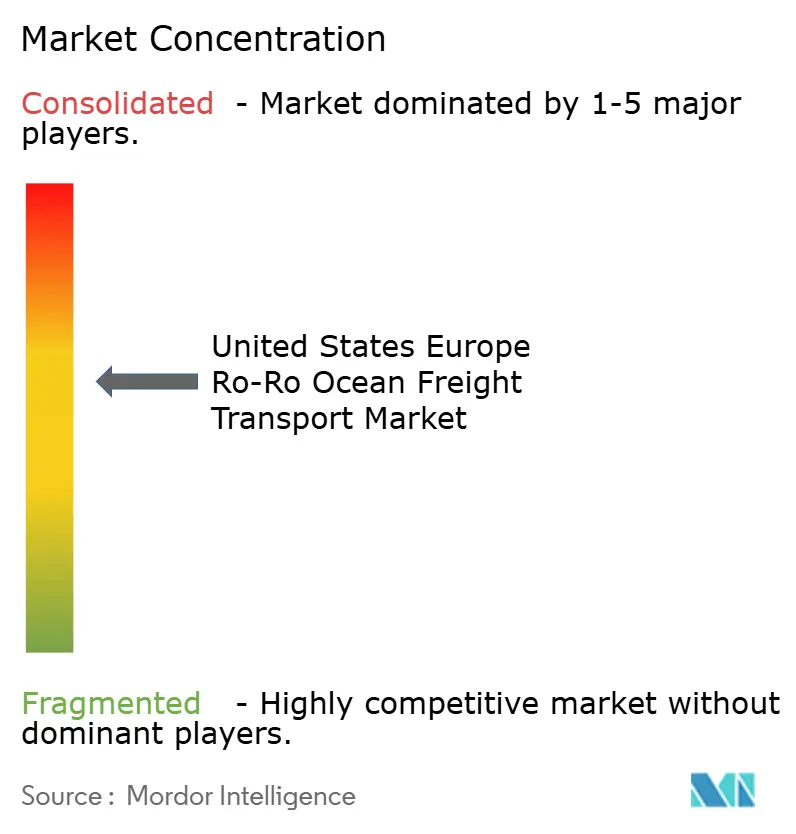
The United States-Europe Ro-Ro ocean freight transport market remains moderately consolidated at the deep-sea level. Wallenius Wilhelmsen, Hoegh Autoliners, Grimaldi Group, ACL, NYK, and MOL form the core group with the strongest scale positions. At the same time, EUKOR, Hyundai Glovis, Sallaum Lines, K Line, and ARC add competitive pressure across contract and niche traffic. The largest carriers benefit from long-standing OEM relationships, stronger balance sheets, and easier access to modern tonnage. That gives the United States-Europe, Ro-Ro ocean freight transport market a structure where scale matters, but not to the point of dominance by a very small number of players. Competitive distance is therefore meaningful, but it is not insurmountable for operators with the right lane focus or regulatory position.
Fleet modernization is one of the clearest ways carriers are defending or improving their standing in the United States-Europe Ro-Ro ocean freight transport market. Höegh Autoliners moved ahead with the development of ammonia-ready vessels, strengthening its position with customers that are placing greater weight on future emissions performance. Hyundai Glovis signed its Amsterdam hub agreement in 2026, strengthening its operating base for finished vehicle distribution in Europe. Sallaum Lines also ordered 2 firm and 2 optional 8,600-CEU dual-fuel PCTCs in June 2026, which signals that second-tier operators are still willing to scale capacity where they see commercial room[4]Source: Sallaum Lines, “Sallaum Lines Orders 2+2 8,600 CEU Dual-Fuel Car Carriers,” Sallaum Lines, sallaumlines.com.
The United States-Europe Ro-Ro ocean freight transport market also has competitive spaces that are narrower and more protected. Government and defense cargo remain important to ARC because United States-flag requirements limit direct competition from many foreign operators in that segment. Smaller and mid-size vessel deployments into secondary ports create another opportunity where service design matters more than overall fleet scale. Compliance is also becoming a harder competitive filter as FuelEU Maritime raises the cost of staying with older tonnage. That means future competition in the United States-Europe Ro-Ro ocean freight transport market will be shaped as much by capital access and vessel profile as by pure sailing frequency.
United States-Europe Ro-Ro Ocean Freight Transport Industry Leaders
Wallenius Wilhelmsen ASA
Höegh Autoliners ASA
Grimaldi Group
NYK Line
Mitsui O.S.K. Lines, Ltd.
- *Disclaimer: Major Players sorted in no particular order

Recent Industry Developments
- June 2026: Sallaum Lines placed an order with Xiamen Shipbuilding Industry (XSI) for 2 firm + 2 optional 8,600-CEU dual-fuel PCTCs, the largest vessels in the company's history, as part of an accelerating fleet renewal program that will expand capacity across Europe, the Americas, Africa, and the Middle East trade lanes. The vessels are LNG-, VLSFO-, and MGO-capable, and ammonia-ready for future conversion.
- May 2026: Hyundai Glovis signed a tripartite strategic cooperation agreement with Port of Amsterdam Authority and Koopman Logistics Group to establish a 480,000 m² finished vehicle logistics hub at the Port of Amsterdam, its first dedicated European port base, with 3 PCTC berths, capacity for 20,000 vehicles, and railway connectivity.
- March 2026: American Roll-On Roll-Off Carrier (ARC) deployed the LifeFinder crew safety technology platform across its fleet of 10 United States-flag Ro-Ro vessels under a five-year agreement following a successful pilot aboard M/V Patriot, enhancing mariner positioning and emergency response capabilities across its transatlantic operations.
- January 2026: Intesa Sanpaolo finalized a EUR 162.3 million (USD 178 million) green financing deal for Grimaldi Euromed (Grimaldi Group) to fund the acquisition of 39,800-CEU next-generation PCTCs, Grande Egitto, Grande Pacifico, and Grande Oceania, all scheduled for delivery in 2026. These vessels carry Ammonia Ready notations, 5 MWh lithium-ion batteries, and 2,500 m² of solar panels.


United States-Europe Ro-Ro Ocean Freight Transport Market Report Scope
| Passenger Vehicles (incl. 2 and 3-wheeler vehicles) |
| Commercial Vehicles |
| Off-road Vehicles |
| Small-size Vessels (Less than 2,000 CEU) |
| Mid-size Vessels (2,000-4,000 CEU) |
| Large vessels (More than 4,000 CEU) |
| OEMs |
| Dealers |
| Others (Rental Companies, Fleet leasing companies, Government & Defense Fleets, etc.) |
| United States Export | Germany |
| Belgium | |
| Netherlands | |
| United Kingdom | |
| France | |
| Italy | |
| Rest of Europe | |
| Europe Export | Germany |
| Belgium | |
| United Kingdom | |
| Sweden | |
| Italy | |
| Spain | |
| Rest of Europe |
| By Cargo Type | Passenger Vehicles (incl. 2 and 3-wheeler vehicles) | |
| Commercial Vehicles | ||
| Off-road Vehicles | ||
| By Vessel-size | Small-size Vessels (Less than 2,000 CEU) | |
| Mid-size Vessels (2,000-4,000 CEU) | ||
| Large vessels (More than 4,000 CEU) | ||
| By End-user Industry | OEMs | |
| Dealers | ||
| Others (Rental Companies, Fleet leasing companies, Government & Defense Fleets, etc.) | ||
| By Flows/Route Clusters | United States Export | Germany |
| Belgium | ||
| Netherlands | ||
| United Kingdom | ||
| France | ||
| Italy | ||
| Rest of Europe | ||
| Europe Export | Germany | |
| Belgium | ||
| United Kingdom | ||
| Sweden | ||
| Italy | ||
| Spain | ||
| Rest of Europe | ||


Key Questions Answered in the Report
What is the 2031 value forecast for the United States, Europe, and Ro-Ro ocean freight transport?
The corridor is forecast to reach USD 938.51 million by 2031, rising from USD 678.67 million in 2026 at a 6.70% CAGR.
Which cargo category leads transatlantic Ro-Ro demand between the United States and Europe?
Passenger vehicles lead the corridor with 85.18% share in 2025, reflecting the heavy role of finished car trade in total volume.
Which route is growing faster: Europe's exports or the United States' exports?
Europe's export share remains larger at 78.71% in 2025, but the United States exports are growing faster and are projected to expand at a 7.06% CAGR through 2031.
Why are modern PCTCs becoming more important on this corridor?
Larger and cleaner PCTCs lower unit costs, improve emissions performance, and help carriers meet stricter customer and regulatory requirements.
What is the biggest near-term risk to this transatlantic vehicle shipping corridor?
Trade friction and tariff volatility remain the main near-term risk because they can quickly reduce finished vehicle flows and delay contracting decisions.
Which end-user group has the most influence on pricing and service terms?
OEMs have the greatest influence because they accounted for 61% of end-user volumes in 2025 and typically negotiate multi-year transport contracts.
Page last updated on:





