
United States Essential Oil Market Size and Share
Market Overview
| Study Period | 2021 - 2031 |
|---|---|
| Forecast Data Period | 2026 - 2031 |
| Base Year Market Size (2025) | USD 6.51 Billion |
| Market Size (2026) | USD 7.09 Billion |
| Market Size (2031) | USD 11.25 Billion |
| Growth Rate (2026 - 2031) | 9.67 % |
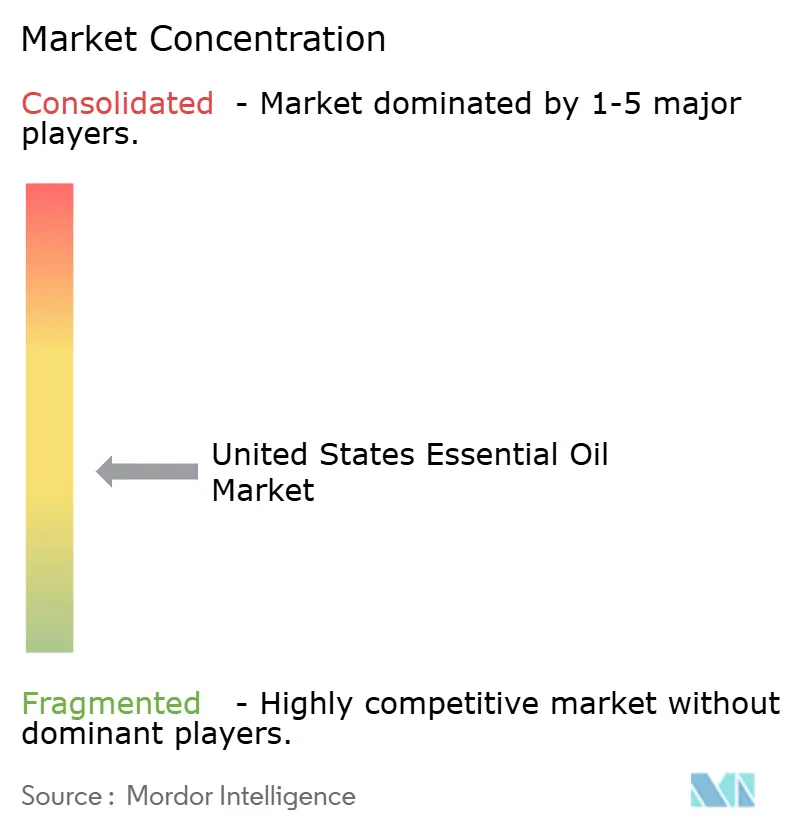
| Market Concentration | Medium |
Major Players *Disclaimer: Major Players sorted in no particular order Image © Mordor Intelligence. Reuse requires attribution under CC BY 4.0. | |
United States Essential Oil Market Analysis by Mordor Intelligence
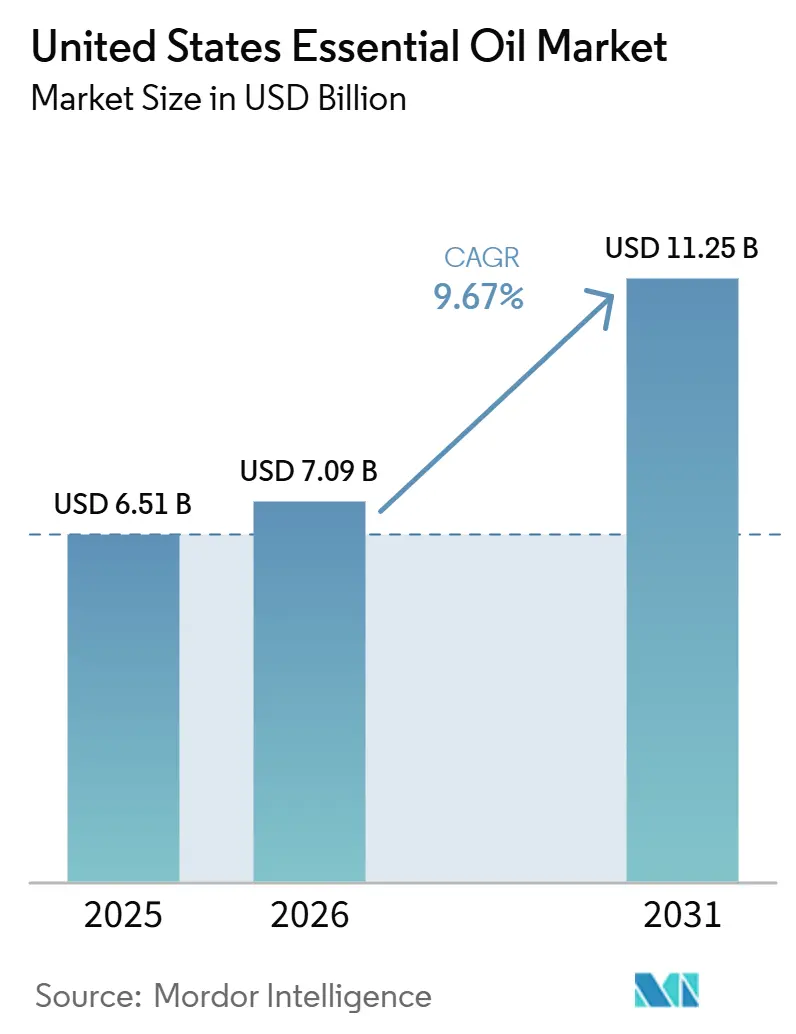
The United States essential oil market size was valued at USD 6.51 billion in 2025. It is expected to grow from USD 7.09 billion in 2026 to USD 11.25 billion by 2031, registering a CAGR of 9.67% during the forecast period (2026-2031). Demand for natural ingredients in food, personal care, and wellness products supports the United States essential oil market. Formulators are placing greater emphasis on ingredient origin, labeling, and documentation as retailer and regulatory requirements become more detailed. Food and beverage manufacturers continue to use botanical flavor systems, while consumer brands are expanding product lines for sleep, focus, and personal care applications. The United States essential oil market also faces supply exposure, as many oils depend on citrus, herb, flower, and resin crops from limited growing regions. Direct-selling brands, online specialists, and ingredient suppliers serving food, fragrance, and personal care manufacturers shape competition in the market.
Key Report Takeaways
- By product type, orange oil held 33.71% revenue share in 2025, while eucalyptus oil is forecast to grow at a 10.96% CAGR through 2031.
- By source, fruits and vegetables held 38.72% revenue share in 2025, while herbs and spices are forecast to expand at an 11.01% CAGR through 2031.
- By nature, conventional oils held 69.81% revenue share in 2025, while organic and certified organic oils are projected to grow at an 11.11% CAGR through 2031.
- By application, food and beverage accounted for 45.13% of the United States essential oil market size in 2025, while the aromatherapy and wellness segment is projected to grow at an 11.51% CAGR through 2031.
Note: Market size and forecast figures in this report are generated using Mordor Intelligence’s proprietary estimation framework, updated with the latest available data and insights as of January 2026.
United States Essential Oil Market Trends and Insights
Drivers Impact Analysis*
| Driver | (~) % Impact on CAGR Forecast | Geographic Relevance | Impact Timeline |
|---|---|---|---|
| Demand for natural and plant-based ingredients | +2.5% | National, concentrated in California, the Pacific Northwest, and the Northeast, premium retail | Long term (≥ 4 years) |
| Expansion of aromatherapy and wellness routines | +2.0% | National: high penetration in California, the Pacific Northwest, and urban metro markets | Long term (≥ 4 years) |
| Clean-label adoption in food, beverage, and personal care formulation | +1.5% | National, with an anchor in the Midwest food and beverage manufacturing clusters | Medium term (2–4 years) |
| E-commerce and direct-to-consumer availability | +1.0% | National growth skewed toward digitally active coastal demographics | Medium term (2–4 years) |
| Flavor and fragrance reformulation toward botanical inputs | +0.9% | National, driven by large food and beverage and personal care manufacturers | Medium term (2–4 years) |
| Crop-to-batch traceability as a premiumization engine | +0.7% | National, with early traction in premium specialty retail and DTC channels | Long term (≥ 4 years) |
| Source: Mordor Intelligence | |||
Demand for natural and plant-based ingredients
Demand for traceable botanical ingredients has become an important formulation consideration for mainstream consumer products. According to the Organic Trade Association, organic product sales in the United States are projected to grow by 6.9% in 2025, with organic food sales reaching USD 70.1 billion[1]Source: Organic Trade Association, “Organic Market Report 2026,” Organic Trade Association, ota.com. This demand supports the use of essential oils in food, personal care, and wellness products. Manufacturers use botanical extracts to strengthen ingredient labels that consumers can recognize more easily. Certified suppliers protect value when buyers require documented farming, extraction, and handling practices. Therefore, the United States essential oil market benefits when demand for natural ingredients remains stronger than price pressure in specialty channels, particularly where buyers require documented farming practices, clear ingredient records, consistent sensory quality, and supplier support for retailer reviews without disrupting established product formulations.
Expansion of aromatherapy and wellness routines
Aromatherapy and wellness products are reaching a broader base of consumers in the United States through direct selling, specialty retail, and online stores. These products support use occasions such as sleep, focus, immune support, and mood enhancement, rather than relying on a single wellness message. This broader use profile can encourage repeat purchases of oils and related diffuser products. Direct-selling companies maintain established customer and distributor networks, while online brands provide wider access to first-time buyers. Brands must manage product claims carefully, as therapeutic or disease-treatment claims can alter the applicable regulatory treatment, according to the Federal Trade Commission. The United States essential oil market benefits from wellness demand when brands combine clear product information with appropriate claims and testing. Buyers may compare products based on intended use, oil quality, label details, testing records, delivery options, and the availability of post-purchase guidance.
Clean-label adoption in food, beverage, and personal care formulation
Food and beverage companies use essential oils to meet flavor, aroma, and ingredient-label objectives. According to the Electronic Code of Federal Regulations, qualifying essential oils are listed under 21 CFR 582.20 for food uses under specified conditions. A 2025 scientific review described plant-based essential oils as sustainable and useful alternatives to synthetic food additives. Major formulation programs can convert an initial clean-label decision into longer-term purchasing agreements for suppliers, favoring producers that meet consistency, sensory, and documentation requirements. Food, beverage, and personal care reformulation keeps the United States essential oil market connected to institutional demand and consumer retail sales, as successful reformulations may remain in place for years and require repeated purchases of the same documented ingredient grade.
E-commerce and direct-to-consumer availability
E-commerce provides essential oil brands with a national route to consumers without relying solely on physical retail or distributor recruitment. According to the United States Census Bureau, the United States retail e-commerce sales are projected at USD 326.7 billion in the first quarter of 2026, representing a 9.8% increase from the prior year[2]Source: U.S. Census Bureau, “Quarterly Retail E-Commerce Sales: Q1 2026,” U.S. Department of Commerce, census.gov. Digital stores can display certificates of analysis, ingredient information, sourcing details, and usage guidance alongside individual products. This transparency helps buyers compare product quality, understand product suitability, and support trust in brands that sell botanical products. Online access also expands distribution beyond regions with dense direct-selling networks, enabling brands to serve consumers in smaller cities and underserved retail markets. The United States essential oil market benefits from this channel, as smaller specialist brands can reach buyers nationwide, publish product and batch information without store-space limitations, and tailor product education for consumers who are unfamiliar with essential oil use.
Restraints Impact Analysis*
| Restraint | (~) % Impact on CAGR Forecast | Geographic Relevance | Impact Timeline |
|---|---|---|---|
| Raw-material supply volatility and climate exposure | -0.9% | Global sourcing origins (Brazil, Indonesia, Florida, Mediterranean); national demand impact | Long term (≥ 4 years) |
| Synthetic substitution and application-specific price competition | -0.7% | National; concentrated in industrial and mid-market fragrance applications | Medium term (2–4 years) |
| Claim-driven regulatory reclassification risk | -0.5% | National; regulated by the FDA, FTC, and EPA across cosmetic, drug, and pesticide classifications | Short term (≤ 2 years) |
| Chemotype variability and batch-standardization costs | -0.4% | National, particularly acute for premium brands and pharmaceutical-grade buyers | Long term (≥ 4 years) |
| Source: Mordor Intelligence | |||
Raw-material supply volatility and climate exposure
Essential oil sourcing concentrates supply risk in narrow agricultural geographies that remain highly sensitive to weather extremes. If El Niño conditions are confirmed by April 2026, they are expected to significantly reduce patchouli output from Sulawesi, Indonesia, with yields likely to fall below multi-year averages as rising temperatures disrupt leaf development. Florida’s orange oil production has contracted structurally since 2019 due to citrus greening disease. In 2024, the United States imported 24,370 tons of orange oil to meet domestic shortfalls, increasing supply chain dependence on Brazil and other import origins while geopolitical shipping costs and new trade barriers continue to compress procurement margins. The Citrus and Allied Essences March 2026 market report is expected to indicate that elevated freight costs, geopolitical risks, and reduced carryover stocks across spice and botanical origins will sustain price volatility into mid-2026. Climate disruptions do not represent a short-term correction; they indicate a structural repricing of raw material risk, accelerating vertical integration strategies among market leaders.
Synthetic substitution and application-specific price competition
Precision fermentation produces nature-identical terpene molecules at declining cost curves, directly challenging natural essential oil pricing in volume-sensitive applications. BASF’s March 2025 launch of Isobionics Natural alpha-Humulene 90, produced through fermentation with certified natural status and suitability for beverage, mint, and citrus flavor applications, is expected to illustrate how biotechnology is narrowing the quality gap between fermentation-derived and plant-extracted aroma compounds. The risk profile remains asymmetric: buyers of premium, certified organic, and pharmaceutical-grade products will prioritize botanical provenance over cost, while mid-market industrial fragrance and cleaning product applications will face continued unit-economics pressure as fermentation costs decline. The FTC’s substantiation requirements for health-benefit claims, combined with the FDA’s reclassification risk for essential oils that make therapeutic or disease-treatment claims, add a regulatory dimension that limits marketing flexibility for brands seeking to differentiate through wellness positioning.
*Our forecasts treat driver/restraint impacts as directional, not additive. The impact forecasts reflect baseline growth, mix effects, and variable interactions.
Segment Analysis
By Product Type: Orange Oil Anchors Volume, Eucalyptus Leads Value-Accretive Growth
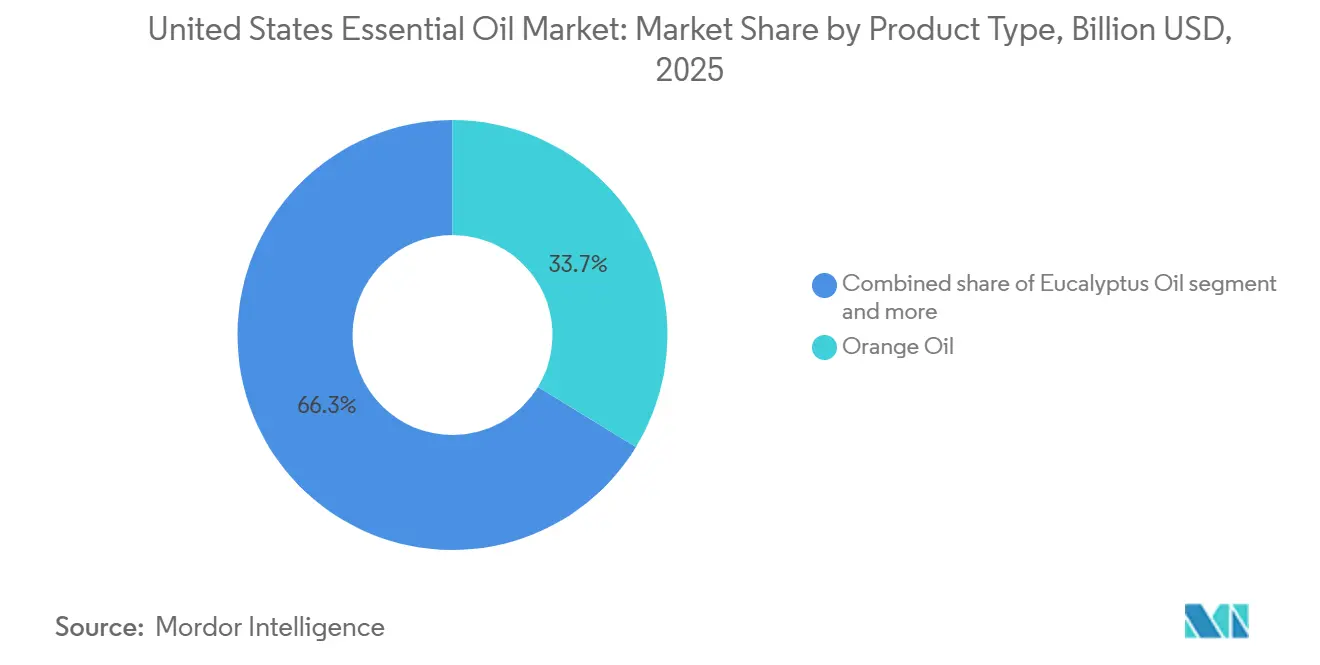
Orange oil is expected to hold a 33.71% share of the United States essential oil market in 2025, supported by its dual role as a natural flavoring agent and an industrial d-limonene source for bio-based cleaning formulations. However, its dominance reflects the economics of citrus processing by-products rather than category premiumization. Orange oil pricing remains structurally linked to orange juice production volumes, which creates procurement cost sensitivity when citrus disease or adverse weather reduces processing throughput. United States orange oil import volumes are increasing, highlighting the country’s import dependence as domestic production in Florida contracts under pressure from citrus greening. Young Living’s planned December 2024 expansion of its Utah distillery for peppermint and spearmint oil, along with the projected recovery of the 2025-2026 Brazilian orange crop to 314.6 million boxes (though with elevated fruit drop risk), signals active supply chain adjustments in response to structural sourcing pressures.
Eucalyptus oil is projected to be the fastest-growing product type, with a 10.96% CAGR during 2026-2031. This growth trajectory differs from broader wellness trends and is rooted in pharmaceutical-grade demand. The pharmaceutical application segment consumed approximately 3,200 metric tons of eucalyptus oil in 2024, representing a 6% year-on-year increase, as OTC cough, cold, and topical analgesic manufacturers specify 1,8-cineole content at validated purity levels. Rosemary, tea tree, and lavender oils maintain stable, application-specific niches in personal care, home sanitation, and personal wellness. These oils benefit from brand loyalty in specialty retail rather than competing on price with commodity citrus streams. The overall product landscape indicates that margin expansion increasingly depends on clinical validation and traceability documentation, rather than volume scale alone.



By Source: Citrus By-Product Volumes Sustain Market Share, Herb-Derived Oils Win on Margin and Growth
Fruits and vegetables are expected to account for a 38.72% source share in 2025, supported by citrus juice processing economics, where orange peel extraction adds limited incremental cost. This advantage makes these oils cost-competitive for high-volume food and beverage and industrial cleaning buyers, but it limits margin upside as pricing remains tied to juice production cycles. Flowers form a smaller but premium source cluster, with the highest per-kilogram pricing in perfumery and prestige personal care, where aroma complexity and origin transparency support brand equity. Other sources, including wood resins and bark extracts, serve niche pharmaceutical and specialty wellness buyers with limited volumes but strong specification lock-in.
Herbs and spices are projected to grow at an 11.01% CAGR through 2031, the fastest among source segments, driven by demand for peppermint, rosemary, coriander seed, and clary sage oils in functional food and beverage pipelines. A 2025 peer-reviewed review in Springer’s Discover Food identifies mint and citronella as the most commercially significant herb-derived oils in food applications, with GRAS classification supporting adoption in clean-label beverage and bakery formulations. USDA National Organic Program compliance raises traceability costs for certified herb-sourced oils but enables a pricing premium over conventional alternatives, supporting margins as retailer certification mandates intensify. For buyers reliant on imported spice-derived oils from India, China, and Spain, elevated logistics costs and geopolitical shipping disruptions, as referenced in Citrus and Allied Essences’ March 2026 market report, create near-term procurement complexity and favor suppliers with domestic or near-shored processing capabilities.
By Nature: Conventional Holds Cost-Advantaged Scale, Organic Accelerates on Retail Mandate
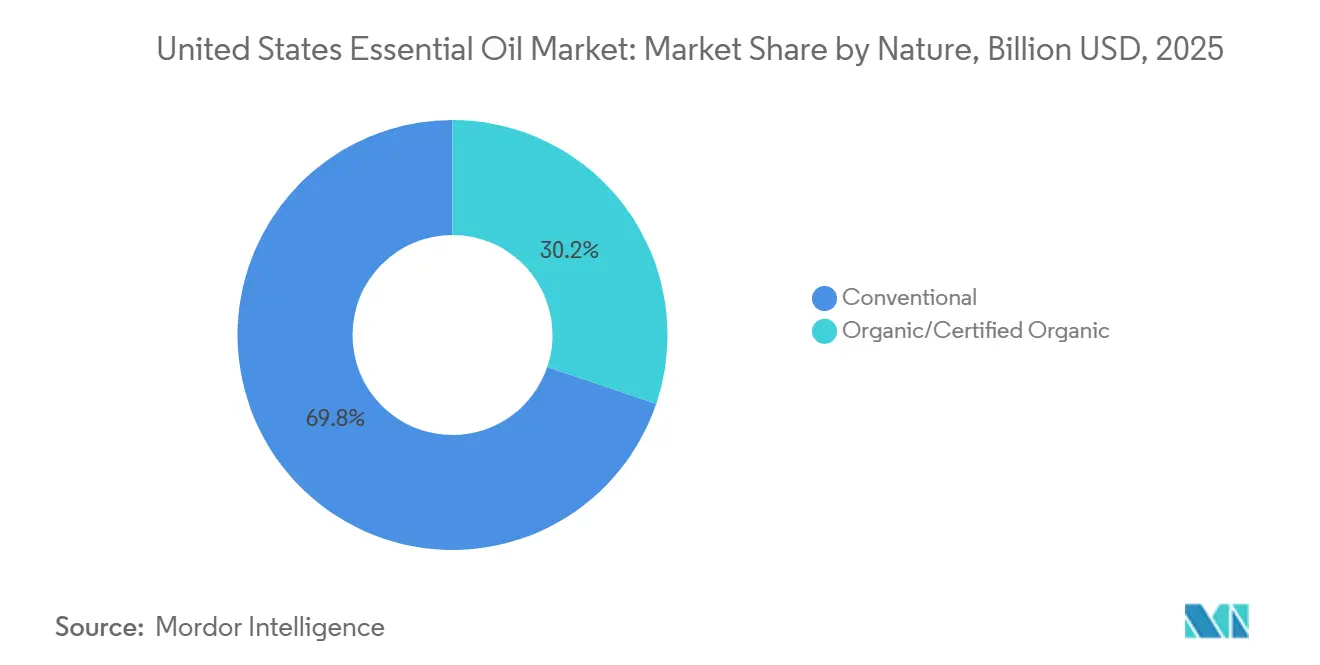
Conventional essential oils are expected to hold a 69.81% market share in 2025, supported by demand from high-volume buyers in food and beverage industrial applications, household products, and mass-market fragrances. Retail data is expected to show rising momentum in the organic segment. The Organic Trade Association’s 2026 Organic Market Report is expected to document 6.9% growth in US organic product sales in 2025, three times the overall food market growth rate, driven mainly by Millennial and Gen Z consumers prioritizing health and sustainability[3]Source: Organic Trade Association, “Organic Market Report 2026,” Organic Trade Association, ota.com. This demographic aligns with the DTC essential oil channel’s core buyer base, reinforcing demand for certified organic products sold through specialty retail and e-commerce. USDA organic certification requires plant sources and extraction methods to meet NOP standards, restricting solvent use, prohibiting adulterated inputs, and mandating supply chain documentation. These requirements raise entry barriers while creating a certification-backed pricing tier.
Organic/certified organic essential oils are projected to grow at a CAGR of 11.11% between 2026 and 2031, outpacing the overall market as natural and specialty retailers favor documented certifications over voluntary brand claims. The MDPI Sustainability 2025 review on green preservation strategies notes that essential oils must meet USDA NOP or EU Organic criteria for both agricultural sourcing and extraction to qualify for organic or natural labels. This requirement disqualifies many commodity suppliers and concentrates certified supply among vertically integrated producers. doTERRA’s October 2025 UEBT membership and eight supply chain assessments across five countries in 2025 reflect this credentialing imperative, positioning the company ahead of regulatory disclosure mandates and evolving consumer preferences.
By Application: Food and Beverage as the Demand Foundation, Aromatherapy Redefines the Growth Ceiling
Among essential oil applications in the United States, Food and Beverage is expected to retain the largest share, at 45.13% in 2025. It includes bakery and confectionery, dairy, functional drinks, and other food manufacturing categories that use botanical flavoring systems for sensory performance and label transparency. Sensient Technologies’ June 2025 BioSymphony natural flavor platform, developed through biotransformation, shows how ingredient innovation is reinforcing essential oil use in food formulations. Pharmaceuticals remain a specification-driven application cluster, with eucalyptus and tea tree oils serving as pharmacopeia-validated actives. Personal Care and Cosmetics are benefiting from MoCRA-driven reformulation toward characterized botanical ingredients. Perfumery and Fragrances, though smaller in volume, command the highest per-unit pricing. The GRAS framework under FDA 21 CFR 582.20 enables formulators to use qualifying essential oils as food ingredients without pre-market safety reviews, reducing time-to-market for clean-label NPD initiatives.
Aromatherapy and Wellness is projected to be the fastest-growing application, registering an 11.51% CAGR through 2031, driven by sustained consumer investment in preventive health and self-care. E-commerce-native DTC brands, supported by batch-level CoA transparency and use-occasion targeting, are increasing average order values by segmenting products into sleep, focus, and immune support sub-categories. This vertical has created a distinct market segment within aromatherapy, where brand equity, clinical narrative, and third-party testing credentials influence pricing power more than commodity scale. The diffusion device market, which grew at an estimated 9–12% volume CAGR annually in recent years, serves as a demand multiplier by creating recurring oil replenishment streams beyond first-time buyer acquisition.
Geography Analysis
The United States essential oil market is assessed as a single national market, and no separate state-level market share has been provided. Demand varies across states because consumer preferences, industrial activity, and agricultural production differ by region. California has a strong concentration of natural personal care formulators, premium product demand, and specialty retail activity. State-level product and fragrance requirements increase the need for documented terpene profiles, harvest lots, and extraction records, particularly when suppliers must provide buyers with material details that support product reviews, fragrance disclosure, quality checks, and consistent use across multiple retail channels.
Florida has historically supplied orange and other citrus-derived oils to the domestic market. However, citrus greening disease has reduced this production base since 2019 and increased reliance on imported supply. The Southeast remains important for sourcing, but its supply role now faces recovery challenges. As a result, domestic output, import planning, processing capacity, and alternative citrus origins have become key considerations for companies that require orange oil for flavors, cleaning products, and other high-volume applications. The Midwest is an important industrial consumption area because it hosts major food and beverage manufacturing clusters. Illinois, Ohio, and nearby states use food-grade oils through institutional purchasing by consumer packaged goods and private-label producers.
The Mountain West has become a center for consumer-facing essential oil companies. doTERRA is based in Pleasant Grove, Utah; Plant Therapy is based in Twin Falls, Idaho; and Rocky Mountain Oils is based in Orem, Utah. Their distribution and manufacturing infrastructure support national consumer sales, while digital storefronts, customer service systems, product education, and recurring order programs help convert a regional company base into a nationwide route to market. E-commerce reduces the importance of local store density because brands can reach customers in all 50 states through digital channels. U.S. retail e-commerce represented 16.9% of total retail sales in the first quarter of 2026.
Competitive Landscape
The United States essential oil market has a moderate concentration profile, as several business models operate at scale. Direct-selling and direct-to-consumer brands include doTERRA, Young Living, Plant Therapy, Edens Garden, Mountain Rose Herbs, Rocky Mountain Oils, NOW Health Group, Nature's Truth, PipingRock, and Frontier Co-op with Aura Cacia. Ingredient suppliers and distributors include Lebermuth, Vigon International, and The Essential Oil Company. Givaudan, IFF, Symrise, Sensient Technologies, Robertet, MANE, and Biolandes serve institutional customers. These groups compete on specifications, supply reliability, application support, and long-term customer relationships. Their customers assess product quality, traceability, documentation, delivery dependability, price, and suppliers’ capacity to support changes in product formulation.
Consumer brands compete through distributor networks, online education, quality claims, and use-oriented portfolios. Ingredient companies focus on contract supply, batch consistency, and formulation support for food, fragrance, and personal care applications. The differing models limit direct share competition in some channels, though they can overlap in wellness and branded natural ingredients. Plant Therapy and Edens Garden address part of the space between premium direct-selling brands and commodity suppliers. This positioning can appeal to consumers seeking documented quality without distributor-model overhead, especially when buyers want product information, direct online ordering, transparent testing, practical use guidance, and a price point that differs from both premium direct-selling brands and commodity offerings.
Givaudan announced a CHF 55 million investment in Campus 52 in Grasse, France, to support its House of Naturals strategy. doTERRA joined the Union for Ethical BioTrade and secured FairWild certification for frankincense supply chains, with further work planned across Brazil, Haiti, India, and Sri Lanka. NOW Health Group partnered with LeafWorks to use DNA sequencing for botanical identity testing. These actions show how traceability, ethical sourcing, and identity testing are becoming competitive tools.
United States Essential Oil Industry Leaders
doTERRA International LLC
Young Living Essential Oils LC
NOW Health Group, Inc.
Edens Garden, Inc.
- *Disclaimer: Major Players sorted in no particular order

Recent Industry Developments
- June 2026: Givaudan SA announced an agreement to acquire a majority stake in Eurofragance, a Barcelona-based fragrance house active across Europe, the Middle East, Asia, Africa, and Latin America. On a pro forma basis, Eurofragance would have added approximately CHF 185 million (approximately USD 207 million) in sales to Givaudan's 2025 results, expanding its regional reach and fine fragrance capabilities under its 2030 growth strategy.
- February 2026: Givaudan announced a CHF 55 million investment to construct "Campus 52" in Grasse, France, a center of excellence for its House of Naturals strategy. The facility was designed to support natural fragrance ingredient research and supply chain development, strengthening Givaudan's differentiation in botanical naturals as precision fermentation alternatives expanded.
- February 2026: Young Living released 8 new essential oils and blends in a phased rollout, including three single-origin distillations (Sichuan Black Pepper, Tasmanian Blue Gum Eucalyptus, and Haitian Vetiver) and five purposeful blends that targeted focus, sleep, immune support, mood, and travel wellness.


United States Essential Oil Market Report Scope
Essential oils are highly concentrated plant extracts that capture the natural flavor, scent, and beneficial properties of their source. The United States essential oil market is segmented by product type, source, nature, and application. By product type, the market is segmented into orange, peppermint, lavender, eucalyptus, and others. By source, the market is segmented into fruits and vegetables, herbs and spices, flowers, and others. By nature, the market is segmented into conventional and organic/certified organic. By application, the market is segmented into food and beverage, personal care, pharmaceuticals, aromatherapy and wellness, perfumery, and others. The market forecasts are provided in terms of value (USD).
| Orange Oil |
| Peppermint Oil |
| Spearmint Oil |
| Lavender Oil |
| Rosemary Oil |
| Tea Tree Oil |
| Eucalyptus Oil |
| Others |
| Fruits and Vegetables |
| Herbs and Spices |
| Flowers |
| Other Sources |
| Conventional |
| Organic/Certified Organic |
| Food and Beverage | Bakery and Confectionery |
| Dairy | |
| Functional Drinks | |
| Others | |
| Personal Care and Cosmetics | |
| Pharmaceuticals | |
| Aromatherapy and Wellness | |
| Perfumery and Fragrances | |
| Others |
| Product Type | Orange Oil | |
| Peppermint Oil | ||
| Spearmint Oil | ||
| Lavender Oil | ||
| Rosemary Oil | ||
| Tea Tree Oil | ||
| Eucalyptus Oil | ||
| Others | ||
| Source | Fruits and Vegetables | |
| Herbs and Spices | ||
| Flowers | ||
| Other Sources | ||
| Nature | Conventional | |
| Organic/Certified Organic | ||
| Application | Food and Beverage | Bakery and Confectionery |
| Dairy | ||
| Functional Drinks | ||
| Others | ||
| Personal Care and Cosmetics | ||
| Pharmaceuticals | ||
| Aromatherapy and Wellness | ||
| Perfumery and Fragrances | ||
| Others | ||


Key Questions Answered in the Report
What is the projected value of the United States essential oil market by 2031?
The market is projected to reach USD 11.25 billion by 2031, expanding at a 9.7% CAGR from 2026.
Which product leads United States essential oil demand?
Orange oil led product demand with a 33.71% share in 2025, supported by food flavoring and bio-based cleaning uses.
Which application is growing fastest through 2031?
The aromatherapy and wellness segment is projected to grow at an 11.51% CAGR through 2031, supported by wellness routines and digital sales.
Why are organic essential oils gaining demand?
Organic and certified organic oils are projected to grow at an 11.11% CAGR as buyers place greater weight on certified sourcing and traceability.
Page last updated on:





