
United States Enterprise Content Management (ECM) Market Size and Share
Market Overview
| Study Period | 2020 - 2031 |
|---|---|
| Forecast Data Period | 2026 - 2031 |
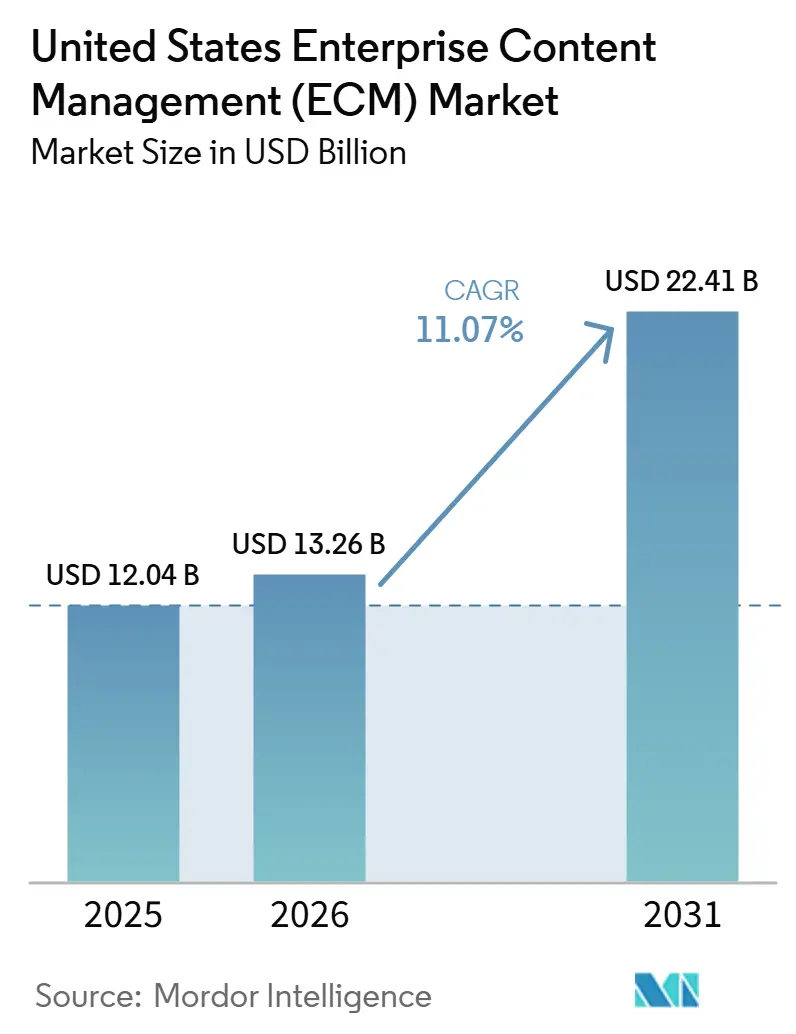
| Base Year Market Size (2025) | USD 12.04 Billion |
| Market Size (2026) | USD 13.26 Billion |
| Market Size (2031) | USD 22.41 Billion |
| Growth Rate (2026 - 2031) | 11.07% CAGR |
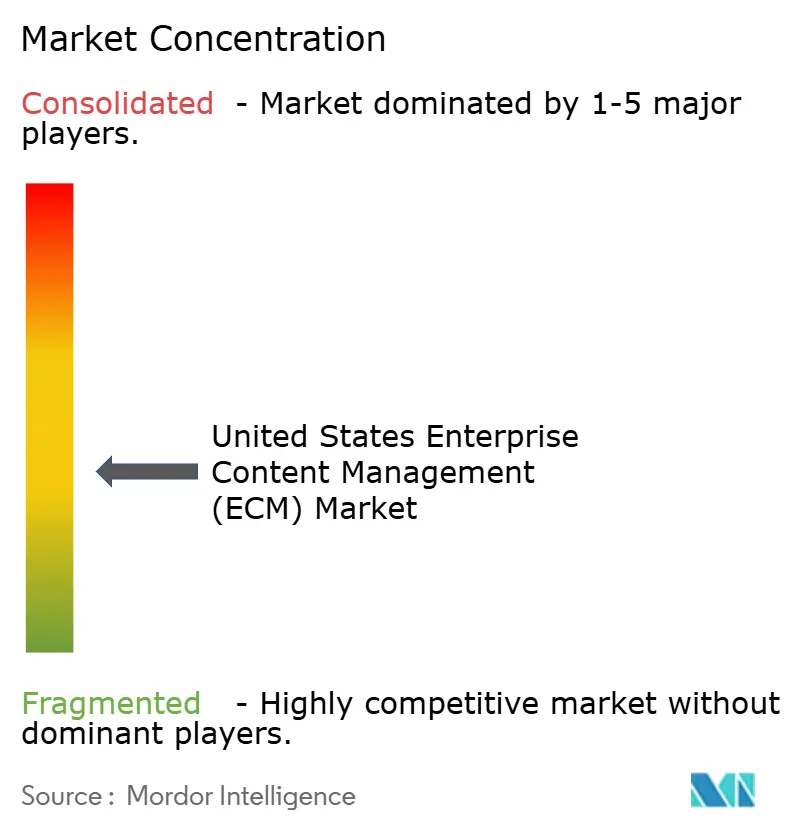
| Market Concentration | Medium |
Major Players *Disclaimer: Major Players sorted in no particular order Image © Mordor Intelligence. Reuse requires attribution under CC BY 4.0. | |
United States Enterprise Content Management (ECM) Market Analysis by Mordor Intelligence
The United States Enterprise Content Management (ECM) market size was valued at USD 12.04 billion in 2025 and is forecast to reach USD 22.41 billion by 2031, at a CAGR of 11.07% from 2026 to 2031. The United States Enterprise Content Management (ECM) Market is expanding as compliance rules tighten, cloud adoption becomes standard, and generative AI moves into daily content workflows. Buyers are now placing greater weight on whether a platform can organize, protect, and expose trusted content for AI use, rather than treating ECM as a storage tool alone. The shift is pushing vendors to sharpen their cloud delivery, improve governance controls, and more closely connect content with business processes. It is also creating space for newer products that automate classification, audit logging, and workflow routing within a single system. At the same time, complex legacy estates and stricter privacy obligations are slowing some migration plans and stretching deployment timelines.
Key Report Takeaways
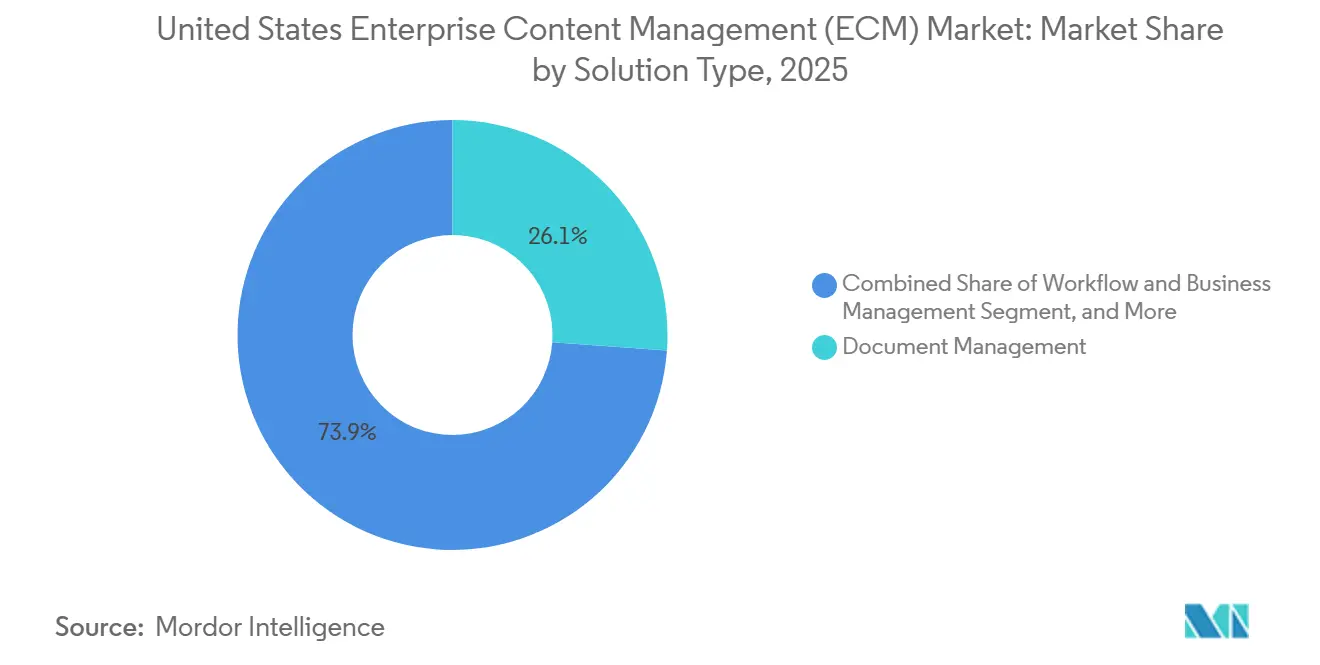
- By solution type, Document Management accounted for 26.14% of revenue in 2025, while Workflow and Business Process Management are projected to expand at a 17.42% CAGR through 2031.
- By deployment mode, cloud held 72.83% of the United States Enterprise Content Management (ECM) market share in 2025, while cloud is also projected to record the fastest CAGR at 16.94% through 2031.
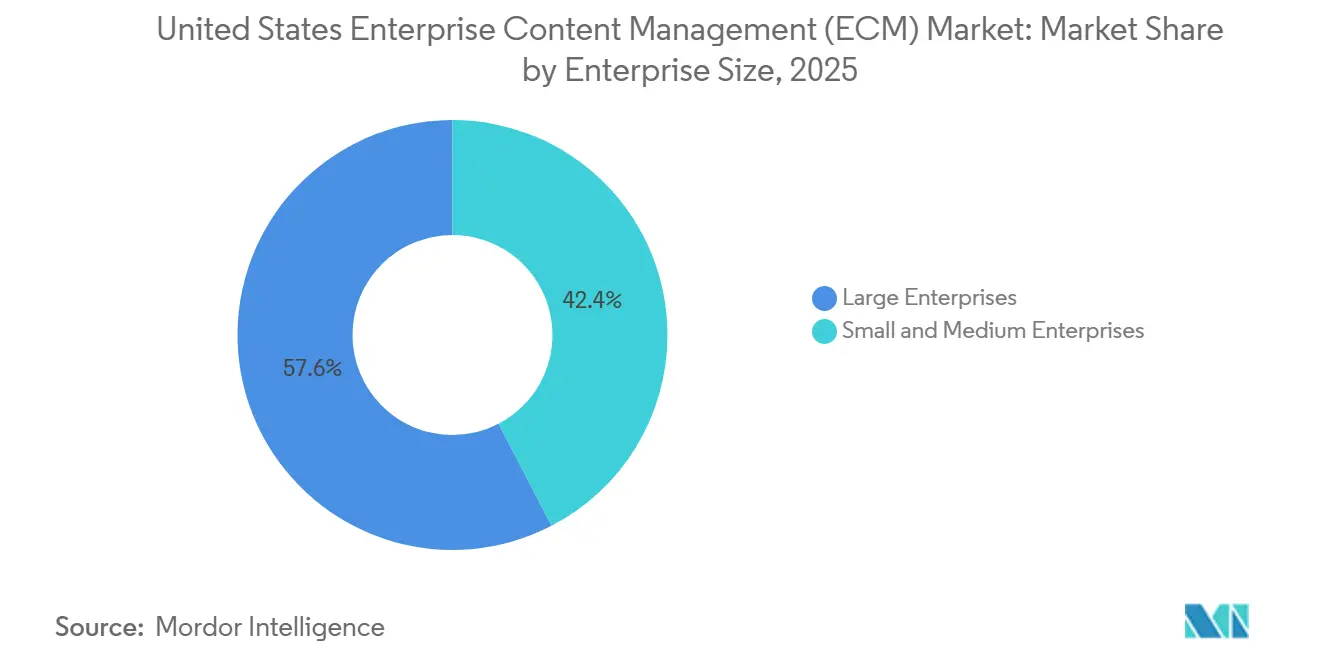
- By enterprise size, large enterprises held 57.62% of revenue in 2025, while SMEs are projected to expand at a 17.18% CAGR through 2031.
- By end-user industry, BFSI accounted for 22.41% of the United States Enterprise Content Management (ECM) market in 2025, while healthcare is projected to grow at a 17.63% CAGR through 2031.
Note: Market size and forecast figures in this report are generated using Mordor Intelligence’s proprietary estimation framework, updated with the latest available data and insights as of January 2026.
United States Enterprise Content Management (ECM) Market Trends and Insights
Drivers Impact Analysis*
| Driver | (~) % Impact on CAGR Forecast | Geographic Relevance | Impact Timeline |
|---|---|---|---|
| Accelerating Digital Document Standardization Across Regulated Industries | +2.5% | National, with stronger pull in financial and healthcare centers | Short term (≤ 2 years) |
| Rapid Shift Toward Cloud-First Content Platforms | +2.2% | National, with early gains in technology hubs and federal corridors | Short term (≤ 2 years) |
| Growing Need for Audit-Ready Records and Traceability | +1.8% | National, strongest in BFSI and healthcare clusters | Medium term (2-4 years) |
| Rising Demand for AI-Assisted Metadata Capture and Content Classification | +1.5% | National, with advanced uptake in California, Texas, and Washington | Medium term (2-4 years) |
| Expansion of Citizen-Facing and Customer-Facing Digital Workflows | +1.0% | National, including state and municipal agencies | Medium term (2-4 years) |
| Hybrid Work and Distributed Collaboration Requirements | +0.8% | National, with higher relevance in technology and professional services firms | Long term (≥ 4 years) |
| Source: Mordor Intelligence | |||
Accelerating Digital Document Standardization Across Regulated Industries
Regulatory demands for document lifecycle control are becoming stricter across several sectors, strengthening demand in the United States Enterprise Content Management (ECM) Market. SEC Rule 17a-4 gives broker-dealers a choice of storage approaches, but both options still require formal electronic recordkeeping and reliable auditability. In healthcare, the HHS Office for Civil Rights proposed changes in December 2024 that would require technology asset inventories, network maps showing ePHI flows, and annual compliance audits for covered entities and business associates.[1]U.S. Department of Health and Human Services, “HIPAA Security Rule Notice of Proposed Rulemaking to Strengthen Cybersecurity for Electronic Protected Health Information,” U.S. Department of Health and Human Services, hhs.gov Those requirements align closely with modern ECM functions such as retention control, access governance, audit logs, and documented disposition workflows. Once firms standardize content processes for one rule set, the same structure often supports other internal and external controls, which makes broader rollouts easier to justify.
Rapid Shift Toward Cloud-First Content Platforms
Cloud is now the main architecture choice in the United States Enterprise Content Management (ECM) Market, and buyers are treating it as a default starting point for new content programs. The current move is less tied to infrastructure savings and more to the need for governed content that supports AI, collaboration, and distributed access. OpenText reported cloud revenue of USD 478 million in the second quarter of fiscal year 2026, and enterprise cloud bookings reached USD 295 million, up 18.0% year over year.[2]OpenText Corporation, “OpenText Reports Second Quarter Fiscal Year 2026 Financial Results,” OpenText, opentext.com iManage stated in May 2026 that 78% of its global customer base had migrated to the cloud, indicating that even highly regulated users are moving core repositories out of older environments. Vendors that cannot show cloud-native governance, role-based control, and AI-ready interfaces are finding it harder to defend older deployment models.
Growing Need for Audit-Ready Records and Traceability
Audit readiness now plays a larger role in buying decisions across regulated parts of the United States Enterprise Content Management (ECM) Market. FINRA Rule 4511 and SEC Rule 17a-4 require many core records to be retained for at least 6 years, with the first 2 years kept in immediately accessible form.[3]IBM Corporation, “A New Era of Agentic Content Automation Has Arrived with IBM Content Cortex Essentials Edition,” IBM Community, community.ibm.com In healthcare, the proposed HIPAA Security Rule changes would require restoration of compromised electronic information systems within 72 hours and vulnerability scans at least every 6 months. These obligations favor platforms that can preserve records, automate legal holds, and show time-stamped activity without manual evidence gathering. Providers that can deliver inspection-ready evidence quickly are building stronger competitive positions as compliance teams push for faster response times.
Rising Demand for AI-Assisted Metadata Capture and Content Classification
AI-assisted tagging and classification are changing how buyers define value in the United States Enterprise Content Management (ECM) Market. IBM launched the Content Cortex Essentials Edition in June 2026 to enable AI agents to classify, extract, redact, and apply legal holds to enterprise content through MCP-native integration with major AI frameworks.[4]BM Corporation, “A New Era of Agentic Content Automation Has Arrived with IBM Content Cortex Essentials Edition,” IBM Community, community.ibm.com Hyland reported a 220% surge in customer adoption of agentic content services in Q4 2025, which showed that enterprise buyers had moved beyond early testing into wider deployment. M-Files expanded its agentic AI capabilities in June 2026 with new agents for metadata enrichment, conversational access, intelligent search, and workflow automation. Content that is well classified and well governed is easier to use for retrieval, automation, and policy control, making metadata quality a core platform requirement.
Restraints Impact Analysis*
| Restraint | (~) % Impact on CAGR Forecast | Geographic Relevance | Impact Timeline |
|---|---|---|---|
| Legacy Integration Complexity in Large United States Enterprises | -1.2% | National, most acute in older financial, manufacturing, and large enterprise environments | Medium term (2-4 years) |
| Data Residency And Compliance Concerns for Sensitive Content | -0.9% | National, with higher relevance in California and federally regulated sectors | Short term (≤ 2 years) |
| Budget Pressure From Multi-Year Enterprise Software Modernization Cycles | -0.8% | National, strongest in large enterprises with older technology estates | Long term (≥ 4 years) |
| Limited Internal ECM Skills in Mid-Market Organizations | -0.6% | National, especially outside major technology centers | Medium term (2-4 years) |
| Source: Mordor Intelligence | |||
Legacy Integration Complexity in Large United States Enterprises
Older ECM estates still rely on custom links to ERP, CRM, collaboration, and archive tools, which slows modernization across the United States Enterprise Content Management (ECM) Market. Many large organizations must run both old and new repositories in parallel during migration, which increases operational effort and extends decision cycles. OpenText completed the divestiture of eDOCS to NetDocuments for USD 163 million in January 2026, which showed how vendors are pruning older portfolios as they refocus on cloud and AI. Buyers with deep custom rules, retention schedules, and permissions models face more challenging transitions because those controls must be carefully rebuilt in the target environment. The result is continued demand for modernization, but slower implementation and more staged migration plans in large accounts.
Data Residency and Compliance Concerns for Sensitive Content
State-level privacy rules are making deployment design more complex for firms that manage sensitive files across multiple jurisdictions. The California Privacy Protection Agency finalized new CCPA regulations in September 2025, and those rules took effect in January 2026 with added requirements around automated decision-making transparency, data mapping, and consumer consent workflows. Those obligations directly affect how content is classified, stored, accessed, and routed inside enterprise content systems. OpenText responded in November 2025 by expanding its partnership with Google Cloud to support sovereign cloud options for regulated customers. Procurement teams are therefore spending more time on choosing cloud regions, mapping policies, and implementing contractual safeguards before approving new deployments.
*Our forecasts treat driver/restraint impacts as directional, not additive. The impact forecasts reflect baseline growth, mix effects, and variable interactions.
Segment Analysis
By Solution Type: Workflow Automation Reshapes Platform Value
Document Management held 26.14% of the United States Enterprise Content Management (ECM) market share in 2025, making it the largest solution category. Its lead came from long-standing demand for document capture, retention, and retrieval in sectors where compliance rules shape daily operations. In banking and financial services, recordkeeping obligations still make defensible document control a basic purchase requirement. In healthcare, this need is reinforced by tighter expectations for ePHI governance, auditability, and controlled access.
Records Management and Case Management continue to serve related needs in legal, healthcare, and public-sector environments where file integrity and a traceable action history matter. Web Content Management supports outward-facing digital publishing, while Digital Asset Management is gaining more attention in retail and media settings that manage larger volumes of brand and media files. Workflow and Business Process Management is projected to grow at a 17.42% CAGR through 2031, making it the fastest-moving solution area in this report. That shift reflects a change in buyer focus from storing content to moving work through a set of governed steps. Box launched Box Automate in April 2026 as a no-code workflow tool that routes tasks across people, AI agents, and connected systems, which shows how content management and process automation are coming together.



By Deployment Mode: Cloud Remains The Core Architecture
Cloud accounted for 72.83% of the United States Enterprise Content Management (ECM) market in 2025, making it the clear leader in the deployment model. The large installed base reflects several years of migration activity and a wider preference for subscription delivery, remote access, and faster updates. iManage reported in May 2026 that 78% of its global customer base was already on its cloud platform, and the company had added 90 new customer logos in the year through mid-2026. Cloud is also projected to record the highest CAGR of 16.94% through 2031 as buyers seek AI-ready environments and easier access.
On-premises deployments still matter in federal agencies, defense-related settings, and tightly regulated financial environments where content location and system control remain sensitive. Hybrid is gaining relevance as a bridge model because it lets organizations keep some records in controlled environments while using the cloud for collaboration, analytics, and newer AI functions. Microsoft’s SharePoint Embedded positioning, together with Purview-based compliance integration, reflects the demand for connectors between older repositories and newer cloud services. That approach reduces the pressure to replace everything at once and gives buyers a more gradual migration path that works for large, mixed estates.
By Enterprise Size: SMEs Gain Ground As SaaS Expands Access
Large enterprises accounted for 57.62% of revenue in 2025 in the United States Enterprise Content Management (ECM) Market. Their lead reflects the scale of content estates, the number of systems involved, and the weight of overlapping rules around privacy, auditability, and retention. In these environments, ECM spending is closely tied to governance architecture because permissions, legal holds, retention schedules, and evidence trails must work across departments. Multi-year licensing and broader platform footprints also make incumbent positions harder to displace quickly.
SMEs are projected to grow at a 17.18% CAGR through 2031, making them the fastest-growing segment by enterprise size. Subscription-based SaaS models are lowering entry barriers by reducing upfront infrastructure costs and shifting maintenance to the vendor. Privacy obligations are also expanding the buyer base, especially as smaller firms cross thresholds that make CCPA compliance relevant to their operations. Vendors that offer modular pricing, packaged templates, and managed onboarding are better placed to capture this expansion. The result is a broader customer mix for the United States Enterprise Content Management (ECM) Market, even though the biggest contracts still come from large organizations.
By End-User Industry: Healthcare Posts The Fastest Expansion
BFSI accounted for 22.41% of the United States Enterprise Content Management (ECM) market in 2025, making it the largest end-user group. The sector depends on structured records, retention enforcement, and traceable access because financial recordkeeping rules leave little room for informal document handling. Government and public sector also remain important users because agencies manage records, case files, approvals, and citizen-facing documentation across large administrative workflows. That mix keeps compliance, security, and controlled retrieval at the center of demand across the United States Enterprise Content Management (ECM) Market.
Healthcare is projected to expand at a 17.63% CAGR through 2031, making it the fastest-growing end-user segment. The HHS Office for Civil Rights proposed changes in December 2024 that would require annual audits, faster system restoration, and stronger oversight of business associates, all of which raise the need for automated records and traceable workflows. IT and telecommunications firms use ECM for contracts, technical files, and controlled documentation, while manufacturers use it for traceability records and engineering document control. Retail and media users are also expanding ECM into digital asset management and content supply chain coordination, but they still contribute less than BFSI and healthcare. This pattern keeps healthcare as the main growth engine while BFSI remains the largest spending base.
Geography Analysis
The United States Enterprise Content Management (ECM) Market follows the country’s industry concentration patterns, and the Northeast remains the deepest established base for ECM demand. New York and the wider Northeast corridor continue to attract strong spending from financial institutions subject to strict recordkeeping and audit requirements. That creates steady demand for retention control, searchable archives, audit trails, and policy-driven document handling. The Washington, DC metropolitan area forms a separate demand center because federal agencies buy ECM with a stronger focus on records management, security approval, and controlled deployment models. Preference for on-premises and hybrid environments remains higher in this corridor than in purely commercial markets because federal requirements often more tightly shape architectural choices.
The West Coast serves as the primary innovation hub for the United States Enterprise Content Management (ECM) Market, as many cloud-native vendors and platform teams are concentrated there. California also carries added weight because its privacy rules force companies to think more carefully about content mapping, consent handling, and access governance. Those pressures are encouraging more mid-market technology firms in the state to revisit older document environments and invest in more structured platforms. The Southeast is emerging as the fastest-growing regional demand cluster, as healthcare systems expand and financial services activity spreads beyond the Northeast. Hospital groups in states such as Texas and Florida are under greater pressure to modernize records and controls as HIPAA expectations around restoration, audits, and data oversight become more demanding.
The Midwest shows steadier demand built around manufacturing, engineering documentation, quality records, and contract-heavy professional services workflows. Manufacturers in Ohio, Michigan, and Illinois need ECM systems that integrate seamlessly with ERP systems and maintain document traceability across supplier networks. OpenText highlighted its broader SAP collaboration at OpenText World 2025, which supports this need for tighter links between enterprise applications and governed content. Across regions, the common direction is the same: cloud adoption is advancing, but buyers still want stronger controls around retention, audit evidence, and data movement before they commit at scale.
Competitive Landscape
The United States Enterprise Content Management (ECM) Market remains moderately concentrated, with a small group of broad platform vendors leading revenue and a wider set of specialists competing in narrower use cases. OpenText, Microsoft, and Hyland form the top tier because they can address large enterprise requirements across industries, deployment models, and governance needs. Their positioning in 2025 and 2026 has moved beyond document storage and toward AI-ready content platforms that can support automation and policy enforcement. Hyland introduced the Enterprise Context Engine and Enterprise Agent Mesh at CommunityLIVE 2026, demonstrating how major vendors are trying to orchestrate AI services around governed content rather than treating AI as a separate layer. This shift is raising pressure on mid-tier providers to expand AI support without weakening compliance or hybrid deployment flexibility.
Specialists such as iManage, M-Files, Laserfiche, and NetDocuments are gaining attention because they move faster in specific vertical or workflow-heavy areas. iManage introduced its MCP Server at ConnectLive 2026 to give AI agents permission-aware access to governed repositories, meeting the needs of legal and financial users who want tighter control over work product exposure. M-Files expanded its agentic AI capabilities in June 2026 by building agents on its Enterprise Knowledge Graph, with a focus on metadata, search, and workflow automation. Laserfiche also brought AI Agents to general availability for Laserfiche Cloud users in 2026, reinforcing the push toward natural language interaction within governed repositories. OpenText’s sale of eDOCS to NetDocuments in January 2026 gave NetDocuments a stronger installed base in legal document management and sharpened its relevance in a segment where cloud migration remains active.
Competitive behavior in the United States Enterprise Content Management (ECM) Market is now centered on 3 themes: AI governance, cloud delivery, and workflow depth. OpenText expanded its partnership with Google Cloud in November 2025 to support sovereign cloud needs, which addressed a clear concern for regulated customers managing sensitive content. Box launched Box Automate in April 2026 to connect people, AI agents, and enterprise systems within no-code workflows, reflecting the market’s move toward content-led process orchestration. As more vendors package governance, automation, and AI into a single stack, the field is likely to remain competitive, even with a clear top tier.
United States Enterprise Content Management (ECM) Industry Leaders
Microsoft Corporation
OpenText Corporation
IBM Corporation
Oracle Corporation
Hyland Software, Inc.
- *Disclaimer: Major Players sorted in no particular order

Recent Industry Developments
- July 2026: M-Files Corporation launched M-Files for Consulting, a purpose-built application targeting the full proposal-to-delivery lifecycle for consulting firms, built on its AI-native platform with role-based user experiences and governed AI content generation. The release is the latest in M-Files' growing industry solutions portfolio, which also includes solutions for Tax Advisory and Contracts, indicating a deliberate pivot from horizontal ECM to vertical AI applications.
- June 2026: M-Files Corporation expanded its agentic AI capabilities with a suite of new AI Agents built on the M-Files Enterprise Knowledge Graph, enabling context-aware automation across metadata enrichment, conversational access, intelligent search, and workflow automation. The announcement positioned M-Files as a governance-first AI automation platform designed for regulated environments where traceability and human-in-the-loop controls are mandatory.
- June 2026: IBM Corporation launched Content Cortex Essentials Edition, an agentic content automation platform enabling AI agents via MCP-native integration with major AI frameworks including watsonx Orchestrate, Claude, Copilot, and ChatGPT to classify, extract, redact, and apply legal holds to enterprise content. The platform's Navigator Core Agent automates document classification and organization tasks, reducing hours-long manual workflows to under a minute through natural language interaction.
- May 2026: iManage LLC unveiled the next evolution of its platform at ConnectLive 2026 in Chicago, introducing iManage MCP Server, available for Insight+, which enables AI agents and large language models to search and surface permission-aware context from governed iManage repositories. The company reported 78% of its global customer base on cloud and 90 new customer logos in 2026, with 83% of Top Global 100 law firms relying on the platform.


United States Enterprise Content Management (ECM) Market Report Scope
The United States enterprise content management (ECM) market refers to the ecosystem of software solutions and services designed to systematically capture, manage, store, preserve, and deliver an organization's unstructured and structured content and documents within the country. This includes technologies such as document management, records management, workflow, business process management, case management, digital asset management, and web content management. Deployed on-premises, in the cloud, or in hybrid models, these solutions cater to organizations of all sizes across diverse industries in the US, including BFSI, government, healthcare, IT, and manufacturing. Driven by the country's advanced digital infrastructure, the widespread shift toward remote and hybrid work environments, and the critical need to comply with stringent federal and industry-specific regulations (such as HIPAA, SOX, and FINRA), ECM solutions enable US businesses to streamline complex workflows, enhance enterprise-wide collaboration, mitigate data security risks, and transition from legacy paper-based systems to highly efficient, digitized operations.
The United States Enterprise Content Management (ECM) Market Report is Segmented by Solution Type (Document Management, Records Management, Workflow and Business Process Management, Case Management, Digital Asset Management, Web Content Management, and Other Solutions), Deployment Mode (On-Premises, Cloud, and Hybrid), Enterprise Size (Small and Medium Enterprises, and Large Enterprises), and End-User Industry (BFSI, Government and Public Sector, Healthcare, IT and Telecommunications, Manufacturing, Retail, Media and Entertainment, Education, Energy and Utilities, and Other End-User Industries). The Market Forecasts are Provided in Terms of Value (USD).
| Document Management |
| Records Management |
| Workflow and Business Process Management |
| Case Management |
| Digital Asset Management |
| Web Content Management |
| Other Solutions |
| On-Premises |
| Cloud |
| Hybrid |
| Small and Medium Enterprises |
| Large Enterprises |
| BFSI |
| Government and Public Sector |
| Healthcare |
| IT and Telecommunications |
| Manufacturing |
| Retail |
| Media and Entertainment |
| Education |
| Energy and Utilities |
| Other End-User Industries |
| By Solution Type | Document Management |
| Records Management | |
| Workflow and Business Process Management | |
| Case Management | |
| Digital Asset Management | |
| Web Content Management | |
| Other Solutions | |
| By Deployment Mode | On-Premises |
| Cloud | |
| Hybrid | |
| By Enterprise Size | Small and Medium Enterprises |
| Large Enterprises | |
| By End-User Industry | BFSI |
| Government and Public Sector | |
| Healthcare | |
| IT and Telecommunications | |
| Manufacturing | |
| Retail | |
| Media and Entertainment | |
| Education | |
| Energy and Utilities | |
| Other End-User Industries |


Key Questions Answered in the Report
What is the size of the United States Enterprise Content Management (ECM) Market?
The United States Enterprise Content Management (ECM) Market was valued at USD 12.04 billion in 2025 and is forecast to reach USD 22.41 billion by 2031, growing at a CAGR of 11.07% from 2026 to 2031.
Why is cloud deployment leading enterprise content management in the United States?
Cloud held 72.83% of revenue in 2025 because buyers want easier scaling, remote access, faster updates, and better support for AI-enabled content workflows.
Which solution area is growing fastest through 2031?
Workflow and Business Process Management is the fastest-growing solution type, with a projected CAGR of 17.42%, as enterprises shift from storage toward governed process automation.
Why is healthcare becoming a stronger buyer of ECM platforms?
Healthcare is projected to grow at a 17.63% CAGR through 2031 because tighter ePHI governance, audit expectations, and restoration requirements are increasing the need for structured records management.
What is slowing modernization in large enterprises?
Legacy integration complexity is a major brake because large organizations often run custom links across multiple systems and must migrate content, permissions, and retention logic in stages.
Which companies are shaping competition the most?
OpenText, Microsoft, and Hyland lead the top tier, while iManage, M-Files, Laserfiche, Box, IBM, and NetDocuments are strengthening competition through AI-led and workflow-focused offerings.
Page last updated on:






