
United States Bathroom Vanities Market Size and Share
Market Overview
| Study Period | 2020 - 2031 |
|---|---|
| Forecast Data Period | 2026 - 2031 |
| Base Year Market Size (2025) | USD 9.13 Billion |
| Market Size (2026) | USD 9.23 Billion |
| Market Size (2031) | USD 12.32 Billion |
| Growth Rate (2026 - 2031) | 5.94 % |
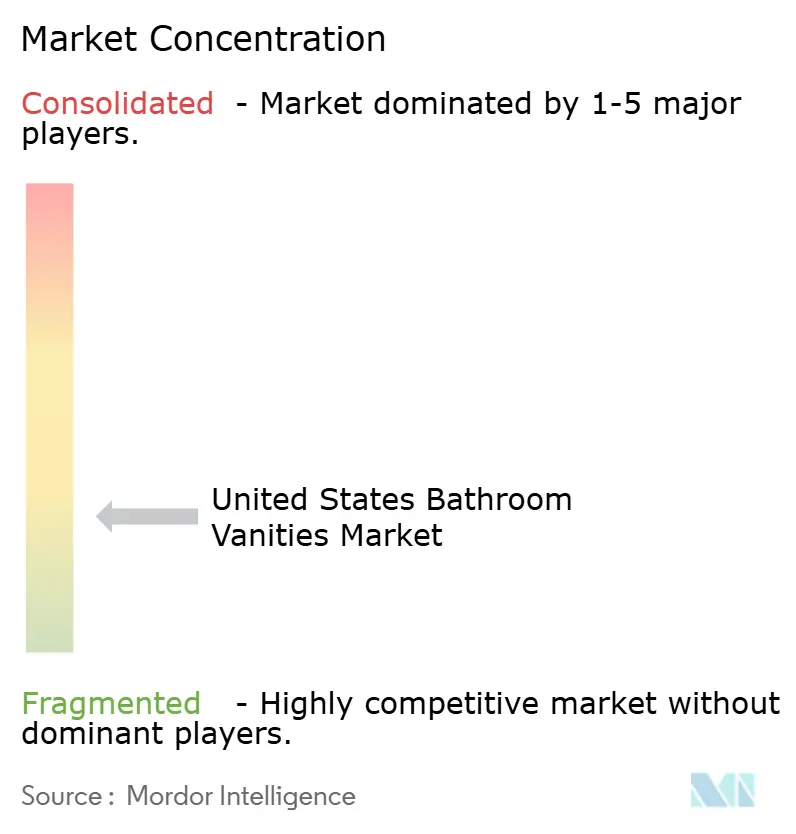
| Market Concentration | Low |
Major Players *Disclaimer: Major Players sorted in no particular order Image © Mordor Intelligence. Reuse requires attribution under CC BY 4.0. | |
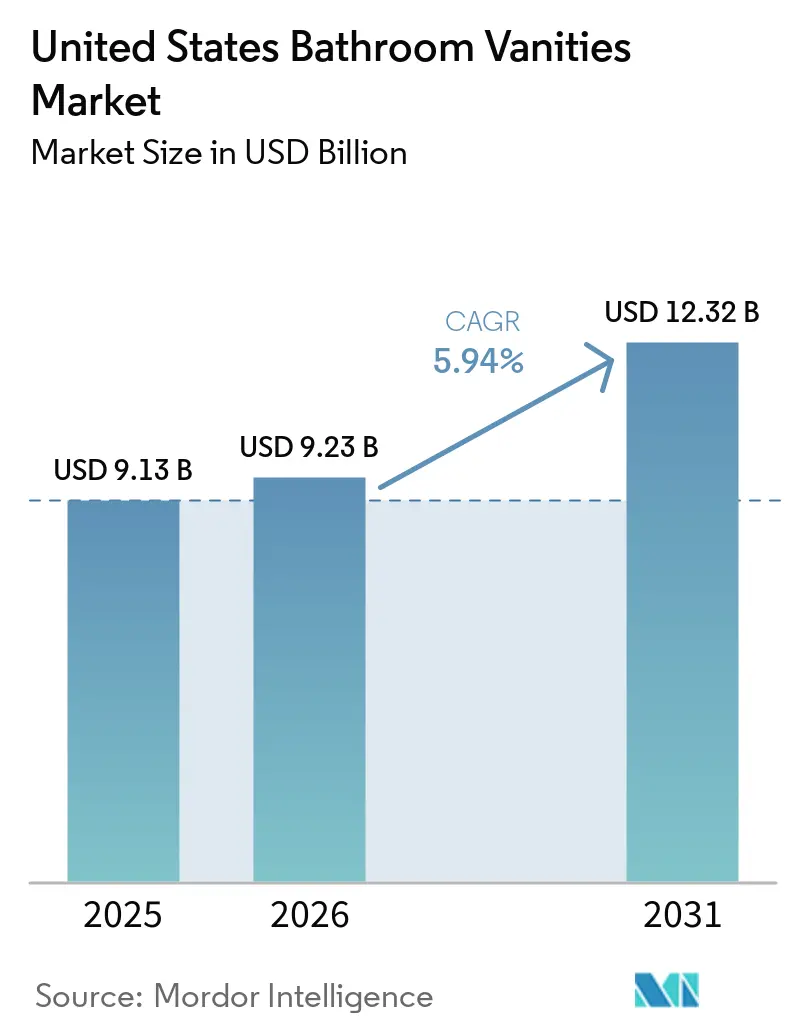
United States Bathroom Vanities Market Analysis by Mordor Intelligence
The United States bathroom vanity market size was valued at USD 9.13 billion in 2025 and estimated to grow from USD 9.23 billion in 2026 to reach USD 12.32 billion by 2031, at a CAGR of 5.94% during the forecast period (2026-2031). Homeowner remodeling outlays are expected to support demand for replacement vanities, especially in projects that improve a bathroom without changing the entire home. The United States bathroom vanity market also benefits when homeowners remain in their current homes and direct available equity toward visible upgrades. Higher tariffs on imported vanities are changing sourcing decisions and may favor suppliers with domestic production or more diversified supply chains. Professional renovation work is expected to grow faster than do-it-yourself activity, which gives manufacturers more reason to build relationships with designers, contractors, and showrooms. The United States bathroom vanity market has opportunities in accessible bathroom projects, premium specifications, and commercial renovation work where reliable delivery and consistent finishes matter.
Key Report Takeaways
- By installation type, freestanding formats led with 58.00% of the 2025 United States bathroom vanities market share, while wall-mounted configurations recorded the fastest 7.26% CAGR through 2031.
- By material, wood accounted for 34.60% of the 2025 United States bathroom vanities market share, and stone posted the highest 7.74% CAGR to 2031.
- By sink configuration, single-sink units accounted for 57.00% of the 2025 United States bathroom vanities market share, while double-sink units advanced at a 6.99% CAGR.
- By end-user, residential commanded 82.30% of the 2025 United States bathroom vanities market share, while commercial demand expanded at a 7.56% CAGR through 2031.
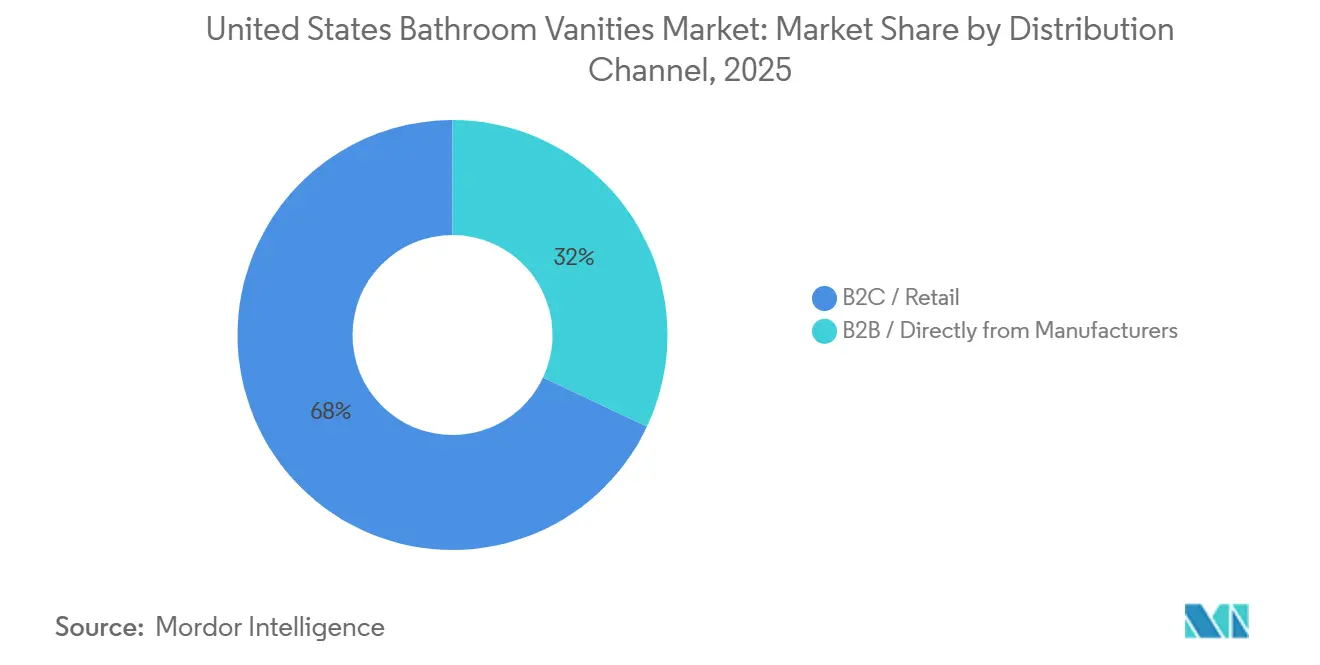
- By distribution channel, B2C/retail contributed 68.00% of the 2025 United States bathroom vanities market share, while direct B2B posted the fastest 7.97% CAGR.
- By geography, the Southeast led with 24.00% of the 2025 United States bathroom vanities market share, while the Southwest recorded the fastest 8.09% CAGR to 2031.
Note: Market size and forecast figures in this report are generated using Mordor Intelligence’s proprietary estimation framework, updated with the latest available data and insights as of January 2026.
United States Bathroom Vanities Market Trends and Insights
Drivers Impact Analysis*
| Driver | (~) % Impact on CAGR Forecast | Geographic Relevance | Impact Timeline |
|---|---|---|---|
| Bathroom Remodeling and Replacement Demand | +1.8% | National, concentrated in the Southeast and the West | Short term (≤ 2 years) |
| Premium Renovation and Design-Led Upgrades | +0.9% | National, strongest in coastal metros and the Mountain West | Medium term (2-4 years) |
| Smart-Home Integration and Electrified Vanity Features | +0.7% | National, led by premium urban projects | Medium term (2-4 years) |
| Hospitality and Commercial Bathroom Refurbishment | +0.6% | National, concentrated in the Southeast, Southwest, and gateway cities | Medium term (2-4 years) |
| E-Commerce-Led Product Discovery and Customization | +0.5% | National, the highest penetration in urban and suburban markets | Short term (≤ 2 years) |
| Aging-in-Place and Universal-Design Requirements | +0.4% | National, strongest in Sun Belt retirement corridors | Long term (≥ 4 years) |
| Source: Mordor Intelligence | |||
Bathroom Remodeling and Replacement Demand Sustains Volume Baseline
Bathroom projects remained the most common work category for professional remodelers in 2025, according to the National Association of Home Builders[1]. Median spending on primary bathroom remodeling reached USD 15,000 in 2025, and major remodels had a median cost of USD 22,000[2]. The United States bathroom vanity market has a recurring replacement base because a vanity can update storage and appearance without requiring a complete room redesign. Homeowners who choose to renovate in place can prioritize this visible change within a partial bathroom project. This demand can remain active even when new-home construction varies by region.
Premium Renovation and Design-Led Upgrades Shift Spending Toward Higher Selling Prices
The highest-spending 10% of bathroom renovation projects reached USD 60,000 in 2024, compared with a USD 22,000 median for major projects. The National Kitchen and Bath Association expects professional-led kitchen and bath spending to grow 4.4% in 2026, compared with 0.6% for do-it-yourself spending. This supports demand for products that combine cabinetry, tops, hardware, lighting, and electrical options. Kohler’s Claude collection, launched with Studio McGee in May 2026, included vanity sizes from 24 inches to 72 inches with Carrara quartz tops and integrated electrical options[3]. The United States bathroom vanity market benefits when showrooms, designers, and trade programs help buyers select these more detailed products.
Smart-Home Integration and Electrified Vanity Features Create a New Specification Layer
Integrated lighting, anti-fog functions, charging surfaces, drawer outlets, and connected controls form part of the feature set described for higher-priced vanities. The United States bathroom vanity market can gain value when these functions are designed into the product rather than sold as separate accessories. They are most relevant when electrical work, mirrors, and cabinetry are planned together. Smart mirrors and connected outlet controllers also make compatibility important in homes and commercial projects. Manufacturers need clear specifications and installation guidance as these features become more common in premium renovation work.
Hospitality and Commercial Bathroom Refurbishment Accelerate B2B Volume
Commercial work is projected to be the fastest-growing end-user segment, at a 7.56% CAGR through 2031. The United States bathroom vanity market can draw on hotel renovation work because operators often replace repeated room fixtures in batches. Brand standards, finish matching, and managed delivery schedules make supplier reliability important in these projects. Healthcare and senior-living facilities may require roll-under forms, lever-faucet compatibility, and knee-clearance layouts. These requirements support direct sales, project logistics, and commercial collections that differ from standard consumer retail offers.
Restraints Impact Analysis*
| Restraint | (~) % Impact on CAGR Forecast | Geographic Relevance | Impact Timeline |
|---|---|---|---|
| Premium Material and Installation Cost | -1.2% | National, most acute in high-cost metros in the Northeast and West Coast | Medium term (2-4 years) |
| Raw-Material, Freight, and Procurement Volatility | -1.0% | National, elevated in import-dependent Southeast and Southwest markets | Short term (≤ 2 years) |
| Moisture-Related Warranty and Installation Risk | -0.5% | National, highest in high-humidity Southeast and coastal markets | Medium term (2-4 years) |
| Return, Damage, and Reverse-Logistics Costs in E-Commerce | -0.4% | National, highest in e-commerce-heavy urban and suburban corridors | Medium term (2-4 years) |
| Source: Mordor Intelligence | |||
Premium Material and Installation Cost Constrain the Mid-Market Addressable Universe
Median planned renovation spending fell to USD 15,000 in 2026 from USD 20,000 in 2025. This can narrow project scope even when homeowners remain interested in bathroom renovation. Professional installation can form a large part of a project budget, especially where plumbing or accessibility changes are required. Buyers may defer replacement, retain an existing cabinet, or choose a lower-cost product when the total project cost rises. The United States bathroom vanity market remains more exposed among price-sensitive households than among buyers pursuing premium renovations.
Raw-Material, Freight, and Procurement Volatility Alter Supply Chain Economics
A September 2025 presidential proclamation imposed a 25% tariff on imported bathroom vanities from October 14, 2025, and the rate increased to 50% on January 1, 2026[4]. The same action imposed a 10% tariff on softwood timber and lumber. Finished products, wood inputs, hardware, and surface materials can all face procurement pressure. Domestic producers remain exposed because they may use imported materials, hardware, and finishes. This makes diversified sourcing, domestic production, and dependable inventory more important across the United States bathroom vanity market.
*Our forecasts treat driver/restraint impacts as directional, not additive. The impact forecasts reflect baseline growth, mix effects, and variable interactions.
Segment Analysis
By Installation Type: Freestanding Holds the Broadest Base While Floating Units Gain Momentum
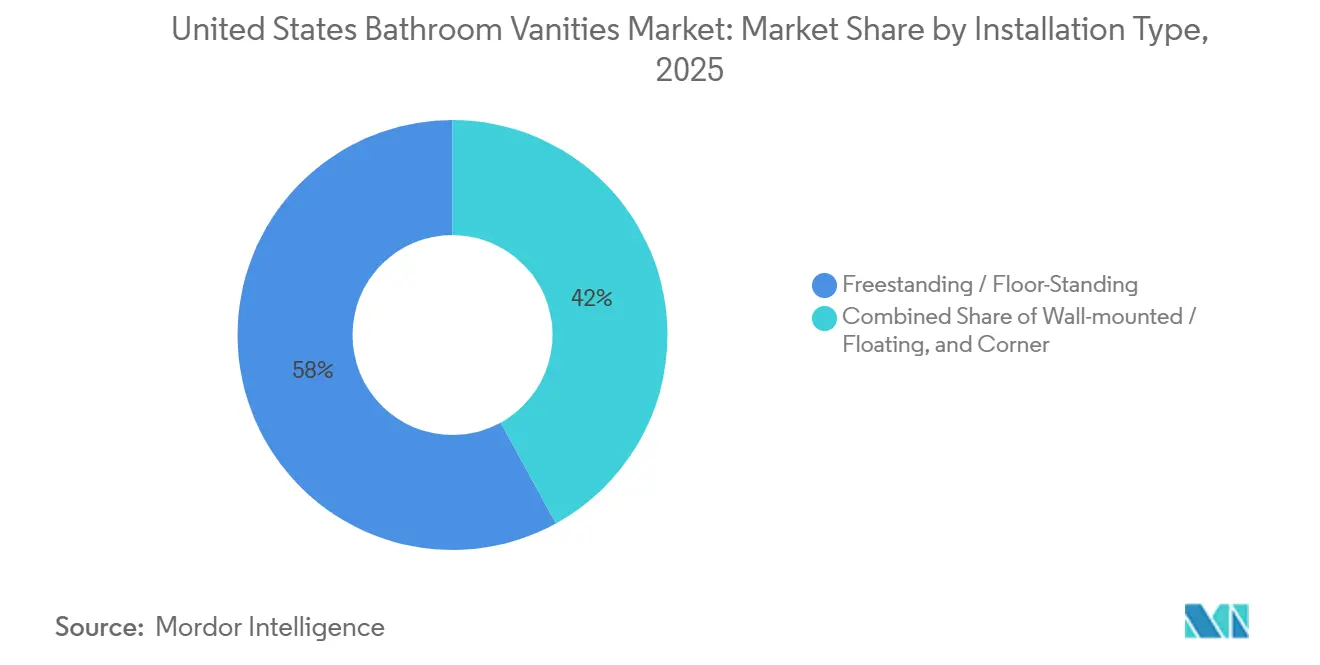
Freestanding and floor-standing units held 58.00% of the United States bathroom vanity market share in 2025. Their position reflects compatibility with older plumbing layouts, where a cosmetic renovation does not require extensive changes to drain or P-trap locations. The United States bathroom vanity market size for freestanding units is supported by the large base of homes built before 2000. These units also fit a wide selection of room styles, including shaker, transitional, and contemporary designs. That range helps suppliers serve entry-level replacements as well as more customized primary-bathroom work. Hospitality retrofit projects can also favor floor-standing products when wall reinforcement would increase construction costs. The format remains practical where renovation schedules and budgets do not allow major structural changes.
Wall-mounted and floating units are projected to grow at a 7.26% CAGR through 2031. Their appeal is linked to open sightlines in multifamily apartments and easier floor cleaning in commercial settings. The United States bathroom vanity market gives these products a role in projects where a bathroom is designed for a more spacious visual effect. Floating units often need wall blocking or reinforced anchors, which requires earlier coordination among designers, contractors, and installers. This can move selection from homeowner-led retail shopping toward professional specification. The shift supports premium collections that are sold through showrooms and trade relationships. Corner vanities serve a smaller need in powder rooms and other tight spaces where footprint control is more important than scale.

By Material: Wood Leads in Share and Forecast Growth
Wood held 34.60% of the United States bathroom vanity market size in 2025, and stone is forecast to grow at a 7.74% CAGR through 2031. In a Houzz study, wood was selected by 26 out of every 100 homeowners as the preferred vanity cabinet choice. The material can support traditional, transitional, and contemporary room designs through changes in finish, grain, and door profile. Engineered wood with veneer or laminate finishes can create a wood appearance at more accessible price points. Moisture-resistant MDF-core specifications can also reduce swelling concerns in humid settings. These options broaden the use of wood beyond the highest-priced residential projects. They also give manufacturers a way to offer different price points without changing the overall look of a collection.
Ceramic has a stable role in high-traffic commercial and coastal settings. Stone materials such as marble, quartz, and granite are used in premium homes and upper-midscale hospitality projects where surface durability and appearance justify higher prices. The United States bathroom vanity market also includes laminate and MDF products for secondary bathrooms, rental properties, and budget-sensitive replacements. Metal, glass, and solid-surface products serve smaller spa-inspired and designer-led applications. Tariff conditions are directing more attention toward domestic material sources, including engineered wood and domestically quarried stone. Imported hardwood and Chinese-processed quartz may face a less favorable procurement position under the tariff structure. Materials strategy is therefore closely connected to price positioning and supply continuity.
By Sink Configuration: Single-Sink Units Retain Scale While Double-Sink Units Expand Faster
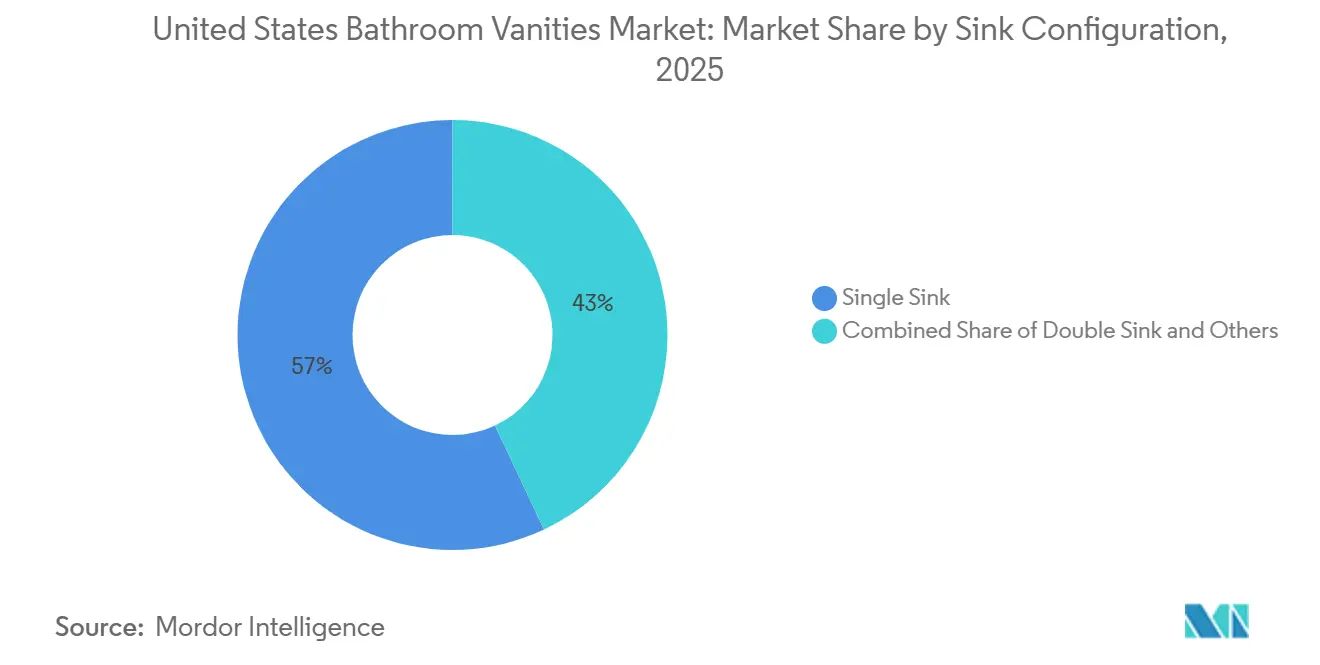
Single-sink configurations held 57.00% of the United States bathroom vanity market share in 2025. They are widely used in secondary bathrooms, powder rooms, and smaller primary bathrooms. Their compact size and lower price support replacement demand across rental properties, starter homes, and entry-level suburban renovation projects. The large stock of older homes also supports this configuration because many bathrooms were not built for wider cabinets. Single-sink units provide a practical way to improve storage and appearance without redesigning the full room. Their broad relevance keeps them important to national retailers and local dealers. Vessel and integrated multi-bowl formats have a smaller role in design-led primary bathroom projects.
Double-sink vanities are projected to grow at a 6.99% CAGR through 2031. The United States bathroom vanity market sees demand for this configuration when households place greater value on separate sink access in a shared bathroom. These packages typically require wider cabinets and deeper plumbing coordination than single-sink products. Buyers may therefore rely more on design-build contractors and showrooms when making the selection. This supports professional specification and can improve the role of trade programs. Manufacturers and channel partners can also benefit from the higher-value package. The configuration is best suited to projects where the bathroom layout can support the added width and plumbing requirements.
By End User: Residential Buyers Provide the Base While Commercial Demand Adds Growth
Residential buyers held 82.30% of the United States bathroom vanity market size in 2025. The segment is supported by more than 140 million housing units, and the persistent importance of bathroom work for professional remodelers. Houzz reported that nearly 1 in 2 homeowners planning a renovation had a bathroom project in their pipeline in 2026. Residential demand ranges from compact replacement units to high-value primary bathroom renovations. Higher-end projects can generate stronger average selling prices through larger cabinets, premium tops, and coordinated lighting. However, the segment remains sensitive to the cost of professional installation and overall household renovation budgets.
Commercial demand is projected to expand at a 7.56% CAGR through 2031. Hotels, healthcare sites, and senior-living facilities have needs that differ from household buyers in terms of product consistency, accessibility, and procurement timing. The United States bathroom vanity market can serve these accounts through designs that allow clear floor space and compatible fixtures. Commercial buyers may place larger orders, but also require reliable manufacturing schedules and coordinated finishes. Product lines that meet accessibility needs can create a clearer fit for institutional purchasing. These orders can be less dependent on individual consumer confidence. They also increase the importance of direct sales teams and project management capability.
By Distribution Channel: Retail Leads Current Value While Direct Sales Grow Faster
B2C and retail channels held 68.00% of the United States bathroom vanity market size in 2025. Home centers support volume through broad assortments and links with contractor programs. Specialty furniture stores serve buyers who need more assistance with design choices and finishes. Online shopping supports product research, particularly when consumers compare dimensions, storage, and style before buying. The augmented-reality visualization and improved return processes as factors that can reduce friction in online selection. Retail remains important because many bathroom projects begin with a homeowner exploring options before a contractor is chosen. Channel coverage must therefore include both physical product displays and clear digital information.
B2B and direct-from-manufacturer sales are forecast to grow at a 7.97% CAGR through 2031. FGI Industries reported Q2 2026 revenue growth of 2.9% and gross margin of 33.4%, compared with 28.1% in Q2 2025. The company also announced a Houston distribution center planned to open by the end of 2026. The United States bathroom vanity market supports direct sales where hospitality and multifamily buyers need volume consistency and managed lead times. WaterSense certification is also increasingly relevant to commercial specifications. Direct channels can give manufacturers more control over project delivery, but they require distribution capacity and customer service built for larger orders.
Geography Analysis
The Southeast held 24.00% of the United States bathroom vanity market share in 2025. The region benefits from housing construction and renovation activity that supports demand for bathroom fixtures. More than 53% of 1.5 million national building permits issued in 2024 were in the South. Florida and Texas recorded 173,326 and 225,756 permits, respectively, in 2025. The United States bathroom vanity market has a broad opportunity in these states because new construction and renovation can occur at the same time. Pro-growth zoning, developable land, and corporate in-migration support regional housing demand. Some Sun Belt multifamily areas are also working through added inventory, which can make short-term project timing uneven.
The Southwest is forecast to grow at a 8.09% CAGR through 2031. Arizona recorded a decade-high housing construction in 2024, while the state added 67,000 residents in 2025. A semiconductor and data center investment pipeline of more than USD 200 billion is reshaping selected Phoenix-area employment corridors. The United States bathroom vanity market can benefit from housing demand around these employment areas, even as statewide permit activity softened in 2025. The West also recorded a 5.3% annual gain in housing starts in July 2026. Western renovation budgets can support premium product demand, as 28% of surveyed respondents planned to spend USD 50,000 or more on renovation.
The Northeast held the smallest regional position in 2025. Older, denser multifamily housing and higher retrofit costs can limit full bathroom renovations in this region. The United States bathroom vanity market still has demand for compact products suited to smaller bathroom footprints. Northeast housing starts rose 11.7% year to date in July 2026, supported by multifamily infill in urban areas. The Midwest recorded the steepest national decline in housing starts, falling 27.6% in July 2026. This creates a more cautious new-construction setting, although replacement demand remains relevant across the established housing stock.
Competitive Landscape
Kohler, LIXIL through American Standard, MasterBrand, and Masco-affiliated brands use national retail placement, scale, and designer programs to maintain visibility. Kohler presented its Charlemont collection at KBIS 2026 and introduced the Claude x Studio McGee suite in 2026. These moves combine broad product reach with collections that support professional specification. The United States bathroom vanity market rewards this approach because many renovation buyers want established products, but also expect differentiated design. Large suppliers can use showroom, contractor, and retail networks to address both needs.
LIXIL entered a licensing partnership with American Bath Group in April 2025, covering production and distribution rights for American Standard, DXV, and Eljer bathing products in North America. The arrangement included the Salem, Ohio, manufacturing facility and certain assets from Monterrey and Mansfield. The transaction reflects a more focused portfolio approach and may create room for other firms in bathroom furniture categories. FGI Industries represents a smaller public competitor that is strengthening its wholesale infrastructure. Its planned Houston distribution center is intended to extend B2B bathroom and vanity coverage across the Southern United States. The United States bathroom vanity market gives such suppliers an opening when they can offer reliable fulfillment and competitive designs.
Wyndham Collection, Design Element, Avanity, FGI Industries, and Bellaterra Home compete in the more fragmented lower tier. Their positioning depends on design responsiveness, competitive pricing, and e-commerce fulfillment. The United States bathroom vanity market requires these companies to manage return risk, product damage, and changing consumer preferences while competing with larger retail assortments. Kohler’s design collaboration, LIXIL’s licensing arrangement, and FGI’s distribution investment show three distinct strategic responses. One response is to build premium design relevance, another is to streamline a portfolio, and another is to improve direct delivery capacity.
United States Bathroom Vanities Industry Leaders
-
Kohler Co.
-
Master Brands, Inc.
-
Masco Corporation
-
LIXIL Corporation
-
Foremost Groups, Ltd.
- *Disclaimer: Major Players sorted in no particular order
Recent Industry Developments
- May 2026: Kohler, with Studio McGee, launched the Claude bathroom collection. Claude bathroom suite includes a full vanity line in 24-inch to 72-inch sizes with Carrara quartz tops, integrated electrical options, and soft-close drawers in 3 finish options: White Oak, Draper Oak, and White, extending Kohler’s designer-collaboration specification strategy.
- January 2026: Kohler presented the Charlemont collection, a midcentury-modern-inspired vanity and bath line, and WasteLAB products made partly from post-industrial manufacturing waste, reinforcing design-forward and sustainability-focused positioning.
United States Bathroom Vanities Market Report Scope
Bathroom vanities are fixtures combining a sink, countertop, and storage, designed to organize essentials and conceal plumbing while serving as a focal point in bathroom design. The United States bathroom vanities market is segmented by installation type, material, sink configuration, end user, distribution channel, and geography. By installation type, the market is segmented into freestanding, wall-mounted, and corner. By material, the market is segmented into wood, ceramic, stone, laminate/MDF, and more. By sink configuration, the market is segmented into single, double, and others. By end user, the market is segmented into residential and commercial. By distribution channel, the market is segmented into B2C/retail and B2B/direct. By geography, the market is segmented into the Northeast, Southeast, Midwest, Southwest, and West. The report offers the market size in value terms in USD for all the above-mentioned segments.
| Freestanding / Floor-standing |
| Wall-mounted / Floating |
| Corner |
| Wood |
| Ceramic |
| Stone (Marble, Quartz, Granite) |
| Laminate / MDF |
| Others (Metal, Glass, Solid Surface) |
| Single Sink |
| Double Sink |
| Others (e.g., Vessel, Integrated Multi-bowl) |
| Residential |
| Commercial |
| B2C/Retail | Home Centers |
| Specialty Furniture Stores (including exclusive brand outlets) | |
| Online | |
| Other Distribution Channels (includes hypermarkets, supermarkets, teleshopping, warehouse clubs, departmental stores, etc.) | |
| B2B/Directly from Manufacturers |
| Northeast |
| Southeast |
| Midwest |
| Southwest |
| West |
| By Installation Type | Freestanding / Floor-standing | |
| Wall-mounted / Floating | ||
| Corner | ||
| By Material | Wood | |
| Ceramic | ||
| Stone (Marble, Quartz, Granite) | ||
| Laminate / MDF | ||
| Others (Metal, Glass, Solid Surface) | ||
| By Sink Configuration | Single Sink | |
| Double Sink | ||
| Others (e.g., Vessel, Integrated Multi-bowl) | ||
| By End User | Residential | |
| Commercial | ||
| By Distribution Channel | B2C/Retail | Home Centers |
| Specialty Furniture Stores (including exclusive brand outlets) | ||
| Online | ||
| Other Distribution Channels (includes hypermarkets, supermarkets, teleshopping, warehouse clubs, departmental stores, etc.) | ||
| B2B/Directly from Manufacturers | ||
| By Geography | Northeast | |
| Southeast | ||
| Midwest | ||
| Southwest | ||
| West | ||
Key Questions Answered in the Report
What is the projected growth rate for United States bathroom vanities through 2031?
The category is projected to grow at a 5.94% CAGR from 2026 to 2031, reaching USD 12.32 billion by 2031.
Which installation type leads bathroom vanity sales in the United States?
Freestanding and floor-standing units led with 58.00% of 2025 value because they work with common existing plumbing layouts.
Which bathroom vanity material is growing fastest?
Stone is projected to be the fastest-growing material at a 7.74% CAGR through 2031, after holding 34.60% of the 2025 value.
Why are wall-mounted bathroom vanities gaining demand?
Wall-mounted units are forecast to grow at a 7.26% CAGR because they support open visual layouts and easier floor maintenance.
What buyer group is expected to expand fastest for bathroom vanities?
Commercial buyers are projected to grow at a 7.56% CAGR through 2031, supported by hospitality, healthcare, and senior-living requirements.