
United Kingdom Soil Monitoring Market Size and Share
Market Overview
| Study Period | 2021 - 2031 |
|---|---|
| Forecast Data Period | 2026 - 2031 |
| Base Year Market Size (2025) | USD 54.93 Million |
| Market Size (2026) | USD 59.71 Million |
| Market Size (2031) | USD 90.61 Million |
| Growth Rate (2026 - 2031) | 8.70 % |
| Market Concentration | Medium |
Major Players *Disclaimer: Major Players sorted in no particular order Image © Mordor Intelligence. Reuse requires attribution under CC BY 4.0. | |
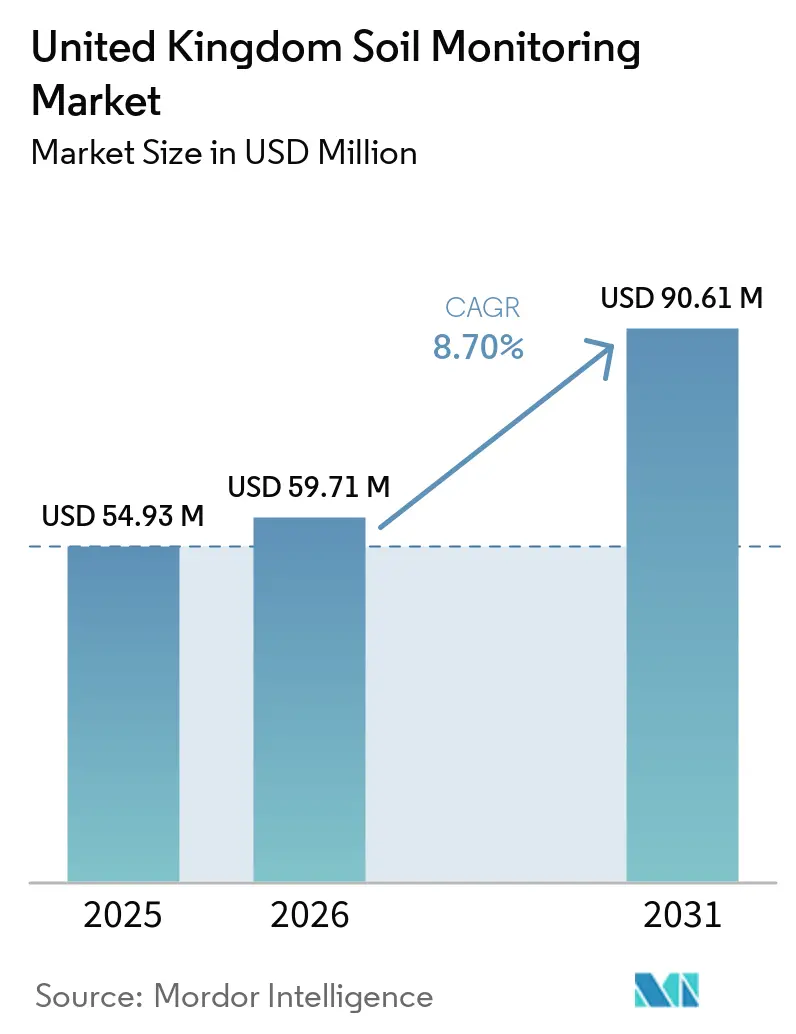
United Kingdom Soil Monitoring Market Analysis by Mordor Intelligence
The United Kingdom soil monitoring market size is projected to be USD 54.93 million in 2025, USD 59.71 million in 2026, and reach USD 90.61 million by 2031, growing at a CAGR of 8.70% from 2026 to 2031. The United Kingdom soil monitoring market is shaped by farm support reforms, climate reporting needs, and the growing use of digital evidence in land management. The Farming Equipment and Technology Fund provides GBP 50 million (USD 64 million) in 2026 to support investments in precision tools, monitoring systems, robotics, and digital technologies, encouraging the adoption of on-farm sensing technologies. The March 2026 Indicators of Soil Health for England created a national baseline for soil carbon storage, flood-risk reduction, and sustainable arable production. Payment rules increasingly favor reliable field records, which raises demand for monitoring systems that connect measurement, reporting, and farm decisions. The removal of the Sustainable Farming Incentive 2026 (SFI26) soil assessment action may reduce the public entry point for smaller farms, while creating room for private subscriptions and managed services.
Key Report Takeaways
- By component, hardware was the largest segment, and accounted for 37.7% of the revenue in 2025, while services were the fastest-growing segment, with a forecast CAGR of 9.3% through 2031.
- By product type, in-situ sensors were the largest segment, with a 41.1% of the United Kingdom soil monitoring market share in 2025, while remote-sensing platforms are the fastest-growing segment, with a forecast CAGR of 9.1% through 2031.
- By connectivity technology, wireless was the largest segment, and held 63.7% of the United Kingdom soil monitoring market size in 2025, and is growing the fastest, with a forecast CAGR of 9.8% through 2031.
- By application, open field was the largest segment, with a 46.7% revenue share in 2025, while protected cultivation is the fastest-growing segment, with a forecast CAGR of 9.2% through 2031.
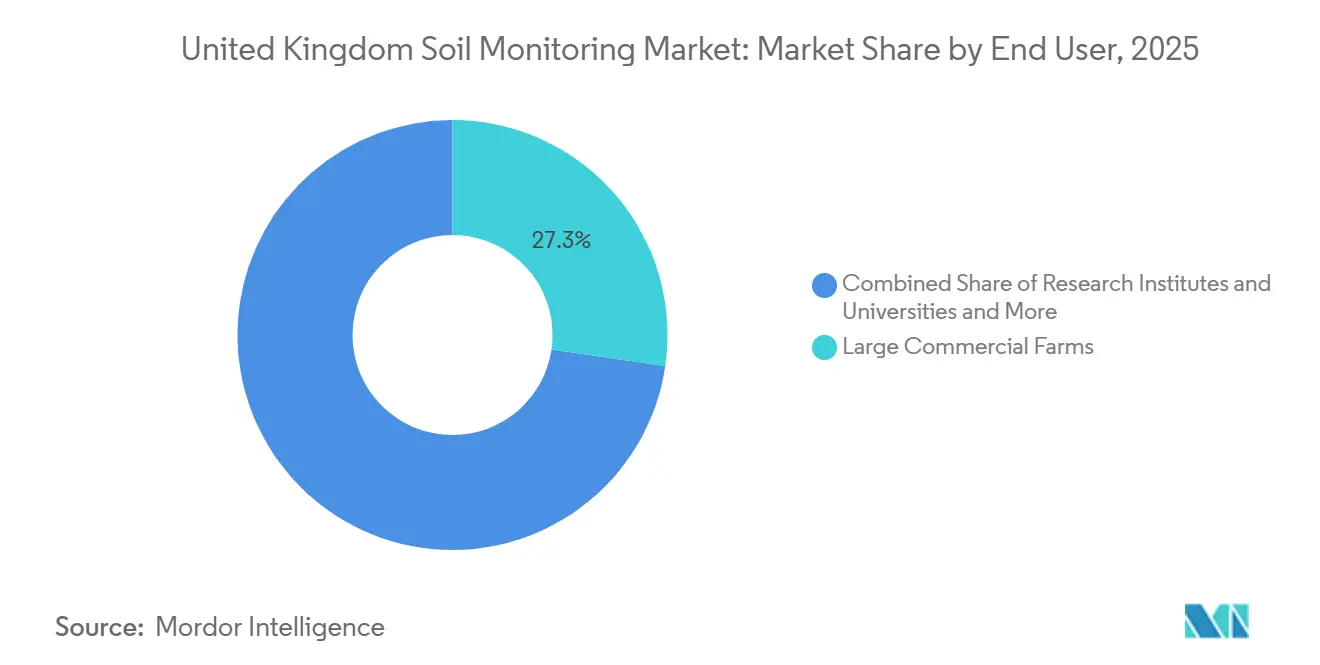
- By end user, large commercial farms were the largest segment, with a 27.3% revenue share in 2025, while research institutes and universities are the fastest-growing segment, with a forecast CAGR of 9.6% through 2031.
Note: Market size and forecast figures in this report are generated using Mordor Intelligence’s proprietary estimation framework, updated with the latest available data and insights as of January 2026.
United Kingdom Soil Monitoring Market Trends and Insights
Drivers Impact Analysis*
| Driver | (~) % Impact on CAGR Forecast | Geographic Relevance | Impact Timeline |
|---|---|---|---|
| Precision Agriculture and Variable-Rate Input Adoption | +2.3% | England, especially the East Midlands and South East, with adoption extending to Scottish lowlands | Medium term (2-4 years) |
| Soil-Health Baseline and Sustainable Farming Incentives | +2.0% | National, with strong relevance in England and Wales | Short term (≤ 2 years) |
| Climate-Resilience Monitoring for Flooding and Drought | +1.5% | England, Scotland, and Wales | Medium term (2-4 years) |
| Integration of Sensors with Farm-Management Software | +1.0% | England, with adoption extending to Scotland and Wales | Medium term (2-4 years) |
| Wireless Connectivity and Remote Field Operations | +0.8% | National, including rural Long Range Wide Area Network corridors in England and Wales | Short term (≤ 2 years) |
| Soil-Carbon and Ecosystem-Service Measurement | +0.7% | National, with early concentration in Scotland and Northern Ireland | Long term (≥ 4 years) |
| Source: Mordor Intelligence | |||
Precision Agriculture and Variable-Rate Input Adoption
The Sustainable Farming Incentive (SFI) was relaunched in 2026, offering 71 funded actions that reward measurable improvements in soil health, nutrient efficiency, cover cropping, and no-till farming[1]Source: Department for Environment, Food & Rural Affairs (Defra), “SFI26: details, definitions and what to expect,” GOV.UK, gov.uk.. While the scheme does not directly subsidize all hardware purchases, its evidence and monitoring requirements can encourage the adoption of soil sensors and other on-farm monitoring technologies. Variable-rate nutrient application under action PRF1 requires preprogrammed files based on zonal soil testing or remote sensing data. This makes field measurement an operational requirement for farms seeking higher-value precision payment options. The 2026 Farming Equipment and Technology Fund also supports precision tools, monitoring systems, and digital technologies. The United Kingdom soil monitoring market, therefore, benefits from a closer link between payment access and documented soil data than many farm technology categories.
Soil Health Baselines and Sustainable Farming Incentives
Soil monitoring is becoming part of the evidence base used in agricultural policy and farm support. The Joint Nature Conservation Committee published the Indicators of Soil Health for England in March 2026, covering soil carbon storage, surface-water flood-prevention risk, and sustainable provision of arable crops. The national baseline increases the value of field data by allowing comparison with recognized soil measures. Northern Ireland's College of Agriculture, Food and Rural Enterprise assessed soil carbon across 240 fields in early 2025, measuring soil organic carbon, bulk density, and soil depth[2]Source: College of Agriculture, Food and Rural Enterprise, “CAFRE Launches an Assessment of Soil Carbon Stocks Project,” College of Agriculture, Food and Rural Enterprise, cafre.ac.uk. These programs define parameters that commercial systems must measure consistently. The removal of the SFI26 CSAM1 soil assessment action could shift more small farms toward paid monitoring and subscription services.
Climate Resilience Monitoring for Flooding and Drought
Agriculture in the United Kingdom faces drought and flood risks, increasing the need for soil moisture data. The 2026 Agriculture and the Water Environment report identified 2022 and 2025 as severe heat- and drought-years that caused significant crop losses. The Floods and Droughts Research Infrastructure program represents GBP 38 million (USD 48 million) in funding for in situ monitoring, digital telemetry, and data analytics[3]Source: European Geosciences Union, “Scalable Soil Carbon Monitoring Framework, 170-Farm United Kingdom Study,” European Geosciences Union General Assembly 2026, meetingorganizer.copernicus.org. In the United Kingdom, 59% of sugar beet is grown on sandy or sand-based soils, where water-deficit losses averaged 10% annually and reached 25% in dry years. Delta-T Devices Ltd supplied data loggers and soil moisture sensors for British Beet Research Organization trials in 2024, enabling automated irrigation responses based on measured soil thresholds. The United Kingdom soil monitoring market is moving toward systems that can support automated control decisions and record field conditions.
Sensor Integration With Farm Management Software
Sensor readings are more valuable when they inform irrigation, nutrient, and crop management decisions. CropX Technologies, Inc. launched the Apex multi-depth soil sensor in April 2026 and integrated it with its digital agronomy platform through SDI-12. The platform provides automated moisture-status and leaching detection, as well as irrigation insights, without manual configuration. Farmer Charlie tested soil monitoring systems with 50 United Kingdom farmers between November 2025 to February 2026, using the pilot to refine sensor performance and application usability. Newcastle University's Cockle Park Farm used Long Range Wide Area Network-enabled soil, crop, and environmental sensors in a 2024 government-backed 5G research program. The Rural Payments Agency also uses satellite imagery to monitor land cover, vegetation condition, and soil erosion risk under farm agreements. These public and commercial platforms make software compatibility a more important purchasing factor in the United Kingdom soil monitoring market.
Restraints Impact Analysis*
| Restraint | (~) % Impact on CAGR Forecast | Geographic Relevance | Impact Timeline |
|---|---|---|---|
| Upfront Installation and Subscription Cost | -1.2% | National, especially smaller farms in Wales, Northern Ireland, and upland Scotland | Short term (≤ 2 years) |
| Fragmented Farm Decision-Making and Selective Adoption | -0.9% | National, particularly tenanted and multi-party farm structures | Medium term (2-4 years) |
| Calibration Drift in Variable Soil Textures and Moisture Regimes | -0.6% | England, Wales, and Scotland | Medium term (2-4 years) |
| Incomplete Interoperability and Comparable Soil Data Standards | -0.5% | National, including devolved frameworks in Wales and Scotland | Long term (≥ 4 years) |
| Source: Mordor Intelligence | |||
Upfront Installation and Subscription Costs
Hardware and service costs remain a major barrier for smaller farm businesses with limited capital flexibility. Individual soil sensor nodes, gateway equipment, software, installation, and reporting support can create a sizable initial commitment. The SFI26 payment cap is GBP 100,000 (USD 127,000) annually, and some action payment rates were reduced in 2026. This can reduce the funds available for equipment purchases while documentation needs rise. Subscription models spread the initial cost, but recurring payments can still deter farms with seasonal cash flows. The United Kingdom soil monitoring market needs models that pair devices with useful reporting support at a cost smaller farms can manage.
Fragmented Farm Decision-Making and Selective Adoption
Technology decisions often involve landowners, tenant farmers, advisers, and farm managers with differing priorities, which can delay investment even when soil monitoring has a clear operational use. Fragmented decision-making structures, particularly on tenanted land, mean that even cost-effective solutions can stall without clear agreement on responsibility and benefit-sharing. The June 2026 SFI26 application window prioritized farms of 3 to 50 hectares and those without existing Environmental Land Management agreements, recognizing the barriers smaller farms face when joining support schemes. However, smaller operations often lack the administrative capacity to navigate application processes, limiting the practical impact of such prioritization. The removal of the CSAM1 soil assessment action also eliminated a low-cost way to use soil data, reducing the options available to farms operating on tighter budgets. Unless providers simplify procurement and service delivery, adoption may remain concentrated among larger commercial farms and research-active operations.
*Our forecasts treat driver/restraint impacts as directional, not additive. The impact forecasts reflect baseline growth, mix effects, and variable interactions.
Segment Analysis
By Component: Services Expand as Monitoring Becomes a Managed Activity
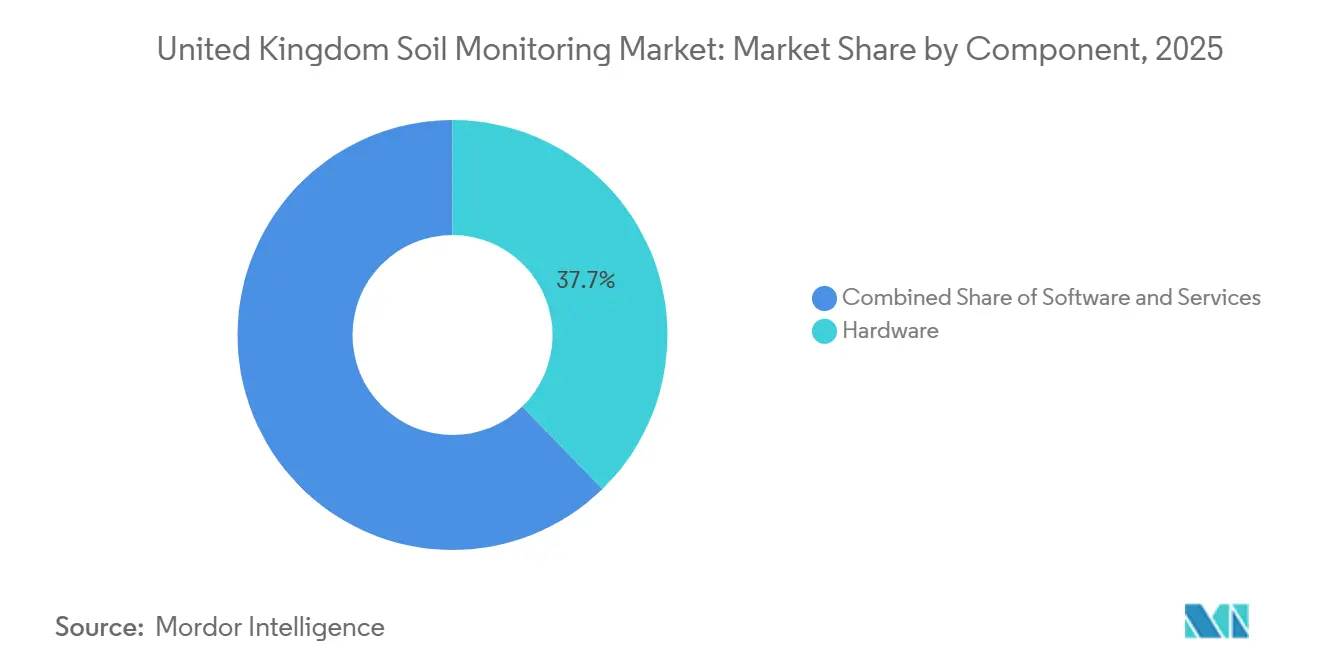
Hardware was the largest component, and accounted for 37.7% of the United Kingdom's soil monitoring market share in 2025. Hardware purchases remain important because farms require sensors, data loggers, and field connectivity to collect data. Services are the fastest component and are forecast to grow at a 9.3% CAGR through 2031. Services include calibration, cloud analytics, managed monitoring, and verified reporting. These offerings gain relevance as farms need usable records instead of raw sensor outputs. SFI26 requires evidence for several actions, which supports demand for providers that can turn field measurements into geo-tagged records.
Farm Carbon Toolkit Version 3.6, released in April 2026, supports multi-year and multi-depth carbon reporting, increasing the need for ongoing data management. Software connects field data with irrigation and nutrient choices across the United Kingdom soil monitoring industry. CropX Technologies, Inc. combines data from soil sensors, satellites, rain gauges, and farm machinery in one agronomy platform. As sensor components become more widely available, software depth and service quality can become stronger points of differentiation. Providers that combine equipment and advisory support can address farms that lack in-house data skills.



By Product Type: In-Situ Sensors Lead While Remote Platforms Extend Coverage
In-situ sensors were the largest product type, and accounted for 41.1% of the United Kingdom soil monitoring market size in 2025. Fixed in-situ systems provide continuing readings of soil moisture, temperature, and electrical conductivity. They serve open-field arable farms, grassland, and controlled cultivation sites. Remote-sensing platforms were the fastest product type, with a forecast CAGR of 9.1% through 2031. Remote systems use satellite imagery, drone scanning, and proximal measurement to cover larger areas. The Rural Payments Agency uses satellite imagery to monitor land cover, vegetation condition, and soil erosion risk, thereby building familiarity with remote sensing data in farm administration.
EarthOptics, Inc. reported more than 5 million mapped acres by July 2025 and collects 4,000 soil data points per 100 acres with its multi-sensor ground platform. Portable probes and test kits support agronomists, field technicians, and research teams that need targeted readings without permanent installation. Pessl Instruments GmbH added METOS TSM in November 2024, a non-contact electromagnetic tool that measures volumetric soil moisture at multiple depths. The British Society of Soil Science notes that direct measurement remains accurate but can be slow, destructive, and costly at scale. This supports integrated measurement approaches that combine permanent, portable, and remote tools.
By Connectivity Technology: Wireless Leads Deployment Across Farm Sites
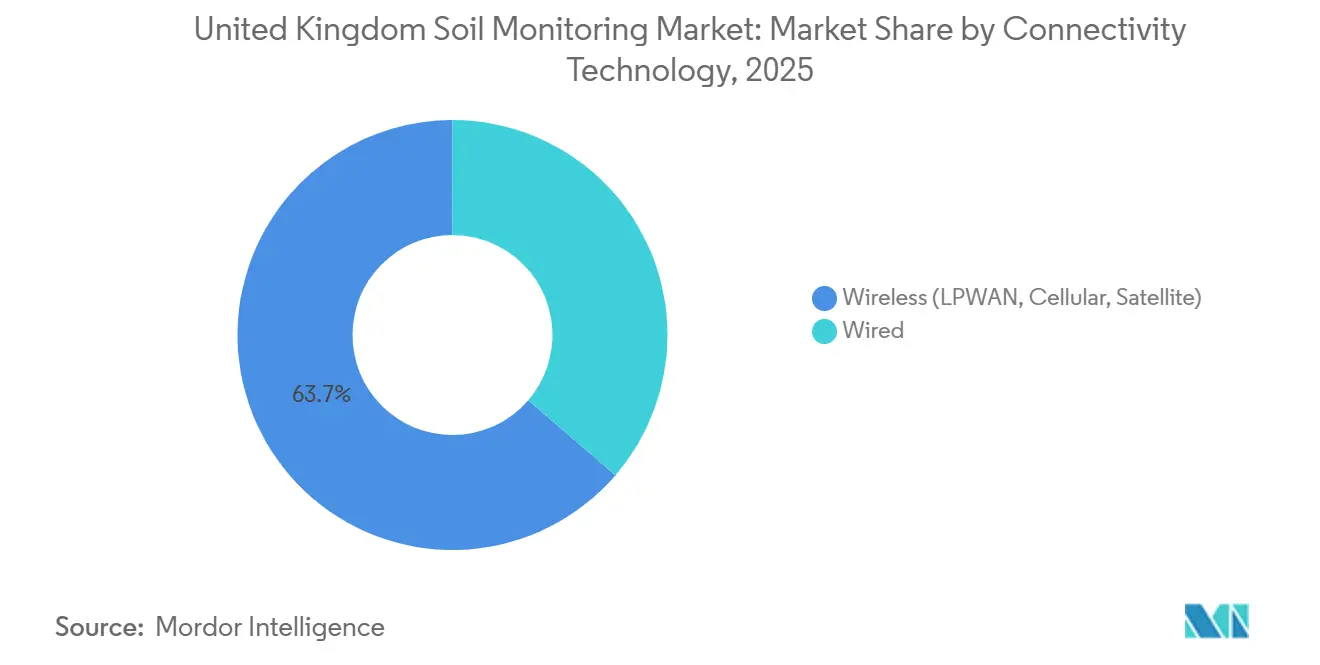
Wireless was the largest connectivity technology, with a 63.7% revenue share in 2025, and is also the fastest-growing, with a forecast CAGR of 9.8% through 2031. Long Range Wide Area Network, cellular, and satellite connections serve different field settings. Long Range Wide Area Network suits open land within gateway range and supports low-power devices. Cellular networks suit farms that need higher data throughput or wider service integration. The European Space Agency's GAUFF project assessed combinations of Long Range Wide Area Network, 5G, and Narrowband Internet of Things for remote locations. This flexibility in connectivity can expand the addressable market for soil monitoring by enabling sensor deployment in remote, poorly connected farming areas in the United Kingdom.
Newcastle University's Cockle Park Farm used Long Range Wide Area Network-enabled sensors as part of a government 5G research program in August 2024. Wired connections retain a role in growrooms, research polytunnels, and instrumented field sites where uninterrupted power and data reliability are important. In 2024, Delta-T Devices Ltd used wired monitoring equipment in British Beet Research Organization drought trials. The United Kingdom soil monitoring market benefits when farms can select a connection method that fits their terrain, crop system, and data requirements.
By Application: Open Field Leads While Protected Cultivation Accelerates
Open field was the largest application with 46.7% revenue share in 2025. Open-field demand reflects the scale of arable land, grassland, and outdoor horticulture across England, Scotland, and Wales. Farms use monitoring to manage irrigation, nutrients, and soil conditions across broad land areas. Protected cultivation was the fastest-growing application, with a forecast CAGR of 9.2% through 2031, as it enables more intensive root-zone monitoring.
J.E. Piccaver and Co used Paul-Tech sensors in 2025 to monitor soil moisture and nitrate dynamics in lettuce plots at 8-centimeter and 20-centimeter depths. The work found that improved moisture and nitrogen management could support a 20% reduction in nitrogen inputs. Forestry is a smaller application, but peatland restoration, woodland carbon projects, and tree-planting programs support its future use. The Woodland Carbon Code and the Peatland Code provide reporting frameworks for measuring carbon and water in this application. These frameworks support demand for reliable soil data across forest and peatland projects.
By End User: Commercial Farms Lead While Research Institutes and Universities Grow Fastest
Large commercial farms were the largest end-user segment with 27.3% revenue share in 2025. Larger farms can spread hardware and subscription costs across more land and revenue. Research institutes and universities were the fastest end-user segment, with a forecast CAGR of 9.6% through 2031, as research users support trials, soil science programs, and instrumented field platforms. Their work also establishes data quality expectations for commercial providers.
Cranfield University used Delta-T Devices Ltd PR2 Profile Probes for research into water movement under different tillage regimes. NIAB East Malling used WET150 sensors and GP2 loggers in growroom research. Rothamsted Research released soil monitoring data from 6 North Wyke Farm Platform field catchments spanning to 2024. College of Agriculture, Food and Rural Enterprise (CAFRE) reported in July 2025 that it was conducting ongoing soil health monitoring across its Greenmount Campus and Glenwherry farms. Such programs support demand for soil-monitoring technologies by demonstrating the value of continuous, field-level data for tracking soil health and informing farm management decisions. Smallholder and cooperative farms remain underserved despite their large number. Government agencies and non-governmental organizations operate public networks that can become reference points or integration partners for commercial providers.
Geography Analysis
England held the largest share of the United Kingdom soil monitoring market in 2025. It continues to lead in 2026 because it has extensive arable land, intensive horticulture, and the largest group of applicants for Department for Environment, Food and Rural Affairs support schemes. The 2026 Farming Equipment and Technology Fund provides GBP 50 million (USD 64 million) for precision equipment and digital technologies. England has a dense network of arable, horticultural, and mixed farming operations where soil monitoring can support irrigation, nutrient management, and compliance records. These farm systems create demand for both fixed field devices and services that interpret the resulting measurements. England also benefits from established public monitoring systems and a wide range of farm types that can use soil data in operational decisions.
Wales is an active area of the United Kingdom soil monitoring market because its Sustainable Land Management framework makes soil health a formal policy measure. The Environment and Rural Affairs Monitoring and Modeling Program (ERAMMP) continued its national field survey through 2025, resurveying 300 monitoring locations across Wales on a rolling basis. The program measures soil carbon, pH, bulk density, moisture, and other soil properties, supporting long-term monitoring of soil health and increasing the need for systematic soil data collection and management. This provides a national reference dataset for agricultural soil conditions. Scotland has a different demand profile because its peatland and upland land areas require water-table and carbon-stock monitoring. Stone Ends Farm used Long Range Wide Area Network sensors to replace manual peatland water-table readings. These applications favor durable systems that can operate in remote and environmentally sensitive locations.
Northern Ireland has a smaller position, but it is growing through institutional soil carbon programs. The College of Agriculture, Food and Rural Enterprise completed soil carbon coring across 240 fields in early 2025. The project measured soil organic carbon, dry bulk density, and soil depth to create field-level baselines. In 2025, The Hybu Cig Cymru Environment Baselining Project used soil sampling, Light Detection and Ranging scanning, and carbon auditing with Welsh livestock businesses. Nonuniform policy timelines across the 4 nations favor providers that can adapt reporting and service models by jurisdiction.
Competitive Landscape
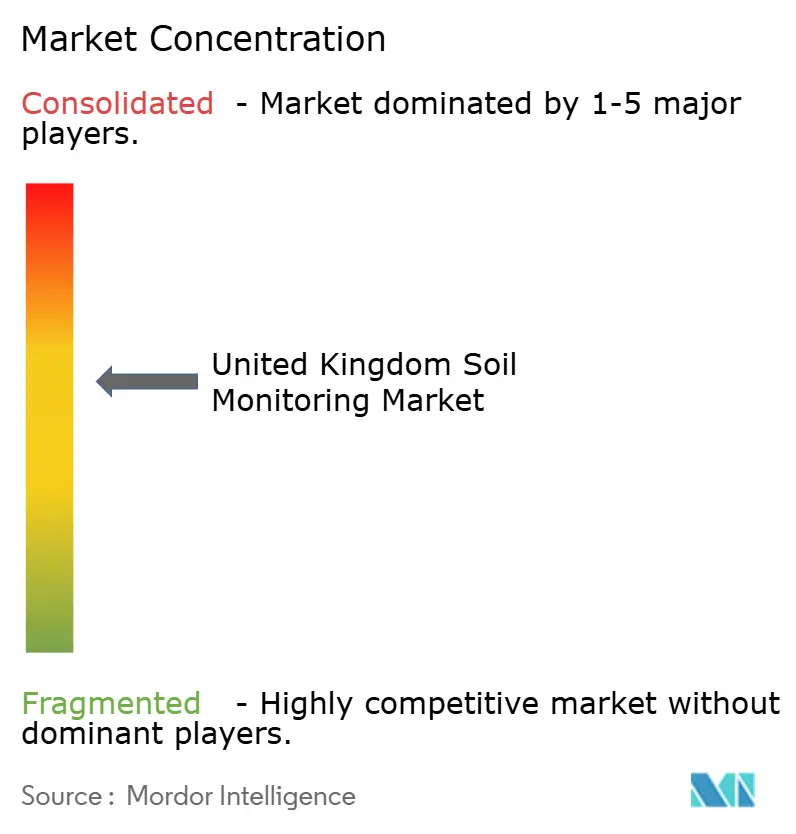
The United Kingdom soil monitoring market is moderately consolidated, with specialist hardware suppliers alongside global digital agronomy platforms in 2025. This competitive mix is expanding access to technology while encouraging providers to differentiate through integrated sensing, analytics, reporting, and advisory services, thereby supporting broader adoption among United Kingdom farms. Hardware competition is intense because lower component costs can put pressure on margins. Providers increasingly combine equipment, data platforms, reporting, and advisory services. CropX Technologies, Inc. completed 7 acquisitions between 2020 and 2025 to integrate soil sensing, remote agronomic analytics, and sustainability reporting into a single platform. EarthOptics, Inc. secured USD 24 million in financing in November 2024 for technology development and geographic expansion. In May 2025, EarthOptics, Inc. launched a mid-infrared carbon testing solution designed for registry-quality reporting at scale. These developments are increasing the breadth of integrated soil-monitoring offerings and intensifying competition around analytics, carbon measurement, and reporting capabilities in the United Kingdom market.
Smaller and medium-sized farms remain an important opportunity because their use of sensors is lower than that of larger commercial operations. Pessl Instruments GmbH launched METOS 5 in November 2025, featuring modular connectivity and simplified field installation. CropX Technologies, Inc. launched Apex in April 2026, featuring multi-depth sensing and direct integration with its platform. Delta-T Devices Ltd remains relevant in research-led and controlled cultivation settings through its sensors, data loggers, and data management tools. The United Kingdom soil monitoring market has room for systems that reduce setup complexity and provide interpretable data without requiring extensive technical expertise.
Compliance requirements affect competitive positioning. United Kingdom Conformity Assessed marking is progressively replacing European Conformity marking for agricultural electronic devices sold in Great Britain. Established providers can more readily manage regulatory documentation and product assurance. Carbon reporting is also raising requirements for consistent measurement and verification. No combined market share data for leading suppliers was provided, so a numeric concentration score cannot be calculated from the available information. The competitive structure remains consistent with a moderately fragmented market, where several specialist and platform providers compete across hardware, software, and services.
United Kingdom Soil Monitoring Industry Leaders
CropX Technologies, Inc.
METER Group, Inc.
The Toro Company
Sentek Ltd
Stevens Water Monitoring Systems, Inc.
- *Disclaimer: Major Players sorted in no particular order

Recent Industry Developments
- April 2026: CropX Technologies, Inc. launched the Apex multi-depth soil sensor, configurable at 12, 24, and 36-inch depths to measure volumetric water content, soil temperature, and salinity at 4-inch intervals throughout the root zone. Integrated through SDI-12 into the CropX platform, Apex delivers automated irrigation insights and leaching detection without manual configuration, extending CropX Technologies, Inc.'s addressable use across deeper-rooted crop systems.
- May 2025: EarthOptics, Inc. commercially launched its mid-infrared (MIR) carbon analysis solution, the first at-scale, registry-quality carbon test using MIR technology. The solution reduces the cost of traditional carbon verification and enables carbon project developers, food brands, and corporate sustainability programs to access registry-grade soil carbon data at scale.
- April 2025: Pessl Instruments GmbH launched METOS STREMO, described as the first real-time, affordable, and permanent plant stress monitoring system. The launch complements soil monitoring deployments by adding canopy-level physiological data for more integrated crop management.


United Kingdom Soil Monitoring Market Report Scope
Soil monitoring is the regular measurement of soil conditions such as moisture, pH, nutrients, temperature, and salinity to assess soil health. It helps farmers and agronomists make better irrigation, fertilization, and crop-management decisions. The United Kingdom Soil Monitoring Market Report is Segmented by Component (Hardware, Software, and Services), by Product Type (In-Situ Sensors, Remote-Sensing Platforms, and Portable Probes and Test Kits), by Connectivity Technology (Wired and Wireless), by Application (Open Field, Protected Cultivation, and Forestry), and by End-User (Large Commercial Farms, Smallholder and Cooperative Farms, Research Institutes and Universities and Government and NGOs). The Market Forecasts are Provided in Terms of Value (USD).
| Hardware |
| Software |
| Services |
| In-situ Sensors |
| Remote-Sensing Platforms |
| Portable Probes and Test Kits |
| Wired |
| Wireless (LPWAN, Cellular, Satellite) |
| Open Field |
| Protected Cultivation |
| Forestry |
| Large Commercial Farms |
| Smallholder and Cooperative Farms |
| Research Institutes and Universities |
| Government and NGOs |
| By Component | Hardware |
| Software | |
| Services | |
| By Product Type | In-situ Sensors |
| Remote-Sensing Platforms | |
| Portable Probes and Test Kits | |
| By Connectivity Technology | Wired |
| Wireless (LPWAN, Cellular, Satellite) | |
| By Application | Open Field |
| Protected Cultivation | |
| Forestry | |
| By End User | Large Commercial Farms |
| Smallholder and Cooperative Farms | |
| Research Institutes and Universities | |
| Government and NGOs |


Key Questions Answered in the Report
What is the projected value of the United Kingdom soil monitoring market by 2031?
The United Kingdom soil monitoring market is projected to reach USD 90.61 million by 2031, expanding at an 8.7% CAGR from 2026. Demand is supported by digital evidence requirements, public monitoring programs, and farm-level investment in sensing tools.
What is driving demand for soil monitoring systems in the United Kingdom?
Farm support rules, climate resilience needs, soil carbon reporting, and digital evidence requirements are increasing demand for field measurement systems. SFI26 rewards documented actions such as soil management and precision nutrient application, while national soil-health indicators make consistent measurements more useful.
Which soil monitoring component is growing fastest?
Services is the fastest component, with a forecast CAGR of 9.3% through 2031. Farms increasingly need calibration, cloud analytics, managed monitoring, and verified reporting support. These services help convert raw readings into records that can support field decisions and reporting requirements.
Which product type leads soil monitoring deployments?
In-situ sensors were the largest product type in 2025, with 41.1% revenue share, because they provide continuous soil readings in field settings.
Why is wireless connectivity important for farm monitoring?
Wireless was the largest and fastest connectivity technology, with 63.7% revenue share in 2025 and a forecast CAGR of 9.8%. It allows sensors to transmit information from dispersed locations, reducing manual readings and supporting regular monitoring in open fields and remote areas.
Which area leads adoption across the United Kingdom?
England was the largest geographic area in 2025 because of its concentration of arable land, horticulture, and access to national farm support programs. Its soil-health indicators and precision equipment funding also support demand for compatible farm data systems.
Page last updated on:





