
United Kingdom Secure Logistics Market Size and Share
Market Overview
| Study Period | 2020 - 2031 |
|---|---|
| Forecast Data Period | 2026 - 2031 |
| Base Year Market Size (2025) | USD 2.26 Billion |
| Market Size (2026) | USD 2.33 Billion |
| Market Size (2031) | USD 3.24 Billion |
| Growth Rate (2026 - 2031) | 6.84 % |
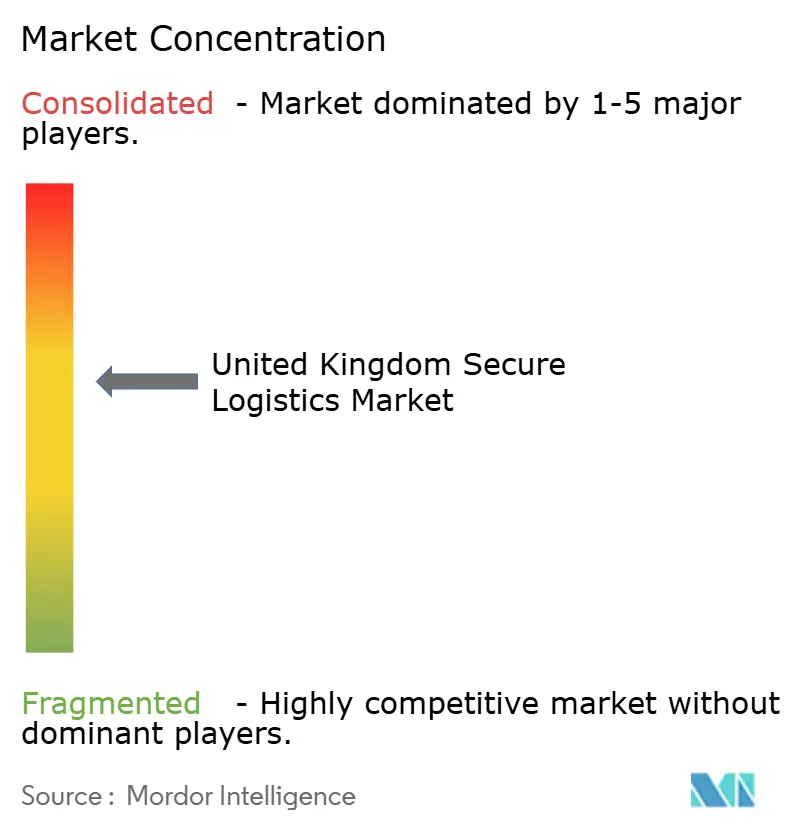
| Market Concentration | Medium |
Major Players *Disclaimer: Major Players sorted in no particular order Image © Mordor Intelligence. Reuse requires attribution under CC BY 4.0. | |
United Kingdom Secure Logistics Market Analysis by Mordor Intelligence
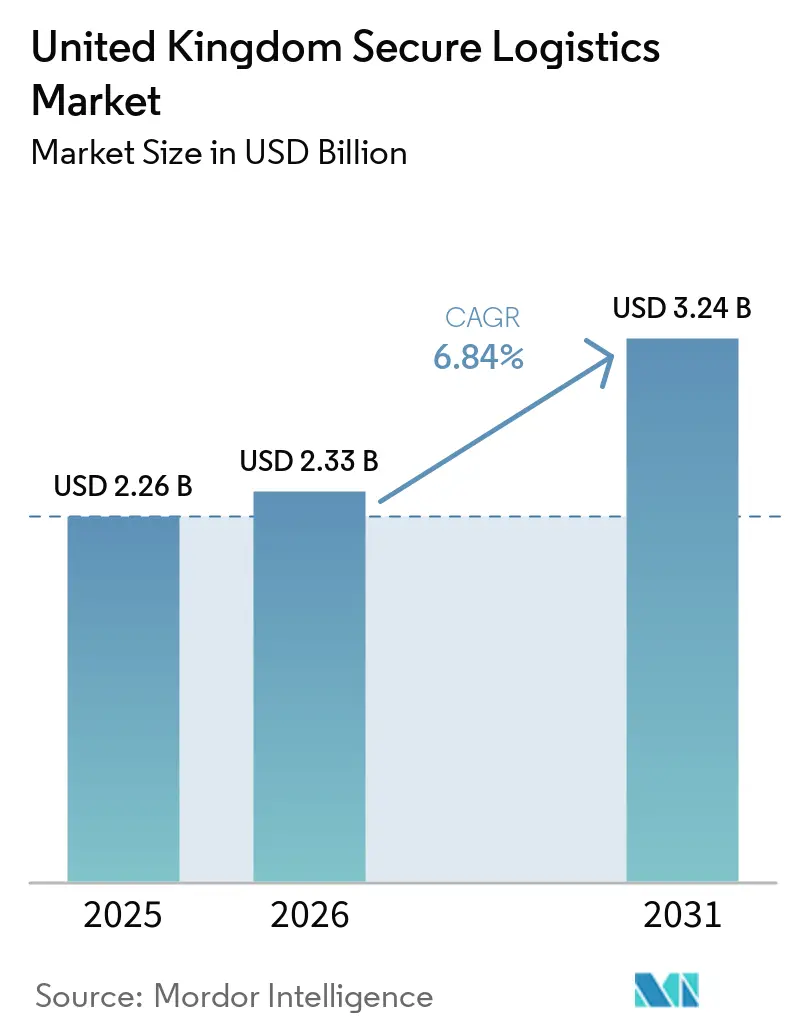
The United Kingdom secure logistics market size was valued at USD 2.26 billion in 2025 and estimated to grow from USD 2.33 billion in 2026 to reach USD 3.24 billion by 2031, at a CAGR of 6.84% during the forecast period (2026-2031).
The United Kingdom secure logistics market continues to depend on cash handling, high-value shipments, and the protection of sensitive supply chains. Greater London’s financial services activity, retail banking network, and bullion role supported specialized transport and vaulting demand. Providers increasingly combined transport with digital monitoring, reporting, and cash forecasting services. Regulatory oversight raised operating requirements for major wholesale cash operators and reinforced the position of established providers. Cash use declined, but larger shipment values and specialized handling needs supported opportunities across the United Kingdom secure logistics market.
Key Report Takeaways
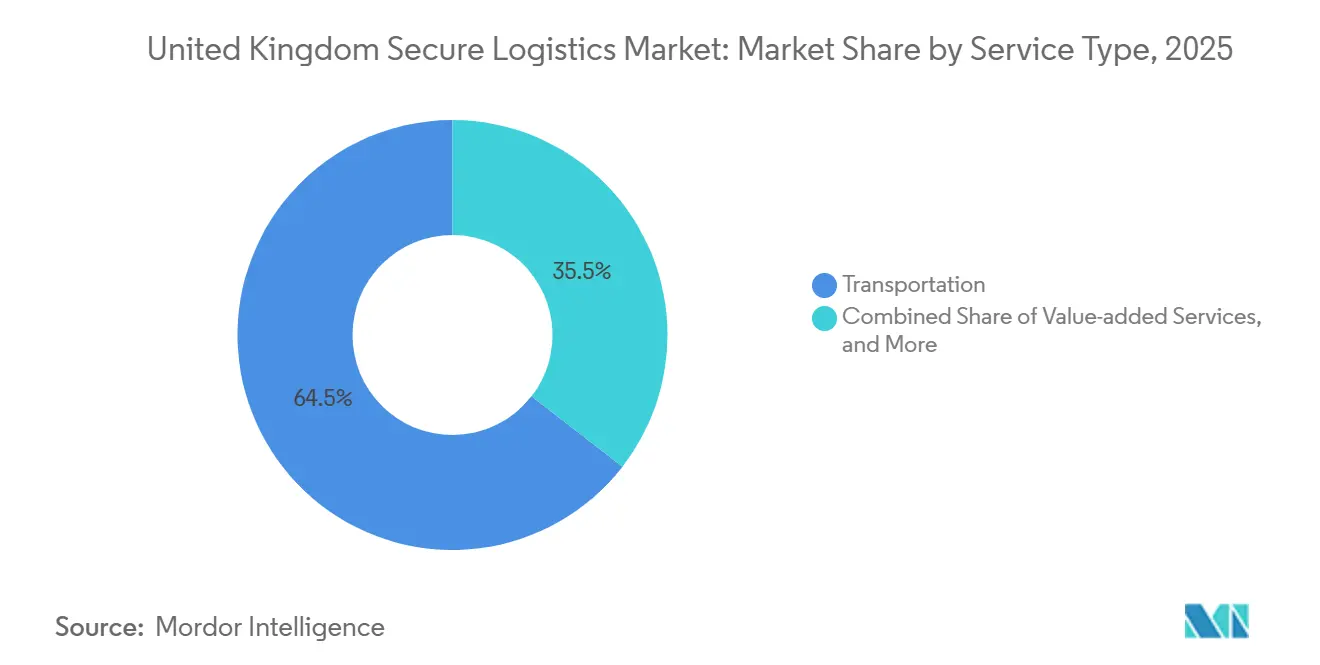
- By service type, transportation led with 64.50% of the United Kingdom secure logistics market share in 2025, while value-added services are forecast to expand at a 9.50% CAGR through 2031.
- By application, cash management held 65.20% of the United Kingdom secure logistics market share in 2025, while jewelry and precious metals are forecast to expand at a 9.20% CAGR through 2031.
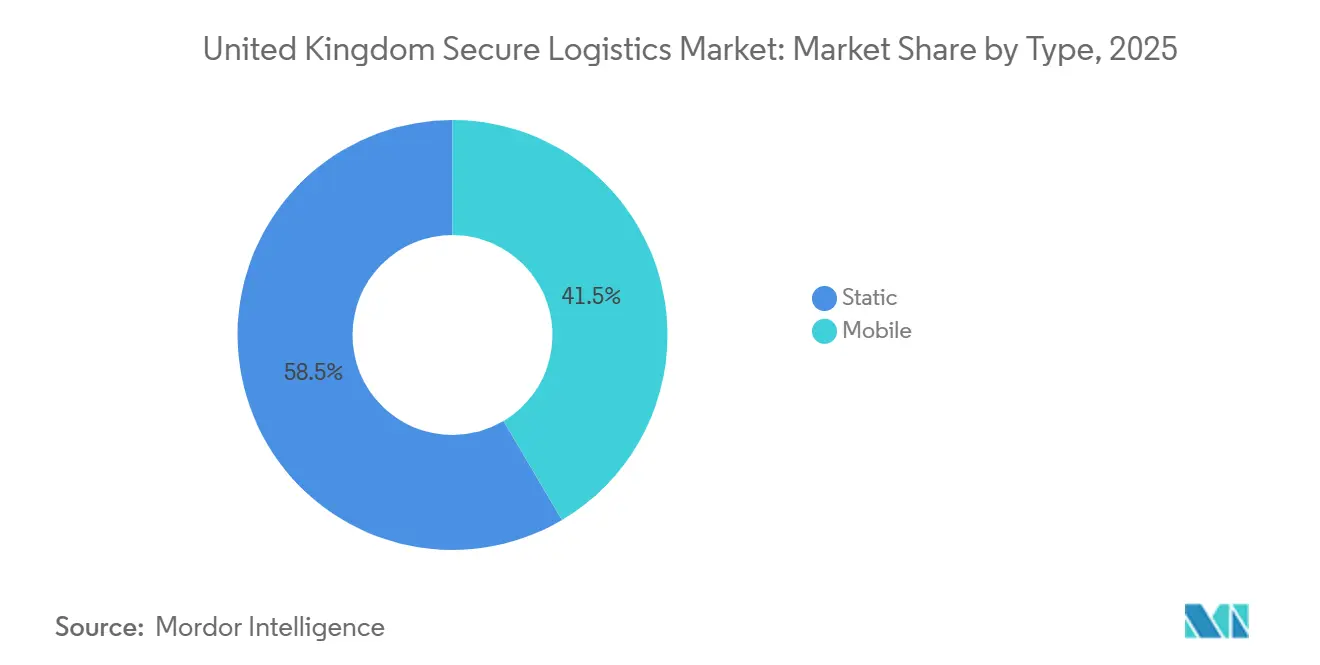
- By type, static services held 58.50% of the United Kingdom secure logistics market size in 2025, while mobile services are forecast to expand at a 7.70% CAGR through 2031.
- By end user, financial institutions held 50.25% of the United Kingdom secure logistics market size in 2025, while retailers are forecast to expand at an 8.80% CAGR through 2031.
Note: Market size and forecast figures in this report are generated using Mordor Intelligence’s proprietary estimation framework, updated with the latest available data and insights as of January 2026.
United Kingdom Secure Logistics Market Trends and Insights
Drivers Impact Analysis*
| Driver | (~) % Impact on CAGR Forecast | Geographic Relevance | Impact Timeline |
|---|---|---|---|
| Cash-Heavy Retail and Banking Footprint | +2.0% | London, Midlands, Northern England, Scotland, national scope | Medium term (2-4 years) |
| High-Value Pharmaceutical and Life Sciences Movements | +1.2% | London, Southeast, Manchester, Edinburgh bio-cluster corridors | Long term (≥ 4 years) |
| Premium Jewelry, Luxury, and Collectibles Distribution | +1.0% | London, Birmingham, Edinburgh | Long term (≥ 4 years) |
| High-Value and Time-Sensitive E-Commerce | +0.8% | National, concentrated in London and Southeast hubs | Medium term (2-4 years) |
| Theft Risk and Cargo Crime | +0.6% | West Midlands, East Yorkshire and Humberside, Southeast, East Midlands | Short term (≤ 2 years) |
| Compliance-Driven Security Requirements | +0.4% | National, including WCDMO-recognized firms and FCA-designated banks | Medium term (2-4 years) |
| Source: Mordor Intelligence | |||
Cash-Heavy Retail and Banking Footprint Remained Material
Cash still serves an important role for many consumers and retail locations across the United Kingdom. Nearly 15% of adults preferred cash, and 1.2 million people used it for almost all daily spending in July 2025. ATM replenishment, vault processing, and note circulation, therefore, remained central to the United Kingdom secure logistics market. Bank branch closures concentrated activity through LINK ATMs, Post Office outlets, and banking hubs. Those sites required frequent replenishment and larger cash deliveries. Tesco IMS processed 300 million cash withdrawals annually through its ATM network, representing 18% of annual United Kingdom cash withdrawals.
High-Value Pharmaceutical and Life Sciences Movements Required Chain-of-Custody Security
Pharmaceutical distribution required documented handovers, temperature control, and secure handling throughout the journey. These requirements made chain-of-custody controls important for high-value and controlled medicines. Specialized operators could support customers who needed validated storage and monitored transport. This requirement encouraged investment in dedicated pharmaceutical infrastructure within the United Kingdom secure logistics market. DHL announced its commitment of EUR 2 billion (USD 2.2 billion) for healthcare and life sciences logistics during 2025-2030. Movianto UK began its 5-year NHS England contract in August 2026, providing national vaccine logistics to more than 11,000 frontline healthcare locations in England.
Premium Jewelry, Luxury, and Collectibles Distribution Supported Specialized Demand
Jewelry, luxury goods, and collectibles required protection because shipment values were high and losses could be material. Dedicated vaulting, tracked vehicle movements, and controlled handovers helped providers meet these requirements. The United Kingdom secure logistics market, therefore, benefited from customers seeking stronger security across transport and storage. Providers also faced demand for premium final-mile delivery that combined identity checks with discreet service. This needs extended protection beyond the transport stage and into the customer handover. Digital shipment visibility and inventory controls became increasingly important for jewelry and precious metals customers.
High-Value and Time-Sensitive E-Commerce Raised Delivery Requirements
High-value e-commerce deliveries required stronger identity verification, tamper evidence, and shipment tracking. Electronics, luxury watches, bespoke jewelry, and collectibles had particular exposure to fraud and unauthorized receipt. DHL Express United Kingdom launched Verified Delivery in 2025, requiring a unique QR code at delivery for eligible high-value shipments. Retailers increasingly expected carriers to manage transport risk alongside physical delivery. This increased the importance of insurance capacity and secure operating procedures. Theft risk and procurement requirements also favored providers that could demonstrate recognized security controls.
Restraints Impact Analysis*
| Restraint | (~) % Impact on CAGR Forecast | Geographic Relevance | Impact Timeline |
|---|---|---|---|
| Cash Substitution in Everyday Transactions | -0.4% | National, most pronounced in London, Manchester, and Bristol | Short term (≤ 2 years) |
| Insurance, Compliance, and Guard Operating Costs | -0.3% | National, concentrated among mid-tier operators | Medium term (2-4 years) |
| Licensed Security and Driver Labor Availability | -0.2% | Northern England, Scotland, and rural areas | Short term (≤ 2 years) |
| Capital Requirements for Secure Fleets and Facilities | -0.2% | National, with highest effect on smaller and emerging operators | Long term (≥ 4 years) |
| Source: Mordor Intelligence | |||
Cash Substitution in Everyday Transactions
Cash payments fell to 3.9 billion in 2025, representing 8% of all United Kingdom payments[1]“UK Cash and Cash Machines 2025,” UK Finance, ukfinance.org.uk. Research reported 4.3 billion cash payments during 2024 and forecasted a 4% share by 2035. This shift reduced low-value and high-frequency replenishment activity, especially in locations with strong debit card use. Residual cash demand remained important among older people, small businesses, informal economy participants, and cash-dependent consumers. These groups continued to require retail-facing collection, ATM, and deposit services. The FCA planned a formal access-to-cash review in the fourth quarter of 2026 and planned to publish findings during the second quarter of 2027.
Insurance, Compliance, and Guard Operating Costs Constrained Smaller Operators
Armored cash-in-transit operations had a substantially different cost profile from general road freight. Insurance pricing reflected routes, cargo values, and theft exposure. Compliance requirements added reporting, audit, and staffing needs for recognized operators. The Bank of England’s oversight regime required recognized businesses to meet resilience and sustainability standards. Labor availability added pressure in Northern England, Scotland, and rural areas where licensed staff were harder to secure. High fleet and facility investment also limited entry by smaller providers into the United Kingdom secure logistics market.
*Our forecasts treat driver/restraint impacts as directional, not additive. The impact forecasts reflect baseline growth, mix effects, and variable interactions.
Segment Analysis
By Service Type: Transportation Retained the Largest Position While Value-Added Services Grew Faster
Transportation held 64.50% of the United Kingdom secure logistics market share in 2025. Armored road fleets supported ATM replenishment, cash collection, and high-value parcel movements across urban and suburban routes. Road operations remained the primary service because they connected retail locations, banking sites, and secure processing centers. Rail and air services served selected bullion and pharmaceutical lanes near financial centers and airports. Transportation also supported inter-branch transfers and recurring retail pickup schedules. The United Kingdom secure logistics market depended on these operating networks because general freight providers did not offer the same security controls.
Value-added services are forecast to grow at a 9.50% CAGR through 2031. Smart-safe monitoring, cash forecasting, route planning, and reconciliation services increased customer reliance on providers. These services turned individual transport assignments into longer-running operating relationships. Loomis expanded this model through SafePoint smart-safe devices that transferred deposit risk at the point of insertion. Warehousing and storage remained important for bullion, pharmaceuticals, and collectibles. The United Kingdom secure logistics industry increasingly competed on integrated operating support as well as vehicle capacity.



By Application: Cash Management Led While Jewelry and Precious Metals Advanced
Cash management accounted for 65.20% of the United Kingdom secure logistics market size in 2025. ATM service, wholesale vault processing, and branch cash handling supported this position. Access-to-cash obligations maintained demand for specialist cash services across banking networks. G4S Cash Centres (United Kingdom) Limited and Vaultex United Kingdom Limited appeared on the Bank of England’s recognized operator list. Diamonds, manufacturing components, and other sensitive goods added specialized applications. Each application required clear custody records and appropriate protection during transport.
Jewelry and precious metals are forecast to grow at a 9.20% CAGR through 2031. The segment relied on secure collection, vaulting, international movements, and monitored delivery. London’s bullion and gemstone activity made specialized capacity important for customers handling high declared values. Providers also served trade events, auction houses, and luxury retailers that required tightly managed movements. Digital tools gave customers better visibility into secure shipments and stored inventory. The United Kingdom secure logistics market gained from this requirement for physical protection and digital visibility.
By Type: Static Services Anchored the Operating Base While Mobile Services Expanded
Static services held 58.50% of the United Kingdom secure logistics market share in 2025. Vaults, secure warehouses, and cash-processing centers provided the fixed infrastructure for wholesale cash distribution. These facilities supported note-quality checks, coin sorting, and denomination management. They also provided protected storage for bullion and other valuable assets. Facility standards mattered for customers who needed controlled access and verified storage conditions. Static capacity consequently remained central to the United Kingdom secure logistics market.
Mobile services are forecast to grow at a 7.70% CAGR through 2031. Dynamic ATM replenishment and on-demand cash-in-transit services supported this expansion. High-value e-commerce also created demand for flexible, monitored transport. Operators used real-time safe data and cash forecasts to schedule visits when needed. This approach reduced reliance on fixed daily or weekly routes. The FCA recorded 121 banking hubs and 93 cash-deposit services by December 2025, creating recurring requirements for mobile support.[2]“Access to Cash Coverage in the United Kingdom 2025 H2,” Financial Conduct Authority, fca.org.uk
By End User: Financial Institutions Held the Largest Position, While Retailers Grew Faster
Financial institutions held 50.25% of the United Kingdom secure logistics market size in 2025. Wholesale cash processing, ATM management, and bank servicing underpinned their demand. Designated banks needed dependable cash-access coverage, and established providers could meet this operational requirement. Their contracts also required broad route coverage, secure centers, and detailed reporting. These conditions favored suppliers with national scale and proven cash-handling systems. Financial institutions, therefore, formed the core end-user base for the United Kingdom secure logistics market.
Retailers are forecast to expand at an 8.80% CAGR through 2031. Supermarkets, convenience stores, and high-value specialty retailers increasingly use smart-safe solutions for in-store cash management. G4S Cash Solutions reported increased customer transitions to Cash360 during the summer of 2026. The system automates counting, validation, reconciliation, and collection triggers. Government customers required secure movements of sensitive documents, defense materials, and currency. Other customers included auction houses, data-center operators, pharmaceutical manufacturers, and art galleries.
Geography Analysis
Greater London and the Southeast held the largest concentration of high-value and cash-related activity within the United Kingdom secure logistics market. The City of London’s financial activity and bullion role supported specialist vaulting and transport. Heathrow Airport remained an important gateway for international jewelry and pharmaceutical cargo. Banking headquarters and dense retail networks added frequent collection and replenishment requirements. Malca-Amit operated a Chubbsafe XII-rated London vault near Heathrow with a 300-ton gold capacity. This concentration supported demand for premium infrastructure and specialized staff.
The West Midlands, East Midlands, and East Yorkshire formed important operating corridors because of manufacturing, retail routes, and security risk. Cargo-crime exposure increased the value of route planning and protected transport in these locations. West Yorkshire Police conducted coordinated raids across 6 Leeds addresses during a national cargo theft investigation in August 2026[3]HM Treasury, “G4S Cash Centres (United Kingdom) Limited Oversight Order,” GOV.UK, gov.uk. Providers needed to adapt their operations to local exposure and insurance conditions. The United Kingdom secure logistics market share remained concentrated in higher-value corridors, while risk management shaped route economics. National enforcement activity gave customers additional reason to seek specialist handling.
Northern England, Scotland, and Wales represented geographically dispersed but important areas for service coverage. Banking centers in Edinburgh and Glasgow supported wholesale cash flows and related processing needs. Rural communities faced gaps after bank branch closures and required cash-access assessments. New banking hubs in affected areas required continuing cash-in-transit support. The Birmingham Jewelry Quarter created a focused demand center for the manufacturing-to-retail pipeline. Providers with regional networks could serve urban routes and rural access commitments. This coverage requirement created an operational advantage for established participants in the United Kingdom secure logistics market.
Competitive Landscape
The United Kingdom secure logistics market was moderately consolidated among large providers and fragmented below that group. Brink’s, Loomis, and G4S Cash Solutions led cash-in-transit and vaulting activity through scale, infrastructure, and customer relationships. G4S Cash Centres (United Kingdom) Limited became subject to wholesale cash oversight in June 2025. Technology platforms helped leading firms integrate into customer cash-management processes. Loomis used SafePoint to link deposit handling with monitored cash management. Brink’s Digital Retail Solutions also emphasized technology-enabled retail cash services.
Brink’s announced its USD 6.6 billion acquisition of NCR Atleos in February 2026. The Competition and Markets Authority opened a Phase 1 inquiry in August 2026 and set an October 2026 decision date[4]“The Brink’s Company and NCR Atleos Corporation Merger Inquiry,” GOV.UK, gov.uk. The proposed transaction would combine cash management services with a global ATM footprint. Brink’s Global AMS also extended its Metro Bank ATM management partnership in March 2026. This helped the provider maintain its presence in ATM operations across the United Kingdom. These moves showed that leading companies sought closer links between cash logistics and ATM management.
Specialist providers focused on vertical expertise rather than national reach. Malca-Amit served jewelry, diamonds, and precious metals through vaulting, event logistics, and digital account tools. DHL, Movianto UK, Rhenus Logistics, and other qualified providers competed in pharmaceutical and life sciences logistics. Smaller businesses served local and niche work where responsiveness and customer service were important. The United Kingdom secure logistics industry had room for specialized providers, but compliance, capital, and network requirements remained meaningful entry barriers.
United Kingdom Secure Logistics Industry Leaders
The Brink’s Company
Loomis AB
Allied Universal
Prosegur Group
DHL Group
- *Disclaimer: Major Players sorted in no particular order

Recent Industry Developments
- August 2026: Movianto UK began a 5-year national logistics contract with NHS England to manage GDP-compliant temperature-controlled distribution to more than 11,000 frontline healthcare locations across England.
- March 2026: Brink’s Global AMS extended its ATM management partnership with Metro Bank across the United Kingdom.
- February 2026: Brink’s and NCR Atleos entered a definitive merger agreement valued at USD 6.6 billion, with completion expected during the first quarter of 2027.
- September 2025: Loomis and NCR Atleos renewed their Tesco Insurance and Money Services relationship, covering more than 3,000 ATMs across 2,000 United Kingdom retail locations.


United Kingdom Secure Logistics Market Report Scope
| Transportation | Road |
| Rail | |
| Air | |
| Sea and Inland Waterways | |
| Warehousing and Storage (including Secure Storage and Vault Services) | |
| Value-added Services |
| Cash Management |
| Diamonds |
| Jewelry and Precious Metal? |
| Manufacturing? |
| Others |
| Static |
| Mobile |
| Financial Institutions |
| Retailers |
| Government |
| Others |
| By Service Type | Transportation | Road |
| Rail | ||
| Air | ||
| Sea and Inland Waterways | ||
| Warehousing and Storage (including Secure Storage and Vault Services) | ||
| Value-added Services | ||
| By Application | Cash Management | |
| Diamonds | ||
| Jewelry and Precious Metal? | ||
| Manufacturing? | ||
| Others | ||
| By Type | Static | |
| Mobile | ||
| By End User | Financial Institutions | |
| Retailers | ||
| Government | ||
| Others |


Key Questions Answered in the Report
What was the size of secure logistics activity in the United Kingdom during 2026?
The United Kingdom secure logistics market was valued at USD 2.33 billion in 2026 and is forecast to reach USD 3.24 billion by 2031.
Which service generated the largest revenue in 2025?
Transportation led service revenue with a 64.50% share, supported by armored road fleets, ATM replenishment, and cash collection.
Which application is growing fastest through 2031?
Jewelry and precious metals are forecast to grow at a 9.20% CAGR through 2031.
Why do financial institutions remain important customers?
Financial institutions held 50.25% revenue share in 2025 because of wholesale cash processing, ATM management, and cash-access requirements.
How are retailers changing their cash handling practices?
Retailers are adopting smart-safe systems that automate cash counting, validation, reconciliation, and collection scheduling.
What is shaping competition among providers?
Large providers compete through national networks, secure facilities, compliance capabilities, and digital cash-management platforms. Specialist providers compete through expertise in jewelry, pharmaceutical, and localized secure movements.
Page last updated on:





