
United Kingdom Robotic Lawn Mower Market Size and Share
Market Overview
| Study Period | 2021 - 2031 |
|---|---|
| Forecast Data Period | 2026 - 2031 |
| Base Year Market Size (2025) | USD 613.46 Million |
| Market Size (2026) | USD 659.47 Million |
| Market Size (2031) | USD 946.75 Million |
| Growth Rate (2026 - 2031) | 7.50 % |
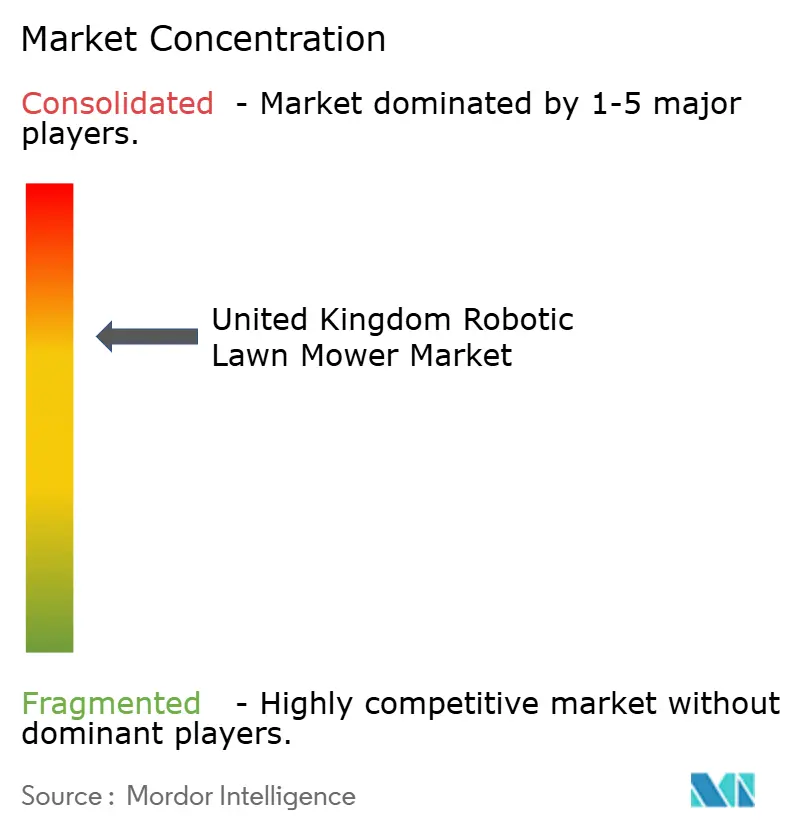
| Market Concentration | Medium |
Major Players
*Disclaimer: Major Players sorted in no particular order Image © Mordor Intelligence. Reuse requires attribution under CC BY 4.0. |
|
United Kingdom Robotic Lawn Mower Market Analysis by Mordor Intelligence
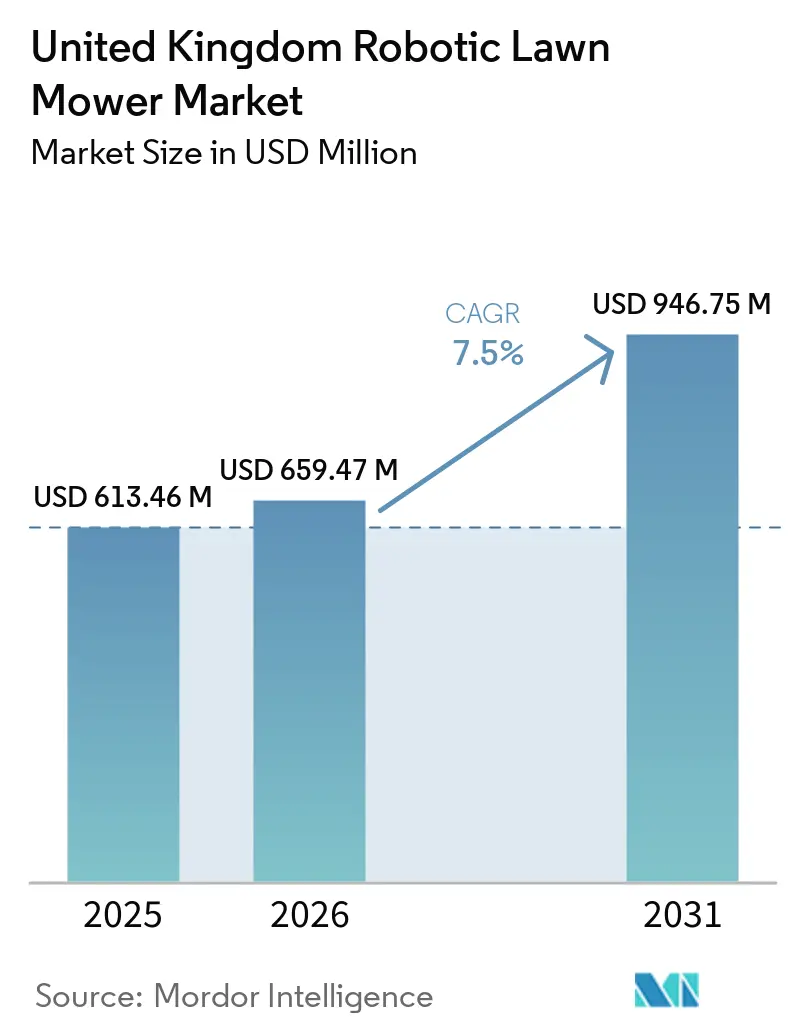
The United Kingdom robotic lawn mower market size was valued at USD 613.46 million in 2025 and is forecast to grow from USD 659.47 million in 2026 to USD 946.75 million by 2031, at a CAGR of 7.50% from 2026 to 2031. The market is expanding beyond early residential adoption, with commercial users deploying machines across golf courses, sports facilities, campuses, and managed estates. Battery-powered equipment, limited availability of landscaping workers, and lower noise levels are broadening the range of sites where autonomous mowing is viable. Products that eliminate the need for boundary-wire installation are gaining importance because they reduce setup requirements and make robotic lawn mowers more attractive to consumers purchasing online. Established European suppliers maintain an advantage through dealer networks and service capability, while newer entrants compete through simpler setups, connected features, and lower-priced models. Wet ground conditions, irregular garden layouts, theft risk, and high upfront costs continue to affect adoption, particularly among price-sensitive household buyers.
Key Report Takeaways
- By range, low (less than 500 m²) accounted for the largest United Kingdom robotic lawn mower market share in 2025, at 51.1%, while high (more than 2,000 m²) is forecast to grow at the fastest CAGR of 11.0% from 2026 to 2031.
- By navigation technology, boundary-wire accounted for the largest share of the United Kingdom robotic lawn mower market in 2025, at 45.1%, while vision/camera is forecast to grow at the fastest CAGR of 18.9% from 2026 to 2031.
- By end-user, residential accounted for the largest share of the United Kingdom robotic lawn mower market in 2025, at 62.9%, while commercial is forecast to grow at the fastest CAGR of 16.6% from 2026 to 2031.
- By distribution channel, offline accounted for the largest share in 2025, at 70.4%, while the United Kingdom robotic lawn mower market size for online is forecast to grow at the fastest CAGR of 17.0% from 2026 to 2031.
Note: Market size and forecast figures in this report are generated using Mordor Intelligence’s proprietary estimation framework, updated with the latest available data and insights as of January 2026.
United Kingdom Robotic Lawn Mower Market Trends and Insights
Drivers Impact Analysis*
| Driver | (~) % Impact on CAGR Forecast | Geographic Relevance | Impact Timeline |
|---|---|---|---|
| Expansion of Smart-Home Automation | +1.8% | United Kingdom-wide, strongest in urban southern England, commuter areas, and Greater London | Medium term (2-4 years) |
| Shift Toward Battery-Electric Outdoor Equipment | +1.5% | United Kingdom-wide, with faster adoption in local authority green spaces in Greater London and Scotland | Medium term (2-4 years) |
| Landscaping Labor Shortages | +1.4% | United Kingdom-wide | Short term (≤ 2 years) |
| Growth of Wire-Free Navigation and Edge Artificial Intelligence | +1.6% | United Kingdom-wide, with early adoption concentrated in South East England | Short term (≤ 2 years) |
| Demand for Low-Noise and Low-Emission Lawn Care | +1% | Urban and suburban areas, especially where noise controls apply | Medium term (2-4 years) |
| Rising Commercial Turf-Automation Deployments | +1.2% | Surrey, Kent, Scotland, sports facilities, and corporate campuses nationwide | Medium term (2-4 years) |
| Source: Mordor Intelligence | |||
Landscaping Labor Shortages
Mowing is a repetitive task that must be completed regularly, creating a recurring labor requirement for grounds maintenance. According to the Department for Education (DfE), 27% of vacancies in the United Kingdom in 2024 were skill-shortage vacancies[1]Source: Department for Education (DfE), "Employer Skills Survey, Calendar year 2024," explore-education-statistics.service.gov.uk.. When posts cannot be filled, operators use autonomous machines that run unattended to cover mowing rounds and redeploy trained staff to horticultural tasks requiring judgment. This is sustaining demand for robotic mowers across residential, commercial, and municipal grounds nationwide.
Growth of Wire-Free Navigation and Edge Artificial Intelligence
The increasing adoption of wire-free navigation and edge artificial intelligence is improving the efficiency, accuracy, and ease of installation of robotic lawn mowers across the United Kingdom. Manufacturers are integrating Real-Time Kinematic Global Positioning System technology, computer vision, Light Detection and Ranging, and on-device artificial intelligence to eliminate perimeter wires while enhancing autonomous navigation and obstacle detection. According to the Golf Club Managers' Association, in May 2026, Royal Lytham and St Annes Golf Club in England deployed four Husqvarna CEORA 546 EPOS robotic mowers and one Automower 580L EPOS, all utilizing wire-free EPOS satellite navigation technology. This commercial deployment reflects growing confidence in advanced autonomous mowing solutions and illustrates how wire-free navigation is driving robotic lawn mower adoption across professional landscape maintenance in the United Kingdom.
Demand for Low-Noise and Low-Emission Lawn Care
Rising demand for quieter and environmentally friendly grounds maintenance is driving the adoption of robotic lawn mowers across the United Kingdom, particularly at schools, healthcare facilities, hotels, and residential communities where noise disturbance is a concern. Battery-powered robotic mowers operate quietly and produce no direct exhaust emissions, making them suitable for noise-sensitive environments. According to the United Kingdom Government, the Noise Emission in the Environment by Equipment for Use Outdoors (Amendment and Transitional) Regulations 2025 came into force in April 2026, introducing updated airborne noise measurement methods for outdoor equipment placed on the Great Britain market[2]Source: Office for Product Safety and Standards, "Noise Emission in the Environment by Equipment for Use Outdoors Regulations 2001: Great Britain," gov.uk.. These updated regulatory requirements reinforce manufacturers' focus on quieter equipment and support the growing adoption of low-noise robotic lawn mowers across the United Kingdom.
Rising Commercial Turf-Automation Deployments
The growing adoption of robotic lawn mowers across commercial landscapes is strengthening demand for autonomous turf maintenance solutions in the United Kingdom. Golf courses, sports venues, educational campuses, and facility management companies are increasingly deploying robotic fleets to improve mowing consistency, optimize labor utilization, and enhance turf quality through frequent autonomous operation. According to Mitie Group plc, in June 2026, the company deployed 24 Kress Voyager autonomous mowing robots across customer sites in the United Kingdom, marking one of the country's largest commercial robotic mower rollouts[3]Source: Mitie Group plc, "Mitie Rolls Out Electric Mowbots to Work Alongside Landscapers Across the UK," Mitie News, mitie.com.. This large-scale deployment reflects rising confidence in autonomous turf management and highlights the expanding commercial opportunity for robotic lawn mowers across the United Kingdom.
Restraints Impact Analysis*
| Restraint | (~) % Impact on CAGR Forecast | Geographic Relevance | Impact Timeline |
|---|---|---|---|
| High Upfront Cost Versus Conventional Mowers | -1.5% | United Kingdom-wide, most limiting in lower-income areas of northern England and Wales | Short term (≤ 2 years) |
| Uneven Terrain and Complex Garden Performance Limitations | -0.8% | Scotland, Wales, and rural northern England | Medium term (2-4 years) |
| Installation, Servicing, and Boundary-Repair Complexity | -0.6% | United Kingdom-wide | Short term (≤ 2 years) |
| Theft, Cybersecurity, and Connectivity Concerns | -0.4% | Urban and suburban areas | Medium term (2-4 years) |
| Source: Mordor Intelligence | |||
High Upfront Cost Versus Conventional Mowers
The high upfront cost of robotic lawn mowers continues to limit adoption among price-sensitive households in the United Kingdom, particularly among consumers with small gardens where conventional electric mowers remain a more affordable option. Although robotic mowers reduce manual effort and offer long-term operational benefits, the initial investment remains a significant barrier to purchase. According to Husqvarna AB's United Kingdom online store, the Automower 305E NERA with EPOS Plug-in, designed for lawns up to 600 m², was priced at GBP 1,659 (USD 2,206) in 2026. This price point discourages first-time buyers and delays broader residential adoption, restraining growth in the United Kingdom robotic lawn mower market despite ongoing technological advancements.
Theft, Cybersecurity, and Connectivity Concerns
Theft risk, cybersecurity vulnerabilities, and network connectivity issues continue to restrain the adoption of robotic lawn mowers in the United Kingdom, particularly among residential and commercial users relying on connected technologies. Outdoor operation increases exposure to theft, while cloud-based applications and remote fleet management require secure digital infrastructure and reliable communication networks. In April 2024, the United Kingdom Government implemented mandatory cybersecurity requirements under the Product Security and Telecommunications Infrastructure Act for internet-connected consumer products, including stricter password and security update obligations. These compliance requirements increase product development complexity and reinforce consumer concerns regarding connected devices, limiting broader adoption of robotic lawn mowers across the United Kingdom.
*Our forecasts treat driver/restraint impacts as directional, not additive. The impact forecasts reflect baseline growth, mix effects, and variable interactions.
Segment Analysis
By Range: Compact Lawns Hold the Largest Position While Large Estates Support Faster Growth
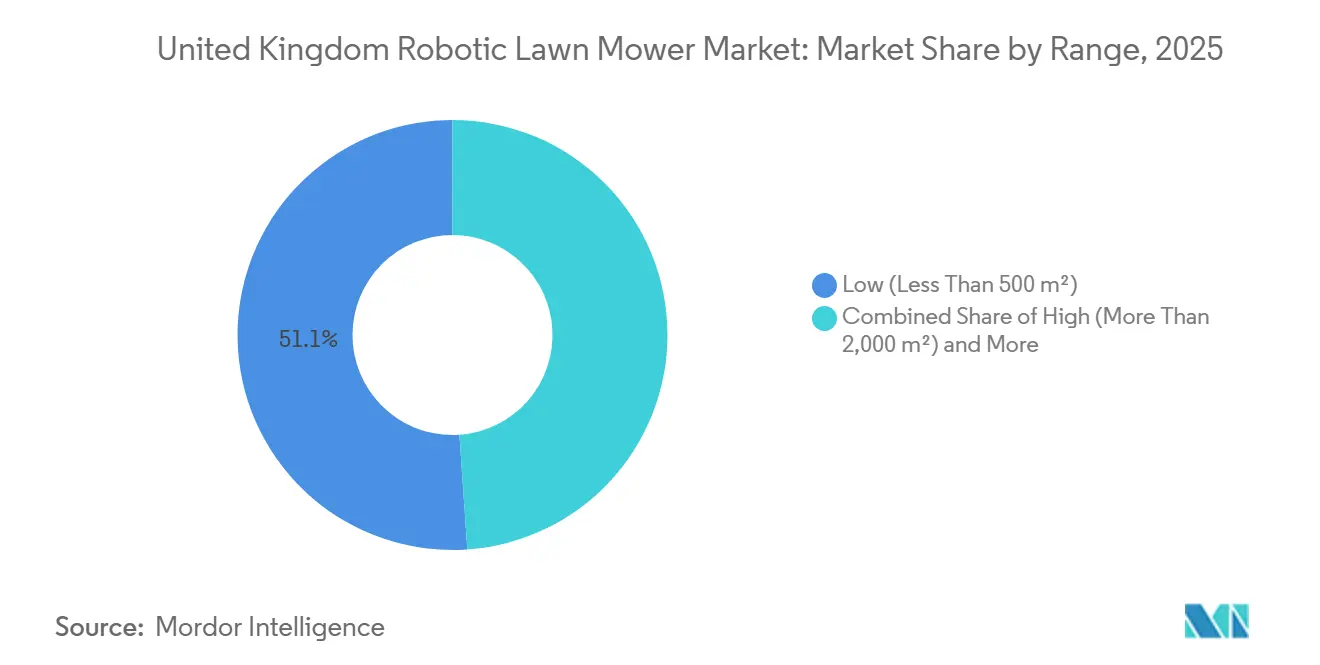
Low (less than 500 m²) accounted for the largest share of the United Kingdom robotic lawn mower market in 2025, at 51.1%. This segment benefits from the country's large base of compact suburban and urban gardens, where homeowners prioritize convenience, affordability, and ease of installation. These products are widely available through DIY stores, specialty dealers, and online retailers, making them accessible to first-time buyers. Smaller battery capacity, lower purchase price, and straightforward maintenance appeal to households seeking automated lawn care without investing in professional-grade equipment. Ongoing improvements in navigation, mobile applications, and battery efficiency continue to support consumer adoption across residential properties.
High (more than 2,000 m²) is projected to grow at the fastest CAGR of 11.0% from 2026 to 2031. Growth is supported by rising adoption across large residential estates, golf courses, sports complexes, universities, public parks, and corporate campuses that require consistent turf maintenance with lower labor requirements. Professional users increasingly prefer autonomous equipment capable of extended operating hours, fleet management, and precise navigation across expansive landscapes. Manufacturers continue to introduce advanced commercial models featuring wire-free operation, satellite positioning, and intelligent route planning, enabling efficient maintenance of large properties while improving productivity, operational flexibility, and long-term cost efficiency.



By Navigation Technology: Wire-Free Systems Gain Ground Against the Installed Boundary-Wire Base
Boundary-wire systems accounted for the largest United Kingdom robotic lawn mower market share in 2025, at 45.1%. The technology maintains a strong installed base as it offers reliable navigation for gardens with enclosed layouts, dense vegetation, and areas where satellite signals may be inconsistent. Many residential users are familiar with boundary-wire systems, and dealers have extensive installation and servicing expertise for these products. Established manufacturers continue to support their existing product portfolios with software improvements and enhanced connectivity, helping sustain customer confidence. The segment also benefits from broad product availability across multiple price categories, supporting continued demand among first-time robotic mower buyers.
The vision/camera segment of the United Kingdom robotic lawn mower market is projected to grow at the fastest CAGR, 18.9%, from 2026 to 2031. Growing consumer preference for simplified installation is driving demand for vision-based navigation that eliminates the need for physical perimeter wires. Artificial intelligence, computer vision, and advanced obstacle detection enable robotic mowers to adapt to changing lawn conditions, improving operational safety and efficiency. Manufacturers are integrating multiple sensing technologies with real-time mapping to improve navigation accuracy across complex gardens. These developments reduce installation effort and broaden the appeal of autonomous mowing solutions among residential and commercial users.
By End-User: Residential Buyers Remain the Largest Base While Commercial Use Expands Faster
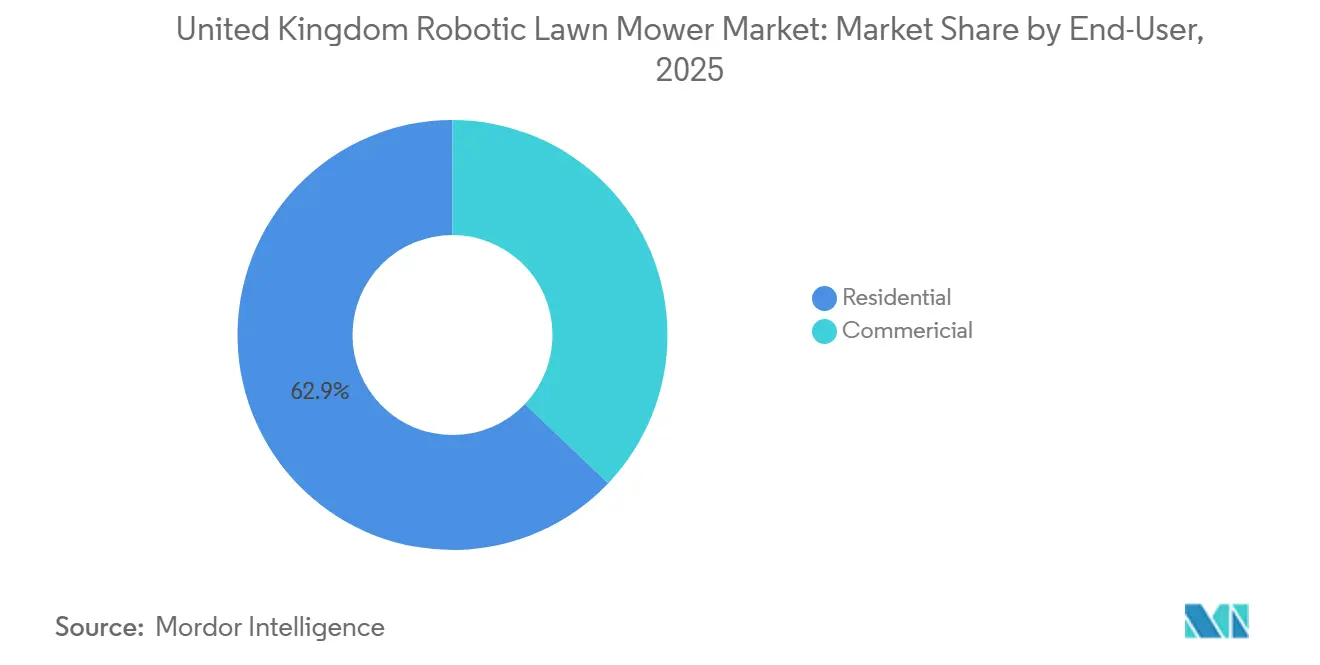
Residential accounted for the largest share of 62.9% in 2025. Homeowners remain the primary customer base as automated lawn maintenance becomes increasingly attractive for reducing routine gardening work. Growing awareness of smart home technologies, cordless outdoor equipment, and connected mobile applications supports wider household adoption. Manufacturers offer products across multiple price ranges and lawn capacities, allowing consumers to select solutions that match different garden sizes and maintenance requirements. Improved battery performance, quieter operation, and user-friendly controls further strengthen the value proposition for homeowners seeking convenient, low-maintenance lawn care.
The commercial segment is projected to grow at the fastest CAGR of 16.6% from 2026 to 2031. Professional landscaping companies, golf courses, educational institutions, healthcare facilities, hotels, and municipal authorities are increasingly adopting robotic mowing systems to improve operational efficiency and optimize workforce utilization. Commercial users prioritize equipment capable of continuous operation, centralized fleet management, and reliable performance across large landscapes. Suppliers are responding by expanding professional product portfolios with advanced navigation technologies, cloud-based monitoring, and service agreements, strengthening the long-term value of robotic mowing solutions across diverse commercial turf maintenance applications.
By Distribution Channel: Offline Retail Leads While Online Sales Grow More Quickly
Offline channels accounted for the largest share at 70.4% in 2025. Physical retail channels remain important as many buyers prefer evaluating robotic lawn mowers before making a purchase decision. Demonstrations, professional consultation, installation guidance, and after-sales service provided by authorized dealers support customer confidence. Specialty retailers also assist consumers in selecting products based on lawn size, terrain complexity, and navigation preferences. The availability of maintenance services, replacement parts, and technical support continues to reinforce the importance of offline distribution across residential and commercial customer segments.
The United Kingdom robotic lawn mower market size for online channels is projected to grow at the fastest CAGR of 17.0% from 2026 to 2031. Digital purchasing channels continue to expand as manufacturers strengthen their direct-to-consumer platforms and marketplace presence. Consumers increasingly compare product specifications, customer reviews, installation videos, and pricing before purchasing robotic lawn mowers online. Improvements in virtual product support, application-based setup guidance, and home delivery services are enhancing the online buying experience. Manufacturers are also investing in digital customer engagement and remote technical assistance, making online channels more attractive for both residential buyers and professional landscape maintenance businesses.
Geography Analysis
England represents the primary market for robotic lawn mower adoption in the United Kingdom, driven by its extensive residential housing stock, large number of private gardens, and well-established dealer and service infrastructure. Strong consumer preference for smart home technologies, battery-powered outdoor equipment, and automated lawn maintenance continues to support product demand among residential users. Manufacturers are strengthening distribution networks, expanding after-sales services, and introducing wire-free models to improve customer accessibility and encourage wider adoption across the region.
Robotic lawn mower adoption is expanding across both commercial and residential segments in the United Kingdom, as property owners increasingly seek efficient, low-maintenance, and environmentally friendly lawn care solutions. Golf courses, sports facilities, educational campuses, hospitality properties, and municipal authorities are investing in autonomous mowing technologies to improve operational efficiency and reduce dependence on manual labor. Manufacturers are also expanding dealer partnerships, product demonstrations, and technical support services to strengthen customer confidence and broaden adoption across a wider range of landscape applications.
Scotland is projected to record the strongest growth during the forecast period, supported by rising investment in autonomous turf maintenance across golf courses, sports venues, and municipal grounds. Gullane Golf Club in East Lothian took delivery of four Toro Turf Pro 500 robotic mowers in April 2026 and reported savings of up to 40 labor hours per week, according to Landscape and Amenity in 2026. Multi-unit deployments of this scale at a single venue drive installed volumes well above single-machine residential purchases, and continued adoption across Scotland's courses, parks, and sports grounds expands the addressable base.
Competitive Landscape
The United Kingdom robotic lawn mower market is moderately consolidated, with Husqvarna AB (Husqvarna Group), Robert Bosch GmbH, Andreas Stihl AG and Co. KG (STIHL Holding AG and Co. KG), Positec Tool Corporation (Positec Group Limited), and Stiga S.p.A. (STIGA Group) holding prominent positions. These companies compete through continuous product innovation, intelligent navigation technologies, extensive distribution networks, and comprehensive after-sales services. Competition is increasingly focused on improving autonomous operation, installation simplicity, connectivity, and user experience. Established manufacturers continue expanding their dealer presence and service capabilities, strengthening customer confidence and maintaining a competitive advantage across residential and commercial applications in the United Kingdom.
Manufacturers are increasingly competing through technological differentiation rather than conventional hardware improvements, with emphasis on artificial intelligence, computer vision, wireless navigation, cloud connectivity, and fleet management capabilities. Continuous investment in research and development is improving navigation accuracy, obstacle detection, battery efficiency, and autonomous operation across diverse landscape conditions. Companies are also strengthening partnerships with distributors, commercial contractors, and professional landscaping organizations to expand market reach. These strategic initiatives are accelerating innovation cycles, enhancing product performance, and supporting broader adoption of robotic lawn mowers among residential and commercial end users.
Competition is projected to intensify as manufacturers expand autonomous product portfolios and strengthen their presence in professional landscape maintenance through advanced navigation technologies and commercial deployment strategies. According to Husqvarna Group, in October 2025, its boundary-wire-free Automower portfolio expanded by 13 models, bringing the total to 24 across residential and professional applications. This expansion reflects the industry's increasing focus on autonomous mowing technologies and reinforces competitive pressure to deliver high-performance solutions for the growing United Kingdom robotic lawn mower market.
United Kingdom Robotic Lawn Mower Industry Leaders
-
Husqvarna AB (Husqvarna Group)
-
Robert Bosch GmbH
-
Andreas Stihl AG & Co. KG (STIHL Holding AG & Co. KG)
-
Positec Tool Corporation (Positec Group Limited)
-
Stiga S.p.A. (STIGA Group)
- *Disclaimer: Major Players sorted in no particular order

Recent Industry Developments
- April 2026: Husqvarna AB (Husqvarna Group) launched the Automower 560 EPOS, a wire-free robotic mower that integrates EPOS satellite navigation and Fleet Management software, targeting municipalities, universities, and commercial landscape maintenance in the market.
- March 2026: Stiga S.p.A. (STIGA Group) introduced nine autonomous robotic lawn mowers featuring Vista Technology, combining AI camera navigation with wire-free installation for lawns from 600 m² to 14,000 m².
- February 2026: Stiga S.p.A. (STIGA Group) partnered with SiMa Technologies Inc. to integrate real-time edge artificial intelligence processing into its robotic mower platforms, enhancing navigation and autonomous decision-making capabilities.


United Kingdom Robotic Lawn Mower Market Report Scope
Robotic lawn mowers are autonomous, battery-powered machines that cut grass automatically using programmable schedules and navigation technologies, including boundary wire, GNSS/RTK GPS, or vision-based systems. They are used for efficient, low-maintenance lawn care in residential and commercial applications.
The United Kingdom robotic lawn mower market report is segmented by range (low (less than 500 m²), medium (501–2,000 m²), and high (more than 2,000 m²), by navigation technology (boundary-wire, GNSS/RTK GPS, and vision/camera), by end-user (residential and commercial), and by distribution channel (offline and online). The market forecasts are provided in terms of value (USD).
| Low (Less Than 500 m²) |
| Medium (501-2,000 m²) |
| High (More Than 2,000 m²) |
| Boundary-Wire |
| GNSS/RTK GPS |
| Vision/Camera |
| Residential |
| Commercial |
| Offline |
| Online |
| By Range | Low (Less Than 500 m²) |
| Medium (501-2,000 m²) | |
| High (More Than 2,000 m²) | |
| By Navigation Technology | Boundary-Wire |
| GNSS/RTK GPS | |
| Vision/Camera | |
| By End-User | Residential |
| Commercial | |
| By Distribution Channel | Offline |
| Online |


Key Questions Answered in the Report
How large is the United Kingdom robotic lawn mower market?
The United Kingdom robotic lawn mower market is valued at USD 659.47 million in 2026 and is forecast to reach USD 946.75 million by 2031.
Which navigation technology is growing fastest for robotic lawn mowers?
Vision/camera navigation technology is forecast to grow at the fastest CAGR of 18.9% from 2026 to 2031.
Which lawn-size category leads sales in the United Kingdom?
Low (less than 500 m²) accounted for the largest share at 51.1% in 2025.
Why are commercial users adopting robotic lawn mowers?
Golf courses, campuses, schools, healthcare facilities, and other managed sites use them to support regular cutting with limited labor.
Page last updated on:


 Your data is secure and never sold or shared.


