
United Kingdom Prefabricated Product Logistics Market Size and Share
Market Overview
| Study Period | 2020 - 2031 |
|---|---|
| Forecast Data Period | 2026 - 2031 |
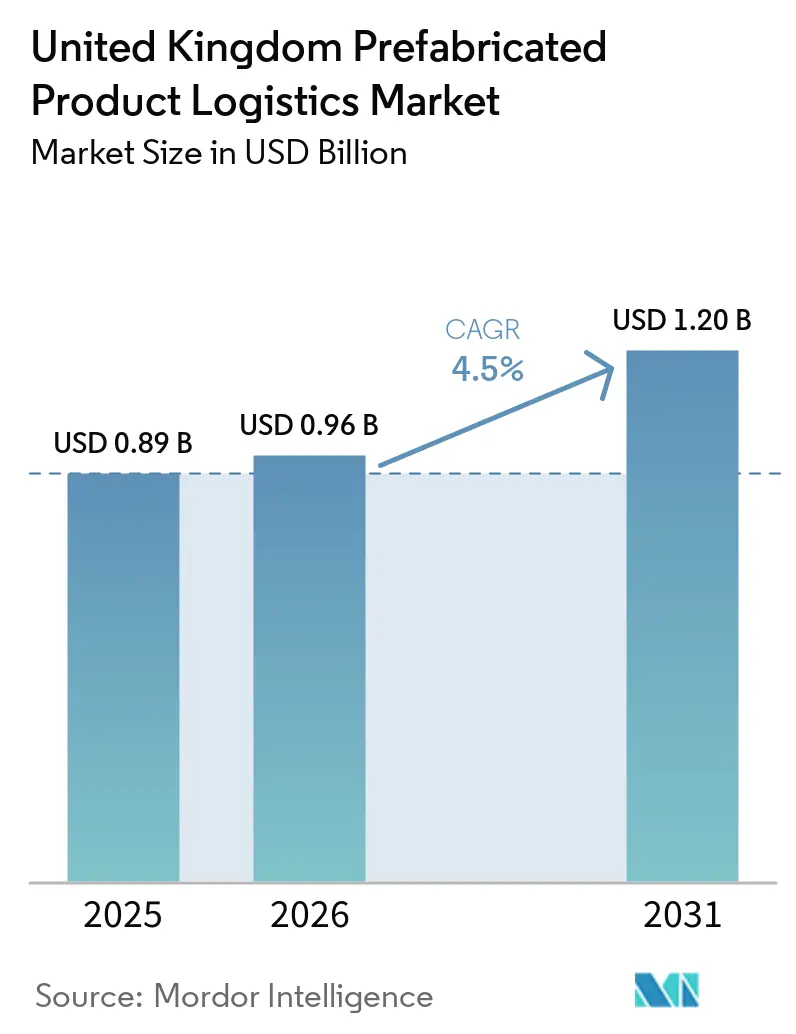
| Base Year Market Size (2025) | USD 0.89 Billion |
| Market Size (2026) | USD 0.96 Billion |
| Market Size (2031) | USD 1.20 Billion |
| Growth Rate (2026 - 2031) | 4.50 % |
| Market Concentration | Low |
Major Players *Disclaimer: Major Players sorted in no particular order Image © Mordor Intelligence. Reuse requires attribution under CC BY 4.0. | |
United Kingdom Prefabricated Product Logistics Market Analysis by Mordor Intelligence
The United Kingdom prefabricated product logistics market size was valued at USD 0.89 billion in 2025 and estimated to grow from USD 0.96 billion in 2026 to reach USD 1.20 billion by 2031, at a CAGR of 4.50% during the forecast period (2026-2031).
Housing delivery, public procurement, and factory-based construction continued to support the United Kingdom prefabricated product logistics market in 2026. The government housing target maintained a large project pipeline, while labor shortages encouraged contractors to shift work from sites to factories. This change increased the importance of specialist transport, route surveys, lifting, and delivery scheduling. It also increased the need to align factory release dates with traffic controls, site access, and installation teams. Larger building units could not simply be held at the roadside when a site was unprepared. Storage capacity and clear chain-of-custody records, therefore, became useful parts of the service. The United Kingdom prefabricated product logistics market also benefited from requirements for lower-carbon homes and better material control. Competition centered on compliance knowledge, suitable fleet equipment, and the ability to complete difficult deliveries reliably. Providers also needed dependable communication between manufacturers, site teams, traffic managers, and lifting contractors throughout each delivery.
Key Report Takeaways
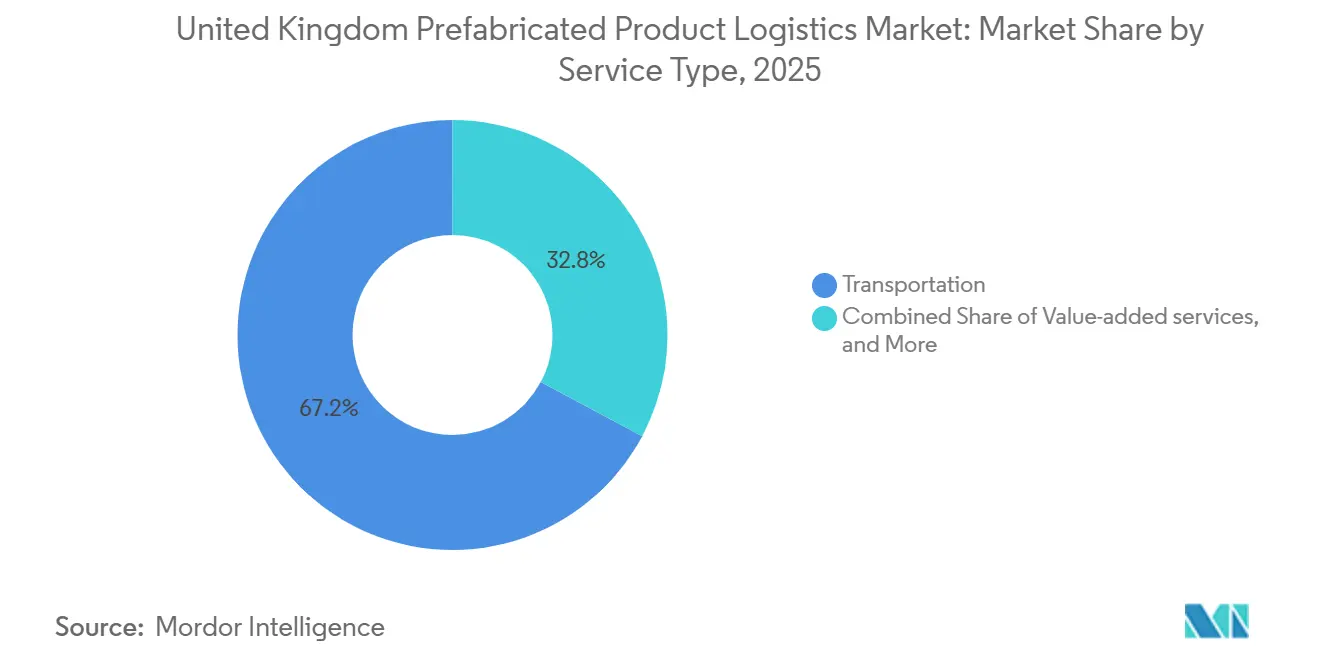
- By service, transportation held 67.20% of the United Kingdom prefabricated product logistics market share in 2025, while value-added services recorded the highest projected CAGR at 6.20% through 2031.
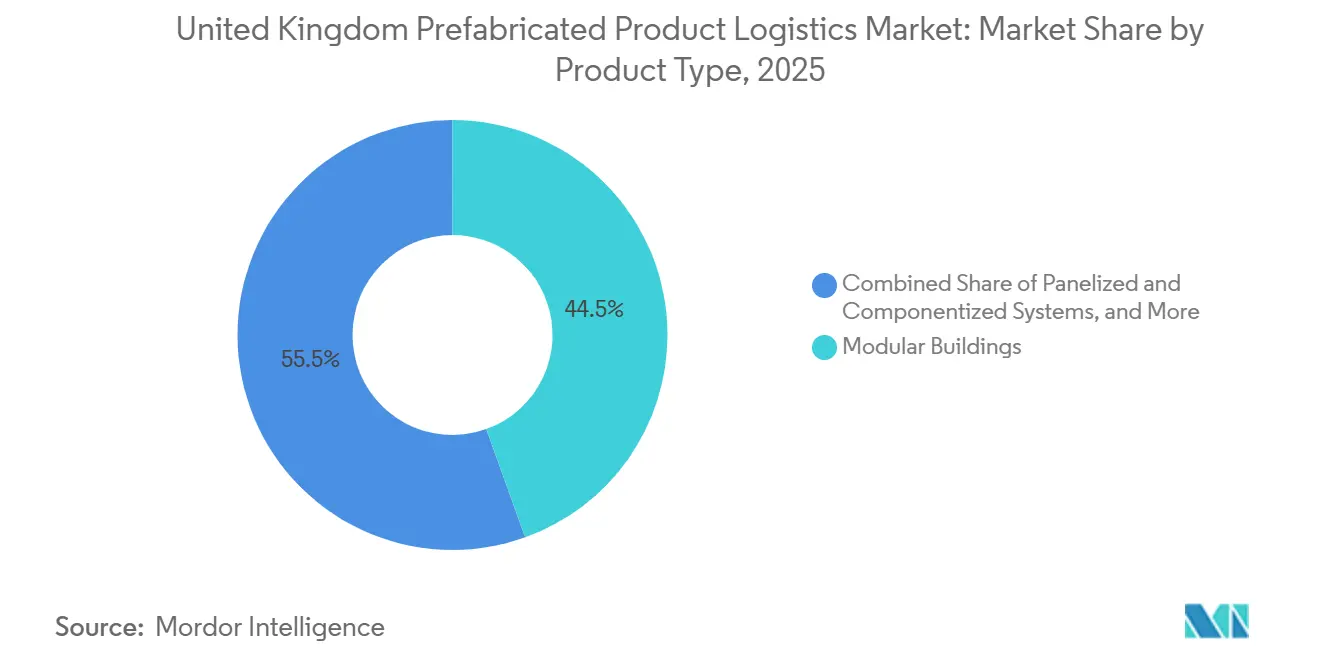
- By product type, modular buildings held 44.50% of the United Kingdom prefabricated product logistics market size in 2025, while panelized and componentized systems recorded the highest projected CAGR at 6.30% through 2031.
- By application, residential buildings held 48.55% of the United Kingdom prefabricated product logistics market share in 2025, while commercial buildings recorded the highest projected CAGR at 5.90% through 2031.
Note: Market size and forecast figures in this report are generated using Mordor Intelligence’s proprietary estimation framework, updated with the latest available data and insights as of January 2026.
United Kingdom Prefabricated Product Logistics Market Trends and Insights
Drivers Impact Analysis*
| Driver | (~) % Impact on CAGR Forecast | Geographic Relevance | Impact Timeline |
|---|---|---|---|
| Housing Delivery Pressure and Public Framework Demand | +1.1% | United Kingdom-wide, predominantly England | Long term (≥ 4 years) |
| Skilled Labor Scarcity and On-Site Productivity Constraints | +0.8% | United Kingdom-wide, acute in London, South East, North West | Medium term (2-4 years) |
| Net Zero Compliance and Low-Waste Offsite Delivery | +0.6% | England, with spillover to Scotland and Wales | Long term (≥ 4 years) |
| Traceability Demand for Complex Prefab Supply Chains | +0.4% | Global standard, with United Kingdom construction adoption focus | Medium term (2-4 years) |
| Planning and Route Constraints on Oversized Loads | +0.3% | England and Wales | Short term (≤ 2 years) |
| Industrial and Logistics Facility Expansion | +0.5% | England, concentrated in the Midlands and North West | Medium term (2-4 years) |
| Source: Mordor Intelligence | |||
Housing Delivery Pressure and Public Framework Demand
The target of 1.5 million new homes by the end of the current Parliament remained a major demand signal for the United Kingdom prefabricated product logistics market. The Social and Affordable Homes Programme for 2026 to 2036 replaced the prior Affordable Homes Programme and accepted bids that used modern methods of construction. This approach supported a continuing flow of factory-made building components and related transport activity. It also made delivery coordination more important because factory output had to arrive when sites, cranes, labor, and local access arrangements were ready. A missed delivery window could disrupt the sequence of installation work, so logistics firms had a stronger role in protecting project schedules.[1]“Homes England Strategic Plan 2025 To 2030,” GOV.UK, gov.uk The United Kingdom prefabricated product logistics market benefited when manufacturers and contractors treated transport planning as part of project delivery rather than a separate purchase. Homes England stated that agency-supported gross housing completions could rise from 40,000 a year in 2025 and 2026 to more than 80,000 a year by 2029 and 2030. Bidders could use off-site methods without a fixed requirement, which placed greater weight on program certainty and delivery performance. Providers that combined route surveys with time-window planning were better placed to support projects that needed dependable factory-to-site delivery.
Skilled Labor Scarcity and On-Site Productivity Constraints
England’s construction workforce declined by 1.3% in 2025 to 2.23 million workers, and CITB projected a further 0.9% decline in 2026 before growth returned from 2027. Government modeling cited by the National Audit Office shows that housing delivery requires 317,000 additional workers, while the Warm Homes Plan requires 130,000, and infrastructure commitments require as many as 445,000 by 2030. The shortage is uneven across the country and affects the availability of site labor. It limits the capacity available for conventional construction tasks, particularly where projects need several trades to work in a tight sequence. Manufacturers could complete more repeatable work in factories, but this shifted pressure to the movement, storage, and controlled arrival of finished units. Specialist providers had to coordinate collections with production schedules and installations with site access restrictions. The National Audit Office also reported that 60% of United Kingdom colleges limited or closed construction apprenticeship courses in 2025, while 56% had waiting lists. Factory production reduced dependence on some site activities and raised the number of completed units that needed specialist movement. The United Kingdom prefabricated product logistics market, therefore, gained work as construction tasks moved from sites to controlled production settings.
Net Zero Compliance and Low-Waste Offsite Delivery
The Building Regulations Amendment England Regulations 2026 were laid before Parliament on March 24, 2026, and were set to take effect on March 24, 2027. New homes built under the Future Homes Standard need to produce at least 75% lower carbon emissions than homes built to 2013 standards. The standard also includes low-carbon heating and photovoltaic panels covering at least 40% of the ground floor area. Controlled factory production can support pre-installed heat-pump connections, pre-wired photovoltaic arrays, and airtight building elements. It also allows manufacturers to manage materials and installation steps under more consistent conditions than congested sites. Each completed assembly needs careful handling because integrated equipment and finished surfaces could be damaged during loading, transport, or lifting.[2]“New Homes England 2025 To 2026 Housebuilding Statistics Published,” GOV.UK, gov.uk This increased the value of operators that understood both heavy-haul requirements and the handling needs of completed building systems. These requirements supported demand for off-site assemblies and for the specialized transport used to deliver them. Operators also faced greater scrutiny of vehicle emissions, which encouraged interest in renewable fuels, rail options, and electric fleets.
Industrial and Logistics Facility Expansion
The National Planning Policy Framework, issued in August 2026, introduced Policy E3, a dedicated national planning policy for freight and logistics development in England. Policy E3 required schemes to show suitable transport access, manage environmental effects, and provide adequate HGV parking. The policy gave additional planning support to logistics facilities outside settlement boundaries where appropriate. This mattered for sites that needed room for HGV access, trailer turning, storage, and safe loading activity. Better-located facilities could reduce avoidable movements between factories, consolidation points, and construction sites. The United Kingdom prefabricated product logistics market used these links to serve projects that depended on time-sensitive delivery of large building components. Prologis submitted plans in March 2026 for a 762,000 square feet rail-served distribution center at DIRFT within more than 1 million square feet of consented expansion capacity. Industrial and logistics buildings increasingly use insulated panels and volumetric service pods to shorten construction schedules. These systems created transport demand whenever developers selected factory-made components over conventional site assembly.
Restraints Impact Analysis*
| Restraint | (~) % Impact on CAGR Forecast | Geographic Relevance | Impact Timeline |
|---|---|---|---|
| High Factory CAPEX and Utilization Risk | -0.7% | United Kingdom-wide, concentrated in England | Long term (≥ 4 years) |
| Certification, Valuation, and Mortgage Acceptance Friction | -0.5% | England and Wales | Medium term (2-4 years) |
| Insolvency-Driven Trust Deficit Across the Supply Chain | -0.6% | United Kingdom-wide, with England dominant | Medium term (2-4 years) |
| Module Size Limits and Transport Complexity | -0.4% | United Kingdom-wide | Long term (≥ 4 years) |
| Source: Mordor Intelligence | |||
High Factory CAPEX and Utilization Risk
Prefabricated product logistics volumes depended on the financial condition and factory use rates of off-site manufacturers. Automated production lines, quality systems, and dedicated factory sites required substantial capital investment. A production suspension or insolvency could remove shipment volumes for a logistics provider with little warning. The effect could extend beyond transport because providers also lost demand for storage, lifting, route planning, and site support. Equipment investments can be difficult to redeploy when trailers or cranes are selected for a narrow range of module dimensions. A broader client base and contracted minimum volumes offered some protection, although smaller firms could find these measures difficult to establish. Construction insolvencies totaled 4,411 in the year to March 2026 and remained 22% above pre-pandemic levels despite a 5% year-over-year decline. Firms reliant on a small group of manufacturers faced revenue gaps when factory utilization fell below viable levels. This risk was greater for operators who bought custom trailers or HIAB equipment designed around one module format.
Certification, Valuation, and Mortgage Acceptance Friction
The RICS Valuation Global Standards, effective from January 2025, require members valuing modern methods of construction properties to check lender policy and accreditation status before completing an assessment.[3]“RICS Valuation Global Standards Red Book,” Royal Institution of Chartered Surveyors, rics.org Accreditation commonly involved the Buildoffsite Property Assurance Scheme or NHBC Buildmark. Incomplete accreditation or limited lender acceptance reduced the viability of some developments. Developers could face delays when funders sought assurance on warranties, valuation, durability, and end-buyer mortgage availability. These issues affected the point at which a project moved from planning to manufacture and delivery. The resulting uncertainty could reduce the consistency of residential orders for factories and the logistics providers that served them. This reduced the project flow available to the United Kingdom prefabricated product logistics market. The flexible approach to modern methods of construction in the Social and Affordable Homes Programme also created differences in accreditation coverage between projects. More consistent certification and more predictable mortgage lending would improve visibility across the residential delivery pipeline.
*Our forecasts treat driver/restraint impacts as directional, not additive. The impact forecasts reflect baseline growth, mix effects, and variable interactions.
Segment Analysis
By Service: Transportation Anchors Revenue, Value-Added Services Accelerate
Transportation held 67.20% of the United Kingdom prefabricated product logistics market share by value in 2025. The service linked off-site factories in Yorkshire, Humberside, the Midlands, and the South West with construction sites across the United Kingdom. Road transport dominated because many modular and panelized loads needed flatbed extenders, low-loaders, or HIAB-equipped rigid vehicles. These movements operated under the Road Vehicles Authorisation of Special Types General Order 2003 framework. The National Police Chiefs’ Council guidance required 2 working days of notification for loads up to 80,000 kg and 5 days for loads up to 150,000 kg. Loads wider than 6.1 m or heavier than 150,000 kg require a Special Order through National Highways.
Value-added services recorded a 6.20% CAGR through 2031, the highest rate among service categories. These services included pre-delivery route surveys, traffic temporary road order management, lifting, crane work, staging, storage, and digital tracking. Clients increasingly sought one provider for these linked activities instead of transport alone. A combined service reduced the number of handovers between parties and gave the contractor a clearer view of where each assembly was in the delivery process. It also helped providers manage changes in site readiness, traffic controls, and lifting availability without separating responsibilities across several firms. These features supported the faster growth of value-added work within the United Kingdom prefabricated product logistics market. GS1 UK and NBS established a 2025 partnership to apply Global Trade Item Numbers to construction products, supporting standardized identification across supply chains. This approach supported clearer records from factory release through site receipt. Warehousing and storage continued to provide a buffer when factory completion dates and site readiness did not align.



By Product Type: Modular Buildings Lead, Panelized Systems Fastest Growing
Modular buildings accounted for 44.50% of the United Kingdom prefabricated product logistics market size by value in 2025. Volumetric units involved complex delivery planning because their dimensions could trigger full abnormal-load notification, escorts, and Special Order applications. These requirements raised transport complexity and supported higher service pricing. Operators needed to assess the route before dispatch, identify physical restrictions, arrange notifications, and align the delivery with lifting plans at the destination. The delivery itself was only one part of the service because preparation and compliance work began before the unit left the factory. This operating model kept Transportation central to the United Kingdom prefabricated product logistics market. Operators needed to assess the route before dispatch, identify physical restrictions, arrange notifications, and align the delivery with lifting plans at the destination. The delivery itself was only one part of the service because preparation and compliance work began before the unit left the factory. This operating model kept transportation central to the United Kingdom prefabricated product logistics market. Public procurement continued to support demand in education, healthcare, and social housing. The Offsite Construction Solutions framework, extended to March 2027, provides public bodies with a compliant route for the design, fabrication, delivery, and installation of prefabricated buildings. Collett & Sons added a Greiner BUSY 1050 bridge crossing system in September 2026, widening route options for oversized loads.[4]“Offsite Construction Solutions Lots 1, 2, 3 And 4 Framework Notice 046752-2026,” Find a Tender Service, find-tender.service.gov.uk
Panelized and componentized systems recorded a 6.30% CAGR through 2031. Their flatter profiles reduced abnormal-load thresholds and allowed access to sites that could not receive volumetric units. The Future Homes Standard supported panelized assemblies that integrated airtightness, solar-ready fabric, and ventilation requirements. Assan Panel opened its first United Kingdom manufacturing facility in Suffolk in June 2026, investing USD 58.5 million and creating more than 100 jobs. The facility expanded local availability of insulated panels for warehouses, data centers, food production, and healthcare buildings. The added manufacturing base shortened the link between panel production and domestic project sites. It also created a need for providers that could protect finished panels during loading and delivery. This suited projects where access limits made volumetric units impractical, while panels could be scheduled in smaller and more flexible loads. Pre-cut structural timber, pre-cast concrete elements, and bathroom pods added stable volumes consistent with wider construction activity.
By Application: Residential Buildings Lead, Commercial Buildings Fastest Growing
Residential buildings held 48.55% of the United Kingdom prefabricated product logistics market share in 2025. Affordable and social housing remained the central source of demand. Homes England recorded 40,332 completions in the 2025 to 2026 program year, a 9% increase from the prior year. The earlier Affordable Homes Programme 2021 to 2026 delivered 132,540 eligible completions over its lifetime. Urban infill sites often require HIAB deliveries, planned cranage, and coordination with local planning authorities. Restricted streets and limited space for unloading made the order of deliveries important. Providers had to match arrival times with available lifting equipment and avoid conflicts with local traffic management. These conditions increased the practical importance of specialist planning within the United Kingdom prefabricated product logistics market. BOPAS supported lender confidence that qualifying offsite systems remained durable and mortgageable for at least 60 years.
Commercial buildings recorded a 5.90% CAGR through 2031. Logistics shed operators, data center developers, and healthcare estate managers used panel systems and volumetric pods in 2025 and 2026 to shorten construction schedules. Portakabin received an appointment in 2026 to deliver a 3-story, 66-module Workdry Group headquarters in Hampshire. The project targeted BREEAM Excellent and full biodiversity net gain. Factory-made systems helped reduce site waste and improve material control, supporting BREEAM-related requirements. Commercial projects also used standard building elements that could be planned and dispatched in repeatable sequences. This reduced some uncertainty at the site while increasing the need for reliable movement from factory to project location. The combination supported a steady flow of work for operators serving commercial offsite construction. Healthcare, education, infrastructure, and industrial projects added steady demand through multi-year institutional procurement.
Geography Analysis
England held the dominant position in the United Kingdom prefabricated product logistics market because it concentrated Homes England-supported housing activity and major factory clusters. Yorkshire, Humberside, the Midlands, and the South West provided important production locations. Homes England projected that agency-supported completions might exceed 80,000 per year by 2029 and 2030. These volumes supported regular freight movements between manufacturing locations and high-demand housing areas. Policy E3 in the August 2026 National Planning Policy Framework gave England its first dedicated national policy for freight and logistics development. The United Kingdom prefabricated product logistics market benefited from this clearer planning basis for facilities supporting modular supply chains. Factory clusters and logistics locations could work more effectively when sites had suitable access for heavy vehicles and abnormal loads. The planning framework also recognized the operational needs of freight activity, including parking and transport-network connections. This supported the physical infrastructure that linked off-site production with construction demand.
The Midlands served as a strategic hub because of its place on the national freight network and its links to major factory and distribution locations. Prologis’s March 2026 proposal for further DIRFT capacity reflected the importance of the region for rail-served logistics Scotland and Wales operated under separate devolved planning frameworks and housing programs. Homes England did not operate in Scotland, Wales, or Northern Ireland. Scotland’s higher use of timber-frame residential construction created specialized demand for panelized deliveries to remote Highland and island locations. CITB projected construction workforce growth of 0.9% a year in the North East and North West of England from 2026 to 2030.
Northern Ireland remained the smallest part of the United Kingdom prefabricated product logistics market. Movements from Great Britain required sea freight, port handling, additional transit time, and coordination across transport modes. All regions faced limits from aging bridge infrastructure and a limited network of approved abnormal-load routes. Loads wider than 5 m required National Highways consent. Loads wider than 6.1 m or heavier than 150,000 kg needed a Special Order and could need as much as 8 weeks of notice. Route knowledge remained important for operators in every part of the United Kingdom.
Competitive Landscape
The United Kingdom prefabricated product logistics market was highly fragmented, with many privately held and regionally focused specialists. No single operator held a dominant share. Collett & Sons, Musgrave Transport, Modular Movements, and Neill & Brown competed through route knowledge, fleet capability, and abnormal-load compliance. Fleet Operator Recognition Scheme Gold accreditation became an important consideration in procurement because it addressed safety, sustainability, and operational practice. Modular Movements achieved FORS Gold in May 2026. The United Kingdom prefabricated product logistics industry relied on specialist skills rather than price alone for complex delivery work.
Collett & Sons acquired 36 Goldhofer THP/SL-L modular axle lines in 2025 and added a Greiner BUSY 1050 bridge crossing system in September 2026. These investments expanded route options on bridge-restricted corridors and reduced reliance on lengthy Special Order processes. The company also completed a 650 square meter warehouse extension at its Elland depot in February 2026. This move combined storage capacity with transport activity for heavy-lift cargo. Musgrave Transport operated specialist abnormal-load services with lorry-mounted cranes for loads up to 6.1 m wide. These capabilities helped providers address restricted sites and difficult delivery windows.
Digital traceability remained an area where operators could strengthen their offer. The 2025 GS1 UK and NBS partnership supported product identification through Global Trade Item Numbers. Verified delivery records could connect products to wider digital information systems. Neill & Brown began a renewable diesel trial in 2025 and continued electric vehicle investment in 2026. The renewable diesel trial reported an 83% reduction in greenhouse gas emissions compared with fossil diesel.
United Kingdom Prefabricated Product Logistics Industry Leaders
Modular Movements Ltd
David Stanley Transport Ltd
Collet & Sons Ltd
Falcon Freight Ltd
A. Rhodes Haulage Ltd
- *Disclaimer: Major Players sorted in no particular order


Recent Industry Developments
- September 2026: Collett & Sons Ltd added a Greiner BUSY 1050 bridge crossing system - capable of overbridging structures up to 25 m to its specialist heavy transport fleet. The modular system reduces axle loads transferred to existing bridge structures, materially expanding viable delivery routes for oversized modular and prefabricated loads on restricted corridors across the United Kingdom. This is the company's first bridge crossing system.
- July 2026: Collett & Sons Ltd executed its first dual-blade-lifter convoy operation using two Goldhofer FTV850 blade lifter trailers for the Sanquhar II wind farm in Dumfries and Galloway, Scotland. The operation demonstrated the firm's expanded specialist transport capability for large, route-constrained components and increased blade delivery capacity on a single project phase.
- February 2026: Collett & Sons Ltd completed a 650 square meter warehouse extension at its Elland depot in West Yorkshire, increasing the site's total internal capacity to 1,100 square meters and installing 15-tonne and 30-tonne overhead gantry cranes. The Elland facility is one of seven Collett depots providing more than 45,000 square meters of combined internal and external storage across the United Kingdom, integrating warehousing with transport operations for heavy-lift project cargo.
- January 2026: Collett & Sons Ltd added 2 MAN TGX 6×4 heavy tractor units with 640 HP engines and 160-tonne gross vehicle weight ratings to its fleet. The units were immediately deployed on active projects and further strengthened the company's capacity for demanding heavy transport operations across its infrastructure, energy, and project cargo client base.


United Kingdom Prefabricated Product Logistics Market Report Scope
| Transportation | Road |
| Rail | |
| Air | |
| Sea and Inland Waterways | |
| Warehousing and Storage | |
| Value-Added Services |
| Modular Buildings |
| Panelized and Componentized Systems |
| Other Prefab Types |
| Residential Buildings |
| Commercial Buildings |
| Others |
| By Service | Transportation | Road |
| Rail | ||
| Air | ||
| Sea and Inland Waterways | ||
| Warehousing and Storage | ||
| Value-Added Services | ||
| By Product Type | Modular Buildings | |
| Panelized and Componentized Systems | ||
| Other Prefab Types | ||
| By Application | Residential Buildings | |
| Commercial Buildings | ||
| Others |


Key Questions Answered in the Report
What was the value of the United Kingdom prefabricated product logistics market in 2026?
The value was USD 0.96 billion in 2026 and is forecast to reach USD 1.20 billion by 2031 at a 4.50% CAGR.
Which service generated the largest revenue share in 2025?
Transportation led with 67.20% revenue share because most modular and panelized deliveries depended on specialist road transport.
Which prefabricated product category grew fastest through 2031?
Panelized & componentized systems recorded the highest projected CAGR at 6.30% through 2031.
Why did construction labor shortages affect offsite deliveries?
Labor shortages encouraged more factory production, which increased the need to move completed units and components to project sites.
Which application held the largest share in 2025?
Residential buildings held 48.55% of value in 2025, supported by affordable and social housing delivery.
What rules affected abnormal-load deliveries in the United Kingdom?
NPCC guidance set notification requirements, while the largest loads required National Highways involvement and Special Orders.
Page last updated on:





