
United Kingdom Plastic Waste Management Services Market Size and Share
Market Overview
| Study Period | 2020 - 2031 |
|---|---|
| Forecast Data Period | 2026 - 2031 |
| Base Year Market Size (2025) | USD 1.45 Billion |
| Market Size (2026) | USD 1.51 Billion |
| Market Size (2031) | USD 1.86 Billion |
| Growth Rate (2026 - 2031) | 4.26 % |
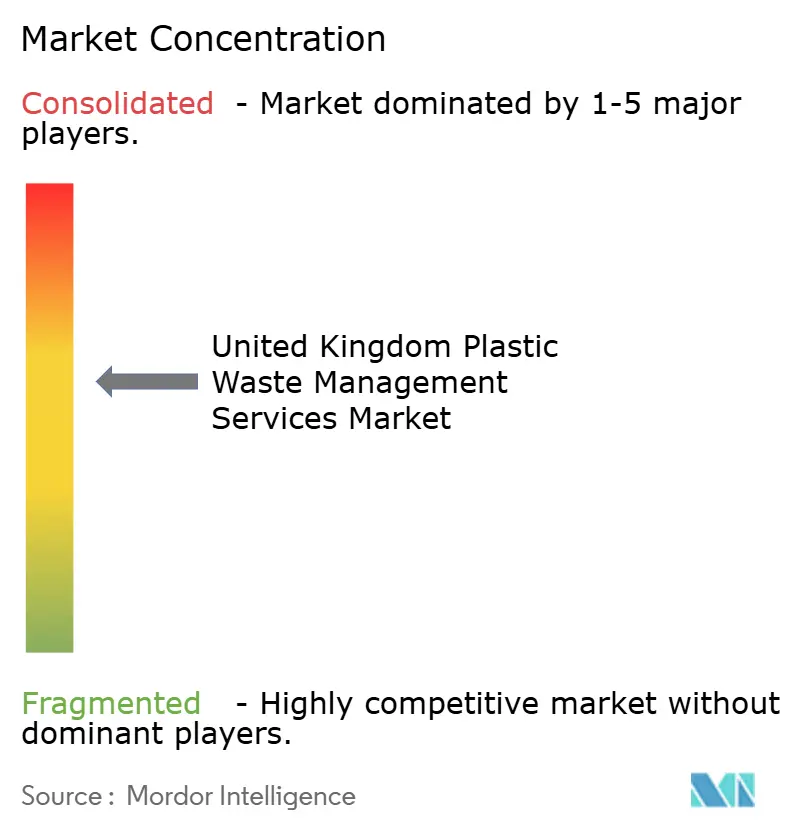
| Market Concentration | Medium |
Major Players *Disclaimer: Major Players sorted in no particular order Image © Mordor Intelligence. Reuse requires attribution under CC BY 4.0. | |
United Kingdom Plastic Waste Management Services Market Analysis by Mordor Intelligence
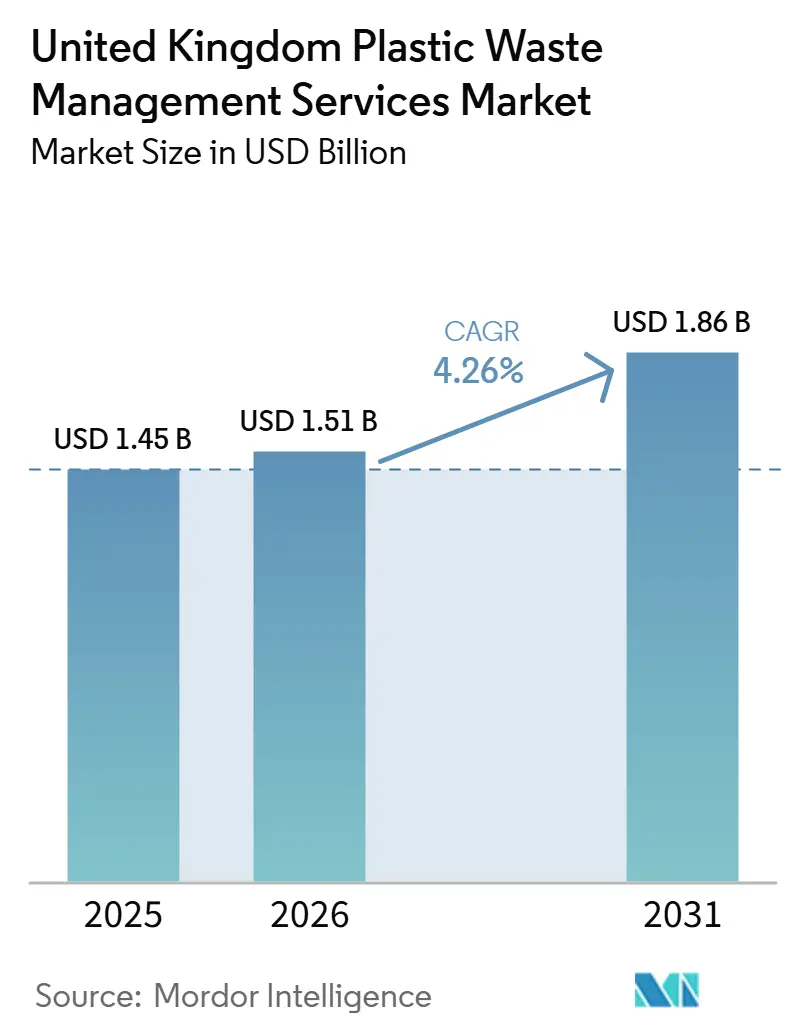
The United Kingdom Plastic Waste Management Services Market size is projected to expand from USD 1.45 billion in 2025 and USD 1.51 billion in 2026 to USD 1.86 billion by 2031, registering a CAGR of 4.26% between 2026 to 2031.
Growth in the United Kingdom plastic waste management services market is being shaped by regulatory change that now requires separate collection of dry recyclables, food waste, and residual waste across English households, following workplace rules introduced in 2025. The United Kingdom plastic waste management services market is also benefiting from the shift of packaging waste costs from councils to producers, as pEPR fees, recyclability ratings, and future film collection rules now make compliance a direct source of service demand. Private operators are responding with new domestic recycling assets. However, the United Kingdom plastic waste management services market still faces pressure from site closures and lost reprocessing capacity, which gives integrated collection and reprocessing operators a clear commercial advantage. The main constraint on the United Kingdom plastic waste management services market is that mandated collection volumes are rising faster than domestic processing capacity, which keeps export dependence, contamination risk, and uneven local implementation as live issues through the forecast period.
Key Report Takeaways
- By source, industrial streams held 37.5% of the United Kingdom plastic waste management services market share in 2025, while commercial streams are projected to grow at a CAGR of 5.0% through 2031.
- By service provider, public/municipal providers held 49.2% share in 2025, while private waste management companies are projected to grow at a CAGR of 5.8% through 2031.
- By service type, collection, transportation, sorting, and segregation accounted for 44.1% of the United Kingdom plastic waste management services market size in 2025, while disposal and treatment are projected to expand at a CAGR of 6.8% through 2031.
Note: Market size and forecast figures in this report are generated using Mordor Intelligence’s proprietary estimation framework, updated with the latest available data and insights as of January 2026.
United Kingdom Plastic Waste Management Services Market Trends and Insights
Drivers Impact Analysis*
| Driver | (~) % Impact on CAGR Forecast | Geographic Relevance | Impact Timeline |
|---|---|---|---|
| Implementation of Simpler Recycling Across England | +1.2% | England-wide, with policy alignment effects across Wales, Scotland, and Northern Ireland | Short term (≤ 2 years) |
| Packaging Extended Producer Responsibility Fee Modulation | +1.0% | National across the United Kingdom | Medium term (2-4 years) |
| Growing Investment in Domestic Plastic Reprocessing Capacity | +0.8% | National, with clusters in Northeast England, Wales, and the West Midlands | Medium term (2-4 years) |
| Expansion of Plastic Film Collection Infrastructure | +0.6% | England, with spillover into Wales and Scotland | Medium term (2-4 years) |
| Increasing Commercial Demand for Recycling Compliance Services | +0.4% | National, with stronger demand in urban and industrial centers | Medium term (2-4 years) |
| Rising Adoption of Closed-Loop Packaging Supply Chains | +0.3% | National, with early traction in food retail and FMCG | Long term (≥ 4 years) |
| Source: Mordor Intelligence | |||
Implementation of Simpler Recycling Across England
Simpler Recycling came into force across English households on March 31, 2026, and it now requires the separate collection of dry recyclables, including plastics, alongside food and residual waste.[1]Department for Environment, Food and Rural Affairs, “Simpler Recycling in England, Policy Update,” GOV.UK, gov.uk Workplace recycling rules already took effect on March 31, 2025, for businesses and relevant non-domestic premises in England with 10 or more employees, so the service model had already started shifting before the household deadline arrived. Plastic films and plastic bags are due to be included in the required collection stream from March 31, 2027, broadening the material scope for the United Kingdom plastic waste management services market and adding a more challenging waste stream to everyday collection systems. The policy is expected to deliver GBP 11.8 billion (USD 15.5 billion) in greenhouse gas savings over its lifetime, indicating that the program is being designed as long-term infrastructure reform rather than a short-term compliance exercise. Veolia stated that the household rollout adds more than 40,000 tons of annual plastic collection volumes to its network, and Biffa recruited around 250 frontline collection staff to prepare for the transition, indicating that the rule change is already affecting operating scale and labor planning. As a result, more consistent kerbside coverage is lifting feedstock volumes and pushing materials recovery facilities to manage higher throughput with better contamination control, which reinforces near-term demand across the United Kingdom plastic waste management services market.[2]WRAP, “Circular Films, Pathways to Scalable Recycling, Executive Summary,” WRAP, wrap.ngo
Packaging Extended Producer Responsibility (pEPR) Fee Modulation
Large packaging producers in the United Kingdom have been paying disposal fees since October 2025, with a base fee for plastic packaging set at GBP 423 (USD 557.3) per ton. From the 2026/27 assessment year, red-rated packaging assessed as non-recyclable is subject to a 1.2x multiplier in year 1, rising to 1.6x and then 2.0x, providing producers with a direct financial incentive to redesign packaging and improve recyclability. PackUK became operational on April 1, 2026, formalizing a producer-funded body that distributes revenues based on verified waste management cost data, which changes how service economics are measured across the United Kingdom's plastic waste management services market. Fee modulation also creates demand for reporting, PRO membership, auditing, and recyclability assessment services, as those tasks now fall within a regulated cost framework rather than a voluntary sustainability process.[3]The Producer Responsibility Obligations (Packaging and Packaging Waste) Regulations 2024,” Legislation.gov.uk, legislation.gov.uk This makes compliance services a more durable part of the United Kingdom plastic waste management services market, especially for operators that can combine collection data, material verification, and producer reporting into a single service line.
Growing Investment in Domestic Plastic Reprocessing Capacity
United Kingdom plastics reprocessing capacity fell by around 22% between 2023 and 2025, and the British Plastics Federation documented the closure of more than 17 sites, which removed around 400,000 tons of annual throughput. A joint WRAP and Defra analysis published in early 2025 projected a 324,000-ton annual shortfall in plastic packaging processing capacity by 2035 if export reliance remains at current levels, so capacity investment is now tied directly to future compliance performance. Endolys is developing the United Kingdom’s first large-scale plastic film chemical recycling plant in Darlington, with GBP 60 million (USD 79.1 million) secured for phase 1, with operations targeted before the end of 2026. Eurokey by Reconomy is also opening a GBP 20 million (USD 26.4 million) closed-loop plastic recycling facility in Corby in the second half of 2026, with 38,000 tons of annual capacity, supplying recycled pellets back to major retailers. Viridor’s 2025 analysis estimated that investment-ready conditions could attract private capital of GBP 4.6 billion to GBP 5.9 billion (USD 6.1 billion to USD 7.8 billion) and support 6,900 to 7,700 permanent jobs, underscoring the broader industrial impact of rebuilding domestic processing capacity. In practical terms, the United Kingdom plastic waste management services market gains most when new plants are linked to verified local collection streams, because that reduces export dependence and improves control over polymer quality, pricing, and traceability.
Expansion of Plastic Film Collection Infrastructure
Mandatory kerbside collection of plastic film from English households and businesses is due by March 31, 2027, and this requirement changes one of the least developed parts of the waste stream into a formal service market. RECOUP reported that only 16% of United Kingdom local authorities offered kerbside plastic film recycling in April 2025, and only 31,000 tons were collected, against 420,500 tons placed on the market in 2024, resulting in a 7% collection rate. The FlexCollect blueprint published in September 2025 found that kerbside film collection is technically viable and cost-effective for councils, but it also identified a meaningful gap in reprocessing infrastructure. WRAP expects 150,000 tons of flexible plastic packaging to be collected for recycling by 2027 and 200,000 tons by 2030, so the service buildout will affect route design, baling, sorting, and end-market contracting across the United Kingdom plastic waste management services market. RECOUP also reported that 78% of English local authorities without a current kerbside film collection plan plan to launch by March 2027, yet 60% of non-collecting authorities have low confidence in finding domestic end markets, which explains why collection expansion and reprocessing investment are moving together. The near-term effect is likely to be a rise in exports to European reprocessors before domestic capacity fully catches up, which keeps film collection as a growth area but not yet a fully balanced one.
Restraints Impact Analysis*
| Restraint | (~) % Impact on CAGR Forecast | Geographic Relevance | Impact Timeline |
|---|---|---|---|
| Inconsistent Waste Collection Models Across Local Authorities | -0.8% | England-wide, with stronger pressure in shire councils and districts with legacy contracts | Short term (≤ 2 years) |
| Escalating Collection and Transportation Costs | -0.6% | National, with stronger pressure in Greater London, the Southeast, and rural areas | Short term (≤ 2 years) |
| Shortage of Skilled Waste Collection Workforce | -0.4% | National, with sharper pressure in urban areas and specialist reprocessing roles | Medium term (2-4 years) |
| Limited Land Availability for New Waste Transfer and Sorting Facilities | -0.3% | Urban and peri-urban areas, especially London and major city cores | Long term (≥ 4 years) |
| Source: Mordor Intelligence | |||
Inconsistent Waste Collection Models Across Local Authorities
England has more than 317 waste collection authorities, and they still operate under different contracts, fleets, frequencies, and sorting methods, which weakens standardization and lowers feedstock consistency for downstream processors. The Government of the United Kingdom stated that more than two-thirds of English councils were ready for the March 31, 2026, household deadline, indicating that a meaningful minority did not complete the full rollout on schedule. WRAP reported that 36% of all MRF contracts were due to expire by the end of 2025 and 65% by 2026, indicating that the market is expanding service coverage while many contract terms are being reset. This fragmentation raises contamination risks because plastics entering the sortation stream do not arrive in a uniform format, and it also increases crew training and route planning costs for operators serving multiple authority areas. Transitional support has helped councils prepare for the new model. Still, the funding envelope remains tight in dense urban areas and in difficult housing layouts, where service complexity is inherently higher. Until contract structures become more uniform, this remains one of the clearest operating restraints on the United Kingdom plastic waste management services market.
Escalating Collection and Transportation Costs
The cost base for plastic waste collection, treatment, and disposal rose across 2025 and 2026, which directly affects margins for local authority contractors and commercial operators. The standard United Kingdom landfill tax increased from GBP 103.7 (USD 136.6) per ton in 2024 to GBP 126.2 (USD 166.3) per ton in April 2025, and then to GBP 130.8 (USD 172.3) per ton in April 2026. WRAP’s Gate Fees survey showed that gross MRF gate fees rose in 2025/26 compared with 2024/25, ranging from GBP 31 to GBP 137 per ton (USD 40.8 to 180.5 per ton), indicating that higher throughput is driving higher processing costs. Labor costs also rose, with average weekly earnings in the United Kingdom rising by 4.6% to 4.7% year on year in 2025, increasing the cost of collection rounds and manual sortation work. Vehicle compliance costs are also higher in cities with low-emission rules, especially Greater London, where older fleets need replacement or upgrades sooner than planned. The layered effects of landfill tax, gate fees, labor inflation, and fleet cost pressure are limiting pricing flexibility across the United Kingdom's plastic waste management services market, especially under fixed-price contracts signed before the recent cost surge.
*Our forecasts treat driver/restraint impacts as directional, not additive. The impact forecasts reflect baseline growth, mix effects, and variable interactions.
Segment Analysis
By Source: Industrial Streams Drive Collection Volume
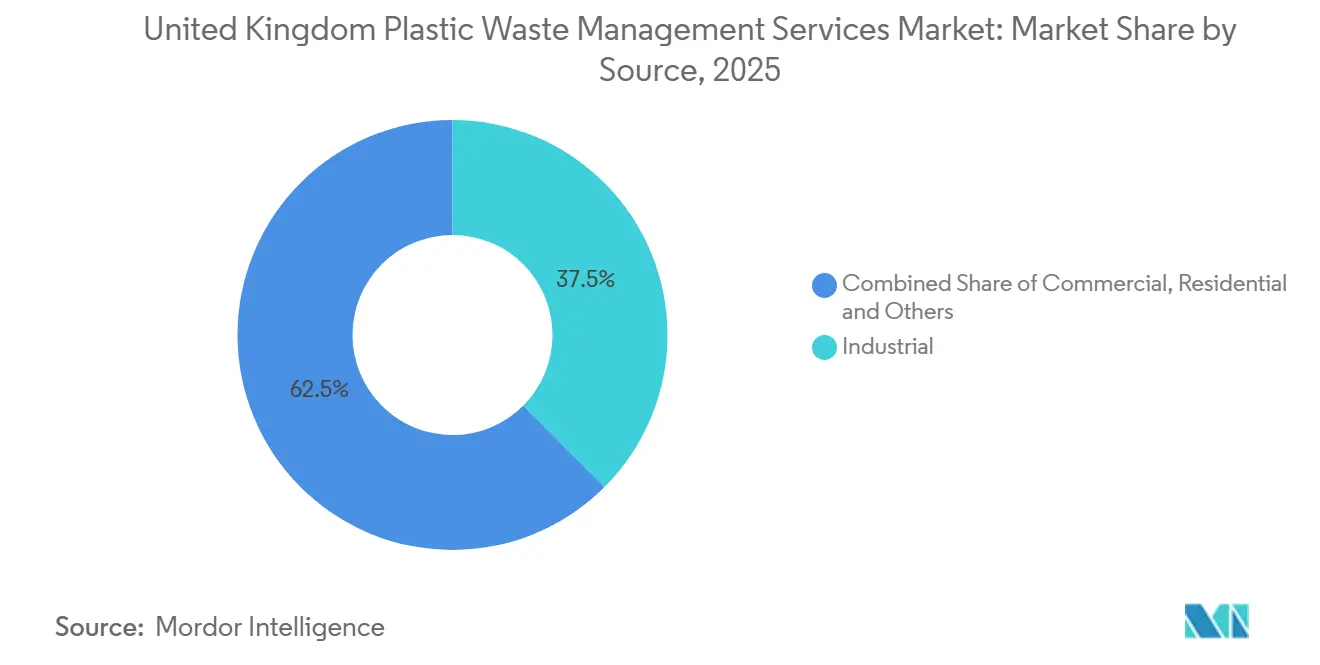
Industrial streams accounted for 37.5% of the United Kingdom plastic waste management services market share in 2025, making them the largest source segment in the current demand structure. This position reflects the high and steady output of polyethylene, polypropylene, and similar commodity polymers across manufacturing, logistics, and processing sites where plastic packaging and protective materials move in large volumes. Industrial generators also tend to work under formal service contracts with scheduled collections, which gives operators denser routes and more predictable inbound volumes than most household channels. Since 2024, large industrial packaging producers have had registration and reporting obligations under the Producer Responsibility rules, and disposal fees have applied since October 2025. That compliance burden is increasing demand for specialist service providers that can improve recyclability ratings and lower future fee exposure across the United Kingdom plastic waste management services market.
The residential segment is now expanding on a more structural basis because Simpler Recycling established a minimum collection standard across English households that did not exist in this form before 2026. The addition of plastic film collection from March 2027 is expected to add 150,000 tons to the residential stream in the first year, which changes both collection planning and downstream sorting requirements. Commercial waste from retail, offices, and hospitality is the fastest-growing source by volume, driven by workplace recycling rules that took effect in March 2025 and by corporate sustainability reporting now more closely tied to producer compliance. Institutional and agricultural streams grouped under others are also becoming more visible as the Separation of Waste regulations narrow exemptions and formalize requirements for non-household municipal premises. Across all source streams, the United Kingdom plastic waste management services industry depends heavily on better segregation at the point of generation, because that is where later recycling yield and contamination performance are largely decided.



By Service Provider: Private Operators Record Fastest Growth
Public/Municipal providers held 49.2% of the United Kingdom plastic waste management services market share in 2025, while Private Waste Management Companies are projected to grow at a CAGR of 5.8% between 2026 and 2031. Their faster growth reflects the way pEPR shifts financial responsibility from the public sector to producers, which creates more room for specialist operators with sorting, compliance, and reprocessing capabilities. The Simpler Recycling rollout is also changing local procurement because councils that previously lacked plastic film or food waste services now need new contract coverage to meet statutory obligations. Veolia’s municipal services division grew by 35% between 2020 and 2025, and the company secured more than GBP 1 billion (USD 1.3 billion) in United Kingdom municipal contracts during 2025 across 11 new or extended agreements. These patterns support faster private-sector expansion, enabling operators to combine contract execution with downstream material recovery.
Public and municipal providers remained the largest category because local authorities still hold the statutory role in household waste services and already own or control much of the collection interface. That position does not remove cost pressure, because landfill disposal reached GBP 130.8 (USD 172.3) per ton in 2026, and MRF gate fees increased in 2025/26 as facilities prepared for higher sorting volumes. The others segment, which includes PROs and compliance scheme operators, is becoming more important because PEPR formalizes intermediary roles between producers and scheme administration. RECOUP’s guidance activity on closed-loop recycling and EPR compliance also shows that advisory and reporting support are becoming operational needs rather than side services. As a result, the United Kingdom plastic waste management services market is becoming more layered, with municipal ownership, private operating scale, and compliance support each playing distinct economic roles.
By Service Type: Collection and Sorting Anchors Revenue Base
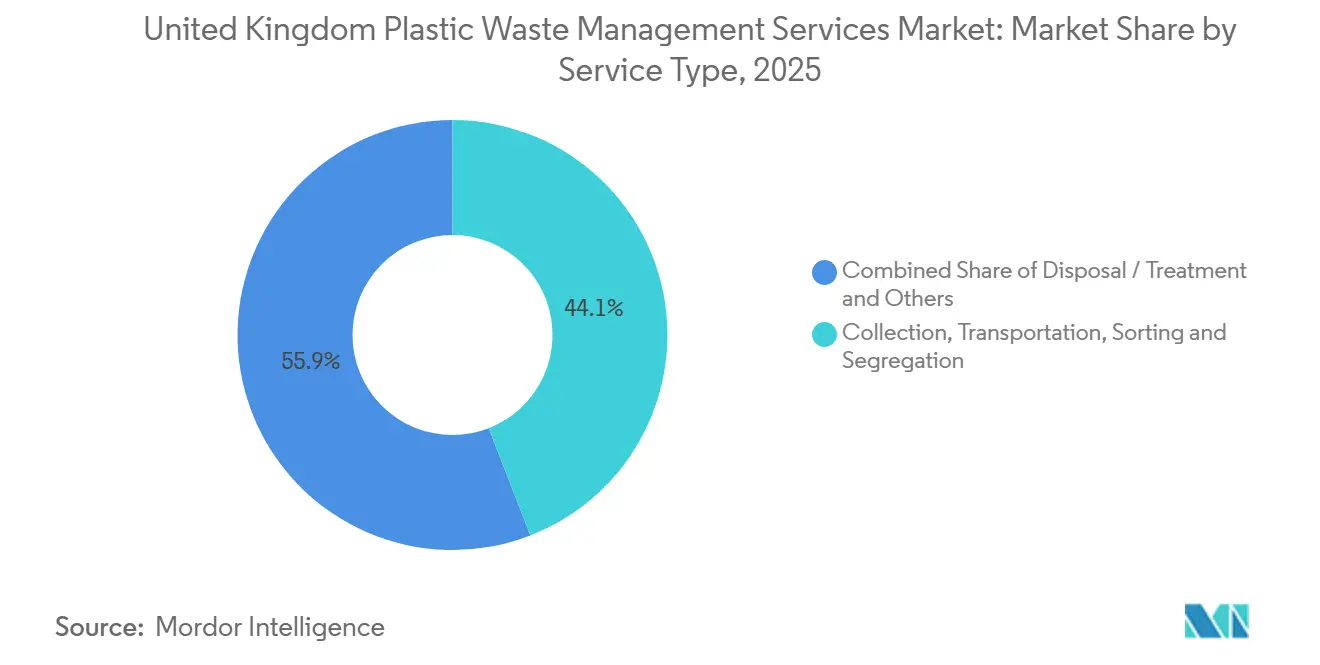
Collection, transportation, sorting, and segregation accounted for 44.1% of the United Kingdom plastic waste management services market in 2025, confirming that logistics and primary material handling still anchor the value chain. The household and workplace rollout under Simpler Recycling is adding new collection points across the country, so this segment sits at the center of near-term volume growth. WRAP’s Gate Fees report also shows that MRF fees increased during the current assessment period as facilities invested in higher-capacity sortation systems to handle rising mixed plastic volumes. Leading operators are increasing the use of optical sorting and AI-enabled contamination detection because higher-purity output improves prices and supports material verification under the new fee regime. Digital waste tracking is also becoming increasingly important in the United Kingdom's plastic waste management services market, as what was once a mainly logistics-led segment now carries stronger data and audit requirements.
Disposal and treatment is the fastest-growing service type because multiple overlapping incentives now support recycling and resource recovery. Modulated pEPR fees and the Plastic Packaging Tax, set at GBP 223.7 (USD 294.7) per ton on packaging with less than 30% recycled plastic from April 2025, both encourage diversion away from landfill and incineration into verified recycling channels. Landfill treatment faces steady pressure from the higher tax rate. At the same time, incineration and waste-to-energy remain the main residual route, as shown by Viridor’s April 2026 financial close on the GBP 2 billion (USD 2.6 billion), Tees Valley Energy Recovery Facility contract. The other sub-segment, covering consulting, audit, and training, is also expanding because PEPR reporting, RAM assessments, and compliance auditing now require formal support. This means the United Kingdom plastic waste management services market is adding value not only through physical handling of plastic waste, but also through verification, reporting, and documentation layers that now carry direct financial consequences.
Geography Analysis
England accounted for the substantial majority of activity in the United Kingdom's plastic waste management services market because it has the largest population base, the most immediate impact from Simpler Recycling, and the direct flow of GBP 1.1 billion (USD 1.4 billion) in EPR revenues to local councils in 2026. The expected GBP 11.8 billion (USD 15.5 billion) in lifetime greenhouse gas savings from Simpler Recycling is also heavily tied to England, as the household reform is being implemented there first at full scale. The government of the United Kingdom also confirmed that more than two-thirds of councils were ready by the household deadline, indicating that the operational rollout is already well advanced, even though implementation remains uneven in some areas. England also hosts a large share of current reprocessing investment, including Endolys in Darlington and Eurokey by Reconomy in Corby, which strengthens its role as the central engine of near-term volume growth and asset buildout.
Wales, Scotland, and Northern Ireland operate under devolved policy and procurement systems, so timing and implementation details do not exactly match the English model. Wales already had more established, separate dry recycling coverage across local authorities before England’s full household rollout, which means its service base is more mature in terms of collection practices. Jayplas announced a GBP 45 million (USD 59.3 million) two-site expansion in Swansea and Tredegar that targets more than 100,000 tons of combined plastic reprocessing output by March 2028, thereby strengthening Wales's role in downstream capacity as well. Scotland is building chemical recycling capability through targeted support, including a GBP 3.5 million (USD 4.6 million) Scottish Enterprise grant to ReVentas in July 2026 for complex plastic waste streams. These developments show that regional growth in the United Kingdom's plastic waste management services market will not be uniform, as collection maturity and processing investment are moving at different speeds across the four nations.
Northern Ireland operates in a separate context because cross-border waste flows with the Republic of Ireland affect routing, compliance choices, and export decisions more directly than in Great Britain. That creates an added layer of logistics planning for operators handling plastic waste near the border, especially when end-market access and regulatory treatment differ across jurisdictions. The geographic pattern, therefore, remains clear, with England driving immediate volume growth, Wales and Scotland adding selective reprocessing capacity, and Northern Ireland operating with more trade-linked complexity. Across all regions, service performance will depend on how quickly collection expansion is matched by domestic sorting and reprocessing infrastructure.
Competitive Landscape
The United Kingdom plastic waste management services market shows moderate concentration among a small group of integrated operators, including Veolia, Biffa, Viridor, and FCC Environment. These companies have advantages in fleet ownership, local authority relationships, MRF access, and the ability to manage multi-service contracts at scale. Competition is centered on contract coverage, price discipline, service reliability, and the ability to connect collection with verified downstream recovery. A clear strategic direction in the United Kingdom plastic waste management services market is end-to-end integration, where operators combine kerbside collection, advanced sorting, and domestic reprocessing to capture more value from EPR-linked demand. Veolia’s GBP 70 million (USD 92.2 million), closed-loop PET facility in Shrewsbury is one example of that strategy because it connects domestic collection and high-value recycled output in a single chain.
Viridor’s April 2026 financial close on the GBP 2 billion (USD 2.6 billion) Tees Valley Energy Recovery Facility marks a different strategic move, in which long-term residual treatment contracts are used to secure stable regional positions over many years. Veolia’s contract wins of more than GBP 1 billion (USD 1.3 billion) across 11 United Kingdom municipal agreements in 2025 show that public procurement remains a major route to scale in the United Kingdom's plastic waste management services market. Endolys’ Darlington plastic film recycling project shows how new entrants can compete by focusing on a specific waste stream where future regulation is set to sharply increase volumes. These moves suggest that scale still matters most, but targeted technology positions can create strong entry points where regulation increases pressure on hard-to-recycle materials.
Specialist small-cap and mid-market operators such as EF Plastics United Kingdom, Jayplas, Ward Recycling, and TerraCycle are also important because they serve narrow material streams, industrial waste niches, or brand-linked closed-loop programs. Their role is usually less about broad municipal scale and more about solving specific recovery problems that larger integrated operators do not always address directly. Regulatory permitting and operational standards still create barriers to informal competition, helping licensed operators protect margins as compliance requirements become more complex. White space remains strongest in chemical recycling, PRO management, and digital waste tracking, where the reporting burden under PEPR is turning regulatory complexity into a commercial service opportunity across the United Kingdom plastic waste management services market.
United Kingdom Plastic Waste Management Services Industry Leaders
Veolia
Biffa
Viridor
FCC Environment UK
Grundon Waste Management Ltd.
- *Disclaimer: Major Players sorted in no particular order

Recent Industry Developments
- July 2026: ReVentas received a GBP 3.5 million (USD 4.6 million) Scottish Enterprise grant to develop plastic recycling capabilities targeting complex and contaminated plastic waste streams in Scotland, forming part of the government’s effort to build domestic reprocessing capacity in a nation with distinct devolved recycling targets.
- April 2026: Veolia commenced an integrated waste management contract for the Isle of Wight Council, providing household collection services to more than 73,000 residential properties and operating the island’s Materials Recovery Facility and Energy Recovery Facility as part of its GreenUp sustainability strategy.
- March 2026: Eurokey by Reconomy progressed its GBP 20 million (USD 26.4 million) closed-loop plastic recycling facility in Corby, Northamptonshire, toward full-scale second-half 2026 operations, and the 138,000-square-foot plant is designed to process up to 38,000 tons of plastic annually into pellets supplied back to major United Kingdom supermarkets and retailers in a verified closed loop.
- March 2026: Veolia was awarded places on all 10 lots of the ESPO Public Sector Framework 379_26 for waste collection and disposal services, covering general waste, paper and cardboard, metals and plastic, glass, mixed recycling, and hazardous waste.


United Kingdom Plastic Waste Management Services Market Report Scope
The United Kingdom Plastic Waste Management Services Market Report is Segmented by Source (Residential, Commercial, Industrial, and Others), by Service Provider (Public/Municipal, Private Waste Management Companies, and Others), by Service Type (Collection, Transportation, Sorting & Segregation, Disposal / Treatment, and Others). The Report Offers Market Size and Forecasts in Value (USD) for all the Above Segments.
| Residential |
| Commercial (Retail, office, etc.) |
| Industrial |
| Others (Institutional, Agricultural, etc) |
| Public/Municipal |
| Private Waste Management Companies |
| Others - Producer Responsibility Organizations (PROs), etc. |
| Collection, Transportation, Sorting & Segregation | |
| Disposal / Treatment | Landfill |
| Recycling & Resource Recovery | |
| Incineration & Waste-to-Energy | |
| Others (Chemical Treatment, etc.) | |
| Others (Consulting, Audit & Training, etc.) |
| By Source | Residential | |
| Commercial (Retail, office, etc.) | ||
| Industrial | ||
| Others (Institutional, Agricultural, etc) | ||
| By Service Provider | Public/Municipal | |
| Private Waste Management Companies | ||
| Others - Producer Responsibility Organizations (PROs), etc. | ||
| By Service Type | Collection, Transportation, Sorting & Segregation | |
| Disposal / Treatment | Landfill | |
| Recycling & Resource Recovery | ||
| Incineration & Waste-to-Energy | ||
| Others (Chemical Treatment, etc.) | ||
| Others (Consulting, Audit & Training, etc.) | ||


Key Questions Answered in the Report
What is the projected value of United Kingdom plastic waste management services by 2031?
The sector is projected to reach USD 1.9 billion by 2031, rising from USD 1.5 billion in 2026 at a 4.3% CAGR.
What is driving demand for plastic waste services in the United Kingdom right now?
The strongest drivers are Simpler Recycling, PEPR fee modulation, new domestic reprocessing investment, and the upcoming expansion of plastic film collection.
Which source segment leads current demand?
Industrial plastic waste is the largest source segment, with 37.5% share in 2025, supported by predictable collection volumes and formal service contracts.
Which service provider group is growing the fastest?
Private waste management companies are the fastest-growing provider segment, with a projected 5.8% CAGR from 2026 to 2031.
Why is plastic film collection becoming more important?
England will require kerbside plastic film collection by March 2027, and WRAP expects 150,000 tons to be collected by 2027 and 200,000 tons by 2030.
What is the main risk to long-term expansion?
The main risk is that collection obligations are growing faster than domestic reprocessing capacity, leading to increased exports, contamination issues, and cost pressure.
Page last updated on:





