
United Kingdom Plant Growth Regulators Market Size and Share
Market Overview
| Study Period | 2021 - 2031 |
|---|---|
| Forecast Data Period | 2026 - 2031 |
| Base Year Market Size (2025) | USD 118.30 Million |
| Market Size (2026) | USD 122.60 Million |
| Market Size (2031) | USD 146.30 Million |
| Growth Rate (2026 - 2031) | 3.60 % |
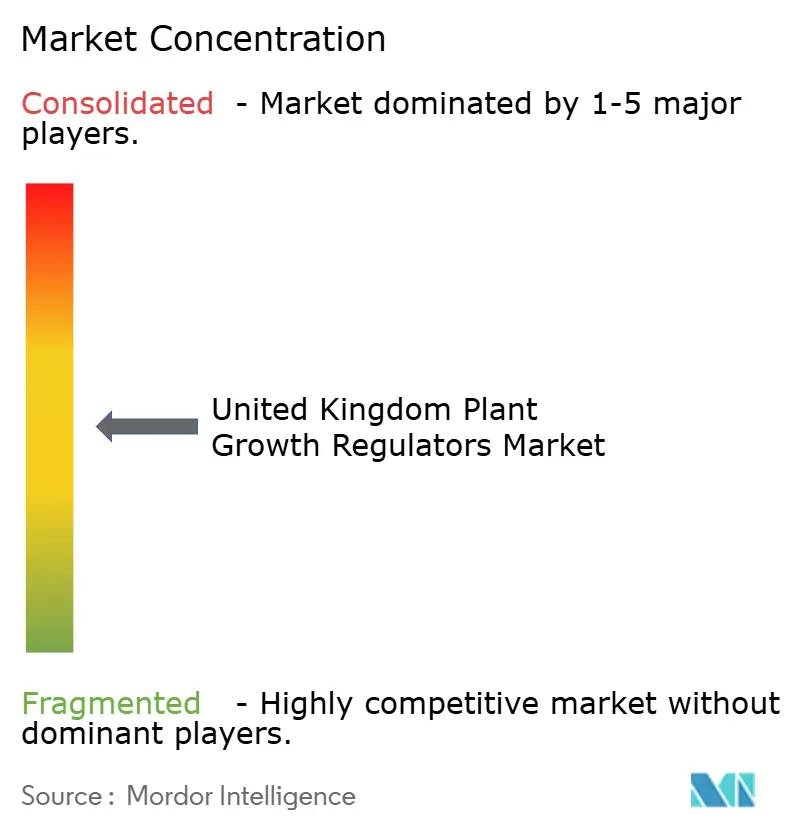
| Market Concentration | Medium |
Major Players *Disclaimer: Major Players sorted in no particular order Image © Mordor Intelligence. Reuse requires attribution under CC BY 4.0. | |
United Kingdom Plant Growth Regulators Market Analysis by Mordor Intelligence
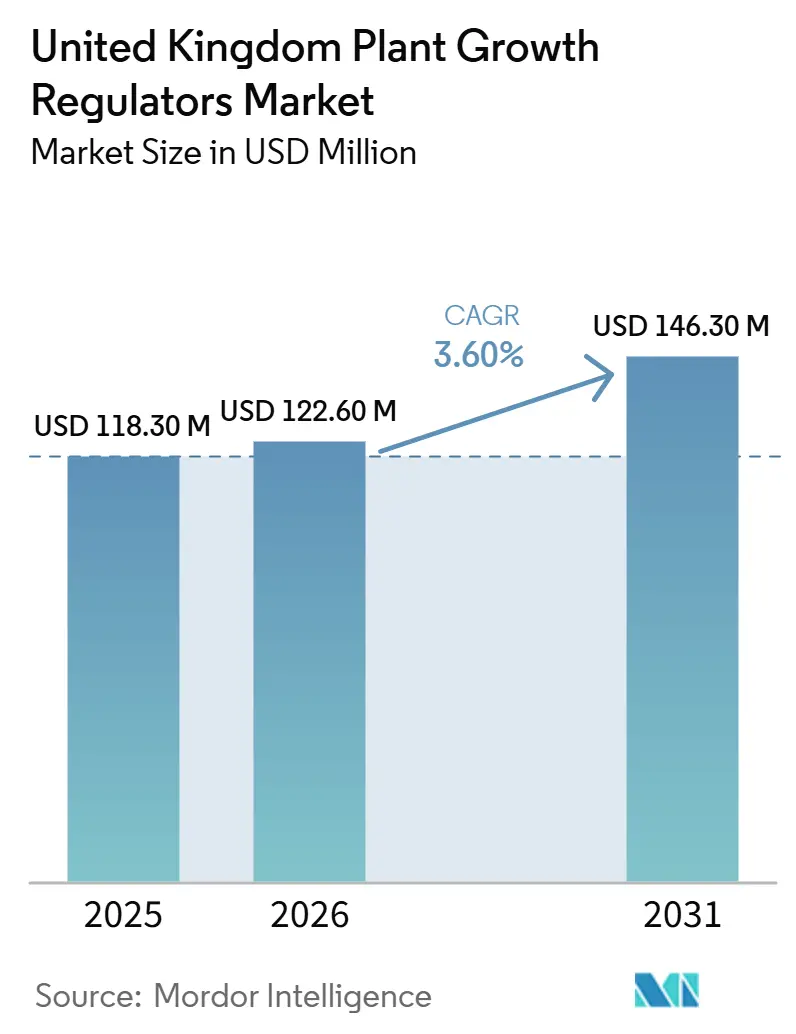
The United Kingdom plant growth regulators market size was valued at USD 118.3 million in 2025 and is projected to grow from USD 122.6 million in 2026 to reach USD 146.3 million by 2031, at a CAGR of 3.6% during the forecast period 2026-2031. The United Kingdom plant growth regulators market is being supported by the need to protect per-hectare productivity as growers operate under tighter input budgets and a more demanding production environment. A narrower active-substance toolkit is also reshaping crop management practices, making plant growth regulators increasingly important across both arable and horticultural systems. In cereals, the rebound in wheat acreage and broader recovery in total cereal area are expanding the treated base for lodging-management products, particularly across England’s intensive production regions[1]Source: Department for Environment, Food and Rural Affairs, “Agricultural Land Use in the United Kingdom at 1 June 2025,” GOV.UK. In horticulture, quality protocols in fruit and vegetable production continue linking plant growth regulator use with commercial compliance standards rather than discretionary spending, giving the market a more stable demand profile than its size alone suggests. Competitive dynamics are also shifting as larger suppliers absorb post-Brexit regulatory and approval costs more effectively than smaller formulators, widening the operating gap within a market that remains only moderately concentrated.
Key Report Takeaways
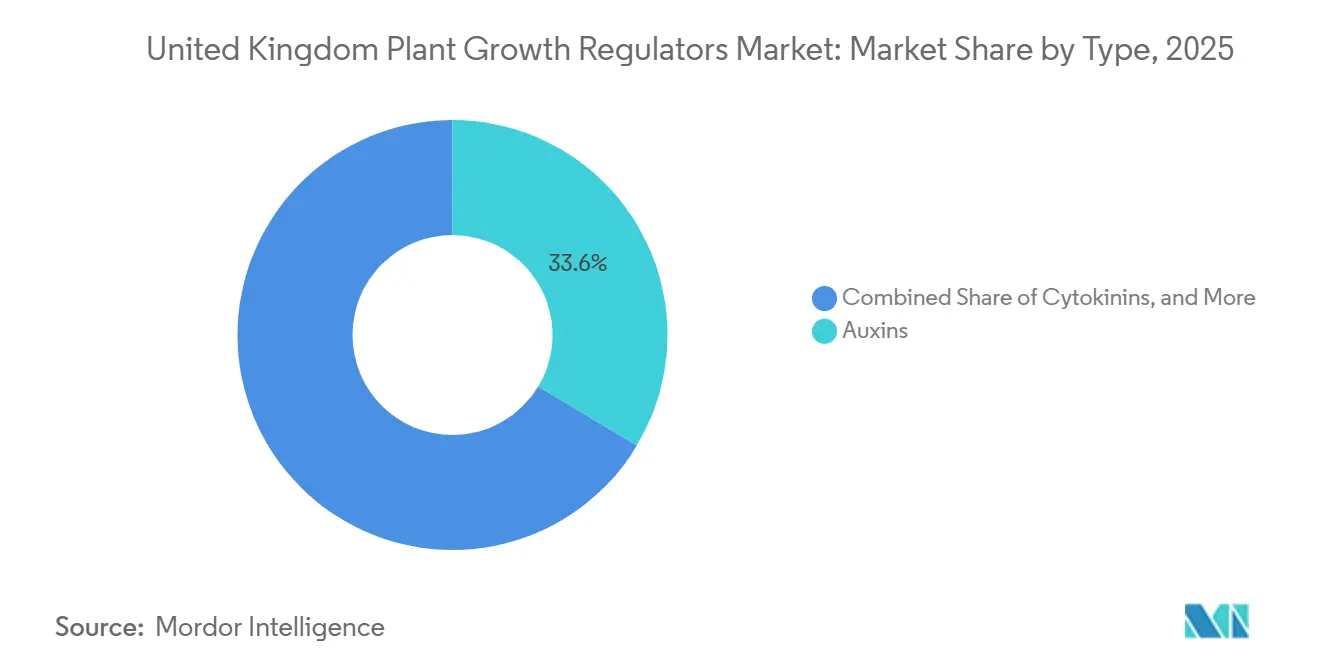
- By type, auxins held the largest share at 33.6% of the United Kingdom plant growth regulators market share in 2025, while cytokinins are forecast to grow at a CAGR of 6.9% from 2026 to 2031, making them the fastest-growing type.
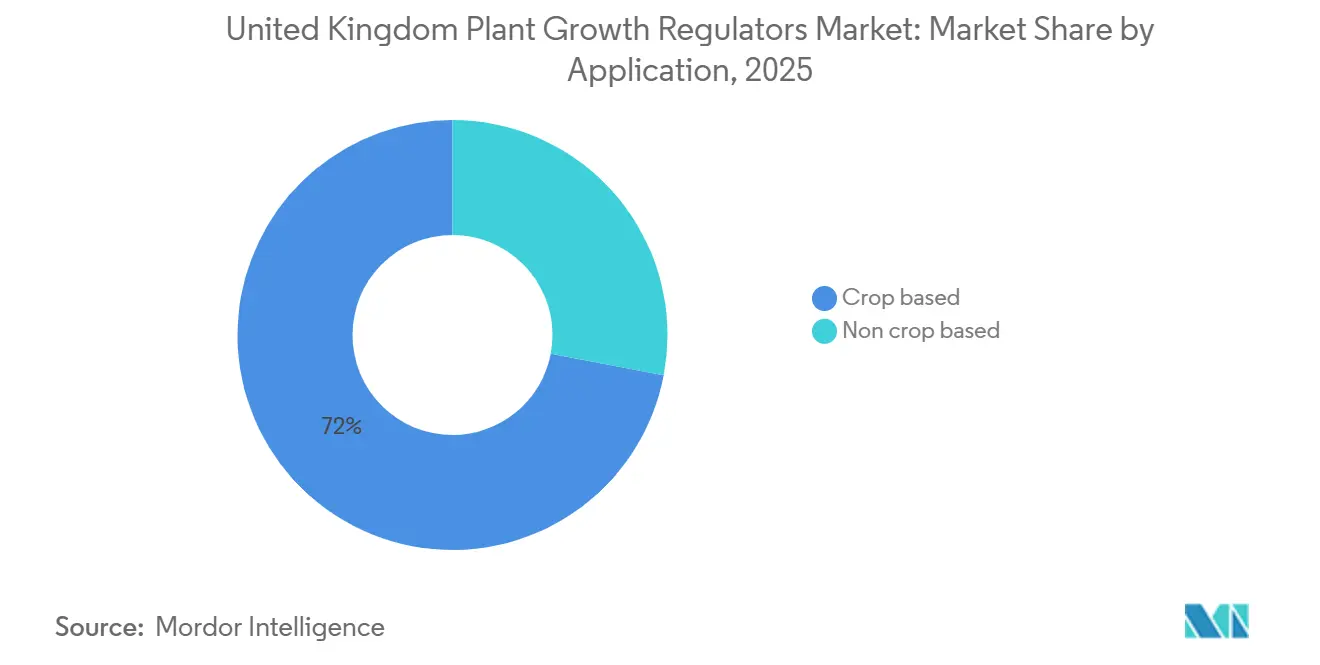
- By application, crop-based applications accounted for 72% of the United Kingdom plant growth regulators market size in 2025, while non-crop-based applications are forecast to grow at a CAGR of 5.8% from 2026 to 2031, making them the fastest-growing application.
Note: Market size and forecast figures in this report are generated using Mordor Intelligence’s proprietary estimation framework, updated with the latest available data and insights as of January 2026.
United Kingdom Plant Growth Regulators Market Trends and Insights
Drivers Impact Analysis*
| Driver | (~) % Impact on CAGR Forecast | Geographic Relevance | Impact Timeline |
|---|---|---|---|
| Cereal Lodging-Risk Management Demand | +1% | England (primary), Scotland and Wales (secondary) | Short term (≤ 2 years) |
| High-Value Horticulture Quality Optimization | +0.9% | England, especially the Southeast, East Anglia, and Herefordshire, and Scotland’s soft fruit belt | Medium term (2-4 years) |
| Organic and Sustainable Acreage Expansion | +0.7% | Scotland (high growth), England’s West Midlands and Southwest | Medium term (2-4 years) |
| Low-Dose Biostimulant and Precision Application Innovation | +0.6% | National, with stronger early uptake in East Anglia and Lincolnshire | Long term (≥ 4 years) |
| Black-Grass Resistance Is Lifting Canopy-Management Demand | +0.6% | England, especially the South and East Midlands, with spillover into Northern England | Short term (≤ 2 years) |
| Cereal and Vegetable Acreage Rebound | +0.8% | England, especially Lincolnshire, Yorkshire, and East Anglia, and Scotland for cereals | Short term (≤ 2 years) |
| Source: Mordor Intelligence | |||
Cereal Lodging-Risk Management Demand
Preventing lodging in dense wheat and barley stands remains the clearest volume driver for the United Kingdom plant growth regulators market, as cereals continue to represent the country’s broadest treated crop area. According to the Department for Environment, Food and Rural Affairs, the United Kingdom’s total cereal area reached 3.0 million hectares in 2025, keeping seasonal demand for trinexapac-ethyl and chlormequat products structurally important for suppliers serving arable growers. Early plant growth regulator applications are also linked to root recovery and stand stability, which become more important when autumn and spring weather conditions increase the risk of weak anchorage under heavy crop canopies. This pattern supports the United Kingdom plant growth regulators market not only through product volume but also through repeat applications across tightly timed cereal growth stages. As growers continue to prioritize harvestable yield over simple biomass accumulation, lodging control remains one of the clearest pathways through which agronomy translates into commercial demand.
High-Value Horticulture Quality Optimization
The United Kingdom plant growth regulators market draws strong value from horticulture because fruit and vegetable crops generate significantly higher returns per hectare than broadacre arable systems. According to the Department for Environment, Food and Rural Affairs the United Kingdom’s fruit sector was valued at GBP 1.1 billion (USD 1.4 billion), while the vegetable sector reached GBP 2.0 billion (USD 2.5 billion), highlighting why growers protect fruit set, size, firmness, and shelf life through more disciplined crop input programs[2]Source: Department for Environment, Food and Rural Affairs, “Horticulture Statistics 2024,” GOV.UK. Research published during 2025 also showed that auxin and cytokinin applications improved productivity, fruit size, coloration, and pulp firmness in apple production, reinforcing the biological basis behind commercial plant growth regulator use patterns in the United Kingdom market. Retail quality standards are also making these applications increasingly difficult to treat as discretionary, particularly in premium fruit supply chains where uniformity and shelf performance carry direct commercial value. This continues to keep demand concentrated in horticulture, even when weather conditions or broader farm economics create caution across other areas of crop input spending.
Organic and Sustainable Acreage Expansion
Organic conversion is expanding the addressable market for United Kingdom plant growth regulators, particularly within biostimulant-class products that fit certified and lower-input production systems. According to the Department for Environment Food and Rural Affairs the United Kingdom’s organic land reached 540,000 hectares in 2025, rising by 7.3%, while Scotland’s land under conversion more than doubled to 56,000 hectares, giving suppliers a larger base for nontraditional plant growth regulator offerings. This matters because growers entering organic and sustainability-linked schemes still require crop vigor, root development, and stress-management tools that do not rely on older synthetic chemistry. The United Kingdom plant growth regulators market is therefore developing a secondary demand channel where conventional and organic practices increasingly overlap through biostimulant-style formulations and crop response management programs. This broadens market relevance beyond traditional cereal lodging applications and helps explain why Scotland is becoming a more important incremental demand region.
Low-Dose Biostimulant and Precision Application Innovation
Innovation in low-dose biostimulants is giving the United Kingdom plant growth regulator market a more specialized growth path, particularly for growers seeking measurable crop responses at lower active ingredient volumes. IntraCrop Ltd stated that TFU (1-(2-(2-hydroxyethyl) phenyl)-3-(3-(trifluoromethoxy)phenyl) urea) entered commercial launch during 2026 and demonstrated increases in grain weight and protein levels across more than 60 trials covering multiple crops and countries[3]Source: IntraCrop Ltd, “IntraCrop to Launch New Single-Molecule Biostimulant TFU,” intracrop.co.uk. The importance of this shift extends beyond product novelty, as these molecules are increasingly paired with precision farming practices that favor dose control and field-specific targeting. Within the United Kingdom plant growth regulator market, this creates a pathway for suppliers to compete through response data, formulation quality, and integration with modern agronomy systems, rather than solely through pricing. Over time, this trend supports margin preservation in a market where older active substances face growing generic competition.
Restraints Impact Analysis*
| Restraint | (~) % Impact on CAGR Forecast | Geographic Relevance | Impact Timeline |
|---|---|---|---|
| Approval and Stewardship Burden for Plant Protection Products | -0.70% | National in Great Britain, with added complexity in Northern Ireland | Short term (≤ 2 years) |
| Weather Volatility and Narrow Spray Windows | -0.40% | National, with greater severity in Northern England, Wales, and western Scotland | Short term (≤ 2 years) |
| Pesticide Load Indicator Reduction Targets | -0.50% | National, with stronger influence near sensitive sites in England | Medium term (2-4 years) |
| Mature Distributor Market and Pricing Pressure | -0.30% | National | Long term (≥ 4 years) |
| Source: Mordor Intelligence | |||
Approval and Stewardship Burden for Plant Protection Products
The post-Brexit approval framework remains a direct restraint on the United Kingdom plant growth regulators market because Great Britain now operates a standalone registration system under the Health and Safety Executive. Separate submissions and renewals continue to add costs, delays, and administrative complexity for suppliers operating across multiple territories. The burden is particularly significant for smaller specialty formulators, as the United Kingdom represents a single-country opportunity that may not justify the cost of repeated dossier submissions given relatively limited sales volumes. This dynamic remained evident in February 2026, when the British Crop Production Council confirmed that key trinexapac-ethyl approvals were extended only until June 15, 2028, highlighting that even core molecules continue to operate under ongoing regulatory review. The United Kingdom plant growth regulator market, therefore, faces a persistent friction point strong agronomic demand does not always translate into a straightforward path for product continuity or portfolio expansion.
Weather Volatility and Narrow Spray Windows
Weather remains a practical restraint on the United Kingdom plant growth regulator market, as product performance depends heavily on precise application timing during cereal growth stages. Wet conditions can delay drilling, compress spray windows, and reduce treatment accuracy during the periods when lodging protection is most effective. The 2024-2025 season already demonstrated how sensitive planted area and field operations can become, with winter barley area falling to 1.1 million hectares following difficult autumn conditions. In the United Kingdom’s maritime climate, missed spray opportunities can matter as much as product selection, because the commercial window for agronomic benefit remains short while crop development continues to advance. This limits the United Kingdom plant growth regulator market by increasing execution risk across cereal systems, which account for a significant share of total product volume.
*Our forecasts treat driver/restraint impacts as directional, not additive. The impact forecasts reflect baseline growth, mix effects, and variable interactions.
Segment Analysis
By Type: Auxins Lead on Application Breadth, Cytokinins on Growth Rate
Auxins accounted for the largest type segment in the United Kingdom plant growth regulators market, representing 33.6% of total market share in 2025. Their leading position reflects broad use across rooting induction, fruit set management, abscission control, and pre-harvest drop prevention within mixed United Kingdom crop systems. This wide physiological role makes auxins more difficult to replace than narrower molecule classes serving fewer crop situations. Research published in 2025 also linked auxin-regulated pathways directly to apple ripening behavior, reinforcing their commercial importance for timing-sensitive fruit management. Within the United Kingdom plant growth regulators market, this breadth keeps auxins closely connected with both arable support functions and premium horticultural value creation. Auxins also benefit from the fact that horticultural programs often integrate them into standard operating practice rather than purchasing them only during favorable pricing or weather conditions. This structural usage pattern gives the segment a more stable demand base than categories tied to a single crop issue or short seasonal trigger.
Cytokinins are projected to be the fastest-growing type, expanding at a CAGR of 6.9% during 2026-2031, as biostimulant crossover products and precision hormone-active formulations gain broader commercial traction in the United Kingdom plant growth regulators market. Gibberellins remain an important value contributor because of their role in berry crops, seedless grape production, and ornamental forcing programs, where size and presentation carry high commercial importance. Ethylene releasers also remain relevant in high-biomass cereal management situations where internode control enhances crop standability.



By Application: Crop-based Applications Lead Market Volume, Non-crop-based Drives Growth
Crop-based applications continue to dominate the United Kingdom plant growth regulators market, holding an 72% share in 2025. This leadership is supported by the country’s strong horticultural, cereal, and oilseed production base, where growers depend on plant growth regulators to improve yield consistency, crop uniformity, and marketable quality. Within this category, fruits and vegetables stand out as the most valuable sub-segment because plant growth regulators use helps improve fruit set, sizing, and postharvest quality. Grains and cereals also generate substantial demand, especially through products used to manage lodging and support standability across large planted areas.
Non-crop-based applications are the fastest-growing part of the market, projected to expand at a 5.8% CAGR between 2021 and 2031. Growth is being led mainly by turf and ornamental grass, where golf courses, sports venues, and municipal landscapes increasingly use plant growth regulators to reduce mowing frequency and maintain uniform playing surfaces. Product adoption is also strengthening in ornamentals and nursery crops, where growers value compact plant form and consistent sizing for retail appeal. Overall, this segment is gaining momentum as amenity and specialty growers look for more precise and cost-efficient growth management tools.
Geography Analysis
England accounts for the dominant share of the United Kingdom plant growth regulators market because it remains the country’s primary arable, horticultural, and amenity production base. According to Department for Environment Food and Rural Affairs, England’s cereal area reached 2.5 million hectares in 2025, while wheat acreage increased by 8.8% to 1.5 million hectares, supporting the largest concentration of cereal plant growth regulator demand within the national market. East Anglia and Lincolnshire remain the most intensive arable regions for lodging-management programs because high-yield systems and nitrogen-intensive regimes create stronger canopy-control requirements. England also maintains the country’s deepest horticultural base, including soft fruit and orchard production across the Southeast and Herefordshire, reinforcing the largest application segment in the United Kingdom plant growth regulators market. The Farming Innovation Program, supported by GBP 127 million (USD 161 million), is also encouraging broader adoption of precision field management practices that complement more targeted use of plant growth regulators across England.
Scotland is becoming a more visible demand region in the United Kingdom plant growth regulators market, particularly where organic conversion and soft fruit specialization intersect. Land under organic conversion in Scotland more than doubled to 56,000 hectares during 2025, representing the largest proportional increase among the United Kingdom’s nations. This transition is creating greater opportunity for biostimulant-class and certification-compliant crop management products than Scotland historically represented. The Scottish soft fruit belt across Angus, Perthshire, and the Clyde Valley also sustains targeted demand for auxin and cytokinin applications in berry production systems. Scotland’s cereal footprint remains smaller than England’s, although wet Atlantic conditions continue keeping lodging risk relevant enough for the United Kingdom plant growth regulators market to retain meaningful cereal demand there as well.
Wales and Northern Ireland represent a smaller but distinct part of the United Kingdom plant growth regulators market. Wales maintains a more limited arable base because much of its agricultural system remains centered on permanent grassland and hill farming, although vegetable production and amenity turf continue to create niche application areas. Northern Ireland also adds regulatory complexity, as suppliers must navigate separate approval pathways and expiry structures for certain products compared with those in Great Britain. The British Crop Production Council confirmed in February 2026 that trinexapac-ethyl approvals continue carrying separate registration considerations across parts of the United Kingdom, highlighting how geography can influence commercial execution as much as crop demand itself. As a result, the United Kingdom plant growth regulator market remains national in scope while still shaped by different crop mixes, approval structures, and growth opportunities across the constituent nations.
Competitive Landscape
The United Kingdom plant growth regulators market is moderately concentrated. Syngenta Group, BASF SE, Sumitomo Chemical Company, Limited, Corteva Agriscience, and Sharda Cropchem Limited anchor the top tier and together hold a meaningful share of market revenue. Their strength comes from broad portfolios, strong regulatory capabilities, and established positions across cereal, turf, and horticultural uses. At the same time, the market remains open enough for specialist players such as IntraCrop Ltd, Micromix Plant Health Ltd, Fine Agrochemicals Limited, and Rovensa Next, S.L.U. to compete through niche formulations and targeted agronomy support.
Competitive strategy is increasingly shaped by label expansion, formulation innovation, and regulatory timing rather than solely by new-molecule discovery. Syngenta Group continues to lead in cereal and turf growth regulation, while BASF SE and other incumbents defend share through product registration and portfolio breadth. Smaller entrants are using biostimulant routes and lower-barrier product categories to reach growers faster and at lower compliance cost. This is creating a clear divide between large multinationals with scale advantages and agile specialists focused on narrower, faster-moving opportunities.
Collaborations with agricultural distributors, cooperatives, research institutions, and independent agronomists are crucial for market expansion. Key companies allocate substantial resources to field trials, demonstration programs, and farmer education initiatives to demonstrate product performance under varying UK climatic conditions. These partnerships build customer confidence, promote product adoption, and foster brand loyalty. Manufacturers are enhancing technical advisory services to help growers incorporate plant growth regulators into comprehensive crop management strategies. These efforts aim to improve yield, quality, and profitability while ensuring compliance with changing environmental regulations.
United Kingdom Plant Growth Regulators Industry Leaders
BASF SE
Sumitomo Chemical Company, Limited
Sharda Cropchem Limited
Syngenta Group
Corteva Agriscience
- *Disclaimer: Major Players sorted in no particular order

Recent Industry Developments
- February 2026: The Health and Safety Executive extended approvals for Syngenta United Kingdom’s trinexapac-ethyl products, including Moddus, Optimus, and Moxa, to June 15, 2028, in both Great Britain and Northern Ireland, providing commercial certainty for the United Kingdom’s most widely applied cereal plant growth regulator franchise across the 2026-2028 growing seasons.
- February 2026: IntraCrop Ltd commercially launched TFU, a single-molecule biostimulant with auxin and cytokinin-like hormonal activity, as a seed treatment for cereals, following national registrations secured in early 2026. TFU, developed in collaboration with Palacky University and the Czech Academy of Sciences Institute of Experimental Botany, showed significant increases in protein levels and grain weight across more than 60 trials in multiple countries and crops.
- December 2025: Rovensa Next launched Myndra, a next-generation seaweed-based biostimulant designed to elevate fruit quality traits in woody perennial crops, including apple, pear, and stone fruit, grown in the United Kingdom, and has received recognition under the European Union Fertilizing Products Regulation 2019/1009 as a certified non-microbial plant biostimulant for commercialization across Europe.


United Kingdom Plant Growth Regulators Market Report Scope
Plant growth regulators are chemical compounds other than nutrients that modify a plant's physiological processes. The United Kingdom Plant Growth Regulators Market Report is Segmented by Type (Cytokinins, Auxins, Gibberellins, Ethylene, and Other Types), and by Application (Crop-Based, and Non-Crop-Based). The Market Forecasts are Provided in Terms of Value (USD) and Volume in (Metric Tons).
| Cytokinins |
| Auxins |
| Gibberellins |
| Ethylene |
| Other Types |
| Crop-based | Grains and cereals |
| Pulses and oilseeds | |
| Fruits and vegetables | |
| Non-crop-based | Turf and ornamental grass |
| Ornamentals and nursery crops |
| Type | Cytokinins | |
| Auxins | ||
| Gibberellins | ||
| Ethylene | ||
| Other Types | ||
| Application | Crop-based | Grains and cereals |
| Pulses and oilseeds | ||
| Fruits and vegetables | ||
| Non-crop-based | Turf and ornamental grass | |
| Ornamentals and nursery crops | ||


Key Questions Answered in the Report
What is the current outlook for the United Kingdom plant growth regulators market?
The United Kingdom plant growth regulators market stands at USD 122.6 million in 2026 and is forecast to reach USD 146.3 million by 2031 at a CAGR of 3.6% during 2026-2031.
Which segment is the largest in the United Kingdom plant growth regulators market by type?
Auxins are the largest type, with 33.6% share in 2025, because they are used across rooting, fruit set, abscission control, and pre-harvest drop prevention.
Which application leads demand in the United Kingdom?
Crop-based is the largest application segment and accounted for 72% of the United Kingdom plant growth regulators market size in 2025.
Which segment is expanding the fastest through 2031?
Cytokinins are the fastest type at a projected 6.9% CAGR during 2026-2031, while non crop based is the fastest application segment at 5.8%.
Page last updated on:





