
United Kingdom ITSM Market Size and Share
Market Overview
| Study Period | 2024 - 2035 |
|---|---|
| Forecast Data Period | 2026 - 2035 |
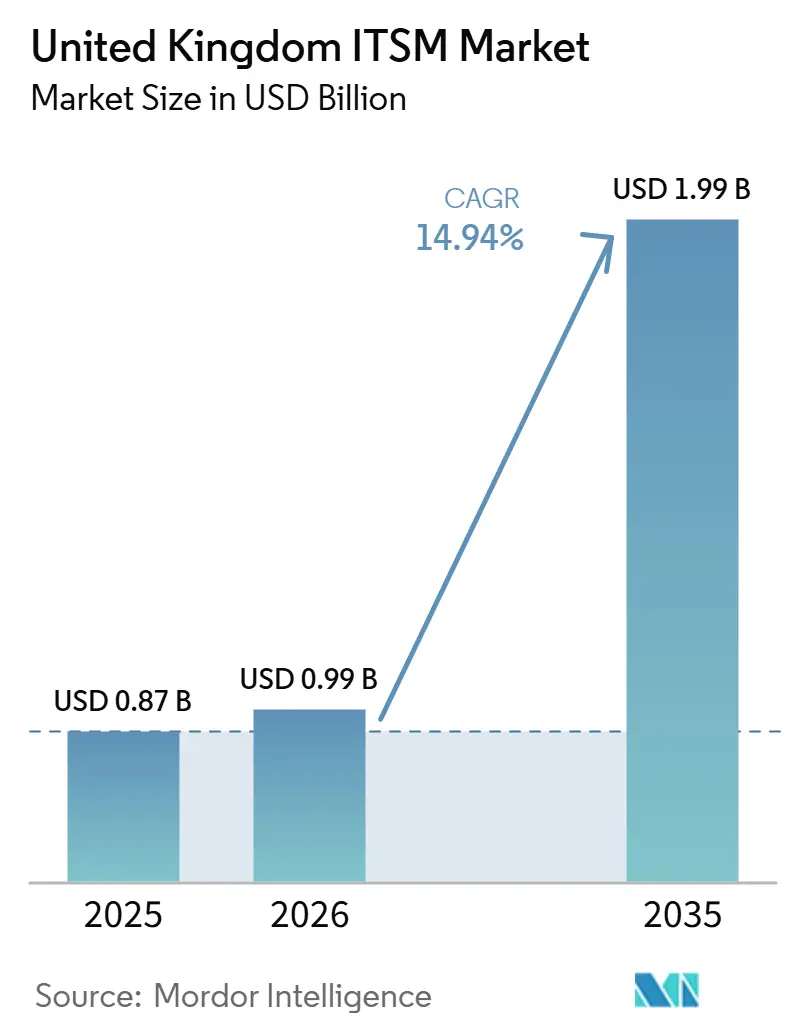
| Base Year Market Size (2025) | USD 0.87 Billion |
| Market Size (2026) | USD 0.99 Billion |
| Market Size (2035) | USD 1.99 Billion |
| Growth Rate (2026 - 2035) | 14.94% CAGR |
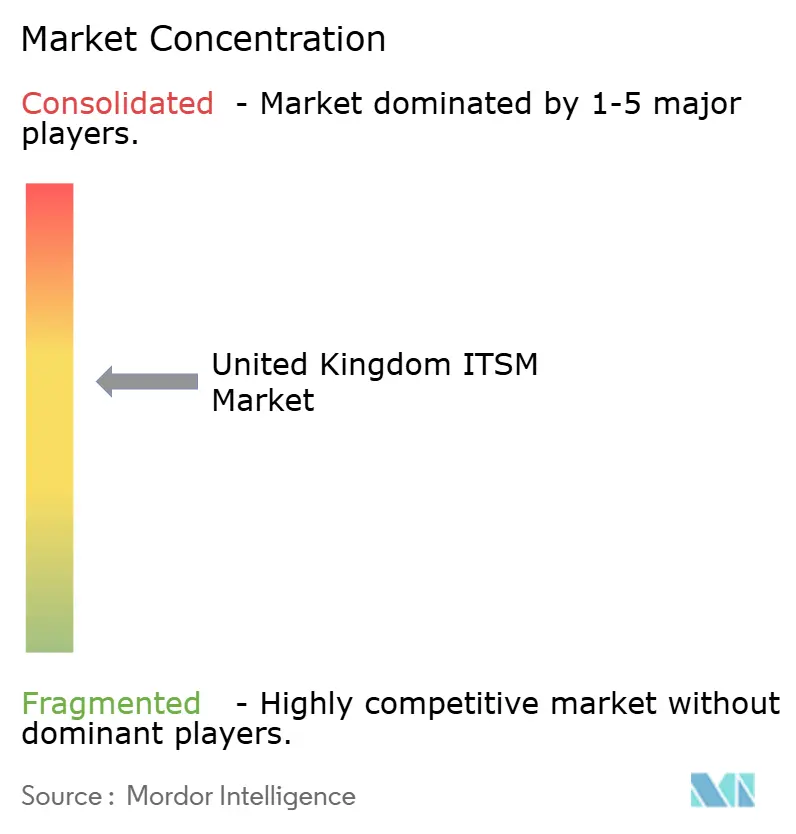
| Market Concentration | Medium |
Major Players *Disclaimer: Major Players sorted in no particular order Image © Mordor Intelligence. Reuse requires attribution under CC BY 4.0. | |
United Kingdom ITSM Market Analysis by Mordor Intelligence
The United Kingdom ITSM Market size was valued at USD 0.87 billion in 2025 and is estimated to grow from USD 0.99 billion in 2026 to reach USD 1.99 billion by 2035, at a CAGR of 14.94% during the forecast period (2026-2035).
The UK ITSM market is expanding as organizations move service operations away from basic ticket handling and toward broader workflow control across IT, HR, and facilities. Demand is also rising because enterprises are under pressure to simplify complex IT estates while keeping service quality stable across cloud, on-premise, and mixed environments. AI-led automation is becoming a core buying factor, especially where service teams need faster resolution, stronger knowledge use, and lower manual workload. Competitive activity is centered on platform depth, AI readiness, local data handling, and partner-led implementation capability, which is creating room for both global vendors and UK-focused specialists. The UK ITSM market is also seeing stronger opportunity in regulated organizations and public institutions, where modernization programs are making service management platforms part of wider digital operating models.
Key Report Takeaways
- By component, solutions led with a 68.42% share in 2025, while services is projected to expand at an 18.65% CAGR through 2031.
- By deployment, cloud held 73.43% share of the UK ITSM market in 2025, with the remaining demand concentrated in on-premise and hybrid environments serving data-sensitive organizations.
- By application, service desk and incident management accounted for 29.21% share in 2025, while knowledge management is projected to expand at a 15.92% CAGR through 2031.
- By end-user industry, BFSI held 21.33% share in 2025, while healthcare is projected to grow at a 17.95% CAGR through 2031.
- By enterprise size, large enterprises held 59.20% share in 2025, while SMEs are projected to expand at an 18.22% CAGR through 2031.
Note: Market size and forecast figures in this report are generated using Mordor Intelligence’s proprietary estimation framework, updated with the latest available data and insights as of January 2026.
United Kingdom ITSM Market Trends and Insights
Drivers Impact Analysis*
| Driver | (~) % Impact on CAGR Forecast | Geographic Relevance | Impact Timeline |
|---|---|---|---|
| Rising Demand for IT Efficiency and Automation | +4.5% | Global, with concentrated gains in London, Birmingham, and Manchester enterprise clusters | Short term (≤ 2 years) |
| Expansion of Cloud-Based ITSM Adoption Among UK Enterprises | +3.8% | UK-wide, with early adopter density in Southeast England and Scottish tech corridor | Medium term (2-4 years) |
| Increased Need for Hybrid Work Service Support | +2.2% | National, with strongest impact in sectors with distributed and field-based workforces | Short term (≤ 2 years) |
| Greater Use of AI-Driven Service Desk Workflows | +2.0% | Global, with UK financial services and public sector as primary early adopters | Medium term (2-4 years) |
| Regulatory Pressure for Auditability and Service Governance | +1.0% | UK and EU cross-border operations, with compliance intensity concentrated in BFSI and healthcare | Long term (≥ 4 years) |
| Rising Integration Demand With IT Asset, Observability, and Workflow Tools | +0.8% | National, with highest concentration in IT and telecom and retail end-user verticals | Long term (≥ 4 years) |
| Source: Mordor Intelligence | |||
Rising Demand For IT Efficiency And Automation
UK organizations are treating service automation as an operating need rather than an optional productivity project. In May 2026, NHS Shared Business Services deployed SBS One with Salesforce, and the AI-powered help center was targeted to handle up to 50% of service demand across NHS corporate services[1]Salesforce, “NHS Shared Business Services and Salesforce Deploy AI-Powered Platform to Transform Corporate Services Across the NHS,” Salesforce News, salesforce.com. Freshworks also launched Freddy AI Agent Studio for Freshservice in May 2026, which gave service teams a no-code way to automate requests and connect outside tools through an MCP Gateway. These product and deployment moves show that automation is now being built directly into the service layer instead of being added as a side tool after rollout. That shift is strengthening the UK ITSM market because buyers are now looking for platforms that reduce manual service effort at the same time they improve speed, consistency, and scale.
Expansion Of Cloud-Based ITSM Adoption Among UK Enterprises
Cloud delivery continues to gain ground because buyers want faster upgrades, lower infrastructure burden, and better access to AI features. The UK Competition and Markets Authority found that cloud customers still face switching friction tied to egress costs and interoperability barriers, which is increasing the value of service platforms that can govern multi-cloud estates from one environment. ServiceNow strengthened this direction in October 2025 by activating NVIDIA AI infrastructure in its UK data centers in London and Newport, which supports local large language model processing for customers with data sovereignty requirements. ServiceNow and Google Cloud had also expanded their partnership in January 2025 to make the Now Platform available on Google Distributed Cloud, which widened sovereign and partner-operated deployment options for regulated users. As more UK buyers weigh resilience, jurisdiction control, and AI access together, the UK ITSM market is moving further toward cloud-native delivery as the default architecture.
Increased Need For Hybrid Work Service Support
Service support in the UK now has to cover users who work across offices, campuses, hospitals, and distributed operating sites. The University of Birmingham’s 2025 procurement activity showed ServiceNow being extended across IT, HR, finance, legal, and other business functions, which reflects the need for one workflow layer across multiple user groups and operating contexts. NHS England also migrated from 3 legacy ITSM systems into a ServiceNow environment with Cognizant support, which points to the need for unified service management across large and geographically dispersed public service operations. ServiceNow’s UK-based AI infrastructure further supports this trend because organizations with strict data handling requirements can still centralize support services in cloud environments. The result is that the UK ITSM market is benefiting from a service model where constant availability and unified workflows matter more than support tied to one location or one function.
Greater Use Of AI-Driven Service Desk Workflows
AI is moving from assisted triage toward fuller service resolution across the UK ITSM market. Ivanti said in January 2026 that its Neurons platform was adding persona-based agentic AI for ITSM, along with autonomous endpoint management and stronger asset visibility[2]Ivanti, “Ivanti Unveils AI-Driven Innovations to the Neurons Platform to Power the Future of IT and Security,” Ivanti Press Releases, ivanti.com. In April 2026, Ivanti also released its autonomous AI Self-Service Agent for Neurons ITSM, enabling incident creation, request submission, and knowledge-base resolution through natural language without analyst involvement. Freshworks added to the same direction with Freddy AI Agent Studio, while Salesforce supported one of the largest UK public health examples through SBS One. These moves are changing buying criteria because organizations now expect service platforms to combine workflow control, knowledge use, and AI-based action in one environment. That is supporting faster replacement and upgrade decisions across the UK ITSM market, where older platforms cannot match this level of embedded capability.
Restraints Impact Analysis*
| Restraint | (~) % Impact on CAGR Forecast | Geographic Relevance | Impact Timeline |
|---|---|---|---|
| High Cost and Complexity of Legacy Platform Replacement | -2.1% | National, with highest impact in public sector and BFSI organizations with multi-decade legacy estates | Short term (≤ 2 years) |
| Data Migration and CMDB Normalization Challenges | -1.5% | National, with particular severity in large enterprises running bespoke CMDB schemas | Medium term (2-4 years) |
| Budget Sensitivity in Mid-Market and Public Sector Buyers | -1.0% | UK national, with concentrated impact in NHS trusts, local authorities, and mid-sized manufacturing firms | Short term (≤ 2 years) |
| Skills Gaps in ITSM Administration and Workflow Design | -0.8% | National, with a reported 35% vacancy rate across NHS digital roles as an indicator of systemic shortage | Long term (≥ 4 years) |
| Source: Mordor Intelligence | |||
High Cost And Complexity Of Legacy Platform Replacement
The Germany ITSM market still faces a major constraint from legacy complexity, because many enterprises have service workflows that sit across old ERP systems, plant systems, endpoint tools, and internally customized support processes. Replacing or upgrading service management in those settings is rarely a single-platform job, and the work often depends on stable links between asset data, request handling, user directories, and operational records. SAP's Syntegon example shows how large modernizations can span 47 locations and nearly 400 interfaces, which helps explain why service management redesign often becomes slower and more demanding than planned. Ivanti's emphasis on stronger cloud-to-on-premises synchronization also underlines the reality that the Germany ITSM market still has to serve buyers who cannot cut away from mixed environments in one step. This restraint does not stop adoption, but it does lengthen project timelines, increase service dependency, and reward vendors with tested connectors, migration tools, and local implementation depth. It also keeps services demand high, because many customers need ongoing support after the initial platform rollout is complete.
Data Migration And CMDB Normalization Challenges
Data quality and configuration visibility remain major barriers when organizations move to newer platforms. Genomics England’s late 2025 tender for ITSM and CMDB tooling stated that it had no existing CMDB, which shows that even digitally active institutions may still lack the configuration foundation needed for smoother migration and automation. Freshworks responded to this kind of gap in April 2026 by adding continuous infrastructure discovery and dependency mapping from Device42 into Freshservice, which points directly to buyer demand for better asset visibility and cleaner configuration data. UK public sector tenders also continue to stress integration, scalability, and auditability, which means migration work is not limited to moving tickets and users from one system to another. This restraint matters because AI, automation, and change control all work better when the underlying service and asset data is complete, current, and structured in a consistent way.
*Our forecasts treat driver/restraint impacts as directional, not additive. The impact forecasts reflect baseline growth, mix effects, and variable interactions.
Segment Analysis
By Component: Services Growth Reshapes Platform Revenue Dynamics
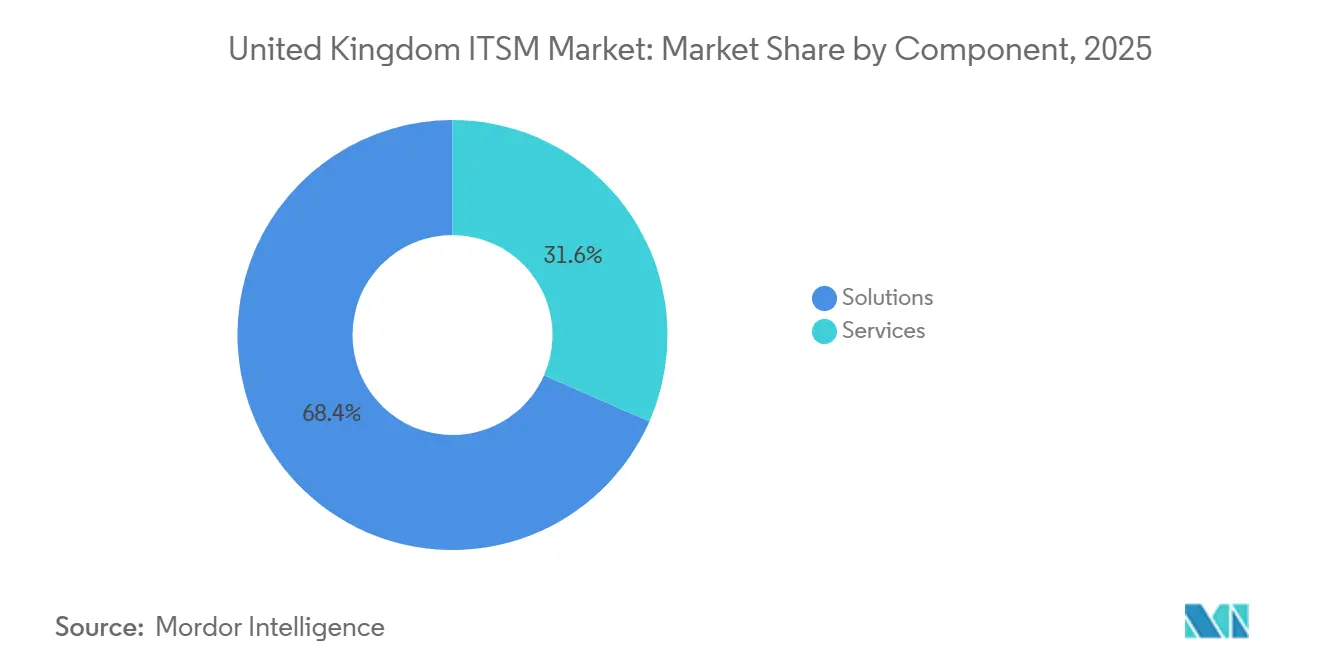
Solutions held a 68.42% share of the UK ITSM market in 2025, which kept software licenses and SaaS subscriptions as the main revenue base. Services is projected to expand at an 18.65% CAGR through 2031, which makes it the faster-growing component in the UK ITSM market. That pattern shows that buyers are no longer stopping at platform purchase and first deployment. They are spending more on configuration, workflow design, integration support, and managed service delivery as service environments become broader and more complex. This shift is also consistent with a market where AI features, cross-functional service catalogs, and cloud migrations require ongoing hands-on support after the initial implementation phase.
Services growth is also being reinforced by channel and partner strategies across the UK ITSM industry. Freshworks and Unisys announced a strategic partnership in February 2025 to resell Freshworks ITSM solutions, including Freshservice and Device42, to mid-market and enterprise customers. That kind of model gives buyers access to both the platform and the surrounding implementation capability through one commercial route. In practice, it shortens the gap between purchase and operational use, especially for organizations that do not have deep internal ITSM administration teams. As a result, the UK ITSM market is seeing services move from a supporting role into a stronger value driver that shapes how platforms are adopted, expanded, and renewed.


By Deployment: Cloud Cements Its Position As The Default Architecture
Cloud deployment led with 73.43% of UK ITSM market share in 2025, which confirmed cloud as the main architecture for new and expanding deployments. The remaining on-premise and hybrid demand stayed concentrated in sectors where data sovereignty, legacy integration, or internal control still limit full cloud migration. This mix shows that the UK ITSM market has already moved well beyond cloud experimentation. Buyers now treat cloud as the normal operating model, while local or hybrid environments are used where institutional constraints remain harder to remove. The leadership of cloud also reflects the practical value of subscription pricing, faster product upgrades, and direct access to AI-enabled service capabilities.
ServiceNow strengthened the cloud case in October 2025 when it activated NVIDIA AI infrastructure in its UK data centers in London and Newport for local model processing. ServiceNow and Google Cloud had already expanded sovereign deployment options in January 2025 by making the Now Platform available on Google Distributed Cloud. The CMA’s cloud market findings also showed why centralized governance across providers has become more valuable for UK customers facing interoperability and switching limits. Together, these factors are keeping cloud at the center of the UK ITSM market, even where buyers still need UK-resident processing and tightly controlled deployment conditions. The UK ITSM market size tied to cloud deployment is therefore supported by both functionality gains and regulatory practicality.
By Application: Service Desk Anchors Value While Knowledge Management Advances Fastest
Service desk and incident management accounted for 29.21% share of the UK ITSM market size in 2025, which kept it as the largest application area. Knowledge management is projected to expand at a 15.92% CAGR through 2031, which makes it the fastest-growing application in the UK ITSM market. The current mix shows that incident handling still anchors platform value because it is the most visible service function for employees and internal support teams. At the same time, faster growth in knowledge management shows where future platform benefits are likely to concentrate. Organizations are placing more value on structured knowledge because self-service, AI agents, and automated resolution depend on it.
This direction is visible in current product development and public sector buying behavior. Freshworks launched Freddy AI Agent Studio for Freshservice in May 2026, which supports AI-led service actions that work better when strong knowledge assets and workflows are already in place. A 2025 UK public sector tender also specified ServiceNow as a single integrated platform for critical ITSM practices, with clear requirements for scalability, auditability, and integration with other enterprise systems. That kind of procurement approach supports applications beyond the service desk, including change control, request fulfillment, asset visibility, and enterprise-wide service workflows. The UK ITSM market is therefore keeping incident management at the center while expanding faster around the knowledge, automation, and control layers that make service operations more efficient over time.
By End-User Industry: BFSI Leads The Market While Healthcare Signals Faster Expansion
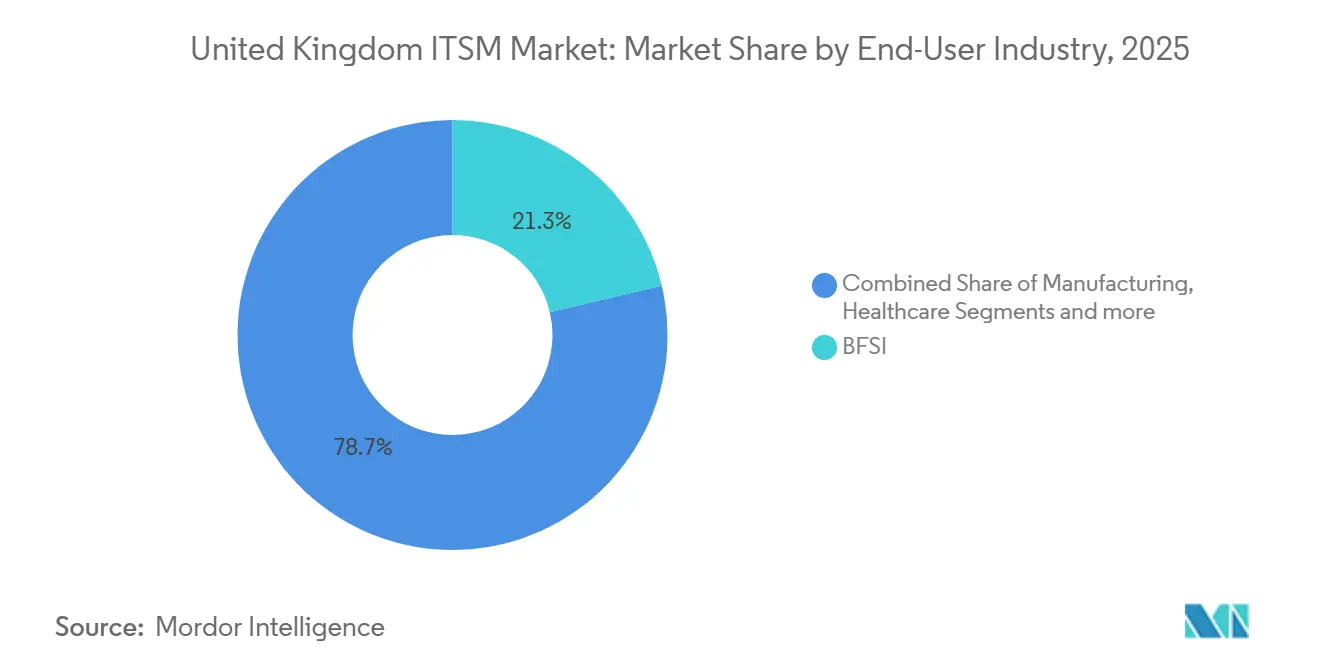
BFSI held 21.33% share in 2025, which made it the largest end-user segment in the UK ITSM market. Healthcare is projected to grow at a 17.95% CAGR through 2031, which points to a stronger expansion path than other end-user groups. BFSI’s lead reflects the sector’s long-standing need for service continuity, auditability, and change control in highly regulated environments. That has kept financial institutions close to mature ITSM models and has supported steady demand for enterprise-grade platforms. Healthcare’s faster growth, by contrast, is tied to ongoing modernization programs and the wider use of service automation across NHS-related operations.
The healthcare case became more visible in 2026. NHS Shared Business Services deployed an AI-powered digital help center with Salesforce in May 2026, and the system was targeted to handle up to 50% of service demand. The Department of Health and Social Care program referenced in the draft also tied digital spending to workflow automation and productivity gains, including GBP 8.2 billion (USD 10.4 billion) in 4-year gains and GBP 36.6 billion (USD 46.5 billion) in 10-year benefits. Manufacturing, government and public sector, and IT and telecom remain important because each uses service management in a different way, from plant support and public administration to complex partner ecosystems. The UK ITSM industry is therefore being shaped by a mature regulated core in BFSI and a faster public-service expansion path led by healthcare modernization.

By Enterprise Size: Large Enterprises Anchor Revenue While SMEs Expand Faster
Large enterprises held 59.20% share in 2025, which kept them as the main revenue base in the UK ITSM market. SMEs are projected to expand at an 18.22% CAGR through 2031, which makes them the faster-growing enterprise-size segment. Large organizations continue to dominate spend because they run more complex estates, process higher service volumes, and require deeper functionality around governance, integration, and reporting. Their buying behavior often extends across several business units, which lifts both contract size and implementation scope. This is why the UK ITSM market still draws a large share of its revenue from enterprise-wide platform deployments rather than small, function-specific tools.
The University of Birmingham’s 2025 workflow automation procurement showed how large institutions use ServiceNow across IT and non-IT functions, which is a clear example of enterprise-scale expansion. At the same time, the UK Department for Business and Trade reported that SMEs place strong value on system integration, implementation speed, and total cost when adopting technology, which fits well with cloud-native ITSM platforms. Freshworks and Unisys targeted the same opening through their February 2025 partnership, which was designed to extend ITSM access to mid-market and enterprise buyers through a broader delivery network. The result is a UK ITSM market where large enterprises still define the revenue center, while SMEs are driving a faster pace of incremental adoption as pricing, deployment, and support models become easier to absorb. SMEs are therefore expanding from the edge of the market into a more meaningful demand base without changing the enterprise-led structure of current revenue.
Competitive Landscape
The UK ITSM market is moderately concentrated at the platform level, while delivery and services remain more fragmented. ServiceNow holds the strongest position in large enterprise and public sector accounts because it combines broad workflow coverage, UK infrastructure investment, and a mature partner ecosystem. Its October 2025 activation of NVIDIA AI infrastructure in London and Newport showed a clear move to strengthen local AI processing for regulated customers [3]ServiceNow, “ServiceNow Accelerates UK AI Innovation With NVIDIA AI Infrastructure for Agentic AI Capability,” ServiceNow Newsroom, servicenow.com. ServiceNow and Google Cloud also widened sovereign deployment options in January 2025, which improved its fit for customers that need tighter location and control requirements. These moves help explain why ServiceNow remains the reference point for enterprise-grade capability in the UK ITSM market.
Atlassian remains a strong alternative in organizations that already use its software stack, while Ivanti, Freshworks, BMC, and UK-headquartered specialists continue to compete across different buyer groups. Ivanti sharpened its position in January 2026 by adding agentic AI, autonomous endpoint management, and expanded asset visibility to the Neurons platform [4]Ivanti, “Ivanti Unveils AI-Driven Innovations to the Neurons Platform to Power the Future of IT and Security,” Ivanti Press Releases, ivanti.com. In April 2026, Ivanti also released an autonomous AI Self-Service Agent for Neurons ITSM, which moved its offer further toward action-oriented service automation. Freshworks took a different route by building strength in accessible service automation and practical asset visibility, including Freddy AI Agent Studio in May 2026 and Device42-based discovery capabilities in April 2026. That leaves the UK ITSM market with a clear split between broad enterprise platforms and vendors that compete more directly on speed, pricing, or mid-market fit.
Competitive behavior is also shifting toward wider platform control rather than narrow ticketing capability. Buyers increasingly want ITSM, asset visibility, AI agents, knowledge workflows, and service governance in one environment. Freshworks and Unisys pushed into this opening through their February 2025 partnership, which broadened Freshworks’ reach across mid-market and enterprise accounts. UK-focused players such as HaloITSM, Hornbill, and Axios Systems still hold an important place because they compete well on local support, configuration speed, and commercial transparency. Even so, the direction of the UK ITSM market favors vendors that can combine AI capability, deployment flexibility, and ecosystem support without making the platform too difficult to adopt. That keeps the market competitive, but it also gives larger vendors an advantage where customers are making long-term decisions around workflow architecture rather than just replacing a help desk tool.
United Kingdom ITSM Industry Leaders
ServiceNow
BMC Software
Atlassian
Ivanti
Matrix42
- *Disclaimer: Major Players sorted in no particular order

Recent Industry Developments
- May 2026: Freshworks launched Freddy AI Agent Studio, a no-code agent builder for Freshservice, alongside an MCP Gateway for third-party tool connectivity and an AI Insights analytics layer at its annual Refresh conference. The launch followed Freshworks' Q1 2026 acquisition of FireHydrant, an AI-native incident management platform, creating a unified ITSM and IT operations management service operations stack.
- May 2026: NHS Shared Business Services deployed an AI-powered platform in partnership with Salesforce as part of a multi-million pound investment, creating SBS One, an AI-driven digital help center for NHS-wide service automation. The AI agent is targeted to handle up to 50% of service demand, positioning it as one of the UK's largest AI-powered service management deployments in the public health sector.
- April 2026: Ivanti released the autonomous AI Self-Service Agent for Neurons ITSM as part of its Q2 2026 platform update, enabling end-to-end incident creation, service request submission, and knowledge base resolution via natural language without analyst involvement. The agent uses retrieval-augmented generation for contextually accurate responses and marks the first production-grade agentic ITSM capability in the Ivanti product portfolio.
- April 2026: Freshworks expanded Freshservice's IT asset management capabilities by integrating continuous infrastructure discovery and dependency mapping from Device42 directly into the platform, enabling a unified view of cloud, on-premise, and hybrid assets alongside ITSM workflows.
- January 2026: Ivanti unveiled AI-driven innovations to its Neurons platform, including persona-based agentic AI for ITSM, autonomous endpoint management, and enhanced asset visibility with embedded license management. The release positioned the platform as a natively integrated AI solution unifying ITSM, endpoint management, and security into a single product architecture.
- October 2026: ServiceNow activated NVIDIA AI infrastructure in its UK data centers in London and Newport, enabling local large language model processing for UK customers, including public sector organizations with data sovereignty requirements. The activation represented a key milestone within the company's USD 1.5 billion 5-year UK investment program first announced at the International Investment Summit in October 2024.


United Kingdom ITSM Market Report Scope
The UK IT Service Management Market Report is segmented by component (solutions and services), deployment (cloud, on-premise, and hybrid), application (service desk, asset management, change management, request management, knowledge management, and others), end-user industry (BFSI, manufacturing, government, IT and telecom, healthcare, retail, travel, and others), and enterprise size (large enterprises and SMEs). The Market Forecasts are Provided in Terms of Value (USD).
| Solutions |
| Services |
| Cloud |
| On-Premise |
| Hybrid |
| Service Desk |
| Asset and Configuration Management |
| Change and Release Management |
| Service Request Management |
| Knowledge Management |
| Other Applications |
| BFSI |
| Manufacturing |
| Government and Public Sector |
| IT and Telecom |
| Retail and E-Commerce |
| Healthcare |
| Travel and Hospitality |
| Other End-User Industries |
| Large Enterprises |
| Small and Medium Enterprises |
| By Component | Solutions |
| Services | |
| By Deployment | Cloud |
| On-Premise | |
| Hybrid | |
| By Application | Service Desk |
| Asset and Configuration Management | |
| Change and Release Management | |
| Service Request Management | |
| Knowledge Management | |
| Other Applications | |
| By End-User Industry | BFSI |
| Manufacturing | |
| Government and Public Sector | |
| IT and Telecom | |
| Retail and E-Commerce | |
| Healthcare | |
| Travel and Hospitality | |
| Other End-User Industries | |
| By Enterprise Size | Large Enterprises |
| Small and Medium Enterprises |


Key Questions Answered in the Report
What is the current size of the UK ITSM market?
The UK ITSM market stood at USD 990.99 million in 2026 and is projected to reach USD 1,988.27 million by 2031 at a CAGR of 14.94%.
Which deployment model leads service management spending in the UK?
Cloud deployment led with 73.43% share in 2025, supported by demand for subscription pricing, faster upgrades, and easier access to AI capabilities.
Which application area is growing fastest in UK service management platforms?
Knowledge management is projected to expand at a 15.92% CAGR through 2031, showing the rising value of structured knowledge for self-service and AI-led resolution.
Which end-user group is creating the strongest growth opportunity?
Healthcare is projected to grow at a 17.95% CAGR through 2031, supported by NHS modernization and wider use of AI-powered service automation.
Why do large enterprises still account for most revenue?
Large enterprises held 59.20% share in 2025 because they run more complex IT estates, handle higher service volumes, and need broader governance and integration features.
What is driving vendor competition in the UK right now?
Competition is centered on AI functionality, local data handling, cloud flexibility, and partner-led delivery, with ServiceNow, Ivanti, Freshworks, Atlassian, and UK-focused specialists all shaping the landscape.
Page last updated on:






