
Size and Share of United Kingdom Air Freight Ancillary Services
Market Overview
| Study Period | 2020 - 2031 |
|---|---|
| Forecast Data Period | 2026 - 2031 |
| Base Year Market Size (2025) | USD 3.91 Billion |
| Market Size (2026) | USD 4.21 Billion |
| Market Size (2031) | USD 5.93 Billion |
| Growth Rate (2026 - 2031) | 7.12 % |
| Market Concentration | Medium |
Major Players *Disclaimer: Major Players sorted in no particular order Image © Mordor Intelligence. Reuse requires attribution under CC BY 4.0. | |
Analysis of United Kingdom Air Freight Ancillary Services by Mordor Intelligence
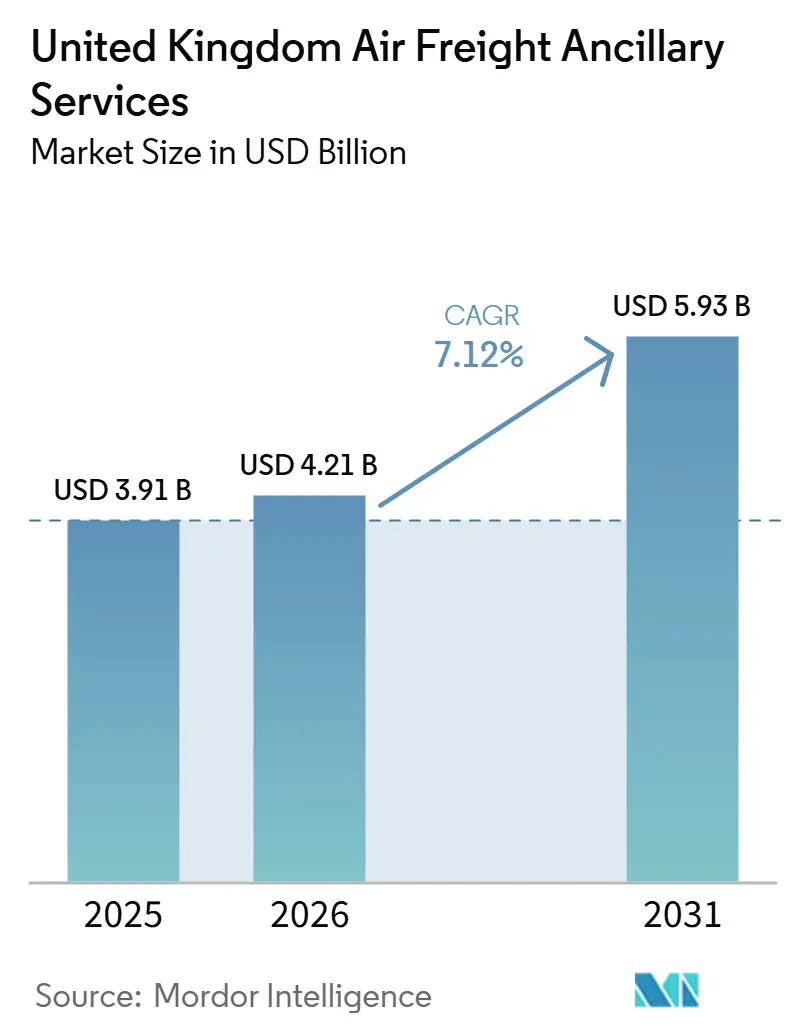
The United Kingdom air freight ancillary services market size was valued at USD 3.91 billion in 2025 and estimated to grow from USD 4.21 billion in 2026 to reach USD 5.93 billion by 2031, at a CAGR of 7.12% during the forecast period (2026-2031).
The United Kingdom air freight ancillary services market is holding up well, supported by recovering cargo activity, limited capacity at major hubs, and stronger demand for value-added services like cold chain handling, rapid processing, and shipment visibility. The market is gradually moving toward higher-margin services rather than relying only on freight volumes. Ongoing pressure on airport operations is encouraging investment in automation, digital tools, and off-airport support services. Sustainability and compliance requirements are also shaping service offerings. Overall, the outlook remains positive, with growth likely to be driven by time-critical, temperature-sensitive, and e-commerce-related shipments.
Key Report Takeaways
- By service type, temperature-controlled services held 32.46% of the United Kingdom air freight ancillary services market share in 2025 and are expected to expand at a CAGR of 8.49% through 2026-2031.
- By shipment type, international shipments accounted for 69.80% of the United Kingdom air freight ancillary services market size in 2025, and are expected to expand at a CAGR of 7.41% through 2026-2031.
- By industry vertical, e-commerce and retail accounted for 29.21% of the United Kingdom air freight ancillary services market share in 2025, while healthcare and technology are forecasted to record the fastest CAGR of 10.43% through 2031.
- By geography, England accounted for 72.47% of the United Kingdom air freight ancillary services market size in 2025 and is forecast to expand at a 8.38% CAGR through 2031.
Note: Market size and forecast figures in this report are generated using Mordor Intelligence’s proprietary estimation framework, updated with the latest available data and insights as of January 2026.
Insights and Trends of United Kingdom Air Freight Ancillary Services
Drivers Impact Analysis*
| Driver | (~) % Impact on CAGR Forecast | Geographic Relevance | Impact Timeline |
|---|---|---|---|
| Rising demand for time-critical air cargo handling | +1.2% | Global, concentrated at Heathrow and Stansted | Short term (≤ 2 years) |
| Growth of e-commerce air cargo and cross-border parcel flows | +1.5% | England, with spillover to Scotland | Short term (≤ 2 years) |
| Pharmaceutical and temperature-sensitive cargo compliance requirements | +1.3% | England and Scotland are linked to pharma clusters | Medium term (2-4 years) |
| Airlines and airports focus on yield-enhancing ancillary services | +0.9% | England, centered on Heathrow and Gatwick | Medium term (2-4 years) |
| Expansion of specialist cold chain packaging and chain-of-custody services | +0.8% | England, with gains in northern England and Scotland | Medium term (2-4 years) |
| Heathrow-centric demand for premium handling and expedited turnaround | +0.7% | England, especially Heathrow and Gatwick | Long term (≥ 4 years) |
| Source: Mordor Intelligence | |||
Rising Demand for Time-Critical Air Cargo Handling
United Kingdom air freight is moving further toward goods that cannot absorb delays, including advanced biologics, aerospace components, semiconductors, and just-in-time industrial inputs. Heathrow’s cargo volumes rose to 1.5 million tons in 2025, while cargo trade handled by the airport reached GBP 293 billion (USD 375 billion), which shows that value growth is outpacing tonnage growth. Heathrow also reported record handling days in December 2025, indicating strong concentration during peak windows and supporting premium pricing for rapid transfers and priority acceptance services. This operating pattern favors handlers that can combine fast physical processing with dependable digital tracking and space allocation. As a result, the United Kingdom air freight ancillary services market is seeing stronger demand for services that protect speed, visibility, and compliance within a constrained airport estate.
Growth Of E-Commerce, Air Cargo And Cross-Border Parcel Flows
E-commerce places a heavier service burden on the United Kingdom air freight ancillary services market because each parcel generates customs, labeling, returns, and tracking work that often rises faster than tonnage. Glasgow Prestwick has become a visible example of this shift, with Chinese e-commerce carriers using the airport’s 24/7, curfew-free operation and its scheduled links to mainland China to support parcel-heavy flows. The removal of the EU’s EUR 150 (USD 174) de minimis customs duty exemption from July 1, 2026, adds more compliance work for United Kingdom-to-Europe parcel movements, which directly supports customs brokerage and documentation services. Express hubs and regional handlers also benefit because parcel flows need faster scanning, sortation, and exception management than traditional consolidated cargo. This keeps e-commerce as the strongest short-term demand driver across the United Kingdom air freight ancillary services market.
Pharmaceutical And Temperature-Sensitive Cargo Compliance Requirements
Pharmaceutical cargo remains the most compliance-heavy part of the United Kingdom air freight ancillary services market. That burden is increasing as product formats shift toward biologics and cryogenic therapies. GDP requirements mean that forwarders, handlers, airlines, and delivery agents all need qualified processes, which narrows the field of providers that can serve regulated shipments. DHL expanded its dedicated cold chain airfreight network in February 2026 across more than 30 GDP-compliant aviation hubs, which supports tighter chain-of-custody control for pharmaceutical cargo. As cell and gene therapies scale, handlers are being pushed toward active temperature management and greater capital intensity, which strengthens the position of larger, better-funded operators in the United Kingdom air freight ancillary services market.
Airline And Airport Focus On Yield-Enhancing Ancillary Services
Airlines and airports are now shaping the United Kingdom air freight ancillary services market more actively by developing services that increase revenue per shipment rather than treating cargo support as a basic utility. Heathrow’s Air Cargo Community Advisory Body has focused on ULD handling, truck slot coordination, and cargo area planning, which shows that throughput value is a core operating goal[1]Source: British International Freight Association, “Air Cargo Community Advisory Body Focuses on ULD Handling at Heathrow in Latest Workshop,” British International Freight Association, bifa.org. IAG Cargo’s product structure, including CONSTANT CLIMATE and PRIORITY FRESH, shows how airlines are embedding specialized handling into core commercial offers. The April 2026 expansion of the DHL and IAG Cargo SAF partnership at Heathrow also points to a growing market for emissions documentation and verified sustainability-linked services. This strengthens pricing opportunities for providers that can pair physical cargo handling with auditable environmental and compliance records.
Restraints Impact Analysis*
| Restraint | (~) % Impact on CAGR Forecast | Geographic Relevance | Impact Timeline |
|---|---|---|---|
| Slot constraints and limited cargo capacity at key airports | -0.6% | England, concentrated at Heathrow | Long term (≥ 4 years) |
| High labor and compliance costs for security-critical handling | -0.5% | England and Wales, with a secondary United Kingdom impact | Medium term (2-4 years) |
| Customs complexity and documentation friction after Brexit | -0.7% | England and Northern Ireland, with spillover to Wales | Medium term (2-4 years) |
| Fragmented SME demand limits automation payback in smaller facilities | -0.4% | England, with a secondary impact in Scotland and Wales | Long term (≥ 4 years) |
| Source: Mordor Intelligence | |||
Slot Constraints And Limited Cargo Capacity At Key Airports
Heathrow is operating near full slot use, which creates a structural limit on how fast the United Kingdom air freight ancillary services market can add physical handling capacity. Heathrow’s approved third runway is expected to raise cargo capacity by 50% and add 3 million tons of annual throughput. Still, the related infrastructure program means the benefit is unlikely to arrive before the mid-2030s. In the meantime, established operators are paying heavily for scarce airport space, as shown by WFS signing a 20-year lease for a new 11,000 m² cargo facility at Heathrow. That space premium supports incumbent pricing power but also suppresses volume-led expansion, keeping entry barriers high for smaller service providers. This means near-term growth in the United Kingdom air freight ancillary services market depends more on value-added handling than on a broad rise in available throughput.
Customs Complexity And Documentation Friction After Brexit
Customs friction remains one of the most persistent restraints on the United Kingdom air freight ancillary services market because compliance mistakes in air freight have little room for correction before cargo misses its planned movement. Since January 31, 2025, safety and security declarations have been mandatory for goods entering Great Britain from the EU, expanding routine paperwork for operators handling cross-border traffic. From January 1, 2026, the EU’s ICS2 system became mandatory for all modes, adding another real-time filing layer for United Kingdom exporters sending goods into EU territory[2]Source: Globalior, “ICS2 Mandatory 2026, What UK Exporters Shipping to EU Need to Do,” Globalior, globalior.com. Large forwarders can absorb this with proprietary systems and sell compliance as a service, while smaller operators face higher outsourcing costs or client losses. The burden slows operational simplicity but also increases demand for specialist paperwork management within the United Kingdom air freight ancillary services market.
*Our forecasts treat driver/restraint impacts as directional, not additive. The impact forecasts reflect baseline growth, mix effects, and variable interactions.
Segment Analysis
By Service Type: Cold Chain Defines the Value Architecture of the Market
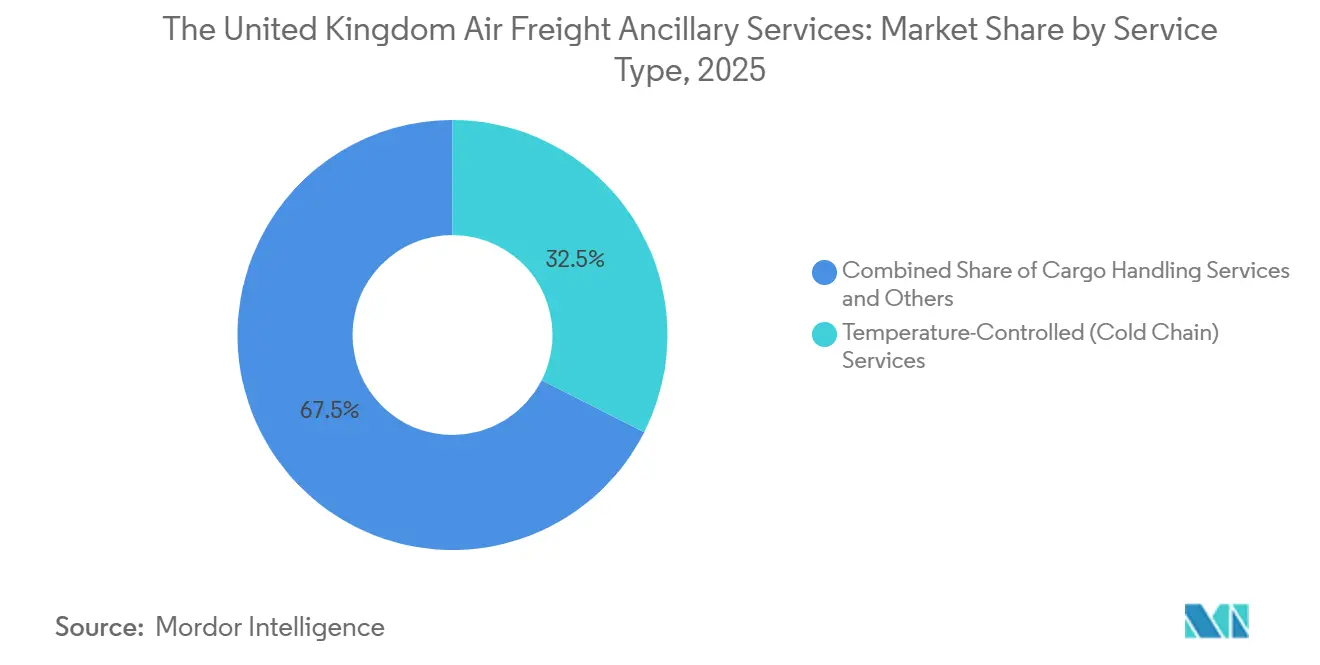
Temperature-controlled services held 32.46% of the United Kingdom air freight ancillary services market share in 2025 and are forecast to expand at a CAGR of 8.49% through 2031, making cold chain the segment that most clearly shapes investment priorities and service differentiation. Demand comes from 2 distinct streams: pharmaceutical cargo that requires tightly controlled temperature ranges, and perishables such as Scottish salmon, fresh produce, and dairy products that require rapid air handling. Swissport’s January 2026 launch of a 2,694 m² dedicated perishables center at Heathrow, with an annual target of 30,000 tons, shows how operators are deploying capital into specialized facilities rather than generic space. Its linked 3-year partnership with Scan Global Logistics also shows that long-term customer commitments are increasingly needed to justify infrastructure spending at constrained airports.
Cargo handling remains the next-largest revenue stream in the United Kingdom air freight ancillary services industry because Heathrow’s terminal network still relies on build-up, breakdown, transfer, and airside movement at scale. Packaging, labeling, insurance, and consolidation are smaller categories, but they are gaining importance as e-commerce creates more individual shipment events and raises the need for parcel-level intervention. Customs brokerage and documentation management are also becoming denser revenue streams because post-Brexit and ICS2 filing rules increase the amount of billable paperwork per shipment. Through 2031, service growth should continue to lean toward providers that can combine cold chain handling with compliant chain-of-custody and active temperature management.



By Shipment Type: International Flows Anchor the Revenue Base
International shipments accounted for 69.80% of the United Kingdom air freight ancillary services market size in 2025 and are forecasted to expand at a CAGR of 7.41% through 2031, which reflects the country’s strong dependence on non-EU air trade lanes for high-value cargo. More than 90% of Heathrow’s cargo trade by value is linked to non-EU countries, so international movements remain the main source of customs, security, insurance, and compliance work. Each international shipment also involves more service steps than a domestic movement because it may require customs entry, origin paperwork, health certification, and temperature monitoring during longer transit times. Parcel-heavy flows from China through Heathrow and Glasgow Prestwick increase this effect because ancillary revenue rises with shipment count as much as with weight.
Truck slot pre-booking and tighter cargo area coordination at Heathrow are improving handoff speed between airside and landside operations, which supports domestic handling efficiency. Even so, international traffic should maintain its structural lead, as new bilateral corridors and stricter customs rules continue to increase the service intensity of cross-border consignments within the United Kingdom air freight ancillary services industry. Domestic growth will therefore support the market, but international flows will remain the core revenue anchor through 2031.
By Industry Vertical: Healthcare Acceleration Reshapes the Value Hierarchy
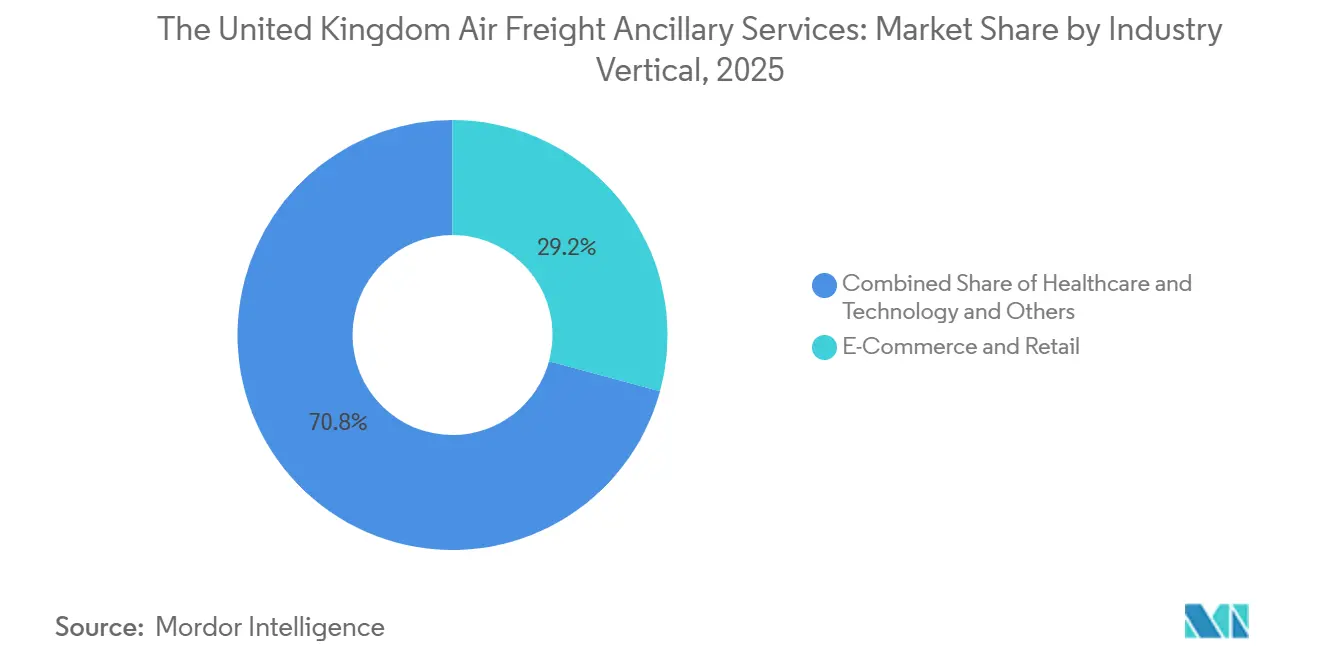
E-commerce and retail held the largest share by industry vertical at 29.21% in 2025, supported by direct-to-consumer imports from Asia and premium outbound retail shipments. Aerospace and defense continue to generate steady, high-margin work because urgent aircraft parts, dangerous goods, and oversized movements all need specialized handling and documentation. Automotive, consumer electronics, perishables, chemicals, and fashion each play a defined role because they require different mixes of security, temperature control, insurance, and rapid turnaround. Fashion and luxury are smaller in volume, but they still deliver high ancillary revenue per kilogram because speed, insurance, and careful handling all matter.
The United Kingdom air freight ancillary services market size for healthcare and technology is projected to expand at a 10.43% CAGR through 2031, making it the fastest-growing vertical in the market. Demand is supported by biologics procurement, clinical trial logistics, and urgent handling needs that require GDP-compliant movement across multiple parties. Geodis underlined this direction by opening a GDP- and WDA-compliant temperature-controlled pharmaceutical warehouse near Manchester Airport in June 2026 with 2,000 pallet positions and multiple ISO certifications[3]Source: GEODIS, “GEODIS to Enhance Its Pharmaceutical Logistics Capabilities and Move into a New Temperature-Controlled, GDP-Compliant Warehouse in Manchester,” GEODIS, geodis.com. This kind of investment could gradually spread certified pharma handling beyond Heathrow and widen the service base of the United Kingdom air freight ancillary services industry.
Geography Analysis
England held 72.47% of the United Kingdom air freight ancillary services market share in 2025 and is forecast to expand at 8.38% CAGR through 2031. Heathrow remains the primary driver of that lead because it handled GBP 293 billion (USD 375 billion) of goods in 2025 and accounted for around 75% of United Kingdom air cargo by value. February 2026 cargo volumes at Heathrow rose 4% year over year, even with fewer dedicated freighter movements, which shows how bellyhold capacity is carrying a larger share of complex handling work. England’s network also includes the East Midlands and Stansted, which widens the market for express freight and mid-market forwarding. Even with that breadth, short-term growth still depends more on yield per ton than on major throughput expansion because Heathrow’s slot constraints remain severe.
Scotland is emerging as the fastest-changing regional part of the United Kingdom air freight ancillary services market as Glasgow Prestwick builds scheduled freight links with China and positions itself around e-commerce and specialist exports[4]Source: Glasgow Prestwick Airport, “Glasgow Prestwick Airport Celebrates One Year of China Southern Air Logistics Services,” Meantime Communications, meantime. global. Its 24/7 operation, free of curfew restrictions, gives it a scheduling advantage for overnight and time-sensitive cargo that does not fit easily within Heathrow’s operating limits. Prestwick has also highlighted cold-chain investment for salmon and pharmaceutical exports, indicating that the region is developing deeper ancillary capabilities rather than acting only as a transit node. The airport now handles 15 scheduled weekly services to mainland China, with cross-border trade expected to reach GBP 250 million (USD 320 million) in 2026.
Wales and Northern Ireland account for a smaller share of revenue in 2025, but both have clearer niche roles than their current scale suggests. Cardiff is benefiting from new freight activity linked to reshoring and e-commerce redistribution, providing Wales with a base for gradual ancillary service development. Northern Ireland stands out because the Windsor Framework leaves EU-facing movements under single-market rules, while Great Britain-facing flows are subject to United Kingdom customs requirements. That dual system creates a specific opening for customs brokerage, dual-labeling support, and compliance services that can handle EU and United Kingdom standards simultaneously.
Competitive Landscape
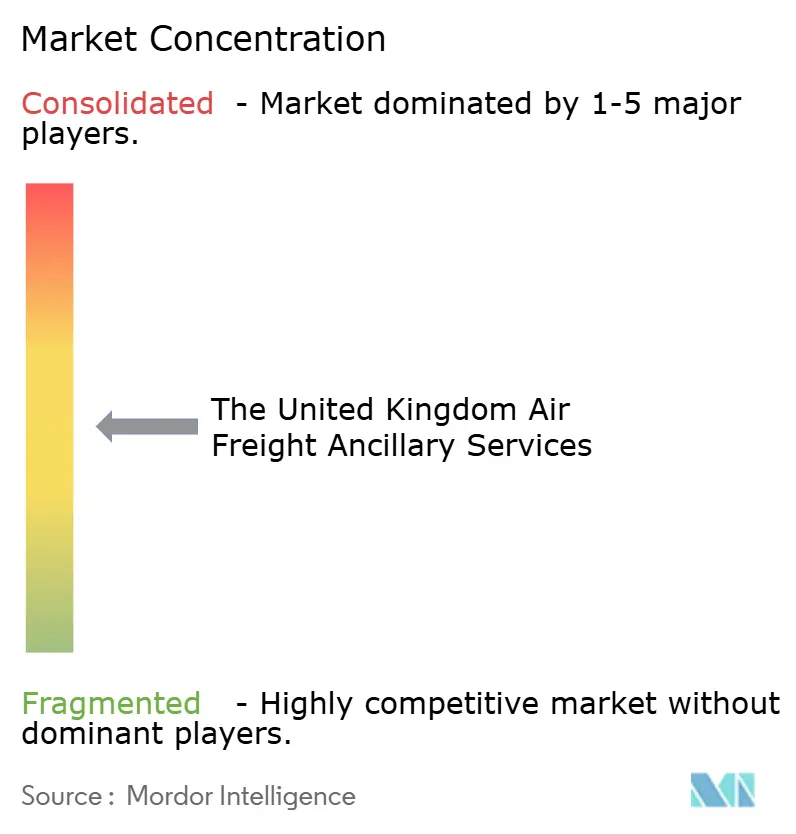
The United Kingdom air freight ancillary services market is moderately fragmented in daily operations. Still, it is consolidating in strategic control as large forwarders and major handlers deepen their positions around Heathrow and other leading airports. DHL Global Forwarding, Kuehne + Nagel, DSV, and CEVA use scale in forwarding volumes to bundle handling, documentation, cold chain, and insurance under broader customer contracts. Swissport, Menzies Aviation, and dnata compete more directly in physical processing, where slot access, facility quality, and certification matter most. The line between these groups is narrowing because forwarders want greater control over handling, and handlers want greater control over documentation and service packaging. This is making the United Kingdom air freight ancillary services market more competitive around integrated offers than around standalone airport services.
Recent strategic moves show how providers are building that integration. Swissport signed binding agreements in July 2025 to acquire ASC, adding Heathrow and Gatwick cargo assets and strengthening its London coverage. Menzies integrated Air Menzies International into its Cargo division in 2025, creating a single global cargo platform that combined wholesale forwarding, e-commerce, and charter capabilities with airport operations. Geodis expanded its certified pharmaceutical capacity in June 2026 through its new temperature-controlled warehouse near Manchester Airport, strengthening its position in regulated healthcare logistics. Swissport also added EMIS-enabled screening capability at its Heathrow perishables center, improving security processing for dense palletized cargo and making it difficult for smaller players to match quickly.
Certification remains a major moat because regulated agents and GDP-aligned operators can accept cargo streams that non-certified competitors cannot handle at the same commercial standard. There is still room for focused providers in mid-market pharmaceutical documentation, Northern Ireland dual-compliance brokerage, and automated returns handling for parcel-heavy e-commerce flows. Sustainability-linked documentation and digital visibility are also becoming more relevant, as large shippers increasingly seek verified handling and emissions records for cargo movements. Overall, the United Kingdom air freight ancillary services market is likely to remain balanced between global-scale providers and specialists that hold airport access, deep compliance, or service expertise in narrow but valuable cargo niches.
Leaders of United Kingdom Air Freight Ancillary Services
DHL
Kuehne + Nagel International AG
Menzies Aviation
Swissport International Ltd.
dnata
- *Disclaimer: Major Players sorted in no particular order

Recent Industry Developments
- May 2026: Geodis opened a temperature-controlled, GDP- and WDA-compliant pharmaceutical warehouse near Manchester Airport, offering 2,000 pallet positions across chilled (2-8 °C) and controlled room-temperature (15-25 °C) zones, with 24/7 alert monitoring and a validated WMS.
- April 2026: CEVA Logistics introduced 165 new DAF trucks across its United Kingdom transport network, completing a fully HVO-powered United Kingdom ground and rail fleet under its FORPLANET sustainability program. CEVA Logistics reported revenues of USD 18.3 billion in 2025 as part of the CMA CGM Group.
- July 2025: Swissport International signed binding transaction agreements to acquire ASC, the ground and cargo handler operating at London Heathrow and Gatwick airports. The acquisition added two Heathrow cargo warehouses and expanded Swissport's ground handling capability at both London hubs, deepening its coverage of the roughly 60% of United Kingdom air freight that moves through London's airports.
- February 2025: Menzies Aviation secured a three-year contract with Air India to provide ground handling and cargo services at eight locations across four continents, including London Heathrow.


Scope of Report on United Kingdom Air Freight Ancillary Services
| Cargo Handling Services |
| Cargo Consolidation Services |
| Packaging and Labeling Services |
| Cargo Insurance Services |
| Temperature-Controlled (Cold Chain) Services |
| Other Services |
| Domestic Shipments |
| International Shipments |
| Aerospace and Defense |
| Consumer Electronics |
| Automotive and Industrial Manufacturing |
| E-commerce and Retail |
| Healthcare and Technology |
| Food and Beverage (Perishables) |
| Chemicals and Hazardous Materials |
| Fashion and Luxury Goods |
| Others |
| England |
| Scotland |
| Wales |
| Northern Ireland |
| By Service Type | Cargo Handling Services |
| Cargo Consolidation Services | |
| Packaging and Labeling Services | |
| Cargo Insurance Services | |
| Temperature-Controlled (Cold Chain) Services | |
| Other Services | |
| By Shipment Type | Domestic Shipments |
| International Shipments | |
| By Industry Vertical | Aerospace and Defense |
| Consumer Electronics | |
| Automotive and Industrial Manufacturing | |
| E-commerce and Retail | |
| Healthcare and Technology | |
| Food and Beverage (Perishables) | |
| Chemicals and Hazardous Materials | |
| Fashion and Luxury Goods | |
| Others | |
| By Geography | England |
| Scotland | |
| Wales | |
| Northern Ireland |


Key Questions Answered in the Report
What is the 2031 value forecast for the United Kingdom air freight ancillary services?
The market is forecast to reach USD 5.93 billion by 2031, rising from USD 4.21 billion in 2026 at a 7.12% CAGR.
Which service category generates the most revenue in the United Kingdom air freight ancillary services space?
Temperature-controlled services led in 2025 with a 32.46% share, supported by pharmaceutical and perishables demand.
Why do international shipments matter more than domestic movements in this sector?
International shipments held 69.80% share in 2025 because they generate more customs, security, insurance, and documentation work per consignment.
Which end-user vertical is growing fastest through 2031?
Healthcare and technology are the fastest-growing verticals, with a forecast CAGR of 10.43% through 2031.
Which part of the United Kingdom leads this business today?
England led with a 72.47% share in 2025 and is projected to grow at an 8.38% CAGR through 2031, driven mainly by Heathrow and other large cargo airports.
What is the main constraint on future expansion?
Heathrow slot scarcity and stricter post-Brexit and ICS2 compliance requirements are the main constraints, as they raise costs and limit rapid capacity additions.
Page last updated on:





