
United Arab Emirates Wire and Cable Market Size and Share
Market Overview
| Study Period | 2020 - 2031 |
|---|---|
| Forecast Data Period | 2026 - 2031 |
| Base Year Market Size (2025) | USD 1.05 Billion |
| Market Size (2026) | USD 1.09 Billion |
| Market Size (2031) | USD 1.32 Billion |
| Growth Rate (2026 - 2031) | 3.90 % |
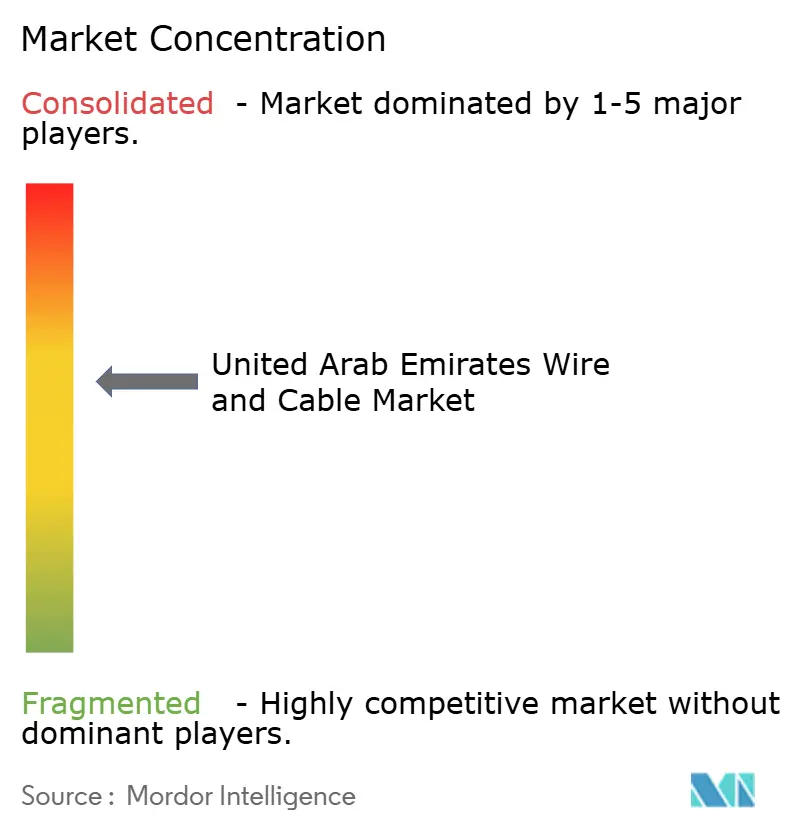
| Market Concentration | Medium |
Major Players *Disclaimer: Major Players sorted in no particular order Image © Mordor Intelligence. Reuse requires attribution under CC BY 4.0. | |
United Arab Emirates Wire and Cable Market Analysis by Mordor Intelligence
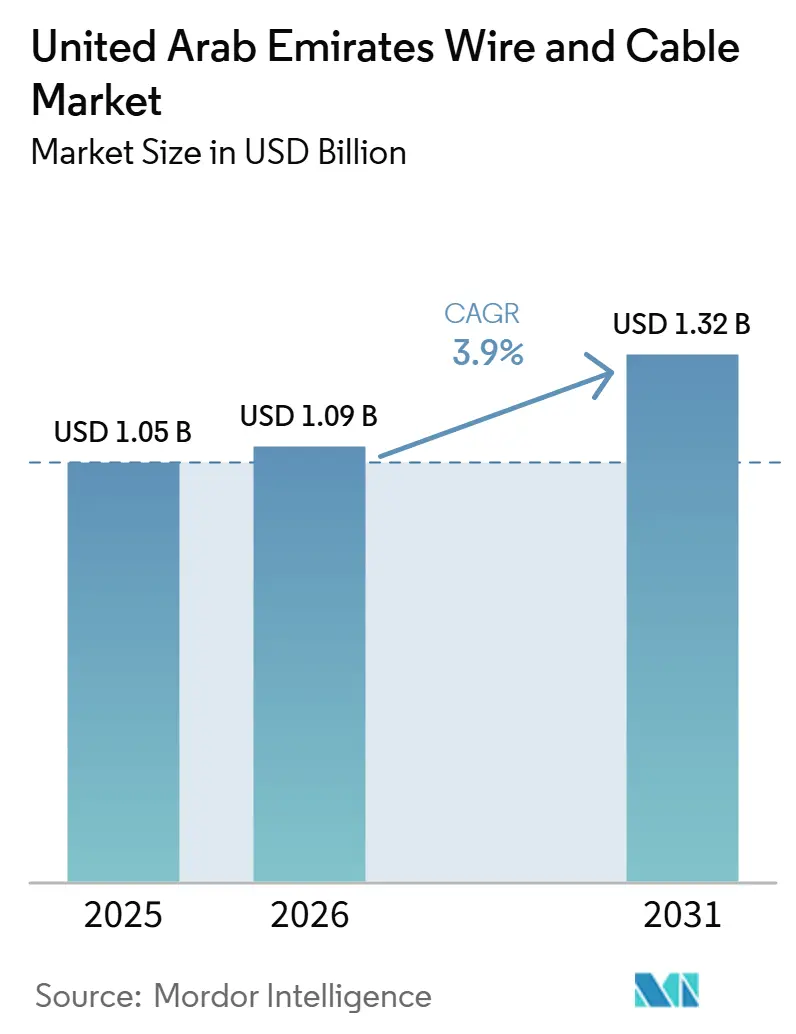
The United Arab Emirates wire and cable market size is expected to grow from USD 1.05 billion in 2025 to USD 1.09 billion in 2026 and is forecast to reach USD 1.32 billion by 2031 at 3.9% CAGR over 2026-2031. Electricity transmission expansion, renewable power projects, storage facilities, construction activity, and data infrastructure are supporting demand. These demand streams are occurring at the same time, which supports purchases of both standard building products and specialized cables, while also increasing the need for cable accessories, testing services, installation capability, technical documentation, and reliable delivery schedules across projects with very different operating requirements, from large utility connections and offshore systems to commercial buildings, transport networks, renewable facilities, charging sites, and data-intensive campuses. Suppliers with approved products, local testing capabilities, and experience in utility work are likely to be better placed in higher-value tenders, where detailed product qualification, system testing, installation support, and an established record of meeting local requirements can influence final supplier selection. Copper and aluminum price changes, along with tender-led competition, remain important factors for project margins and procurement decisions, because manufacturers and buyers must balance technical compliance, delivery security, product availability, and cost exposure throughout long project schedules, including the practical need to align bids, raw-material purchasing, fabrication capacity, logistics, installation timing, testing, and project acceptance requirements.
Key Report Takeaways
- By voltage, low-voltage cables held 47.65% of revenue share in the United Arab Emirates wire and cable market in 2025, while extra- and high-voltage cables are projected to expand at a CAGR of 5.18% through 2031.
- By cable type, power cables held 67.42% of revenue share in the United Arab Emirates wire and cable market in 2025, while fiber-optic cables are expected to expand at a CAGR of 5.54% through 2031.
- By conductor material, copper cables accounted for 56.84% of revenue share in the United Arab Emirates wire and cable market in 2025, while optical glass/polymer cables are projected to grow at a CAGR of 5.71% through 2031.
- By installation, underground cables accounted for 63.18% of revenue share in the United Arab Emirates wire and cable market in 2025, while submarine cables are expected to grow at a CAGR of 4.82% through 2031.
- By end-user vertical, commercial construction accounted for 23.76% of revenue share in the United Arab Emirates wire and cable market in 2025, while telecommunications and data centers are projected to expand at a CAGR of 5.93% through 2031.
- By insulation, insulated cables held 92.64% of revenue share in the United Arab Emirates wire and cable market in 2025 and are expected to grow at a CAGR of 4.07% through 2031.
Note: Market size and forecast figures in this report are generated using Mordor Intelligence’s proprietary estimation framework, updated with the latest available data and insights as of January 2026.
United Arab Emirates Wire and Cable Market Trends and Insights
Drivers Impact Analysis*
| Driver | (~) % Impact on CAGR Forecast | Geographic Relevance | Impact Timeline |
|---|---|---|---|
| Government-Led Transmission and Distribution Expansion | +1.2% | Dubai and Abu Dhabi core, with spillover to Sharjah and Northern Emirates | Long term (≥ 4 years) |
| Renewable Energy and Grid-Storage Build-Out | +0.9% | Abu Dhabi and Dubai | Medium term (2-4 years) |
| Construction, Transport, and Urban Development Pipeline | +0.8% | Dubai and Abu Dhabi primary, Sharjah and Ajman secondary | Medium term (2-4 years) |
| Data Center and Artificial Intelligence Infrastructure Expansion | +0.7% | Abu Dhabi and Dubai | Short term (≤ 2 years) |
| Offshore Electrification of Oil and Gas Assets | +0.4% | Abu Dhabi offshore assets and ADNOC concessions | Long term (≥ 4 years) |
| Electric Vehicle Charging Network Expansion | +0.3% | UAE, with early concentration in Dubai and Abu Dhabi highway corridors | Short term (≤ 2 years) |
| Source: Mordor Intelligence | |||
Government-Led Transmission and Distribution Expansion
Dubai’s transmission program is creating sustained demand for 132 kV and 400 kV systems. DEWA reported cumulative transmission investment of AED 10.2 billion (USD 2.72 billion) and planned additional substations and underground cable connections. The program includes long cable routes that support multi-year procurement rather than isolated purchases, because each substation connection requires cables, accessories, civil coordination, testing, protection interfaces, and installation services that must be sequenced carefully with wider grid development and the planned energization of new capacity. Underground installations require products designed for high ambient temperatures and established installation practices. This favors suppliers that meet DEWA technical requirements and can provide certified XLPE-insulated systems. Parallel utility procurement in Abu Dhabi and the Northern Emirates broadens the addressable UAE wire and cable market beyond Dubai, while distinct approval processes make local product records, installation support, and the ability to respond to detailed technical requests important during supplier selection.[1]Dubai Electricity and Water Authority, “DEWA Accelerates Dubai’s Shift to Sustainable Mobility by Expanding EV Green Charger Network,” Dubai Electricity and Water Authority, dewa.gov.ae
Renewable Energy and Grid-Storage Build-Out
Renewable generation and energy storage projects require multiple cable categories across a single site. Solar arrays need direct-current collection systems, while battery facilities need connection cables and high-voltage links to the grid. The 5.2 GW solar and 19 GWh storage project in Abu Dhabi is an important example of this combined requirement. Its development creates demand for medium-voltage, high-voltage, and control products across a large desert site, where developers must connect generation areas, inverters, transformers, battery equipment, monitoring systems, and grid export facilities while addressing heat, distance, dust, construction access, and the need for dependable system performance. The UAE Energy Strategy 2050 and the expansion of the Mohammed bin Rashid Al Maktoum Solar Park point to additional utility connections over time, which will require developers and utilities to coordinate collection networks, substation capacity, protection equipment, transmission routes, and the related cable systems needed to move electricity safely from generation sites into the national grid. These projects support the UAE wire and cable market because cables are needed from early construction through grid commissioning, including array connections, inverter links, battery cabling, protection circuits, transformer connections, and long-distance evacuation routes that must perform reliably in desert operating conditions, with designs that address route length, thermal loading, equipment interfaces, maintenance needs, and the staged delivery of major generation and storage assets.
Construction, Transport, and Urban Development Pipeline
Public infrastructure and large private developments continue to support demand for building and utility cables. Abu Dhabi announced AED 55 billion (USD 15 billion) in public-private partnership projects for 2026 and 2027. Road schemes, flood infrastructure, public facilities, commercial districts, and industrial upgrades require power, signaling, and communications systems. Dubai’s financial district expansion and Silicon Oasis upgrade also require low-voltage wiring, medium-voltage distribution, control cables, and structured cabling. Metro development adds demand for traction power, tunnel safety, and signaling products, with underground routes requiring carefully specified cables for stations, trackside systems, emergency functions, lighting, communications, and operational control that can continue to perform under the safety conditions defined for a major public transport network. This broad project base reduces reliance on any single construction category within the UAE wire and cable market, because each scheme calls for a different combination of building wire, distribution products, communication systems, fire-rated cables, and equipment connections across its design and delivery phases, and it spreads demand across project owners, contractors, engineering firms, and specialist installers that can use standard products and technically supported cable systems for complex infrastructure work.
Data Center and Artificial Intelligence Infrastructure Expansion
Data center construction is increasing the demand for both power and fiber infrastructure. Stargate UAE in Abu Dhabi has a planned 5 GW capacity and a first phase of 200 MW, targeted for completion in Q3 2026. Data centers need medium-voltage feeds, dense internal power distribution, cooling controls, and high-capacity optical links. The shift toward liquid-cooled AI equipment increases the need for dependable power distribution and control wiring, as facility operators must coordinate energy delivery, cooling controls, backup systems, racks, and high-speed network links in an environment where downtime, heat management, and equipment reliability are central operating concerns. Microsoft, G42, and Khazna Data Centers have also announced capacity plans that extend this demand base. Prysmian’s digital solutions agreements and planned optical capacity investment show that global suppliers are allocating more resources to data infrastructure, where product selection is shaped by power density, cooling design, network resilience, upgrade flexibility, and the need to keep critical services operating without interruption.[2]Prysmian, “Digital Solutions,” Prysmian, prysmian.com
Restraints Impact Analysis*
| Restraint | (~) % Impact on CAGR Forecast | Geographic Relevance | Impact Timeline |
|---|---|---|---|
| Copper and Aluminum Price Volatility | -0.6% | Global, with direct pass-through to United Arab Emirates pricing and margins | Short term (≤ 2 years) |
| Tender-Centric Price Competition and Margin Compression | -0.4% | United Arab Emirates, most acute in Dubai and Abu Dhabi utility tenders | Medium term (2-4 years) |
| Extreme Ambient Heat and Derating Requirements | -0.2% | United Arab Emirates, most acute for outdoor and above-ground installations | Long term (≥ 4 years) |
| Fragmented Utility Approvals and Specification Lock-In | -0.1% | United Arab Emirates, with separate DEWA, ADDC, and FEWA systems | Medium term (2-4 years) |
| Source: Mordor Intelligence | |||
Copper and Aluminum Price Volatility
Copper and aluminum account for a large share of cable manufacturing costs, making commodity movements a direct margin risk. Copper traded between USD 12,434 and USD 14,527 per ton during 2026, while aluminum prices also changed sharply. Fixed-price supply contracts can therefore become less profitable when metal costs rise after bid submission. The copper-to-aluminum price relationship has also encouraged buyers to assess conductor substitution. However, underground installations and utility specifications can limit switching opportunities in the UAE. Manufacturers with metal hedging, flexible purchasing arrangements, and adjustment clauses are better able to manage this constraint, since they can align procurement more closely with delivery schedules and avoid bearing the full cost of sudden commodity price changes on fixed-price orders.
Tender-Centric Price Competition and Margin Compression
Government and utility tenders often place significant weight on price after technical approval. This approach increases competition among local, regional, and international suppliers. Producers from Saudi Arabia and Egypt can exert price pressure on commodity cable categories due to their regional manufacturing positions. Long approval and award cycles can expose suppliers to price changes in materials between quotation and delivery. Some buyers are moving toward pricing linked to the London Metal Exchange plus a fixed processing charge. The adoption of these clauses remains uneven, so margin exposure continues to affect the UAE wire and cable market, particularly where tender documents require firm prices, long delivery periods, and tightly defined specifications that offer limited scope for material or design changes after award.
*Our forecasts treat driver/restraint impacts as directional, not additive. The impact forecasts reflect baseline growth, mix effects, and variable interactions.
Segment Analysis
By Voltage: High-Voltage Grid Work Reshapes Demand Structure
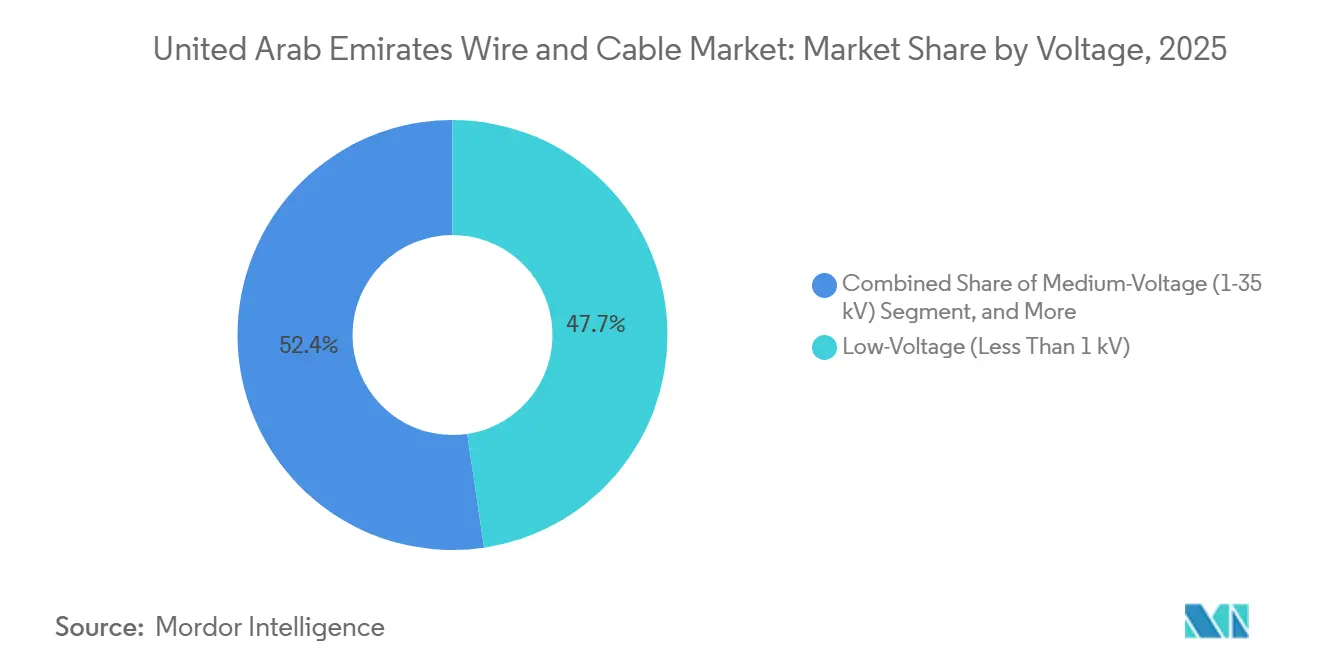
Low-voltage cables accounted for 47.65% of the UAE wire and cable market in 2025, supported by demand for commercial and residential wiring. These products are used throughout buildings, retail sites, hospitality projects, and smaller distribution networks. Their volume reflects the scale of ongoing urban construction across the country. Medium-voltage cables serve industrial areas, utility feeders, solar facilities, and larger commercial developments. Jebel Ali, Ruwais, and Khalifa Industrial Zone are examples of locations that need these distribution systems. The category also links photovoltaic arrays to central equipment within solar developments. Demand across these voltage classes gives suppliers a broad base of construction and industrial business, with product requirements changing by site size, load profile, installation location, safety standards, and the level of testing required before the electrical system can be energized.
Extra- and high-voltage cables are projected to grow at a CAGR of 5.18% through 2031. The UAE wire and cable market size for this class is supported by utility reinforcement and renewable energy connections. New 132 kV substations, planned 400 kV facilities, and underground transmission routes require specialized insulation and jointing. These cables must undergo extensive factory and system testing before they can be installed, and their procurement commonly involves a detailed review of conductor design, insulation performance, accessories, route conditions, thermal ratings, and installation procedures that are not normally required for ordinary building wiring. Ducab completed an extended prequalification test for a 400 kV extra-high-voltage system rated at 105°C in February 2026. The test was aligned with IEEE, IEC, and AEIC standards and strengthens domestic technical capability. This progress may help qualified local suppliers compete for work that previously favored established European producers, especially when tender evaluations consider approved technical performance, local service availability, the ability to support jointing and testing, and a record of delivery in demanding utility environments.



By Cable Type: Fiber-Optic Infrastructure Pulls Alongside Power in Growth Rate
Power cables held 67.42% of the UAE wire and cable market in 2025. They remain essential for transmission, distribution, building wiring, industrial power supply, and renewable projects. This position reflects the importance of electricity infrastructure across all major end-user categories. Signal and control cables support automation, oil and gas instrumentation, and building management systems. Coaxial and data cables continue to serve selected broadband and video applications. Fiber connections are gradually replacing some legacy communications installations, particularly where owners need higher bandwidth, more dependable connections, shorter response times, and a network architecture that can support cloud services, automated systems, video traffic, and the expansion of connected equipment. The cable type mix, therefore, combines a large power requirement with a growing need for digital links, as developers seek integrated electrical, automation, security, building management, and communications systems that can support increasingly connected commercial and industrial assets.
Fiber-optic cables are projected to expand at a CAGR of 5.54% through 2031. Hyperscale facilities require high-capacity inter-rack and campus fiber connections with low latency. Subsea landing systems also increase the need for fiber systems on the UAE coast. du partnered with Datawave Networks in February 2026 to land the Singapore-India-Gulf system at Kalba. Ooredoo and du also announced plans to deploy the Fiber in the Gulf system, which is designed to deliver 720 Tbps across 24 fiber pairs. Ducab introduced a high-voltage fiber-optic cable in Dubai in 2025, combining electrical transmission and optical communication in a single design. This approach supports smart-grid sensing and data transfer when separate cable routes are impractical, and it may reduce installation complexity in projects that require real-time network monitoring, communications resilience, and reliable transmission capacity within constrained physical corridors.[3]Ooredoo, “Ooredoo Group and du to Land FIG Subsea Cable in the UAE,” Ooredoo, ooredoo.com
By Conductor Material: Optical Fiber Leads Growth as Copper Holds Structural Lead
Copper cables accounted for 56.84% of the UAE wire and cable market in 2025. Copper retains a strong role because of its conductivity and broad acceptance in established utility and building specifications. It is widely used in building wiring, industrial applications, and many distribution systems. Aluminum remains important for medium-voltage and high-voltage lines, where lower weight and material cost can be useful. Buyers are reviewing substitution options as the copper-to-aluminum price ratio remains elevated. The UAE’s reliance on underground networks limits the scope for broad substitution in some applications, since cable selection must also consider space constraints, jointing requirements, heat dissipation, existing network practices, and the performance expectations established by utilities and engineering consultants. Existing code requirements also support continued copper use in many projects, particularly where established wiring practices, equipment interfaces, safety requirements, and performance expectations have been designed around copper conductors and cannot be changed without further engineering review.
Optical glass and polymer cables are projected to grow at a CAGR of 5.71% through 2031. Demand comes from data centers, subsea landing systems, smart infrastructure, and 5G backhaul networks. This material category supports the communications layer of the UAE wire and cable market. Prysmian announced a EUR 1.25 billion (USD 1.35 billion at the 2025 IRS average rate of 1.08) investment in capacity for optical cable and fiber preform production through 2031. The investment indicates that global capacity is being directed toward large data infrastructure programs. UAE distributors without long-term supply arrangements may face selective availability pressure, especially when large global data infrastructure programs reserve fiber and preform capacity, leaving smaller buyers with fewer procurement options and less flexibility over delivery schedules, product configurations, and commercial terms. IEC 60794 provides an international technical framework for fiber-optic cable specifications used in telecom and utility applications, helping purchasers evaluate characteristics such as mechanical protection, environmental resistance, handling performance, and suitability for the specific route and network architecture involved.
By Installation: Underground Dominance Deepens While Submarine Segment Accelerates
Underground cables held 63.18% of the UAE wire and cable market in 2025. Urban design preferences and utility regulations favor buried systems in cities and major developments. Below-grade routes can also help protect cables from high surface temperatures. DEWA uses underground connections for new 132 kV and 400 kV substation projects in Dubai. These installations require careful thermal design, coordination with civil works, and specialized joints. Overhead cables have a smaller role in inter-emirate corridors and rural distribution, where their lower installation cost can be relevant, but exposure to weather, visual considerations, route availability, and the need for clearances shape their use differently from dense urban networks. The installation mix therefore supports steady demand for underground systems and associated accessories, including joints, terminations, ducts, protective systems, and monitoring components that are necessary to complete reliable cable routes in dense urban settings.
Submarine cables are projected to expand at a CAGR of 4.82% through 2031. Offshore energy development and subsea data connectivity are the 2 principal demand sources. ADNOC completed laying 1,000 km of high-voltage direct current cables for Project Lightning in January 2025. The program connects Das Island and Zakum Island to Abu Dhabi’s onshore grid through 2 subsea links of more than 130 km and a combined 3.2 GW capacity. Prysmian supplied high-voltage direct-current cables under a contract valued at EUR 220 million (USD 232 million) at the 2022 IRS average rate of 1.054. These projects illustrate the high technical threshold and large contract values in offshore cable work, where suppliers must manage detailed design, marine installation planning, specialist testing, coordination with offshore facilities, and long-term performance obligations in demanding operating conditions.
By End-User Vertical: Telecom and Data Centers Emerge as the Growth Engine
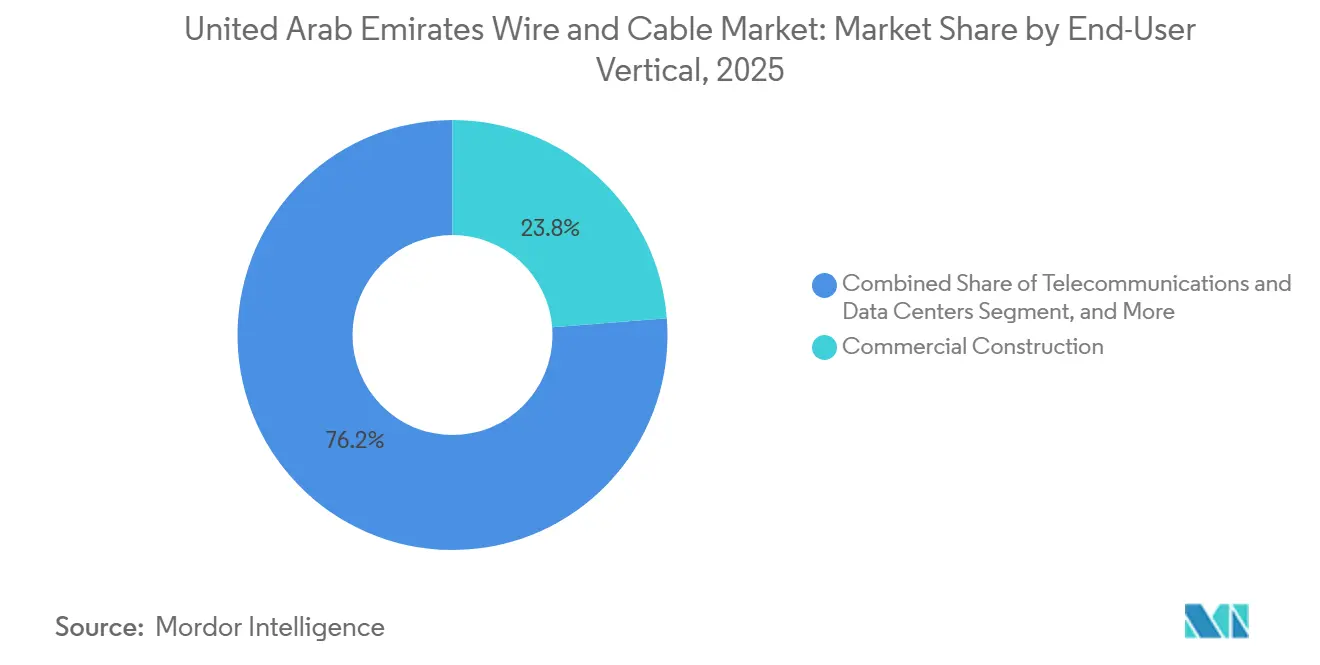
Commercial construction accounted for 23.76% of the UAE wire and cable market in 2025. Office, retail, hospitality, and mixed-use projects in Dubai and Abu Dhabi supported this position. These developments need standard building wire, fire-resistant products, control cables, and structured data cabling. Commercial projects also create replacement demand as tenants revise layouts and building systems. Power infrastructure provides another important demand source through transmission and renewable projects, where cable systems link generation assets, substations, storage equipment, and end users, and where projects often require specialized products that can operate reliably over long routes and under demanding site conditions. Oil and gas facilities require power, instrumentation, and control products for new and replacement work. Residential construction, automotive charging, and industrial manufacturing also contribute to cable consumption, adding recurring demand for building wire, distribution products, control systems, equipment connections, and upgrades as new assets are built and existing facilities are expanded.
Telecommunications and data centers are projected to expand at a 5.93% CAGR through 2031. The sector requires power distribution, fiber interconnects, network control cable, and high-specification internal systems. AI-focused facilities raise the performance requirements for power density, cooling controls, and optical throughput. MESC secured a USD 46.6 million contract in June 2026 for low-voltage power and communication cables for ADNOC’s Lower Zakum development. ADNOC Distribution also launched a 60-point superfast charging hub in January 2026 and announced plans for 20 highway hubs by the end of 2027. These hubs require medium-voltage feeders, low-voltage distribution systems, charging cables, protection equipment, controls, communications links, and site infrastructure to support safe operation and customer access along major travel corridors.
By Insulation: Insulated Cables Dominate as Safety Codes Tighten
Insulated cables held 92.64% of the UAE wire and cable market in 2025. Electrical insulation is required across most building, utility, industrial, and communications applications. This broad requirement explains the dominant position of insulated products. Low-smoke, zero-halogen, and fire-resistant cable systems are particularly relevant in enclosed public areas. They are used where smoke reduction, flame performance, and halogen limits are important safety considerations. Non-insulated conductors are mainly used for overhead lines and earthing applications, where clearance, routing, and exposure conditions allow their use and where the operating environment differs substantially from enclosed buildings, underground utilities, and systems that require direct contact protection. Their use is more limited because these applications depend on clearance distances and open installation environments.
Insulated cables are projected to grow at a CAGR of 4.07% through 2031. The UAE wire and cable market is benefiting from greater use of higher-specification products in commercial and mixed-use buildings. IEC 60332 addresses flame propagation, while IEC 60754 covers halogen-related requirements. DEWA and Abu Dhabi Civil Defense specifications increasingly favor low-smoke, zero-halogen systems for tunnels, enclosed spaces, and dense buildings. This can limit the use of lower-cost PVC products in specified projects, particularly when design teams and authorities require products with documented smoke, flame, and halogen performance for public buildings, transport facilities, high-rise developments, and other locations with demanding occupant-safety requirements. Suppliers with certified products and documented test performance can secure approval before the tender stage. Such approvals can remain important throughout procurement and installation, because project teams often require clear documentation for product selection, safety review, installation methods, test results, and final acceptance before systems are placed into service.
Geography Analysis
Abu Dhabi is the largest concentration of cable-intensive capital activity in the UAE. Offshore oil and gas projects, utility-scale renewables, storage development, and data facilities support demand across several cable categories. The 5.2 GW solar and 19 GWh storage project in Al Dhafra requires collection, battery connection, and grid evacuation cables. ADNOC’s offshore electrification work also supports demand for submarine and high-voltage products. Project Lightning connected offshore facilities to the onshore grid and established a major reference for high-voltage direct current systems. The UAE wire and cable market in Abu Dhabi is also supported by a public-private partnership pipeline of AED 55 billion (USD 15 billion) for 2026 and 2027. Large projects in the emirate often use technically detailed tender requirements, which means suppliers must demonstrate appropriate cable designs, suitable insulation systems, reliable accessories, installation support, test documentation, and familiarity with the conditions applicable to large energy, utility, and offshore works.
Dubai provides a broad and continuing demand from construction, transmission projects, metro development, commercial districts, and data centers. DEWA awarded AED 3 billion (USD 817 million) in contracts for 132 kV cable extensions across 21 substation projects in the first half of 2026. These projects covered 64 km of cable extensions across several districts. The DIFC expansion and Dubai Silicon Oasis upgrade will require building wire, distribution cables, structured cabling, and data connections. The Blue Line and Gold Line will also require traction power, signaling, and fire-rated tunnel products. Dubai’s concentration of data centers and submarine fiber landing activity adds a separate communications requirement. This diversified project base gives the emirate the broadest mix of cable end uses, ranging from standard building connections and public infrastructure to transmission work, complex transport systems, digital facilities, and communications networks that require different technical standards and procurement practices.
Sharjah, Ajman, Ras Al Khaimah, Fujairah, and Umm Al Quwain form a smaller but growing source of demand. Industrial parks, residential developments, ports, logistics facilities, and energy assets support the purchase of medium-voltage and control cables. Sharjah’s AED 500 million (USD 136 million) conference project and Ajman’s Masfout Gate initiative indicate broader infrastructure activity. Fujairah also acts as a secondary point for subsea connectivity and port-related systems. Ras Al Khaimah’s industrial zones require power and control products for manufacturing operations. FEWA maintains its own qualified vendor lists for electricity procurement in these emirates. Suppliers seeking countrywide coverage must therefore manage separate approval and compliance requirements, maintain relationships with different utilities and project owners, and ensure that their products, technical documents, installation support, and service arrangements meet the needs of each emirate.
Competitive Landscape
The UAE wire and cable market is moderately consolidated among 5 to 6 established suppliers at the high-value end. Dubai Cable Company, Prysmian S.p.A., Nexans Middle East FZE, Elsewedy Electric, and Alfanar Company compete for utility, government, industrial, and major infrastructure projects. A wider set of regional and international suppliers serves commercial construction and standard industrial applications. Domestic manufacturers have advantages in local delivery, approvals, and knowledge of utility specifications. Global suppliers offer broader product portfolios in high-voltage direct-current, submarine, and specialized fiber systems, as well as experience in complex engineering, international project execution, and large-scale procurement, which can be relevant when UAE projects require systems beyond standard power and building cable applications. Regional producers from Saudi Arabia and Egypt add price competition in standard cable categories. This structure results in meaningful competition but does not fully fragment the sector, because the ability to meet demanding specifications, secure utility approval, manage large contracts, and supply technically specialized products limits participation in the most valuable project categories.
Technical qualification is an important differentiator in major tenders. Ducab completed an extended prequalification test for a 400 kV system in February 2026, which improved its position in extra-high-voltage work. Prysmian supplied high-voltage direct-current cable systems for Project Lightning, demonstrating its role as a global specialist on complex offshore projects. Prysmian also signed digital solutions agreements with Molex and other infrastructure providers in July 2026. The company is targeting cumulative incremental digital solutions revenue of EUR 10 billion (USD 10.8 billion) at the 2025 IRS rate, through 2035. It's EUR 1.25 billion (USD 1.35 billion) at the 2025 IRS average rate of 1.08; optical capacity investment supports this strategy. These actions show a greater focus on fiber and data infrastructure alongside established power cable businesses, as suppliers respond to a broader shift in demand toward high-capacity networks, data-intensive facilities, and products that deliver reliable electrical and communications performance within the same project environment.
Growth opportunities are strongest in products where compliance, engineering performance, and specialist installation experience matter. Low-smoke zero-halogen cables, submarine fiber systems, high-voltage direct-current products, and EV charging cables are examples of these categories. Ducab’s 2025 high-voltage fiber-optic product also reflects the growing overlap between power delivery and data transmission. Suppliers that can combine electrical and optical capabilities may have an advantage in smart-grid and data center projects. Price competition is likely to remain stronger in basic building wire and standard industrial cable. Local approvals, proven project references, and commodity risk management will remain central to competitive performance, along with the ability to provide engineering support, maintain product availability, meet delivery schedules, and offer solutions that match the operating conditions of large utility, construction, industrial, and offshore projects.
United Arab Emirates Wire and Cable Industry Leaders
Dubai Cable Company (Private) Limited
National Cables Industry LLC
Power Plus Cable Co. L.L.C.
Middle East Specialized Cables Company (MESC)
Tekab Company LLC
- *Disclaimer: Major Players sorted in no particular order

Recent Industry Developments
- July 2026: DEWA confirmed that its cumulative investments in electricity transmission had surpassed AED 10 billion (USD 2.72 billion). It reported that 8 new 132 kV substations had been commissioned in the first half of 2026 and that further underground cable and substation work was planned.
- July 2026: Masdar’s USD 6.1 billion Round-the-Clock solar-plus-storage project in Abu Dhabi achieved financial close. The project includes 5.2 GW of solar capacity and 19 GWh of battery energy storage and is expected to begin commercial operations in 2027.


United Arab Emirates Wire and Cable Market Report Scope
The United Arab Emirates wire and cable market revenue is generated through the sale of low-, medium-, and high-voltage wires and cables, including power, fiber-optic, signal and control, and coaxial/data cables with copper, aluminum, or optical glass/polymer conductors, along with associated value-added products and installation-specific solutions for overhead, underground, and submarine network deployments.
The United Arab Emirates wire and cable market report is segmented by voltage (extra- and high-voltage (greater than 35 kV), medium-voltage (1-35 kV), and low-voltage (less than 1 kV)), cable type (power cable, fiber-optic cable, signal and control cable, and coaxial and data cable), conductor material (copper, aluminum, and optical glass/polymer), installation (overhead, underground, and submarine), end-user vertical (residential construction, commercial construction, power infrastructure (utilities and renewables), telecommunications and data centers, oil and gas and petrochemicals, automotive and mobility, and industrial manufacturing), and insulation (insulated and non-insulated). The market forecasts are provided in terms of value (USD).
| Extra- and High-Voltage (Greater Than 35 kV) |
| Medium-Voltage (1-35 kV) |
| Low-Voltage (Less Than 1 kV) |
| Power Cable |
| Fiber-Optic Cable |
| Signal and Control Cable |
| Coaxial and Data Cable |
| Copper |
| Aluminum |
| Optical Glass/Polymer |
| Overhead |
| Underground |
| Submarine |
| Residential Construction |
| Commercial Construction |
| Power Infrastructure (Utilities and Renewables) |
| Telecommunications and Data Centers |
| Oil and Gas and Petrochemicals |
| Automotive and Mobility |
| Industrial Manufacturing |
| Insulated |
| Non-Insulated |
| By Voltage | Extra- and High-Voltage (Greater Than 35 kV) |
| Medium-Voltage (1-35 kV) | |
| Low-Voltage (Less Than 1 kV) | |
| By Cable Type | Power Cable |
| Fiber-Optic Cable | |
| Signal and Control Cable | |
| Coaxial and Data Cable | |
| By Conductor Material | Copper |
| Aluminum | |
| Optical Glass/Polymer | |
| By Installation | Overhead |
| Underground | |
| Submarine | |
| By End-User Vertical | Residential Construction |
| Commercial Construction | |
| Power Infrastructure (Utilities and Renewables) | |
| Telecommunications and Data Centers | |
| Oil and Gas and Petrochemicals | |
| Automotive and Mobility | |
| Industrial Manufacturing | |
| By Insulation | Insulated |
| Non-Insulated |


Key Questions Answered in the Report
What is the United Arab Emirates wire and cable market size?
The United Arab Emirates wire and cable market was valued at USD 1.05 billion in 2025 and is estimated to reach USD 1.32 billion by 2031, at a CAGR of 3.90% during 2026-2031.
What is driving demand for wire and cable products in the United Arab Emirates?
Transmission investment, renewable energy and storage projects, construction, transport projects, data centers, and EV charging infrastructure are supporting demand.
Which voltage category is growing fastest in the United Arab Emirates?
Extra- and high-voltage cables are projected to expand at a CAGR of 5.18% through 2031, supported by grid reinforcement and renewable energy connections.
Which cable type has the highest projected growth?
Fiber-optic cables are expected to expand at a CAGR of 5.54% through 2031 as data centers and subsea connectivity projects increase demand.
Why are underground cables important in the United Arab Emirates?
Underground cables held 63.18% share in 2025 because urban regulations, high temperatures, and new substation connections favor buried utility systems.
Which end-user category is expected to grow fastest?
Telecommunications and data centers are projected to expand at a CAGR of 5.93% through 2031 as the UAE adds AI and hyperscale infrastructure.
Page last updated on:





