
United Arab Emirates Sustainable Agriculture Market Size and Share
Market Overview
| Study Period | 2021 - 2031 |
|---|---|
| Forecast Data Period | 2026 - 2031 |
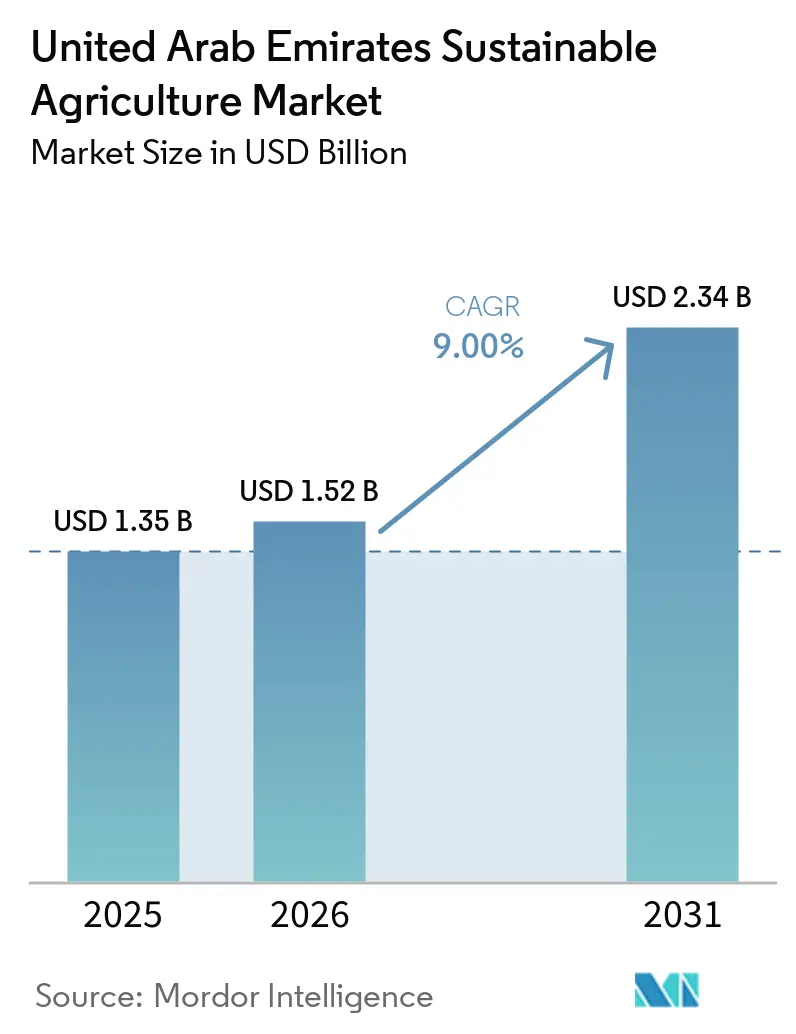
| Base Year Market Size (2025) | USD 1.35 Billion |
| Market Size (2026) | USD 1.52 Billion |
| Market Size (2031) | USD 2.34 Billion |
| Growth Rate (2026 - 2031) | 9.00 % |
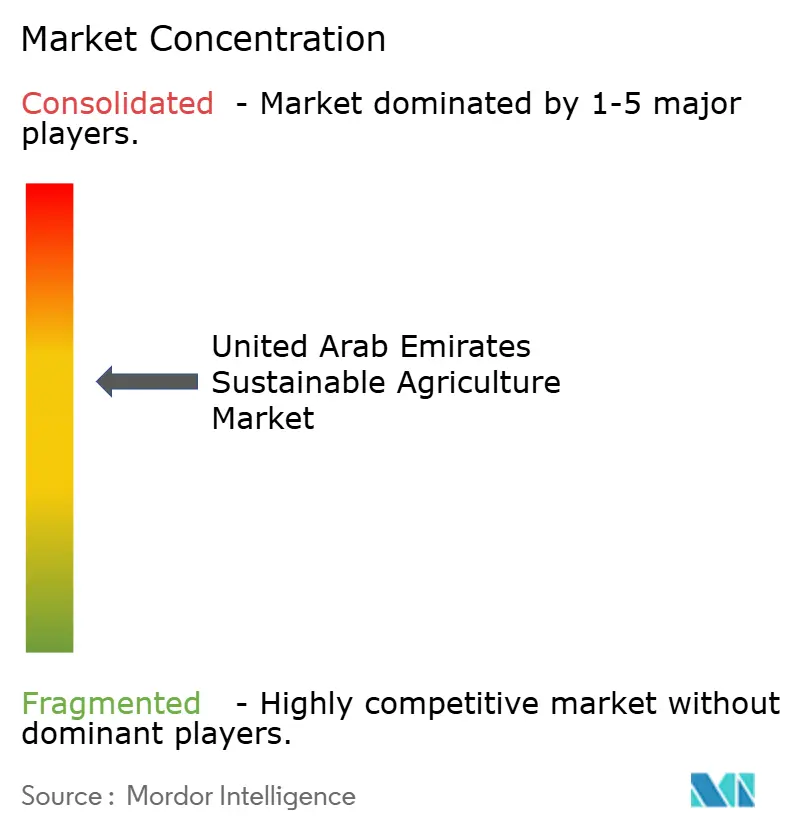
| Market Concentration | Medium |
Major Players *Disclaimer: Major Players sorted in no particular order Image © Mordor Intelligence. Reuse requires attribution under CC BY 4.0. | |
United Arab Emirates Sustainable Agriculture Market Analysis by Mordor Intelligence
The United Arab Emirates (UAE) sustainable agriculture market size was valued at USD 1.35 billion in 2025 and estimated to grow from USD 1.52 billion in 2026 to reach USD 2.34 billion by 2031, at a CAGR of 9% during the forecast period (2026-2031). The UAE's sustainable agriculture market is expanding because the country continues to depend heavily on imported food, keeping food security at the center of both policy frameworks and private investment strategies[1]Source: UAE Ministry of Climate Change and Environment, “HE Dr Al Dahak Launches Sustainable Product Initiative to Increase Local Produce Use in the UAE's Hospitality Sector to 25%,” Mid-East.info, mid-east.info. Local production is gradually increasing, with domestically grown vegetables meeting a growing share of demand, while structured sourcing programs are creating a more stable demand base for local producers. Capacity expansion in Al Ain and Dubai is pushing the UAE's sustainable agriculture market toward larger, more technology-driven production systems, particularly where greenhouse farming, vertical agriculture, and integrated agritech platforms are supported by institutional funding. Competitive positioning in the UAE sustainable agriculture market is increasingly determined by access to controlled-environment infrastructure, agronomic expertise, and long-term procurement agreements rather than brand visibility. The primary constraint remains cost, as energy, water, and capital requirements make the UAE sustainable agriculture market more accessible to well-capitalized operators than to smaller participants.
Key Report Takeaways
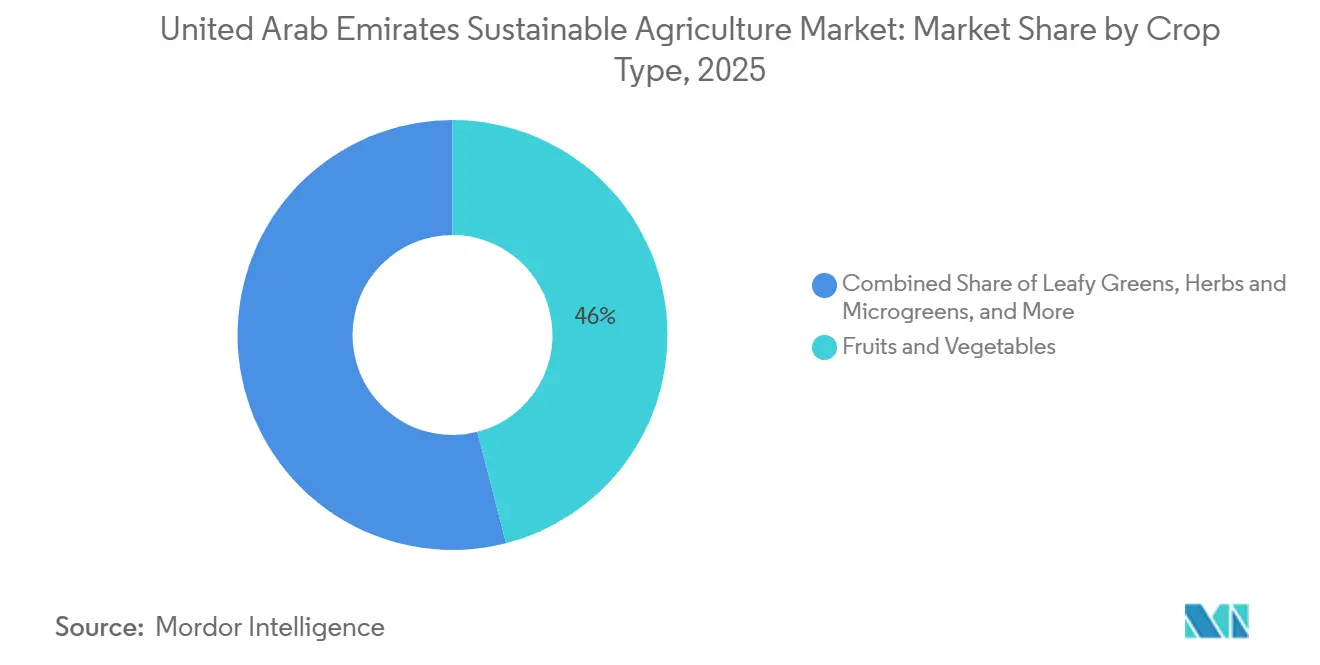
- By crop type, fruits and vegetables led the United Arab Emirates sustainable agriculture market share at 46.0% in 2025, while herbs and microgreens are forecast to expand at a CAGR of 13.5% from 2026 to 2031.
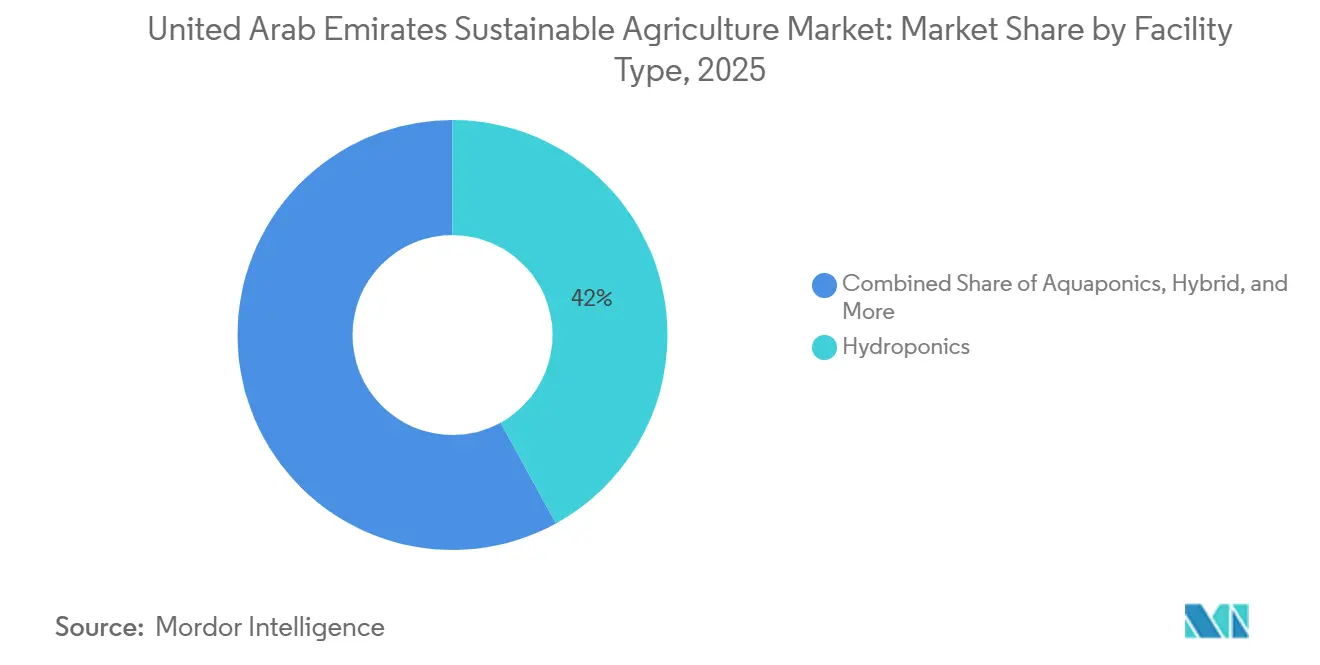
- By production method, hydroponics held 42.0% of the United Arab Emirates sustainable agriculture market size in 2025, while the hybrid segment is forecast to record the highest CAGR of 13.2% between 2026 and 2031.
- By facility type, the indoor vertical farms segment accounted for 38.0% of revenue in 2025 and is also forecast to grow the fastest, with a 13.8% CAGR from 2026 to 2031.
Note: Market size and forecast figures in this report are generated using Mordor Intelligence’s proprietary estimation framework, updated with the latest available data and insights as of January 2026.
United Arab Emirates Sustainable Agriculture Market Trends and Insights
Drivers Impact Analysis*
| Driver | (~) % Impact on CAGR Forecast | Geographic Relevance | Impact Timeline |
|---|---|---|---|
| Water Scarcity is Accelerating Controlled-Environment Agriculture Adoption | +2.2% | UAE-wide, strongest in Abu Dhabi and Al Ain groundwater zones | Short term (≤ 2 years) |
| Food Security Policy is Pulling Capital Into Local Production | +2.0% | UAE-wide, with Abu Dhabi and Dubai as main policy centers | Short term (≤ 2 years) |
| Retail and HoReCa Demand for Consistent Local Fresh Produce | +1.5% | Dubai urban core, with spillover into Abu Dhabi retail and hospitality | Medium term (2-4 years) |
| Yield Stability Under Extreme Heat and Salinity Stress | +1.0% | Al Ain, interior UAE, and coastal belts with saline groundwater | Medium term (2-4 years) |
| Premiumization of Pesticide-Free and Traceable Produce | +0.8% | Dubai and Abu Dhabi urban consumers, with relevance for GCC exports | Medium term (2-4 years) |
| Climate-Smart Agriculture Tech is Lowering Operating Risk | +1.0% | UAE-wide across all emirates | Long term (≥ 4 years) |
| Source: Mordor Intelligence | |||
Water Scarcity is Accelerating Controlled-Environment Agriculture Adoption
Water scarcity is a primary reason the UAE sustainable agriculture market is shifting toward controlled-environment systems. Renewable freshwater availability is extremely limited, making open-field cultivation difficult to scale reliably. The country relies on desalination for 42% of its total water supply in 2025. Controlled-environment systems help reduce this burden, as hydroponic and aeroponic models can save 90% to 95% of water compared with conventional irrigation. The Hassyan desalination plant is set to reach a capacity of 818,000 cubic meters per day in 2027, which strengthens the broader water infrastructure but does not eliminate the need for water efficiency at the farm level. For lenders and institutional buyers, farms that use closed-loop water systems are easier to support on long-term contracts due to lower supply risk. As a result, water stress is not only an environmental concern in the UAE sustainable agriculture market but also a direct factor in commercial project design and funding.
Food Security Policy is Pulling Capital Into Local Production
Food security policy remains one of the strongest drivers supporting the UAE sustainable agriculture market. Government-led initiatives are creating structured demand channels by encouraging greater domestic sourcing across the hospitality and retail sectors. The Sustainable Product initiative launched in January 2026 requires hotels and restaurants to source 25% of agricultural and animal products from UAE farms, which creates a firmer domestic demand base for local producers. Financial institutions and development programs are also directing capital toward agriculture and agritech, supporting both infrastructure expansion and innovation-led growth. Long-term national strategies aimed at increasing agricultural output, expanding organic farming, and accelerating the adoption of climate-smart practices provide investors with clear direction and policy certainty. These frameworks transform food security from a broad objective into measurable targets, funding mechanisms, and procurement requirements. In practical terms, this reduces demand uncertainty for producers that can meet quality and supply consistency standards. It also enables large-scale projects in key regions to secure funding more efficiently. As a result, the UAE's sustainable agriculture market is strongly shaped by policy-driven investment flows and structured growth pathways.
Retail and HoReCa Demand for Consistent Local Fresh Produce
Retail and HoReCa demand is providing the UAE sustainable agriculture market with a more dependable outlet for high-quality local produce. The hospitality sourcing target announced in January 2026 was supported by six strategic MoUs with major hospitality groups, giving growers a clearer route into recurring institutional demand[2]Source: HORECA Middle East, “UAE Sets 25% Local Sourcing Target for Hospitality Sector in Landmark Food Security Initiative,” HORECA Middle East, horecamea.com. Bustanica (Emirates Flight Catering) products were already available in more than 200 retail stores in the UAE, and the company also supplies Emirates in-flight catering, demonstrating how scale can be achieved when farm output is tied to large distribution channels. Major retail and foodservice buyers place greater value on consistent product size, appearance, and shelf life than on seasonal variation. This benefits controlled-environment farms, as they can deliver year-round output with tighter quality control than open-field supply. It also increases the value of traceability and certification, since procurement teams require repeatable standards across deliveries. As these buyers represent a growing share of demand, the UAE sustainable agriculture market is shifting toward contracts that reward consistency as much as volume. This trend supports scale expansion for farms that can align production planning with hospitality, airline, and premium retail requirements.
Yield Stability Under Extreme Heat and Salinity Stress
Yield stability is a key concern in the UAE sustainable agriculture market, given that the country faces some of the most challenging outdoor growing conditions globally. Summer temperatures regularly exceed 45°C, and salinity pressure remains a significant issue for soils and groundwater. Controlled-environment production reduces exposure to both variables and enables year-round output, which is difficult to sustain in open-field farming. In April 2026, the International Center for Biosaline Agriculture (ICBA) and the Ministry of Climate Change and Environment (MOCCAE) launched a national initiative comprising 45 applied field trials across 1,000-square-meter plots to test climate-smart crop varieties and irrigation performance under UAE conditions. Silal (ADQ) also established a Center of Excellence (CoE) for Abiotic Resilience and Crop Genomics with Limagrain Vegetable Seeds in Al Ain to improve crop tolerance to heat and salinity for tomatoes, cucumbers, and melons. These efforts matter because growers need simultaneous improvements in seed performance and irrigation efficiency to scale production beyond a limited range of protected crops. Lenders are also more likely to support projects that manage climate risk through both infrastructure and genetics. This positions yield stability as a practical growth driver for the UAE sustainable agriculture market, rather than a purely technical concern.
Restraints Impact Analysis*
| Restraint | (~) % Impact on CAGR Forecast | Geographic Relevance | Impact Timeline |
|---|---|---|---|
| High Capex and Long Payback for Controlled Environment Farms | -1.5% | UAE-wide, most acute for new entrants outside Abu Dhabi and Dubai funding ecosystems | Short term (≤ 2 years) |
| Dependence on Desalinated Water and Energy Raises Operating Costs | -1.0% | UAE-wide, especially Al Ain and inland zones without wastewater reuse networks | Medium term (2-4 years) |
| Limited Technical Talent for Advanced Agronomy and Automation | -0.8% | UAE-wide, with imported talent common across advanced facilities | Medium term (2-4 years) |
| Crop Economics Still Favor a Narrow Set of High-Value Produce | -0.7% | UAE-wide, most visible beyond leafy greens and tomatoes | Long term (≥ 4 years) |
| Source: Mordor Intelligence | |||
High Capex and Long Payback for Controlled Environment Farms
High upfront investment remains one of the most significant restraints on the UAE sustainable agriculture market. Large-scale controlled-environment facilities require substantial capital expenditure, making entry into the market challenging for smaller operators. Energy consumption accounts for a significant portion of operating costs, particularly in advanced vertical farming systems that require continuous climate control. While efficient operations can achieve relatively short payback periods, timelines tend to extend for larger or more automated facilities. Financing programs are available but often cover only a portion of total project costs, limiting their effectiveness for full-scale developments. As a result, market expansion has been led primarily by well-funded entities, including government-backed and corporate-backed platforms. Capital intensity also influences competitive dynamics by slowing new market entry even as demand continues to grow. Until cost structures improve or financing becomes more accessible, capital requirements will continue to restrict broader participation in the UAE sustainable agriculture market.
Dependence on Desalinated Water and Energy Raises Operating Costs
Operating costs remain elevated because much of the UAE sustainable agriculture market relies on high-cost inputs such as desalinated water and energy. Water costs vary depending on access to recycled sources, with farms lacking such access facing higher operating expenses. Indoor and greenhouse production adds further pressure, as these operations require constant cooling and system balancing during extended hot periods. The AgriPV project launched by Elite Agro Projects and Abu Dhabi Future Energy Company (Masdar) in 2026 indicates that operators are actively pursuing lower-cost energy models, though these solutions remain limited relative to the total installed base. Even as desalination capacity expands at the national level, the cost burden at the farm level remains a commercial challenge rather than solely a utility issue. As a result, the UAE sustainable agriculture market remains highly sensitive to site selection, water access, cooling efficiency, and energy management. Until these costs decline more broadly, margins will remain under pressure for smaller or less optimized farms.
*Our forecasts treat driver/restraint impacts as directional, not additive. The impact forecasts reflect baseline growth, mix effects, and variable interactions.
Segment Analysis
By Crop Type: Fruits and Vegetables Dominate, Herbs and Microgreens Lead Premium-Driven Expansion
Fruits and vegetables accounted for 46.0% of the UAE sustainable agriculture market in 2025, reflecting their role as the main commercial volume base for local supply. Demand from airlines, retailers, and the HoReCa channel supported stable output across tomatoes, cucumbers, peppers, and leafy produce in 2025. Herbs and microgreens are forecast to expand at a 13.5% CAGR from 2026 to 2031, making them the fastest-growing crop group in the UAE sustainable agriculture market. The segment is benefiting from health-focused consumption and premium menu demand for traceable specialty produce, increasingly preferred by urban consumers and high-end foodservice outlets.
Leafy greens remained a major category in the UAE sustainable agriculture market, supported by large-scale controlled-environment production. Bustanica's annual output of more than 1 million kilograms, combined with consistent retail and foodservice demand nationwide, contributed to the category's strong performance[3]Source: Emirates Flight Catering, “Emirates Flight Catering Fully Acquires Bustanica, the World's Largest Indoor Vertical Farm,” Emirates Media Centre, emirates.com. Flowers and ornamentals remained smaller, indicating that scale still lies with edible crops rather than decorative output in current production systems. Other crop types, including climate-adapted fodder and experimental lines, are becoming more relevant through field trials and local testing programs that are expanding crop diversity. Compliance is also reshaping competition, as certification frameworks push buyers toward accredited producers and make quality assurance a condition of commercial access across supply chains.



By Production Method: Hybrid Systems Gain Ground as Hydroponics Reaches Maturity
Hydroponics accounted for 42.0% of the market by production method in 2025, making it the largest operating model in the UAE sustainable agriculture market. That position reflects its wide crop applicability and its consistent output performance across both large flagship projects and smaller urban farms. The hybrid segment is forecast to grow with a CAGR of 13.2% between 2026 and 2031, as operators increasingly prefer combined models that blend hydroponics, aeroponics, vertical stacking, and integrated climate control systems for greater efficiency. Badia Farms' 27-year agreement with Food Tech Valley in 2026 supports this trend, as it is centered on hybrid growing models across a 236,000-square-foot plot and targets 90% lower water use compared to conventional farming.
Aquaponics and aeroponics each accounted for smaller market shares, and aeroponics stands out because near-zero soil contact aligns well with premium, pesticide-free positioning and high-value crop production strategies. Soil-based sustainable farming still held a notable share, indicating that legacy farms are not disappearing but are gradually adopting drip irrigation, precision tools, and improved input management practices. Industry collaboration is supporting this transition through digital farming tools, seed trials, and capacity building across farms. This keeps production methods evolving while maintaining a balance between traditional systems and advanced controlled-environment approaches.
By Facility Type: Indoor Vertical Farms Drive Dual Leadership in Scale and Speed
Indoor vertical farms accounted for 38.0% of the UAE sustainable agriculture market share in 2025 and are forecast to grow at a 13.8% CAGR from 2026 to 2031. The format is leading because it combines land efficiency, year-round climate control, and location flexibility near major demand centers in urban environments. In the UAE sustainable agriculture market, this matters because urban consumption is strong and open-field conditions are difficult for a steady premium supply. Large-scale vertical farming projects are anticipated to strengthen supply capabilities and reduce dependence on imports over time. The GigaFarm project in Dubai is anticipated to begin its first harvest phase in 2026, and the draft states that the first 20 towers alone could replace 1% of UAE fresh produce imports.
Glass or poly greenhouses held a significant share of the facility market in 2025 and remain central to large-scale tomato, cucumber, and pepper production in the UAE's sustainable agriculture market. Greenhouse production continues to offer strong scale economics in desert conditions while maintaining lower capital intensity than fully indoor vertical systems. Container farms fill smaller, modular use cases where operators want faster deployment, tighter site footprints, or a lower initial investment before scaling operations. This keeps facility choice closely tied to buyer mix, land access, and capital availability rather than to one standard model across the whole market.
Geography Analysis
Abu Dhabi captured a significant share of the UAE sustainable agriculture market in 2025, making it the largest regional cluster in the country. Its lead reflects a deeper support system that combines regulation, financing, research, and project development under coordinated institutional frameworks. The emirate also has a large base of farms and livestock holdings, which provides a broader foundation for domestic sourcing and food-processing linkages across the value chain. Ongoing development initiatives continue to strengthen its position through integrated agricultural and infrastructure investments.
Dubai is projected to be the fastest-growing geography in the UAE sustainable agriculture market. The emirate benefits from dense commercial demand, strong logistics access, and a well-developed ecosystem that supports food technology and sustainable production systems. Large-scale controlled-environment projects are reinforcing their growth trajectory by aligning production with urban consumption and export-oriented supply chains. Hospitality demand also plays a significant role in shaping procurement patterns and supporting consistent demand for locally produced premium crops.
The rest of the United Arab Emirates accounted for a smaller share of the market in 2025 and is projected to grow steadily through the forecast period. Growth in these emirates is coming more from modular container farms, small greenhouse additions, and improved irrigation systems than from large flagship projects. This part of the UAE sustainable agriculture market is important because it broadens local production beyond the main investment centers and supports more distributed supply coverage across regions. However, the gap with larger emirates remains visible due to differences in capital access and infrastructure availability.
Competitive Landscape
The UAE sustainable agriculture market remains moderately concentrated, with the top players accounting for a significant share of total revenue in 2025. Pure Harvest Smart Farms leads the market, followed by Bustanica (Emirates Flight Catering), Badia Farms, Silal (ADQ), and Al Dahra Holding. This structure indicates that scale is important, but it also leaves room for smaller specialist growers, research-focused platforms, and technology service providers. Competitive strength in this market depends more on capital access, agronomy capability, and control over protected growing systems than on consumer branding alone. This keeps the market open to niche participants, but clearly favors operators that can fund expansion and meet institutional procurement standards.
Pure Harvest Smart Farms has built a strong position through AI-enabled controlled-environment farming across three UAE sites and a broader regional footprint. Bustanica (Emirates Flight Catering) strengthened its position after Emirates Flight Catering completed a full acquisition in February 2024, deepening its advantage in airline catering and retail distribution. Silal has taken a more research-intensive approach through its Innovation Oasis, AgriTech Academy, and crop genomics partnerships, giving it a broader role beyond farm output. Al Dahra Holding remains significant due to its role in linking local food security strategy to larger agricultural supply chains and overseas production platforms. These company positions indicate that the UAE sustainable agriculture market is being shaped by different strategic models rather than a single uniform approach.
Technology is becoming a stronger line of differentiation in the UAE sustainable agriculture market. Advanced digital systems are improving real-time visibility across finance, supply chains, inventory, and customer management within large-scale operations. Partnerships across the ecosystem are also supporting innovation in areas such as digital farming, traceability, and crop optimization. Smart lighting, automation, and climate control technologies are improving efficiency and consistency in controlled-environment agriculture. The overall result is a UAE sustainable agriculture market where execution capability, operational efficiency, and technological integration are becoming as important as production scale.
United Arab Emirates Sustainable Agriculture Industry Leaders
Pure Harvest Smart Farms
Bustanica (Emirates Flight Catering)
Badia Farms
Silal (ADQ)
Al Dahra Holding
- *Disclaimer: Major Players sorted in no particular order

Recent Industry Developments
- January 2026: Elite Agro Projects and Abu Dhabi Future Energy Company (Masdar) launched the MENA region's first agricultural photovoltaic project at Elite Agro's Al Foah Farm in Al Ain, integrating solar generation with controlled-environment crop production to improve energy and water efficiency simultaneously. This strengthens the UAE sustainable agriculture market by lowering energy intensity in controlled-environment systems and improving long-term cost efficiency for large-scale farms.
- February 2026: Al Dahra Holding signed a landmark MoU with Tanzania Investment and Special Economic Zones Authority for agricultural investment of up to USD 100 million, targeting at least 10,000 hectares of farmland initially to enhance food commodity supply chains for the UAE
- April 2025: Silal (ADQ) inaugurated the Innovation Oasis R&D facility and the Advance AgriTech Academy in Al Ain, providing infrastructure for agricultural technology research, talent development, and innovation in national food security. This supports the UAE sustainable agriculture market by building local technical capability, accelerating innovation, and improving the scalability of advanced farming systems.


United Arab Emirates Sustainable Agriculture Market Report Scope
Sustainable agriculture in the UAE refers to resource-efficient farming systems that produce food under arid conditions while minimizing water, energy, and environmental impacts. It emphasizes controlled-environment agriculture, advanced irrigation methods, and climate-adaptive technologies to ensure consistent local food production, improve food security, and reduce reliance on imports.
The United Arab Emirates Sustainable Agriculture Market Report is Segmented by Crop Type (Fruits and Vegetables, Herbs and Microgreens, Leafy Greens, Flowers and Ornamentals, and Other Crop Types), by Production Method (Hydroponics, Aquaponics, Aeroponics, Soil-Based Sustainable Farming, and Hybrid), and by Facility Type (Glass or Poly Greenhouses, Indoor Vertical Farms, Container Farms, and Other Facility Types). The Market Forecasts are Provided in Terms of Value in USD.
| Fruits and Vegetables |
| Herbs and Microgreens |
| Leafy Greens |
| Flowers and Ornamentals |
| Other Crop Types |
| Hydroponics |
| Aquaponics |
| Aeroponics |
| Soil-Based Sustainable Farming |
| Hybrid |
| Glass or Poly Greenhouses |
| Indoor Vertical Farms |
| Container Farms |
| Other Facility Types |
| By Crop Type | Fruits and Vegetables |
| Herbs and Microgreens | |
| Leafy Greens | |
| Flowers and Ornamentals | |
| Other Crop Types | |
| By Production Method | Hydroponics |
| Aquaponics | |
| Aeroponics | |
| Soil-Based Sustainable Farming | |
| Hybrid | |
| By Facility Type | Glass or Poly Greenhouses |
| Indoor Vertical Farms | |
| Container Farms | |
| Other Facility Types |


Key Questions Answered in the Report
What is the 2026 value and 2031 outlook for sustainable agriculture in the UAE?
The UAE sustainable agriculture market is valued at USD 1.52 billion in 2026 and is projected to reach USD 2.34 billion by 2031 at a 9% CAGR.
Which crop group leads revenue generation in the UAE?
Fruits and Vegetables led with 46.0% share in 2025 because they fit steady procurement from retailers, airlines, and HoReCa buyers.
Which production method is growing the fastest in the UAE?
Hybrid segment is forecast to grow at 13.2% CAGR from 2026 to 2031 because operators want more flexibility across hydroponic, aeroponic, and AI-managed production models.
Why are indoor vertical farms gaining traction in the UAE?
Indoor Vertical Farms segment held 38.0% share in 2025 and is forecast to grow at 13.8% CAGR between 2026 and 2031 because they reduce land constraints and allow year-round output under controlled conditions.
What is the biggest challenge for operators in this space?
High capital and operating costs remain the main challenge, especially for energy, cooling, desalinated water, and the large upfront investment needed for advanced controlled-environment farms.
Page last updated on:





