
United Arab Emirates Hydroponics Market Size and Share
Market Overview
| Study Period | 2021 - 2031 |
|---|---|
| Forecast Data Period | 2026 - 2031 |
| Base Year Market Size (2025) | USD 114.63 Million |
| Market Size (2026) | USD 124.63 Million |
| Market Size (2031) | USD 189.35 Million |
| Growth Rate (2026 - 2031) | 8.72 % |
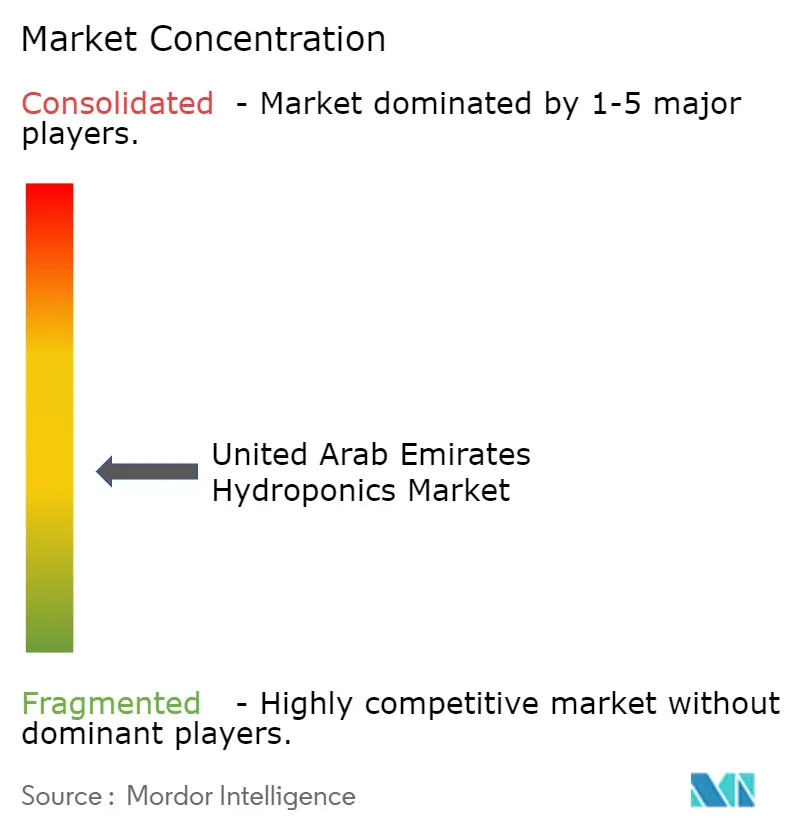
| Market Concentration | Medium |
Major Players
*Disclaimer: Major Players sorted in no particular order Image © Mordor Intelligence. Reuse requires attribution under CC BY 4.0. |
|
United Arab Emirates Hydroponics Market Analysis by Mordor Intelligence
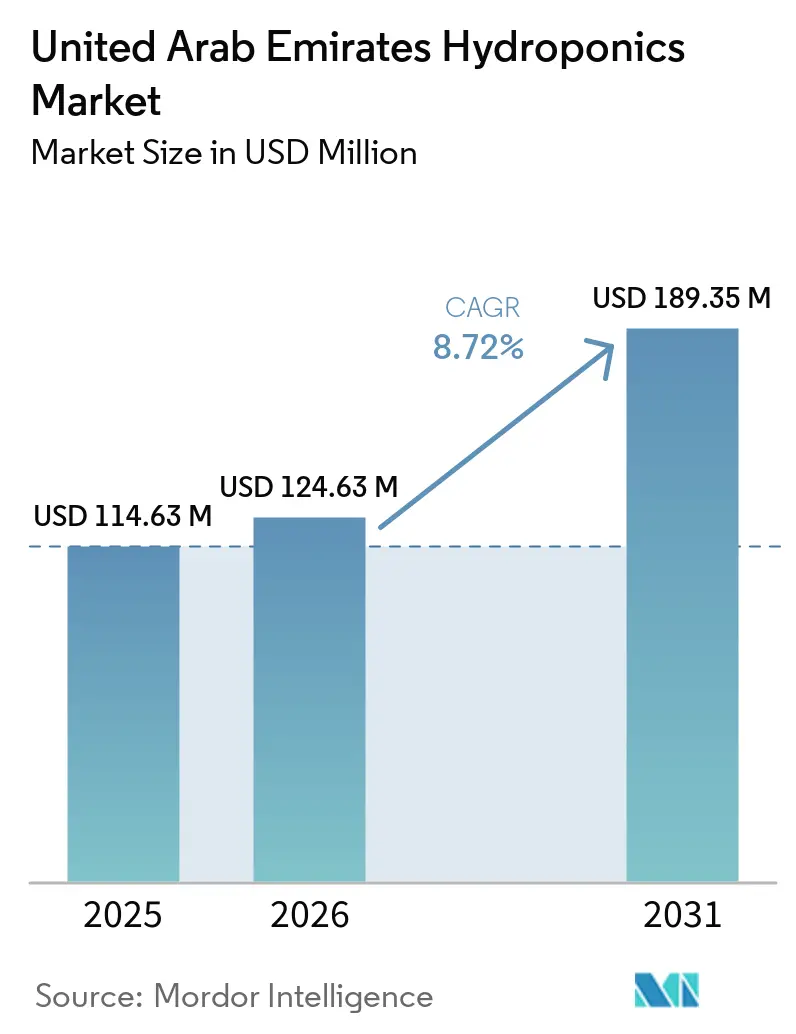
The United Arab Emirates hydroponics market was valued at USD 114.63 million in 2025 and is projected to grow from USD 124.63 million in 2026 to USD 189.35 million by 2031, registering a CAGR of 8.72% from 2026 to 2031. The United Arab Emirates continues to prioritize hydroponics as part of its long-term strategy to strengthen domestic food production and reduce dependence on imported fresh produce. National food security initiatives, combined with investments in controlled-environment agriculture, are accelerating the adoption of water-efficient hydroponic systems suited to the country's arid climate. Rising procurement from supermarkets, hospitality operators, and airline catering companies is creating stable demand for locally grown, pesticide-free produce. At the same time, agritech innovation, greenhouse expansion, and dedicated agricultural clusters are improving production capacity, while commercial cultivation remains focused on high-value crops that can offset the higher operating costs of hydroponic farming.
Key Report Takeaways
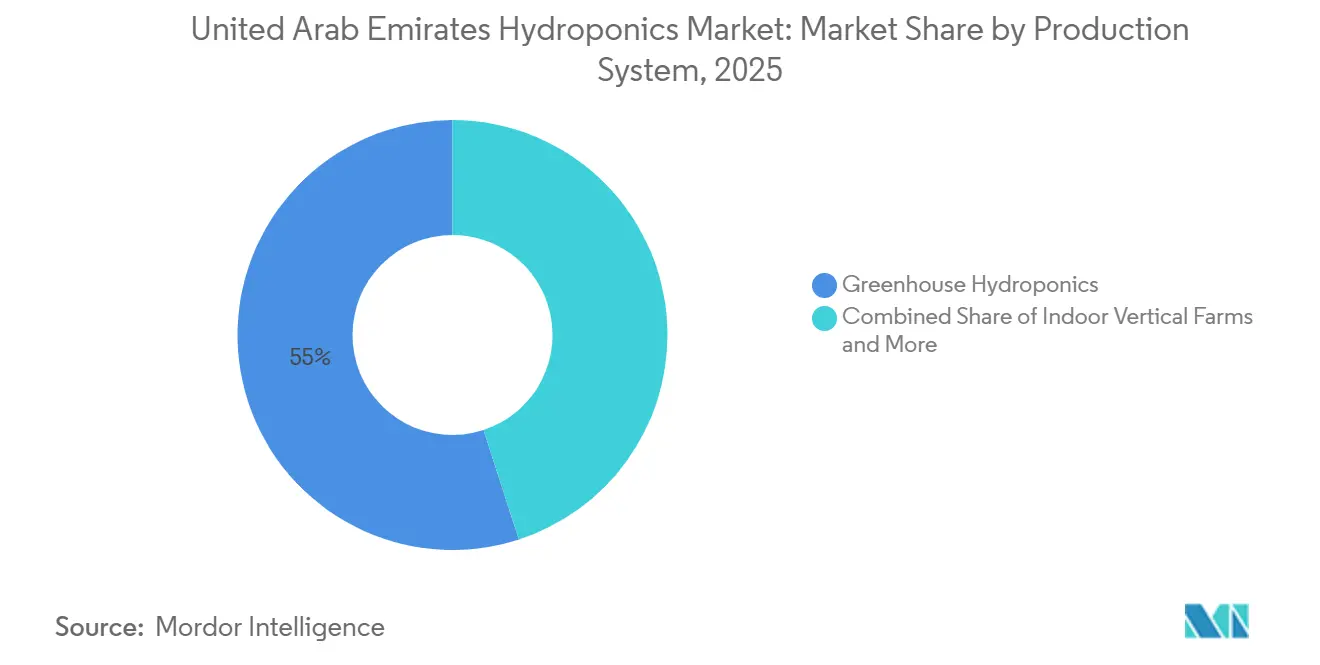
- By production system, greenhouse hydroponics accounted for the largest 55.0% of the United Arab Emirates hydroponics market share in 2025, while indoor vertical farms are projected to grow at the fastest CAGR of 12.6% from 2026 to 2031.
- By crop type, leafy greens accounted for the largest 32.0% share in 2025, while the United Arab Emirates hydroponics market size for herbs and microgreens is projected to grow at the fastest CAGR of 12.1% from 2026 to 2031.
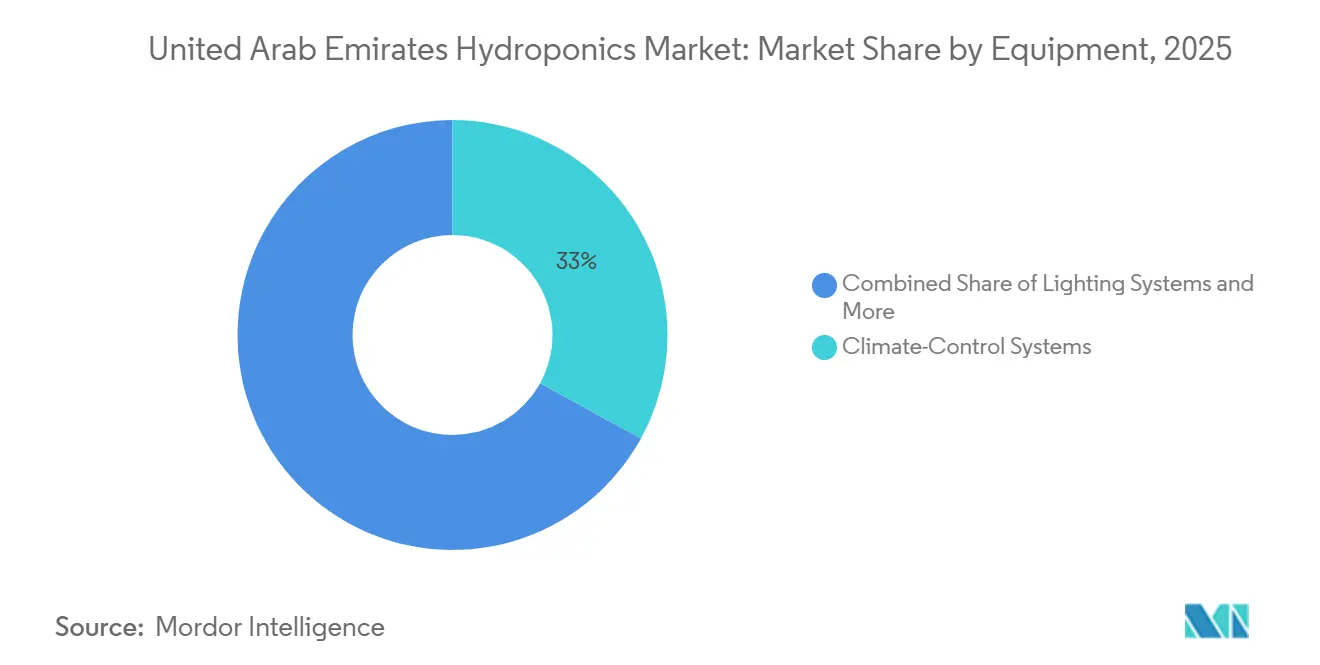
- By equipment, climate-control systems accounted for the largest 33.0% share in 2025, while lighting systems are projected to grow at the fastest CAGR of 12.4% from 2026 to 2031.
- By production scale, large-scale hydroponic farms accounted for the largest 54.0% share in 2025, while small-scale hydroponic farms are projected to grow at the fastest CAGR of 12.0% from 2026 to 2031.
Note: Market size and forecast figures in this report are generated using Mordor Intelligence’s proprietary estimation framework, updated with the latest available data and insights as of January 2026.
United Arab Emirates Hydroponics Market Trends and Insights
Drivers Impact Analysis*
| Driver | (~) % Impact on CAGR Forecast | Geographic Relevance | Impact Timeline |
|---|---|---|---|
| Food Import Substitution and National Food Security Priorities | +2.8% | National, led by Abu Dhabi and Dubai | Long term (≥ 4 years) |
| Water-Efficient Production in an Arid Climate | +1.9% | National, with early gains in Al Ain and Ras Al Khaimah | Long term (≥ 4 years) |
| Premium Demand for Locally Grown Pesticide-Free Produce | +1.5% | Dubai and Abu Dhabi urban corridors | Medium term (2-4 years) |
| Public and Quasi-Public Agritech Investment | +2.1% | Abu Dhabi and Dubai | Medium term (2-4 years) |
| Expansion of Retail, Hospitality, and Airline-Catering Procurement | +1.2% | National, concentrated in Dubai | Short term (≤ 2 years) |
| Cluster Development Through Food Tech Valley and Al Ain Agritech Hubs | +1% | Dubai and Al Ain | Medium term (2-4 years) |
| Source: Mordor Intelligence | |||
Food Import Substitution and National Food Security Priorities
The United Arab Emirates' high dependence on imported food continues to drive investment in hydroponic farming as part of its long-term food security strategy. According to the International Monetary Fund (IMF), in 2025, at least 80% of domestic food consumption in the United Arab Emirates is imported, exposing the country to geopolitical disruptions and supply chain risks [1]Source: International Monetary Fund (IMF), "United Arab Emirates: 2025 Article IV Consultation – Press Release, Staff Report and Statement by the Executive Director for the United Arab Emirates," imf.org.. In response, the United Arab Emirates National Food Security Strategy 2051 promotes controlled-environment agriculture, including hydroponics, to strengthen domestic production through modern agricultural technologies. This supportive policy framework, combined with increasing institutional demand for locally produced fresh vegetables, is encouraging commercial investment and expanding hydroponic cultivation across the country.
Water-Efficient Production in an Arid Climate
Water scarcity continues to strengthen the business case for hydroponic farming in the United Arab Emirates, where controlled-environment agriculture enables year-round production with substantially lower water consumption than conventional cultivation. Efficient irrigation, nutrient recirculation, and closed-loop production systems allow growers to maximize output while reducing pressure on limited freshwater resources. According to a 2025 study published in Sustainability, a solar-powered reverse-osmosis hydroponic system produced irrigation-grade water at USD 1.05 per m³, compared with USD 2.52–3.20 per m³ for commercial desalinated water under the October 2025 tariff schedule. Lower irrigation costs improve the economic viability of hydroponic farms and support broader commercial adoption across the country.
Premium Demand for Locally Grown Pesticide-Free Produce
Demand for premium, locally grown, pesticide-free produce is increasing in the United Arab Emirates, driven by affluent consumers, a large expatriate population, and a growing hospitality sector. Hotels, restaurants, premium retailers, and airline catering companies increasingly prioritize fresh produce with consistent quality, traceability, and year-round availability, creating favorable conditions for hydroponic growers. According to the United States Department of Agriculture Foreign Agricultural Service Food Service - Hotel, Restaurant, and Institutional Annual Report 2025, foreign nationals comprise almost 89% of the United Arab Emirates population[2]Source: United States Department of Agriculture Foreign Agricultural Service (USDA FAS), "Food Service Hotel Restaurant Institutional Annual, United Arab Emirates," apps.fas.usda.gov., supporting diverse dietary preferences and sustained demand for premium fresh vegetables and herbs. This consumer profile encourages commercial investment in hydroponic cultivation of leafy greens, herbs, and microgreens.
Public and Quasi-Public Agritech Investment
Public and quasi-public investment is accelerating hydroponic adoption in the United Arab Emirates by strengthening the country's agritech research and commercialization ecosystem. According to Silal (ADQ) in April 2025, the newly inaugurated Innovation Oasis in Al Ain spans more than 300,000 square meters and features laboratories, growth chambers, phenotyping facilities, greenhouses, and experimental research plots dedicated to climate-resilient and controlled-environment agriculture. The availability of advanced testing infrastructure enables growers to validate hydroponic technologies, improve crop performance, and reduce commercialization risks, encouraging greater private investment and supporting the long-term expansion of the United Arab Emirates hydroponics market.
Restraints Impact Analysis*
| Restraint | (~) % Impact on CAGR Forecast | Geographic Relevance | Impact Timeline |
|---|---|---|---|
| High Capital Intensity of Climate-Controlled Farms | -0.7% | National | Long term (≥ 4 years) |
| Cooling, Lighting, and Energy-Cost Pressure | -0.5% | National, strongest in inland Abu Dhabi and Al Ain | Long term (≥ 4 years) |
| Narrow Crop Economics Outside Leafy Greens, Tomatoes, and Selected Berries | -0.3% | National | Medium term (2-4 years) |
| Traceability, Packing, and Food-Safety Compliance Costs | -0.3% | National, with enforcement concentrated in Dubai and Abu Dhabi | Medium term (2-4 years) |
| Source: Mordor Intelligence | |||
Cooling, Lighting, and Energy-Cost Pressure
High energy consumption remains a significant operational challenge for hydroponic farms in the United Arab Emirates, where year-round production depends on continuous cooling, artificial lighting, water circulation, and automated climate-control systems to manage extreme desert temperatures. According to a 2026 study published in Frontiers in Sustainable Food Systems, energy consumption in greenhouses can account for up to 50% of total production costs in arid environments, making electricity one of the largest operating expenses for commercial growers. This cost burden reduces profit margins, increases production costs, and discourages investment by smaller operators, limiting the expansion of the United Arab Emirates hydroponics market.
Narrow Crop Economics Outside Leafy Greens, Tomatoes, and Selected Berries
Hydroponic farming in the United Arab Emirates is economically viable for several commercial crops, including leafy greens, tomatoes, cucumbers, peppers, herbs, and microgreens. However, profitability varies by crop, as the costs of climate-controlled production, energy consumption, infrastructure, and operations can be difficult to recover for crops with lower selling prices or limited market demand. A 2025 study published in the Journal of Cleaner Production assessed 35 hydroponic farms in Abu Dhabi, focusing on tomato and cucumber production[3]Source: Fathelrahman, E. et al., "Life Cycle Assessment of Open and Closed Hydroponic Systems for Vegetable (Tomato and Cucumber) Production in Arid Lands," sciencedirect.com.. While these crops have demonstrated commercial viability, expanding hydroponics to a wider range of staple and lower-value crops remains challenging, limiting diversification and broader market expansion.
*Our forecasts treat driver/restraint impacts as directional, not additive. The impact forecasts reflect baseline growth, mix effects, and variable interactions.
Segment Analysis
By Production System: Greenhouse Hydroponics Lead the Market, While Indoor Vertical Farms Expand Rapidly
Greenhouse hydroponics accounted for the largest share of the United Arab Emirates hydroponics market at 55.0% in 2025. Greenhouse systems remain the preferred commercial production model because they combine controlled growing conditions with lower capital requirements than fully enclosed indoor facilities. Their ability to use natural sunlight while integrating automated irrigation, fertigation, and climate management improves production efficiency year-round. Commercial growers widely adopt greenhouse cultivation to consistently produce vegetables despite harsh climatic conditions. This balance of operational reliability, scalability, and cost efficiency continues to reinforce greenhouse hydroponics as the dominant production system.
Indoor vertical farms are projected to grow at the fastest CAGR of 12.6% from 2026 to 2031. This growth is supported by rising investment in controlled-environment agriculture for urban food production and improved resource efficiency. Vertical farms enable year-round cultivation independent of seasonal weather while maximizing productivity within limited land footprints. Advanced lighting, automation, environmental monitoring, and precise nutrient delivery improve crop consistency and operational control. Growing interest from food retailers, hospitality operators, and technology developers is encouraging broader adoption, making indoor vertical farming one of the most promising production systems in the country.



By Crop Type: Leafy Greens Lead the Market, Herbs and Microgreens Record the Fastest Growth
Leafy greens accounted for the largest share, at 32.0%, in 2025. Their short production cycles, high planting density, and suitability for controlled-environment cultivation make them the preferred crop category for commercial hydroponic operations. Consistent demand from supermarkets, food-service providers, and airline catering supports year-round production. Leafy greens also benefit from predictable yields, efficient water utilization, and lower production risk compared with many fruiting crops. These factors allow producers to optimize facility utilization while maintaining a reliable supply for both retail and institutional customers.
The United Arab Emirates hydroponics market size for herbs and microgreens is projected to grow at the fastest CAGR of 12.1% from 2026 to 2031. Demand continues to expand as these specialty crops command premium pricing and require relatively short cultivation cycles. Producers increasingly target restaurants, premium retailers, hotels, and catering companies seeking fresh, locally produced ingredients with consistent quality and traceability. Controlled-environment production enables rapid harvesting and frequent crop turnover while minimizing transportation time. These factors position herbs and microgreens as an attractive segment for specialized hydroponic producers serving premium food markets.
By Equipment: Climate-Control Systems Lead the Market, While Lighting Systems Grow Fastest
Climate-control systems accounted for the largest share, at 33.0%, in 2025. Reliable cooling, humidity regulation, ventilation, and environmental monitoring are fundamental to maintaining stable growing conditions in the country's hot climate. Integrated climate-control technologies help reduce crop stress while improving productivity, product quality, and resource efficiency throughout the production cycle. Commercial operators increasingly combine automated sensors with centralized control platforms to optimize greenhouse performance and reduce operational variability. The essential role of climate-control systems in protecting crops and supporting year-round cultivation continues to sustain demand for advanced equipment in this category.
Lighting systems are projected to grow at the fastest CAGR, 12.4%, from 2026 to 2031. Adoption is accelerating as indoor farming operators expand controlled-environment production and seek greater energy efficiency. Modern light-emitting diode lighting provides optimized light spectra that support plant growth while generating less heat than conventional alternatives. Lower heat output also reduces cooling requirements, improving overall operational efficiency. Integration with automated lighting controls enables precise crop management across different growth stages, strengthening the role of advanced lighting technologies within commercial hydroponic production facilities.
By Production Scale: Large Farms Dominate Revenue, Small Farms Record the Fastest Expansion
Large-scale hydroponic farms accounted for the largest share, at 54.0%, in 2025. Their operational scale enables efficient use of infrastructure, labor, logistics, and post-harvest handling, while supporting long-term commercial supply agreements with retailers and institutional buyers. Large facilities are also better positioned to invest in automation, climate-control technologies, and advanced cultivation systems that improve productivity and consistency. Greater financial capacity allows these operators to expand production and adopt new technologies more rapidly, reinforcing their dominance in the country's commercial hydroponic industry.
Small-scale hydroponic farms are projected to grow at the fastest CAGR of 12.0% from 2026 to 2031. Growth is supported by increasing interest in localized food production, modular cultivation systems, and direct marketing opportunities. Smaller operators can respond quickly to changing consumer preferences while focusing on premium crops supplied to restaurants, specialty retailers, and local communities. Flexible production models also encourage experimentation with new cultivation techniques and niche product offerings. These factors continue to strengthen the commercial prospects of small-scale hydroponic farming across the country.
Geography Analysis
Abu Dhabi is the primary center for hydroponic production and investment in the United Arab Emirates. The emirate benefits from strong government support for controlled-environment agriculture, advanced research infrastructure, and long-term food security initiatives. Large commercial greenhouse developments, agritech innovation programs, and public-private collaborations have encouraged the adoption of hydroponic production technologies. The presence of dedicated research centers and commercial farming operations supports technology validation under desert conditions. These factors continue to strengthen Abu Dhabi's position in commercial hydroponic farming and technology adoption.
Dubai is emerging as a dynamic hub for hydroponic expansion and controlled-environment agriculture. Growth is supported by increasing investment in urban agriculture, vertical farming, and food technology infrastructure designed to strengthen domestic food production. Government-led initiatives encourage private investment in advanced farming technologies while creating opportunities for commercial hydroponic producers serving retail, hospitality, and airline catering sectors. Strong demand for premium locally grown produce, combined with innovation-focused development programs and the expansion of controlled-environment farming capacity, continues to drive hydroponic adoption across the emirate.
The Northern Emirates, including Sharjah and Ras Al Khaimah, are gradually strengthening their presence in the United Arab Emirates hydroponics market through agricultural diversification initiatives. Government programs and regional partnerships are encouraging greater adoption of protected cultivation and improved market access for local growers. In March 2026, Silal (ADQ) expanded its operations into the Al Hamraniyah area of Ras Al Khaimah through a partnership with the National Agricultural Center to support farmers with production, post-harvest handling, and product marketing, strengthening the regional agricultural ecosystem.
Competitive Landscape
The United Arab Emirates hydroponics market is moderately fragmented in 2025, with major players including Pure Harvest Smart Farms Ltd., Emirates Bustanica (Emirates Flight Catering Company L.L.C.), VeggiTech Hydroponic Technologies Private Limited (SNASCO Holding Company), Badia Farms (Gulf Islamic Investments), and UNS Farms (Speedex Group). Competition is driven by expertise in controlled-environment farming, production scale, technology adoption, crop quality, and established relationships with retailers, hospitality companies, and food-service operators. Market participants differentiate themselves through automation, resource-efficient cultivation methods, premium crop portfolios, and research investments that enhance productivity and operational resilience in desert-growing conditions.
Companies are strengthening their competitive positions through investments in controlled-environment agriculture, product diversification, and strategic collaborations that improve production efficiency and market reach. Pure Harvest Smart Farms Ltd. has expanded its branded product portfolio to include locally produced tomato-based products following recognition of its greenhouse-grown tomatoes. Emirates Bustanica (Emirates Flight Catering Company L.L.C.) continues to broaden Bustanica's presence across retail and food-service channels beyond airline catering. These developments reflect increasing emphasis on value-added offerings, brand differentiation, and technology-driven production to strengthen competitive positioning in the domestic market.
Competitive differentiation is also supported by investments in large-scale controlled-environment agriculture. Bustanica, operated by Emirates Flight Catering Company L.L.C., produces more than 1 million kilograms of leafy greens annually, demonstrating the commercial scale that advanced indoor farming can achieve in the country. This production capacity strengthens supply reliability for airline catering, retail, and hospitality customers while encouraging broader adoption of hydroponic technologies. Continued investment in automation, sustainable production systems, and value-added product offerings is projected to intensify competition across the market.
United Arab Emirates Hydroponics Industry Leaders
-
Pure Harvest Smart Farms Ltd.
-
Emirates Bustanica (Emirates Flight Catering Company L.L.C.)
-
VeggiTech Hydroponic Technologies Private Limited (SNASCO Holding Company)
-
Badia Farms (Gulf Islamic Investments)
-
UNS Farms (Speedex Group)
- *Disclaimer: Major Players sorted in no particular order

Recent Industry Developments
- June 2026: UNS Farms (Speedex Group) opened a 10,000-square-meter controlled-environment tomato production facility in Al Ain, expanding its hydroponic farming capacity. The facility integrates hydroponics, IoT, artificial intelligence, and automated climate-control systems to support year-round tomato production.
- October 2024: Badia Farms signed a 27-year agreement with Food Tech Valley to develop hybrid vertical and horizontal farms across 236,000 square feet. The agreement aims to expand controlled-environment production capacity and support hydroponic cultivation of premium fruits and vegetables in the United Arab Emirates.
- February 2024: Emirates Bustanica (Emirates Flight Catering Company L.L.C.) fully acquired Emirates Bustanica (formerly Emirates Crop One) and its consumer brand Bustanica, making the world's largest indoor vertical farm a 100% United Arab Emirates-owned venture and strengthening its controlled-environment agriculture business.


United Arab Emirates Hydroponics Market Report Scope
Hydroponics is a soilless cultivation method that grows plants using nutrient-rich water solutions, often supported by inert growing media. It enables efficient use of water and nutrients, supports year-round production, and can increase crop yields and production intensity. It is widely used for cultivating vegetables, herbs, and fruits in controlled environments.
The United Arab Emirates hydroponics market report is segmented by production system (greenhouse hydroponics, indoor vertical farms, container-based hydroponics, and other hydroponic production systems), by crop type (leafy greens, tomatoes, cucumbers, herbs and microgreens, berries, peppers, and other hydroponically grown crops), by equipment (lighting systems, irrigation components and pumps, climate-control systems, environmental sensors and control systems, and other hydroponic equipment), and by production scale (small-scale hydroponic farms, medium-scale hydroponic farms, and large-scale hydroponic farms). The market forecasts are provided in terms of value (USD).
| Greenhouse Hydroponics |
| Indoor Vertical Farms |
| Container-Based Hydroponics |
| Other Hydroponic Production Systems |
| Leafy Greens |
| Tomatoes |
| Cucumbers |
| Herbs and Microgreens |
| Berries |
| Peppers |
| Other Hydroponically Grown Crops |
| Lighting Systems |
| Irrigation Components and Pumps |
| Climate-Control Systems |
| Environmental Sensors and Control Systems |
| Other Hydroponic Equipment |
| Small-Scale Hydroponic Farms |
| Medium-Scale Hydroponic Farms |
| Large-Scale Hydroponic Farms |
| By Production System | Greenhouse Hydroponics |
| Indoor Vertical Farms | |
| Container-Based Hydroponics | |
| Other Hydroponic Production Systems | |
| By Crop Type | Leafy Greens |
| Tomatoes | |
| Cucumbers | |
| Herbs and Microgreens | |
| Berries | |
| Peppers | |
| Other Hydroponically Grown Crops | |
| By Equipment | Lighting Systems |
| Irrigation Components and Pumps | |
| Climate-Control Systems | |
| Environmental Sensors and Control Systems | |
| Other Hydroponic Equipment | |
| By Production Scale | Small-Scale Hydroponic Farms |
| Medium-Scale Hydroponic Farms | |
| Large-Scale Hydroponic Farms |


Key Questions Answered in the Report
What is the UAE hydroponics market size in 2026 and 2031?
The UAE hydroponics market is valued at USD 124.63 million in 2026, and it is projected to reach USD 189.35 million by 2031.
Which production system leads United Arab Emirates hydroponics?
Greenhouse hydroponics led with the largest 55.0% of revenue in 2025 because it can combine natural daylight with climate control.
Which crops have the strongest demand in hydroponic farms?
Leafy greens led crop revenue with the largest 32.0% in 2025. Herbs and microgreens are projected to grow fastest at a 12.1% CAGR from 2026 to 2031.
Why are vertical farms expanding in Dubai?
Urban land constraints, Food Tech Valley development, and demand from hotels and restaurants support multi-level indoor production.
Page last updated on:


 Your data is secure and never sold or shared.


