
United Arab Emirates Enterprise Content Management Market Size and Share
Market Overview
| Study Period | 2020 - 2031 |
|---|---|
| Forecast Data Period | 2026 - 2031 |
| Base Year Market Size (2025) | USD 0.56 Billion |
| Market Size (2026) | USD 0.63 Billion |
| Market Size (2031) | USD 1.22 Billion |
| Growth Rate (2026 - 2031) | 14.25% CAGR |
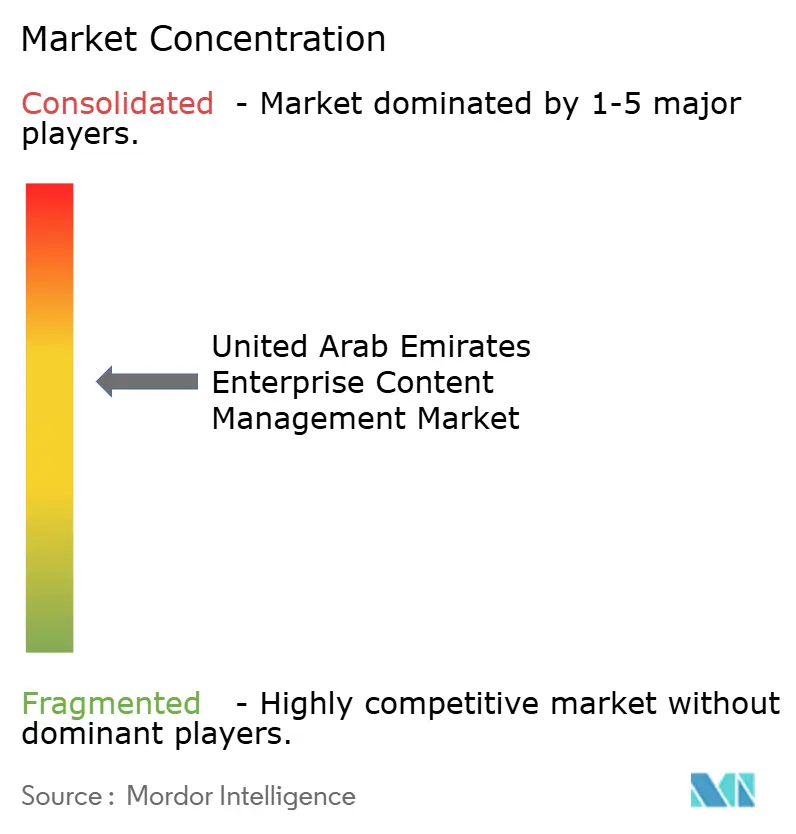
| Market Concentration | Medium |
Major Players *Disclaimer: Major Players sorted in no particular order Image © Mordor Intelligence. Reuse requires attribution under CC BY 4.0. | |
United Arab Emirates Enterprise Content Management Market Analysis by Mordor Intelligence
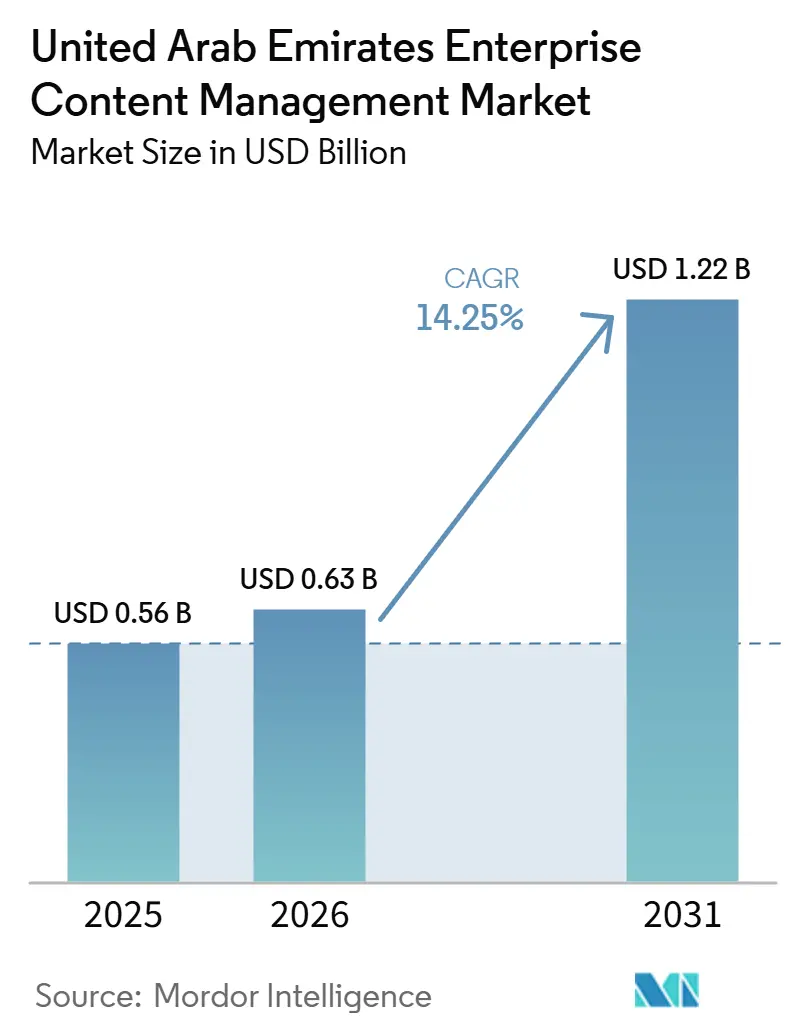
The United Arab Emirates enterprise content management market size was valued at USD 0.56 billion in 2025 and estimated to grow from USD 0.63 billion in 2026 to reach USD 1.22 billion by 2031, at a CAGR of 14.25% during the forecast period (2026-2031). The growth path is tied closely to the country’s push to move public services and enterprise workflows into AI-enabled digital systems. That shift is raising the value of governed, machine-readable, and searchable content repositories across both public and private organizations. The installed cloud base is already high, so the next phase of expansion will come from AI-based content services, regulated cloud migration, and workflow orchestration rather than just basic digitization. Competitive positioning is also becoming more selective, because sovereign hosting, data residency, and compliance credentials now matter as much as product depth in many large contracts. The United Arab Emirates enterprise content management market also benefits from spillover demand from ministries, healthcare systems, banks, and their partner ecosystems, even as local hosting costs and legacy integration issues slow some project rollouts.
Key Report Takeaways
- By solution type, document management held a 28.43% share in 2025, while workflow and business process management is projected to expand at a 15.56% CAGR through 2031.
- By deployment mode, cloud held 79.18% of the United Arab Emirates enterprise content management market share in 2025, and is projected to expand at a 14.89% CAGR through 2031.
- By enterprise size, large enterprises held a 63.21% share in 2025, while small and medium enterprises are projected to advance at a 15.11% CAGR through 2031.
- By end-user industry, government and public Administration held a 26.37% share in 2025, while healthcare and lifesciences is projected to grow at a 16.38% CAGR through 2031.
Note: Market size and forecast figures in this report are generated using Mordor Intelligence’s proprietary estimation framework, updated with the latest available data and insights as of January 2026.
United Arab Emirates Enterprise Content Management Market Trends and Insights
Drivers Impact Analysis*
| Driver | (~) % Impact on CAGR Forecast | Geographic Relevance | Impact Timeline |
|---|---|---|---|
| Accelerated Government Digitization in Dubai and Abu Dhabi | +4.2% | Dubai and Abu Dhabi primarily, with spillover to Northern Emirates | Short term (≤ 2 years) |
| AI-Based Content Classification and Workflow Orchestration | +3.1% | National, concentrated in Dubai, Abu Dhabi free zones, and federal entities | Medium term (2-4 years) |
| Cloud Migration of Content Workloads in Regulated Enterprises | +2.5% | Dubai, Abu Dhabi, and national federal entities | Medium term (2-4 years) |
| Compliance-Driven Record Retention and Audit Readiness | +2.1% | National, with early concentration in DIFC and ADGM-linked sectors | Short term (≤ 2 years) |
| Expansion of Citizen Service Portals and Paperless Service Delivery | +1.4% | National across Dubai, Abu Dhabi, Sharjah, and other emirates | Short term (≤ 2 years) |
| Multilingual Content Demand Across Arabic and English Workflows | +0.9% | National, concentrated in government and BFSI sectors | Long term (≥ 4 years) |
| Source: Mordor Intelligence | |||
Accelerated Government Digitization in Dubai and Abu Dhabi
Abu Dhabi’s Government Digital Strategy 2025-2027 committed USD 3.54 billion to digitize government processes and build an AI-native operating model, which directly raises demand for structured enterprise repositories and governed document flows. The Department of Government Enablement also launched TAMM 4.0 at GITEX Global 2025, and that rollout introduced AutoGov for the autonomous execution of service-heavy workflows that depend on reliable content handling.[1]Abu Dhabi Media Office, “Department of Government Enablement Launches TAMM 4.0 During GITEX Global 2025,” Abu Dhabi Media Office, mediaoffice.abudhabi In July 2026, the Abu Dhabi Government and Microsoft launched the Frontier Employee Program across 27 government entities and 35,000 civil servants, while Advanced Data Residency kept AI-based document processing within UAE borders. Dubai added urgency with a directive for government entities to integrate services into a unified digital platform within one year, which increases the need for interoperable records and shared content controls. These programs lift spending beyond the ministries that buy software directly, because service providers, contractors, and ecosystem partners must align with the same digital standards. That makes government digitization the strongest short-term demand engine in the United Arab Emirates enterprise content management market.
AI-Based Content Classification and Workflow Orchestration
The UAE Cabinet approved the Agentic AI Government Framework in May 2026, and it set a target for at least 50% of federal services to become agentic AI-powered within two years. That policy changes the role of enterprise content systems, because AI agents cannot process approvals, service requests, or compliance actions effectively when core content remains unstructured or poorly tagged. The United Arab Emirates enterprise content management market is therefore moving from basic storage toward content classification, intelligent retrieval, and orchestration layers that can support automated decisions. KPMG’s UAE Tech Report 2026, as cited in regional coverage, found that 97% of UAE organizations embed AI agents into workflows, which shows that demand has already moved beyond pilot use. That adoption pattern creates a second revenue layer for vendors, because customers add intelligent capture, natural language tagging, and workflow automation on top of existing repository subscriptions. It also supports longer account expansion cycles in the United Arab Emirates enterprise content management market, even when net-new logo growth is not the main source of revenue.
Cloud Migration of Content Workloads in Regulated Enterprises
Cloud already accounted for 79.18% of the installed base in 2025, but the real shift in the United Arab Emirates enterprise content management market is the move from generic cloud environments toward sovereign and in-country architectures. The UAE Cyber Security Council certified du Tech’s National Hypercloud as the first sovereign cloud under the relevant framework, which gave regulated buyers a clearer path for compliant hosting. In February 2026, the UAE Central Bank and Core42 announced the development of a sovereign financial cloud services infrastructure for UAE-licensed banks, and that move narrowed the range of acceptable hosting options for regulated content workloads. Hyland’s June 2026 Microsoft Azure partnership and OpenText’s October 2025 Core42 agreement show how major vendors are aligning product delivery with local data residency expectations. Buyers in BFSI, healthcare, and government are now judging cloud readiness through a compliance lens as much as a technical one. That keeps cloud dominant, but it also changes which providers can compete effectively in the United Arab Emirates enterprise content management market.
Compliance-Driven Record Retention and Audit Readiness
Federal Decree-Law No. 10 of 2025 created a five-year retention baseline for customer due diligence records, transaction records, and suspicious transaction reporting in AML-sensitive environments, which raises the floor for formal records management in financial institutions. The Central Bank’s April 2026 AML, CFT, and CPF guidance package then tightened expectations further by emphasizing inspection-ready audit trails and accessible records rather than simple document storage.[2]Tax Adepts, “CBUAE Updates AML, CFT, and CPF Guidance for Licensed Financial Institutions,” Tax Adepts, taxadepts.com A separate localization push also matters, because the September 16, 2026, reconciliation deadline under Decree-Law No. 6 of 2025 adds pressure around payment-data handling within UAE borders. These overlapping rules are forcing banks and similar institutions to consolidate fragmented repositories, automate retention schedules, and improve traceability in the same investment cycle. The United Arab Emirates enterprise content management market benefits because compliance deadlines shorten internal decision windows and make legacy file-sharing tools harder to defend. This driver is especially strong in BFSI, where record volume, audit risk, and cross-system dependencies are all high.
Restraints Impact Analysis*
| Restraint | (~) % Impact on CAGR Forecast | Geographic Relevance | Impact Timeline |
|---|---|---|---|
| High Sovereign Cloud and Local Hosting Compliance Costs | -1.5% | National, most acute for non-Core42 aligned vendors serving federal clients | Short term (≤ 2 years) |
| Integration Complexity with Legacy and Cross-Agency Repositories | -1.1% | Dubai and Abu Dhabi government entities, and cross-emirate organizations | Medium term (2-4 years) |
| Scarcity of Arabic-Speaking ECM Implementation Talent | -0.8% | National, with greater pressure in smaller entities and Northern Emirates | Long term (≥ 4 years) |
| Procurement Friction from Data Residency and Vendor Qualification Rules | -0.6% | National, most restrictive in federal and critical infrastructure sectors | Medium term (2-4 years) |
| Source: Mordor Intelligence | |||
High Sovereign Cloud and Local Hosting Compliance Costs
The push for sovereign hosting raises costs for both vendors and buyers, because compliant local infrastructure is more expensive than standard hyperscale deployment models. The United Arab Emirates enterprise content management market therefore, favors providers that have already invested in local infrastructure or are strong in-country partnerships, while mid-tier vendors face a much harder economics case. Buyers also feel the effect through higher total project costs, because compliance-ready hosting can extend business approval cycles and reduce room for broader deployment. The June 2026 establishment of the Federal Authority for Artificial Intelligence and Data adds to that pressure, because it points to tighter oversight of AI-enabled content tools used in government and sensitive environments. Cost pressure does not remove demand, but it does slow vendor entry and stretches procurement cycles in the United Arab Emirates enterprise content management market.
Integration Complexity with Legacy and Cross-Agency Repositories
Many ministries and large enterprises still run content across incompatible repositories, departmental archives, and older business systems, so integration remains one of the largest practical barriers to faster rollout. This issue is more visible where service integration is moving quickly, because shared digital portals require consistent metadata, reliable search, and cross-system content access rather than isolated storage. Dubai’s unified digital ecosystem push and Abu Dhabi’s TAMM model both increase the value of interoperability, but they also expose gaps in legacy case management and ERP links. Distinct technical standards across emirates and organizations make implementation work more time-consuming, even when the same vendor platform is selected. That slows revenue recognition for suppliers and delays time-to-value for buyers in the United Arab Emirates enterprise content management market.
*Our forecasts treat driver/restraint impacts as directional, not additive. The impact forecasts reflect baseline growth, mix effects, and variable interactions.
Segment Analysis
By Solution Type: Document Management Leads While Workflow Automation Accelerates
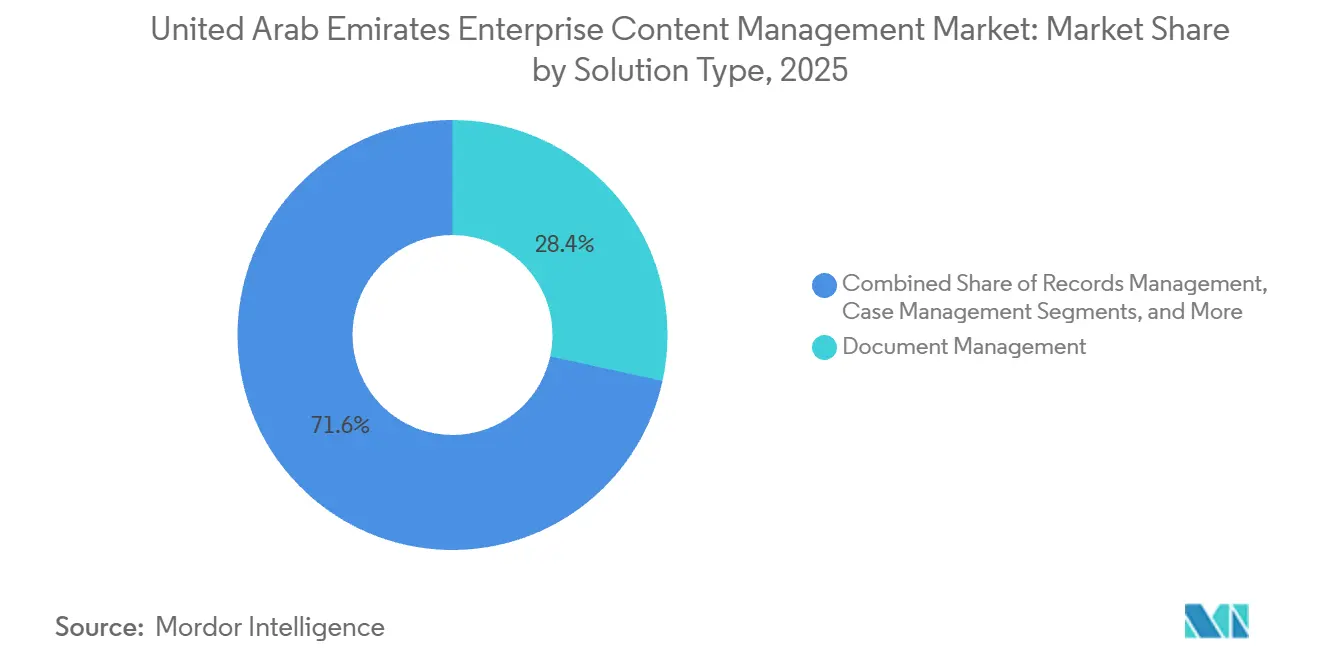
Workflow and Business Process Management is projected to expand at a 15.56% CAGR through 2031, making it the fastest-growing solution segment in the United Arab Emirates enterprise content management market. That pace reflects a clear shift in buyer priorities, because many organizations that completed early digitization now want automation layers that can route approvals, standardize tasks, and reduce manual handoffs. Document Management remained the largest segment in 2025, and it captured 28.43% of the United Arab Emirates enterprise content management market share in the same year. Its leadership is still supported by the ongoing move from paper records and disconnected files toward governed digital repositories across government, BFSI, healthcare, and education. This part of the market remains foundational, because every higher-value use case still depends on a stable document layer.
The next stage of growth is being shaped by the convergence of workflow management, case management, and AI-assisted service execution. Abu Dhabi’s TAMM 4.0 launch is an important example, because AutoGov was presented as an autonomous service capability for document-heavy citizen workflows. Records Management continues to matter in regulated sectors that need retention control, audit readiness, and policy-led disposition. Digital Asset Management and Web Content Management add a different stream of demand, especially where organizations manage rich media, multilingual content, and citizen-facing digital channels. Taken together, that mix shows how the United Arab Emirates enterprise content management industry is moving from storage-centered deployments toward broader process execution and service delivery.



By Deployment Mode: Cloud Dominates as Sovereign Compliance Reshapes Architecture
The United Arab Emirates enterprise content management market size for cloud deployment is projected to expand at a 14.89% CAGR through 2031, while cloud already held a 79.18% share in 2025. That is an unusual mix, because the leading deployment model is still the fastest-growing one. The pattern reflects two demand streams at once, which are greenfield adoption by smaller and newer organizations, and migration of older on-premises environments by regulated enterprises that now face tighter localization and compliance needs. This keeps Cloud Central in the United Arab Emirates enterprise content management market even as the type of cloud being purchased becomes more specialized. It also explains why growth remains strong despite the already high penetration base.
The real architectural shift is from standard public cloud toward sovereign, in-country, or tightly controlled regional cloud environments. The certification of du Tech’s National Hypercloud and the Central Bank-Core42 sovereign financial cloud initiative both strengthened the case for local hosting in regulated sectors. On-premises deployment still serves organizations with classified data, air-gapped environments, or unusually strict internal controls. Hybrid models are also gaining traction because they let buyers move content in phases while keeping operational and compliance risk manageable. This transition shows that the United Arab Emirates enterprise content management industry is not moving away from the cloud, but it is redefining what acceptable cloud architecture now looks like.
By Enterprise Size: Large Enterprises Lead While SMEs Close the Gap
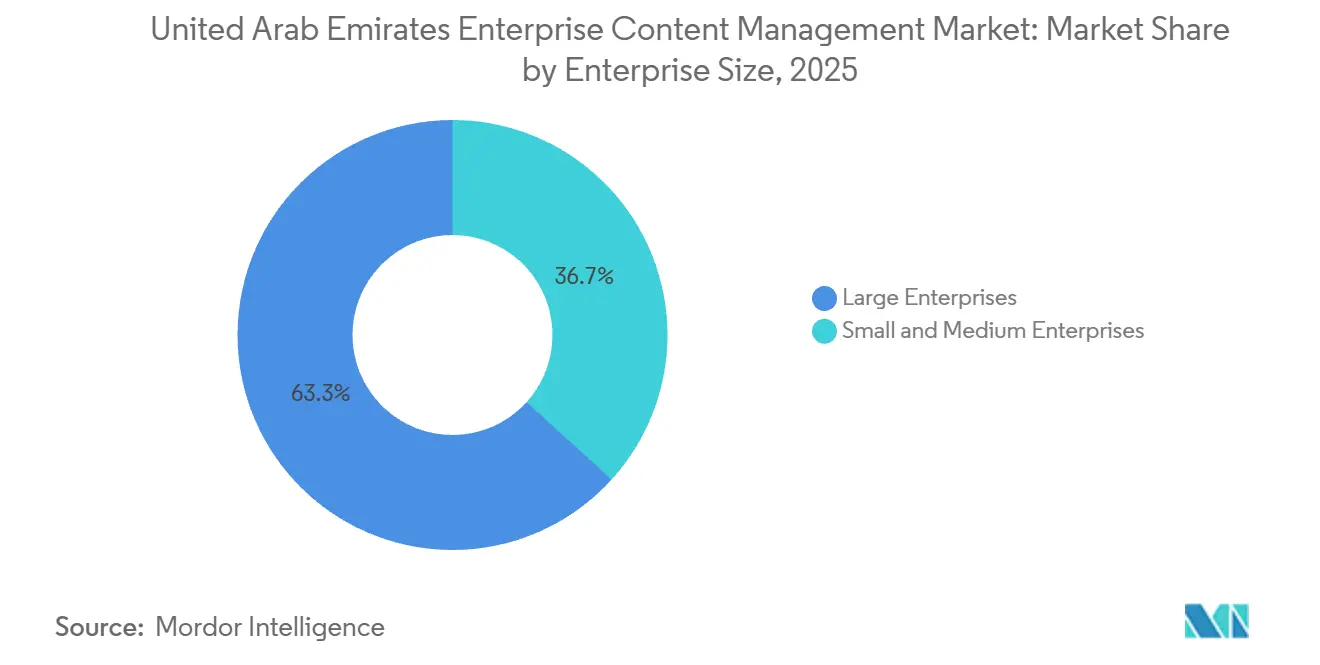
Large Enterprises accounted for 63.21% of revenue in 2025, making them the dominant customer segment in the United Arab Emirates enterprise content management market. Their lead comes from the sector mix, because government, BFSI, healthcare, and large diversified groups carry the heaviest document volumes, integration requirements, and compliance costs. These buyers are also better able to fund long implementation programs, dedicated security controls, and process redesign around enterprise-grade platforms. In many cases, one large bank or ministry can generate demand equal to a wide set of smaller firms simply through record volume and audit complexity. That concentration keeps large accounts at the center of vendor strategy.
Small and Medium Enterprises are still becoming more important, because they are projected to grow at a 15.11% CAGR through 2031. Cloud-native platforms lower the entry barrier for this group by reducing capital spending, shortening implementation time, and offering easier consumption-based pricing. The growth of digital-first firms across Dubai Internet City, Hub71, and the wider free zone ecosystem is building a larger addressable base for content tools that are API-led and easier to configure. The KPMG UAE Tech Report 2026 finding that 97% of organizations embed AI agents into workflows, suggests that smaller companies are also likely to add AI-capable content functions over time. As a result, vendors that once focused only on large contracts are adapting packages and pricing for a faster-growing SME tier in the United Arab Emirates enterprise content management market.
By End-User Industry: Government Anchors Demand While Healthcare Sets the Growth Pace
Healthcare and Lifesciences is projected to expand at a 16.38% CAGR through 2031, which makes it the fastest-growing end-user segment in the United Arab Emirates enterprise content management market. Dubai’s NABIDH platform had surpassed 10.41 million patient records by June 2025, which shows the scale of digital health information already being managed in the country.[3]Dubai Eye 103.8, “Dubai's NABIDH Platform Surpasses 10 Million Medical Records,” Dubai Eye 103.8, dubaieye1038.com The Ministry of Health and Prevention also unveiled Bayan in 2026 as an enterprise health data warehouse built around hundreds of indicators and dozens of dashboards, which points to growing demand for interoperable and well-governed content backends. A 2025 medical products and devices regulatory framework adds another layer of documentation and records control for lifesciences participants. These conditions make healthcare one of the clearest growth pockets for vendors that can support privacy, interoperability, and structured records handling.
Government and Public Administration remained the largest end-user segment in 2025, with a 26.37% revenue share. That position is tied to the scale of national and emirate-level digital service programs, which keep document governance, workflow control, and auditability high on spending agendas. BFSI remains the next major demand layer because localization, AML, and inspection readiness continue to force formal records modernization. IT and telecommunications, manufacturing, retail and e-commerce, and education add broader opportunity, though their buying cycles tend to be less compressed than those in government and banking. This leaves the United Arab Emirates enterprise content management market balanced between large public-led contracts and a widening set of private sector use cases.
Geography Analysis
Abu Dhabi and Dubai generated the majority of demand in the United Arab Emirates enterprise content management market in 2025, and Abu Dhabi remained the stronger government-led growth center. Abu Dhabi’s Government Digital Strategy 2025-2027 committed USD 3.54 billion to digitization, sovereign cloud adoption, and AI-native government operations, which gave the emirate an unusually strong pipeline of content-heavy transformation work. The Abu Dhabi Global Market also tightened the importance of formal records controls through data protection rules aligned with high international standards, which affects financial and professional services firms registered there. The Frontier Employee Program further reinforced Abu Dhabi’s lead, because it moved AI-assisted document workflows into daily use across 27 government entities and 35,000 civil servants.
Dubai’s demand profile is broader because private sector activity plays a larger role alongside government modernization. The order to bring government services into a unified digital platform within one year increased pressure for interoperable repositories and records governance across entities. DIFC’s own data protection regime adds a separate layer of compliance for financial and professional firms operating in the center, which supports sustained demand for audit-ready content systems. Dubai also stands out in healthcare content management because NABIDH moved past 10.41 million medical records and showed that large-scale records exchange can operate under a federated governance model. Wider initiatives such as Riayati and the paperless government agenda keep document volumes high even outside a single procurement cycle.
The Northern Emirates are still a smaller base, but they represent the clearest medium-term expansion area for the United Arab Emirates enterprise content management market. Sharjah’s Government Media Office presented a new media content management platform in June 2026, which showed that structured content governance is beginning to deepen beyond the two main centers.[4]Sharjah24, “Government of Sharjah Media Office Reviews Media Content Management Platform,” Sharjah24, sharjah24.ae The expansion of federal digital identity and service integration into more emirate-level agencies also raises the need for connected back-end content handling at the local level. As uniform digital government expectations spread across all seven emirates, deferred demand in the Northern Emirates is likely to turn into a more visible opportunity for vendors that can deploy at lower cost and with simpler implementation models.
Competitive Landscape
The United Arab Emirates enterprise content management market is moderately concentrated, with a first tier of global vendors that includes OpenText, Microsoft, IBM, Hyland, and Oracle, and a second tier of regional and mid-market specialists that compete in narrower workflow and compliance pockets. OpenText strengthened its position through an October 2025 agreement with Core42 around AI, cloud, and intelligent automation for the UAE public sector. It also added local route-to-market depth through a separate agreement with Moro Hub, which gave it stronger access to Dubai’s digital infrastructure ecosystem. OpenText’s work with the Higher Colleges of Technology also created a visible reference deployment around cloud migration and AI-enabled content management in a public institution.[5]OpenText Blogs, “Turning Complexity into Clarity, Advancing Zero Bureaucracy at UAE's Higher Colleges of Technology Using OpenText Documentum Content Management,” OpenText Blogs, blogs.opentext.com These moves show why large accounts in the United Arab Emirates enterprise content management market continue to favor vendors with both product scale and local delivery credibility.
Hyland also improved its position in June 2026 through its Microsoft Azure partnership, which gave buyers geographic data residency options that are more aligned with UAE compliance expectations. The practical effect is that sovereign and in-country infrastructure is becoming part of the product decision rather than only a hosting detail. IBM and e& also pushed agentic AI into governance, risk, and compliance workflows, which shows that orchestration and content handling are becoming more closely linked in enterprise buying criteria. One open space remains Arabic-language AI content management, because large global vendors still lack a fully established Arabic-native generative classification and retrieval position built for the UAE government and regulated enterprise workflows. As certification expectations tighten, vendors that delay localization and compliance alignment are likely to lose access to the strongest public and regulated opportunities in the United Arab Emirates enterprise content management market.
Regional and specialist vendors still have room to compete where buyers want faster implementation, Arabic-language workflow support, or narrower compliance solutions. Newgen’s presence in government and regulated financial environments illustrates that specialists can still win when the use case is clear and delivery speed matters. This keeps pricing and positioning active below the top tier, especially in workflow-heavy projects that do not require the broadest enterprise suite. Overall, the United Arab Emirates enterprise content management market remains competitive, but scale, local infrastructure alignment, and credible references still give the largest vendors a durable advantage.
United Arab Emirates Enterprise Content Management Industry Leaders
OpenText Corporation
Hyland Software, Inc.
Infas MEA
IBM Corporation
Newgen Software Technologies Limited
- *Disclaimer: Major Players sorted in no particular order

Recent Industry Developments
- June 2026: Abu Dhabi Government and Microsoft launched the Frontier Employee Programme, deploying Microsoft 365 Copilot to 35,000 civil servants across 27 government entities with Advanced Data Residency (ADR) guarantees ensuring all AI-based document processing occurs within UAE borders; the initiative establishes generative AI-augmented content workflows as the baseline operational standard for Abu Dhabi's public sector, directly accelerating government ECM platform demand across the TAMM ecosystem and 1,150-plus connected services.
- June 2026: UAE Cabinet established the Federal Authority for Artificial Intelligence and Data, consolidating three separate technology oversight bodies into a unified authority reporting directly to the Cabinet; the authority sets binding standards for data management, AI governance, and digital transformation compliance, including requirements that directly govern how ECM platforms handle government and sensitive enterprise content.
- June 2026: Hyland announced a strategic partnership with Microsoft to bring the Hyland Content Innovation Cloud to Microsoft Azure, offering enterprise customers geographic data residency options, including UAE-domiciled Azure regions; the partnership directly addresses sovereign cloud compliance requirements for content management workloads in UAE-regulated industries and expands Hyland's addressable government and BFSI segment.
- May 2026: UAE Cabinet approved the Agentic AI Government Framework, mandating that at least 50% of federal government sectors, services, and operations transition to agentic AI within two years; with 80,000 federal workers enrolled in AI training, document processing, and content orchestration are named as core use cases, directly expanding institutional ECM procurement across federal entities.


United Arab Emirates Enterprise Content Management Market Report Scope
The United Arab Emirates enterprise content management market comprises software platforms and related services that enable organizations to capture, create, manage, store, secure, govern, and distribute enterprise content and business documents throughout their lifecycle. The market includes document management, records management, workflow and business process management, case management, digital asset management, web content management, and other content-centric solutions delivered through cloud, on-premises, and hybrid deployment models. Market estimates represent revenue generated from enterprise content management software licenses, subscriptions, maintenance, implementation, consulting, integration, training, and managed services within the United Arab Emirates.
The United Arab Emirates Enterprise Content Management Market Report is Segmented by Solution Type (Document Management, Records Management, Workflow and Business Process Management, Case Management, Digital Asset Management, Web Content Management, and Other Solutions), Deployment Mode (On-Premises, Cloud, and Hybrid), Enterprise Size (Small and Medium Enterprises, and Large Enterprises), and End-user Industry (BFSI, Government and Public Administration, Healthcare and Lifesciences, IT and Telecommunications, Industrial Manufacturing, Retail and E-Commerce, Media and Entertainment, Education, Energy and Utilities, and Other End-user Industries). The Market Forecasts are Provided in Terms of Value (USD).
| Document Management |
| Records Management |
| Workflow and Business Process Management |
| Case Management |
| Digital Asset Management |
| Web Content Management |
| Other Solutions |
| On-Premises |
| Cloud |
| Hybrid |
| Small and Medium Enterprises |
| Large Enterprises |
| BFSI |
| Government and Public Administration |
| Healthcare and Lifesciences |
| IT and Telecommunications |
| Industrial Manufacturing |
| Retail and E-Commerce |
| Media and Entertainment |
| Education |
| Energy and Utilities |
| Other End-User Industries |
| By Solution Type | Document Management |
| Records Management | |
| Workflow and Business Process Management | |
| Case Management | |
| Digital Asset Management | |
| Web Content Management | |
| Other Solutions | |
| By Deployment Mode | On-Premises |
| Cloud | |
| Hybrid | |
| By Enterprise Size | Small and Medium Enterprises |
| Large Enterprises | |
| By End-User Industry | BFSI |
| Government and Public Administration | |
| Healthcare and Lifesciences | |
| IT and Telecommunications | |
| Industrial Manufacturing | |
| Retail and E-Commerce | |
| Media and Entertainment | |
| Education | |
| Energy and Utilities | |
| Other End-User Industries |


Key Questions Answered in the Report
What is the current and forecast value of the United Arab Emirates enterprise content management space?
It was valued at USD 0.56 billion in 2025, stands at USD 0.63 billion in 2026, and is forecast to reach USD 1.22 billion by 2031 at a 14.25% CAGR.
Which solution area leads revenue and which one is growing the fastest?
Document Management led with a 28.43% share in 2025, while Workflow and Business Process Management is projected to post the fastest growth at 15.56% through 2031.
Why is cloud deployment so dominant in the UAE?
Cloud held 79.18% share in 2025 because it supports faster rollout, lower upfront costs, and stronger alignment with local compliance and sovereign hosting requirements.
Which customer group is expanding the fastest?
Healthcare and Lifesciences is the fastest-growing end-user segment at 16.38% CAGR, while SMEs are the fastest-growing enterprise size group at 15.11% CAGR.
How are Abu Dhabi and Dubai shaping demand?
Abu Dhabi is driving large public-sector programs through AI-native government and sovereign cloud projects, while Dubai adds strong private-sector and financial services demand alongside public digital integration.
Which vendors appear best positioned for large contracts?
OpenText, Microsoft, IBM, Hyland, and Oracle are best placed in large accounts because scale, sovereign cloud alignment, and public-sector references matter strongly in current buying decisions.
Page last updated on:






