
Ultra-Precision Machining Centers Market Size and Share
Market Overview
| Study Period | 2020 - 2031 |
|---|---|
| Market Size (2026) | USD 1.66 Billion |
| Market Size (2031) | USD 2.48 Billion |
| Growth Rate (2026 - 2031) | 8.36 % |
| Fastest Growing Market | Asia-Pacific |
| Largest Market | Asia-Pacific |
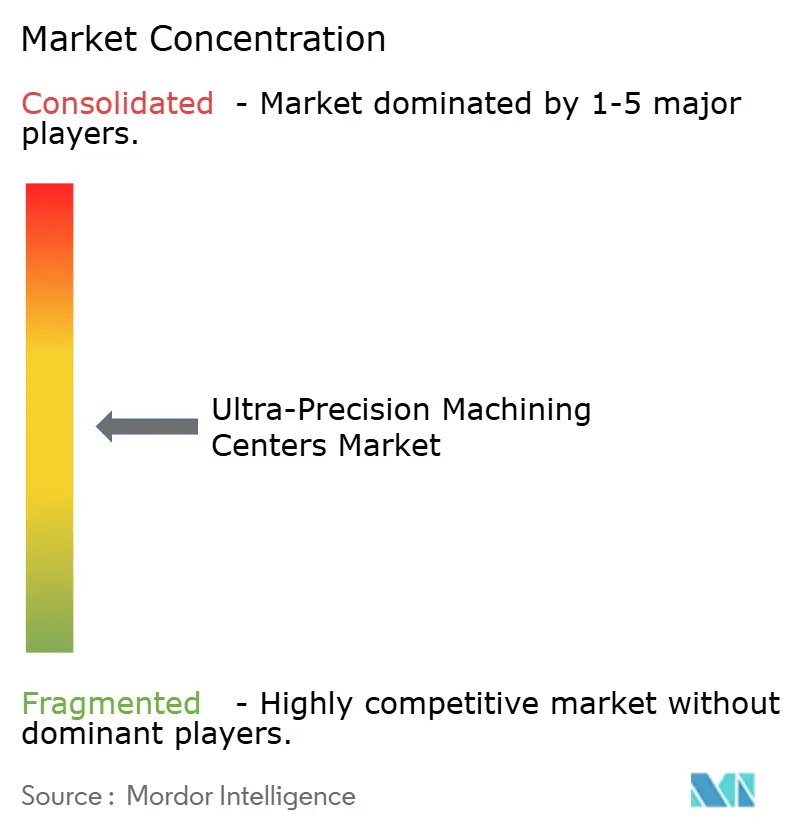
| Market Concentration | Medium |
Major Players *Disclaimer: Major Players sorted in no particular order Image © Mordor Intelligence. Reuse requires attribution under CC BY 4.0. | |
Ultra-Precision Machining Centers Market Analysis by Mordor Intelligence
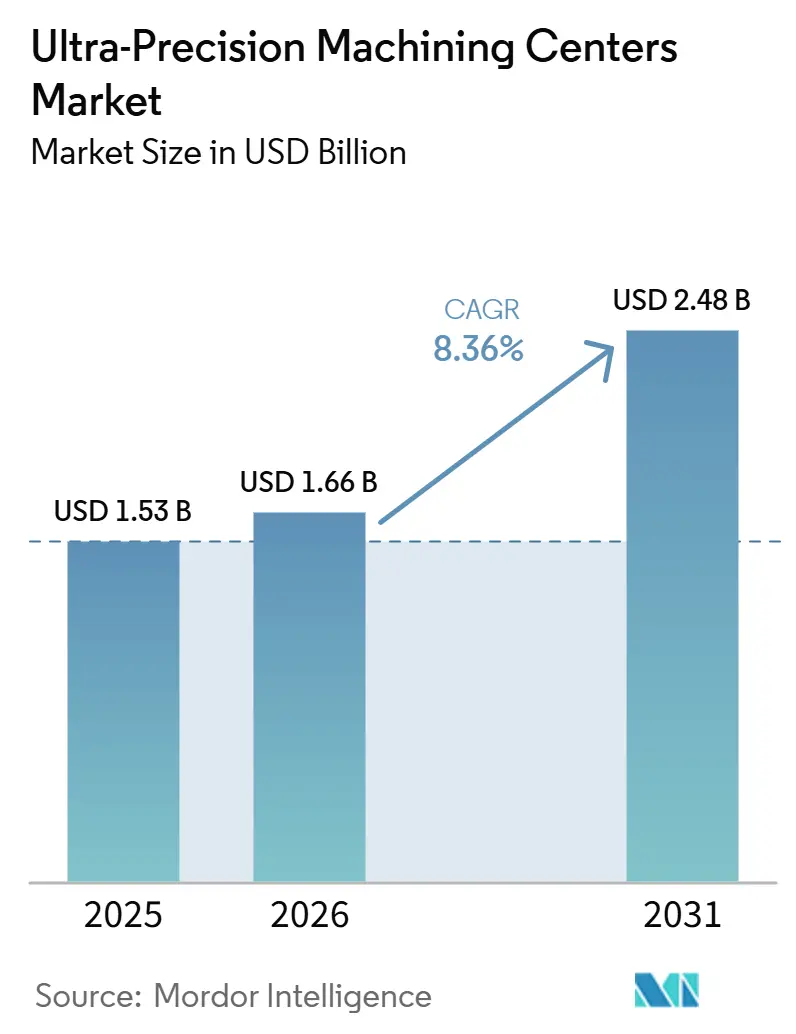
The Ultra-Precision Machining Centers Market size is expected to grow from USD 1.53 billion in 2025 to USD 1.66 billion in 2026 and is forecast to reach USD 2.48 billion by 2031 at 8.36% CAGR over 2026-2031.
The ultra-precision machining centers market is moving into a more stringent manufacturing environment, where semiconductors, aerospace, optics, and defense buyers now require tolerances that standard precision systems cannot meet. Demand is being shaped by rising fab investment, tighter part qualification rules, and a broader shift toward sub-micron and nanometer-level control in production settings. Buyers are also weighing software capability more heavily because AI-enabled compensation and digital twin support now influence machine performance, scrap reduction, and the useful life of installed assets. At the same time, the ultra-precision machining centers market faces constraints from export controls, high facility qualification costs, and a limited pool of operators capable of commissioning and sustaining these systems. The clearest openings remain in aerospace retrofit programs, silicon photonics scale-up, quantum device fabrication, and augmented reality optics, where the specification gap between conventional and ultra-precision equipment continues to widen.
Key Report Takeaways
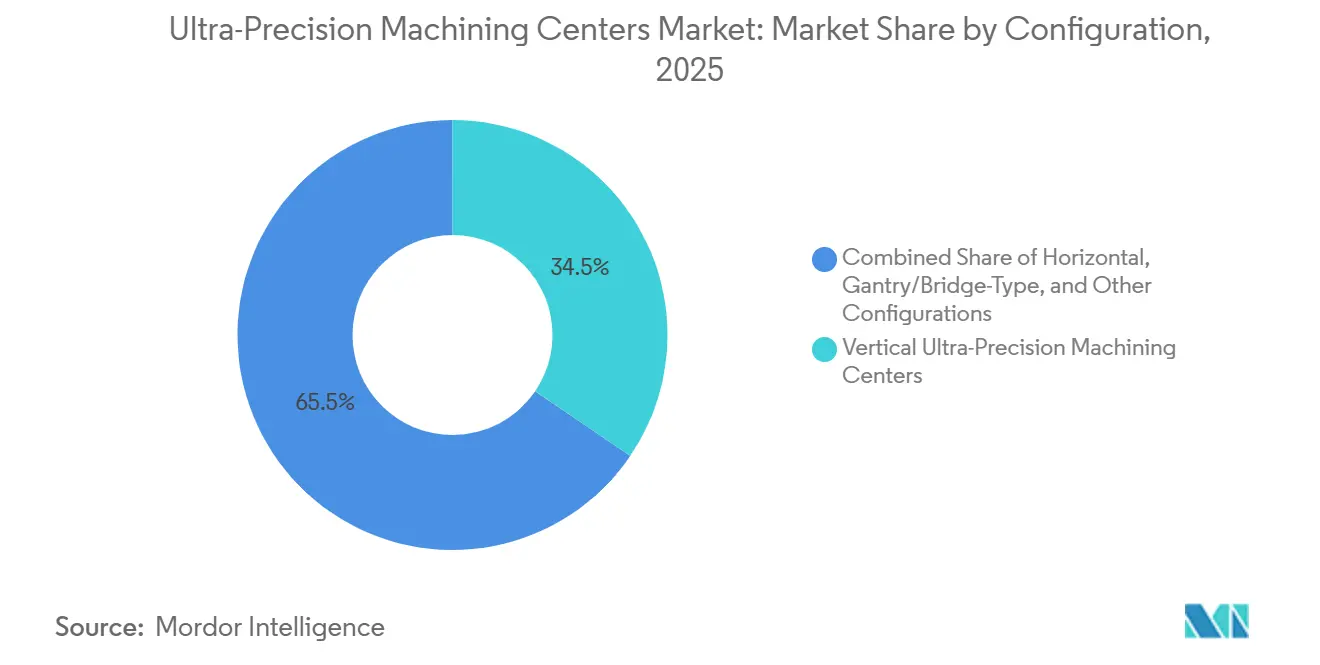
- By configuration, vertical ultra-precision machining centers accounted for 34.50% of the ultra-precision machining centers market share in 2025, while gantry and bridge-type systems are projected to be the fastest-growing, with a 9.60% CAGR through 2031.
- By machine type, 5-axis ultra-precision machining centers accounted for 39.45% of the ultra-precision machining centers market size in 2025 and are also expected to remain the fastest-growing, with a 10.00% CAGR through 2031.
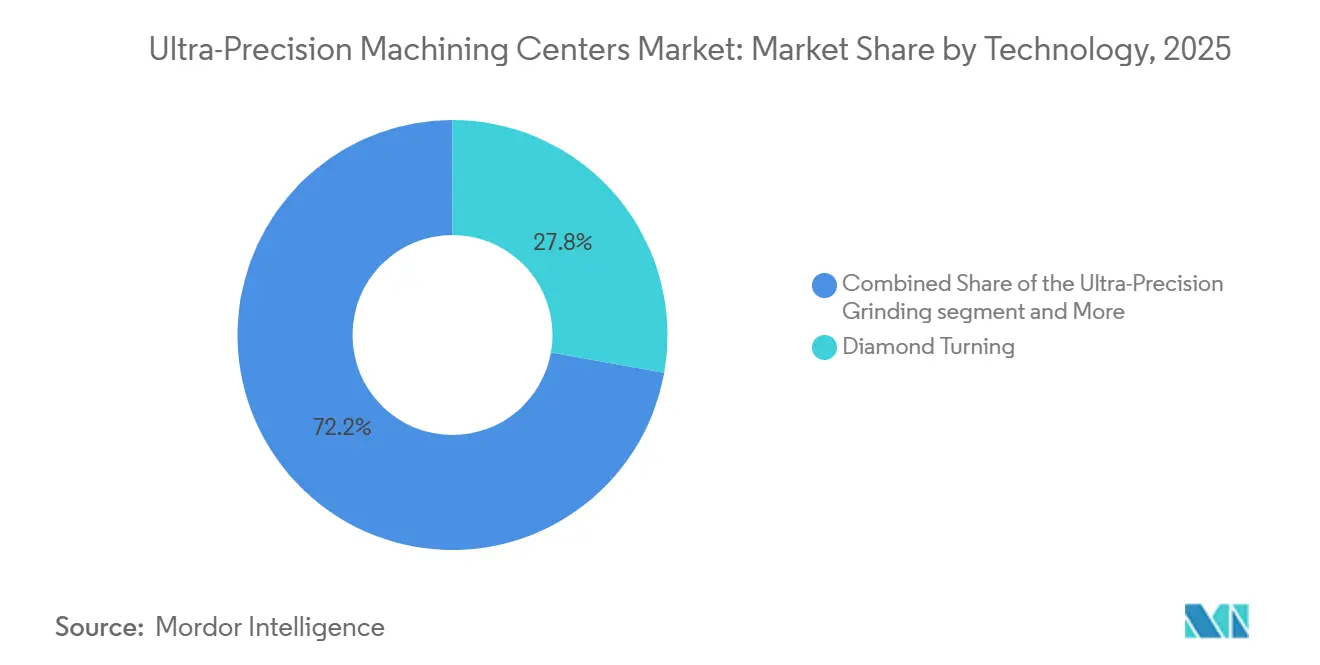
- By technology, diamond turning held 27.80% of the market share in 2025, while laser-based ultra-precision machining is projected to expand the fastest at 10.00% CAGR through 2031.
- By end user, the semiconductor and electronics segment accounted for 31.00% of the market in 2025 and is also expected to remain the fastest-growing, with an 11.30% CAGR through 2031.
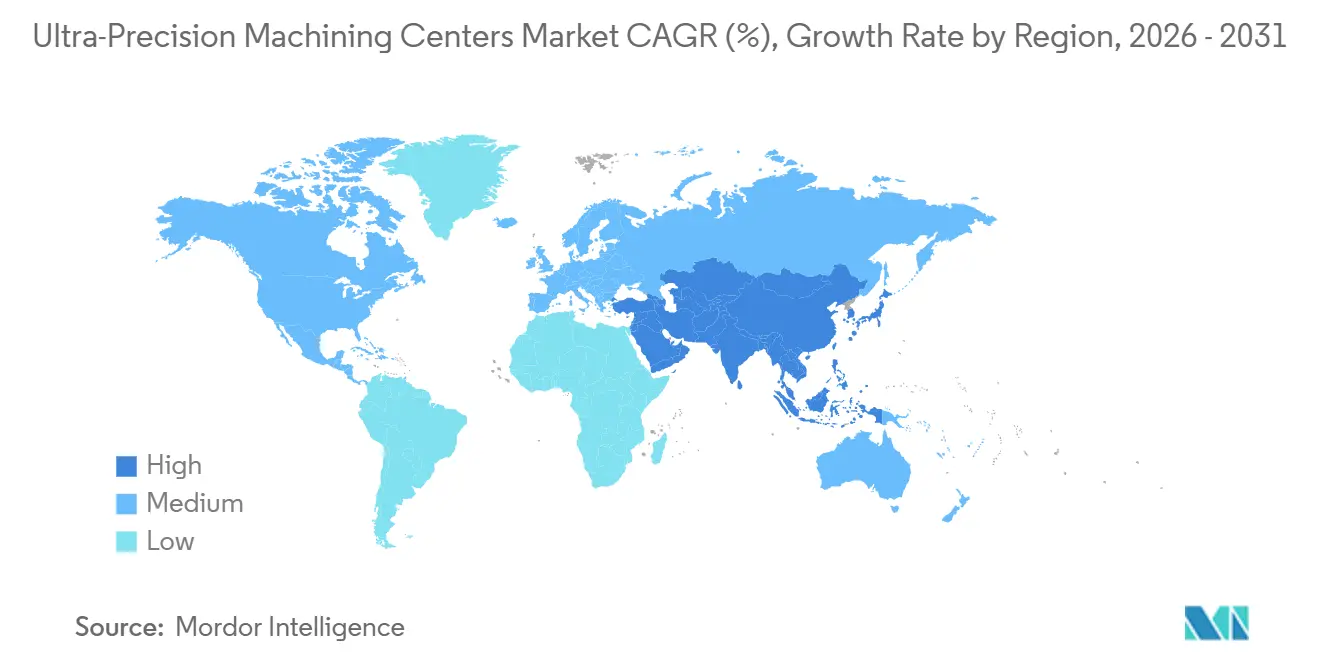
- By geography, Asia-Pacific held the leading position, accounting for 39.55% market share in 2025 and is expected to remain the fastest-growing regional segment at 9.30% CAGR through 2031.
Note: Market size and forecast figures in this report are generated using Mordor Intelligence’s proprietary estimation framework, updated with the latest available data and insights as of January 2026.
Market Trends and Insights
Drivers Impact Analysis of Ultra-Precision Machining Centers Market*
| Driver | (~) % Impact on CAGR Forecast | Geographic Relevance | Impact Timeline |
|---|---|---|---|
| Semiconductor Fab Expansion Requiring Sub-Micron Tolerances | +2.8% | Global, concentrated in Asia-Pacific including China, Taiwan, and South Korea, with spillover to North America and Europe | Medium term (2-4 years) |
| Aerospace Titanium and Superalloy Part Complexity | +1.9% | North America and Europe, with growing pull from Japan and India aerospace supply chains | Long term (≥ 4 years) |
| AI-Enabled Closed-Loop Compensation in Machine Controls | +1.4% | Global, with early commercial uptake concentrated in Asia-Pacific and North America | Medium term (2-4 years) |
| Optical and Photonics Manufacturing Scale-Up | +1.0% | Global, with key demand nodes in Taiwan, Japan, South Korea, Germany, and the Netherlands | Medium term (2-4 years) |
| Defense Reshoring and Localized Precision Capacity Buildout | +0.7% | North America first, with secondary gains in the United Kingdom, Germany, and France | Medium term (2-4 years) |
| Retrofit-Driven Replacement Cycle in Installed Precision Assets | +0.3% | Global, with near-term concentration in established precision clusters including Stuttgart, Tokyo, and the Boston corridor | Short term (≤ 2 years) |
| Source: Mordor Intelligence | |||
Semiconductor Fab Expansion Requiring Sub-Micron Tolerances
Record semiconductor investment is the main commercial force lifting the ultra-precision machining centers market in 2026. Global semiconductor equipment billings reached USD 135.1 billion in 2025, up 15% year on year, and 300mm fab equipment spending is projected to rise 18% to USD 133 billion in 2026. TSMC is also raising capital expenditure to a record range of USD 40 billion to USD 56 billion in 2026, while advancing its Arizona fabrication buildout and future sub-2nm production plans. In the ultra-precision machining centers market, every advanced fab build requires more wafer chucks, optical mounts, vacuum chamber parts, and photomask-related components that depend on ultra-fine surface quality and repeatability. A 2026 review confirmed that modern ultra-precision diamond turning and micro-grinding systems can achieve form accuracy below 50 nm and surface finishes below 1 nm Ra on metals, ceramics, and semiconductor wafers.[1] This shift indicates that the ultra-precision machining centers market benefits not only from volume growth in fabs but also from the higher minimum machining standards that each new process generation requires suppliers to meet.
Aerospace Titanium and Superalloy Part Complexity
Aerospace demand is strengthening the ultra-precision machining centers market, as titanium alloys and nickel-based superalloys are difficult to machine to very tight tolerances. A 2025 aerospace review noted that titanium machining is affected by its low thermal conductivity, chemical reactivity, and springback, which can cause dimensional errors unless the process is tightly controlled. A second 2025 review found that productive titanium machining depends on advanced tool design, controlled coolant delivery, and very accurate cutting motion, especially for α+β titanium alloys used in structural airframe parts. Turbine blades add another layer of complexity because internal cooling passages and leading-edge finish quality must be maintained within extremely tight limits at high operating temperatures. The ultra-precision machining centers market benefits from this because aircraft manufacturers are embedding machining data into digital traceability systems, and platforms that cannot deliver repeatable sub-micron output risk exclusion from qualified supply chains. As certification programs progress toward the end of the decade, the ultra-precision machining centers market should continue to see sustained aerospace demand even without a surge in entirely new aircraft programs.
AI-Enabled Closed-Loop Compensation in Machine Controls
AI-based compensation is changing how buyers judge value in the ultra-precision machining centers market. A 2026 study in Mechanical Systems and Signal Processing showed that a digital twin-based contour-error compensation system reduced real-time tracking error on physical ultra-precision equipment. Another 2026 study showed that neural network models combined with swarm optimization can estimate and compensate for CNC machining errors before they affect the workpiece surface.[2] For high-value parts in aerospace, optics, and semiconductor production, that matters because a rejected part can cost more than a full day of machine time. The ultra-precision machining centers market is therefore separating into systems that pair mechanical accuracy with embedded software intelligence and systems that still depend on heavier offline inspection and rework. Over the forecast period, this will continue to push the ultra-precision machining centers market toward software-defined performance as CNC developers add more adaptive control and reinforcement learning capabilities.
Optical And Photonics Manufacturing Scale-Up
Silicon photonics and advanced optics are opening a fresh demand lane for the ultra-precision machining centers market outside the traditional fab equipment cycle. In July 2026, United Microelectronics Corporation and SILITH Technology announced the first mass-production wafer delivery of photonic ICs from UMC's 12-inch Singapore fab for 1.6 Tbps silicon photonics platforms. In the same month, Tower Semiconductor announced a major silicon photonics capacity expansion in Japan with METI support and Phase 1 production readiness targeted for Q4 2027. This matters to the ultra-precision machining centers market because photonics output is often limited by optomechanical assembly accuracy, especially the active alignment of photonic integrated circuits with fiber and waveguide structures. Aerotech, Santec, and SENKO highlighted that requirement in January 2026 when they introduced the PICAlign architecture for co-packaged optics production using nano-precision motion stages with six-degree-of-freedom alignment. As output moves from pilot-scale to volume production, the ultra-precision machining centers market is poised to benefit from rising demand for lens mounts, waveguide substrates, and precision housings that conventional CNC systems cannot reliably produce.
Restraints Impact Analysis of Ultra-Precision Machining Centers Market*
| Restraint | (~) % Impact on CAGR Forecast | Geographic Relevance | Impact Timeline |
|---|---|---|---|
| High Capital Intensity and Qualification Burden | -1.5% | Global, most acute in South and Southeast Asia and the Middle East & Africa, where cleanroom infrastructure is still limited | Long term (≥ 4 years) |
| Export Controls, Tariffs, and Customs Compliance Friction | -1.0% | Global, with direct pressure on United States, European, and Japanese exporters and spillover for buyers in China, India, and wider Asia-Pacific | Short term (≤ 2 years) and Medium term (2-4 years) |
| Skilled Operator and Metrology Talent Shortage | -0.7% | Global, with highest severity in North America and Europe | Long term (≥ 4 years) |
| Thermal Stability and Facility Infrastructure Constraints | -0.4% | Global, especially in markets without mature precision manufacturing infrastructure | Medium term (2-4 years) |
| Source: Mordor Intelligence | |||
High Capital Intensity and Qualification Burden
High machine prices are only one part of the entry barrier in the ultra-precision machining centers market. ISO 230-3:2020 defines the thermal conditions under which machine tool accuracy is validated, including a 20°C reference environment, which means facilities without very tight temperature control face major qualification limits before production even starts. ISO 14644-1 also establishes cleanroom air cleanliness classifications relevant to contamination-sensitive precision work, factoring in facility costs before the machine itself is installed. In regulated sectors such as aerospace and medical devices, approval cycles can stretch for months because process development, first-article inspection, and statistical process control must be established before serial output is accepted. The ultra-precision machining centers market, therefore, remains concentrated among larger manufacturers that can absorb both infrastructure spending and long qualification timelines. This barrier also slows market entry in newer manufacturing locations where demand exists, but the supporting thermal, metrology, and cleanroom ecosystem is still limited.
Export Controls, Tariffs, and Customs Compliance Friction
Trade and export rules are becoming a harder constraint on the ultra-precision machining centers market. A September 2024 Federal Register rule expanded United States controls on semiconductor, quantum, and additive manufacturing-related items, while changes in ECCN structures increased compliance obligations for advanced equipment categories. ECCN 2B001 was expanded in 2024 to cover simultaneous 5-axis CNC controllers above defined positional accuracy thresholds, which reaches much of the commercially relevant ultra-precision installed base. In July 2026, BIS released a draft interim rule that would further narrow the STA licensing exception for qualifying five-axis and above CNC machining centers, with a proposed effective date of September 1, 2026. That adds more licensing, end-user verification, and documentation work across exporters, buyers, and freight partners. The result is that the ultra-precision machining centers market now carries a lasting compliance burden that can lengthen delivery times and reduce cross-border flexibility for both suppliers and customers.
*Our forecasts treat driver/restraint impacts as directional, not additive. The impact forecasts reflect baseline growth, mix effects, and variable interactions.
Ultra-Precision Machining Centers Market Segment Analysis
By Configuration:
Vertical Platforms Hold Volume Advantage as Gantry Formats Capture Aerospace DemandVertical ultra-precision machining centers held a 34.50% share in 2025, while gantry and bridge-type systems are expected to expand the fastest at at 9.60% CAGR through 2031. Their lead reflects a long-established base across semiconductor tooling, optical components, and medical device parts that fit stable, compact work envelopes. The vertical arrangement also supports gravity-assisted chip removal and simpler workholding for disc, ring, and wafer-like substrates, which remain common in high-volume precision production. That practical setup has helped the ultra-precision machining centers market maintain strong demand for vertical systems in applications where repeatability and part handling matter more than large travel range. Makino's iQ500 is an example of how the category continues to advance, with 0.005 µm-resolution scale feedback and 45,000 rpm spindle speeds for ultra-fine milling in LED tooling and optics-related work.
The growth profile is shifting, however, because gantry and bridge-type systems solve a different structural problem in the ultra-precision machining centers market. Large aerospace parts, defense housings, and optical mirror blanks require long travel ranges without sacrificing sub-micron volumetric accuracy along the entire path. Gantry frames provide stronger stiffness, more stable force flow, and better geometric control across wide working envelopes than many alternative layouts. GROB's GP1350 launch in March 2026 to show this trend, with a portal milling center offering 1,400 mm by 1,950 mm by 1,100 mm travel and full automation compatibility for large parts. That makes the ultra-precision machining centers market more polarized by use case, with vertical systems remaining the volume choice and gantry formats pulling ahead where structural size and rigidity dominate buying decisions. Horizontal systems and dedicated rotary or mill-turn cells remain relevant, but their roles stay narrower and more application-specific.

By Machine Type:
5-Axis Systems Define the Performance Benchmark for Complex-Geometry Production5-axis systems were both the largest and the fastest-growing machine type in the ultra-precision machining centers market, with a 39.45% market share in 2025 and an expected 10.00% CAGR through 2031. Their lead comes from the need to machine complex aerospace surfaces and advanced precision electronics parts in a single setup with minimal stack-up error. For turbine blades and similarly complex components, simultaneous 5-axis interpolation allows continuous finishing across multiple surfaces without repeated re-clamping. That improves both geometric control and throughput, which is why the ultra-precision machining centers market increasingly treats 5-axis capability as a baseline requirement in top-end applications. A 2026 study in the International Journal of Advanced Manufacturing Technology found that deep learning and multi-objective optimization in 5-axis CNC milling can improve machining accuracy, energy use, and tool wear together under closed-loop control. This reinforces the idea that 5-axis architecture is not only a mechanical advantage in the ultra-precision machining centers market, but also the format best suited to advanced control software.
Other machine types still hold important positions, although their roles are narrower. The 3-axis installed base remains relevant for flat and rotationally symmetric parts in optical fabrication and metrology tooling, where simpler kinematics can limit thermal error accumulation. The 4-axis category often serves as a transition step for manufacturers moving from indexed work into more continuous precision machining on cylindrical aerospace and medical parts. Multi-tasking ultra-precision systems are attracting interest from contract manufacturers because turning, milling, and sometimes grinding can be completed in a single enclosure, reducing handoff time across operations. Regulated frameworks such as AS9100 Rev D and ISO 13485 favor platforms that can complete more operations within a single qualification cycle, which supports the demand for multitasking systems in the ultra-precision machining centers market. DMG MORI's DM 20 linear and ULTRASONIC 20 linear 3rd generation reflect the premium edge of this category, where simultaneous 5-axis motion, linear drives, and direct measurement are aimed at glass, ceramic, and other difficult precision materials.
By Technology:
Diamond Turning's Process Maturity Anchors Volume While Laser Machining Opens New Material FrontiersDiamond turning held 27.5% market share and had the largest installed base of ultra-precision machining centers in 2025. Its position rests on long use in optical lens production, military infrared optics, and semiconductor wafer substrate preparation, where customers already understand its process limits and qualification pathways. That maturity matters because approved operator training, known process control benchmarks, and established surface specifications reduce adoption risk for buyers. A 2026 review reported spindle errors below 0.05 µm on diamond-turning machines, with real-time interferometry and atomic-force microscopy supporting in-process correction of nanometric deviations. In the ultra-precision machining centers market, that proven record gives diamond turning an advantage over newer methods when defense, semiconductor, and optics buyers need performance they can qualify quickly. Grinding and milling continue to complement this installed base, with grinding favored for hard and brittle materials and milling used where free-form metal geometry is the central requirement.
Laser-based ultra-precision machining is expected to be the fastest-growing technology in the ultra-precision machining centers market, with a 10.00% CAGR through 2031. The driver is not only higher output in silicon photonics and augmented reality optics, but also the need to machine precision glass and silicon carbide with less contact stress and less thermal damage than traditional cutting can create. A 2026 study in Precision Engineering that demonstrated in-situ laser polishing of diamond-turned silicon surfaces, achieving roughness improvements beyond those achievable with mechanical polishing alone. That kind of result broadens the addressable material set for the ultra-precision machining centers market and supports hybrid process chains rather than single-method machining. Micro-EDM still serves a focused role in hardened tool steel, tungsten carbide, and conductive ceramics, where spark erosion can reach shapes that cutting tools struggle to form. Hybrid systems that combine ultrasonic assistance, laser heating, and cutting are still in their early stages. Still, they show how the ultra-precision machining centers market is beginning to respond to harder materials and tighter finish demands by integrating processes rather than relying on isolated machine functions.[3]
By End User:
Semiconductor Pull Establishes a Demand Floor, Adjacent Sectors Drive Incremental ComplexitySemiconductors and electronics were both the largest and the fastest-growing end-user segments in the ultra-precision machining centers market, accounting for 31.00% of market share in 2025 and expected to register a 11.30% CAGR through 2031. The reason is not only higher fab spending but also the physical demands of advanced-node production, where reticle substrates, EUV-related components, and wafer-stage parts require extremely flat surfaces and repeatable geometric control. SEMI data showed that spending on 300mm fab equipment is projected to increase 18% to USD 133 billion in 2026, with logic and micro leading the expansion. That spending pattern matters to the ultra-precision machining centers market because each new fab generation drives separate demand for tooling components and structural parts that sit outside the fab's direct equipment line item. Medical device manufacturers were the second-largest end-user group, supported by quality systems that require clear dimensional conformance on implants and other regulated parts. This keeps demand steady for ultra-precision lathes and milling centers, where compliance is tied to repeatability and documented process capability rather than solely to output volume.
Aerospace and defense create a different demand profile in the ultra-precision machining centers market, as the priority is on part complexity, material difficulty, and traceable process control for large, high-value components. The United States Defense Production Reshoring Act of 2025 introduced a 25% investment tax credit and accelerated depreciation for qualifying domestic aerospace and defense manufacturing facilities, which is expected to support new private investment in precision capacity through the forecast period. That directly supports gantry and 5-axis demand because those platforms are most aligned with large structural parts, reshoring mandates, and munitions-related component production. Automotive remains smaller inside the ultra-precision machining centers market, but demand is strengthening where EV powertrain, rotor, and motor shaft tolerances move closer to ultra-precision thresholds. Precision engineering, mold manufacturing, and research institutes complete the end-user picture, with demand tied to die and mold work, academic precision manufacturing programs, and national metrology activity. This mix gives the ultra-precision machining centers market a stable base in semiconductors while still allowing adjacent sectors to raise complexity and support premium machine demand.
Geography Analysis
APAC Ultra-Precision Machining Centers Market
Asia-Pacific held the largest regional position in 2025 and is expected to remain the fastest-growing geography in the ultra-precision machining centers market through 2031. The region combines the world's deepest semiconductor fabrication base with a strong machine-tool supply chain across Japan, Taiwan, South Korea, and China. SEMI reported that China, Taiwan, and South Korea together accounted for 79% of global semiconductor equipment spending in 2025, while Taiwan's spending rose 90% to USD 31.5 billion and South Korea's increased 26% to USD 25.8 billion. Japan adds a separate growth layer because it combines advanced machine production capability with direct support for next-generation photonics capacity. Tower Semiconductor's July 2026 expansion plan in Japan, backed by METI, shows how silicon photonics is becoming a practical demand source for the ultra-precision machining centers market beyond mainstream logic and memory output.
North America and Europe Ultra-Precision Machining Centers Market
North America and Europe support the ultra-precision machining centers market in different but complementary ways. In North America, reshoring and defense manufacturing expansion are increasing the need for high-accuracy machining capacity close to aerospace and semiconductor programs. More than USD 14.7 billion in new domestic aerospace and defense manufacturing investment was announced in the first half of 2026, strengthening the case for more local precision infrastructure. TSMC's planned Arizona expansion also creates a regional node for tooling, structural components, and demand for process parts supporting leading-edge semiconductor production. Europe remains anchored in long-established precision engineering clusters, especially in Germany, where companies such as GF Machining Solutions, DMG MORI Ultrasonic Lasertec GmbH, and DANOBAT maintain globally relevant development and production capabilities. This makes Europe important to the ultra-precision machining centers market not only as a demand center, but also as a source of application-specific machine design, process know-how, and specialized production.
MEA, South America and Turkey Ultra-Precision Machining Centers Market
South America, the Middle East, and Africa remain smaller in the ultra-precision machining centers market, but all three regions show selective demand formation. In South America, Brazil stands out because automotive production and EV-related tooling are the clearest short-term route for higher-precision machine procurement. In the Middle East and Africa, Saudi Arabia and the UAE are the main markets, supported by industrial diversification plans and investment in precision engineering capability. Turkey also shows localized demand where defense electronics, drones, and missile guidance supply chains require tighter component accuracy. These regions still face infrastructure limits in thermal stability, contamination control, and metrology support, which slow deployment. Even so, the ultra-precision machining centers market has a positive long-term outlook there because precision manufacturing capability is gradually becoming part of broader industrial policy rather than an isolated capital purchase.
Competitive Landscape
The ultra-precision machining centers market shows moderate concentration at the specialist end. A small group of niche suppliers, including Kugler GmbH, LT Ultra-Precision Technology GmbH, Innolite GmbH, Hembrug Machine Tools B.V., and Roeders GmbH, compete for top-end optical, semiconductor, and defense applications. In contrast, larger machine-tool groups address the segment through focused divisions. The competitive split in the ultra-precision machining centers market is therefore not simply about company size, because specialists often defend narrow application spaces that generalist builders cannot easily enter. Larger manufacturers compete by combining controls, automation, and software into a broader ecosystem that supports switching costs and premium pricing. Smaller specialists stay relevant by going deeper on spindle error, thermal stability, process knowledge, and single-crystal diamond tool compatibility.
Consolidation is becoming more important in the ultra-precision machining centers market as suppliers seek broader geographic reach and service coverage. In May 2026, Shibaura Machine agreed to acquire Moore Nanotechnology Systems, a company with more than 1,000 installed ultra-precision systems across 30+ countries. That move strengthens Shibaura's access to North America and Europe while giving it a wider installed base for cross-selling service and related machine lines. DMG MORI is also leaning into long-term differentiation through process intelligence, as shown by its 2026 Machining Transformation Research Center with the University of Tokyo. Its June 2026 Stipshausen expansion and launch of the ULTRASONIC 80 Precision also show that capacity, R&D, and training are being treated as linked competitive assets rather than separate functions. In the ultra-precision machining centers market, those moves matter because buyers increasingly want not only machine accuracy, but also application support, digital capability, and dependable service coverage.
The next competitive line in the ultra-precision machining centers market is likely to center on how well companies connect machining, metrology, and adaptive control. The integrated process cells with in-situ metrology remain a white-space opportunity because many users still move parts between machining and measurement rooms, which adds time and risk. Export compliance is also shaping competition, as tighter ECCN 2B001 rules increase the burden on suppliers that depend on cross-border sales of high-accuracy machines. No single company controls the full field across all end users, configurations, and technologies. That means the ultra-precision machining centers market should continue to favor companies that combine deep application expertise, AI-enabled performance, automation readiness, and regulatory discipline into a coherent offering.
Ultra-Precision Machining Centers Industry Leaders
-
Kugler GmbH
-
LT Ultra-Precision Technology GmbH
-
Innolite GmbH
-
Hembrug Machine Tools B.V.
-
Roeders GmbH
- *Disclaimer: Major Players sorted in no particular order
Ultra-Precision Machining Centers Market Companies Covered in this Report
- Kugler GmbH
- LT Ultra-Precision Technology GmbH
- Innolite GmbH
- Hembrug Machine Tools B.V.
- Roeders GmbH
- AMETEK, Inc.
- Moore Nanotechnology Systems, LLC
- Fives
- Hardinge Inc.
- Schneider Optical Machines, Inc.
- Kern Microtechnik GmbH
- Shibaura Machine Co., Ltd.
- DANOBAT Group
- Mikrotools Pte Ltd
- Makino Milling Machine Co., Ltd.
- DMG MORI Co., Ltd.
- Okuma Corporation
- Yamazaki Mazak Corporation
- GF Machining Solutions Management SA
- Mitsui Seiki Kogyo Co., Ltd.
Recent Industry Developments in Ultra-Precision Machining Centers Market
- July 2026: The United States Bureau of Industry and Security released a draft interim rule proposing to narrow the STA licensing exception under EAR Section 740.17 for five-axis and above CNC machining centers with positional accuracy ≤ 1.5 µm and dynamic repeat positioning accuracy ≤ 0.8 µm, with a proposed effective date of September 1, 2026. The rule, if finalized, would require advance license applications for exports to specified countries and regions, directly affecting delivery cycles for buyers of ultra-precision machining centers outside the STA country group.
- July 2026: Tower Semiconductor announced a strategic capacity expansion in Japan with METI support, encompassing a multi-fold increase in 300mm Silicon Photonics capacity at its Uozu facility and construction of a new adjacent 300mm manufacturing facility. Full production readiness for Phase 1 is targeted for Q4 2027, with the expansion designed to support AI data center and next-generation optical connectivity applications.
- July 2026: United Microelectronics Corporation and SILITH Technology announced the first mass-production wafer delivery of photonic ICs from UMC's 12-inch Singapore fab, targeting 1.6 Tbps silicon photonics platforms. The collaboration represents a significant scaling milestone for silicon photonics manufacturing, with UMC's platform opening to additional customers in 2027.
- June 2026: DMG MORI inaugurated the expansion of its Stipshausen manufacturing facility, adding approximately 1,400 m² of production, logistics, R&D, and training space. The expansion coincided with the world premiere of the ULTRASONIC 80 Precision, a new hybrid milling-grinding machine targeting hard, brittle material applications in the precision optics and semiconductor tooling sectors.
Global Ultra-Precision Machining Centers Market Report Scope
The Ultra-Precision Machining Centers Market Report is Segmented by Configuration (Vertical, Horizontal, and More), by Machine Type (3-Axis, 4-Axis, and More), by Technology (Diamond Turning, Ultra-Precision Grinding, and More), by End-User (Semiconductor & Electronics Manufacturers, and More), and by Geography (Asia-Pacific, Europe, and More). The Report Offers Market Size and Forecasts in Value (USD) for all the Above Segments.
Segmentation Overview
| Vertical Ultra-Precision Machining Centers |
| Horizontal Ultra-Precision Machining Centers |
| Gantry/Bridge-Type Ultra-Precision Machining Centers |
| Other Configurations |
| 3-Axis Ultra-Precision Machining Centers |
| 4-Axis Ultra-Precision Machining Centers |
| 5-Axis Ultra-Precision Machining Centers |
| Multi-Tasking Ultra-Precision Machining Centers |
| Other Ultra-Precision Machining Centers |
| Diamond Turning |
| Ultra-Precision Grinding |
| Ultra-Precision Milling |
| Ultra-Precision Electrical Discharge Machining (Micro-EDM) |
| Laser-Based Ultra-Precision Machining |
| Hybrid & Other Ultra-Precision Technologies |
| Semiconductor & Electronics Manufacturers |
| Medical Device Manufacturers |
| Aerospace & Defense Manufacturers |
| Automotive Manufacturers |
| Precision Engineering & Mold Manufacturers |
| Others - Research Institutes & Laboratories, etc. |
| North America | United States |
| Canada | |
| Mexico | |
| South America | Brazil |
| Rest of South America | |
| Europe | United Kingdom |
| Germany | |
| France | |
| Italy | |
| Spain | |
| Netherlands | |
| Sweden | |
| Rest of Europe | |
| Asia-Pacific | China |
| India | |
| Japan | |
| Australia | |
| South Korea | |
| Rest of Asia-Pacific | |
| Middle East and Africa | Saudi Arabia |
| United Arab Emirates | |
| Turkey | |
| Rest of Middle East and Africa |
| By Configuration | Vertical Ultra-Precision Machining Centers | |
| Horizontal Ultra-Precision Machining Centers | ||
| Gantry/Bridge-Type Ultra-Precision Machining Centers | ||
| Other Configurations | ||
| By Machine Type | 3-Axis Ultra-Precision Machining Centers | |
| 4-Axis Ultra-Precision Machining Centers | ||
| 5-Axis Ultra-Precision Machining Centers | ||
| Multi-Tasking Ultra-Precision Machining Centers | ||
| Other Ultra-Precision Machining Centers | ||
| By Technology | Diamond Turning | |
| Ultra-Precision Grinding | ||
| Ultra-Precision Milling | ||
| Ultra-Precision Electrical Discharge Machining (Micro-EDM) | ||
| Laser-Based Ultra-Precision Machining | ||
| Hybrid & Other Ultra-Precision Technologies | ||
| By End User | Semiconductor & Electronics Manufacturers | |
| Medical Device Manufacturers | ||
| Aerospace & Defense Manufacturers | ||
| Automotive Manufacturers | ||
| Precision Engineering & Mold Manufacturers | ||
| Others - Research Institutes & Laboratories, etc. | ||
| By Geography | North America | United States |
| Canada | ||
| Mexico | ||
| South America | Brazil | |
| Rest of South America | ||
| Europe | United Kingdom | |
| Germany | ||
| France | ||
| Italy | ||
| Spain | ||
| Netherlands | ||
| Sweden | ||
| Rest of Europe | ||
| Asia-Pacific | China | |
| India | ||
| Japan | ||
| Australia | ||
| South Korea | ||
| Rest of Asia-Pacific | ||
| Middle East and Africa | Saudi Arabia | |
| United Arab Emirates | ||
| Turkey | ||
| Rest of Middle East and Africa | ||
Key Questions Answered in the Report
What is the 2031 value forecast for ultra-precision machining centers?
The ultra-precision machining centers market is forecast to reach USD 2.48 billion by 2031, rising from USD 1.66 billion in 2026 at an 8.36% CAGR over 2026-2031.
Which end-user group is driving the most demand for ultra-precision machining centers?
Semiconductors and electronics were both the largest and the fastest-growing end-user segments in the ultra-precision machining centers market, accounting for 31.00% of market share in 2025 and expected to register a 11.30% CAGR through 2031, supported by leading-edge fab expansion and tighter process tolerances.
Why are 5-axis systems so important in this field?
5-axis systems lead with 39.45% market share because they support complex geometries in a single setup, reducing re-fixturing errors and improving surface quality on aerospace and electronics components.
Which region leads global demand for ultra-precision machining centers?
Asia-Pacific leads and is also the fastest-growing region, registering a 39.55% market share and 9.30% CAGR, supported by semiconductor concentration, machine-tool ecosystems, and state-backed industrial programs.
What is the main technology trend shaping future machine demand?
AI-enabled closed-loop compensation is a major trend because it improves error control, lowers scrap risk, and increases the value of software in machine performance.
What is the biggest barrier to faster adoption of these machines?
High capital intensity remains the main barrier, as buyers must fund not only the machine but also thermal control, cleanroom standards, metrology support, and long qualification cycles.