
Market Overview
| Study Period | 2020 - 2031 |
|---|---|
| Forecast Data Period | 2026 - 2031 |
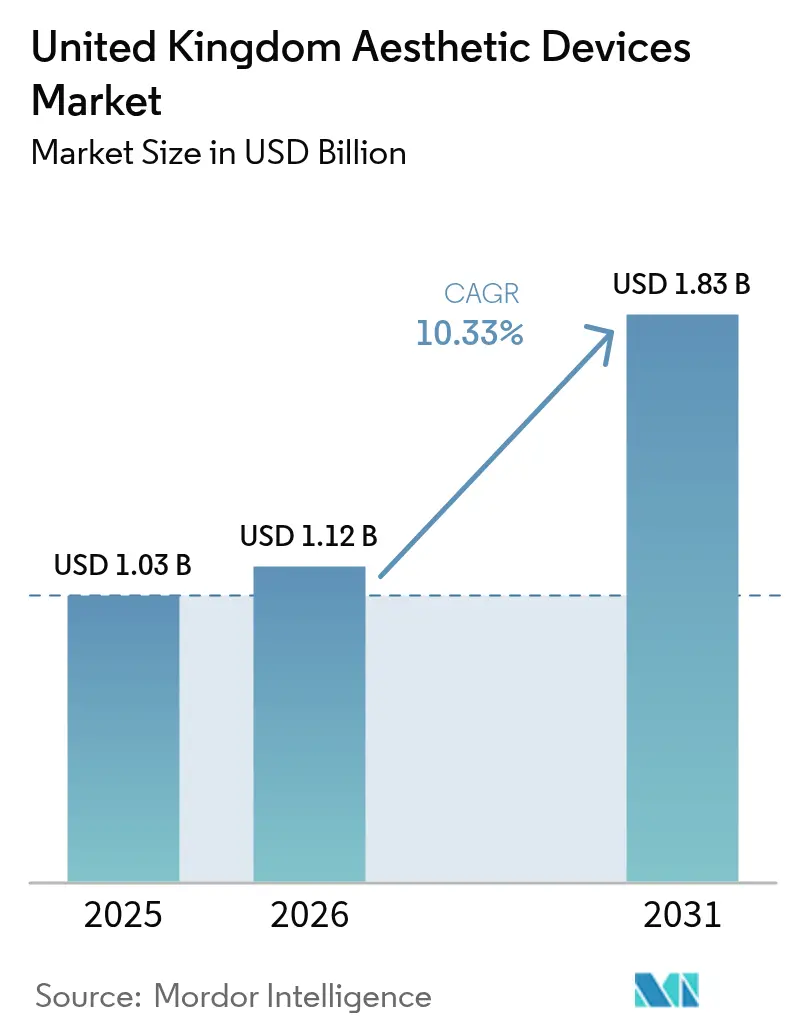
| Base Year Market Size (2025) | USD 1.03 Billion |
| Market Size (2026) | USD 1.12 Billion |
| Market Size (2031) | USD 1.83 Billion |
| Growth Rate (2026 - 2031) | 10.33 % |
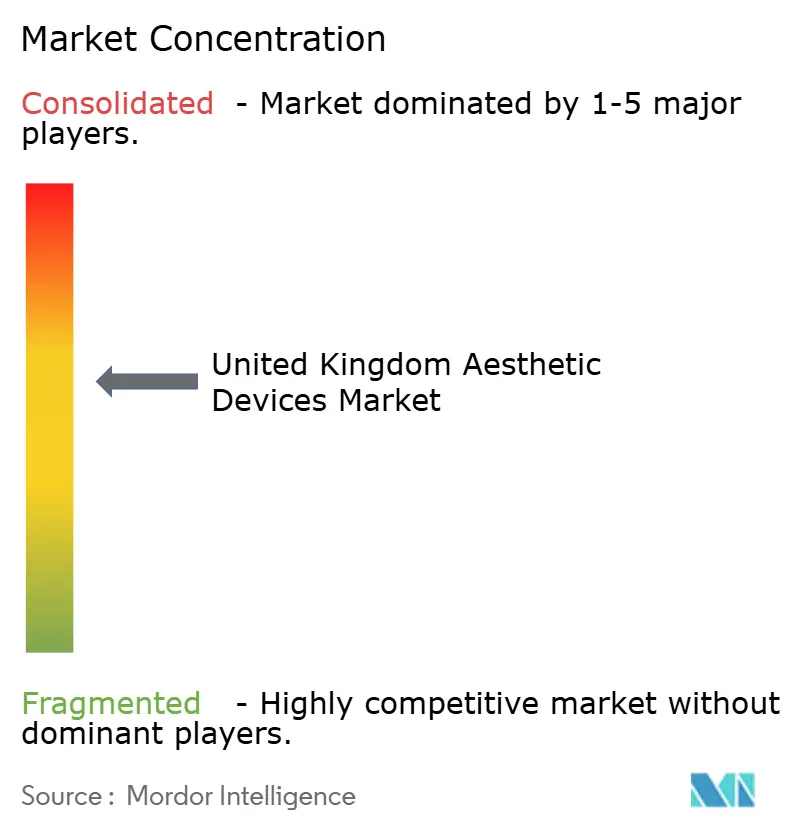
| Market Concentration | Medium |
Major Players *Disclaimer: Major Players sorted in no particular order Image © Mordor Intelligence. Reuse requires attribution under CC BY 4.0. | |
United Kingdom Aesthetic Devices Market Analysis by Mordor Intelligence
The United Kingdom Aesthetic Devices Market size is projected to expand from USD 1.03 billion in 2025 and USD 1.12 billion in 2026 to USD 1.83 billion by 2031, registering a CAGR of 10.33% between 2026 to 2031.
A sustained pivot toward minimally- and non-invasive procedures, rapid upgrades that bundle laser, radiofrequency and ultrasound modalities into a single console, and the emergence of at-home LED and microcurrent tools keep the United Kingdom aesthetic devices market on a double-digit growth path. Regulatory clarity—through Medicines and Healthcare products Regulatory Agency (MHRA) approvals and impending non-surgical licensing rules—has reduced gray-market imports, giving fully compliant manufacturers clearer access to clinics and medical spas. Private operators also benefit from the National Health Service (NHS) Provider Selection Regime, which outsources selected laser treatments and supplies a predictable patient pipeline during traditionally slow summer quarters. Meanwhile, rising wait lists for gender-affirming care and medical-tourism complications have heightened consumer awareness around MHRA-registered devices, encouraging domestic spend.
Key Report Takeaways
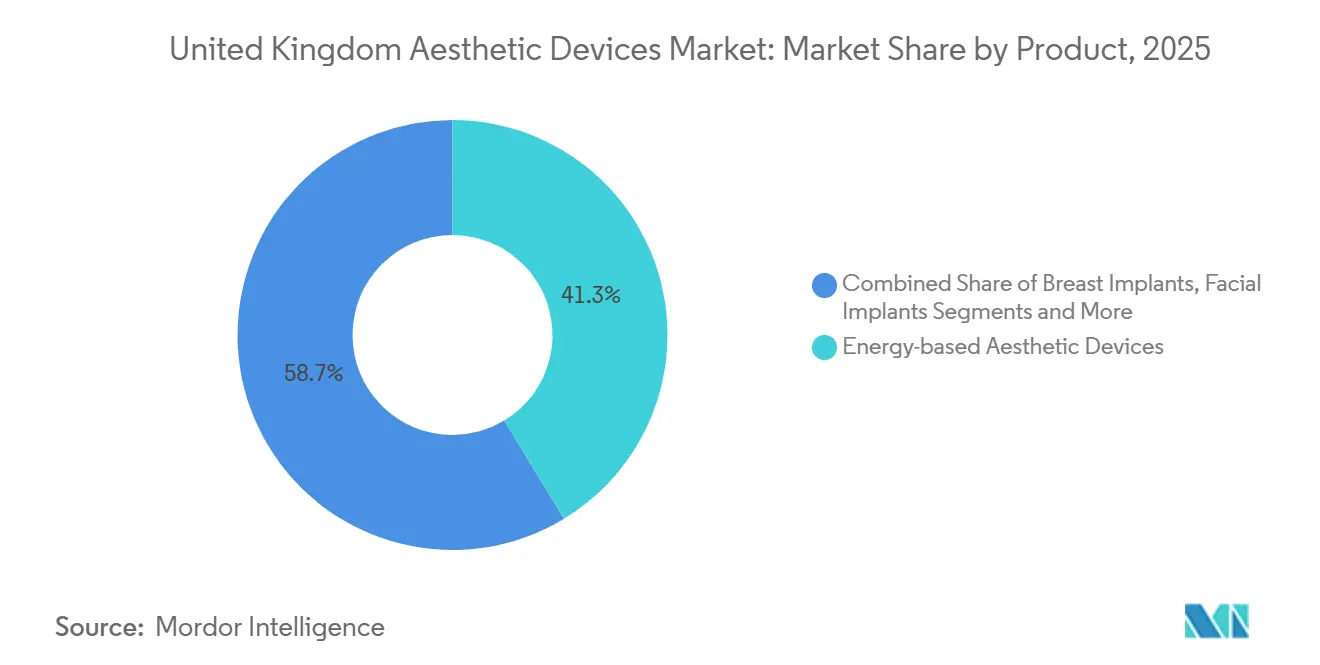
- By product, energy-based platforms led with 41.32% revenue in 2025, while thread-lift devices are projected to expand at a 12.52% CAGR through 2031.
- By application, facial contouring and skin rejuvenation commanded 36.64% of 2025 sales; tattoo and scar removal is forecast to post a 13.24% CAGR to 2031.
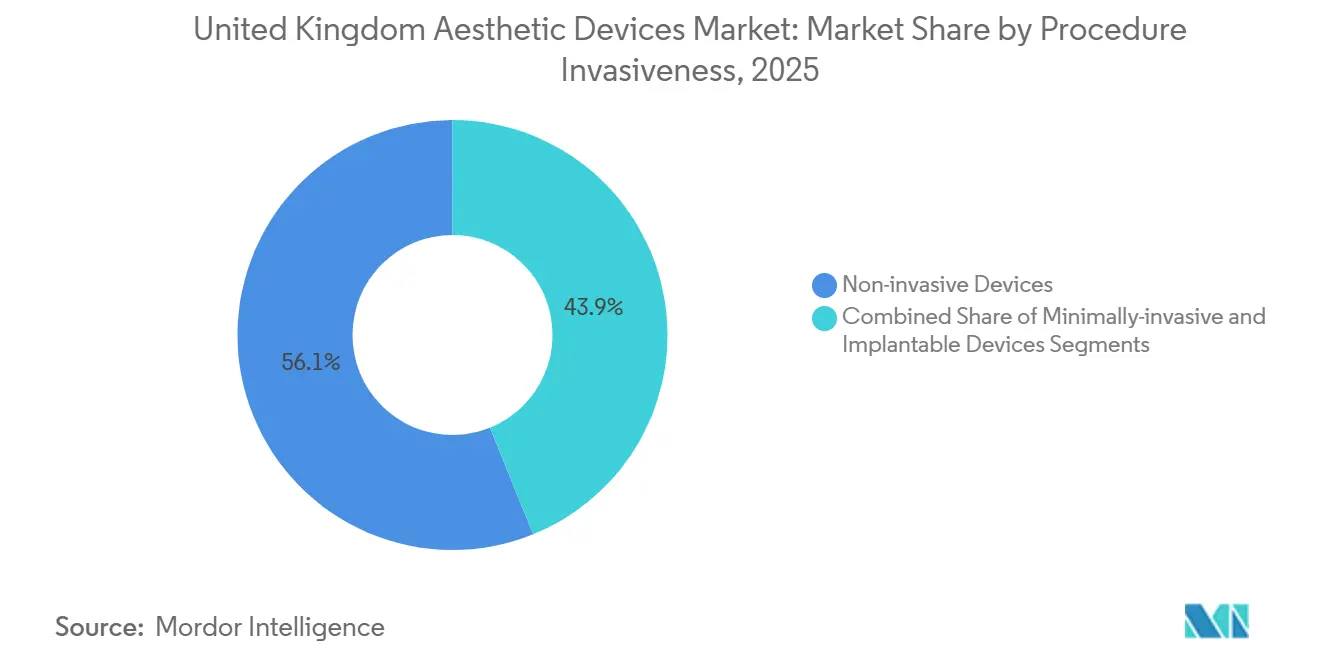
- By procedure invasiveness, non-invasive solutions held 56.12% of 2025 demand, yet minimally-invasive systems are on track for a 14.32% CAGR during the outlook period.
- By end-user, dermatology and cosmetic clinics contributed 44.21% of 2025 spending, whereas home-use settings are expected to grow at a 12.46% CAGR to 2031.
Note: Market size and forecast figures in this report are generated using Mordor Intelligence’s proprietary estimation framework, updated with the latest available data and insights as of 2026.
United Kingdom Aesthetic Devices Market Trends and Insights
Drivers Impact Analysis*
| Driver | (~) % Impact on CAGR Forecast | Geographic Relevance | Impact Timeline |
|---|---|---|---|
| Rising Demand for Minimally-Invasive Cosmetic Procedures | +2.1% | National, concentrated in London, Manchester, Birmingham metropolitan areas | Short term (≤ 2 years) |
| Aging Population with Higher Discretionary Income | +1.8% | National, with elevated spending in South East England, Edinburgh, Bristol | Medium term (2-4 years) |
| Rapid Technology Upgrades in Energy-Based Devices | +1.6% | National, early adoption in specialist dermatology hubs (Harley Street, Manchester) | Short term (≤ 2 years) |
| Expansion of Cosmetic Clinics & Medical Spas | +1.4% | National, accelerated growth in Sheffield, Belfast, Glasgow | Medium term (2-4 years) |
| NHS Outsourcing of Aesthetic Laser Services | +1.2% | England-focused, pilot schemes in Midlands and North West NHS trusts | Long term (≥ 4 years) |
| Growth in Gender-Affirming Body-Contouring Needs | +0.9% | National, concentrated in urban centers with specialized gender clinics | Medium term (2-4 years) |
| Source: Mordor Intelligence | |||
Rising Demand for Minimally-Invasive Cosmetic Procedures
Consumers continue to favor treatments that avoid general anesthesia, produce little to no scarring and allow same-day discharge. BAAPS reported a 5% rise in non-surgical volumes in 2024, driven by protocols that pair radiofrequency microneedling with platelet-rich plasma for collagen remodeling without incisions.[1]British Association of Aesthetic Plastic Surgeons Staff, “BAAPS Audit 2024,” BAAPS, baaps.org.uk Thread-lift technology typifies this shift; Care Quality Commission guidelines now require surgical registration, weeding out poorly trained providers and boosting public confidence. Since 2016, the Association of PDO Thread Practitioners has certified more than 640 clinicians, standardizing technique and lowering complication rates. Combination plans that blend absorbable sutures with fillers or polynucleotides can extend visible results beyond 30 months, improving clinic retention rates.
Aging Population with Higher Discretionary Income
Individuals aged 50-64 hold median household wealth topping GBP 500,000, positioning them as the financial engine behind the United Kingdom aesthetic devices market.[2]Emily Jones, “Household Wealth Statistics 2024,” Office for National Statistics, ons.gov.uk Many prefer in-office radiofrequency or high-intensity focused ultrasound sessions over one-time surgery, valuing minimal downtime and natural-looking outcomes. Cynosure’s ELITE iQ PRO, introduced in 2024, cuts session length by a third yet delivers higher fluence, appealing to busy professionals. Real-time melanin-reader adjustments broaden suitability to Fitzpatrick IV-VI skin types, enlarging the market’s demographic base.
Rapid Technology Upgrades in Energy-Based Devices
Device makers increasingly fuse multiple energy sources—laser, radiofrequency, ultrasound and electromagnetic muscle stimulation—into modular workstations that reduce capital outlay while expanding treatment menus. Lumenis’ LightSheer QUATTRO dual-wavelength system shortens hair-removal plans from as many as 10 sessions to as few as 6, trimming per-patient variable costs.[3]Lumenis, “LightSheer QUATTRO Dual-Wavelength Platform,” Lumenis, lumenis.comBTL’s Emface Submentum couples synchronized RF heat with muscle stimulation to treat submental fat in under 20 minutes. InMode’s IgniteRF integrates microneedling and surface heating, giving clinics a single platform for acne scars, striae and laxity, all while avoiding lengthy CO2 downtime.
Expansion of Cosmetic Clinics & Medical Spas
Secondary cities with lower real-estate prices but solid disposable incomes are attracting clinic investment. Sk:n Clinics channeled GBP 500,000 into its July 2025 Belfast opening, debuting energy-based hair removal and body-contouring capabilities in a 2,000-square-foot space. Sheffield’s Wellness Space launched in spring 2025, focusing on polynucleotide injectables for Yorkshire professionals. Lorena Cosmetics’ acquisition of Sk:n and Harley Medical Group created a 30-site network that cross-sells aesthetic services alongside Optical Express vision correction, tightening margins for independent dermatologists.
Restraints Impact Analysis*
| Restraint | (~) % Impact on CAGR Forecast | Geographic Relevance | Impact Timeline |
|---|---|---|---|
| Stringent MHRA & EU-MDR Compliance Costs | -1.3% | National, disproportionate burden on small-to-midsize device importers | Short term (≤ 2 years) |
| High Treatment Cost to Consumers | -1.1% | National, acute in regions with below-median household income (North East, Wales) | Medium term (2-4 years) |
| Sustainability & Re-Processing Scrutiny | -0.7% | National, regulatory focus on single-use device waste reduction | Long term (≥ 4 years) |
| "Natural Look" Social-Media Backlash | -0.6% | National, strongest among Gen Z demographic (ages 18-27) | Short term (≤ 2 years) |
| Source: Mordor Intelligence | |||
Stringent MHRA & EU-MDR Compliance Costs
Manufacturers and importers must now appoint UK Responsible Persons, submit exhaustive technical files and undertake annual post-market surveillance to satisfy MHRA and EU-MDR rules. Smaller suppliers face yearly compliance bills between GBP 50,000 and GBP 150,000, often prompting portfolio cuts or market exits. New sustainability guidance adds environmental-impact assessments for single-use applicators, stretching approval timelines by up to a year.
High Treatment Cost to Consumers
Laser hair-removal packages run GBP 800-2,500, thread lifts GBP 1,200-3,000, and RF skin-tightening sessions GBP 300-800. With negligible NHS reimbursement, many households outside affluent corridors defer aesthetic spend. Finance plans help spread costs but borrow-rate premiums of 9-15% APR can add 30% to the final bill. Complication costs from overseas surgery—NHS spent GBP 110,690 in 2024—do generate some “buy local” momentum, yet price still curbs penetration in lower-income regions.
*Our forecasts treat driver/restraint impacts as directional, not additive. The impact forecasts reflect baseline growth, mix effects, and variable interactions.
Segment Analysis
By Product: Energy Platforms Dominate, Thread Lifts Surge
Energy-based platforms controlled 41.32% of 2025 revenue, highlighting continued preference for laser hair removal, intense-pulsed-light photofacials and radiofrequency skin-tightening. The United Kingdom aesthetic devices market share for energy-based systems stems from their versatility and short learning curves, letting clinics amortize capital quicker than implant or injectable devices. Cynosure’s ELITE iQ PRO illustrates the arms race for higher power and larger spot sizes, shaving treatment times and lifting margin per staff hour.
Thread-lift kits are the breakout category, forecast to rise at 12.52% CAGR thanks to polydioxanone and poly-L-lactic sutures that suspend tissue without general anesthesia. The Care Quality Commission’s ruling that thread placement requires surgical registration removed unqualified operators and lifted consumer trust. As a result, the United Kingdom aesthetic devices market size for thread-lift systems is projected to expand from USD 48 million in 2026 to USD 87 million by 2031. Breast and facial implants face headwinds as patients favor autologous fat transfer, yet Allergan’s 2025 acquisition of Northwood Medical and its earFold implant shows niche hardware can still thrive when it addresses specific aesthetic pain points.



By Application: Facial Rejuvenation Leads, Tattoo Removal Accelerates
Facial contouring and skin-rejuvenation represented 36.64% of 2025 turnover, reflecting demand for collagen-boosting lasers, fractional RF and injectables that postpone surgical facelifts. Tattoo and scar removal is the fastest accelerator, set for 13.24% CAGR as picosecond lasers slash session counts by 75% versus older Q-switched systems.
Body-contouring maintains double-digit growth through radiofrequency-assisted lipolysis, cryolipolysis and high-intensity EM muscle stimulation, but competes with surgical liposuction for dramatic fat-loss seekers. Hair removal remains the United Kingdom aesthetic devices market workhorse by volume, yet commoditization pressures per-session prices. Breast-enhancement devices battle textured-implant scrutiny, while port-wine-stain laser therapies gain stability from NHS outsourcing agreements.
By Procedure Invasiveness: Minimally-Invasive Gains Ground
Non-invasive options captured 56.12% of 2025 demand, underscoring patient appetite for zero-downtime treatments. Nevertheless, minimally-invasive systems—which include RF microneedling, fractional CO2 and thread lifts—are pacing the field with a 14.32% CAGR. Their ability to penetrate deeper layers without general anesthesia positions them as the future backbone of the United Kingdom aesthetic devices market.
Combination procedures are fueling uptake. InMode’s IgniteRF delivers fractional microneedling plus bipolar RF in a single 20-minute visit, letting clinics treat scarring, laxity and striae simultaneously. BTL’s Emface Submentum applies RF and EM muscle stimulation under the chin, achieving fat reduction and lift without cryolipolysis plates. Regulatory restrictions on textured implants further tilt patient choices toward reversible, small-incision procedures.
By End-User: Clinics Dominate, Home-Use Expands
Dermatology and cosmetic clinics relied on specialist staff and Class IIb devices to capture 44.21% of 2025 value. The United Kingdom aesthetic devices market share among clinics remains under threat from vertical integrations such as Lorena Cosmetics’ takeover of Sk:n and Harley Medical Group, which cross-sell treatments to Optical Express eye-surgery customers. Hospitals occupy a niche centered on reconstructive indications, buoyed by NHS outsourcing that fills empty operating-room blocks with reimbursed laser cases.
Home-use gadgets—LED masks, microcurrent toners, percussive devices—are breaking beyond early-adopter circles. CurrentBody, NuFACE and TheraFace PRO lead, aided by social-media tutorials that demystify usage. Although capped at lower power outputs, these devices prolong in-clinic results and entice price-sensitive households that cannot finance a full professional course
Geography Analysis
London and the broader South East remain the locus of premium demand, supported by Harley Street’s specialist ecosystem and proximity to high-net-worth communities in Surrey and Berkshire. Manchester and Birmingham serve as northern and Midlands anchors, where clinic networks benefit from airport connectivity that pulls patients from surrounding counties. Edinburgh has emerged as Scotland’s aesthetic capital, with professional-grade facilities such as The Wellness Space satisfying clients who prefer to avoid travel to London.
Belfast entered the high-growth roster after Sk:n Clinics invested GBP 500,000 in its 2025 flagship, making energy-based hair removal and fractional RF treatments locally accessible. Wales and North East England continue to trail in per-capita spend due to below-median incomes; nonetheless, pockets of affluence in Cardiff and Newcastle underpin boutique practices. Across the United Kingdom aesthetic devices market, clinics face a compliance mosaic: England’s licensing consultation, Scotland’s draft framework and separate standards in Wales and Northern Ireland require multi-site operators to maintain jurisdiction-specific protocols that inflate legal and training budgets.
Medical tourism remains a challenge. Cut-price procedures in Turkey or Spain lure value-driven patients, yet NHS data on complication management costs are turning the narrative toward “stay-home, stay-safe.” Gender-affirming services add another regional layer: London, Manchester and Brighton clinics report steady bookings from transgender clients unable to secure timely NHS slots. These dynamics combine to keep the United Kingdom aesthetic devices market on a resilient regional growth footing.
Regulatory Landscape
Aesthetic devices marketed as medical devices in Great Britain (England, Scotland, Wales) are regulated by the Medicines and Healthcare products Regulatory Agency (MHRA) under the UK Medical Devices Regulations 2002 (as amended). Core obligations include appointing a UK Responsible Person (UKRP) for non-GB manufacturers, maintaining registration, preparing technical documentation, and meeting post-market requirements. In Northern Ireland, EU MDR alignment continues to influence placement routes and labeling expectations, which adds compliance complexity for multi-site clinic operators and distributors serving both GB and NI.
Recent regulatory change has raised post-market expectations and accelerated reform planning. The Medical Devices (Post-market Surveillance requirements) (Amendment) Regulations 2024 took effect on 16 June 2025, and the Medical Devices (Amendment) (Great Britain) Regulations 2025 came into force on 24 May 2025, tightening traceability and surveillance expectations for energy-based platforms and accessories used in high-volume aesthetic settings. In 2026, MHRA opened a consultation (from 16 February 2026) on indefinite recognition of CE-marked devices in Great Britain. In May 2026, it also published a draft amendment to the UK MDR 2002 (via WTO notification), incorporating modernization elements such as international reliance pathways and updated market access processes.
Value Chain Analysis
The value chain starts with global OEMs covering energy-based platforms, handpieces, consumables, and home-use devices, then moves through UK importers and distributors and UK Responsible Persons, before reaching dermatology and cosmetic clinics, medical spas, and an expanding direct-to-consumer e-commerce channel for home-use tools. Clinical adoption is reinforced by training and credentialing ecosystems, including accredited education partners and clinic protocols. Service, maintenance, and consumable replenishment (tips, cartridges, and other disposables) also support recurring revenue and device uptime for higher-throughput practices.
Regulatory architecture acts as a material operating layer across the chain. In Great Britain, transitional access for CE-marked devices (extended to June 2028 for many devices, and to June 2030 for certain EU MDR/IVDR-compliant devices) and constraints such as limited UK approved-body capacity for UKCA conformity assessment affect launch sequencing and inventory planning. Divergence between Great Britain, including MHRA-led UK MDR 2002 reforms and movement toward international reliance routes, and Northern Ireland, which remains aligned with EU MDR, typically results in parallel documentation and labeling workflows. Clinics, in turn, tend to prioritize suppliers that can demonstrate compliant supply, post-market support, and incident traceability.
Competitive Landscape
Market concentration is moderate. Allergan, Galderma and Merz Pharma dominate injectables through entrenched relationships with dermatologists, while BTL Aesthetics and InMode accelerate share in energy-based equipment by introducing multi-modal consoles that lower clinic capital outlay. Allergan’s May 2025 purchase of earFold developer Northwood Medical underscores interest in procedure-specific hardware that bypasses traditional otoplasty, whereas Galderma invests heavily in extended-duration hyaluronic acid fillers to fend off erosive price competition.
Lorena Cosmetics’ December 2024 takeover of Sk:n and Harley Medical Group stitched together more than 30 sites and rehired 150 staff, creating an integrated chain able to leverage Optical Express footfall. CurrentBody, NuFACE and TheraFace PRO ride e-commerce prowess to cement first-mover advantage in home-use LED and microcurrent tools. Cynosure rolled out the CynoGlow protocol in 2025, pairing Picosure Pro lasers with Potenza RF microneedling in a single visit, trimming patient journeys from six to four appointments and giving partner clinics a throughput edge.
Cutera’s partnership with the Medical Aesthetics Training Academy embeds AviClear acne lasers in Ofqual-regulated curricula, capturing device loyalty at the career outset. Meanwhile, 4T Medical’s modular Eve platform lets practices add or swap handpieces without purchasing a full console, curbing long-term capital expenditures by 30-40%. These strategies illustrate that the United Kingdom aesthetic devices industry rewards both scale and nimble engineering.
United Kingdom Aesthetic Devices Industry Leaders
BTL Aesthetics
Hologic (Cynosure)
Galderma
Lumenis
Abbvie
- *Disclaimer: Major Players sorted in no particular order

Market Opportunities and Future Outlook
Professionalization and licensing momentum are creating room for suppliers that can package devices alongside compliant training, governance, and documentation that multi-site operators can use for audits. In England, Section 180 of the Health and Care Act 2022 provides powers to establish a licensing scheme for non-surgical cosmetic procedures. Scotland enacted the Non-surgical Procedures and Functions of Medical Reviewers (Scotland) Act 2026, with Royal Assent on 12 May 2026, including tighter controls such as restricting provision to specified premises and prohibiting provision to under-18s. Collectively, these changes increase demand for MHRA-registered, traceable systems, along with manufacturer support for clinics through standard operating procedures, readiness for adverse-event reporting, and jurisdiction-specific operating models.
Technology and access pathways also open near-term commercialization avenues. MHRA is implementing an Early Access service for innovative medical devices and is progressing reforms that include international reliance routes, which can reduce duplicated review for products already cleared by comparable regulators. On the demand side, clinic portfolios are broadening beyond classic injectables toward regenerative and combination-led protocols, including polynucleotides and other biostimulatory approaches, which aligns with energy-based platforms and microneedling-based systems. This can expand opportunities for modular handpieces and consumables. Market structure also suggests operational headroom: an April 2026 audit counted about 34,158 non-surgical aesthetics providers across the United Kingdom, indicating a large, fragmented customer base where supplier-led standardization, training partnerships, and service networks can support conversion from low-end or non-compliant channels toward medical-grade device ecosystems.
Recent Industry Developments
- July 2026: Cynosure Lutronic launched the XERF monopolar radiofrequency skin-tightening platform across the EMEA region. The system uses dual-frequency energy delivery (6.78 MHz and 2 MHz), expanding non-invasive tightening options for UK clinics that compete on treatment time and comfort. The EMEA rollout supports distributor and clinic network planning around next-generation RF capital upgrades.
- June 2026: BTL Aesthetics launched EMFUSION in the UK, introducing a facial management device built around DYNAM IQ technology. The launch broadens BTLs addressable base in facial rejuvenation workflows and strengthens its portfolio alongside existing body and facial energy-based systems. UK availability also increases competitive pressure on rival facial-tightening and collagen-stimulation platforms in clinics and medical spas.
- May 2025: AbbVie (Allergan Aesthetics) received MHRA approval for BOTOX (botulinum toxin type A) for the temporary improvement of platysma prominence. The indication expansion supports new treatment protocols in the lower-face and neck area, influencing device and injectable bundling strategies used by aesthetic clinics. It also reinforces the role of MHRA-cleared labeling in driving patient confidence and clinic marketing claims.


Research Methodology Framework and Report Scope
Market Definition and Coverage
For this methodology, the UK aesthetic devices market includes revenue generated from devices used in cosmetic and dermatology procedures across clinics, hospitals, medical spas, and approved home use, covering both energy-based systems and implantable or minimally invasive aesthetic products.
Scope exclusions: Purely topical cosmetics and skin care consumables that are not device-led are excluded, and procedure service fees are not counted as device market revenue.
Segmentation Overview
- By Product
- Energy-based Aesthetic Devices
- Breast Implants
- Facial Implants
- Dermal Filler/Injectable Delivery Devices
- Microdermabrasion Devices
- Thread-lift Devices
- Other Products
- By Application
- Facial Contouring & Skin Rejuvenation
- Body Contouring & Cellulite Reduction
- Hair Removal
- Breast Enhancement
- Tattoo & Scar Removal
- Other Applications
- By Procedure Invasiveness
- Non-invasive Devices
- Minimally-invasive Devices
- Invasive / Implantable Devices
- By End-User
- Hospitals
- Dermatology & Cosmetic Clinics
- Medical Spas
- Home-use Settings
Data Sources, Market Sizing, and Validation
Desk Research
Desk research starts by building a fact base around UK procedure demand, device clearances, and how aesthetic care is delivered across settings, then mapping that demand into equipment revenue. We referenced public sources such as NHS publications and procedure activity notes, Office for National Statistics population and age-structure series, MHRA guidance on medical devices, and UK trade statistics using relevant import and export codes, which often act as a practical proxy for device flow.
To keep assumptions grounded, we also used company annual reports, investor presentations, regulatory updates, and reputable press coverage covering clinic expansion and technology adoption. Where needed, we pulled company financials and news intelligence, along with patent databases and an import and export shipment-level database, mainly to sanity check supplier exposure and the timing of new launches. These desk research sources are illustrative only, and other references were also used for data collection, validation, and clarification during the study.
Primary Interviews and Surveys
Primary interviews and surveys focused on confirming what is actually being bought and used in the UK, and what drives replacement and upgrade cycles. We spoke with distributors, clinic operators, and decision-makers at dermatology and cosmetic practices, plus service partners and industry specialists across the UK, to test pricing bands, utilization patterns, and adoption constraints. We then adjusted desk assumptions where stated buying behavior did not match the initial equipment revenue build.
Distribution of primary research fieldwork respondents
| Company type | Respondent position |
|---|---|
| Top tier: 32% | CXOs: 12% |
| Mid tier: 54% | Functional/Unit leaders: 39% |
| Smaller Players: 14% | Managers: 49% |
Market-Sizing & Forecasting
Sizing is built using a top-down and bottom-up approach. The top-down structure starts from UK procedure demand pools and care settings, then translates into device units and revenue using penetration and replacement logic. For example, procedure volumes for hair removal, facial rejuvenation, body contouring, and tattoo or scar removal were linked to typical device throughput and installed-base renewal cycles, then converted into revenue using price bands.
We corroborated totals with selective bottom-up checks, such as rolling up sampled supplier and distributor revenues, validating average selling price ranges by modality, and cross-checking channel mix by end user (clinics, hospitals, medical spas, and home-use settings). Where company revenue disclosure was limited, we handled gaps through category-level allocation based on product mix and the UK exposure discussed in interviews.
For forecasting, we leaned on scenario analysis supported by trend lines in key variables, including age profile shifts, discretionary spending sensitivity, MHRA-related compliance changes that can affect adoption timing, installed-base replacement cadence, and the pace of newer energy-based modalities entering routine practice. Assumptions were reviewed with primary respondents so growth does not rely on a single aggressive uptake curve.
Data Validation & Update Cycle
Each market total was checked against independent signals, including procedure directionality, import and export movement trends, and whether implied installed base growth looked reasonable for the number of active care sites. Outliers, such as unusually high implied pricing or sudden share shifts, were flagged and revisited. Follow-up calls were triggered when variance could not be explained by launches, regulation, or one-off procurement.
Before sign-off, the model goes through a multi-step review so inputs, formulas, and year-over-year movements remain consistent across categories. The report is refreshed annually, and interim updates are added when material events occur, such as major regulatory changes or notable technology adoption shifts. Right before delivery, a final analyst pass is completed so the client receives the most current view.
Mordor Intelligence's UK Aesthetic Devices Market Size Compared With Other Published Estimates
Published market sizes for UK aesthetic devices can vary even when the category name looks the same, because studies often count different product buckets, use different base years, and apply different pricing logic for multi-year forecasts. Differences also show up when some estimates lean more on shipment proxies, while others lean on procedure demand signals and installed base renewal assumptions.
The main gap comes from whether injectable-related delivery devices, implantables, and home-use settings are counted alongside energy-based systems, and how price bands are escalated over time when product mix shifts. Some sources also publish a near-term year as their starting point, which can make the number look larger or smaller depending on the growth phase and currency timing used for conversion, followed by how frequently assumptions are refreshed. The table points to this spread, and Mordor Intelligence counts revenue only for device categories within the defined UK scope, then stress-tests totals using procedure-linked utilization and replacement checks so adjacent beauty services do not inflate the device pool.
Benchmark comparison
| Source | Market Size | Gaps in Research Methodology |
|---|---|---|
| Mordor Intelligence | USD 1.03 B (2025) | |
| Industry Publisher A | USD 1.12 B (2024) | Uses a 2024 base year and a narrower segmentation that emphasizes energy-based device types, and it can differ on whether implantables and delivery devices are fully captured in the same total. |
| Industry Publisher B | USD 1.20 B (2026) | Starts at 2026 and can embed faster early-year price and adoption assumptions, which tends to lift the starting value versus models anchored to a 2025 base with tighter replacement-cycle checks. |
Across the three figures, most of the spread is explained by the year chosen for the stated market size and by which adjacent device categories are pulled into the total. When scope is kept consistent and the revenue build is tied back to procedure-linked utilization, installed base renewal, and realistic UK price bands, the resulting market value becomes easier to trace and repeat from one update cycle to the next.


Key Questions Answered in the Report
What is the 2031 value forecast for the United Kingdom aesthetic devices market?
It is projected to reach USD 1.83 billion, expanding at a 10.3% CAGR over 2026-2031.
Which product category is growing fastest?
Thread-lift devices are set for a 12.52% CAGR through 2031, driven by demand for minimally-invasive facial rejuvenation.
How large is the market for tattoo and scar removal platforms?
Picosecond-laser adoption is expected to lift the segment above USD 120 million by 2031, reflecting a 13.24% CAGR.
Why are minimally-invasive systems gaining traction?
They penetrate deeper tissue without general anesthesia, leading to a 14.32% projected CAGR and strong clinic adoption.
What regions show the highest clinic density?
London and the South East lead, followed by Manchester, Birmingham and Edinburgh, due to higher disposable incomes and specialist hubs.
How is NHS outsourcing affecting private providers?
The Provider Selection Regime supplies guaranteed laser-treatment volumes, stabilizing clinic revenue while requiring efficient operations.
Page last updated on:


 Your data is secure and never sold or shared.


