
Uganda Energy Drinks Market Size and Share
Market Overview
| Study Period | 2021 - 2031 |
|---|---|
| Forecast Data Period | 2026 - 2031 |
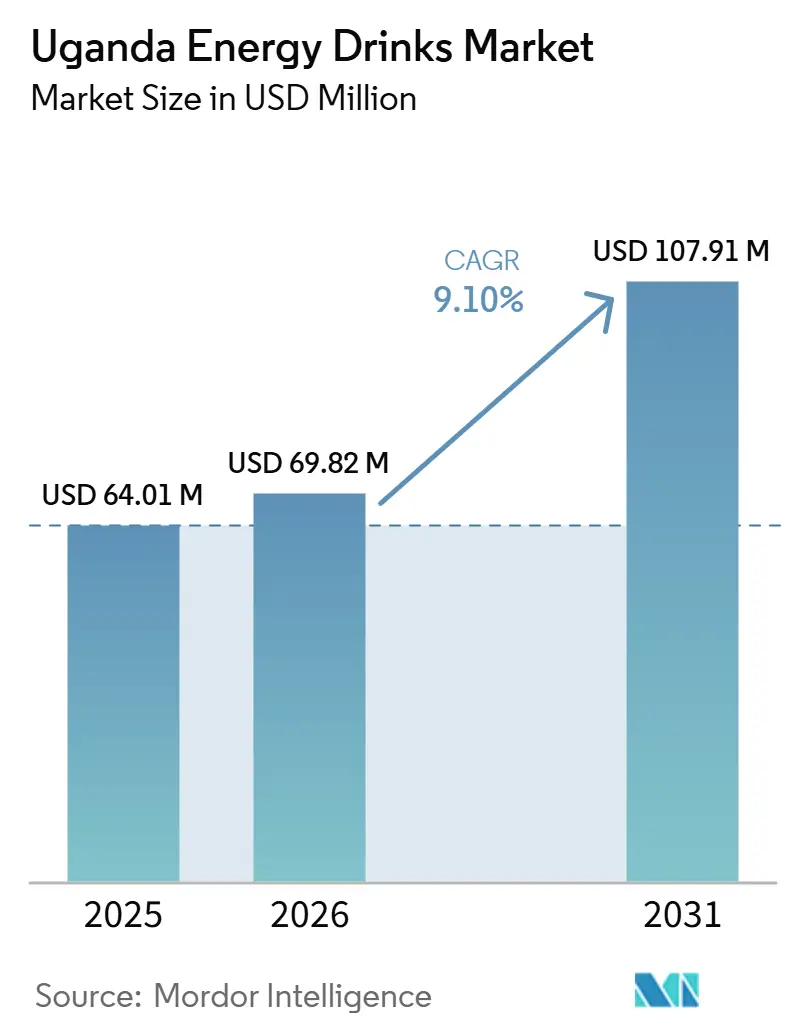
| Base Year Market Size (2025) | USD 64.01 Million |
| Market Size (2026) | USD 69.82 Million |
| Market Size (2031) | USD 107.91 Million |
| Growth Rate (2026 - 2031) | 9.10 % |
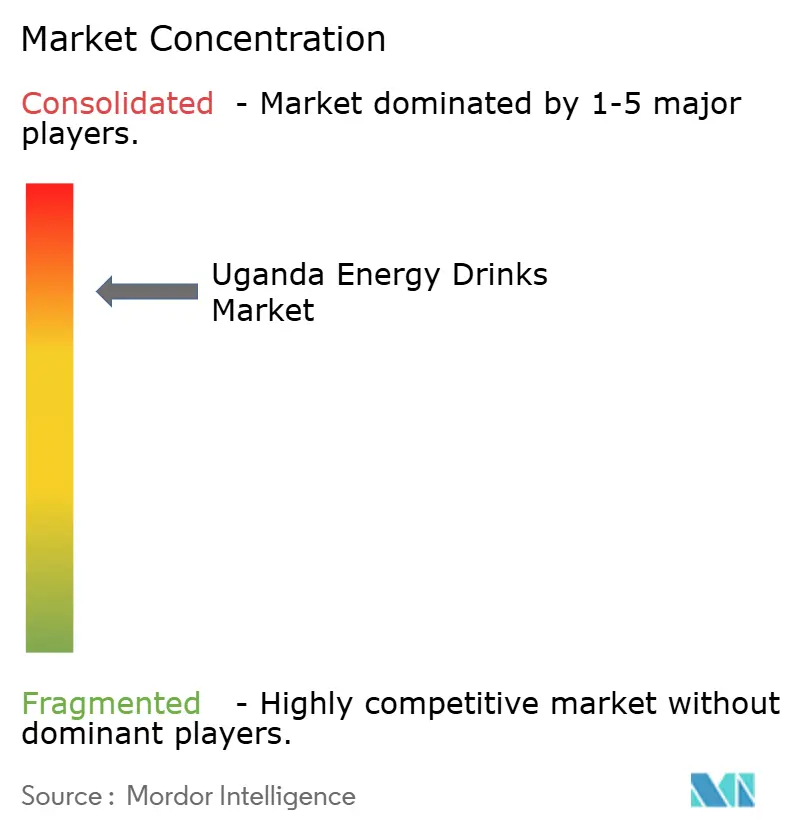
| Market Concentration | High |
Major Players
*Disclaimer: Major Players sorted in no particular order Image © Mordor Intelligence. Reuse requires attribution under CC BY 4.0. |
|
Uganda Energy Drinks Market Analysis by Mordor Intelligence
The Uganda energy drinks market size was USD 64.01 million in 2025 and is projected to reach USD 69.82 million in 2026 and USD 107.91 million by 2031, growing at a 9.10% CAGR from 2026 to 2031. Uganda energy drinks market is moving beyond its earlier concentration in premium urban outlets as younger consumers, organized retail, sports participation, and wider distribution create more frequent consumption occasions. Traditional products continue to support category volume, while natural, low-calorie, recovery, and digital retail formats broaden the choices available to consumers. Leading companies are strengthening their positions through local distribution, targeted pricing, sports partnerships, and digital ordering systems. Regulatory scrutiny of high-stimulant products and the circulation of non-compliant products create a stronger need for quality control, traceability, and clear product communication. These conditions give established suppliers an advantage where they can combine distribution reach with credible quality standards.
Key Report Takeaways
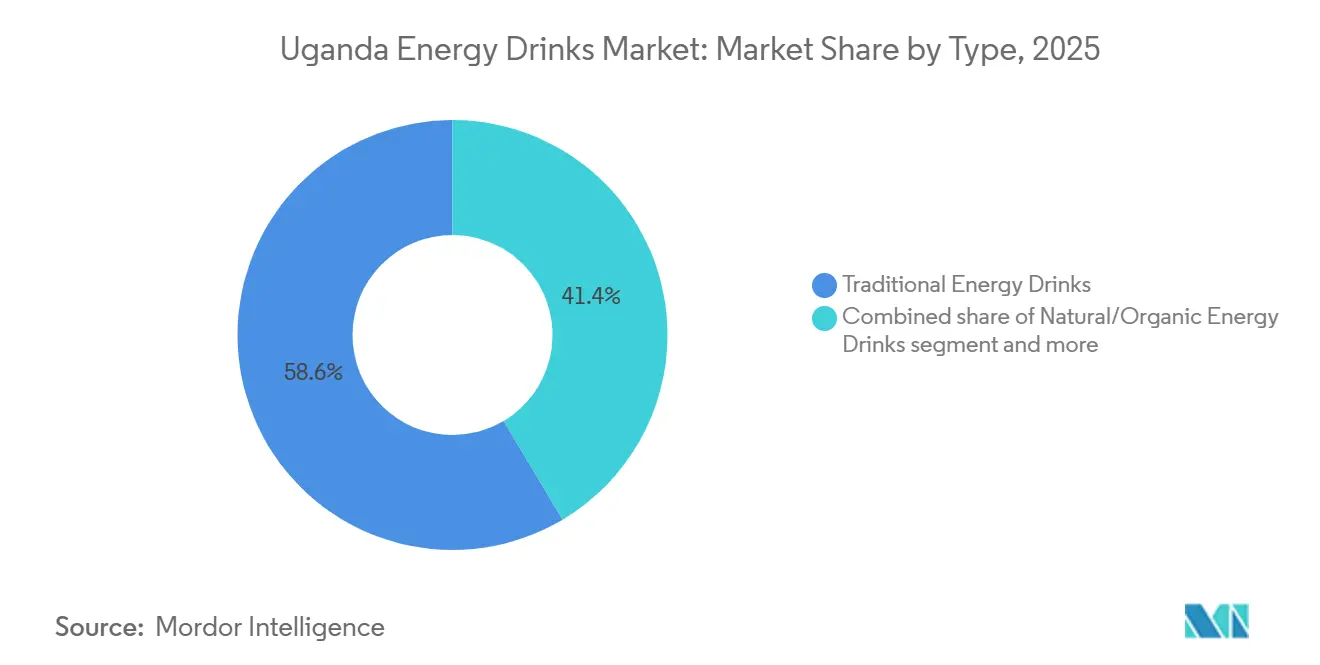
- By type, traditional energy drinks held 58.56% of the Uganda energy drinks market in 2025, while natural/organic energy drinks recorded the highest projected CAGR at 11.94% through 2031.
- By functionality, endurance and energy boost accounted for 78.31% of the Uganda energy drinks market in 2025, while muscle recovery is forecast to grow at a 10.76% CAGR through 2031.
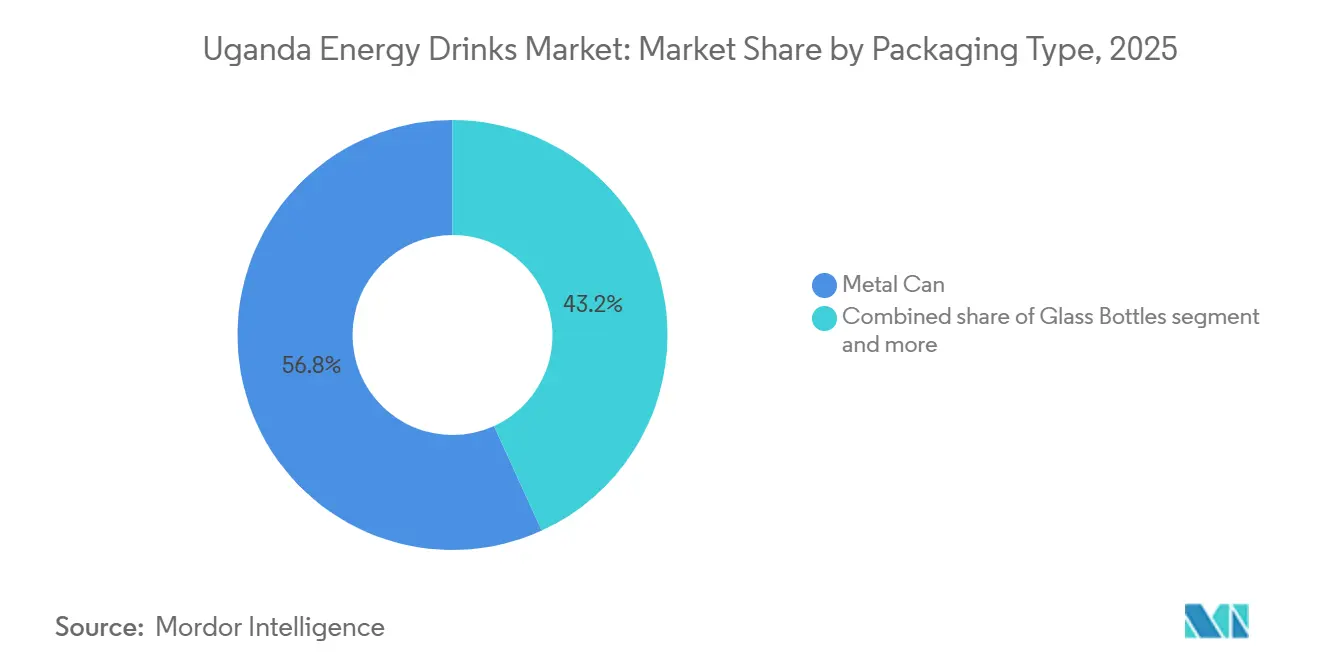
- By packaging type, metal cans held 56.81% of the Uganda energy drinks market in 2025, while glass bottles are projected to expand at a 10.53% CAGR through 2031.
- By distribution channel, supermarkets/hypermarkets accounted for 53.75% of the Uganda energy drinks market in 2025, while online retail is forecast to advance at a 12.08% CAGR through 2031.
Note: Market size and forecast figures in this report are generated using Mordor Intelligence’s proprietary estimation framework, updated with the latest available data and insights as of January 2026.
Uganda Energy Drinks Market Trends and Insights
Drivers Impact Analysis*
| Driver | (~) % Impact on CAGR Forecast | Geographic Relevance | Impact Timeline |
|---|---|---|---|
| Rising participation in sports and fitness activities | +2.2% | Urban Uganda, especially Kampala, Gulu, and Mbarara | Short term (≤ 2 years) |
| Urban convenience and on-the-go consumption | +1.3% | National, concentrated in Kampala and peri-urban corridors | Short term (≤ 2 years) |
| Local flavor innovation and product localization | +1.0% | National | Medium term (2-4 years) |
| Aggressive marketing and sponsorship activities | +1.5% | National, with strong relevance among urban and sports-viewing audiences | Short term (≤ 2 years) |
| Digital promotions and retailer-led consumer engagement | +0.8% | Urban Uganda, with reach into secondary towns through mobile platforms | Medium term (2-4 years) |
| Premiumization through international brands | +1.2% | Urban Uganda, especially Kampala retail and on-trade outlets | Medium term (2-4 years) |
| Source: Mordor Intelligence | |||
Rising participation in sports and fitness activities
Fitness activity is becoming more visible in Kampala and other urban centers, expanding the occasions when consumers consider energy products. Research on fitness spaces in Kampala indicates that gyms have become socially and economically significant within the city, rather than remaining isolated leisure venues [1]Source: AnthroSource, "Renegade Relationality: Fitness Spaces as Sites of Social Exception in Urban Uganda", anthrosource.onlinelibrary.wiley.com. Gym culture in these urban centers is drawing in a broader demographic, including young professionals and students, who increasingly associate energy drinks with active lifestyles. This environment supports demand before exercise, during social activity, and during long workdays. The Uganda energy drinks market benefits when a product first purchased for exercise becomes part of a consumer's everyday routine. As consumers develop more regular fitness habits, their familiarity with energy products tends to increase, reinforcing repeat purchases across multiple consumption occasions. Endurance-focused products remain well aligned with this use case, as they address fatigue management in addition to exercise preparation.
Urban convenience and on-the-go consumption
Urban consumers increasingly require portable beverages suited to work, travel, study, retail, and social occasions. Ready-to-drink formats meet this need, as they require no preparation before consumption. This supports demand in the Uganda energy drinks market. Kampala and peri-urban corridors have the strongest formal retail presence, refrigerated displays, and product variety. This trend is reinforced by Uganda's growing urban population, which accounted for 31.28% of the total population in 2024, according to the World Bank Group [2]Source: World Bank Group, "Urban population (% of total population) - Uganda", worldbank.org. As urban populations grow, consumers gain greater access to modern retail formats, convenience stores, and refrigerated beverage displays, improving product availability and purchase frequency. Convenience and grocery outlets extend access beyond large supermarkets, particularly for lower-priced formats. The wider use of PET bottles and smaller pack sizes helps suppliers reach consumers who make frequent, low-value purchases. As familiarity with functional beverages increases, convenience is likely to remain a key driver of repeat purchases.
Local flavor innovation and product localization
Local flavor development allows suppliers to make products more relevant to Ugandan taste preferences without changing the core energy proposition. The 2025 launch of Predator Mango demonstrated how a global brand can use a localized flavor to broaden its appeal in the Uganda energy drinks market. Flavor differentiation can reduce direct comparison with standard carbonated drinks and support trial among consumers who do not typically purchase energy products. It can also help brands stand out in outlets where shelf space is limited. Natural and fruit-oriented profiles are particularly relevant to consumers who are more attentive to ingredients and sugar intake. Localized products must still maintain consistent quality, clear labeling, and accessible pricing to establish repeat demand.
Aggressive marketing and sponsorship activities
Marketing and sponsorship activities continue to play a significant role in expanding awareness and consumption of energy drinks in Uganda, particularly among young adults, students, sports enthusiasts, and working professionals. Global beverage companies are investing in brand-building through sports sponsorships, music festivals, university events, influencer collaborations, and digital campaigns, positioning energy drinks as lifestyle and performance-enhancing beverages rather than occasional refreshments. Reflecting the scale of these investments, PepsiCo reported selling, general, and administrative (SG&A) expenses of approximately USD 5.4 billion in 2025, including approximately USD 3.4 billion dedicated to advertising and marketing[3]Source: PepsiCo, "2025 FINANCIAL HIGHLIGHTS", pepsico.gcs-web.com. Such promotional spending strengthens brand recognition, accelerates consumer trial, and reinforces repeat purchases across both established and emerging markets. In Uganda, localized marketing strategies, including sports partnerships, youth-focused events, in-store promotions, and social media engagement, are expected to further expand category penetration and encourage energy drink consumption across multiple usage occasions.
Restraints Impact Analysis*
| Restraint | (~) % Impact on CAGR Forecast | Geographic Relevance | Impact Timeline |
|---|---|---|---|
| Health concerns related to high sugar and caffeine content | -1.7% | National; heightened awareness in urban Kampala, secondary cities | Medium term (2-4 years) |
| Competition from affordable soft drinks and bottled water | -0.8% | National; most acute in price-sensitive rural and peri-urban markets | Short term (≤ 2 years) |
| Increasing regulatory scrutiny | -0.6% | National; compliance cost primarily affects manufacturers and importers | Medium term (2-4 years) |
| Counterfeit/substandard products | -1.1% | National; concentrated in informal markets, rural distribution channels | Medium term (2-4 years) |
| Source: Mordor Intelligence | |||
Health concerns related to high sugar and caffeine content
Health concerns can limit demand for high-sugar and high-caffeine products as consumers become more aware of diet-related risks. The Uganda energy drinks market faces increasing pressure from groups seeking clearer nutritional information and restrictions on marketing to children. This pressure favors suppliers that offer sugar-free, low-calorie, or natural product alternatives, and makes transparent labeling and responsible promotion more important for established brands. Traditional formats remain relevant as they meet the core need for stimulation at accessible price points. However, the faster growth outlook for natural and low-calorie products reflects shifting consumer expectations.
Competition from affordable soft drinks and bottled water
Energy drinks compete with lower-priced soft drinks and bottled water for daily beverage spending. This competition is most pronounced in rural and peri-urban areas, where disposable income is lower and cold-chain coverage is less extensive. Consumers may choose familiar, lower-cost beverages when the price premium of energy drinks is not justified. The Uganda energy drinks market therefore depends on package sizes, retail availability, and pricing that reflect local purchasing patterns. PET bottles and informal retail channels remain relevant as they can reach consumers outside large supermarkets. Brands also need a clear functional proposition to distinguish themselves from ordinary carbonated beverages.
*Our forecasts treat driver/restraint impacts as directional, not additive. The impact forecasts reflect baseline growth, mix effects, and variable interactions.
Segment Analysis
By Type: Traditional Formats Support Volume While Natural Products Grow Faster
Traditional energy drinks held 58.56% of the Uganda energy drinks market share in 2025, supported by consumer familiarity and broad national availability. The segment remains central to the market because it addresses everyday fatigue management at accessible price points. Hariss International states that its products reach a wide national retail footprint, which supports the visibility of established domestic brands.
Natural/organic energy drinks are forecast to grow at 11.94% CAGR through 2031, the highest rate among the reported type segments. This segment responds to consumer interest in ingredients such as green tea extract, ginseng, and fruit-based flavor profiles. Sugar-free and low-calorie products occupy a related position by preserving energy functionality while addressing concerns over sugar content. Energy shots serve consumers who prefer a concentrated format for long-distance travel, night work, or intense physical activity.



By Functionality: Endurance Leads While Recovery Builds a Smaller Base
Endurance and energy boost accounted for 78.31% of Uganda's energy drinks market share in 2025, making it the dominant functional segment. Consumers primarily associate energy drinks with caffeine-driven stimulation and fatigue management. This preference supports mainstream products positioned for work, travel, social activity, and exercise. The large share also reflects the limited availability of specialized functional alternatives at accessible price points. Brands with broad retail coverage are well positioned to serve this everyday use case. The segment's share is expected to remain stable as new functional categories gain consumer awareness.
Muscle recovery is projected to grow at a 10.76% CAGR through 2031, representing the strongest functional growth outlook among all segments. This growth is tied to the increasing presence of gym culture and more structured exercise routines in urban Uganda. Hydration and electrolyte support remains closely related to sports drinks and is relevant to competitive athletes and regular gym users. Mental alertness and focus address students, gaming audiences, and consumers seeking concentration-oriented products.
By Packaging Type: Metal Cans Lead While Glass Targets Premium Outlets
Metal cans accounted for 56.81% of energy drink packaging in Uganda in 2025, driven by their use in high-volume carbonated products and on-trade occasions. Cans preserve carbonation and align with the merchandising practices of bars, nightlife outlets, and refrigerated displays. Their association with established brands reinforces consumer familiarity in urban retail. The format also offers suppliers a consistent presentation across different outlet types. Metal cans are expected to remain the primary packaging format for mainstream-branded energy drinks, reflecting the role of organized retail in Kampala and other major cities.
Glass bottles are forecast to grow at a 10.53% CAGR through 2031, the fastest rate among the packaging formats covered. The format is associated with premium on-trade settings such as upscale bars, restaurants, and hospitality venues, and international brands may use glass in selected outlets to communicate a higher-quality experience. PET bottles remain important for accessibility, as they suit price-sensitive consumers and informal retail channels. Overall, packaging choices in Uganda are closely tied to price, channel coverage, and consumer occasion. As no single format meets the needs of all retail settings, the market will continue to use multiple packaging types.
By Distribution Channel: Supermarkets Lead While Online Retail Expands Access
Supermarkets and hypermarkets accounted for 53.75% of the energy drinks distribution channel share in Uganda in 2025, making them the dominant distribution channel. These stores offer refrigerated displays, a wider variety of products, and greater visibility for branded products. They are concentrated in Kampala, Entebbe, and major secondary cities, where organized retail demand is strongest. Large suppliers benefit from shelf access and distributor relationships in these channels, creating a practical barrier for smaller entrants that cannot consistently supply formal retail. Supermarkets are expected to remain an important distribution channel for energy drinks in Uganda, as they support both mainstream and premium product lines.
Online retail is projected to grow at a CAGR of 12.08% through 2031, the fastest growth rate among all reported channels. Digital platforms can connect suppliers and small retailers more efficiently, particularly when supported by delivery and cold-chain systems. Nile Breweries' distribution of Red Bull through its network and the BEES platform is one example of this approach. Convenience and grocery stores will continue to provide broad daily access across urban, peri-urban, and rural areas. Online ordering is not replacing neighborhood retail, but it can improve stock availability for those outlets, making digital commerce a useful complement to established wholesale and retail channels.
Geography Analysis
Uganda is one of the more dynamic energy drink markets in East Africa. The country's USD 64.01 million market in 2025 places it behind Kenya and Tanzania in absolute terms, but ahead of several comparable Sub-Saharan African peers in per-capita urban consumption, particularly in Kampala. The concentration of youth, modern retail, and sports infrastructure in Kampala creates demand that is disproportionate to the national population.
Kampala is Uganda's primary consumption center, accounting for the vast majority of organized retail sales and all on-trade energy drink volumes. The city's fitness culture, reflected in the rise of gym memberships across Kampala, Entebbe, and Wakiso, and its large university student population generate overlapping demand for both mainstream caffeinated formats and emerging recovery and focus-oriented variants.
Rural Uganda presents a structurally different market dynamic. Price sensitivity is high, bottled water and low-cost carbonated soft drinks dominate the beverage basket, and cold-chain penetration is insufficient to support the premium energy drink formats that drive the bulk of market value. Rural market relevance to the Uganda energy drinks market is primarily limited to lower-cost, ambient-stable formats, PET bottle products at or below UGX 2,000, sold through informal roadside retail along mobility corridors connecting Kampala to regional centers.
Competitive Landscape
The Uganda energy drinks market is highly concentrated, with Hariss International, Coca-Cola Beverages Uganda Limited, Red Bull, and PepsiCo collectively accounting for the majority of market value. These companies compete through complementary strategies, including domestic distribution depth, premium brand equity, and localized flavor extensions. The strategic approach among market leaders prioritizes infrastructure: Hariss International operates with 1,500 employees and supplies 250,000 retail outlets, while Nile Breweries leverages AB InBev's BEES digital distribution network for Red Bull.
Both approaches reflect a deliberate effort to secure shelf presence through route-to-market investments before challenger brands can scale. Two areas of white space remain underdeveloped: functional variants targeting mental performance and hydration, which lag behind the endurance category, and the organic/natural segment, where no domestic brand has yet established a clear market position.
Emerging challengers are more likely to originate from within East Africa than from outside the region, given the logistical and regulatory costs associated with new market entry for non-regional brands. AJE Group's established Africa distribution model and HELL ENERGY's selective expansion into frontier markets represent credible challenger profiles. Bakhresa Group and Azam Beverages also possess the regional supply chain infrastructure to accelerate scale, provided they commit product and marketing investment comparable to that of Hariss International and the Coca-Cola system.
Uganda Energy Drinks Industry Leaders
-
Hariss International Ltd.
-
Coca-Cola Beverages Africa (CCBA)
-
Monster Beverage Corporation
-
Red Bull GmbH
-
PepsiCo, Inc.
- *Disclaimer: Major Players sorted in no particular order

Recent Industry Developments
- April 2026: Coca-Cola Beverages Uganda (CCBU), a company within the Coca-Cola Beverages Africa (CCBA) group, launched a nationwide consumer promotion giving Ugandan Predator energy drink consumers the chance to win daily airtime worth UGX 405 million, 15 motorbikes, and the grand prize of an all-expenses-paid trip to London for 5 winners and their guests to watch a Chelsea FC match at Stamford Bridge Stadium.
- April 2025: Hariss International's energy drink brand Rock Boom entered into a three-year partnership valued at over UGX 1 billion with the Uganda Rugby Union (URU), becoming the Official Energy Drink Partner of Ugandan Rugby. Under the agreement, Rock Boom will support the men's and women's national rugby teams (Rugby Cranes and Lady Cranes), as well as major domestic competitions including the Nile Special Rugby Premiership, Uganda Cup, and National 7s Series.
- March 2025: Nile Breweries Limited entered into a distribution agreement with Red Bull and Charms, becoming an official distributor of Red Bull products in Uganda. This partnership will expand the product offerings available on the AB-InBev BEES marketplace e-commerce platform, enabling businesses across Uganda to access a broader range of products with greater ease and reliability.


Uganda Energy Drinks Market Report Scope
| Traditional Energy Drinks |
| Sugar-free or Low-calories Energy Drinks |
| Natural/Organic Energy Drinks |
| Energy Shots |
| Other Energy Drinks |
| Endurance and Energy Boost |
| Muscle Recovery |
| Hydration and Electrolyte Support |
| Mental Alertness and Focus |
| PET Bottles |
| Glass Bottles |
| Metal Can |
| Supermarkets/Hypermarkets |
| Convenience/Grocery Stores |
| Online Retail Stores |
| Other Distribution Channels |
| By Type | Traditional Energy Drinks |
| Sugar-free or Low-calories Energy Drinks | |
| Natural/Organic Energy Drinks | |
| Energy Shots | |
| Other Energy Drinks | |
| By Functionality | Endurance and Energy Boost |
| Muscle Recovery | |
| Hydration and Electrolyte Support | |
| Mental Alertness and Focus | |
| By Packaging Type | PET Bottles |
| Glass Bottles | |
| Metal Can | |
| By Distribution Channel | Supermarkets/Hypermarkets |
| Convenience/Grocery Stores | |
| Online Retail Stores | |
| Other Distribution Channels |


Key Questions Answered in the Report
What companies shape competition in Uganda’s energy drink sector?
The draft identifies Hariss International, Coca-Cola Beverages Uganda, Red Bull, and PepsiCo as leading competitors.
What is the projected growth rate for energy drinks in Uganda?
The Uganda energy drinks market is projected to grow at a 9.10% CAGR from 2026 to 2031, reaching USD 107.91 million by 2031.
Which product type leads energy drink sales in Uganda?
Traditional energy drinks led with 58.56% share in 2025, while natural/organic energy drinks have the fastest projected growth at 11.94% CAGR through 2031.
Which functional energy drink category is growing fastest in Uganda?
Metal Cans held 56.81% share in 2025, while Glass Bottles are projected to grow at the fastest packaging CAGR of 10.53% through 2031.
Page last updated on:





