
UAE Q-Commerce Logistics Market Size and Share
Market Overview
| Study Period | 2020 - 2031 |
|---|---|
| Forecast Data Period | 2026 - 2031 |
| Base Year Market Size (2025) | USD 262.23 Million |
| Market Size (2026) | USD 300.15 Million |
| Market Size (2031) | USD 571.82 Million |
| Growth Rate (2026 - 2031) | 13.76 % |
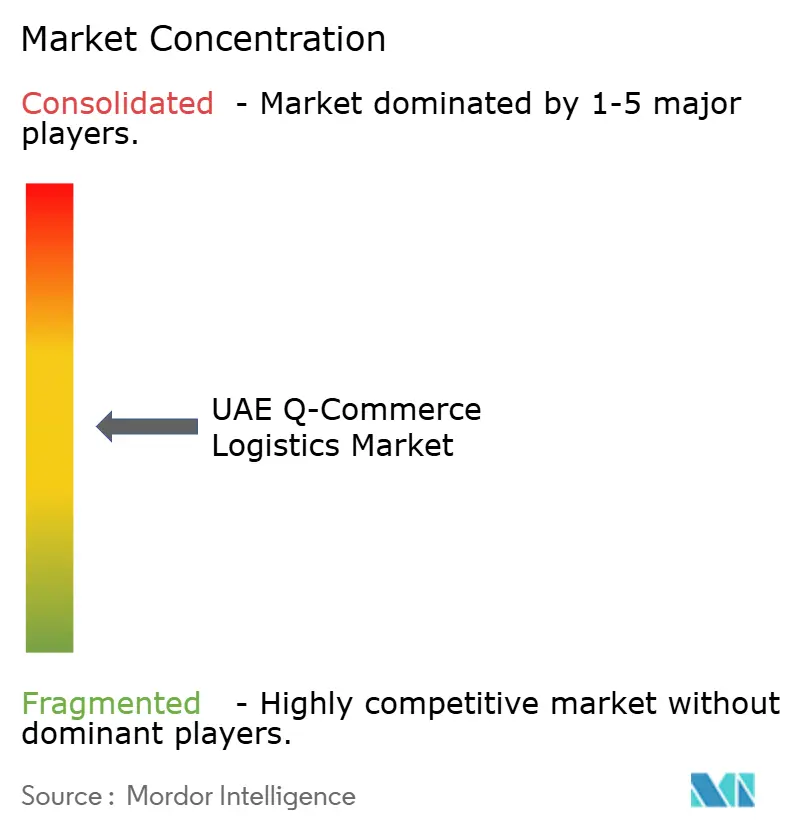
| Market Concentration | Medium |
Major Players
*Disclaimer: Major Players sorted in no particular order Image © Mordor Intelligence. Reuse requires attribution under CC BY 4.0. |
|
UAE Q-Commerce Logistics Market Analysis by Mordor Intelligence
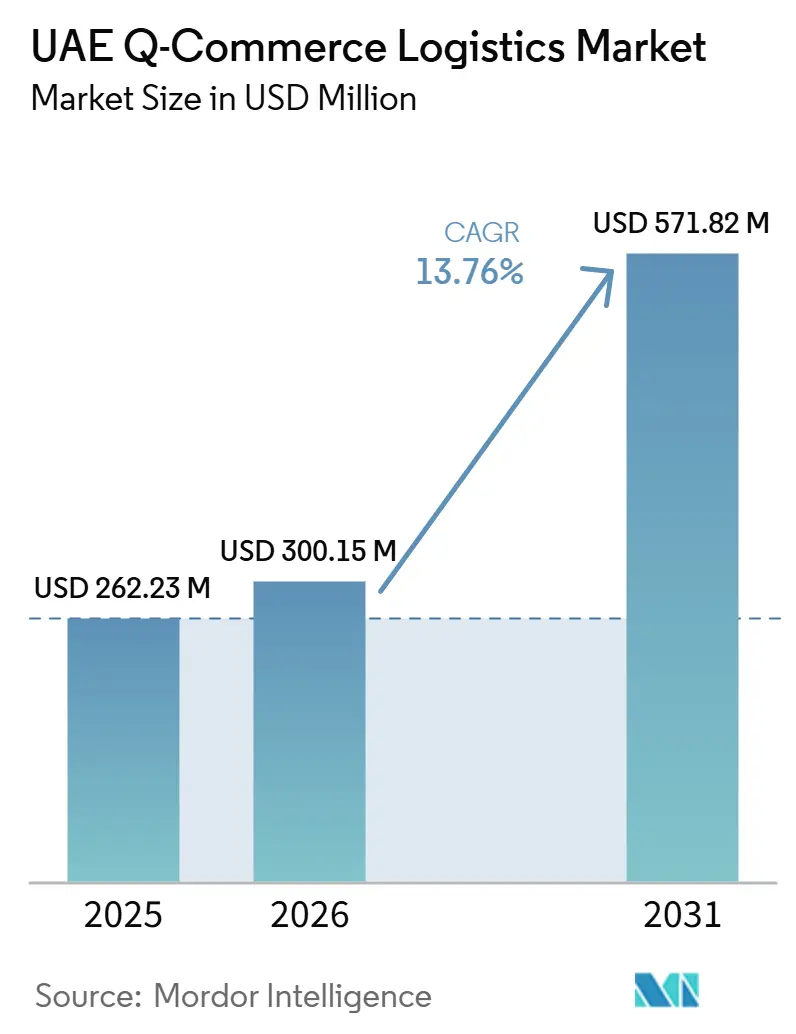
The UAE q-commerce logistics market size was valued at USD 262.23 million in 2025 and estimated to grow from USD 300.15 million in 2026 to reach USD 571.82 million by 2031, at a CAGR of 13.76% during the forecast period (2026-2031).
The UAE q-commerce logistics market is moving away from the subsidy-led customer-acquisition model that shaped 2022 to 2024, and operators are now placing greater emphasis on profitability, subscription retention, and fulfillment efficiency. Fulfillment-node density, AI-supported route planning, and tighter basket economics are becoming more important than broad discounting because these tools help platforms protect delivery speed without taking the same margin pressure as before. Policy support remains favorable because the UAE has continued to build national logistics capacity and digital trade systems, which lower friction for large-scale operators that depend on fast replenishment and integrated supply chains. The April 2026 fuel shock and continued rider churn showed that the current growth rate reflects a more mature operating model rather than weak demand, since operators now have to absorb cost volatility while maintaining service quality. Competition in the UAE q-commerce logistics market remains active because Talabat, Noon, and Careem are pursuing different infrastructure strategies, and operators with stronger network density and more disciplined order economics are better placed to expand through 2031.
Key Report Takeaways
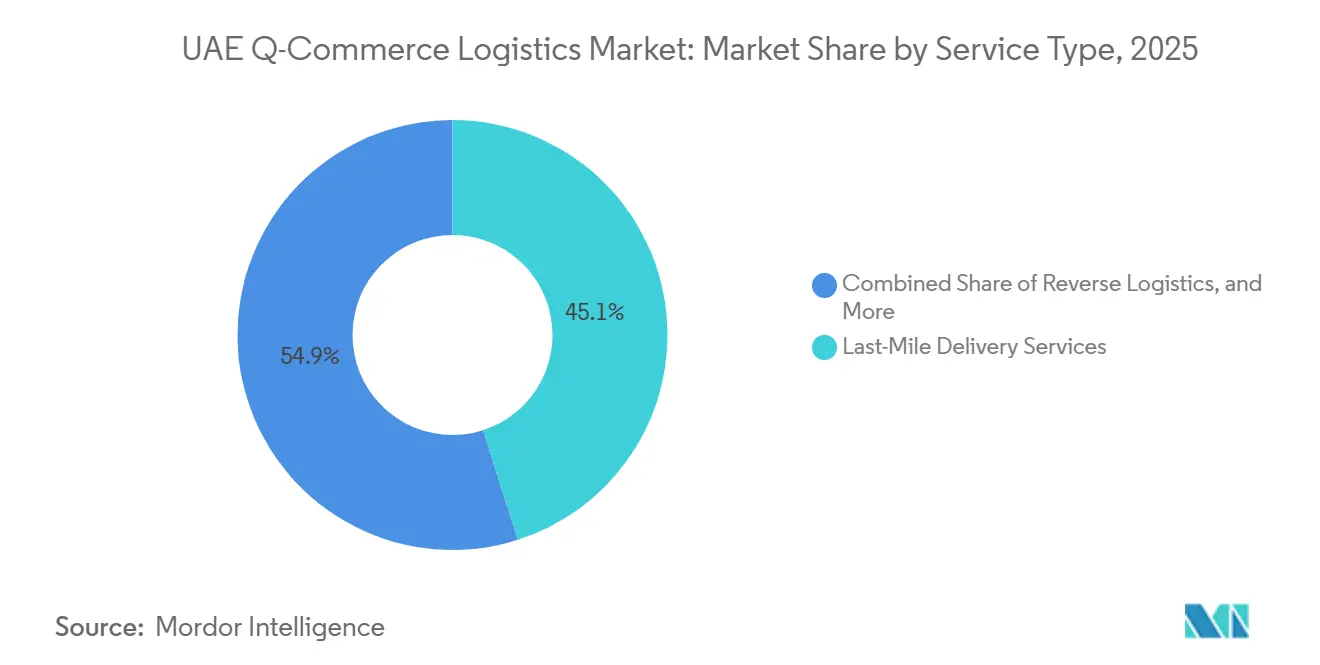
- By service type, last-mile delivery services held 45.08% share of the UAE q-commerce logistics market size in 2025, while reverse logistics is forecast to grow at a 3.50% CAGR through 2031.
- By fulfillment model, dark-store-based fulfillment accounted for 36.09% of the UAE q-commerce logistics market share in 2025, while MFC-based fulfillment is projected to grow at a 4.2% CAGR through 2031.
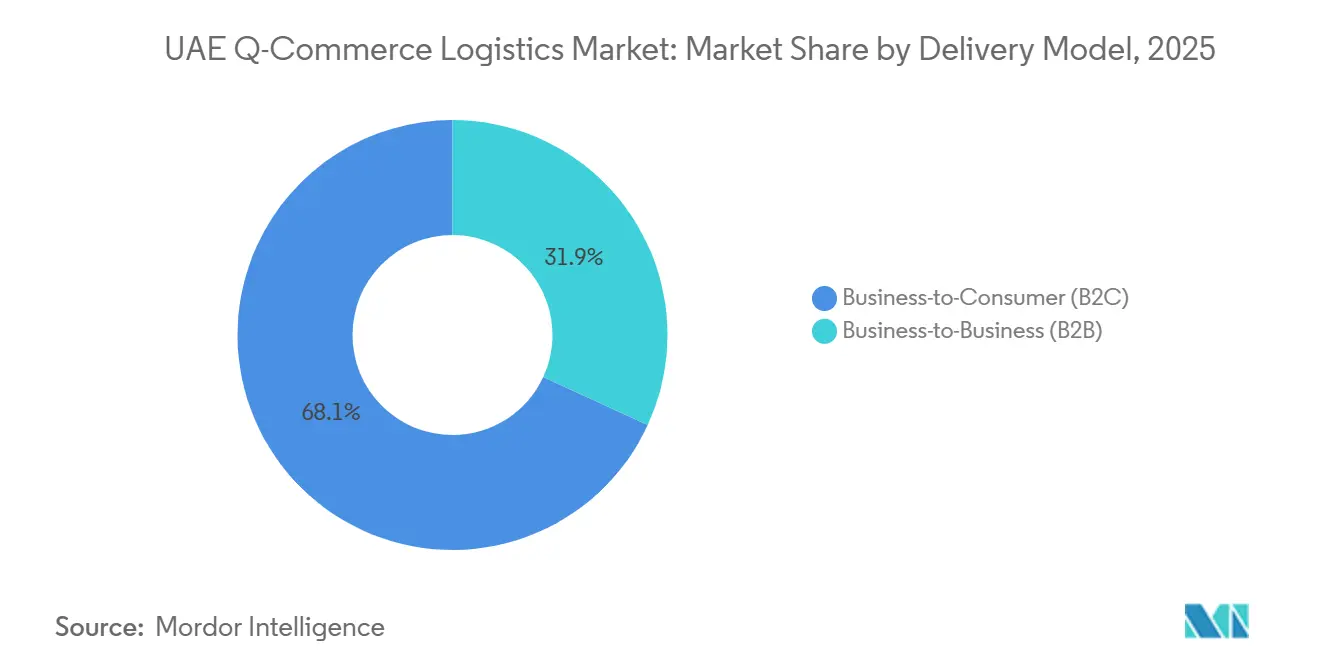
- By delivery model, B2C delivery accounted for 68.12% of the UAE q-commerce logistics market share in 2025, while B2B delivery is expected to expand at a 4.1% CAGR through 2031.
- By city tier, Tier I cities captured 61.92% share of the UAE q-commerce logistics market size in 2025, while Tier II cities are forecast to grow at a 5.27% CAGR through 2031.
- By emirate, Dubai commanded 58.71% of the UAE q-commerce logistics market share in 2025; Sharjah is forecast to expand at a 19.72% CAGR through 2031.
Note: Market size and forecast figures in this report are generated using Mordor Intelligence’s proprietary estimation framework, updated with the latest available data and insights as of 2026.
UAE Q-Commerce Logistics Market Trends and Insights
Drivers Impact Analysis*
| Driver | (~) % Impact on CAGR Forecast | Geographic Relevance | Impact Timeline |
|---|---|---|---|
| High smartphone penetration and mobile-first shopping behavior | +0.8% | National, concentrated in Tier I (Dubai, Abu Dhabi) | Medium term (2–4 years) |
| Strong consumer preference for ultra-fast delivery in dense urban areas | +0.9% | Tier I metros primary; Tier II as secondary | Short term (≤ 2 years) |
| Expansion of dark stores and micro-fulfillment centers improves delivery speed | +1.0% | National, with early gains in Dubai, Abu Dhabi, Sharjah | Short term (≤ 2 years) |
| Growth in digital wallets and cashless payments improves checkout experience | +0.6% | National, highest adoption in Dubai and Abu Dhabi | Short term (≤ 2 years) |
| Subscription models and real-time route optimization improving unit economics | +0.5% | National | Medium term (2–4 years) |
| Government-backed logistics investment and broader digital economy initiatives | +0.7% | National, with early gains in Abu Dhabi and Dubai free zones | Long term (≥ 4 years) |
| Source: Mordor Intelligence | |||
High Smartphone Penetration and Mobile-First Shopping Behavior
UAE internet penetration reached 99.0% and mobile connections reached 21.9 million at the start of 2025, equal to 195% of the total population, keeping delivery platforms within constant reach of consumers nationwide. In 2025, a Visa Acceptance Solutions and PyMNTS study found that 67% of UAE consumers used a mobile device in their most recent retail purchase, up 23% from 2022, supporting faster repeat orders for app-based delivery models. In the UAE q-commerce logistics market, this behavior reduces friction at the order stage by bringing browsing, payment, tracking, and handoff into a single mobile journey. Widespread smartphone use also improves rider dispatch and routing because GPS tracking, instant order confirmation, and contactless delivery records are now standard operating inputs. The result is that app usage data is no longer just a sales signal, and it is now part of how operators plan SKU selection, replenishment cadence, and rider allocation in the UAE q-commerce logistics market.
Expansion of Dark Stores and Micro-Fulfillment Centers Improves Delivery Speed
The UAE q-commerce logistics market has seen a broad increase in fulfillment-node density, with 80 to 100 micro-fulfillment centers opened across major emirates by 2025, each serving small urban catchments with 1,500 to 2,500 SKUs. This has shifted competition away from simple app visibility and toward physical proximity to customers, because delivery time now depends heavily on how closely operators place inventory. Noon's December 2025 launch of a 252,000 m²fulfillment center at KEZAD Abu Dhabi shows how large platforms are tying logistics capacity to major industrial and economic zones. Operators are also building category-specific dark stores for fresh produce and electronics, which improve product handling while helping them meet stricter traceability and quality requirements. Dark stores still need 150 to 200 daily orders to remain viable, so expansion in the UAE q-commerce logistics market is becoming more selective and more favorable to platforms that already have brand pull and recurring order volume.
Government-Backed Logistics Investment and Broader Digital Economy Initiatives
The UAE announced the Emirates Council for Logistics Integration in February 2025, with a mandate to increase sector value from USD 35.1 billion to more than USD 54.45 billion within 7 years, thereby strengthening the long-term operating backdrop for rapid delivery networks. The council covers digital trade systems, air cargo, customs coordination, and supply chain links across roads, ports, and airports, all of which are relevant to quick commerce operators that depend on frequent replenishment. ADEED, operated by 7X under the Emirates Investment Authority, expanded in May 2026 to include more than 30 logistics and express delivery entities and reported a 100% closing rate on supply chain and trade financing requests within 1 month of its Abu Dhabi launch. These policies matter in the UAE q-commerce logistics market because they reduce friction outside the app itself, especially in inventory flow, financing access, and cross-network coordination. They also help large operators scale faster in Tier I and Tier II cities because the public logistics framework is becoming more aligned with rapid urban fulfillment.
Growth in Digital Wallets and Cashless Payments Improves Checkout Experience
Digital wallets accounted for 43.92% of UAE e-commerce payments in 2025, and 70.7% of consumers said they were more willing to use wallets such as Apple Pay, Google Pay, and Samsung Wallet in March to April 2026. The Aani instant payments platform passed 12.5 million users and 774,000 merchant integrations by April 2026, with account-to-account payments completed in an average of 3 seconds. In the UAE q-commerce logistics market, a lower reliance on cash-on-delivery reduces the work riders carry at the doorstep, as they no longer need to manage change, payment collection, and reconciliation to the same extent. This directly improves drops per hour and helps operators hold tighter delivery windows in dense neighborhoods. The push toward 75% cashless transactions by 2026 also means platforms that delay payment integration will have less room to compete on convenience over the next few years[1]"Digital 2025: United Arab Emirates." DataReportal, datareportal.com/reports.
Restraints Impact Analysis*
| Restraint | (~) % Impact on CAGR Forecast | Geographic Relevance | Impact Timeline |
|---|---|---|---|
| Weak Unit Economics Under Persistent Margin Pressure | -0.6% | National, most acute in Tier I cities including Dubai and Abu Dhabi | Short term (≤ 2 years) |
| Urban Congestion and Narrow Delivery Windows | -0.3% | Tier I cities including Dubai, Abu Dhabi, and Sharjah | Short term (≤ 2 years) |
| Rider Churn and Labor Intensity Compounding Operational Complexity | -0.5% | National | Short term (≤ 2 years) |
| Inventory Synchronization Across Micro-Hubs and Live App Layers | -0.4% | National, with spillover to Tier II expansion zones | Medium term (2-4 years) |
| Source: Mordor Intelligence | |||
Weak Unit Economics Under Persistent Margin Pressure
The UAE q-commerce logistics market continues to face unit economics pressure because order growth has not fully removed the cost burden from delivery subsidies, fuel inflation, and rider replacement. In April 2026, UAE petrol prices rose 30%, and diesel prices rose 72%, pushing direct delivery costs 15% to 20% higher in a single day, while fuel reached as much as 40% of the urban delivery cost base, excluding labor. Operators are responding with higher free-delivery thresholds, small-order surcharges, and basket minimums, but these moves can weigh on order frequency among more price-sensitive users. Subscription tiers are becoming a more viable commercial model because they increase customer lifetime value, yet they still need marketing support and sufficient recurring revenue to offset acquisition costs. The pressure is greatest on operators that cannot achieve at least 8 rider drops per hour, pushing the market toward stronger consolidation discipline through 2028.
Rider Churn and Labor Intensity Compounding Operational Complexity
Rider churn remains one of the clearest operating constraints in the UAE q-commerce logistics market because delivery quality and labor stability are closely linked in short-window networks. Six-week churn rates range from 35% to 50% across major UAE last-mile operators, and recruitment and onboarding costs range from AED 950 (USD 258.7) to AED 1,400 (USD 381.2) per rider. As of June 2026, regulators and transport experts were calling for a shift from commission-based pay structures to fixed-salary compensation, which would raise labor costs if made mandatory. The summer Midday Break Rule also compresses usable working hours from mid-June to mid-September, adding scheduling pressure while order demand can remain high. Platforms that give riders better payout visibility and same-shift incident reporting appear to retain workers more effectively, so labor management in the UAE q-commerce logistics market is increasingly tied to software and workflow design rather than fleet size alone.
*Our forecasts treat driver/restraint impacts as directional, not additive. The impact forecasts reflect baseline growth, mix effects, and variable interactions.
Segment Analysis
By Service Type: Last-Mile Density Defines Tier I Margins
Last-mile delivery services held 45.08% of the UAE q-commerce logistics market share in 2025, reflecting the dense urban delivery patterns in Dubai and Abu Dhabi, where operators can serve multiple districts from a small fulfillment footprint. The market benefits from a strong home-delivery preference, with DHL’s eCommerce Trends Report 2026 showing that 84% of UAE consumers prefer home delivery and 64% already hold a paid delivery subscription. This mix supports continued investment in last-mile fleets because consumer willingness to pay for convenience makes fast delivery a service expectation rather than a premium option. It also explains why dense urban zones remain the main profit centers for the UAE q-commerce logistics market, since the same route can absorb more drops within a short period.
Reverse logistics is the fastest-growing service category, with a 3.5% CAGR through 2031, reflecting rising returns on electronics, fashion, and perishables that require more formal return-handling systems. A 2026 Frontiers in Sustainability study found that sustainability culture fully mediates the relationship between reverse logistics infrastructure and sustainable logistics performance in Gulf operators[2]"Sustainable Logistics Performance in the Arab Gulf: How Reverse Logistics and Sustainability Culture Shape Outcomes." Frontiers in Sustainability, www.frontiersin.org. Value-added logistics services are also expanding because traceability, temperature control, specialty packaging, and compliance-linked delivery are becoming more important in regulated and quality-sensitive categories. Fulfillment and dark store operations remain the fixed-cost backbone behind these services because they determine how quickly orders can be picked, staged, and routed. Together, these patterns show that the UAE q-commerce logistics industry is not only scaling delivery speed, and it is also building more formal service layers around returns, handling, and compliance.



By Fulfillment Model: Dark Stores Anchor Share as Automation Scales Up
Dark-store-based fulfillment accounted for 36.09% of the UAE q-commerce logistics market share in 2025, reflecting years of investment in stand-alone nodes designed for faster picking and shorter rider dispatch cycles. In practice, dark stores still give operators the cleanest control over inventory placement, labor planning, and delivery radii in high-density neighborhoods. This is why they continue to anchor the operating model in Dubai and Abu Dhabi even as other formats gain relevance. Their established role also means they remain the base against which newer automation-led models are being measured in the market.
MFC-based fulfillment is projected to grow at a 4.20% CAGR through 2031, driven by automation efficiency rather than simply expanding floor space. The Carrefour’s 10,000 m² automated facility in Dubai, which processes 3,000 orders per hour and cuts labor costs by 30%, underscores why MFC economics are appealing when order density supports full automation. Retail Store-Based Fulfillment still carries significant weight with operators such as Lulu Hypermarket, Spinneys, Choithrams, and Carrefour, as existing store networks reduce the need for separate real estate. The April 2025 Noon and ADNOC Distribution partnership, which placed Noon Minutes fulfillment hubs inside 551 service stations and 373 ADNOC Oasis stores, shows how existing retail and roadside assets can be turned into rapid fulfillment infrastructure. Hybrid fulfillment models are gaining traction in Tier II cities because they let operators combine spoke-and-hub logistics with local collection points and preserve service levels without the full fixed-cost burden of dedicated dark stores.
By Delivery Model: B2C Dominates as B2B Captures Underpenetrated White Space
B2C delivery accounted for 68.12% of the UAE's q-commerce logistics market size in 2025, and it remains the main volume driver as households continue to use rapid delivery for groceries, prepared meals, and daily essentials. This segment is already mature in Dubai and Abu Dhabi, where dense residential clusters and app familiarity keep order velocity high. Even so, B2C still has room to grow in Tier II cities, as expanding digital wallet adoption reduces payment friction and makes repeat ordering easier. In this sense, the market continues to rely on B2C demand for scale while using other segments to improve margins.
B2B delivery is the fastest-growing delivery model, with a 4.10% CAGR through 2031, and growth is tied to on-demand restocking across hospitality, healthcare, food service, and office channels. Careem’s enterprise B2B logistics suite, built around API integration, fleet management, and same-day delivery, directly targets this demand. B2B orders also support better economics because they typically carry higher order values and lower return rates than B2C orders. The UAE Ministry of Finance's e-invoicing initiative is likely to reinforce this shift, as digital documentation makes repeat business procurement more seamless[3]"eInvoicing Initiative." UAE Ministry of Finance, 2025/2026.mof.gov.ae. As a result, the UAE q-commerce logistics industry is likely to see B2B become a more important profit layer even if B2C remains the larger revenue pool.
By City Tier: Tier II Growth Outpaces the Market on Infrastructure Arbitrage
Tier I cities captured 61.92% of the UAE q-commerce logistics market share in 2025, and Dubai and Abu Dhabi remain the core demand centers because they combine high order density, broader fulfillment coverage, and a stronger willingness to pay for speed. Noon’s 252,000 m² KEZAD facility in Abu Dhabi and Talabat’s USD 120 million 2026 commitment to mart-store density and supply chain infrastructure both demonstrate how leading operators are still allocating major capital to Tier I locations. These cities remain the main testing ground for premium service models because dense demand allows operators to justify smaller delivery windows and more specialized infrastructure. Their scale also makes them the operational base from which the market extends into lower-density cities.
Tier II cities are forecast to grow at a 5.27% CAGR through 2031, and they are expanding faster because their lower rents improve the economics of new node deployment. The rental costs in these cities trail Dubai's by 30% to 40%, making dark-store pilots more viable once daily orders reach 150 to 200. Sharjah’s 1.8 million residents and 65% digital wallet adoption rate give operators a meaningful demand base, while Noon has already deployed 3 dark stores there, offering 1,800 SKUs tailored to South Asian and Filipino preferences. This matters because success outside Tier I depends on assortment localization as much as simple geographic reach. Tier III cities and below still depend mainly on spoke-and-hub extensions from larger nodes, which means the UAE q-commerce logistics market is expanding in layers rather than through a uniform nationwide model.
Geography Analysis
Dubai dominated the UAE quick commerce logistics market in 2025, commanding a 58.71% share. Dense residential clusters, extensive micro-fulfillment capacity, and strong cargo infrastructure continue to support rapid replenishment cycles, high order frequency, and efficient last-mile delivery across the emirate.
Abu Dhabi remains the second major logistics hub, supported by Noon’s 252,000 m² KEZAD fulfillment center and expanding last-mile innovation. The facility strengthens national inventory staging, while Talabat’s electric two-wheeler and battery-swapping pilot supports more efficient urban delivery operations.
Sharjah is forecast to record the fastest growth, expanding at a 19.72% CAGR through 2031. Rising warehousing availability, lower operating costs, and planned port and dry-port investments are improving the commercial viability of localized fulfillment and replenishment networks beyond Tier I markets.
Competitive Landscape
The UAE q-commerce logistics market is moderately concentrated at the platform level, but it remains fragmented when fulfillment partners, dark-store operators, and technology providers are included. Talabat, Noon, Careem, and Deliveroo account for most consumer-facing order volume in Tier I cities, yet leadership has shifted several times in recent years, and no single operator has locked in durable control across the full market. Competition now depends less on pure customer acquisition and more on which operator can build the most reliable combination of node density, rider productivity, and recurring order economics. Talabat, Noon, and Careem each follow distinct competitive paths, with Talabat emphasizing mart-store density, Noon focusing on large-scale fulfillment assets, and Careem expanding its enterprise logistics offering. This keeps the UAE q-commerce logistics market active, even though the leading names are well-known.
Talabat’s Q1 2026 results showed GMV growth of 19% year on year to USD 2.7 billion and revenue growth of 23% to USD 1 billion, and that scale gives it stronger room to invest than smaller competitors facing the same fuel and labor pressures. Noon’s December 2025 KEZAD facility is another example of a scale-led move because it deepens both storage reach and network control from Abu Dhabi. Careem’s B2B logistics suite adds a third route to scale by leveraging an established fleet to serve hospitality, healthcare, and business restocking demand, rather than only household delivery. Another notable move came in April 2026 when ENOC and 7X signed an agreement to integrate dark-store solutions and smart lockers into ENOC’s fuel-station network across the UAE. These steps show that strategic control in the UAE q-commerce logistics market now comes from infrastructure placement as much as from app traffic.
Technology is also becoming a more visible source of differentiation because forecasting, routing, payment, and documentation systems now shape operating margins in real time. The Noon is piloting autonomous three-wheelers with a target of reducing driver costs by 50% by 2027, while Talabat Kitchens uses its Pepper AI engine to predict demand across more than 30 hubs in the MENA region. Platforms that prepare early for the UAE Ministry of Finance e-invoicing system may also gain an advantage in B2B workflows, as compliance and documentation matter more as the customer base includes enterprises and regulated buyers. The wider field still includes retailers, local delivery specialists, and fulfillment providers. Hence, the UAE q-commerce logistics market remains open enough for specialist roles even as scale benefits rise at the platform level. That mix of strong leaders and a broad supporting field explains why competition remains firm but not closed.
UAE Q-Commerce Logistics Industry Leaders
-
Talabat (Delivery Hero)
-
Noon Minutes
-
Careem Quik
-
InstaShop
-
Amazon, Inc.
- *Disclaimer: Major Players sorted in no particular order

Recent Industry Developments
- May 2026: 7X expanded its ADEED UAE Supply Chain Support Platform to incorporate over 30 new entities, including express delivery companies, transport firms, and logistics providers across the UAE. Within one month of the Abu Dhabi launch, ADEED achieved a 100% closing rate on supply chain, trade financing, and logistics service requests, positioning it as a critical national coordination layer for Q-commerce supply continuity.
- May 2026: Careem launched an enterprise B2B logistics and delivery suite offering API integration, fleet management, and same-day delivery capabilities for e-commerce operators and corporate clients, targeting the GCC's underserved B2B on-demand restocking segment.
- April 2026: ENOC (a Dubai government energy group) and 7X (under the Emirates Investment Authority) signed an MoU to integrate dark-store solutions and 7X's smart locker and out-of-home pick-up and drop-off services into ENOC's fuel station network across the UAE, repositioning stations as multi-service digital fulfillment and loyalty infrastructure nodes.
- February 2026: FedEx Express introduced 14 Mercedes-Benz eSprinter electric vans into its UAE pickup and delivery fleet, the first FedEx deployment of this model in the Middle East, with the fleet estimated to avoid approximately 148 metric tonnes of CO₂ annually.


UAE Q-Commerce Logistics Market Report Scope
Q-commerce, short for quick commerce, is a specialized branch of e-commerce that emphasizes swift deliveries, typically within an hour. Originating primarily from the food delivery sector, Q-commerce still sees this domain as its dominant player. Central to the Q-commerce model is the rapid on-demand delivery of consumer orders. By harnessing the benefits of traditional e-commerce and innovations in last-mile delivery, Q-commerce stands out as a faster evolution of its predecessor.
The Q-commerce Industry is segmented by category (food, personal care, grocery products, household goods, pharmaceuticals, and other categories). The market size and forecasts are provided in terms of value (USD) for all the above segments.
| Fulfillment and Dark Store Operations |
| Last-Mile Delivery Services |
| Reverse Logistics Services |
| Value-Added Logistics Services |
| Dark Store-Based Fulfillment |
| Micro-Fulfillment Center (MFC)-Based Fulfillment |
| Retail Store-Based Fulfillment |
| Hybrid Fulfillment Model |
| Business-to-Consumer (B2C) |
| Business-to-Business (B2B) |
| Tier I |
| Tier II |
| Tier III and Below |
| By Service Type | Fulfillment and Dark Store Operations |
| Last-Mile Delivery Services | |
| Reverse Logistics Services | |
| Value-Added Logistics Services | |
| By Fulfillment Model | Dark Store-Based Fulfillment |
| Micro-Fulfillment Center (MFC)-Based Fulfillment | |
| Retail Store-Based Fulfillment | |
| Hybrid Fulfillment Model | |
| By Delivery Model | Business-to-Consumer (B2C) |
| Business-to-Business (B2B) | |
| By City Tier | Tier I |
| Tier II | |
| Tier III and Below |


Key Questions Answered in the Report
What is the forecast value of the UAE q-commerce logistics space by 2031?
The UAE q-commerce logistics market is projected to reach USD 571.82 million by 2031, up from USD 300.15 million in 2026, at a CAGR of 13.76% over 2026 to 2031.
Which service category leads current revenue?
Last-mile delivery services led with a 45.08% share in 2025, supported by dense urban delivery networks in Dubai and Abu Dhabi.
Which fulfillment model is expanding the fastest?
MFC-based fulfillment is the fastest-growing model, with a 4.20% CAGR through 2031, as automation improves throughput and lowers labor intensity.
Why are Tier II cities becoming more important?
Tier II cities are forecast to grow at a 5.27% CAGR through 2031 because lower rents and improving logistics assets make new node deployment more viable than in high-cost Tier I districts.
What is the main cost challenge for operators in 2026?
Fuel inflation and rider churn remain the key pressure points. In April 2026, fuel price increases pushed direct delivery costs 15% to 20% higher in a single day.
How is B2B demand changing the operating model?
B2B delivery is forecast to grow at a 4.10% CAGR through 2031 as hospitality, healthcare, and business customers adopt on-demand restocking with better order values and lower returns than B2C.
Page last updated on:





