
UAE ITSM Market Size and Share
Market Overview
| Study Period | 2024 - 2031 |
|---|---|
| Forecast Data Period | 2025 - 2031 |
| Base Year Market Size (2025) | USD 162.41 Million |
| Market Size (2026) | USD 192.5 Million |
| Market Size (2031) | USD 467.52 Million |
| Growth Rate (2025 - 2031) | 19.42% CAGR |
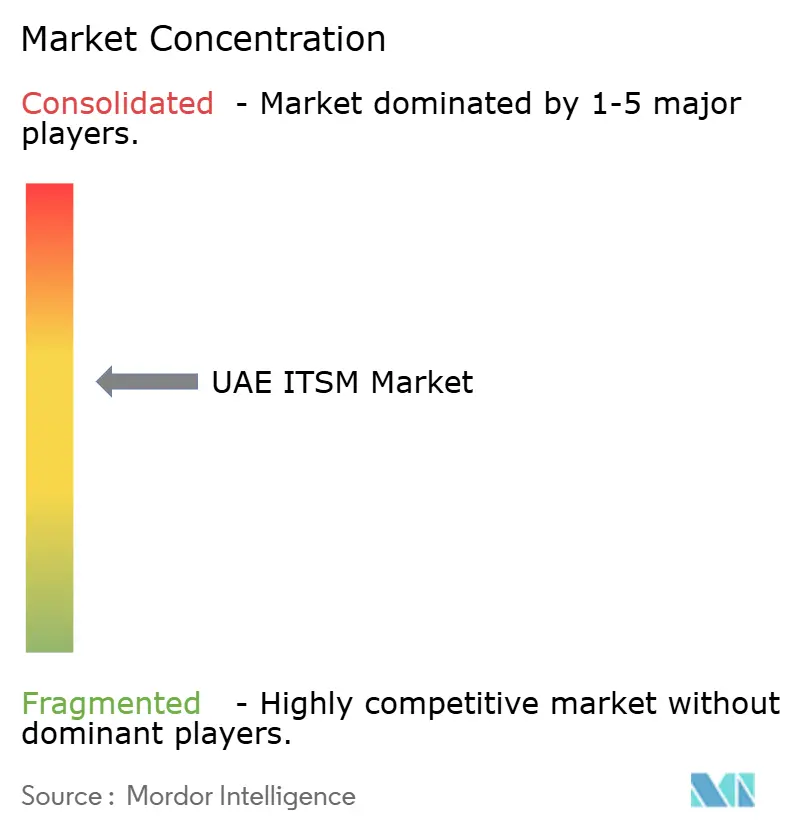
| Market Concentration | Medium |
Major Players *Disclaimer: Major Players sorted in no particular order Image © Mordor Intelligence. Reuse requires attribution under CC BY 4.0. | |
UAE ITSM Market Analysis by Mordor Intelligence
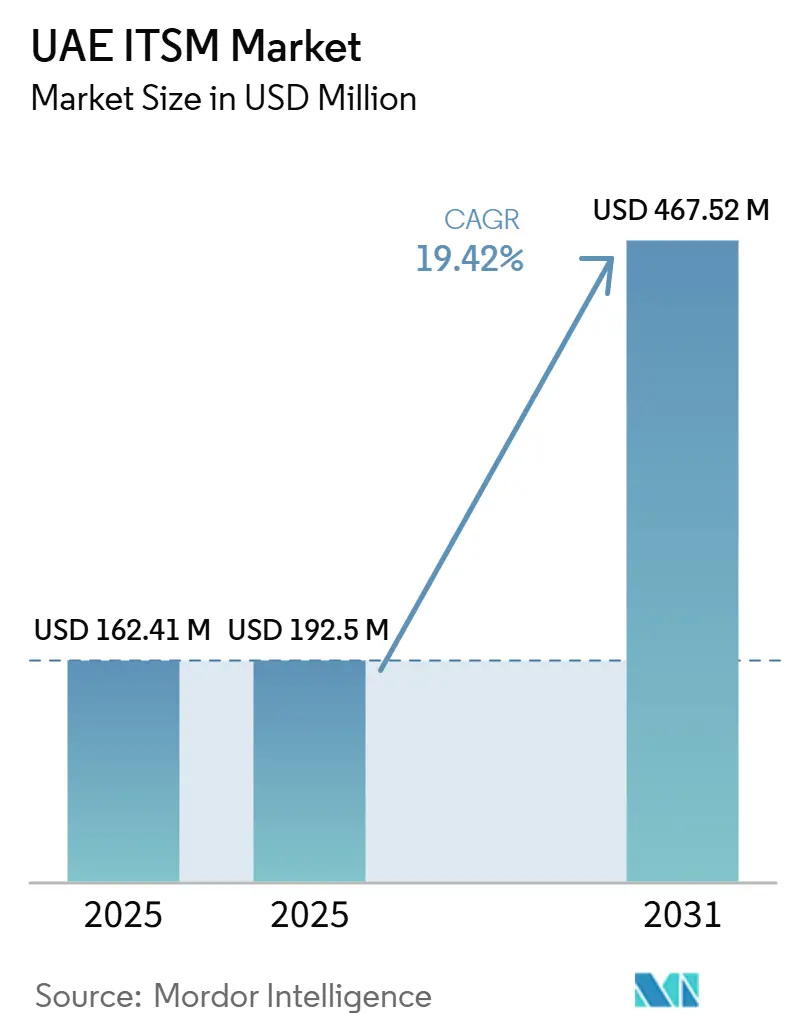
The UAE ITSM Market size is projected to be USD 162.41 million in 2025, USD 192.5 million in 2026, and reach USD 467.52 million by 2031, growing at a CAGR of 19.42% from 2026 to 2031.
In the UAE, the IT service management market is outpacing many adjacent enterprise software sectors. This surge is largely due to the increasing alignment of service operations with digital delivery, governance, and automation objectives in both public and private entities. Key drivers of this demand include the adoption of sovereign clouds, formalized digital government initiatives, and a pronounced preference for platforms that champion workflow automation while ensuring robust local hosting and oversight. Furthermore, the UAE's IT service management landscape is witnessing a notable shift: buyers are moving from basic ticketing solutions to comprehensive service orchestration. This evolution is prompting vendors to rethink their strategies, emphasizing implementation, managed support, and AI-driven features. Competition is intensifying, extending beyond just core platform functionalities. Buyers are now prioritizing local hosting, the depth of partner delivery, migration assistance, and the seamless integration of service workflows across various departments. Organizations that are pivoting their service delivery models towards cloud solutions, AI, and unified digital platforms stand to gain the most. However, a significant hurdle remains: the considerable time and effort required to modernize legacy deployments.
Key Report Takeaways
- By component, solutions held 67% revenue share in 2025, while services are projected to expand at a 21.40% CAGR through 2031.
- By deployment, cloud held 73% of the UAE IT service management market share in 2025 and is projected to expand at a 24% CAGR through 2031.
- By application, service desk and incident management accounted for 32% of the UAE IT service management market size in 2025, while knowledge management is projected to expand at a 23.30% CAGR through 2031.
- By end-user industry, BFSI held the largest share at 22% in 2025, while healthcare is projected to advance at a 22.30% CAGR through 2031.
- By enterprise size, large enterprises accounted for 64% share in 2025, while SMEs are projected to expand at a 23.60% CAGR through 2031.
Note: Market size and forecast figures in this report are generated using Mordor Intelligence’s proprietary estimation framework, updated with the latest available data and insights as of January 2026.
UAE ITSM Market Trends and Insights
Drivers Impact Analysis*
| Driver | (~) % Impact on CAGR Forecast | Geographic Relevance | Impact Timeline |
|---|---|---|---|
| Accelerating cloud-first enterprise modernization | +5.0% | UAE-wide, strongest in Abu Dhabi and Dubai government and enterprise clusters | Short term (≤ 2 years) |
| AI-assisted ticket triage and self-service adoption | +4.5% | UAE-wide, concentrated in major public sector and enterprise technology hubs | Short term (≤ 2 years) |
| Public sector digitization and shared service standardization | +3.5% | National, with early gains in Abu Dhabi federal entities and Dubai government departments | Medium term (2-4 years) |
| Cybersecurity and compliance pressure on service workflows | +3.0% | National, acute in BFSI, telecom, and critical infrastructure operators | Medium term (2-4 years) |
| Rising ITIL-aligned service automation requirements | +2.5% | UAE-wide across enterprise and public sector organizations | Long term (≥ 4 years) |
| Growing demand for employee experience platforms | +1.5% | UAE-wide, with early traction in IT, telecom, and BFSI | Long term (≥ 4 years) |
| Source: Mordor Intelligence | |||
Accelerating Cloud-First Enterprise Modernization
In the UAE, cloud migration is evolving beyond mere infrastructure changes, with many organizations simultaneously redesigning their service workflows. ServiceNow successfully launched its UAE Cloud on Microsoft Azure, offering government and regulated buyers a local deployment option that aligns with residency and procurement mandates. du also introduced its national hypercloud platform for entities in the UAE, underscoring the shift toward locally governed cloud environments[1]du, “du Launches the National Hypercloud,” du Media Centre, du.ae. This evolution means that the UAE's IT service management market is not only witnessing a surge in platform demand but also a transformation in processes related to incident, change, request, and configuration management. Vendors lacking the ability to support in-country hosting, migration planning, and phased rollouts are finding themselves sidelined, despite having robust product offerings. As a result, the UAE IT service management market is increasingly favoring providers that seamlessly integrate software solutions with residency compliance and local delivery capabilities.
AI-Assisted Ticket Triage And Self-Service Adoption
In the UAE, IT service management is increasingly embracing AI, with buyers seeking automation to streamline manual tasks and enhance service quality. In June 2026, the UAE Cabinet bolstered its AI governance and digital execution policies by approving the Federal Authority for AI and Data. In May 2026, Freshworks unveiled its Freddy AI Agent Studio, highlighting a trend where vendors offer domain-specific automation tailored for service teams, minimizing the need for extensive engineering. This approach resonates with the UAE's IT service management sector, as many teams pursue swift automation benefits without delving into extensive internal development. However, the effectiveness of AI-driven service workflows hinges on well-maintained knowledge bases and consistent configuration records. Thus, the market is increasingly gravitating towards platforms and service partners that not only enhance automation results but also bolster data governance.
Public Sector Digitization And Shared Service Standardization
In the UAE, the IT service management market is witnessing robust growth, largely driven by the expanding scale and complexity of digital service delivery in government programs. Committing a substantial AED 13 billion (approximately USD 3.54 billion), Abu Dhabi's Digital Strategy 2025-2027 is channeling funds into initiatives like AI-driven governance, migration to sovereign clouds, and the digitization of processes across public entities[2]Department of Government Enablement, “Abu Dhabi Government Digital Strategy 2025-2027 Accelerates AI-Native Government Journey,” Department of Government Enablement, dge.gov.ae. Meanwhile, in April 2024, Dubai took a significant step by consolidating citizen and business services from various government entities into a singular digital platform. This move amplifies the demand for efficient request, catalog, and workflow management. Such policy initiatives bolster the UAE's IT service management landscape, as these unified digital services necessitate a consistent service logic, managed changes, and dependable service ownership across different departments. Furthermore, private firms catering to government clients often adopt similar platform choices and process frameworks, streamlining integration. Consequently, the UAE's IT service management market is buoyed by both direct public investments and the broader economic effects of standardization.
Cybersecurity And Compliance Pressure On Service Workflows
As buyers in the UAE increasingly seek automation to enhance service response quality and minimize manual triage, AI's role in the UAE's IT service management market is becoming more pronounced. In June 2026, the UAE Cabinet approved the formation of the Federal Authority for AI and Data, bolstering the nation's AI governance and digital execution policies[3]Dubai Media Office, “Hamdan bin Mohammed Orders Unified Digital Services Platform,” Dubai Media Office, mediaoffice.ae. In May 2026, Freshworks unveiled its Freddy AI Agent Studio, highlighting a trend where vendors offer domain-specific automation tailored for service teams, sidestepping the need for extensive engineering. This approach resonates with the UAE's IT service management sector, as many teams are eager for swift automation benefits without the burden of extensive internal development. However, the efficacy of AI-driven service workflows hinges on well-maintained knowledge bases and consistent configuration records. Thus, inadequate governance can undermine even the most sophisticated tools. Consequently, there is a rising interest in the UAE's IT service management market for platforms and service partners that not only enhance automation results but also bolster data discipline.
Restraints Impact Analysis*
| Restraint | (~) % Impact on CAGR Forecast | Geographic Relevance | Impact Timeline |
|---|---|---|---|
| High switching costs from legacy ITSM implementations | -2.5% | UAE-wide, particularly acute in large enterprises and government entities with older deployments | Short term (≤ 2 years) |
| Data residency and integration complexity across hybrid environments | -2.0% | National, acute in regulated sectors including BFSI, healthcare, and government | Medium term (2-4 years) |
| Limited mid-market budget appetite for premium platforms | -1.5% | UAE-wide, strongest headwind in Northern Emirates SME clusters | Medium term (2-4 years) |
| Skills gaps in process design, CMDB governance, and automation | -1.0% | UAE-wide, concentrated in mid-market and government IT teams | Long term (≥ 4 years) |
| Source: Mordor Intelligence | |||
High Switching Costs From Legacy ITSM Implementations
In the UAE, many large organizations continue to rely on deeply customized older platforms, hindering the IT service management market. These organizations often have service tools intricately linked to ERP, HR, security, and operating systems via numerous legacy integrations, making them challenging to reconstruct. As a result, migration timelines extend, and purchasing behaviors shift; some clients opt for a phased coexistence rather than a complete overhaul. Consequently, the UAE's IT service management market witnesses more rapid growth in greenfield deployments, platform expansions, and cloud-native adoptions by SMEs, rather than in direct legacy replacements. Vendors offering migration tools, pre-built connectors, and localized consulting services hold a competitive edge. However, they grapple with prolonged decision-making processes in larger accounts. This scenario underscores the importance of execution quality, equating it with product capability, especially when vying for significant transformation initiatives.
Data Residency And Integration Complexity Across Hybrid Environments
In the UAE, the IT service management market faces challenges associated with hybrid operating models. Organizations must navigate the balance between local hosting regulations and global service mandates. For example, the Emirates Health platform, a key component of the expansive digital health ecosystem, highlights the increased need for seamless support, change management, and incident coordination. Similarly, financial institutions are aligning legacy workflows with the sovereign financial cloud introduced by the Central Bank of the UAE and Core42. While the UAE's IT service management market continues to advance, these hybrid challenges are extending deployment timelines, increasing service costs, and delaying the full realization of automation benefits. Additionally, there is a growing reliance on local integration specialists. Buyers seek platforms capable of seamlessly connecting diverse environments while adhering to governance standards. Notably, although these accounts are not rejecting modernization, their pace often lags behind the broader market's growth rate.
*Our forecasts treat driver/restraint impacts as directional, not additive. The impact forecasts reflect baseline growth, mix effects, and variable interactions.
Segment Analysis
By Component: Services Growth Shows A Clear Shift Toward Outcome-Based Contracts
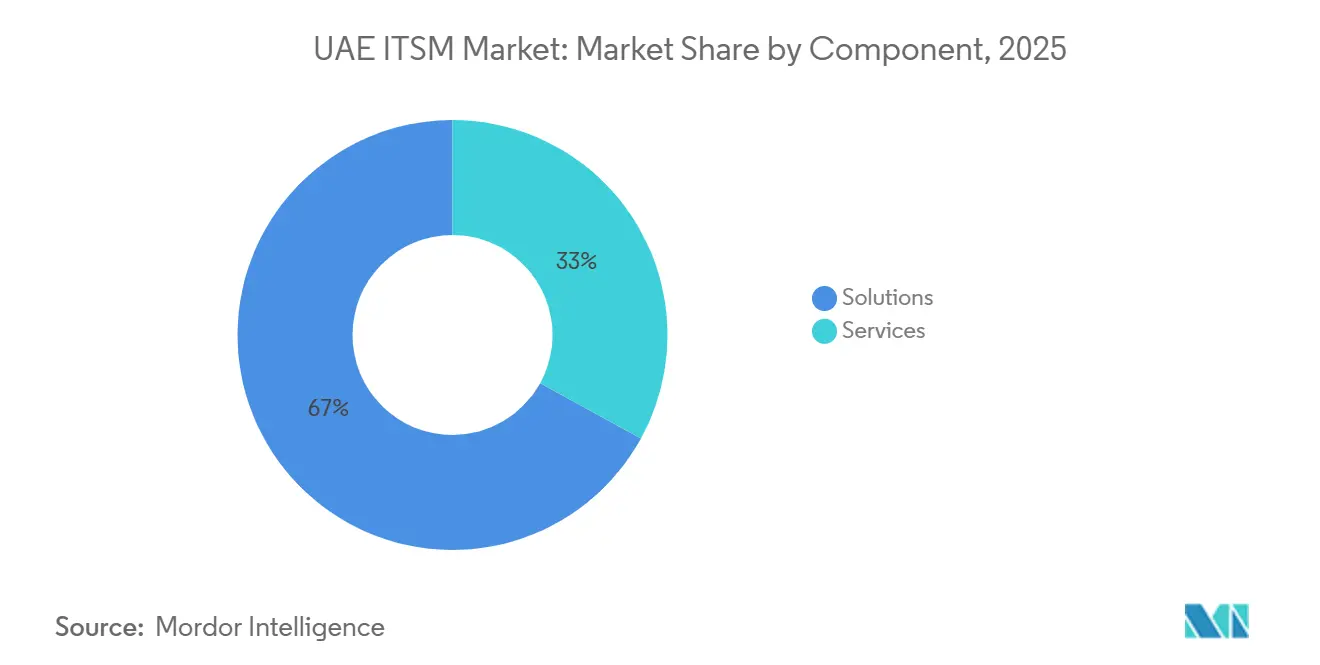
In 2025, solutions accounted for 67% of the UAE's IT service management market, underscoring the historical significance of platform licensing in major public and enterprise contracts. This installed base remains crucial, as core workflow systems are integral to service operations in sectors such as finance, government, telecom, and healthcare. However, there is a noticeable shift in the UAE IT service management market regarding buyer priorities post-platform selection. Enterprises are now emphasizing the quality of implementation, migration support, local hosting design, workflow optimization, and governance after deployment. Consequently, the services segment of the market is projected to grow at a 21.40% CAGR through 2031, outpacing the solutions layer.
This surge in services not only alters the revenue mix but also highlights the increasing operational complexity in the UAE's IT service management landscape. Buyers are now seeking partners who prioritize rollout speed, platform configuration, integration sequencing, and adoption outcomes over mere software delivery. This demand intensifies for organizations integrating AI, cloud, and compliance into their service models. As a result, the UAE IT service management market favors vendors and partners adept in advisory roles, implementation, managed operations, and coordinated workflow redesigns. The trend indicates that mere software differentiation may fall short in future bids, especially for public entities and regulated firms seeking immediate, measurable service enhancements. Practically, while platforms still dominate current revenues, the industry's focus is undeniably shifting toward a more service-centric model.


By Deployment: Cloud Keeps Expanding From A Position Of Strength
In 2025, the cloud commanded a dominant 73% share of the UAE's IT service management market. Projections indicate a robust expansion at a 24% CAGR through 2031, solidifying its status as both the largest and the fastest-growing deployment model. This dual distinction underscores a pivotal trend: the UAE's IT service management landscape is not merely contemplating a shift to the cloud; it is already entrenched in it as the primary delivery model. While on-premise systems continue to cater to sensitive workloads and legacy operating environments, especially for organizations prioritizing stringent internal controls, hybrid deployments serve as a transitional bridge. They allow customers to gradually adapt while safeguarding older integrations. Despite these exceptions, the prevailing demand unmistakably leans towards cloud-first service management.
Vendors have played a pivotal role in this transition, alleviating residency and availability concerns that previously hindered adoption. ServiceNow's UAE Cloud has carved out a robust enterprise pathway, catering to regulated and public sector clients desiring local hosting without compromising on platform diversity. Meanwhile, Freshworks has bolstered the cloud landscape by inaugurating a UAE data center, offering a cost-effective local solution for smaller and mid-sized enterprises. As a result, the rising cloud-centric valuation of the UAE's IT service management market is not merely about the existence of local hosting. It is a race against time: how swiftly can organizations transition their processes and integrations? The cloud's ascent is further fueled by the allure of seamless updates, expedited AI feature rollouts, and enhanced access to managed support, benefits that resonate with both large enterprises and smaller entities alike.
By Application: Knowledge Management Moves From Support Tool To Core Capability
In 2025, service desk and incident management dominated the UAE's IT service management market, claiming a 32% share. This trend is expected to continue, as incident handling serves as the primary entry point for numerous deployments and stands out as the most recognizable workflow for internal users. While asset and configuration management, change and release management, and service request management play pivotal roles in shaping process control and ensuring service quality across broader operations, there is a notable shift in the UAE's IT service management landscape. Knowledge management is gaining prominence, with projections indicating a robust 23.30% CAGR growth rate through 2031, making it the fastest-growing segment.
This surge in knowledge management underscores a pressing challenge many organizations are addressing. For self-service to effectively diminish ticket volumes, support knowledge must be up-to-date, easily searchable, and structured for optimal use by both users and AI tools. Highlighting this need, Abu Dhabi's digital government strategy has heavily leaned into AI-driven service delivery, underscoring the importance of dependable institutional knowledge for every automated response and guided workflow. As a result, the UAE's IT service management market is evolving, prioritizing knowledge capture, reuse, and continuous updating over mere ticket capture. This evolution aligns with a broader trend of platform consolidation, as companies increasingly seek to integrate incident, request, and knowledge workflows, rather than isolating them in distinct tools. Consequently, vendors adept at merging search capabilities, service content governance, and workflow automation into a unified operating model are poised to see their value increase.
By End-User Industry: Healthcare Adds The Fastest New Demand
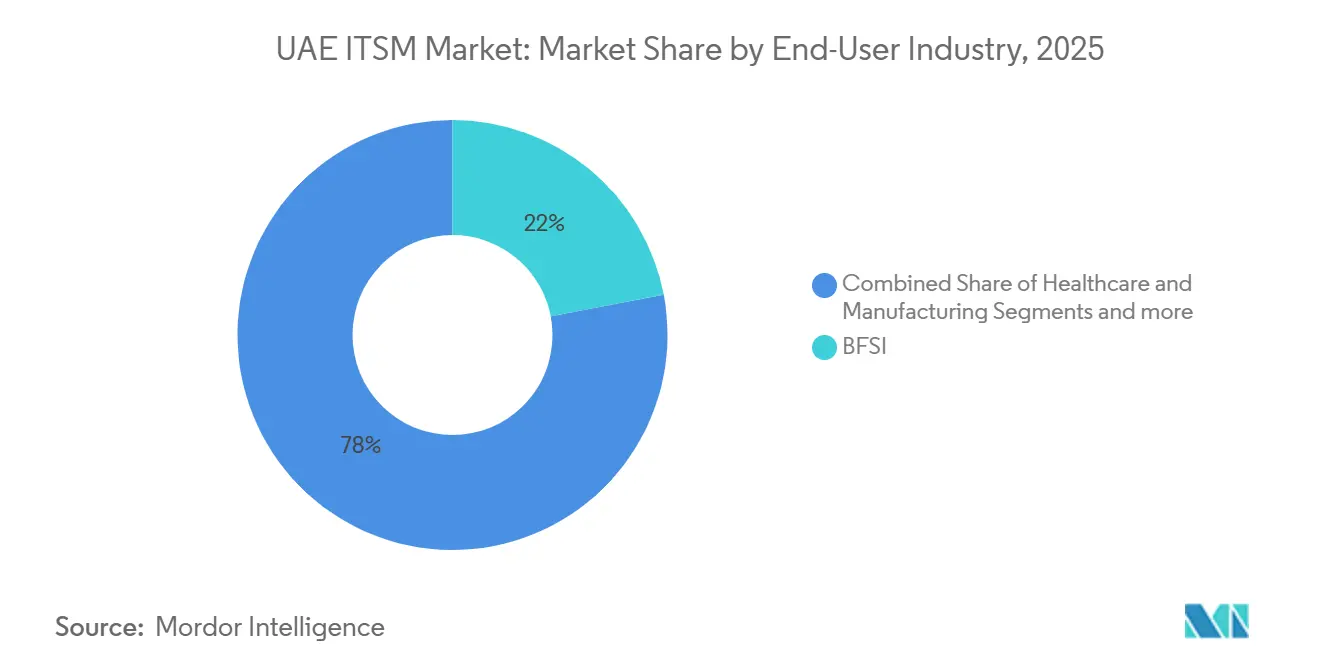
In 2025, the BFSI sector commanded a dominant 22% share, underscoring its entrenched spending habits, intricate controls, and heightened demand for organized IT support. The UAE's IT service management landscape has historically leaned on banking and financial institutions, given their reliance on uninterrupted high-volume digital services. Other key players include the government, public sector, manufacturing, and IT & telecommunications, all of which intertwine service management with broader operational transformations. Notably, healthcare is set to surge at a robust 22.30% CAGR through 2031, emerging as the most rapidly growing sector in the current forecast. This shift indicates a broader redistribution of demand among end-user segments.
Healthcare's upward trajectory is fueled by a burgeoning digital health infrastructure and increasingly interconnected operations. The Emirates Health platform, with its expansive and integrated health data framework, underscores the necessity for uniform incident management, change oversight, and service coordination across diverse systems and entities. This demand is further amplified in the UAE's IT service management realm, where platforms must navigate stringent governance mandates without hindering clinical and administrative workflows. Moreover, healthcare stakeholders often seek more than just basic help desk services; they require features like configuration oversight, structured approvals, escalation pathways, and traceable service records. While retail, travel, and hospitality sectors add to the demand, it is healthcare that presents the most pronounced growth opportunity for vendors adept at managing intricate digital operations. Consequently, while BFSI remains the cornerstone, the landscape is witnessing a swift pivot towards health-centric services.

By Enterprise Size: SME Adoption Broadens The Revenue Base
In 2025, large enterprises dominated the UAE IT service management market, holding a 64% share. Historically, banks, conglomerates, public entities, and major digital operators have been the primary revenue sources. These entities, managing vast user bases and intricate workflows, are pivotal to the market. Their significant spending on implementation, integration, and managed support amplifies their value to platform vendors and service partners. However, the landscape is shifting. Smaller firms are now finding it easier to purchase and deploy cloud-based service tools than in previous years. Projections indicate that SMEs will grow at a robust 23.60% CAGR through 2031, positioning them as the fastest-growing segment.
This surge is not due to a newfound IT complexity but rather factors like pricing, onboarding, and user-friendliness. Features such as lower upfront commitments, subscription models, pre-built workflows, and simplified configurations have eased the entry for organizations with smaller teams. Freshworks bolstered this trend by establishing a UAE data center, addressing local cloud deployment concerns for smaller clients. While large accounts continue to dominate revenue discussions, the UAE IT service management market is expanding its horizons beyond its traditional enterprise focus. However, it is essential to note that SME demand may not mirror the predictability of major contract renewals. Smaller budgets are more susceptible to economic fluctuations and postponed technology decisions. Nevertheless, the growing SME segment is diversifying the market, paving the way for vendors who prioritize swift implementation, easy adoption, and reduced operational costs.
Competitive Landscape
In the UAE's IT service management landscape, ServiceNow stands out, particularly in large enterprises and government sectors. Its edge stems from a broad platform, extensive partner network, and the introduction of its UAE Cloud, tailored for local hosting and regulatory needs. This is significant because UAE buyers prioritize not just workflow features, but also data residency, local service delivery, and scalability across service domains. ServiceNow excels where organizations transition from IT support to comprehensive enterprise service management, all while retaining the same vendor. This unique positioning bolsters its advantage in major transformation initiatives.
Freshworks is carving a niche as a formidable contender in the UAE's mid-market IT service management arena. Its establishment of a UAE data center has bolstered trust among clients seeking local cloud solutions, offering a simpler and more cost-effective alternative to enterprise-centric platforms. Freshworks is also harnessing AI-driven service operations with its Freddy AI, catering to smaller teams desiring automation without hefty consulting fees. This strategy positions Freshworks favorably to tap into the burgeoning SME market and select mid-sized enterprises. Meanwhile, BMC, Ivanti, and partners centered around Atlassian, along with various niche players, actively vie in areas like operations management and service desk modernization, ensuring the market remains diverse and not overly concentrated.
Moves in 2025 and 2026 highlight a shift in competition dynamics, emphasizing ecosystem depth over mere product claims. In September 2025, Cognizant bolstered its ServiceNow collaboration in the Middle East, enhancing its capacity for significant transformation projects. ServiceNow's debut of a local cloud conferred a strategic edge in public sector and regulated enterprise contracts. Freshworks mirrored this strategy with its UAE data center, targeting the more budget-conscious segment. Additionally, du's launch of a national hypercloud fortified the local infrastructure, benefiting platform vendors catering to public and enterprise clients[4]du, “du Launches the National Hypercloud,” du Media Centre, du.ae. Consequently, market leadership now hinges not only on core ITSM capabilities but also on local hosting, partner execution, and the adaptability of workflows.
UAE ITSM Industry Leaders
ServiceNow Inc.
BMC Software, Inc.
Atlassian Corporation Plc
Freshworks Inc.
ManageEngine (Zoho Corporation Pvt. Ltd.)
- *Disclaimer: Major Players sorted in no particular order

Recent Industry Developments
- June 2026: The UAE Cabinet approved the establishment of the Federal Authority for AI and Data (الهيئة الاتحادية للذكاء الاصطناعي والبيانات). This unified national body is mandated to oversee AI governance, data management, and digital government across all federal entities. The authority will define standards for AI deployment in public-sector IT service management workflows, introducing a new compliance layer for platform vendors.
- April 2026: H.H. Sheikh Hamdan bin Mohammed bin Rashid Al Maktoum directed all Dubai government service entities to consolidate every citizen and business service into a single unified digital platform within one year. This initiative triggered a structured refresh of service catalog and fulfillment workflows across Dubai government IT teams.
- February 2026: The Central Bank of the UAE (CBUAE) and Core42, a G42 company, announced the development of the world’s first sovereign financial cloud services infrastructure. All UAE-licensed financial institutions are required to integrate their IT service management and operational risk workflows with the new platform ahead of regulatory deadlines.
- September 2025: Cognizant expanded its Global Elite ServiceNow partnership into the Middle East. This move was part of a joint ambition to build a USD 1 billion global ServiceNow business. The expansion included localized delivery capacity and Arabic-language expertise tailored to serve UAE government and enterprise accounts.


UAE ITSM Market Report Scope
The UAE IT Service Management (ITSM) Market Report is Segmented by Component (Solutions, Services), Deployment (Cloud, On-Premises, Hybrid), Application (Service Desk and Incident Management, Asset and Configuration Management, and More), End-User Industry (BFSI, Manufacturing, and More), and Enterprise Size (Large Enterprises, Small and Medium Enterprises). The Market Forecasts are Provided in Terms of Value (USD).
| Solutions |
| Services |
| Cloud |
| On-Premise |
| Hybrid |
| Service Desk and Incident Management |
| Asset and Configuration Management |
| Change and Release Management |
| Service Request Management |
| Knowledge Management |
| Other Applications |
| BFSI |
| Manufacturing |
| Government and Public Sector |
| IT and Telecommunications |
| Retail and E-Commerce |
| Healthcare |
| Travel and Hospitality |
| Other End-User Industries |
| Large Enterprises |
| Small and Mid-Size Enterprises (SMEs) |
| By Component | Solutions |
| Services | |
| By Deployment | Cloud |
| On-Premise | |
| Hybrid | |
| By Application | Service Desk and Incident Management |
| Asset and Configuration Management | |
| Change and Release Management | |
| Service Request Management | |
| Knowledge Management | |
| Other Applications | |
| By End-User Industry | BFSI |
| Manufacturing | |
| Government and Public Sector | |
| IT and Telecommunications | |
| Retail and E-Commerce | |
| Healthcare | |
| Travel and Hospitality | |
| Other End-User Industries | |
| By Enterprise Size | Large Enterprises |
| Small and Mid-Size Enterprises (SMEs) |


Key Questions Answered in the Report
What is the size of the UAE IT service management market?
The UAE IT service management market was valued at USD 162.41 million in 2025, is estimated at USD 192.50 million in 2026, and is forecast to reach USD 467.52 million by 2031 at a CAGR of 19.42%.
Which deployment model leads adoption in the UAE?
Cloud led adoption with a 73% share in 2025 and is also the fastest-growing deployment model, projected to expand at a 24% CAGR through 2031.
Which application area is growing the fastest?
Knowledge management is the fastest-growing application segment, with a projected CAGR of 23.30% through 2031, as organizations strengthen self-service and AI-enabled support.
Which end-user group creates the largest demand today?
BFSI held the largest end-user share at 22% in 2025, reflecting the sector’s strong need for structured, auditable, and resilient IT service workflows.
Why is healthcare becoming more important for vendors?
Healthcare is projected to grow at a 22.30% CAGR through 2031 because digital health infrastructure and connected service environments are increasing support and governance needs.
What is shaping vendor competition in 2026?
Competition is being shaped by local hosting, partner delivery strength, migration support, and AI-ready workflow design, not only by core ticketing or service desk features.
Page last updated on:






