
UAE Hydroponics and Aquaponics Market Size and Share
Market Overview
| Study Period | 2021 - 2031 |
|---|---|
| Forecast Data Period | 2026 - 2031 |
| Base Year Market Size (2025) | USD 138.60 Million |
| Market Size (2026) | USD 149.41 Million |
| Market Size (2031) | USD 217.51 Million |
| Growth Rate (2026 - 2031) | 7.80 % |
| Market Concentration | Medium |
Major Players *Disclaimer: Major Players sorted in no particular order Image © Mordor Intelligence. Reuse requires attribution under CC BY 4.0. | |
UAE Hydroponics and Aquaponics Market Analysis by Mordor Intelligence
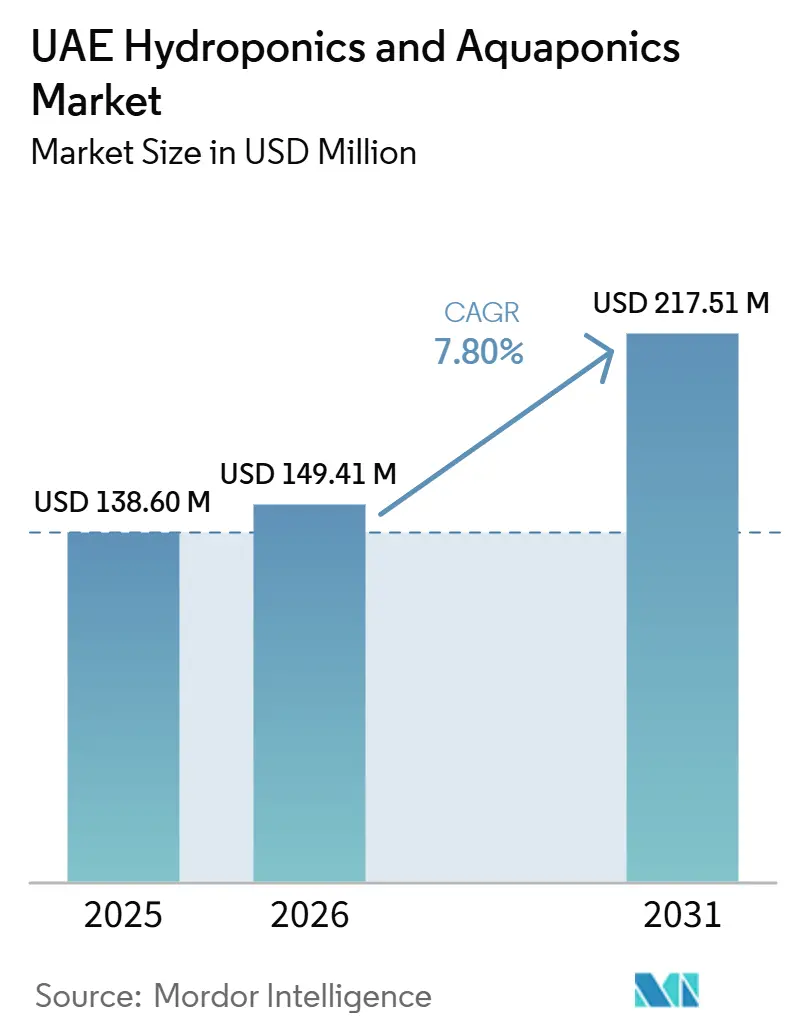
The UAE hydroponics and aquaponics market size is projected to expand from USD 138.60 million in 2025 and USD 149.41 million in 2026 to USD 217.51 million by 2031, registering a CAGR of 7.80% between 2026 and 2031. The UAE hydroponics and aquaponics market is supported by a food security agenda that gives locally controlled-environment production a strategic role, as the country has historically depended on imported food and continues to push local output through the National Food Security Strategy 2051. The UAE hydroponics and aquaponics market also benefits from local structural conditions, as arable land remains scarce, water is limited, and controlled systems can reduce water use compared to conventional soil cultivation. Demand is also becoming more durable because local retailers, airline catering, and hotel, restaurant, and catering (HORECA) buyers increasingly value short lead times, traceability, and stable year-round output from domestic farms. At the same time, the UAE hydroponics and aquaponics market still faces constraints due to high capital requirements, energy-intensive operations, and a shortage of specialized operational talent needed to scale complex facilities efficiently.
Key Report Takeaways
- By growing system, hydroponics was the largest segment with 59.8% of the hydroponics and aquaponics market size in 2025, while aquaponics is the fastest-growing segment, with an 8.7% CAGR from 2026 to 2031.
- By component, hardware was the largest segment, with 54.7% market share in 2025, and is also the fastest-growing disclosed sub-category, with a 6.4% CAGR from 2026 to 2031.
- By facility type, commercial greenhouses were the largest segment, with a 46.2% share in 2025, while indoor vertical farms are the fastest-growing segment, with a 6.7% CAGR from 2026 to 2031.
- By crop type, leafy greens were the largest segment with 38.9% share in 2025, while herbs are the fastest-growing disclosed sub-category, with a 6.2% CAGR from 2026 to 2031.
Note: Market size and forecast figures in this report are generated using Mordor Intelligence’s proprietary estimation framework, updated with the latest available data and insights as of January 2026.
UAE Hydroponics and Aquaponics Market Trends and Insights
Drivers Impact Analysis*
| Driver | (~) % Impact on CAGR Forecast | Geographic Relevance | Impact Timeline |
|---|---|---|---|
| Food security push and import substitution | +1.7% | UAE-wide, with the strongest policy pull in Dubai and Abu Dhabi | Short term (≤ 2 years) |
| Water-intensive crop reallocation to closed-loop production | +1.4% | UAE-wide, with concentrated adoption in Al Ain and Abu Dhabi | Medium term (2-4 years) |
| Desert climate premium for climate-resilient fresh produce | +1.2% | National, with premium retail and HORECA demand strongest in Dubai | Short term (≤ 2 years) |
| Emirate-level agri-tech incentives and sovereign investment | +1.5% | Abu Dhabi, Dubai, and Sharjah | Medium term (2-4 years) |
| Energy-optimized LED and climate control economics | +0.8% | Dubai and Abu Dhabi commercial farms, with spillover to the Northern Emirates | Long term (≥ 4 years) |
| Retail and foodservice demand for traceable local produce | +0.9% | Dubai and Abu Dhabi, especially dense HORECA centers | Short term (≤ 2 years) |
| Source: Mordor Intelligence | |||
Food Security Push and Import Substitution
The UAE hydroponics and aquaponics market is closely tied to food security, as the country still relies heavily on imported food and remains exposed to external supply shocks. The National Food Security Strategy 2051 keeps local technology-led production at the center of long-term planning and gives controlled-environment farming a clear policy role. This matters most for short shelf-life produce because leafy greens, herbs, and tomatoes lose competitiveness quickly when freight, spoilage, and delivery time rise. Buyers that serve airlines, modern retail, and hospitality therefore have a stronger reason to contract with local farms that can deliver consistent output. That procurement pattern supports operators that can guarantee traceability, regular harvest cycles, and food safety standards rather than only low spot-market prices. It also keeps the UAE hydroponics and aquaponics market more policy-linked than many other produce categories, reducing dependence on purely cyclical consumer demand.
Water-Intensive Crop Reallocation to Closed-Loop Production
Water economics remain one of the clearest reasons for controlled cultivation to expand in the UAE hydroponics and aquaponics market. Hydroponic systems can reduce water use by 70% to 90%, which turns water efficiency into a direct commercial advantage in a country with severe resource constraints. In 2025, Abu Dhabi Distribution Company listed commercial water tariffs at AED 7.84 per cubic meter (USD 2.1) and agricultural water tariffs at AED 3.13 per cubic meter (USD 0.9), which shows how utility pricing can shape project economics[1]Source: Abu Dhabi Distribution Company, “Business Rates and Tariffs 2025,” Abu Dhabi Distribution Company, addc.ae. The shift is therefore moving beyond irrigation efficiency toward relocating water-intensive crops into recirculating systems that use climate control, fertigation, and controlled nutrient delivery. This favors integrated facility designs over small standalone kits because the economic value now comes from system performance rather than from single pieces of hardware. It also supports the gradual expansion of the UAE hydroponics and aquaponics market into aquaculture-linked formats that can yield higher output per unit of water.
Desert Climate Premium for Climate-Resilient Fresh Produce
The desert setting gives the UAE hydroponics and aquaponics market a practical local advantage, as conventional open-field farming cannot deliver stable yields for many crops throughout the year. Controlled facilities can keep production more stable and can reduce exposure to transit delays, spoilage, and supply interruptions tied to imported produce. UNS Farms opened a 10,000-square-meter tomato greenhouse in Al Ain in June 2026, designed to produce 150,000 kg of tomatoes each year while cutting water consumption by up to 90%[2]Source: UNS Farms, “UNS Farms Opens 10,000 Sqm Tomato Facility in Al Ain,” UNS Farms, unsfarms.com. The same facility operates with short delivery windows of 24 to 48 hours, which shows why locally controlled output is useful for retail and HORECA channels that need freshness and reliability. This premium is driven less by lifestyle branding and more by procurement logic, because buyers want less temperature exposure and better product control. As a result, the UAE hydroponics and aquaponics market is gaining a stronger position in categories where timing and quality matter more than the lowest landed cost.
Emirate Level Agri-Tech Incentives and Sovereign Investment
Sovereign backing remains a central force in the UAE hydroponics and aquaponics market because public capital is helping define where new projects are built and which technologies are scaled. Abu Dhabi launched the AgriFood Growth and Water Abundance cluster in June 2024 through the Abu Dhabi Department of Economic Development (ADDED) and the Abu Dhabi Investment Office (ADIO), with a target of AED 128 billion (USD 34.9 billion) in attracted investment by 2045[3]Source: Abu Dhabi Media Office, “Khaled Bin Mohamed Bin Zayed Approves Launch of AgriFood Growth and Water Abundance (AGWA) Cluster,” Abu Dhabi Media Office, mediaoffice.abudhabi. The program is aligned with both food security and water security priorities, which gives desert-adapted production technologies a stronger commercial runway than they would have under normal market demand alone. This creates a competitive setting in which access to land, permitting support, and institutional partners can matter as much as agronomy or equipment quality. It also helps explain why large projects are clustering first in Abu Dhabi and Dubai before diffusing outward. Over time, that pattern is likely to keep the UAE hydroponics and aquaponics market anchored by a small group of well-capitalized platforms.
Restraints Impact Analysis*
| Restraint | (~) % Impact on CAGR Forecast | Geographic Relevance | Impact Timeline |
|---|---|---|---|
| High capital intensity for fully controlled environments | -1.7% | UAE-wide, with the sharpest pressure on new entrants outside major hubs | Medium term (2-4 years) |
| Power and cooling cost exposure | -1.5% | Dubai and the Northern Emirates, especially on commercial tariffs | Medium term (2-4 years) |
| Shortage of specialized grow-operations talent | -1.0% | UAE-wide, especially in agronomy and control-system roles | Long term (≥ 4 years) |
| Biosecurity and water quality management complexity | -0.8% | UAE-wide, with greater exposure in recirculating aquaponics systems | Long term (≥ 4 years) |
| Source: Mordor Intelligence | |||
High Capital Intensity for Fully Controlled Environments
High setup costs continue to slow the UAE hydroponics and aquaponics market, as controlled facilities require significant upfront investment in lighting, sensors, pumps, recirculation systems, and cooling systems. The issue is not only the cost of the building itself, but the cost of making the production system stable enough for year-round output in harsh local conditions. That raises the barrier for new private operators without access to sovereign support, patient capital, or guaranteed procurement channels. It also gives larger platforms more room to spread fixed costs across multiple crops, large contract volumes, and longer project horizons. In practice, this means the UAE hydroponics and aquaponics market tends to reward operators who can finance scale early rather than those trying to grow in small steps. The result is a market structure in which growth is real, but entry remains selective.
Power and Cooling Cost Exposure
Energy remains one of the biggest operating constraints in the UAE hydroponics and aquaponics market, as cooling demand is unavoidable in indoor, tightly controlled facilities. According to a 2023 study published in the International Journal of Energy Production and Management, cooling and heating, ventilation, and air conditioning (HVAC) systems can account for approximately 40–60% of operating costs in controlled-environment agriculture under the climatic conditions of the Arabian Peninsula, including the UAE. Abu Dhabi Distribution Company lists commercial electricity at AED 0.2 per kWh (USD 0.05 per kWh), while agricultural electricity is AED 0.045 per kWh (USD 0.01 per kWh), demonstrating how tariff classification can materially affect viability. Indoor farms that rely heavily on artificial lighting and active cooling, therefore, face tighter cost-control requirements than greenhouse operators who can balance technology use with natural light. This keeps project returns sensitive to design choices, land classification, and the mix between indoor and semi-controlled formats. It also explains why the UAE hydroponics and aquaponics market continues to support both commercial greenhouse models and fully indoor vertical farms, rather than moving entirely toward one format.
*Our forecasts treat driver/restraint impacts as directional, not additive. The impact forecasts reflect baseline growth, mix effects, and variable interactions.
Segment Analysis
By Growing System: Hydroponics Leads While Aquaponics Builds Depth
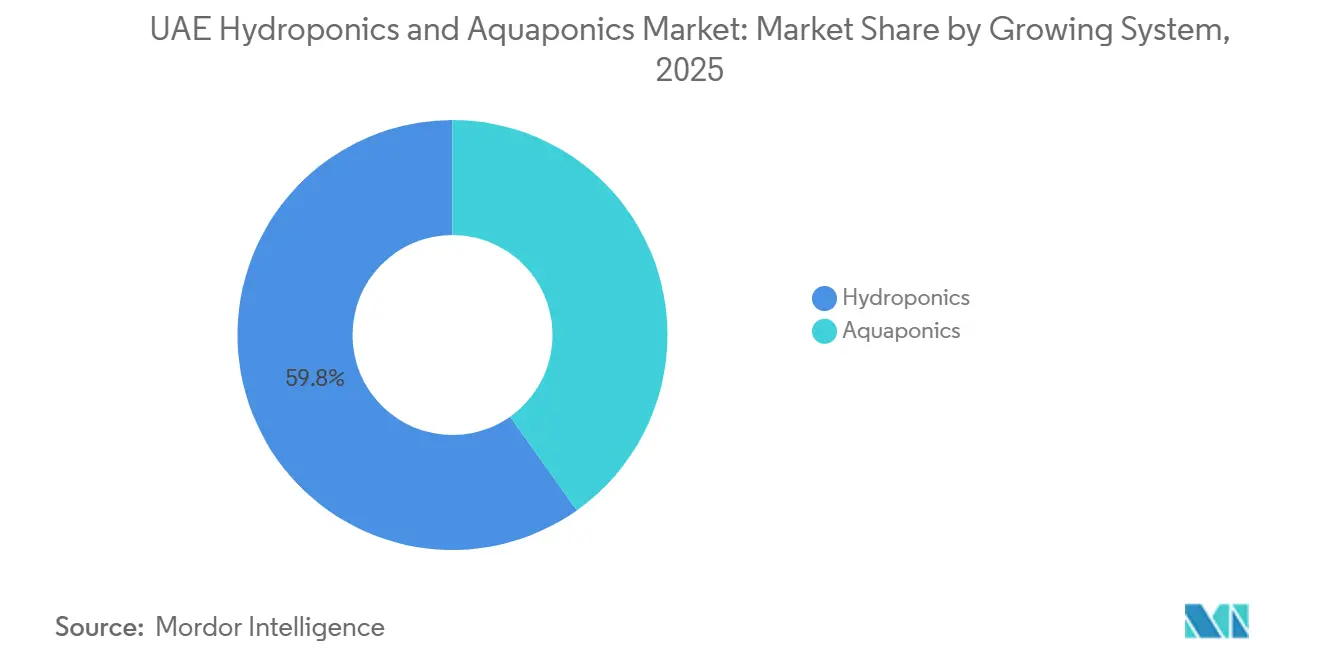
Hydroponics was the largest-growing system and held 59.8% of the UAE hydroponics and aquaponics market share in 2025, while aquaponics was the fastest-growing system at an 8.7% CAGR from 2026 to 2031. This lead reflects the stronger installed base of nutrient film technique, drip, deep water culture, and other hydroponic formats already used across greenhouses and modular farms. Hydroponics also benefits from clearer operating procedures, greater familiarity with crops, and a more developed base of suppliers and service partners. That makes it the easier choice for commercial farms that need predictable output and a shorter route to scale. In the near term, the UAE hydroponics and aquaponics market still leans on hydroponics as its main production backbone.
Aquaponics is expanding faster because it aligns with a broader food security view that combines vegetables with controlled aquatic protein production. In December 2024, Abu Dhabi Developmental Holding Company PJSC is pursuing this direction through partnerships with Khalifa Economic Zones Abu Dhabi (KEZAD), a pilot shrimp-farming facility with Aqua Development and a feasibility study with Finnforel for a 3,000 metric ton fish farm. These projects do not yet displace hydroponics, but they expand the commercial case for recirculating systems that can use water more productively across outputs. Aquaponics also benefits from the fact that the United Arab Emirates imports a large share of its seafood, thereby increasing the strategic value of local aquatic production. Over time, the UAE hydroponics and aquaponics industry is likely to keep hydroponics as the largest base while aquaponics becomes the faster strategic buildout.



By Component: Hardware Holds the Base While Control Layers Gain Weight
Hardware was the largest component segment, accounting for 54.7% of the UAE hydroponics and aquaponics market size in 2025. This share is consistent with the heavy build cost of pumps, lighting, irrigation systems, growing media, meters, controllers, and cooling equipment required before production can begin. In the UAE hydroponics and aquaponics market, hardware remains unavoidable because harsh climate conditions require durable physical infrastructure rather than simple low-cost setups. The segment, therefore, captures the largest share of initial project budgets and remains central even as software and services become more important later. This also helps explain why capital intensity stays high across both greenhouses and indoor farms.
Hardware is the fastest-growing disclosed, with a 6.4% CAGR from 2026 to 2031, reflecting the need for improved energy efficiency and crop-specific control. Climate management software is also gaining importance as growers seek stronger monitoring, more precise nutrient dosing, and remote oversight to reduce dependence on scarce specialist staff. The role of services is expanding for the same reason, as facility design, commissioning, agronomy support, and operational assistance can reduce execution risk for new farms. Providers such as Signify Holding B.V., Argus Control Systems Ltd., Artechno Growsystems, and Pentair plc are aligning with this shift toward integrated solutions rather than one-time equipment supply. As facilities become more complex, the UAE hydroponics and aquaponics market is likely to keep hardware as the largest revenue pool while software and service layers deepen recurring value.
By Facility Type: Commercial Greenhouses Stay Largest While Vertical Farms Scale Faster
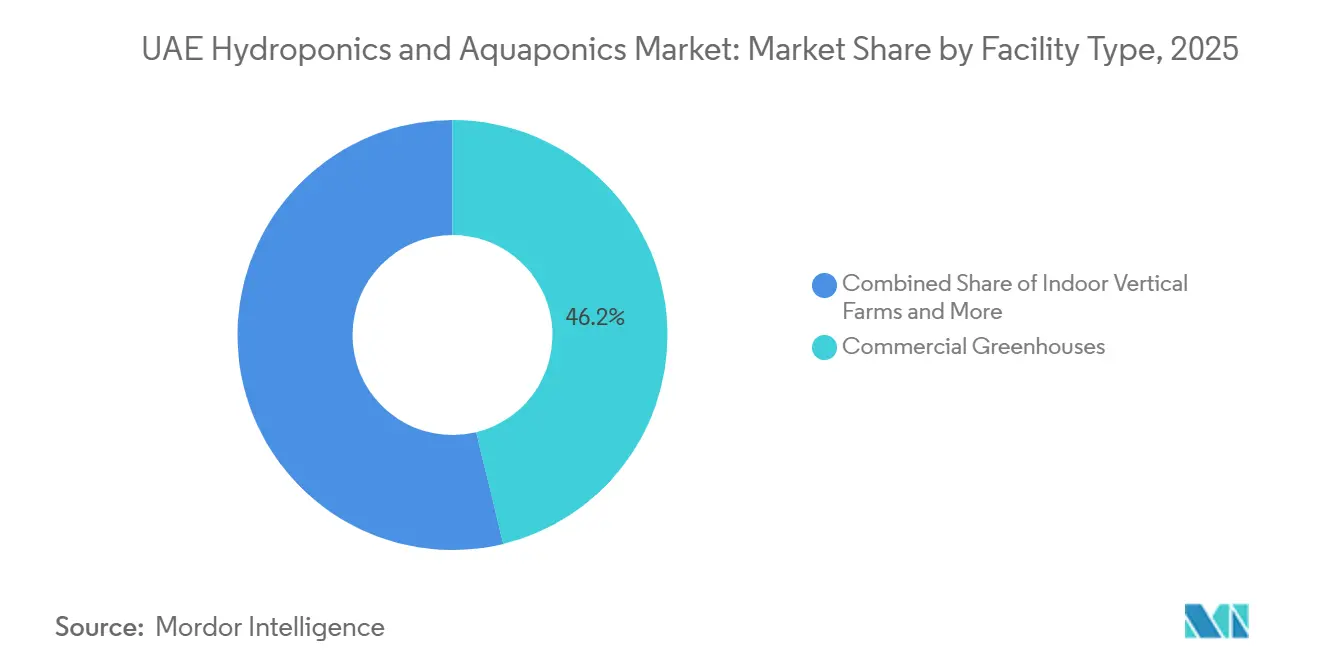
Commercial greenhouses were the largest facility type and accounted for 46.2% of the UAE hydroponics and aquaponics market share in 2025, while indoor vertical farms were the fastest-growing facility type, with a 6.7% CAGR from 2026 to 2031. This segment has scale because greenhouse formats can support high-volume production of tomatoes, cucumbers, peppers, and berries with lower energy intensity than sealed indoor farms. Commercial greenhouses also fit well with the land profile of Al Ain and Abu Dhabi, where operators can combine controlled irrigation with natural light and practical cooling systems. That makes them the most established output platform in the market. In value terms, they remain the largest anchor of the UAE hydroponics and aquaponics market.
Indoor vertical farms are scaling faster because they use less land, suit urban demand centers, and support short-cycle crops that benefit from tight quality control. In February 2024, Emirates Flight Catering assumed full ownership of Bustanica, one of the world's largest vertical farming facilities. Located near Al Maktoum International Airport, the 330,000-square-foot facility produces more than 1 million kilograms of leafy greens annually while using up to 95% less water than conventional agriculture. Bustanica demonstrates the commercial viability of large-scale indoor farming when supported by integrated procurement networks and strong institutional backing in 2024. Container farms, rooftop farms, and research farms still serve useful roles, especially in testing, niche supply, and modular deployment. Even so, the main facility balance in the UAE hydroponics and aquaponics market remains between output-led commercial greenhouses and faster-scaling indoor vertical farms.
By Crop Type: Leafy Greens Lead While Crop Mix Broadens
Leafy greens were the largest crop segment, accounting for 38.9% of the UAE hydroponics and aquaponics market in 2025. Their lead comes from short harvest cycles, regular retail demand, and strong fit with airline catering, hospitality, and premium grocery channels. Leafy greens also work especially well in indoor vertical farms, where rapid rotation and consistent quality matter more than maximum crop variety. Bustanica’s annual output of more than 1 million kg shows how this crop group can support both contract demand and branded retail distribution at scale. That makes leafy greens the clearest commercial benchmark for the UAE hydroponics and aquaponics market.
Herbs are the fastest-growing disclosed sub-category, with a 6.2% CAGR from 2026 to 2031. Tomatoes remain the leading fruiting crop within the market’s controlled-environment portfolio and are supported by both greenhouse and newer precision formats. Herbs, cucumbers, peppers, and strawberries extend the crop mix and help growers balance contract needs, pricing, and seasonal selling windows. The diversification trend matters because farms need more than one strong crop line to smooth revenue and reduce reliance on a single buyer segment. As the UAE hydroponics and aquaponics market matures, crop portfolios are likely to broaden further while leafy greens remain the largest value contributor.
Geography Analysis
Abu Dhabi remains the largest institutional base within the UAE hydroponics and aquaponics market because it combines sovereign capital, policy support, and a large agricultural footprint. The AgriFood Growth and Water Abundance cluster was launched there in June 2024 through the Abu Dhabi Department of Economic Development and the Abu Dhabi Investment Office, with a target to attract AED 128 billion (USD 34.9 billion) by 2045. Abu Dhabi also has 24,000 farms, with half in Al Ain, giving the Emirate a deeper agricultural base than a greenfield buildout would allow. That base makes Abu Dhabi the main location for large greenhouse, aquaculture, and integrated food technology projects in the market.
Dubai serves as the main commercial hub in the UAE hydroponics and aquaponics market because it is home to airline catering, hospitality, premium retail, and dense urban consumption. The facility also uses 95% less water than traditional farming, which strengthens Dubai’s role in high-visibility food technology deployment. The city’s logistics profile supports short delivery windows and helps controlled-environment farms serve both institutional and retail customers with fresher products. That makes Dubai especially important for branded leafy greens, premium herbs, and other crops that depend on rapid movement and stable quality.
Sharjah and the Northern Emirates remain smaller, but they are emerging as the next growth area in the UAE hydroponics and aquaponics market. Their appeal comes from lower land intensity, room for pilot projects, and growing interest in modular and distributed production formats. SweGreen AB and Urban Agritechs Ltd signed a partnership in May 2026 to roll out up to 15 farming units in the United Arab Emirates, with installations planned to begin in phases during the fourth quarter of 2026, indicating broader geographic expansion beyond the main hubs. As more modular and aquaculture-linked projects move outward from Abu Dhabi and Dubai, the market's national footprint is likely to become wider and less concentrated.
Competitive Landscape
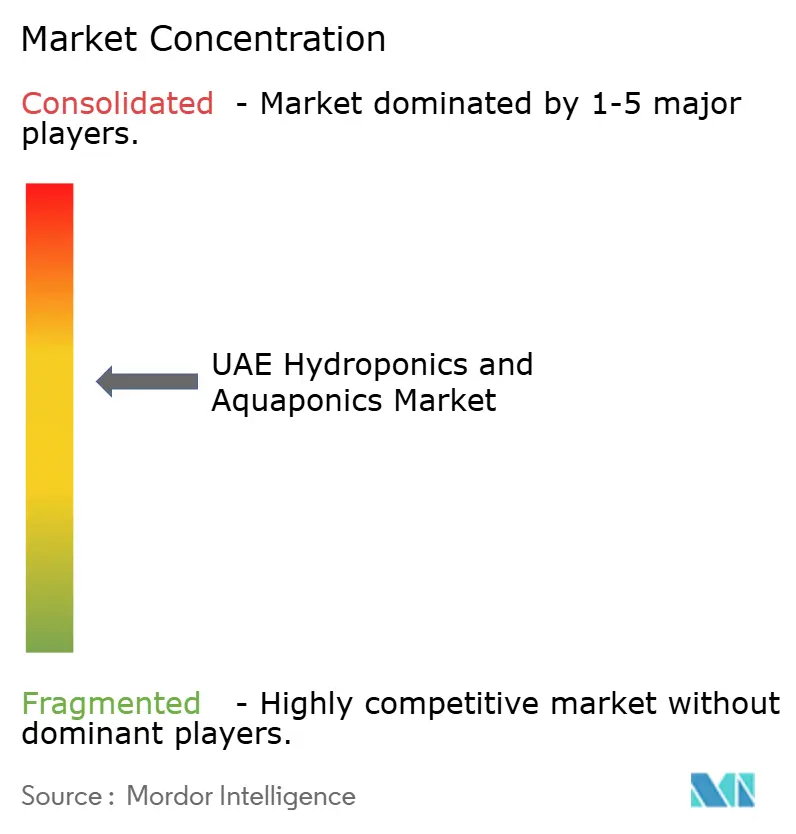
The UAE hydroponics and aquaponics market is moderately concentrated, with the strongest positions held by large, well-capitalized platforms that benefit from procurement access, land, and long investment horizons. Pure Harvest Smart Farms, through Bustanica, is one of the clearest leaders because it controls the world’s largest indoor vertical farm and can tie production directly to airline catering and retail channels. Hydrofarm Holdings Group, Inc. also remains important in the competitive set because the market continues to rely heavily on greenhouse-led fruiting crop production. Silal Group-linked initiatives add another major layer because sovereign-supported food and agriculture platforms are shaping how technologies are deployed across the country.
This structure creates a clear divide between large platforms and smaller operators. The largest players can more easily absorb high initial capital requirements and justify multi-year investments in climate control, automation, and specialist operating teams. Smaller and mid-tier participants, therefore, compete through crop focus, customer proximity, and service quality rather than pure scale. Technology suppliers also matter more than in traditional farming because lighting, monitoring, filtration, irrigation, and control systems directly shape output consistency and cost. That is why providers such as Signify Holding B.V., Pentair plc, Argus Control Systems Ltd., and Artechno Growsystems remain strategically relevant even when they are not farm operators themselves.
Recent strategic moves show that the competitive field is evolving through both vertical integration and new-format partnerships. Emirates Flight Catering fully acquired Bustanica in February 2024 and turned it into a fully United Arab Emirates-owned venture, which reinforced captive supply as a workable model for institutional food buyers. Abu Dhabi Developmental Holding Company PJSC partnered with Aqua Development on a pilot shrimp-farming facility at Khalifa Economic Zones Abu Dhabi (KEZAD) and also explored a 3,000 metric ton cold-water trout project with Finnforel, demonstrating how aquaculture-linked systems are becoming part of the competitive landscape. SweGreen AB’s partnership with Urban Agritechs Ltd also suggests that lower-capital farming-as-a-service entry models are beginning to test the market from the outside. Overall, competition remains active, but leadership still rests mainly with operators and sponsors that can combine capital, technology, and reliable off-take.
UAE Hydroponics and Aquaponics Industry Leaders
Pure Harvest Smart Farms
Hydrofarm Holdings Group, Inc.
AeroFarms, LLC
Gulf Hydroponic Agriculture Services LLC
GreenOponics Agricultural Services LLC
- *Disclaimer: Major Players sorted in no particular order

Recent Industry Developments
- June 2026: UNS Vertical Farms, part of the UAE-based Speedex Group, opened a 10,000-square-meter controlled-environment tomato greenhouse in Al Ain, producing 150,000 kg of fresh tomatoes annually using hydroponics, the Internet of Things (IoT), and artificial intelligence (AI)-based climate management, with up to 90% water savings compared to conventional farming.
- February 2026: Qatar-based agri-tech startup Hydrovest secured USD 275,000 in funding and announced a planned operational entry into Dubai in Q4 2026, targeting premium retail channels and distribution partnerships with AI-driven hydroponics cultivation systems, bringing regional startup competition into the UAE market.
- February 2025: Careem Groceries entered into a partnership with Bustanica to deliver pesticide-free, hydroponically grown leafy greens, including parsley, lettuce, spinach, kale, arugula, and microgreens, directly to customers in Dubai and Abu Dhabi, marking a new last-mile distribution channel for controlled-environment produce and broadening domestic hydroponics market reach beyond traditional retail.


UAE Hydroponics and Aquaponics Market Report Scope
Hydroponics is a soilless farming method where plants grow directly in nutrient-rich water solutions. Aquaponics combines hydroponics with aquaculture, using nutrient-rich waste from live fish to fertilize the plants.
The UAE hydroponics and aquaponics market report is segmented by growing system (hydroponics and aquaponics), by component (hardware, software, and services), by facility type (commercial greenhouses, indoor vertical farms, container farms, rooftop farms, and research and demonstration farms), and by crop type (leafy greens, herbs, tomatoes, cucumbers, peppers, strawberries, and other crop types). The forecasts are provided in terms of value in USD.
| Hydroponics | Nutrient Film Technique |
| Deep Water Culture | |
| Drip System | |
| Ebb and Flow | |
| Wick System | |
| Aggregate-Based Systems | |
| Aquaponics | Media-Based Aquaponics |
| Nutrient Film Technique Aquaponics | |
| Deep Water Culture Aquaponics | |
| Other Aquaponics Systems |
| Hardware | Growing Media |
| HVAC Systems | |
| Irrigation Systems | |
| LED Grow Lights | |
| Meters and Controllers | |
| Pumps | |
| Software | |
| Services |
| Commercial Greenhouses |
| Indoor Vertical Farms |
| Container Farms |
| Rooftop Farms |
| Research and Demonstration Farms |
| Leafy Greens |
| Herbs |
| Tomatoes |
| Cucumbers |
| Peppers |
| Strawberries |
| Other Crop Types |
| By Growing System | Hydroponics | Nutrient Film Technique |
| Deep Water Culture | ||
| Drip System | ||
| Ebb and Flow | ||
| Wick System | ||
| Aggregate-Based Systems | ||
| Aquaponics | Media-Based Aquaponics | |
| Nutrient Film Technique Aquaponics | ||
| Deep Water Culture Aquaponics | ||
| Other Aquaponics Systems | ||
| By Component | Hardware | Growing Media |
| HVAC Systems | ||
| Irrigation Systems | ||
| LED Grow Lights | ||
| Meters and Controllers | ||
| Pumps | ||
| Software | ||
| Services | ||
| By Facility Type | Commercial Greenhouses | |
| Indoor Vertical Farms | ||
| Container Farms | ||
| Rooftop Farms | ||
| Research and Demonstration Farms | ||
| By Crop Type | Leafy Greens | |
| Herbs | ||
| Tomatoes | ||
| Cucumbers | ||
| Peppers | ||
| Strawberries | ||
| Other Crop Types | ||


Key Questions Answered in the Report
What is the 2031 outlook for hydroponics and aquaponics in the United Arab Emirates?
The sector is forecast to reach USD 217.51 million by 2031 from USD 149.41 million in 2026, growing at a 7.8% CAGR over 2026 to 2031.
Which production system is expanding faster in the country?
Aquaponics is the fastest system with an 8.7% CAGR from 2026 to 2031, while hydroponics remained the largest system with 59.8% share in 2025.
Why are controlled-environment farms gaining traction in the United Arab Emirates?
Food security policy, high import dependence, scarce arable land, and the ability to cut water use by 70% to 90% are making controlled systems more attractive.
Which facility format currently leads, and which one is scaling faster?
Commercial greenhouses were the largest facility type with 46.2% share in 2025, while indoor vertical farms are growing faster at a 6.7% CAGR.
What crops are most important for local operators?
Leafy greens led with 38.9% share in 2025, while tomatoes remain the key fruiting crop in large controlled facilities.
What are the main limits on future growth?
High upfront capital, energy and cooling costs, and the shortage of specialized operating talent remain the main barriers to wider scaling.
Page last updated on:





