
UAE Fixed Wireless Access Market Size and Share
Market Overview
| Study Period | 2020 - 2031 |
|---|---|
| Forecast Data Period | 2026 - 2031 |
| Base Year Market Size (2025) | USD 0.81 Billion |
| Market Size (2026) | USD 0.91 Billion |
| Market Size (2031) | USD 1.96 Billion |
| Growth Rate (2026 - 2031) | 16.59 % |
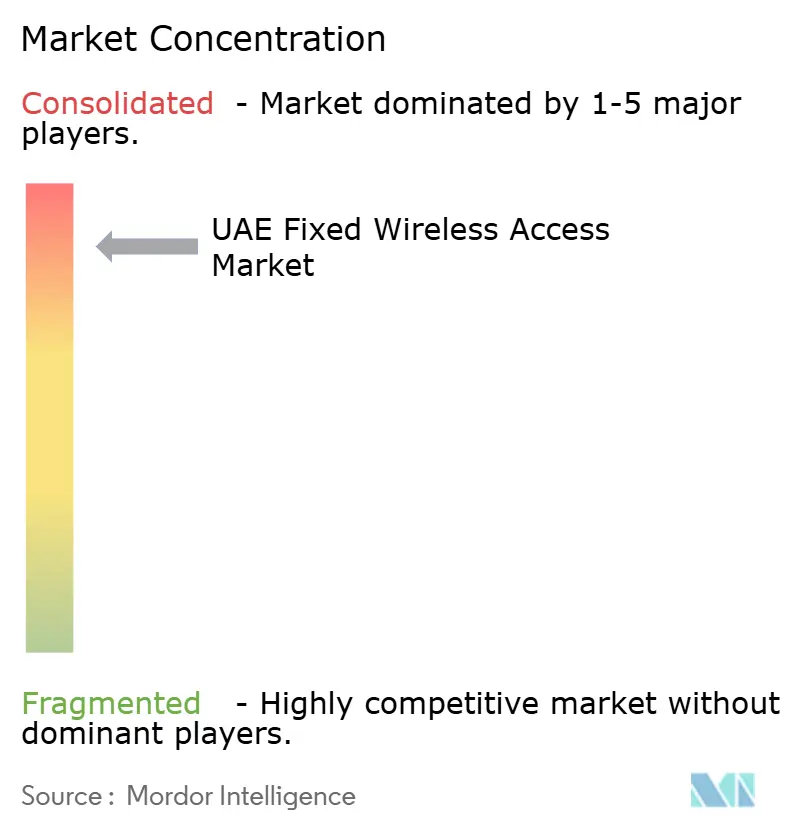
| Market Concentration | High |
Major Players *Disclaimer: Major Players sorted in no particular order Image © Mordor Intelligence. Reuse requires attribution under CC BY 4.0. | |
UAE Fixed Wireless Access Market Analysis by Mordor Intelligence
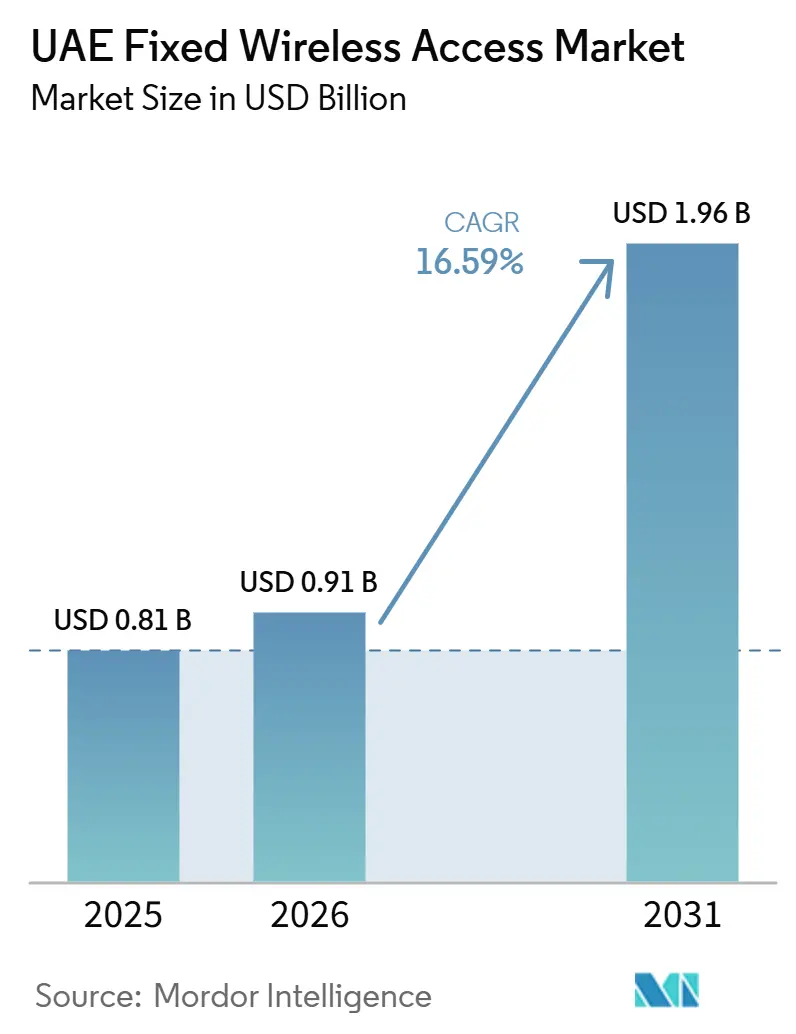
The UAE fixed wireless access market size was valued at USD 0.81 billion in 2025 and estimated to grow from USD 0.91 billion in 2026 to reach USD 1.96 billion by 2031, at a CAGR of 16.59% during the forecast period (2026-2031). Growth is being supported by the commercial maturation of 5G Standalone networks across e& and du, which is improving service quality and widening the range of use cases for wireless broadband. The UAE fixed wireless access market is also benefiting from a large expatriate renter base that tends to prefer portable and low-commitment broadband options over long installation cycles and long-term fiber contracts. Competition centers on a licensed duopoly at the service layer, but operators are still using product design, premium home bundles, self-install hardware, and enterprise-grade connectivity packages to differentiate their offerings. The market is also gaining support from the national spectrum roadmap and the move toward the upper 6 GHz band and next-generation wireless platforms, while fiber-led pricing pressure and licensing timelines remain the main constraints on monetization. These conditions keep the UAE fixed wireless access market on a strong growth path, with the clearest opportunities sitting in portable residential broadband, premium home wireless tiers, and business continuity services.
Key Report Takeaways
- By type, hardware held 60.11% share in 2025, while services are projected to expand at a 17.12% CAGR through 2031.
- By application, residential held 61.19% share of the UAE fixed wireless access market size in 2025, while government and public safety are projected to expand at a 16.98% CAGR through 2031.
- By frequency band, sub-6 GHz commanded 52.17% share in 2025, while mmWave is projected to grow at a 17.61% CAGR through 2031.
- By deployment mode, indoor CPE held 60.11% share of the UAE fixed wireless access market size in 2025, while self-install window-mount CPE is projected to expand at a 17.89% CAGR through 2031.
Note: Market size and forecast figures in this report are generated using Mordor Intelligence’s proprietary estimation framework, updated with the latest available data and insights as of January 2026.
UAE Fixed Wireless Access Market Trends and Insights
Drivers Impact Analysis*
| DRIVER | (~) % IMPACT ON CAGR FORECAST | GEOGRAPHIC RELEVANCE | IMPACT TIMELINE |
|---|---|---|---|
| 5G Standalone Rollout Expanding Residential FWA Capacity | +4.5% | UAE-wide, with early gains concentrated in Dubai and Abu Dhabi | Short term (≤ 2 years) |
| Rapid Gbps-Grade Home Internet Demand in High-Density Urban Districts | +3.5% | Dubai, Abu Dhabi, Sharjah, high-density residential zones | Medium term (2-4 years) |
| Faster Install and Portable Connectivity Versus Premises-Dependent Fiber | +2.8% | UAE-wide, pronounced in high-turnover expat-residential districts | Short term (≤ 2 years) |
| Enterprise Backup Connectivity Demand for Business Continuity | +2.2% | Dubai and Abu Dhabi are commercial hubs | Medium term (2-4 years) |
| Operator Monetization Through Premium Wireless Home Broadband Bundles | +1.8% | UAE-wide, driven by tiered plan structures across e& and du | Medium term (2-4 years) |
| mmWave Trial Success Improving Coverage and Peak Throughput Economics | +1.5% | Dense urban UAE, with spillover to mixed-use commercial zones | Long term (≥ 4 years) |
| Source: Mordor Intelligence | |||
5G Standalone Rollout Expanding Residential FWA Capacity
The shift from 5G Non-Standalone to 5G Standalone is changing the service economics of the UAE fixed wireless access market, as slicing, dedicated bearer allocation, and stronger quality controls become commercially viable at scale. Du deployed the first commercial 5G Standalone Cloud RAN solution in the Middle East and Africa with Nokia in December 2024, providing the operator with a stronger foundation for advanced connectivity services and cloud-native operations.[1]Nokia, “Nokia and du Deploy First Commercial 5G Standalone Cloud RAN Solution in Middle East and Africa,” Nokia Newsroom, nokia.com On a Standalone network, operators can split households into performance tiers and protect premium users from congestion during busy hours, which supports better pricing discipline in the UAE fixed wireless access market. TDRA has also been re-planning IMT blocks to support wider contiguous allocations, including 100 MHz in mid-bands and 800 MHz and above in mmWave, specifically to support advanced mobile broadband services such as FWA.[2]TDRA, “UAE Spectrum Outlook 2026-2031, Version 2.0,” Telecommunications and Digital Government Regulatory Authority, tdra.gov.ae This combination of network architecture and spectrum planning increases residential capacity without requiring the same civil works as fixed networks. It also gives operators more room to sell differentiated home broadband packages instead of relying only on entry-level price competition
Rapid Gbps-Grade Home Internet Demand In High-Density Urban Districts
Demand for higher home broadband speeds is rising across densely populated residential areas as households use more streaming, connected devices, cloud storage, and AI-assisted workflows simultaneously. This matters in the UAE fixed wireless access market because dense apartment clusters create a large addressable base for premium wireless broadband if throughput remains stable during busy periods. Du stated that 70% of its mobile and FWA traffic ran over 5G infrastructure in 2024, and that operating mix continued to support higher-capacity service delivery as the network expanded through 2025.[3]Huawei, “From Connectivity to Capability, How 5G FWA Is Powering National Digital Transformation,” Huawei Tech, huawei.com TDRA's upper 6 GHz roadmap also supports this demand pattern by enabling larger contiguous capacity blocks better suited to high-throughput urban use cases. As a result, the UAE fixed wireless access market is moving closer to a point where gigabit-class wireless can compete for a wider share of premium home connectivity demand. That shift is important because revenue growth will increasingly depend on higher-value household plans rather than on subscriber additions alone.
Faster Install and Portable Connectivity Versus Premises-Dependent Fiber
The UAE fixed wireless access market has a clear advantage in activation speed because fiber often needs trenching, in-building wiring, and landlord approval before service can go live. That process is less attractive in a rental-heavy environment where many households value flexibility and shorter commitments over permanent premises-based connectivity. FWA can be activated within hours of hardware delivery, providing a better fit for mobile households and shorter move-in timelines. Vantiva and e& UAE deployed the region's first eSIM-enabled 5G FWA gateway in October 2024, enabling self-activation without a technician visit or a physical SIM card. Du reported a 12% year-over-year increase in its Home Wireless subscriber base in Q2 2025, with 76,000 net additions over the previous 12 months, which shows that convenience is translating into real take-up.[4]du, “du Reports a Stellar Net Profit Expansion in Q2 2025 with a 25.1% Year-over-Year Growth,” Zawya, zawya.com TDRA's structured device approval environment also supports this model by helping self-install products move more smoothly into retail channels, which keeps the UAE fixed wireless access market aligned with low-friction onboarding.
Enterprise Backup Connectivity Demand for Business Continuity
Business demand is widening the UAE fixed wireless access market beyond home broadband, as many organizations now treat wireless access as either a backup path or a faster primary option when fiber lead times do not align with operating needs. Ports, logistics hubs, financial facilities, hotels, airports, and public safety users all need resilient connectivity that can be provisioned quickly and managed under tighter service rules. E& UAE launched the Middle East and Africa's first commercial 5G network slicing product in May 2025, providing enterprise users with dedicated, reserved capacity on a shared 5G infrastructure. Du and Huawei then signed a strategic MoU in March 2026 to develop 5G-A Phase 2 capabilities for 10 Gbps-class connectivity in venues such as airports, hotels, shopping centers, and exhibition sites.[5]du, “du and Huawei Partner to Deliver 10Gbps Network Experience Through 5G-A Technology,” Zawya, zawya.com The device ecosystem is also adapting, as newer enterprise FWA routers increasingly support dual-SIM failover, slicing compatibility, and stronger operational resilience. This gives the UAE fixed wireless access market a broader revenue mix and reduces its dependence on household demand alone.
Restraints Impact Analysis*
| RESTRAINT | (~) % IMPACT ON CAGR FORECAST | GEOGRAPHIC RELEVANCE | IMPACT TIMELINE |
|---|---|---|---|
| Spectrum Availability and Licensing Constraints | -2.4% | UAE-wide, governed by TDRA's structured allocation process | Short term (≤ 2 years) |
| Fiber Bundling and Price Competition Limiting FWA ARPU Expansion | -1.9% | Dubai and Abu Dhabi are mature fiber-served residential districts | Medium term (2-4 years) |
| Signal Variability in Dense Urban and Indoor Environments | -1.3% | Dubai and Abu Dhabi core urban zones with dense tower infrastructure | Short term (≤ 2 years) |
| CPE Subsidy Pressure and Equipment Import Cost Sensitivity | -0.9% | UAE-wide, with higher sensitivity in Northern Emirates price-conscious segments | Medium term (2-4 years) |
| Source: Mordor Intelligence | |||
Spectrum Availability and Licensing Constraints
Spectrum remains the main structural constraint on the UAE fixed wireless access market, as new bands do not become commercially usable immediately after appearing on a roadmap. TDRA operates an individually licensed and technology-neutral spectrum framework, which means operators still need formal authorizations, network planning, and ecosystem readiness before they can convert capacity into active services. This creates a timing gap between allocation policy and network monetization, which can slow subscriber growth in the near term. TDRA allocated the 6.425-7.125 GHz band for advanced 5G in 2024, but device, chipset, and CPE certification cycles still require time before the band reaches a broad commercial scale. The mmWave bands above 37 GHz are scheduled for study and consultation during 2028-2031, so they are not expected to add meaningful capacity within most of the current forecast window. TDRA's spectrum fee schedule also increases the cost of using wider bandwidth blocks, which matters when operators develop higher-throughput service tiers in the UAE fixed wireless access market.
Fiber Bundling and Price Competition Limiting FWA ARPU Expansion
Price pressure from fiber bundles is limiting the extent to which FWA can sustain a premium in the most mature residential districts of the UAE fixed wireless access market. This trend is especially relevant in Dubai and Abu Dhabi, where fiber is already well established, and consumers can compare wireless portability with high fixed-line performance. Du stated that growth in its 2025 fixed revenues was supported by the normalization of Home Wireless promotions, showing that pricing remains central to subscriber acquisition and retention. This makes ARPU expansion harder even when connection growth remains healthy, as promotional activity cannot deliver the same value uplift as a durable premium tier. Lower-priced home wireless offers in the market also set a benchmark that larger bundled providers must address, narrowing the scope for margin improvement in entry and mid tiers. As a result, subscriber growth in the UAE fixed wireless access market can outpace revenue growth until higher-end performance packages gain wider acceptance.
*Our forecasts treat driver/restraint impacts as directional, not additive. The impact forecasts reflect baseline growth, mix effects, and variable interactions.
Segment Analysis
By Type: Hardware Leads While Services Reshape the Revenue Mix
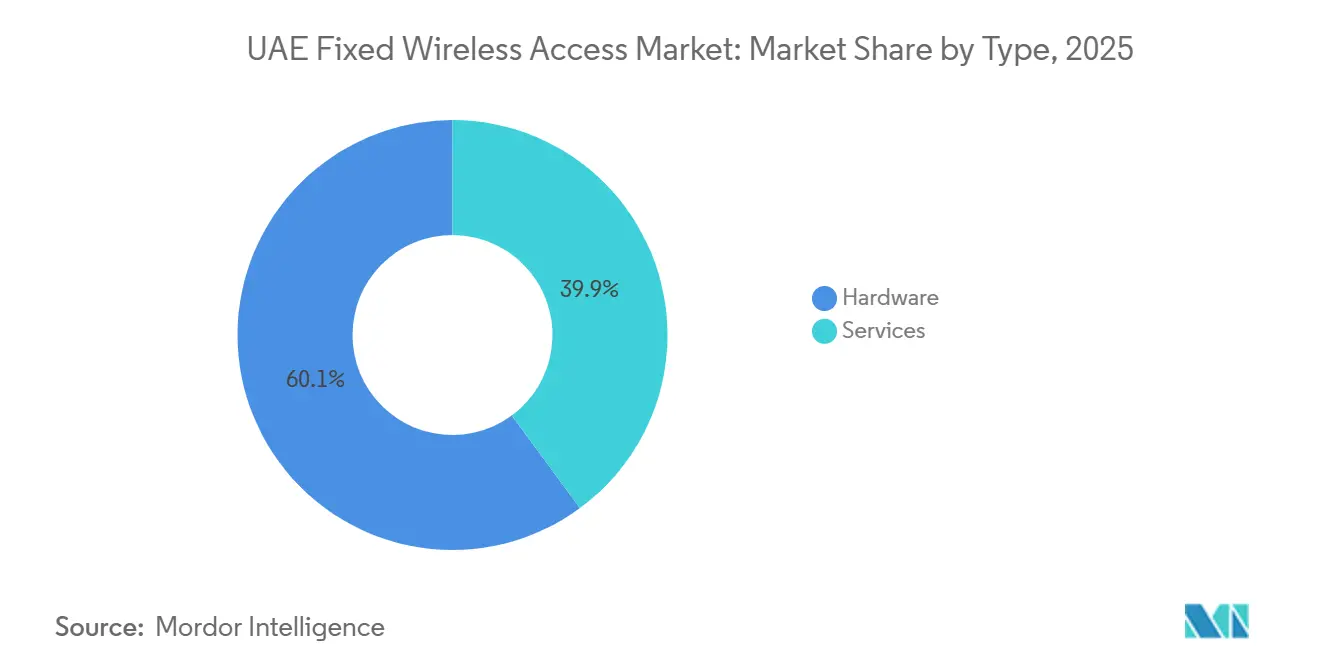
Hardware is expected to command 60.11% of the UAE fixed wireless access market in 2025, making it the largest current revenue component across the value chain. This share reflects the customer premises equipment procurement cycle, as operators either subsidize gateway devices as part of subscriber acquisition or sell them separately to support upfront cost recovery. Customer premises equipment, including indoor routers, outdoor receivers, and window-mount units, accounts for most hardware revenue, while access units such as femtocells and picocells support the densification needed in multi-dwelling buildings. This indicates that the near-term structure of the UAE fixed wireless access industry still depends heavily on physical device deployment, even when service plans remain the main consumer-facing product.
Services are projected to grow at a 17.12% CAGR through 2031, indicating a gradual shift in the UAE fixed wireless access market size toward recurring connectivity revenue rather than one-time device sales. Operators are promoting subscription-first models that separate devices from contracts and make managed service tiers easier to scale over time. Du's SIM-only Home Wireless offers, including plans sold through Virgin Mobile, show how providers are redirecting margins away from large hardware subsidies and toward ongoing service billing. Nokia launched the FastMile Gateway 4 in 2025 with Wi-Fi 7 support and speeds of up to 4 Gbps, giving operators a stronger product base for premium plan design. As this model expands, the current hardware-heavy mix is likely to narrow because device costs will begin to spread across the contract term rather than remain concentrated at activation. This transition matters because it supports steadier cash flow and provides the UAE's fixed wireless access market with a more service-led revenue structure over the forecast period.


By Application: Residential Anchors the Market While Government Demand Accelerates
Residential connections are expected to account for 61.19% of the market in 2025, forming the main demand base for the UAE fixed wireless access market. This position stems from mass-market home wireless offers targeted at premises where fiber is unavailable, delayed, or less attractive due to installation complexity. Residential demand is now splitting into two tracks: premium users are moving toward faster plans that generate more revenue per connection, while value users remain more sensitive to monthly pricing. This split keeps the residential segment large, but it also makes product design more important than simple volume expansion.
Commercial use by small and medium enterprises is expected to remain active in 2025, and du linked Office Wireless adoption to full-year fixed service revenue growth of 9.4%. Industrial and public sector demand starts from a smaller base, creating more room for rapid scale as use cases become more specialized. Government and public safety are projected to expand at a 16.98% CAGR, making it the fastest-growing application segment in the UAE fixed wireless access market. E& UAE's commercial 5G network slicing offer targets public safety, manufacturing, and port operations, showing how wireless access is moving from backup connectivity to a more strategic infrastructure role. This shift broadens the revenue mix and brings more quality-sensitive use cases into the UAE fixed wireless access industry. It also gives operators a stronger reason to develop differentiated packages with reserved capacity, managed support, and more stable service rules.
By Frequency Band: Sub-6 GHz Leads But mmWave Is Redefining Urban Capacity Economics
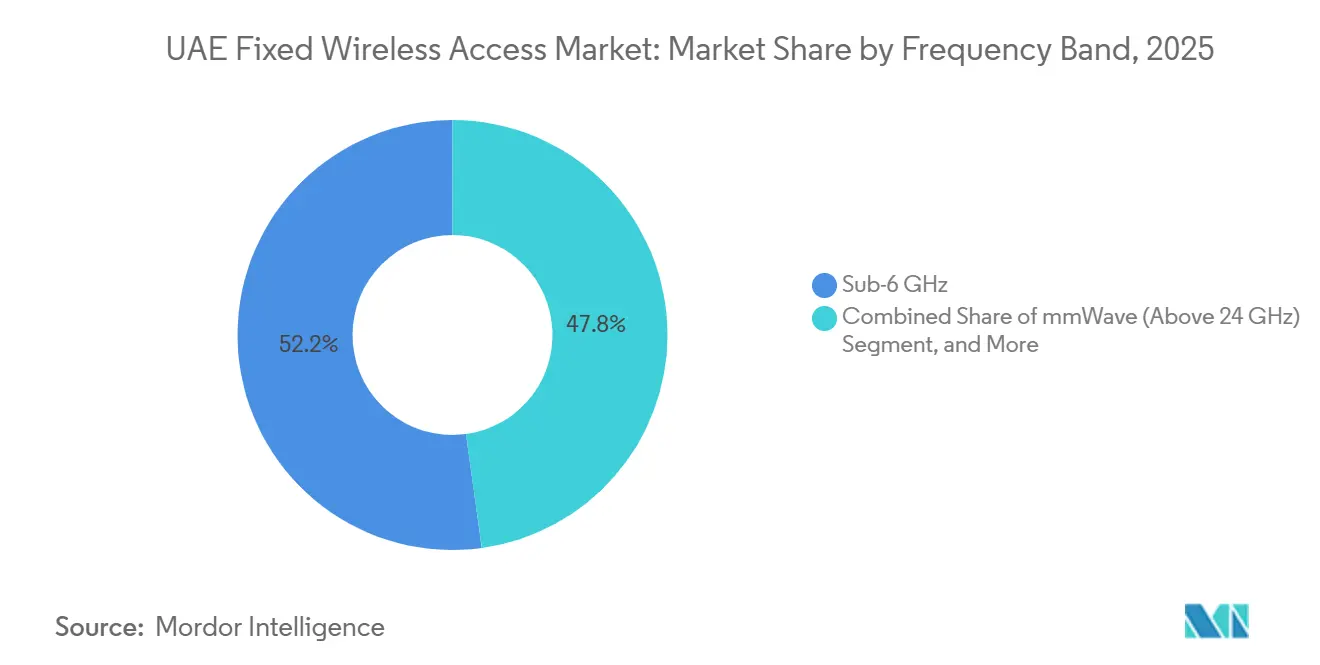
Sub-6 GHz is expected to hold a 52.17% share in 2025 and remain the foundation of the UAE fixed wireless access market because existing 5G mid-band assets are already deployed at commercial scale. Both national operators have active 3.3-3.8 GHz infrastructure, and that spectrum sits within a mature global CPE ecosystem that supports device availability and faster rollout timing. The band offers a practical balance between coverage and throughput, making it suitable for residential FWA, where outdoor CPE can connect to macro towers with fewer installation complications. This installed base gives operators a lower-risk path for subscriber additions and keeps sub-6 GHz central to near-term market execution.
mmWave is projected to expand at a 17.61% CAGR through 2031, making it the fastest-growing frequency option in the UAE fixed wireless access market. Ericsson and du completed the UAE's first mmWave extended-range 5G Standalone proof of concept in April 2026, using macro architecture to deliver multi-gigabit throughput in residential neighborhoods. This result matters because it showed that mmWave FWA can work in residential settings without relying on dedicated small-cell infrastructure. TDRA's upper 6 GHz roadmap adds another layer to this capacity outlook, as 700 MHz of contiguous spectrum can support high capacity with better propagation than traditional mmWave. This creates a broader wireless capacity ladder within the UAE fixed wireless access market, with sub-6 GHz supporting coverage, upper 6 GHz adding scale, and mmWave addressing the highest-throughput pockets. It also explains why unlicensed and shared-band models remain niche in the UAE, where FWA scale remains closely tied to licensed operator spectrum strategies.

By Deployment Mode: Indoor CPE Dominates as Self-Install Models Gain Ground
Indoor CPE is expected to hold a 60.11% share in 2025, keeping it at the center of the UAE fixed wireless access market share for current deployments. Plug-and-play routers suit high-rise housing across Dubai, Abu Dhabi, and Sharjah, and they align well with operator subsidy models and existing in-home Wi-Fi setups. Outdoor CPE remains important for villas, suburban locations, and enterprise sites where stronger link budgets justify technician visits and more deliberate placement. This split shows that deployment mode in the UAE fixed wireless access market depends not only on network design but also on the physical structure of housing stock and the economics of field support.
Self-install window-mount CPE is projected to grow at a 17.89% CAGR through 2031, making it the fastest-growing segment in the UAE fixed wireless access market. These units combine better signal positioning with lower installation costs, helping operators reduce last-mile service expenses while improving user experience. They also suit a rental market where relocatable equipment offers clear value for households that move frequently or prefer shorter commitments. Vantiva and e& UAE launched the region's first eSIM-enabled 5G FWA gateway in October 2024, designing it for self-activation without a technician or a physical SIM card. As adoption expands, self-install models will continue shifting the UAE fixed wireless access market toward faster onboarding and lower support intensity. This matters because an easier setup improves customer convenience while protecting operator margins at scale.
Geography Analysis
Dubai and Abu Dhabi are expected to represent the main demand centers in the UAE fixed wireless access market in 2025, although emirate-level market shares have not been disclosed. Dubai combines premium residential demand with strong enterprise traffic from the Dubai International Financial Center, Dubai Airport Free Zone, and Dubai Internet City, increasing the need for both primary and backup connectivity. Abu Dhabi has a different demand profile, with government, logistics, and critical infrastructure users playing a larger role in commercial adoption. E& UAE stated that its fixed broadband subscriber base is expected to reach 1.4 million in 2025, supported by higher fiber penetration and expanding home wireless coverage in these two urban cores. This concentration indicates that the UAE fixed wireless access market will continue to draw much of its near-term volume from dense urban areas, where service upgrades can scale quickly.
Sharjah and the Northern Emirates represent the clearest medium-term expansion zone for the UAE fixed wireless access market, as fiber penetration there is lower than in Dubai and Abu Dhabi. This supply gap creates opportunities for wireless access to attract households that prioritize faster activation and lower commitment over trench-based connectivity. Residential affordability dynamics in Sharjah and Ajman also support entry-level FWA plans for price-sensitive users. Du said its 2025 network expansion in high-growth areas would support broader penetration, aligning with the residential growth pattern seen across these northern corridors. As upper 6 GHz coverage expands further, these emirates are likely to receive their first large-scale gigabit-class service wave within the forecast period.
Within the Gulf Cooperation Council, the UAE fixed wireless access market stands out for its early 5G Standalone rollout, duopoly structure, and active spectrum planning. Other Gulf markets are also deploying FWA, but the UAE has moved faster because both licensed operators are advancing commercial offers simultaneously. This two-operator dynamic has created stronger commercial pressure than is common in more concentrated regional telecom structures. Du also partnered with Ooredoo Group on the Fiber in the Gulf subsea cable, demonstrating how UAE operators are strengthening the broader digital infrastructure to meet national connectivity demand. This regional role reinforces the case for continued investment in high-capacity fixed and wireless networks in the country and supports the UAE fixed wireless access market over time.
Competitive Landscape
The UAE fixed wireless access market operates as a licensed duopoly, with e& and du the only providers authorized to offer public FWA services under the TDRA framework. This structure makes the service layer highly concentrated, although the equipment layer remains open to several global vendors. Nokia, Ericsson, Huawei, ZTE, Samsung, and Qualcomm compete for positions in radio, core, transport, chipset, and CPE programs across the UAE fixed wireless access market. As a result, the market has a limited number of operator competitors, while vendor rivalry remains active and technology-led.
Nokia has built a strong relationship with du through the December 2024 commercial 5G Standalone Cloud RAN deployment, the November 2024 transport network slicing trial, and the residential gateway rollout. Ericsson is also deepening its position through the April 2026 mmWave FWA proof of concept with du and the October 2025 agreement to modernize e& UAE's 5G Core network and cloud foundation. Huawei remains active on both sides of the duopoly, with e& collaborating on advanced FWA direction and du working with Huawei on 5G-A Phase 2 development for 10 Gbps-class venue coverage. These moves show that vendor strategy in the UAE fixed wireless access market depends less on price competition and more on joint trials, network upgrades, and co-created operator use cases. They also show that both operators are choosing partners that can support current FWA demand and the transition toward 5G-A and future 6G readiness.
The device side is also evolving, as platform and CPE suppliers seek to secure future volume before the next scaling phase of the UAE fixed wireless access market. In April 2026, Inseego announced it would acquire Nokia's FWA CPE business. The transaction is expected to close in Q4 2026, give Nokia an 11% equity stake in Inseego, and create a larger global CPE specialist. Qualcomm's Dragonwing FWA Gen 3 platform is also shaping device competition by providing multiple vendors with a common chipset base while allowing them to compete on integration, form factor, and enterprise features. As a result, the service side of the UAE fixed wireless access market will likely remain concentrated, while the vendor and equipment side should stay more fluid as product cycles advance. This dynamic also keeps partnership execution important, as vendor positions will depend on proving performance in live networks rather than relying only on product breadth.
UAE Fixed Wireless Access Industry Leaders
Ericsson AB
Nokia Corporation
Huawei Technologies Co. Ltd.
ZTE Corporation
Qualcomm Technologies, Inc.
- *Disclaimer: Major Players sorted in no particular order

Recent Industry Developments
- April 2026: Ericsson and du successfully completed the UAE's first 5G Standalone mmWave extended-range proof of concept in residential areas, deploying Ericsson's AIR 5343 radio using macro architecture. The trial achieved multi-gigabit throughput with enhanced neighborhood coverage, demonstrating mmWave FWA's viability at the residential scale without dedicated small-cell infrastructure.
- April 2026: Inseego Corp. and Nokia announced an agreement for Inseego to acquire Nokia's Fixed Wireless Access CPE business. Under the terms, Nokia receives approximately USD 20 million in Inseego equity at closing and makes an additional USD 10 million investment, resulting in approximately 11% Nokia ownership in Inseego. The transaction is expected to approximately double Inseego's revenue and is targeted to close in Q4 2026.
- March 2026: Du and Huawei signed a strategic MoU to accelerate 5G-A Phase 2 development, targeting 10 Gbps-class connectivity in high-value venues including airports, shopping centers, hotels, and exhibition facilities. The collaboration encompasses AI-driven network optimization and autonomous operations, expanding FWA monetization pathways into tiered enterprise performance packages.
- October 2025: E& and Ericsson signed a multi-year agreement covering the modernization of e& UAE's 5G Core network and acceleration of cloud transformation for next-generation connectivity, extending a strategic vendor relationship across the forecast period.


UAE Fixed Wireless Access Market Report Scope
The UAE Fixed Wireless Access Market Report is Segmented by Type (Hardware [Consumer Premise Equipment and Access Units] and Services), Application (Residential, Commercial, Industrial, and Government and Public Safety), Frequency Band (Sub-6 GHz, mmWave (Above 24 GHz), and Unlicensed/Shared CBRS), and Deployment Mode (Indoor CPE, Outdoor CPE, and Self-Install Window-Mount CPE). The Market Forecasts are Provided in Terms of Value (USD).
| Hardware | Consumer Premise Equipment (CPE) |
| Access Units (Femto and Picocells) | |
| Services |
| Residential |
| Commercial |
| Industrial |
| Government and Public Safety |
| Sub-6 GHz |
| mmWave (Above 24 GHz) |
| Unlicensed / Shared CBRS |
| Indoor CPE |
| Outdoor CPE |
| Self-Install Window-Mount CPE |
| By Type | Hardware | Consumer Premise Equipment (CPE) |
| Access Units (Femto and Picocells) | ||
| Services | ||
| By Application | Residential | |
| Commercial | ||
| Industrial | ||
| Government and Public Safety | ||
| By Frequency Band | Sub-6 GHz | |
| mmWave (Above 24 GHz) | ||
| Unlicensed / Shared CBRS | ||
| By Deployment Mode | Indoor CPE | |
| Outdoor CPE | ||
| Self-Install Window-Mount CPE |


Key Questions Answered in the Report
What is the size of the UAE fixed wireless access market?
The UAE fixed wireless access market was valued at USD 0.81 billion in 2025, is estimated at USD 0.91 billion in 2026, and is forecast to reach USD 1.96 billion by 2031 at a 16.59% CAGR.
What is driving fixed wireless access adoption in the UAE?
Adoption is being driven by 5G Standalone rollout, faster installation than fiber, demand for portable broadband among renters, and rising interest in enterprise backup connectivity.
Which end-use segment is growing fastest in the UAE?
Government and public safety is the fastest-growing application segment, with a projected CAGR of 16.98% through 2031, while residential remained the largest segment in 2025 with 61.19% share.
Why is self-install CPE gaining traction in the country?
Self-install window-mount CPE is projected to grow at a 17.89% CAGR because it lowers installation costs, speeds activation, and suits a mobile residential population.
How are sub-6 GHz and mmWave shaping service rollout?
Sub-6 GHz remained the largest frequency band in 2025, with a 52.17% share, as it balances coverage and throughput, while mmWave is the fastest-growing band at a 17.61% CAGR as urban capacity needs rise.
Page last updated on:





