
UAE Air Freight Ancillary Services Market Size and Share
Market Overview
| Study Period | 2020 - 2031 |
|---|---|
| Forecast Data Period | 2026 - 2031 |
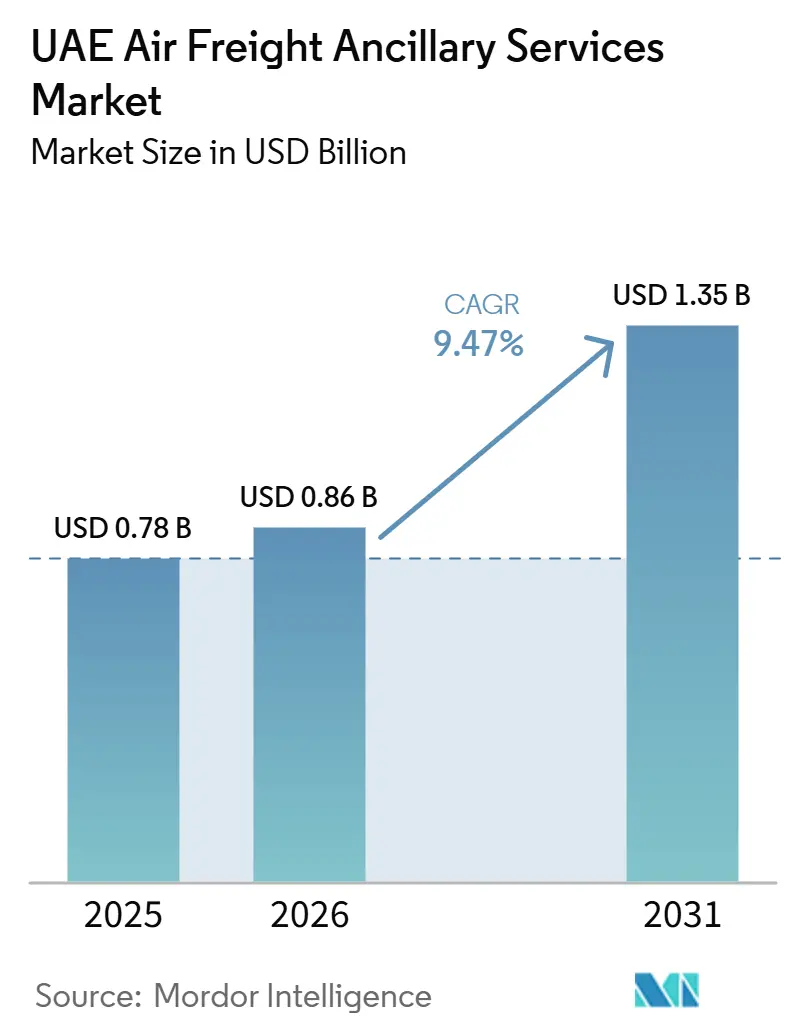
| Base Year Market Size (2025) | USD 0.78 Billion |
| Market Size (2026) | USD 0.86 Billion |
| Market Size (2031) | USD 1.35 Billion |
| Growth Rate (2026 - 2031) | 9.47 % |
| Market Concentration | Medium |
Major Players *Disclaimer: Major Players sorted in no particular order Image © Mordor Intelligence. Reuse requires attribution under CC BY 4.0. | |
UAE Air Freight Ancillary Services Market Analysis by Mordor Intelligence
The UAE air freight ancillary services market size was valued at USD 0.78 billion in 2025 and estimated to grow from USD 0.86 billion in 2026 to reach USD 1.35 billion by 2031, at a CAGR of 9.47% during the forecast period (2026-2031).
The UAE air freight ancillary services market is expanding as cargo flows move beyond simple transit handling and toward higher-value services such as temperature control, packaging, documentation, customs support, and specialized storage. Demand remains strongest around airport and free zone clusters in Dubai and Abu Dhabi, where dense cargo networks help operators attach more paid services to each shipment. Cold chain capacity, digital booking systems, and pre-arrival customs processing continue to support faster turnaround and better monetization of ancillary services across the UAE air freight market. Investment activity from global logistics operators also shows that the market is attracting capital for warehousing, charter capacity, and integrated freight solutions rather than only for basic throughput volume. Growth is still limited by the cost of compliance and by the shortage of certified handling space for pharmaceutical, hazardous, and premium perishable cargo in the highest-margin parts of the market.
Key Report Takeaways
- By service type, temperature-controlled services accounted for 34.27% of the UAE air freight ancillary services market size in 2025 and are forecast to grow at a 10.84% CAGR through 2031.
- By shipment type, international shipments held 84.61% of the UAE air freight ancillary services market share in 2025, while domestic shipments are projected to record the highest CAGR at 9.77% through 2031.
- By industry vertical, e-commerce and retail accounted for 29% of the UAE air freight ancillary services market size in 2025 and are projected to expand at 12.78% CAGR through 2031.
- By emirate, Dubai held 48.11% of the UAE air freight ancillary services market share in 2025, while Fujairah is projected to grow at the fastest CAGR of 10.74% through 2031.
Note: Market size and forecast figures in this report are generated using Mordor Intelligence’s proprietary estimation framework, updated with the latest available data and insights as of January 2026.
UAE Air Freight Ancillary Services Market Trends and Insights
Drivers Impact Analysis*
| Driver | (~) % Impact on CAGR Forecast | Geographic Relevance | Impact Timeline |
|---|---|---|---|
| Rising E-Commerce Parcel Sorting and Return Handling Needs | +2.2% | Dubai South, JAFZA, Abu Dhabi, national e-commerce corridors | Medium term (2-4 years) |
| Growth in Temperature-Controlled Pharma and Perishables Flows | +1.9% | Dubai, Abu Dhabi, with spillover to Sharjah and Fujairah | Medium term (2-4 years) |
| Dubai and Abu Dhabi Hub Density Supports Ancillary Service Monetization | +1.4% | Dubai, Abu Dhabi, JAFZA, ADAFZ | Long term (≥ 4 years) |
| Customs Digitization and Pre-Clearance Reduce Turnaround Times | +1.0% | Dubai and Abu Dhabi customs systems | Short term (≤ 2 years) |
| Free Zone Re-Export Activity Expands Packaging and Consolidation Demand | +0.8% | Dubai, Sharjah, Abu Dhabi Industrial City | Medium term (2-4 years) |
| Integrated Cargo Community Systems Improve Service Attach Rates | +0.5% | National, with early gains in Dubai and Abu Dhabi | Medium term (2-4 years) |
| Source: Mordor Intelligence | |||
Rising E-Commerce Parcel Sorting and Return Handling Needs
The UAE air freight ancillary services market is seeing a clear shift toward parcel-scale activity as online retail expands across cross-border corridors. By December 2025, almost 80% of Emirates SkyCargo shipments were booked digitally through eSkyCargo and connected digital marketplaces, indicating a more system-led cargo environment with faster processing and improved shipment visibility. E-commerce cargo requires more sortation, barcode verification, relabeling, and reverse logistics than general freight, increasing the number of paid handling steps per consignment. Dubai South has become more important in this setup because parcel activity works best in an operating model built for large volumes of smaller shipments rather than for bulk cargo alone. Return flows add another revenue stream because each returned parcel may require customs review, repacking, relabeling, and quality inspection before it is returned to inventory. This is why the UAE air freight ancillary services market continues to benefit from rising online trade, even as overall cargo tonnage does not grow at the same pace.
Growth in Temperature-Controlled Pharma and Perishables Flows
Pharmaceutical and perishable cargo remains one of the strongest growth pillars in the UAE air freight ancillary services market, as these shipments require certified storage, active monitoring, and strict handling controls. Etihad Cargo expanded its cool chain capabilities at Zayed International Airport and now supports more than 2,350 CEIV Pharma-certified trade lanes, strengthening Abu Dhabi’s role in time-sensitive healthcare logistics. JAFZA also supports sea-air cold chain transfers that help pharmaceutical and healthcare cargo move from maritime arrival points to air freight corridors without unnecessary delay, thereby improving the integrity of temperature-sensitive products[1]Source: HLB HAMT, “Setting Up an Advanced Pharma Cold-Chain Hub in JAFZA,” HLB HAMT, hlbhamt.com. These flows are valuable because operators can charge for cool dollies, controlled transfers, compliant storage, active monitoring, and specialized documentation, in addition to core cargo handling. The benefit is not limited to cargo volume because the service mix becomes richer when more pharmaceutical and fresh product lanes pass through the same hub. This makes temperature-controlled handling one of the most important revenue engines inside the UAE air freight ancillary services market.
Dubai and Abu Dhabi Hub Density Supports Ancillary Service Monetization
The UAE air freight ancillary services market benefits from the concentration of airlines, handlers, freight forwarders, and free zone operators around a small number of large cargo hubs. Zayed International Airport handled nearly 700,000 tons of cargo in 2024, up 21%, which shows how quickly Abu Dhabi is strengthening its role in the regional cargo system. Dense hub activity matters because each added route or flight cycle creates more opportunities for consolidation, transfer handling, customs processing, storage, and packaging. Kuehne+Nagel’s use of Dubai as a sea-air gateway also shows that global forwarders view the emirate as a platform for value-added freight services rather than a simple transit stop. The same pattern appears in Dubai South and JAFZA, where multimodal cargo can shift between sea, air, and road with less friction than in many competing hubs. Over time, this hub density supports better pricing and stronger service attachment across the UAE air freight ancillary services market.
Customs Digitization and Pre-Clearance Reduce Turnaround Times
Digital customs systems are making the UAE air freight ancillary services market more efficient by reducing the time between cargo arrival and cargo release. Dubai Customs introduced the Shahin tracking system, featuring smart seals and satellite-based monitoring, improving visibility into shipment movements and helping customs teams respond more quickly to irregular activity[2]Source: Construction Business News Middle East, “Dubai Customs Unveils ‘Shahin’ to Enhance Cargo Flow and Economic Security,” Construction Business News Middle East, cbnme.com. Dubai’s Advanced Cargo Information system also receives shipment data before arrival, allowing customs teams to sort low- and high-risk consignments earlier in the process. The UAE’s Advance Cargo Manifest requirement tightened pre-arrival documentation rules for sea freight from August 2025, with a No Doc No Load enforcement phase planned from the first quarter of 2026, which matters for sea-air transfers routed through JAFZA and DWC. Faster release times improve aircraft and warehouse utilization by allowing operators to clear, sort, and move cargo with less idle time in the chain. This helps the UAE air freight ancillary services market generate more revenue from the same physical footprint.
Restraints Impact Analysis*
| Restraint | (~) % Impact on CAGR Forecast | Geographic Relevance | Impact Timeline |
|---|---|---|---|
| High Compliance Cost for Cold Chain and Dangerous Goods Handling | -1.3% | National, across certified handling and cold chain facilities | Long term (≥ 4 years) |
| Limited Certified Capacity for Specialized Handling and Storage | -0.9% | Dubai, Abu Dhabi, Sharjah | Medium term (2-4 years) |
| Margin Pressure From Rate Volatility and Capacity Substitution | -0.7% | Global, with concentrated UAE impact on DXB and DWC throughput economics | Medium term (2-4 years) |
| Cyber and Data Integration Risk Across Digital Cargo Platforms | -0.5% | National digital cargo platforms and community systems | Medium term (2-4 years) |
| Source: Mordor Intelligence | |||
High Compliance Cost for Cold Chain and Dangerous Goods Handling
The UAE air freight ancillary services market faces a persistent cost burden in high-value cargo categories due to complex, recurring compliance requirements. IATA Dangerous Goods Regulations and CEIV Pharma standards require segregated handling zones, continuous monitoring equipment, trained staff, regular audits, and detailed response protocols. In the UAE, these obligations sit alongside national aviation and health-related requirements, meaning operators must comply with multiple layers of control before they can serve sensitive cargo categories. These costs do not disappear when cargo volumes soften, so smaller handlers have less room to spread fixed overhead across large shipment bases. The result is a clear gap between major infrastructure-backed players and smaller operators trying to enter specialized service areas. This pressure slows expansion in parts of the UAE air freight ancillary services market where premium margins are high, but the cost of staying certified is also high.
Limited Certified Capacity for Specialized Handling and Storage
A second restraint in the UAE air freight ancillary services market is the shortage of certified handling space for specialized freight, even as broader warehouse supply expands. Free zones added logistics space through 2025 and 2026, but GDP-compliant pharmaceutical storage, certified dangerous goods facilities, and advanced temperature-controlled units remain more limited than standard warehousing. This gap is important because the fastest-growing cargo categories often need tightly controlled environments and cannot simply shift into generic storage when demand rises. Al Maktoum International’s second runway contract supports long-term airside expansion, but specialized handling infrastructure must scale in parallel if high-value cargo throughput is to grow smoothly. When certified capacity is tight, cargo owners can face delays, service risk, or rerouting through alternative hubs. That reduces the number of premium services attached to each shipment and limits the pace at which the UAE air freight ancillary services market can convert demand into realized revenue.
*Our forecasts treat driver/restraint impacts as directional, not additive. The impact forecasts reflect baseline growth, mix effects, and variable interactions.
Segment Analysis
By Service Type: Cold Chain Commands the Premium Tier
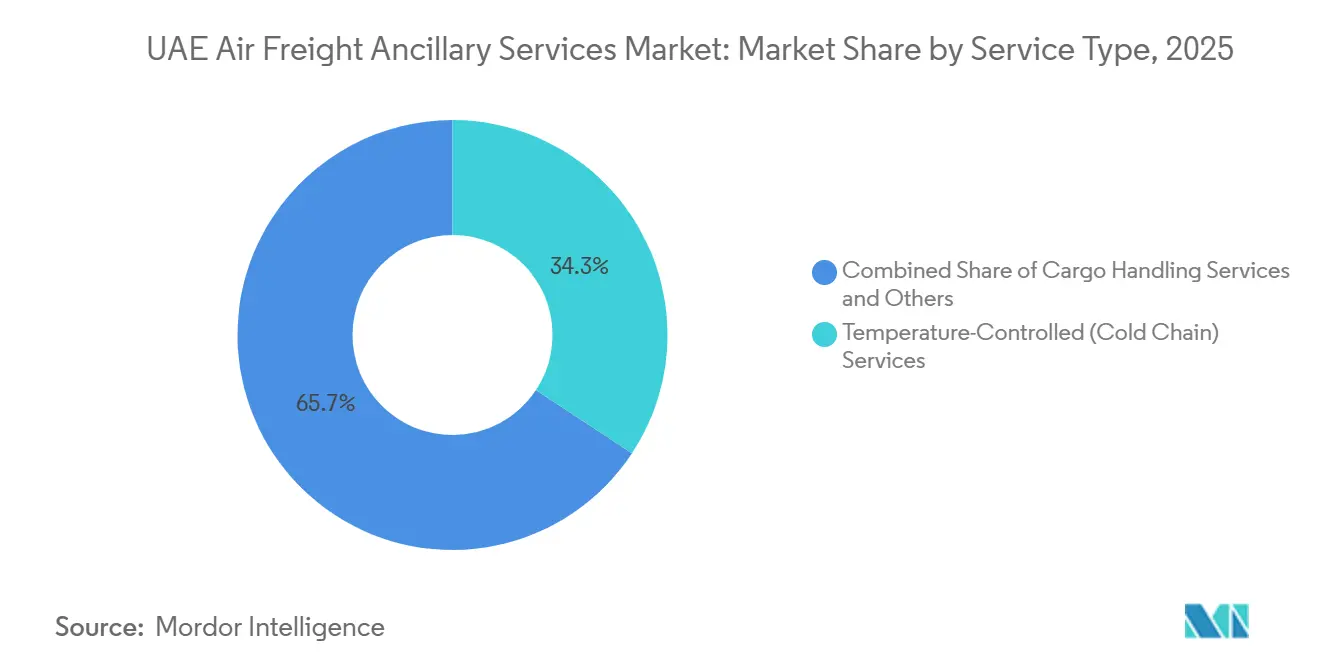
Temperature-controlled services accounted for 34.27% of the UAE air freight ancillary services market share in 2025, making cold chain the largest service category. This lead reflects the higher revenue intensity of pharmaceutical and perishables shipments, which need compliant storage, monitored transfers, and stricter handling than general cargo. The segment is also projected to grow at a 10.84% CAGR through 2031, putting it ahead of the overall market pace. The strongest advantage of the cold chain is not only shipment volume; it is the number of specialized services that can be billed for per consignment. These include cool dollies, controlled handover points, compliant documentation, temperature records, and dedicated short-term storage. That service mix gives the cold chain a premium position across the UAE air freight ancillary services industry.
Etihad Cargo’s purpose-built infrastructure at Zayed International Airport shows how capital-heavy this segment has become, with more than 1,000 temperature-controlled pallet positions and 80 cool ULD storage cells supporting complex cargo flows. The same logic extends to sea-air transfers around JAFZA, where pharmaceutical and healthcare shipments gain value from reduced exposure during modal handoffs. Cargo handling remains the broadest service category by physical volume because every shipment still needs loading, unloading, transfer, and build-up support. Consolidation services are also strong in Dubai’s free zone network because multi-origin cargo often needs to be grouped, documented, and prepared for onward regional dispatch. Packaging and labeling are becoming more important as cross-border retail flows require market-specific compliance and presentation standards. Cargo insurance remains more fragmented, but it is gaining relevance in higher-value verticals such as electronics and healthcare, where shipment values justify stand-alone cover rather than bundled add-ons.



By Shipment Type: International Lanes Anchor Revenue Base
International shipments accounted for 84.61% of the UAE air freight ancillary services market size in 2025, confirming that cross-border cargo remains the core revenue base. The UAE’s role as a re-export and transit hub means international freight generates recurring demand for handling, customs support, repacking, consolidation, and bonded movement. This is especially visible in Dubai, where cargo can move between free zones, airports, and multimodal corridors with limited friction. The structure of the UAE air freight ancillary services market, therefore, depends more on regional and global trade lanes than on domestic cargo volume alone. As more carriers and forwarders add routes across the country, the number of service touchpoints for international cargo continues to rise.
The domestic segment is projected to expand at a 9.77% CAGR through 2031, faster than the overall market. This growth reflects rising same-day and next-day fulfillment needs across the emirates, especially for healthcare supplies and parcel-based retail deliveries. Emirates Courier Express also shows how domestic and international freight models are increasingly overlapping, as imported cargo can be quickly routed into local delivery channels through an integrated network. Over time, operators are likely to bundle customs handling, parcel sorting, packaging, and local dispatch into unified service offers. That will strengthen ancillary revenue from both international arrivals and domestic fulfillment within the UAE air freight ancillary services market.
By Industry Vertical: E-Commerce Rewires Cargo Mix
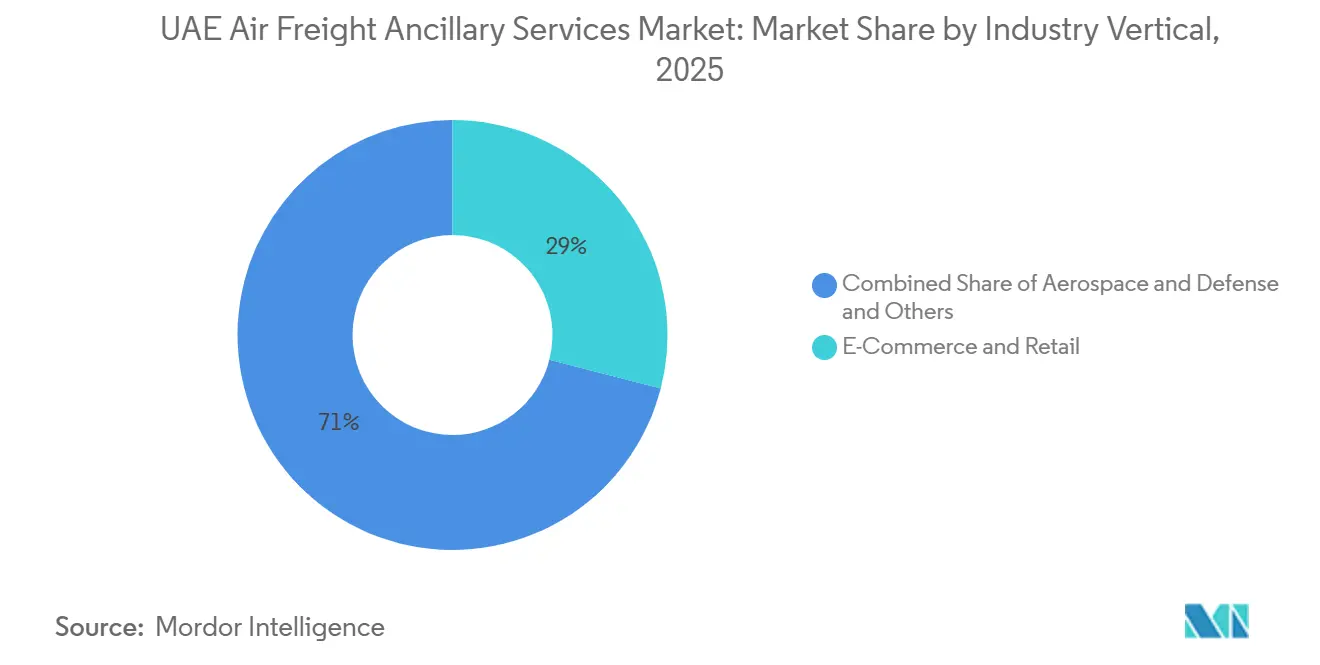
E-commerce and retail accounted for 29% of the UAE air freight ancillary services market share in 2025 and are projected to expand at a 12.78% CAGR through 2031, making this the largest and fastest-growing industry vertical. The segment benefits from cross-border parcel traffic, high sortation needs, rapid returns management, and frequent packaging or relabeling requirements. These features create more billable activities per shipment than standard bulk freight. The result is a cargo mix that is becoming more parcel-led and process-intensive across the UAE air freight ancillary services market. This shift is also increasing the role of digitally coordinated fulfillment and free-zone-based inventory models.
Cross-border e-commerce flows from East Asia into the Gulf are helping the UAE serve multiple destination markets from a single operating base, which supports more concentrated demand for customs and packaging support. Healthcare and technology remain highly important because pharmaceutical cargo carries the highest handling intensity and the strongest need for certified temperature control. Aerospace and defense also generate premium ancillary demand because time-critical and secure movements need dedicated handling lanes, specialist packaging, and controlled storage. Kuehne+Nagel’s Rolls-Royce engine fulfillment center in Dubai South is a strong example of how specialized cargo categories require dedicated infrastructure rather than generic warehouse capacity. Automotive and industrial parts distribution, fashion and luxury goods, chemicals, and consumer electronics also support service demand because each cargo type requires distinct packaging, security, labeling, or compliance controls.
Geography Analysis
Dubai accounted for 48.11% of the UAE air freight ancillary services market size in 2025, making it the clear center of market activity. This position stems from the concentration of Emirates SkyCargo, dnata, DWC, DXB, JAFZA, and Dubai South into a single, connected logistics system. The Dubai model works because sea-air transfers, bonded movements, consolidation, and export preparation can all happen within a closely linked operating corridor. DWC’s ongoing expansion is also expected to support higher freighter throughput and stronger demand for handling, customs, and packaging services over time. Investment activity at JAFZA during 2026 further showed that operators and cargo owners continue to back Dubai’s logistics platform even during periods of regional disruption.
Abu Dhabi is the second major growth engine in the UAE air freight ancillary services market and is gaining weight in pharmaceuticals, defense-linked freight, and contract logistics. Zayed International Airport’s cargo volume growth, together with Etihad Cargo’s CEIV Pharma-linked network, has strengthened Abu Dhabi’s position as a hub for specialized handling. ADQ’s acquisition of a 63.2% stake in Aramex also improved Abu Dhabi’s position across forwarding, warehousing, and value-added freight services by pulling a wider logistics network into the emirate’s transport cluster[3]Source: ADQ, “ADQ Completes Acquisition of Majority Stake in Aramex,” ADQ, adq.ae. Sharjah plays a different role because it is more closely tied to charter activity, lower-cost belly cargo, and time-definite parcel handling. Its inclusion in Kuehne+Nagel’s updated charter rotation shows that Sharjah is now more directly linked to global pharmaceutical and semiconductor cargo flows.
Fujairah is projected to grow at 10.74% CAGR through 2031, making it the fastest-growing emirate in the market. The emirate gained visibility when eastern corridors became more important during the early 2026 disruptions, highlighting the value of geographic redundancy in the UAE's cargo system. Ras Al Khaimah, Ajman, and Umm Al Quwain still hold smaller positions. Still, they remain connected to the wider market through road-linked distribution, light industrial packaging, and hub-fed delivery services. Ras Al Khaimah is especially relevant where local manufacturing clusters create packaging, labeling, and cold chain needs that tie back into air freight support services.
Competitive Landscape
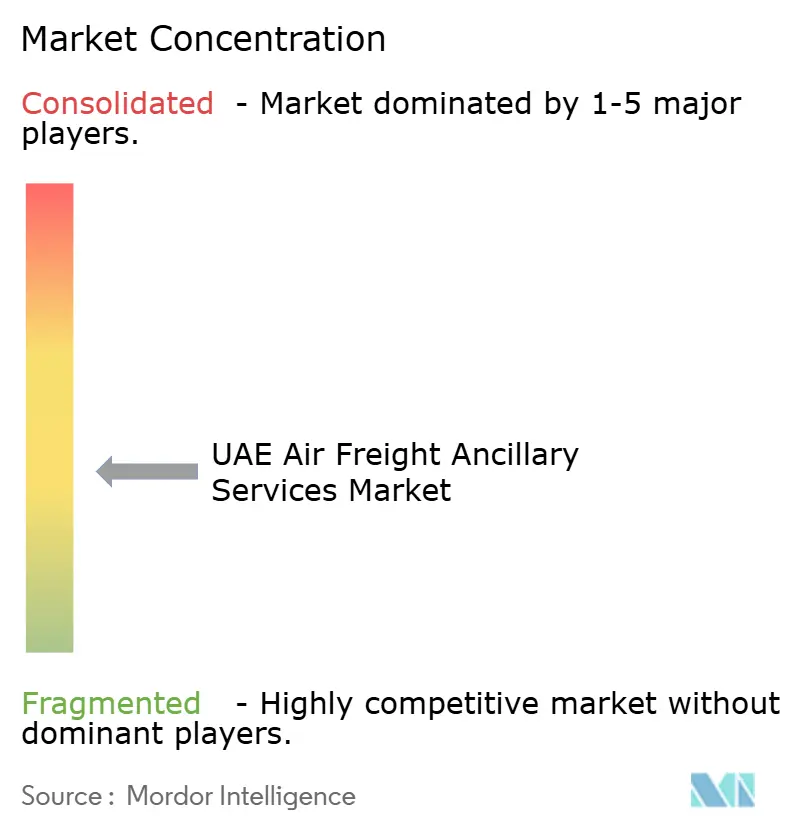
The UAE air freight ancillary services market is moderately concentrated. Emirates SkyCargo, dnata, and Etihad Cargo hold infrastructure-backed positions that are hard to challenge because they combine network scale, airport access, and specialized handling capability. Below this top tier, more than 20 active companies compete across forwarding, packaging, consolidation, cold chain, and related value-added services. This structure allows large operators to dominate high-throughput and certified segments while smaller firms compete in narrower service niches. The competitive balance in the UAE air freight ancillary services market, therefore, depends on access to assets, certifications, and operating density rather than on price alone.
Large forwarders are increasingly moving away from asset-light models and toward owned or long-leased infrastructure in the UAE. DSV’s Dubai integration program and warehouse expansion demonstrate that global operators want a deeper physical footprint in the country, following the Schenker operations combination into a single regional structure. ADQ’s Aramex acquisition created a sovereign-backed competitor with broader multimodal ambition and stronger capital support for network growth. Emirates SkyCargo also formalized a Service Quality Agreement with Kuehne+Nagel, underscoring that service reliability and measurable performance are becoming more central to carrier-forwarder relationships. Kuehne+Nagel’s charter expansion through Sharjah is another sign that leading players are tightening their control over capacity and service execution rather than relying solely on third-party lift.
The main market openings remain mid-tier pharmaceutical storage, parcel returns processing, and hazardous materials handling at secondary gateways. These areas need specialized compliance capability, but they do not always need the same scale as the largest hub operators. Digital booking, pre-clearance integration, and automated cargo visibility are also becoming more important competitive tools because they help operators reduce dwell time and improve customer control over shipments. Emirates SkyCargo’s memorandum with Lood Autonomous also shows that some leading firms are exploring future delivery models that could eventually extend the range of high-value cargo services around the airport ecosystem[4]Source: Emirates, “Emirates SkyCargo Signs MOU with Lood Autonomous at Dubai Airshow 2025,” Emirates, emirates.com. However, certification requirements and airport-linked infrastructure continue to define the baseline for companies seeking to scale in the UAE air freight ancillary services market.
UAE Air Freight Ancillary Services Industry Leaders
Emirates SkyCargo
Etihad Cargo
dnata
DHL
Kuehne + Nagel International AG
- *Disclaimer: Major Players sorted in no particular order

Recent Industry Developments
- June 2026: Kuehne+Nagel updated its Inspire B747-8F charter network operated by Atlas Air to include Sharjah in the rotation, connecting Atlanta, Chicago, Frankfurt, Liege, Sharjah, and Taipei, expanding its own-controlled air freight capacity for pharmaceutical, semiconductor, and cloud infrastructure shipments through the UAE.
- December 2025: DSV completed the go-live of its Dubai operations following global integration of the former Schenker organization, doubling its UAE warehousing footprint and unifying air and sea, contract logistics, and road transport capabilities under a single regional structure in one of the most strategic logistics hubs in the Middle East.
- November 2025: Emirates SkyCargo signed a Memorandum of Understanding with Lood Autonomous at Dubai Airshow 2025 to explore next-generation cargo delivery solutions using autonomous aircraft, with strategic implications for last-mile ancillary service delivery models in UAE intra-emirate and GCC short-haul markets.
- July 2025: ADQ, Abu Dhabi's sovereign wealth fund, completed its acquisition of a 63.16% majority stake in Aramex PJSC through Q Logistics Holding and AD Ports Group at AED 3 per share. The deal integrates Aramex's network across more than 65 countries and 800,000 m² of global warehousing into ADQ's Transport and Logistics cluster, accelerating the expansion of multimodal ancillary services across the UAE and GCC.


UAE Air Freight Ancillary Services Market Report Scope
| Cargo Handling Services |
| Cargo Consolidation Services |
| Packaging and Labeling Services |
| Cargo Insurance Services |
| Temperature-Controlled (Cold Chain) Services |
| Other Services |
| Domestic Shipments |
| International Shipments |
| Aerospace and Defense |
| Consumer Electronics |
| Automotive and Industrial Manufacturing |
| E-commerce and Retail |
| Healthcare and Technology |
| Food and Beverage (Perishables) |
| Chemicals and Hazardous Materials |
| Fashion and Luxury Goods |
| Others |
| Abu Dhabi |
| Dubai |
| Sharjah |
| Ajman |
| Umm Al Quwain |
| Ras Al Khaimah |
| Fujairah |
| By Service Type | Cargo Handling Services |
| Cargo Consolidation Services | |
| Packaging and Labeling Services | |
| Cargo Insurance Services | |
| Temperature-Controlled (Cold Chain) Services | |
| Other Services | |
| By Shipment Type | Domestic Shipments |
| International Shipments | |
| By Industry Vertical | Aerospace and Defense |
| Consumer Electronics | |
| Automotive and Industrial Manufacturing | |
| E-commerce and Retail | |
| Healthcare and Technology | |
| Food and Beverage (Perishables) | |
| Chemicals and Hazardous Materials | |
| Fashion and Luxury Goods | |
| Others | |
| By Emirates | Abu Dhabi |
| Dubai | |
| Sharjah | |
| Ajman | |
| Umm Al Quwain | |
| Ras Al Khaimah | |
| Fujairah |


Key Questions Answered in the Report
What is the current outlook for air freight ancillary services in the UAE?
The UAE air freight ancillary services market is expected to grow from USD 0.86 billion in 2026 to USD 1.35 billion by 2031 at a 9.47% CAGR, supported by cold chain demand, digital customs systems, and continued logistics investment.
Which service category leads revenue generation in the UAE?
Temperature-controlled services lead the market with a 34.27% share in 2025, reflecting strong demand from pharmaceuticals and perishables that need certified storage and monitored handling.
Why does Dubai dominate this space?
Dubai held 48.11% share in 2025 because DXB, DWC, JAFZA, and Dubai South create a tightly linked logistics system for sea-air transfers, consolidation, and export preparation.
Which shipment type matters most for operators?
International shipments are the main revenue source, accounting for 84.61% in 2025, as the UAE serves as a re-export and transit hub for regional and global cargo flows.
What is the fastest-growing demand vertical?
E-commerce and retail are both the largest and fastest-growing verticals, with 29% share in 2025 and a projected 12.78% CAGR through 2031, driven by sortation, returns handling, and cross-border fulfillment activity.
What are the main constraints on future growth?
The biggest constraints are the cost of compliance for cold chain and dangerous goods handling, along with limited certified capacity for specialized storage and premium cargo processing.
Page last updated on:





