
Turmeric Supplements Market Size and Share
Market Overview
| Study Period | 2021 - 2031 |
|---|---|
| Market Size (2026) | USD 368.08 Million |
| Market Size (2031) | USD 506.09 Million |
| Growth Rate (2026 - 2031) | 6.58 % |
| Fastest Growing Market | Asia-Pacific |
| Largest Market | North America |
| Market Concentration | Medium |
Major Players
*Disclaimer: Major Players sorted in no particular order Image © Mordor Intelligence. Reuse requires attribution under CC BY 4.0. |
|
Turmeric Supplements Market Analysis by Mordor Intelligence
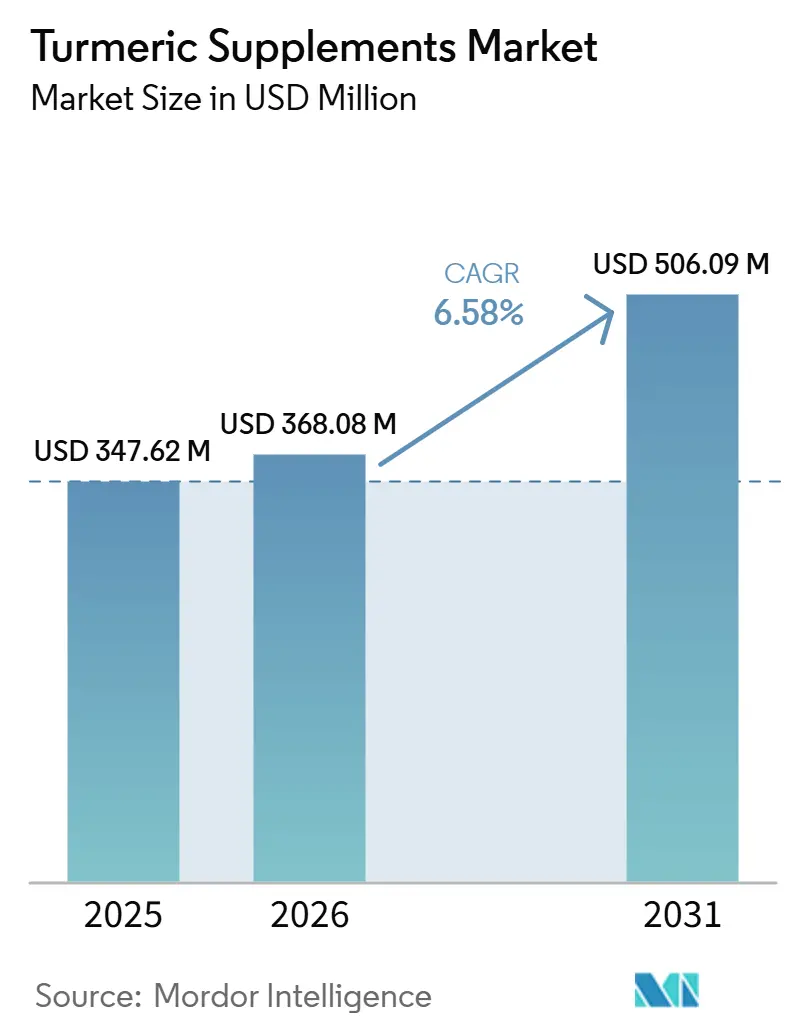
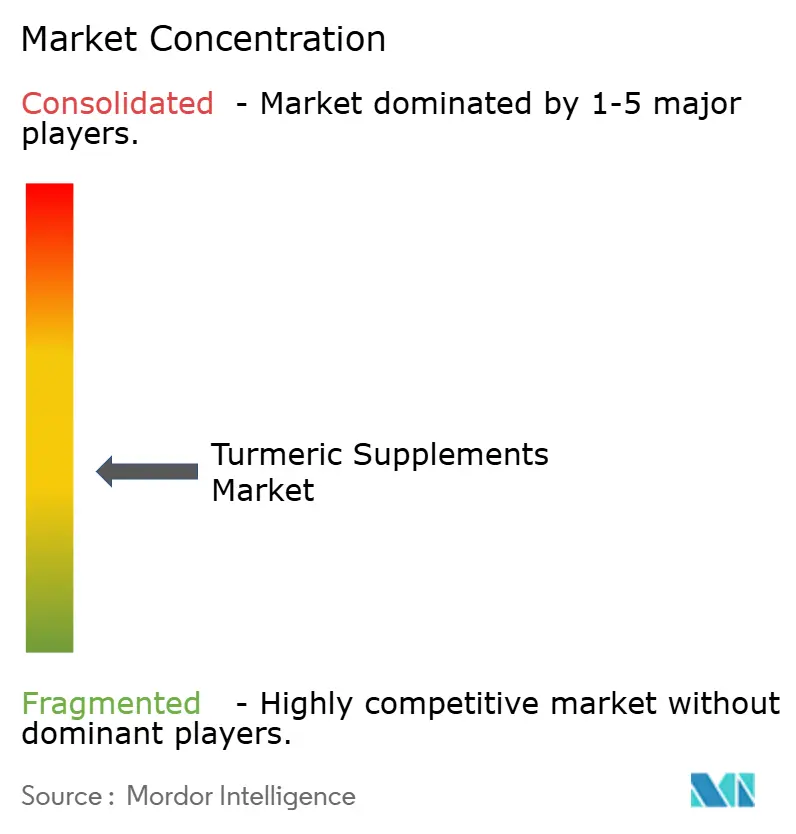
The turmeric supplements market size is projected to rise from USD 347.62 million in 2025 to USD 368.08 million in 2026 and reach USD 506.09 million by 2031, registering a CAGR of 6.58% during 2026-2031. The global turmeric supplements market is benefiting from the continued shift toward preventive care, everyday wellness routines, and plant-based supplement options, which now hold a more stable share of consumer spending. A major trend in the global turmeric supplements market is the move from basic curcumin extracts to enhanced delivery systems that address absorption limitations more effectively and support stronger repeat purchases. Distribution patterns are also evolving, as online channels enable brands to explain formulation differences, build subscription models, and reach younger supplement consumers. Over the forecast period, the global turmeric supplements market is expected to favor brands that combine clinical credibility, practical format innovation, and clear consumer communication across both retail and practitioner-led channels. The market remains moderately fragmented.
Key Report Takeaways
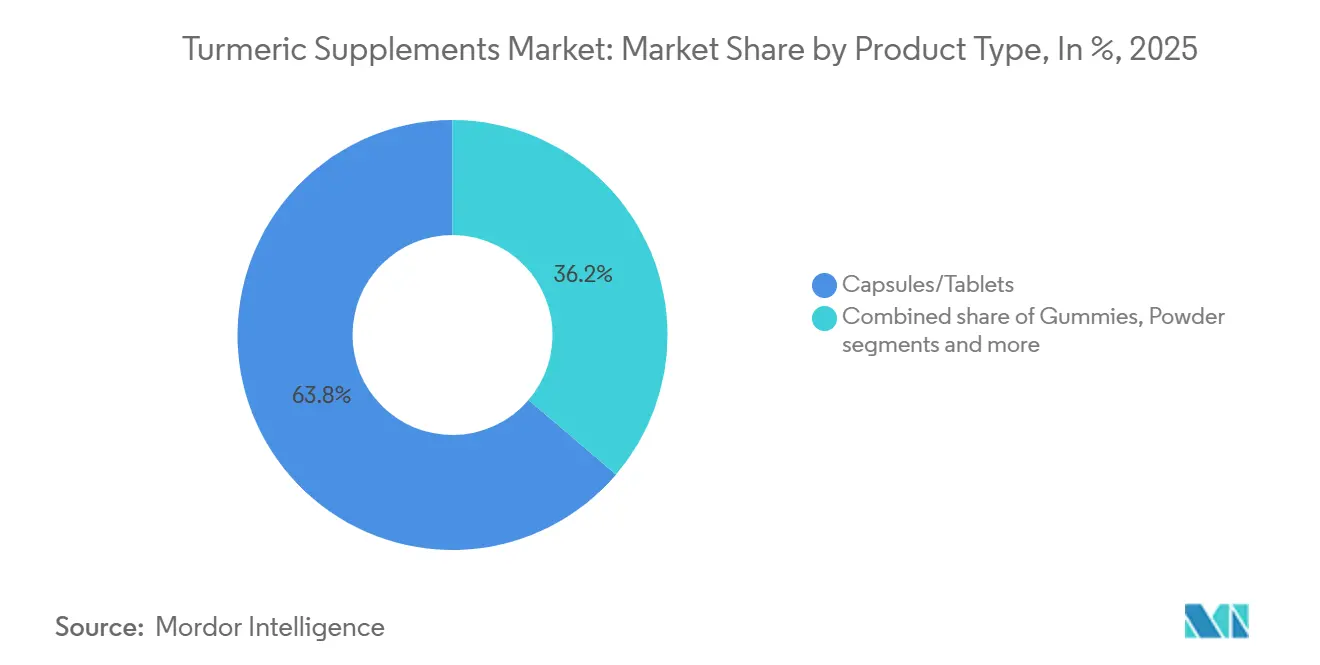
- By product type, capsules and tablets accounted for 63.76% of the segment in 2025, while gummies are forecast to grow at a 8.82% CAGR through 2031.
- By formulation, enhanced and bioavailability-enhanced products held 84.47% of the segment in 2025, while standard formulations are projected to expand at 8.14% CAGR through 2031.
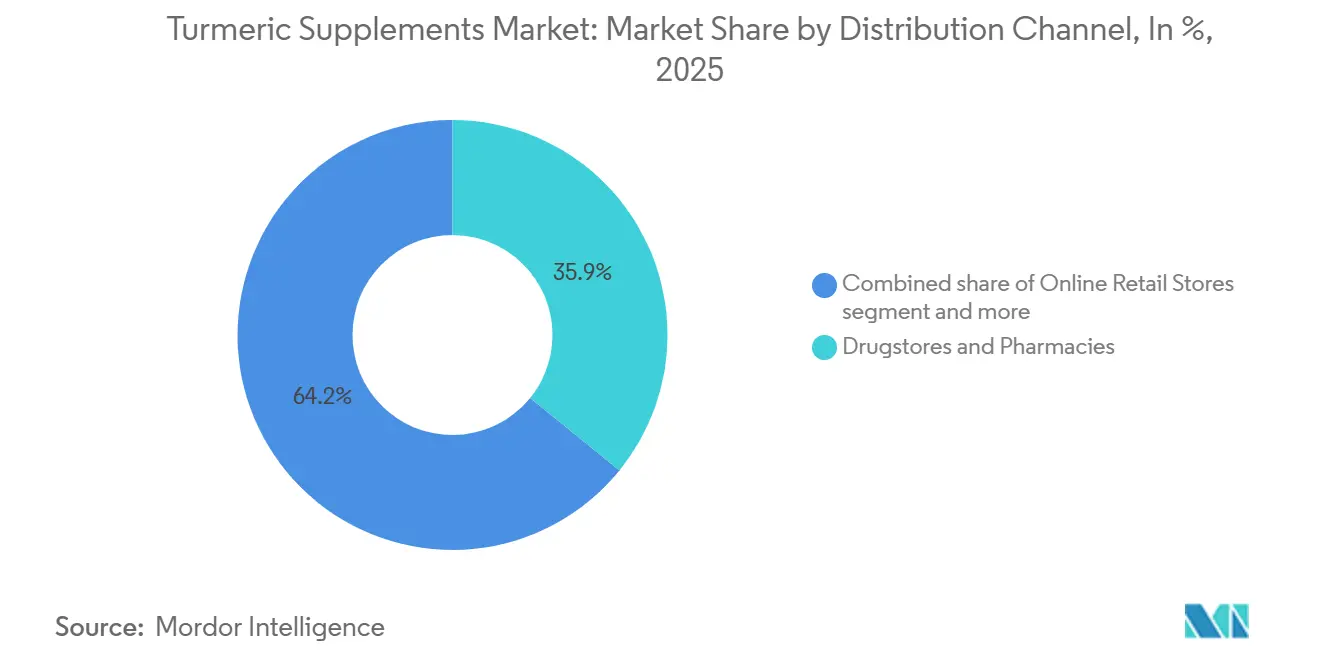
- By distribution channel, drugstores and pharmacies accounted for 35.85% of the global turmeric supplements market in 2025, while online retail stores are expected to grow at a 8.63% CAGR through 2031.
- By geography, North America led the global turmeric supplements market in 2025 with a 22.28% share, while Asia-Pacific is projected to advance at an 8.38% CAGR through 2031.
Note: Market size and forecast figures in this report are generated using Mordor Intelligence’s proprietary estimation framework, updated with the latest available data and insights as of January 2026.
Market Trends and Insights
Drivers Impact Analysis of Turmeric Supplements Market*
| Driver | (~) % Impact on CAGR Forecast | Geographic Relevance | Impact Timeline |
|---|---|---|---|
| Consumer preference for preventive healthcare and natural wellness products | +1.5% | Global, particularly North America and Europe | Medium term (2–4 years) |
| Increasing prevalence of joint health concerns and age-related disorders | +1.3% | Global; concentrated in North America, Europe, and Asia-Pacific aging populations | Long term (≥ 4 years) |
| Advancements in bioavailability-enhanced curcumin formulations | +1.0% | North America and Europe (innovation hubs); Asia-Pacific (manufacturing scale) | Short term (≤ 2 years) |
| Growing popularity of Ayurvedic and traditional herbal medicine | +0.8% | Asia-Pacific core (India, China, Southeast Asia), spill-over to Middle East and Africa and South America | Medium term (2–4 years) |
| Availability of organic and clean-label turmeric supplements | +0.6% | North America and Western Europe | Medium term (2–4 years) |
| Increasing demand for vegan and allergen-free formulations | +0.4% | Global, with early gains in North America and Western Europe | Short term (≤ 2 years) |
| Source: Mordor Intelligence | |||
Increasing prevalence of joint health concerns and age-related disorders
The rising prevalence of arthritis and age-related joint problems is driving growth in the global turmeric supplement market, as more consumers seek natural ingredients that may help reduce inflammation. According to the National Association of Chronic Disease Directors, as of May 2025, the number of people living with arthritis in the United States is expected to exceed 78 million by 2040. About 60% of arthritis patients are under the age of 65, and nearly 220,000 children are also affected, showing that many different age groups need long-term joint health support[1]Source: National Association of Chronic Disease Directors, "Arthritis", chronicdisease.org. To meet this demand, manufacturers continue to launch advanced turmeric supplements, including Greenspace Herbs' Curcumin QA (2026), Cosmos Health's Curcumin18™ (2026), and Blackmores' TurmXTRA™-based supplement range, increasing the availability of high-bioavailability products for joint mobility and healthy aging.
Growing popularity of Ayurvedic and traditional herbal medicine
More people are using Ayurvedic and traditional herbal medicine, which is helping drive the global turmeric supplements market. Consumers are looking for plant-based products to support preventive healthcare and overall wellness. According to the Ministry of AYUSH in 2025, about 46% of the rural and 53% of the urban populations in India use AYUSH (Ayurveda, Yoga, Unani, Siddha, and Homeopathy) to prevent or treat health problems[2]Source: Ministry of AYUSH, "From Roots to Global Reach", ayush.gov.in. This shows that traditional healthcare systems are widely accepted. Due to this growing demand, supplement manufacturers are adding more turmeric-based products. Recent launches include Greenspace Herbs' Curcumin QA, Blackmores' TurmXTRA™-based supplement range, and Dabur's SIENS nutraceutical portfolio, showing rising investment in science-backed herbal and Ayurvedic formulations.
Increasing demand for vegan and allergen-free formulations
More people are choosing vegan lifestyles and allergen-free, clean-label supplements, which is increasing demand in the global turmeric supplements market. Many turmeric supplements are now made without common allergens, such as gluten, dairy, soy, and artificial additives, to match consumer demand for plant-based wellness products. According to the World Animal Foundation, as of May 2026, there are about 88 million vegans worldwide out of a global population of more than 8.3 billion, showing a growing consumer base for vegan nutrition[3]Source: World Animal Foundation, "How Many Vegans Are in the World in 2026? Latest Vegan Stats", worldanimalfoundation.org. To meet this demand, companies are launching plant-based products, such as Cosmos Health's Cur18, a turmeric-derived curcumin supplement launched in 2026, and Greenspace Herbs' Curcumin QA, a vegan, quantum-enhanced curcumin formulation designed to improve bioavailability. Brands such as Garden of Life are also expanding their certified organic and vegan turmeric supplement offerings.
Advancements in bioavailability-enhanced curcumin formulations
Better curcumin formulations are supporting growth in the global turmeric supplements market by helping the body absorb curcumin more easily. Regular curcumin is poorly absorbed, so manufacturers are using technologies such as phytosome complexes, liposomal delivery systems, micelles, nanoparticles, and piperine-enhanced formulations to improve absorption and effectiveness. Recent product launches show this trend, including Greenspace Herbs' Curcumin QA with EASI technology, Cosmos Health's Curcumin18, and Blackmores' TurmXTRA-based supplement range, all designed to improve absorption and support better health outcomes. Continued research and new delivery technologies are also helping build consumer trust and increase demand for premium turmeric supplements.
Restraints Impact Analysis of Turmeric Supplements Market*
| Restraint | (~) % Impact on CAGR Forecast | Geographic Relevance | Impact Timeline |
|---|---|---|---|
| Intense competition from alternative dietary supplements | -1.8% | Global | Medium term (2–4 years) |
| Low bioavailability of curcumin | -1.4% | Global | Short term (≤ 2 years) |
| Stringent regulations governing health claims | -0.9% | North America and Europe | Long term (≥ 4 years) |
| Quality inconsistencies and product adulteration | -0.7% | Asia-Pacific (sourcing markets), spill-over globally | Medium term (2–4 years) |
| Source: Mordor Intelligence | |||
Intense competition from alternative dietary supplements
The turmeric supplements market faces strong competition from other dietary supplements offering similar health benefits. These include omega-3 fatty acids, glucosamine, collagen, boswellia, ginger, cannabidiol (CBD), probiotics, and multivitamins. Consumers looking for joint health, inflammation support, immunity, or general wellness can choose from many well-known alternatives. This increases product substitution and strengthens competition. Manufacturers of competing supplements are also launching new formulations, combination products, and personalized nutrition solutions. This makes it harder for turmeric supplements to stand out. As a result, turmeric supplement brands need to invest in clinical validation, better bioavailability technologies, and product innovation to maintain consumer preference and market share.
Stringent regulations governing health claims
Strict rules on health and functional claims are a major challenge for the global turmeric supplements market. Regulatory authorities, such as the United States Food and Drug Administration (FDA), the European Food Safety Authority (EFSA), and other national agencies, require manufacturers to provide strong scientific evidence before making claims about joint health, inflammation, or disease prevention on product labels or in marketing materials. These requirements increase the time and cost of product development, clinical testing, and regulatory approval. They also limit the claims companies can use to promote their products. As a result, manufacturers need to spend more on research and evidence generation, which raises compliance costs and slows the launch of new turmeric supplement products.
*Our forecasts treat driver/restraint impacts as directional, not additive. The impact forecasts reflect baseline growth, mix effects, and variable interactions.
Turmeric Supplements Market Segment Analysis
By Product Type:
Familiarity Sustains Capsules, Format Innovation Accelerates GummiesCapsules and tablets dominated the turmeric supplements market, accounting for 63.76% of the product type segment in 2025. Consumers continue to prefer these formats for their strong trustworthiness, precise dosage delivery, ease of use, and longer shelf life compared to other supplement formats. Healthcare professionals widely recommend capsules and tablets, particularly for consumers using turmeric supplements for long-term wellness, inflammation management, and joint health support. Their extensive availability across pharmacies, supermarkets, health stores, and online platforms further strengthens their position as the leading product type in the market.
Gummies are projected to be the fastest-growing product type, registering a CAGR of 8.82% during 2026–2031. Rising demand for convenient, palatable, and easy-to-consume supplements is encouraging manufacturers to expand their gummy-based turmeric supplement offerings. The segment is gaining traction among younger consumers, older adults, and first-time supplement users who prefer alternatives to traditional capsules and tablets. Product innovations, including vegan, sugar-free, and enhanced-bioavailability gummies, are broadening consumer appeal and driving faster market growth.



By Formulation:
Enhanced Products Lead, Standard Extracts Feed the Upgrade CycleEnhanced and bioavailability-enhanced formulations accounted for 84.47% of the formulation segment in 2025, making them the leading category in the global turmeric supplements market. Their dominance is supported by rising consumer demand for products that improve curcumin absorption and deliver stronger health outcomes. Manufacturers are increasingly using technologies such as phytosome complexes, micellar systems, and piperine-enhanced formulations to address curcumin’s naturally low bioavailability. These solutions appeal to consumers seeking clinically supported turmeric supplements for joint health, inflammation management, and overall wellness. Continued product innovation and investment in validated delivery technologies are expected to maintain the segment’s strong market position.
Standard formulations are projected to register a CAGR of 8.14% during 2026–2031, despite accounting for a smaller share of the formulation segment. Growth is driven by demand for affordable, minimally processed turmeric supplements, especially in price-sensitive markets. Consumers who prefer natural, clean-label, and traditional herbal products continue to choose standard formulations for daily wellness support. The segment also benefits from broader availability across pharmacies, supermarkets, specialty health stores, and e-commerce platforms. As consumer awareness of turmeric’s health benefits expands, standard formulations are expected to record steady adoption during the forecast period.
By Distribution Channel:
Pharmacy Holds the Base, Online Retail Sets the PaceDrugstores and pharmacies accounted for 35.85% of the turmeric supplements market by distribution channel in 2025, maintaining their position as the leading sales channel. The segment’s strength is driven by high consumer trust, access to pharmacist recommendations, and the availability of recognized supplement brands. Consumers often prefer pharmacies for turmeric supplements due to concerns around product authenticity, safety, and quality assurance. The continued expansion of organized pharmacy chains and wellness-focused retail formats further supports the segment’s dominance.
Online retail stores are expected to record the fastest growth, registering a CAGR of 8.63% during 2026–2031. Growth is supported by rising e-commerce penetration, improved product visibility, and increasing consumer preference for convenient purchasing options. Online platforms provide access to a broader range of brands, competitive prices, subscription models, consumer reviews, and detailed product information. Expanding direct-to-consumer strategies, digital health awareness, and targeted online promotions are expected to further accelerate turmeric supplement sales through this channel.
Geography Analysis
North America Turmeric Supplements Market
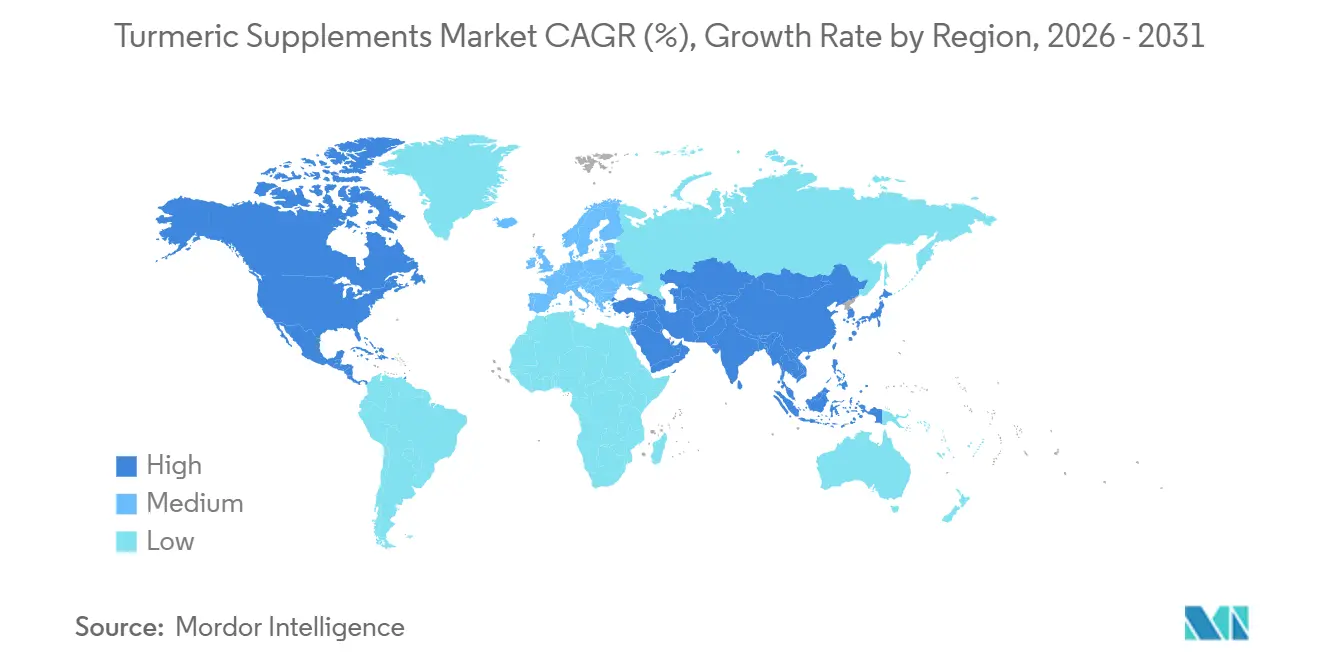
North America accounted for 22.28% of the turmeric supplements market in 2025, making it the largest regional market. The region benefits from strong consumer awareness of preventive healthcare and high spending on dietary supplements. Its well-developed retail, pharmacy, and online distribution networks support broad product availability. The United States remains the key growth driver, supported by demand for clinically validated, high-bioavailability turmeric formulations. Ongoing product innovation and the presence of established brands continue to strengthen North America's market position.
APAC Turmeric Supplements Market
Asia-Pacific is projected to be the fastest-growing region, registering a CAGR of 8.38% during 2026–2031. The region's growth is driven by the long-standing cultural use of turmeric, rising health consciousness, and increasing disposable incomes. India plays a dual role as a major turmeric producer and a fast-expanding consumer market for turmeric supplements. China, Japan, and South Korea are also contributing to demand, particularly for premium, functional, and wellness-focused supplement products. Expanding e-commerce platforms and modern retail formats are further improving product access across the region.
EMEA and South America Turmeric Supplements Market
Europe remains an important market for turmeric supplements, supported by consumer preference for natural health products and preventive wellness solutions. Germany, the United Kingdom, France, Italy, and Spain continue to generate steady demand through pharmacies, health stores, and online channels. The region's established regulatory environment and strong interest in plant-based supplements support continued product adoption. South America and the Middle East and Africa also present emerging opportunities as retail infrastructure improves and consumer awareness increases. Expanding supplement penetration in these regions is expected to support future market development.

Competitive Landscape
The global turmeric supplements market remains moderately fragmented, with competition spread across multinational supplement manufacturers, practitioner-focused nutrition brands, and digital-first wellness companies. Leading players such as NOW Health Group, Nature's Bounty, Pharmavite, and Swanson Health Products strengthen their market presence through broad product portfolios, strong retail visibility, and well-established distribution networks. In parallel, companies such as Thorne HealthTech, Jarrow Formulas, Doctor's Best, and Integrative Therapeutics focus on clinically supported formulations and recommendations from healthcare professionals. This structure creates a competitive environment where brand credibility, product efficacy, pricing, and channel reach influence purchasing decisions.
Product differentiation increasingly centers on improved curcumin absorption and clinically relevant dosage formats. Manufacturers are adopting advanced delivery systems, including phytosome complexes, piperine-enhanced formulations, and other bioavailability technologies, to address curcumin’s naturally low absorption profile. Brands such as Himalaya Wellness, Gaia Herbs, and Banyan Botanicals use their herbal and Ayurvedic expertise to target consumers seeking natural, plant-based wellness products. These strategies help companies position their offerings across both mainstream dietary supplement channels and premium wellness segments.
Companies are also expanding through omnichannel distribution, premium product launches, and stronger consumer education initiatives. Digital-first brands are investing in direct-to-consumer platforms, subscription models, influencer-led campaigns, and targeted online marketing to build customer loyalty. Established manufacturers continue to widen access through pharmacies, supermarkets, health food stores, specialty retailers, and e-commerce platforms. As competition increases, companies that combine clean-label formulations, clinically supported ingredients, transparent sourcing, and strong multi-channel distribution are likely to improve their position in the global turmeric supplements market.
Turmeric Supplements Industry Leaders
-
NOW Health Group, Inc.
-
Nature's Bounty Co.
-
Himalaya Wellness Company
-
Gaia Herbs, Inc.
-
Jarrow Formulas, Inc.
- *Disclaimer: Major Players sorted in no particular order
Turmeric Supplements Market Companies Covered in this Report
- NOW Health Group, Inc.
- Nature's Bounty Co.
- Gaia Herbs, Inc.
- Himalaya Wellness Company
- Jarrow Formulas, Inc.
- Pharmavite LLC
- Doctor's Best, Inc.
- Swanson Health Products, Inc.
- Thorne HealthTech, Inc.
- Natural Factors
- Integrative Therapeutics, LLC
- Life Extension Foundation Buyers Club, Inc.
- Enzymedica, Inc.
- EuroPharma, Inc.
- Source Naturals, Inc.
- Solaray, LLC
- Banyan Botanicals, LLC
- NutriGold Inc.
- Bluebonnet Nutrition Corporation
- Vital Nutrients, LLC

Recent Industry Developments in Turmeric Supplements Market
- May 2026: Greenspace Herbs introduced Curcumin QA, a quantum-enhanced curcumin supplement designed to improve curcumin bioavailability and deliver effective results at lower doses through its proprietary EASI technology.
- April 2026: Cosmos Health launched Curcumin Next-Gen Therapy Supplement (Curcumin18™) in the United States, featuring a patented turmeric-derived formulation with approximately 98.5% curcumin.
- April 2025: Lubrizol partnered with Palmer Holland, Inc., to expand distribution of its nutraceutical ingredient portfolio across the Northeastern United States. The partnership strengthened Lubrizol's market presence for its microencapsulated ingredients, including CURCUSHINE Curcumin, and supports the development of turmeric-based dietary supplements with high bioavailability.
- June 2024: Blackmores introduced a new line of dietary supplements formulated with Nutriventia's TurmXTRA concentrated turmeric ingredient, strengthening its portfolio of science-backed products for joint and muscle health.


Global Turmeric Supplements Market Report Scope
Turmeric supplements are dietary products made with turmeric or its active compound, curcumin, and are commonly used to support joint health, immunity, digestive health, and overall wellness. The global turmeric supplements market is segmented by product type, formulation, distribution channel, and geography. Based on product type, the market is classified into capsules/tablets, softgels, gummies, powders, and others. Based on formulation, the market is classified into standard and enhanced/bioavailability enhanced. Based on distribution channel, the market is classified into supermarkets/hypermarkets, drugstores/pharmacies, online retail stores, and other channels. Based on geography, the market is classified into North America, Europe, South America, Asia-Pacific, and the Middle East and Africa. The market forecasts are provided in terms of value (USD).
| Capsules/Tablets |
| Softgels |
| Gummies |
| Powders |
| Others |
| Standard |
| Enhanced/Bioavailability-Enhanced |
| Supermarkets/Hypermarkets |
| Drugstores and Pharmacies |
| Online Retail Stores |
| Other Channels |
| North America | United States |
| Canada | |
| Mexico | |
| Rest of North America | |
| Europe | Germany |
| United Kingdom | |
| Italy | |
| France | |
| Spain | |
| Rest of Europe | |
| Asia-Pacific | China |
| Japan | |
| India | |
| South Korea | |
| Rest of Asia-Pacific | |
| South America | Brazil |
| Argentina | |
| Colombia | |
| Rest of South America | |
| Middle East and Africa | South Africa |
| Saudi Arabia | |
| United Arab Emirates | |
| Rest of Middle East and Africa |
| By Product Type | Capsules/Tablets | |
| Softgels | ||
| Gummies | ||
| Powders | ||
| Others | ||
| By Formulation | Standard | |
| Enhanced/Bioavailability-Enhanced | ||
| By Distribution Channel | Supermarkets/Hypermarkets | |
| Drugstores and Pharmacies | ||
| Online Retail Stores | ||
| Other Channels | ||
| By Geography | North America | United States |
| Canada | ||
| Mexico | ||
| Rest of North America | ||
| Europe | Germany | |
| United Kingdom | ||
| Italy | ||
| France | ||
| Spain | ||
| Rest of Europe | ||
| Asia-Pacific | China | |
| Japan | ||
| India | ||
| South Korea | ||
| Rest of Asia-Pacific | ||
| South America | Brazil | |
| Argentina | ||
| Colombia | ||
| Rest of South America | ||
| Middle East and Africa | South Africa | |
| Saudi Arabia | ||
| United Arab Emirates | ||
| Rest of Middle East and Africa | ||


Key Questions Answered in the Report
How large is the global turmeric supplements market in 2026?
The turmeric supplements market is estimated at USD 368.08 million in 2026 and is forecast to reach USD 506.09 million by 2031 at a 6.58% CAGR.
Which product format leads turmeric supplements sales worldwide?
Capsules and tablets led product type demand with 63.76% share in 2025, supported by pharmacist familiarity and easy dose standardization.
Which turmeric supplement formulation is growing fastest?
Standard formulations are projected to grow at 8.14% CAGR through 2031, although enhanced products remained dominant with 84.47% share in 2025.
Which sales channel is expanding fastest for turmeric supplements?
Online retail stores are forecast to grow at 8.63% CAGR through 2031 because brands can explain formulation differences better and build subscription-based repeat purchases.
Page last updated on:





