
Turf Care Equipment Market Size and Share
Market Overview
| Study Period | 2022 - 2032 |
|---|---|
| Market Size (2027) | USD 8.15 Billion |
| Market Size (2032) | USD 10.95 Billion |
| Growth Rate (2027 - 2032) | 6.08 % |
| Fastest Growing Market | Asia-Pacific |
| Largest Market | Asia-Pacific |
| Market Concentration | Low |
Major Players *Disclaimer: Major Players sorted in no particular order Image © Mordor Intelligence. Reuse requires attribution under CC BY 4.0. | |
Turf Care Equipment Market Analysis by Mordor Intelligence
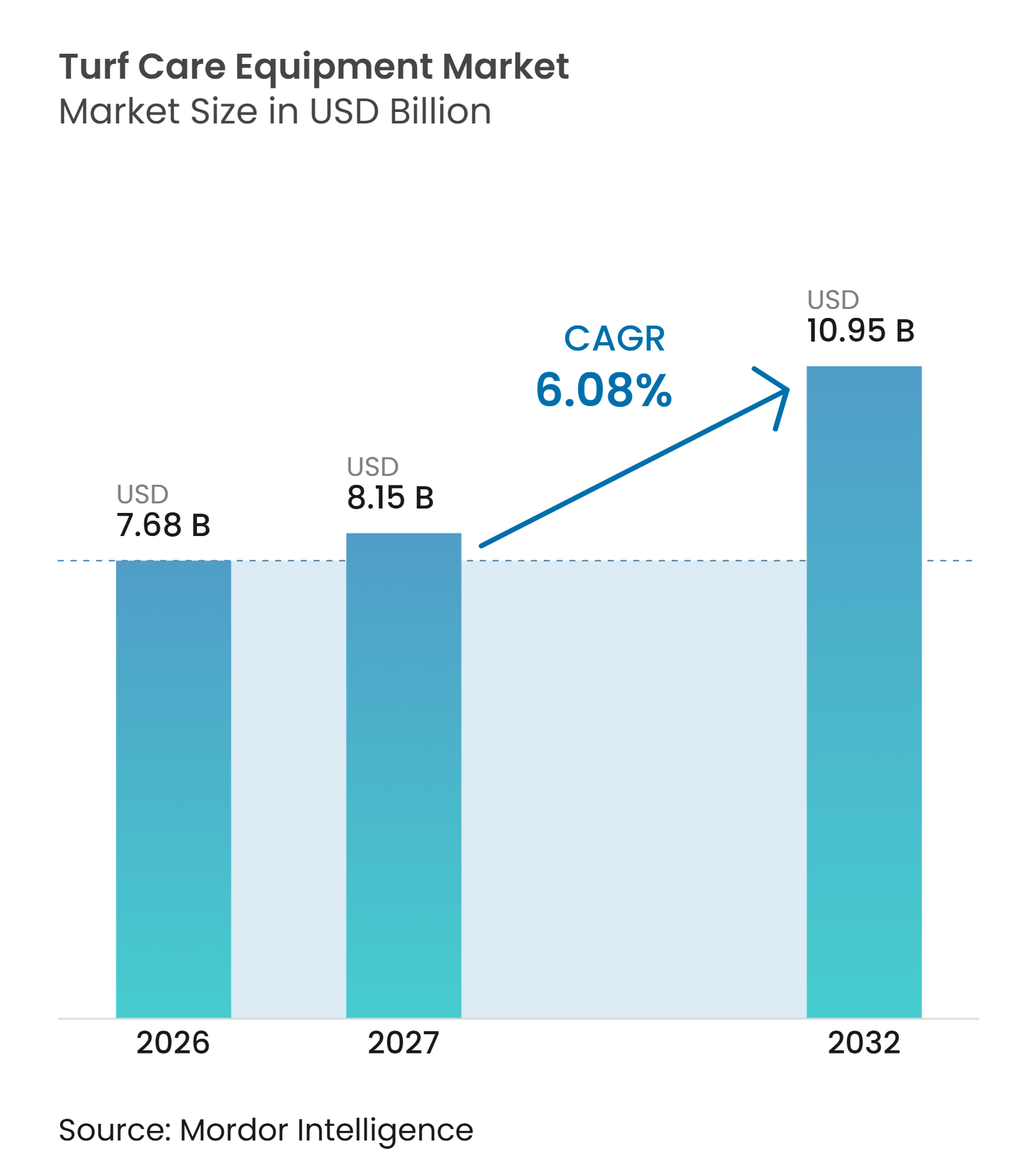
The turf care equipment market size was valued at USD 7.68 billion in 2026 and is forecast to grow from USD 8.15 billion in 2027 to reach USD 10.95 billion by 2032, at a CAGR of 6.08% from 2027 to 2032. Labor shortages, investment in golf and sports facilities, and tighter operating rules are reshaping equipment purchases across professional grounds operations. These conditions encourage buyers to replace several machine categories together when they modernize a fleet. The turf care equipment market serves golf courses, municipal parks, sports venues, schools, airports, commercial landscapers, and hospitality sites. Manufacturers are responding with electric machines, connected fleet tools, and autonomous systems that reduce labor requirements. Charging access and the higher purchase cost of electric equipment remain material limits in the turf care equipment market.
Key Report Takeaways
- By equipment type, mowers held 42.3% of the turf care equipment market share in 2026, while sprayers and spreaders are forecast to grow at a CAGR of 6.1% from 2027 to 2032.
- By power source, internal combustion engine (ICE) held 58.4% of the turf care equipment market size in 2026, while electric is forecast to grow at a CAGR of 11.8% from 2027 to 2032.
- By form, ride-on platforms held 48.0% of the market share in 2026, while stand-on equipment is forecast to grow at a CAGR of 7.8% from 2027 to 2032.
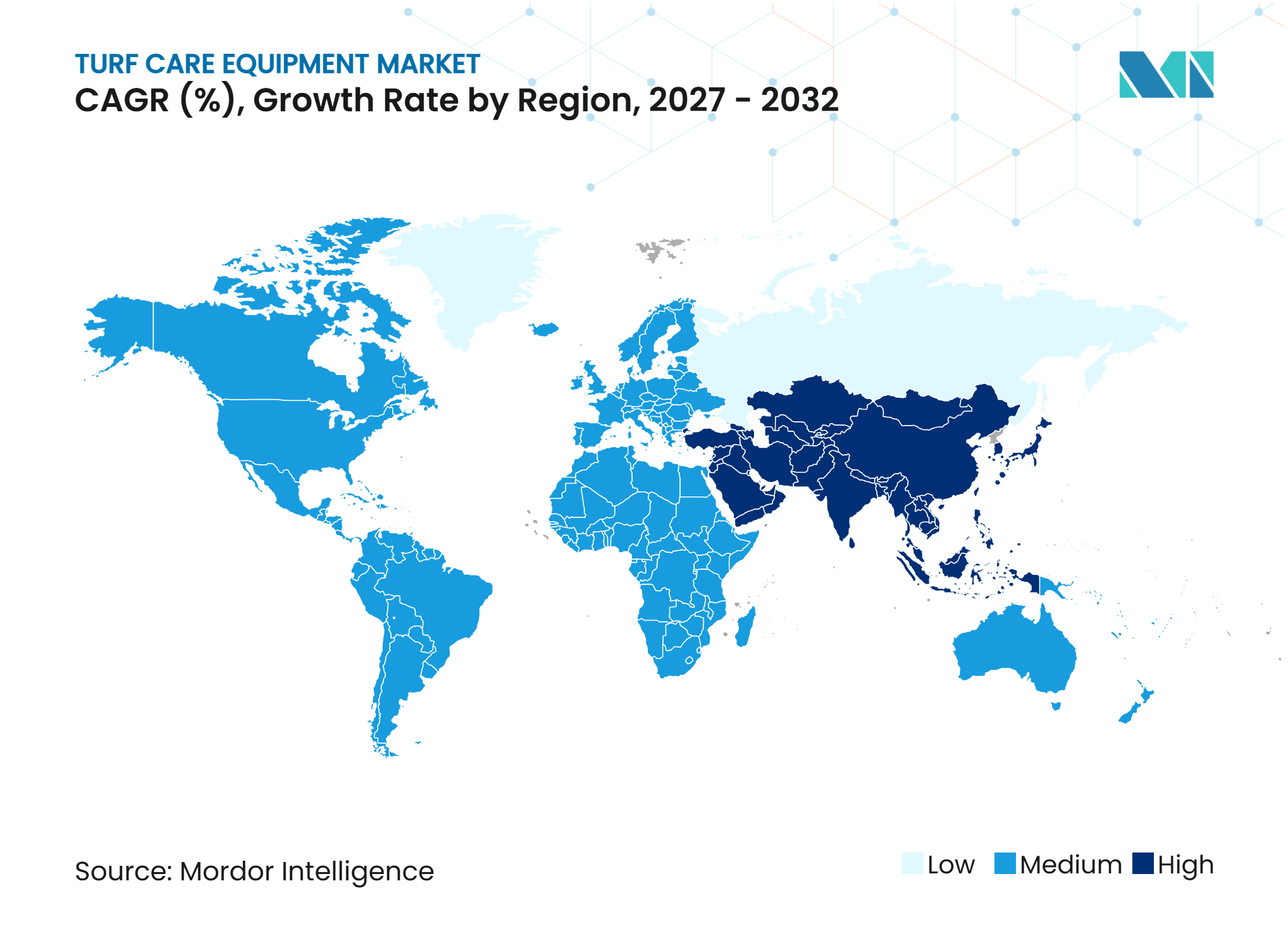
- By geography, Asia-Pacific held 33.0% of the market share in 2026, while Asia-Pacific is forecast to grow at a CAGR of 7.4% from 2027 to 2032.
Note: Market numbers in this report are based on Mordor Intelligence's proprietary estimation framework, which combines nine months of actuals with Q4 projections for base year 2026.
Market Trends and Insights
Drivers Impact Analysis of Turf Care Equipment Market*
| Driver | (~) % Impact on CAGR Forecast | Geographic Relevance | Impact Timeline |
|---|---|---|---|
| Expansion of Sports and Golf Turf Infrastructure | +1.0% | Global, strongest in Asia-Pacific and North America | Medium term (2-4 years) |
| Labor Productivity Pressure and Grounds-Crew Shortages | +1.1% | Global, highest intensity in North America and Europe | Short term (2 years or less) |
| Electrification Driven by Noise and Emissions Rules | +1.0% | North America and Europe, with spillover to Asia-Pacific and the Middle East and Africa | Medium term (2-4 years) |
| Connected Fleet Management and Uptime Optimization | +0.8% | North America and Europe, emerging in Asia-Pacific | Medium term (2-4 years) |
| Autonomous Mowing for Large, Repetitive Turf Areas | +0.9% | Global, with early adoption in North America, Europe, and East Asia | Long term (4 years or more) |
| Water-Efficient and Climate-Adaptive Turf Management | +0.7% | Global, with focus on the Middle East and Africa, western North America, and Australia | Medium term (2-4 years) |
| Source: Mordor Intelligence | |||
Expansion of Sports and Golf Turf Infrastructure
Investment in new and renovated golf and sports facilities supports demand for turf protection and maintenance equipment, as upgraded surfaces require specialized mowing, aeration, spraying, and renovation machinery. In 2025, FireRock Country Club in Arizona undertook a USD 29 million transformation, including full-course regrassing with Stadium Zoysia, while TPC Craig Ranch in Texas commenced a USD 22 million golf course renovation incorporating new turf varieties and redesigned playing surfaces[1]. Arabella Golf Resort Mallorca also advanced a EUR 1.85 million (USD 2.02 million) investment program in 2025, which included golf course infrastructure upgrades and investments in advanced maintenance machinery across its three championship courses. New turf systems and renovated playing surfaces can require tighter cutting tolerances, precise chemical application, and specialized maintenance practices, increasing the need to replace or upgrade existing equipment fleets. These infrastructure investments create recurring demand for suppliers offering broad equipment portfolios, reliable dealer networks, and ongoing maintenance support.
Labor Productivity Pressure and Grounds-Crew Shortages
Labor productivity is becoming an increasingly important consideration in professional grounds maintenance, where mowing, spraying, and renovation activities require frequent and scheduled operations. A 2025 Frontiers in Horticulture study of professional landscape maintenance operators found that reliability, work capacity, and equipment availability were among the highest-rated factors influencing equipment purchasing decisions, highlighting the industry's focus on operational efficiency. Larger cutting decks, ride-on platforms, remote monitoring, and autonomous equipment can help grounds teams increase operating capacity and maintain service levels across large sites. In 2025, Philadelphia Cricket Club deployed more than 30 Husqvarna autonomous mowers that handled approximately 85% of rough mowing ahead of the Truist Championship, demonstrating the potential for automation in repetitive turf maintenance tasks. As grounds managers increasingly prioritize equipment that improves work capacity and operational efficiency, demand for advanced and automated turf care equipment is anticipated to strengthen.
Electrification Driven by Noise and Emissions Rules
Regulatory restrictions on emissions and noise are accelerating the adoption of battery-powered professional turf care equipment. California Assembly Bill 1346, which took effect in January 2024, restricted the sale of new small off-road engines in the state, while a 2025 Frontiers in Horticulture study reported that more than 200 municipalities across 15 U.S. states had introduced restrictions on gas-powered outdoor equipment. Frontiers in Horticulture also reported that 52% of professional operators had incorporated battery-powered equipment into their operations[2]. These requirements influence equipment purchasing decisions, particularly for contractors and grounds teams operating in areas with emissions or noise restrictions. Equipment manufacturers are consequently expanding their battery-powered product portfolios to serve customers facing changing regulatory requirements, supporting the growth of electrified equipment in the turf care equipment market.
Connected Fleet Management and Uptime Optimization
Connected equipment is becoming increasingly relevant for organizations managing large and distributed turf care fleets, as telematics can improve equipment utilization, maintenance planning, and operational visibility. In February 2025, The Toro Company introduced Intelli360 at the Golf Course Superintendents Association of America (GCSAA) Conference, offering real-time information on equipment location, operating status, maintenance schedules, and work-order management through a web-enabled platform. Similarly, Vermeer expanded its VermeerOne platform in April 2025 to consolidate machine manuals, warranty information, Global Positioning System (GPS) tracking, machine health updates, fault reporting, geofencing, and utilization reporting within a single digital platform. These capabilities help operators identify maintenance requirements, improve equipment uptime, and manage crews more efficiently across multiple sites, supporting the growing adoption of connected technologies in the turf care equipment market.
Restraints Impact Analysis of Turf Care Equipment Market*
| Restraint | (~) % Impact on CAGR Forecast | Geographic Relevance | Impact Timeline |
|---|---|---|---|
| High Upfront Cost and Long Replacement Cycles | -1.2% | Global, most acute in Asia-Pacific, the Middle East and Africa, and South America | Short term (2 years or less) |
| Battery Runtime, Charging and Duty-Cycle Constraints | -0.9% | Global, most limiting where charging infrastructure is insufficient | Medium term (2-4 years) |
| Turf Conversion to Synthetic or Low-Maintenance Surfaces | -0.8% | Primarily North America, with spread to Europe and Asia-Pacific | Medium term (2-4 years) |
| Fragmented Service, Dealer and Rental Coverage | -0.7% | Asia-Pacific, the Middle East and Africa, South America, and smaller European markets | Long term (4 years or more) |
| Source: Mordor Intelligence | |||
High Upfront Cost and Long Replacement Cycles
The higher upfront cost of battery-powered commercial equipment can limit adoption among smaller contractors and price-sensitive buyers, even where operators support the transition toward lower-emission machinery. A 2025 Frontiers in Horticulture study cited commercial battery-powered zero-turn mowers with starting prices of USD 18,999, compared with approximately USD 5,000 for comparable gas-powered equipment. This price difference can encourage fleet managers to retain functional internal combustion engine equipment and defer investment in newer platforms, particularly when existing machines remain suitable for routine maintenance operations. Long equipment replacement cycles further slow the transition to electric fleets and can postpone demand for higher-value equipment. Consequently, suppliers must demonstrate lower operating costs, productivity benefits, and regulatory advantages while offering financing, rental, and service programs that reduce the initial capital burden and support adoption across different customer segments.
Battery Runtime, Charging and Duty-Cycle Constraints
Battery runtime and charging infrastructure can limit the adoption of electric turf care equipment for continuous commercial operations requiring extended operating hours. The City of Austin's 2025 landscaping equipment electrification market study identified insufficient daytime charging access and limited charging infrastructure as significant barriers for commercial landscaping contractors transitioning to electric equipment. Contractors serving multiple properties may have limited opportunities to recharge equipment between sites, making internal combustion engine equipment necessary for applications requiring uninterrupted operation. Swappable battery systems can help extend equipment availability but may require additional investment in battery inventories and charging infrastructure. Consequently, the transition toward electric turf care equipment may remain slower among operators with demanding duty cycles or limited access to charging facilities, sustaining demand for conventional and hybrid equipment until battery performance and workplace infrastructure improve.
*Our forecasts treat driver/restraint impacts as directional, not additive. The impact forecasts reflect baseline growth, mix effects, and variable interactions.
Turf Care Equipment Market Segment Analysis
By Equipment Type:
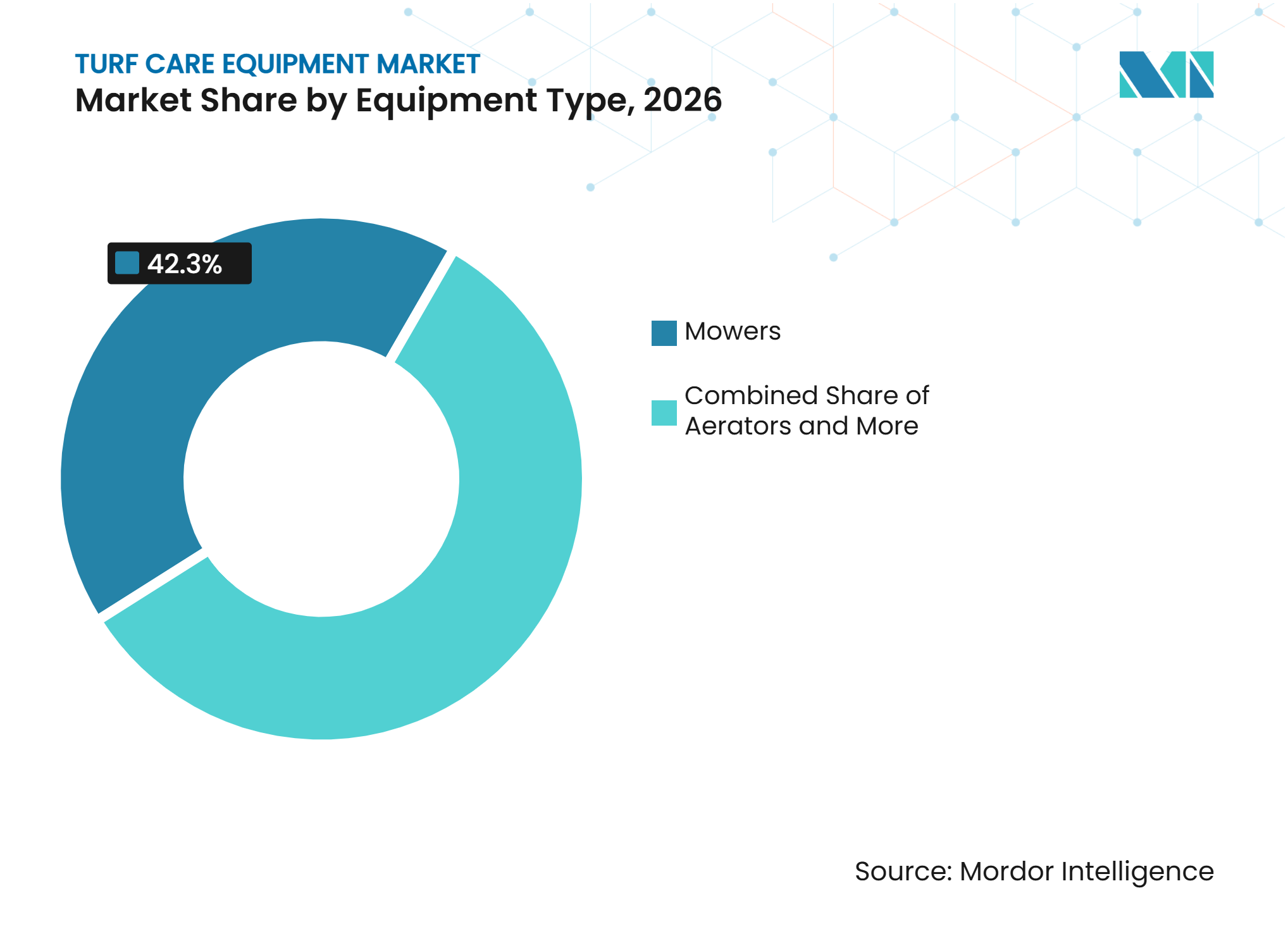
Mowers Lead While Sprayers and Spreaders AdvanceMowers held 42.3% of the turf care equipment market share in 2026, reflecting their widespread use across professional turf settings. Golf courses, municipal parks, sports fields, campuses, and hospitality properties require regular mowing across large areas. The mower category includes fairway, rough, sports-field, zero-turn, and large-estate equipment. Robotic mowers are also changing the category by handling repetitive mowing tasks at suitable sites, supporting greater automation and operational efficiency in professional turf maintenance.
Sprayers and spreaders are forecast to grow at a CAGR of 6.1% from 2027 to 2032. Precision application supports better control of treatment activity and can reduce unnecessary chemical use. A 2025 Virginia Tech study found that Global Navigation Satellite System (GNSS)-guided turf sprayers achieved high application accuracy at speeds ranging from 7.2 to 9.7 kilometers per hour[3]. Aerators, turf tractors and utility vehicles, dethatchers, topdressers, renovation equipment, blowers, sweepers, and bunker rakes also benefit from facility renewal projects. These products are often purchased together when a venue updates its turf maintenance program. The turf care equipment market size for this equipment group is supported by projects that renovate entire courses and athletic facilities.



By Power Source:
ICE Retains the Installed Base as Electric Gains GroundInternal combustion engine (ICE) equipment held 58.4% of the turf care equipment market share in 2026. It remains important because operators value established service networks, familiar maintenance practices, and dependable all-day performance. ICE equipment is particularly suited to applications that require long shifts or operate far from charging facilities. The large installed base also means many buyers replace machines gradually rather than switching across every product category at once. Hybrid equipment addresses the needs of operators that require more runtime than fully electric machinery can currently provide. This mix makes power-source decisions dependent on a site's work pattern and infrastructure.
Electric equipment is forecast to grow at a CAGR of 11.8% from 2027 to 2032. Regulations, lower operating noise, and interest in reducing emissions are expanding its use in restricted locations. A 2025 Frontiers in Horticulture study indicated that adoption remains conditional on adequate performance and work capacity. California restrictions and local regulations are driving demand for commercial electric machines in affected jurisdictions. As battery energy density and charging options improve, electric products can address a broader range of applications. However, the turf care equipment industry still needs to resolve duty-cycle and charging limitations before electric systems can replace ICE equipment across all professional use cases.
By Form:
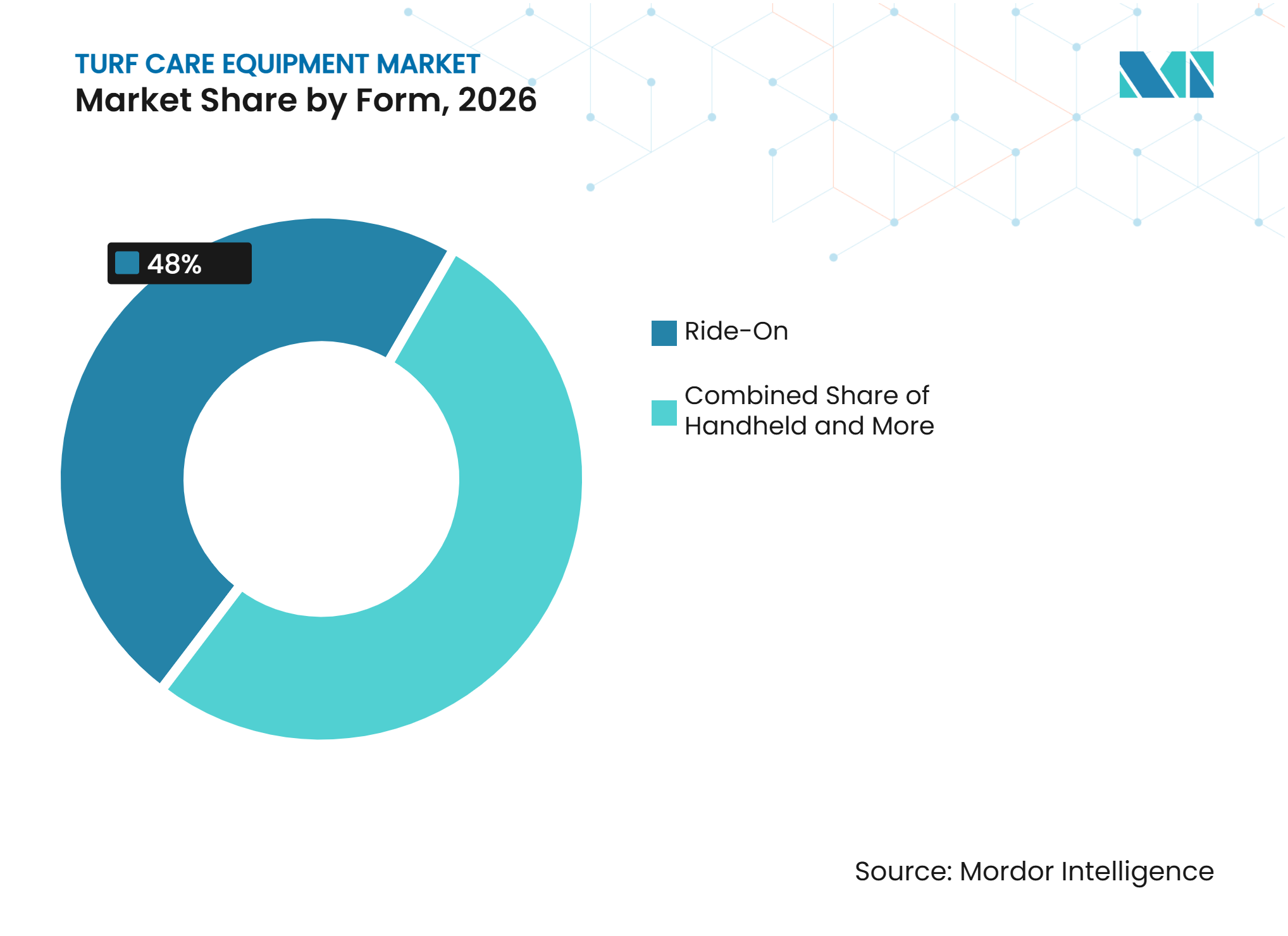
Ride-On Equipment Leads While Stand-On Platforms Grow FasterRide-on platforms held 48.0% of the turf care equipment market share in 2026. They are widely used across golf courses, sports fields, municipal parks, and large estates where crews must maintain broad turf areas. The category includes zero-turn mowers, fairway and rough mowers, sports-field mowers, and large-acreage estate equipment. Their continued use reflects the need for wide cutting decks, reliable output during long shifts, and improved operator comfort. Walk-behind platforms remain important for sites that require close control, maneuverability, and precise cutting around landscaped areas. Robotic and autonomous mowers are expanding into work previously handled by both ride-on and walk-behind products as Global Positioning System (GPS)-based real-time kinematic (RTK) positioning and light detection and ranging (LiDAR) navigation become more capable.
Stand-on platforms are forecast to grow at a CAGR of 7.8% from 2027 to 2032, driven by commercial landscapers that need higher productivity without the capital cost of larger ride-on machines. Stand-on equipment is suited for mid-sized commercial properties where operators need to move quickly between locations and work around obstacles. A 2025 Crop Science study found that GPS-RTK systems support repeatable mowing patterns and improve operating efficiency compared with wire-bound systems. Handheld equipment supports trimming and spot-treatment work, while tractor-mounted and tow-behind equipment remains relevant for large sites where attachment versatility and lower per-acre costs guide purchasing decisions.

Geography Analysis
Asia-Pacific
Asia-Pacific held 33.0% of the turf care equipment market share in 2026 and is forecast to grow at a CAGR of 7.4% from 2027 to 2032. Established golf and sports venues in Japan, Australia, and South Korea support ongoing equipment demand. Construction of golf courses, stadiums, and hospitality landscapes in China, India, Vietnam, and Thailand is adding demand for professional fleets. A 2025 Yano Research Institute study identified robotic and remote-controlled mowing equipment as a primary investment priority in Japan. Labor scarcity and extreme summer heat are increasing the appeal of equipment that can reduce outdoor work hours. Centaur Asia Pacific deployed ECHO Robotics mowers at Bangsai Country Club in Thailand in 2025.
North America
North America has a dense base of golf facilities, sports venues, universities, and municipal parks that require frequent turf maintenance. The region's extensive network of professional and recreational facilities creates sustained demand for mowing, aeration, renovation, and other turf maintenance equipment. Labor shortages have made ride-on, autonomous, and connected equipment increasingly relevant to grounds operations. State and municipal regulations create uneven demand for electric equipment, with California imposing more direct compliance requirements. TPC Craig Ranch, Quail Creek Country Club, and FireRock Country Club completed or began major renovations during 2025, supporting multi-category equipment replacement and reinforcing the importance of dealer and service capacity.
Europe, the Middle East and Africa, and South America
Europe is shifting from internal combustion engine (ICE) equipment to electric fleets, driven by European Union Stage V requirements and national noise regulations that influence equipment selection. The European Golf Association's sustainability framework encourages clubs to reduce carbon emissions by 2030. The Middle East is investing in golf resorts, football stadiums, and landscaped public spaces through Saudi Vision 2030 and related programs. South America and Africa show emerging demand from urban parks, stadiums, and resort developments, though financing constraints and limited dealer coverage restrict wider adoption. Australia has mature golf and sports-turf operations with growing interest in autonomous mowing. In 2025, Green by Nature deployed autonomous mowing robots in government and commercial landscape contracts in Australia.
Competitive Landscape
Market Concentration
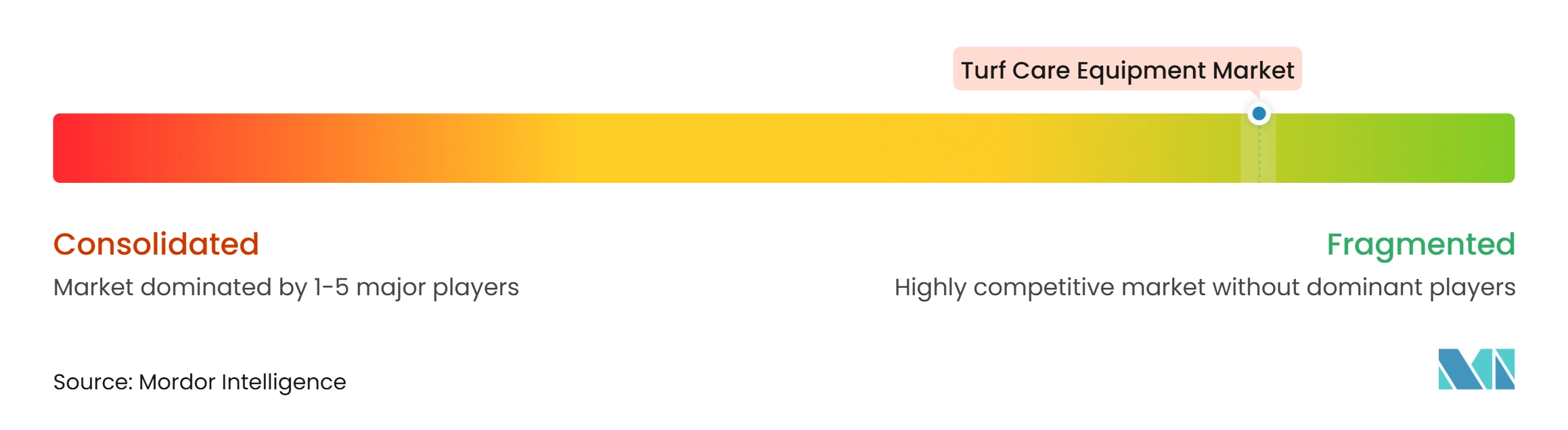
The turf care equipment market was fragmented in 2026, with The Toro Company, Deere & Company, Husqvarna AB, Kubota Corporation, and Textron Specialized Vehicles Inc. (Textron Inc.) identified as the major players. Their competitive positions are supported by broad product portfolios, established dealer and service networks, manufacturing capabilities, and experience serving golf courses, sports facilities, commercial landscapes, and other professional turf applications. Companies compete through equipment performance, reliability, product range, automation capabilities, power-source options, after-sales service, and distribution reach. These factors are encouraging investment in battery-powered, connected, and autonomous equipment designed to improve operational efficiency across different turf management applications.
Leading companies are expanding their autonomous and digital equipment portfolios. Husqvarna has developed professional autonomous mowing systems based on its Exact Positioning Operating System (EPOS) technology, including CEORA and Automower products for large-area applications. In October 2025, the company announced seven robotic lawnmowers incorporating artificial intelligence (AI) Vision technology and nighttime infrared operation. The Toro Company introduced the Turf Pro 500/300 autonomous mowers and Groundsmaster e3300 battery-powered mower in January 2025 and expanded its autonomous portfolio with the PROLINE AMI in October 2025. These developments demonstrate the growing importance of automation, connectivity, and alternative power systems in product differentiation.
Opportunities remain for specialist manufacturers offering equipment for specific turf applications, local service support, and cost-effective solutions. Smaller suppliers can compete through specialized aeration, renovation, and golf course maintenance equipment, while larger companies can broaden their portfolios through product development, acquisitions, and investments in autonomous technologies. The expansion of electric equipment also creates opportunities for manufacturers to differentiate through lower operating costs, reduced emissions, and equipment suited to noise-sensitive professional environments. As professional turf operators increasingly seek to improve labor efficiency and equipment utilization, the ability to combine reliable equipment with technical support, digital fleet management, and autonomous capabilities is anticipated to become an increasingly important competitive factor.
Turf Care Equipment Industry Leaders
-
The Toro Company
-
Deere & Company
-
Husqvarna AB
-
Kubota Corporation
-
Textron Specialized Vehicles Inc. (Textron Inc.)
- *Disclaimer: Major Players sorted in no particular order
Turf Care Equipment Market Companies Covered in this Report
- The Toro Company
- Deere & Company
- Husqvarna AB
- Kubota Corporation
- Textron Specialized Vehicles Inc. (Textron Inc.)
- ANDREAS STIHL AG & Co. KG (STIHL Holding AG & Co. KG)
- Ariens Company
- Metalcraft of Mayville, Inc. (Scag Power Equipment)
- Bad Boy, Inc.
- Doosan Bobcat North America, Inc. (Doosan Bobcat Inc.)
- Moridge Manufacturing, Inc. (The Grasshopper Company)
- Wright Manufacturing, Inc.
- Redexim B.V.
- Smithco, Inc.
- Greenworks (Jiangsu) Co., Ltd.
- Briggs & Stratton, LLC (KPS Capital Partners)
Recent Industry Developments in Turf Care Equipment Market
- July 2026: The Toro Company launched the GreensPro e1700, an all-electric greens roller designed for golf course maintenance, expanding the company's battery-powered turf equipment portfolio.
- June 2026: The Toro Company introduced the Turf Pro 200, an autonomous mower designed for smaller and confined turf areas, expanding its autonomous equipment range for golf courses, sports facilities, and other professional turf applications.
- April 2026: Husqvarna introduced the Automower 560 EPOS, a professional autonomous mower for large-scale green spaces that uses satellite-based positioning and virtual boundaries, strengthening its portfolio of connected and autonomous turf maintenance equipment.
- October 2025: The Toro Company unveiled the autonomous PROLINE AMI mower for landscape professionals, integrating GNSS and RTK positioning, radar-based collision avoidance, and remote monitoring capabilities, strengthening its connected and autonomous turf equipment portfolio.
Global Turf Care Equipment Market Report Scope
Turf care equipment refers to machinery and tools used to establish, maintain, and improve natural turf and grass-covered surfaces. The equipment includes mowers, aerators, sprayers and spreaders, turf tractors, utility vehicles, dethatchers, topdressers, renovation equipment, blowers, sweepers, and bunker rakes used across professional turf applications. Equipment used primarily for general landscaping, forestry, agriculture, construction, and synthetic turf maintenance is excluded from the scope of this market. The Turf Care Equipment Market Report is Segmented by Equipment Type (Mowers, Aerators, Sprayers and Spreaders, Turf Tractors and Utility Vehicles, Dethatchers, Topdressers and Renovation Equipment, and Blowers, Sweepers and Bunker Rakes), by Power Source (Internal Combustion Engine, Electric, and Hybrid), by Form (Handheld, Walk-Behind, Stand-On, Ride-On, and Tractor-Mounted and Tow-Behind), and by Geography (North America, South America, Europe, Asia-Pacific, Middle East, and Africa). Market Forecasts are Provided in Terms of Value (USD).
Segmentation Overview
| Mowers | Walk-Behind Mowers |
| Ride-On Mowers | |
| Zero-Turn Mowers | |
| Reel and Fairway Mowers | |
| Robotic and Autonomous Mowers | |
| Aerators | |
| Sprayers and Spreaders | |
| Turf Tractors and Utility Vehicles | |
| Dethatchers, Topdressers and Renovation Equipment | |
| Blowers, Sweepers and Bunker Rakes |
| Internal Combustion Engine |
| Electric |
| Hybrid |
| Handheld |
| Walk-Behind |
| Stand-On |
| Ride-On |
| Tractor-Mounted and Tow-Behind |
| North America | United States |
| Canada | |
| Mexico | |
| Rest of North America | |
| South America | Brazil |
| Argentina | |
| Rest of South America | |
| Europe | Germany |
| France | |
| United Kingdom | |
| Italy | |
| Spain | |
| Russia | |
| Rest of Europe | |
| Asia-Pacific | China |
| India | |
| Japan | |
| South Korea | |
| Australia | |
| Vietnam | |
| Rest of Asia-Pacific | |
| Middle East | Turkey |
| Saudi Arabia | |
| United Arab Emirates | |
| Rest of Middle East | |
| Africa | South Africa |
| Egypt | |
| Rest of Africa |
| By Equipment Type | Mowers | Walk-Behind Mowers |
| Ride-On Mowers | ||
| Zero-Turn Mowers | ||
| Reel and Fairway Mowers | ||
| Robotic and Autonomous Mowers | ||
| Aerators | ||
| Sprayers and Spreaders | ||
| Turf Tractors and Utility Vehicles | ||
| Dethatchers, Topdressers and Renovation Equipment | ||
| Blowers, Sweepers and Bunker Rakes | ||
| By Power Source | Internal Combustion Engine | |
| Electric | ||
| Hybrid | ||
| By Form | Handheld | |
| Walk-Behind | ||
| Stand-On | ||
| Ride-On | ||
| Tractor-Mounted and Tow-Behind | ||
| By Geography | North America | United States |
| Canada | ||
| Mexico | ||
| Rest of North America | ||
| South America | Brazil | |
| Argentina | ||
| Rest of South America | ||
| Europe | Germany | |
| France | ||
| United Kingdom | ||
| Italy | ||
| Spain | ||
| Russia | ||
| Rest of Europe | ||
| Asia-Pacific | China | |
| India | ||
| Japan | ||
| South Korea | ||
| Australia | ||
| Vietnam | ||
| Rest of Asia-Pacific | ||
| Middle East | Turkey | |
| Saudi Arabia | ||
| United Arab Emirates | ||
| Rest of Middle East | ||
| Africa | South Africa | |
| Egypt | ||
| Rest of Africa | ||
Key Questions Answered in the Report
What is the 2027 value of the turf care equipment market?
The value is USD 8.15 billion in 2027 and is forecast to reach USD 10.95 billion by 2032 at a CAGR of 6.08%. The figures cover professional equipment used for mowing, renovation, application, and utility work.
Which equipment category leads professional turf maintenance?
Mowers led with 42.3% share in 2026 because cutting is a frequent requirement across golf, sports, municipal, and commercial sites. The category includes several machine types built for different terrain, cutting-width, and productivity requirements.
Why are autonomous mowers gaining attention among grounds teams?
They can perform repetitive mowing work and help address workforce shortages at sites suited to automated operation. Their value is strongest where work areas are large, predictable, and manageable through precise positioning systems for routine daily professional maintenance work.
What drives purchases of professional turf care equipment?
Labor shortages, venue renewal, and emissions and noise rules support demand for productive, electric, and autonomous equipment. Buyers also assess whether a new machine can improve crew capacity across regular scheduled work.