
Titanium Ore Market Size and Share
Market Overview
| Study Period | 2021 - 2031 |
|---|---|
| Market Size (2026) | USD 7.56 Billion |
| Market Size (2031) | USD 10.20 Billion |
| Growth Rate (2026 - 2031) | 6.18% CAGR |
| Fastest Growing Market | Asia-Pacific |
| Largest Market | Asia-Pacific |
| Market Concentration | Medium |
Major Players *Disclaimer: Major Players sorted in no particular order Image © Mordor Intelligence. Reuse requires attribution under CC BY 4.0. | |
Titanium Ore Market Analysis by Mordor Intelligence
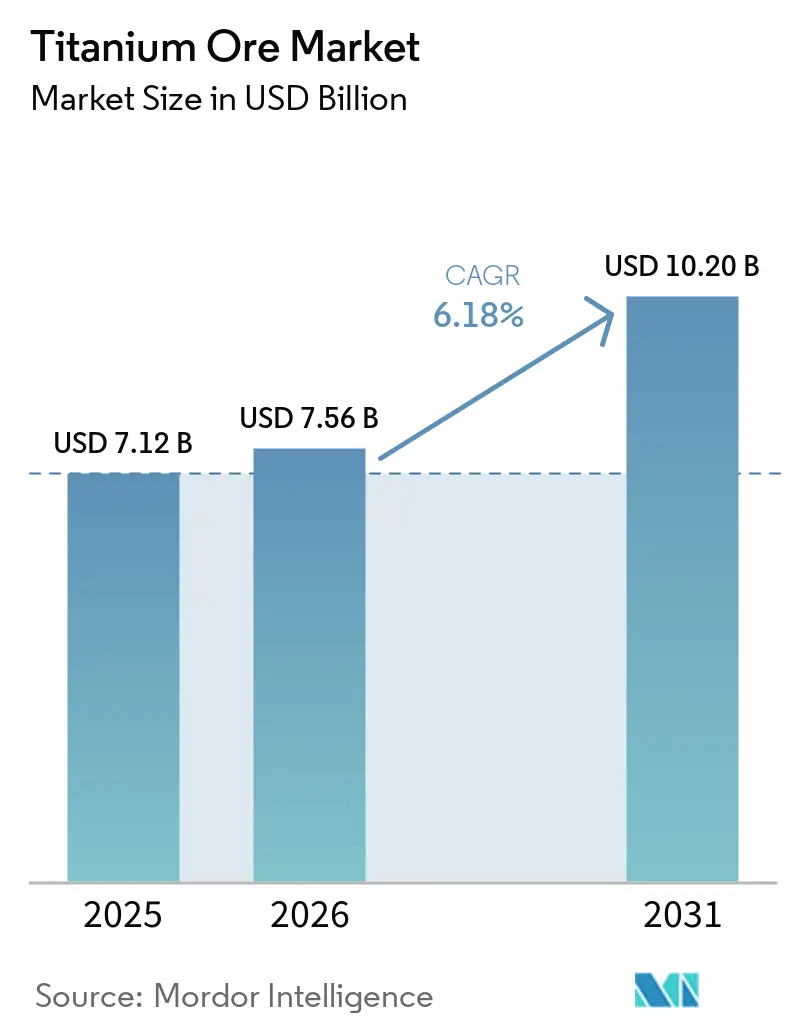
The titanium ore market size was valued at USD 7.12 billion in 2025 and is estimated to grow from USD 7.56 billion in 2026 to reach USD 10.20 billion by 2031, at a CAGR of 6.18% during the forecast period (2026-2031). Bulk pigment-grade ilmenite remains the primary feedstock by abundance and continued use in the large sulfate-route pigment base, while high-purity rutile and upgraded products command higher value in chloride-process titanium dioxide and titanium metal supply chains. U.S. apparent consumption of titanium mineral concentrates rose 10% in 2025, and imports increased 12%, reflecting inventory normalization after two subdued years rather than a sustained shift in underlying demand. The titanium ore market is shaped by a widening gap between ordinary ilmenite and feedstocks suitable for chloride-process pigment or aerospace sponge production, with grade, processing capability, and customer qualification increasingly influencing supplier value. Producers are responding to weak spot pricing through selective supply and contracting strategies, while buyers are seeking reliable, high-grade material and more secure procurement channels. Construction-related pigment demand and defense-related titanium demand provide distinct demand bases that moderate the impact of a slowdown in either end-use area, reducing dependence on a single industrial cycle.
Key Report Takeaways
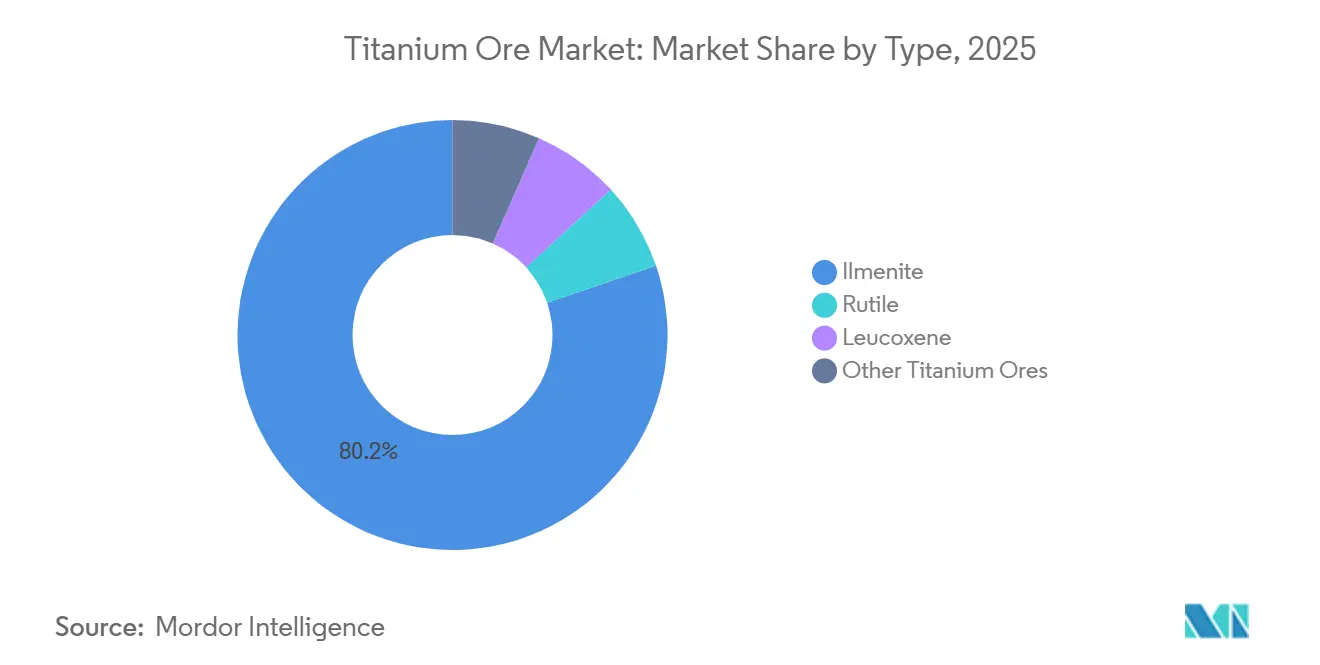
- By type, ilmenite held 80.23% of the titanium ore market share in 2025, while rutile is forecast to grow at a 7.05% CAGR through 2031.
- By application, titanium dioxide pigments accounted for 60.52% of the titanium ore market size in 2025, while titanium metal is forecast to grow at a 7.38% CAGR through 2031.
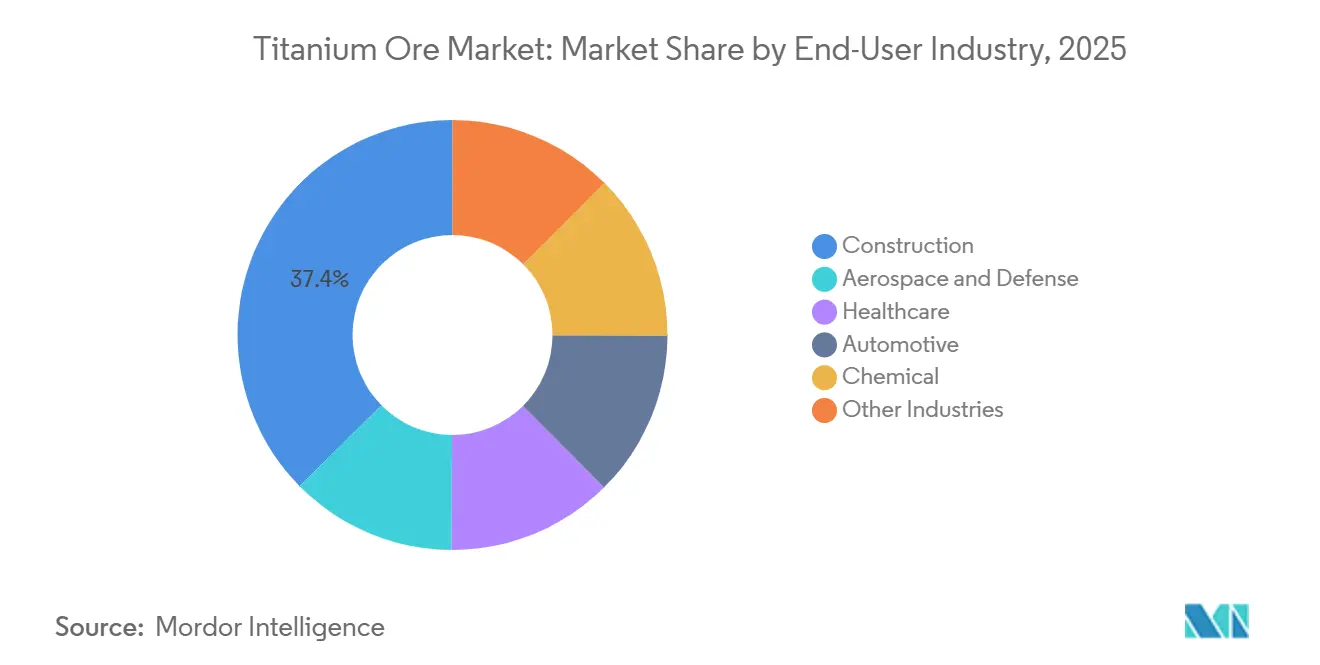
- By end-user industry, construction held 37.41% of the titanium ore market share in 2025, while aerospace and defense are forecast to grow at a 7.71% CAGR through 2031.
- By geography, Asia-Pacific accounted for 45.18% of the titanium ore market size in 2025 and is forecast to grow at a 6.78% CAGR through 2031.
Note: Market size and forecast figures in this report are generated using Mordor Intelligence’s proprietary estimation framework, updated with the latest available data and insights as of January 2026.
Global Titanium Ore Market Trends and Insights
Drivers Impact Analysis*
| Drivers | (~) % Impact on CAGR Forecast | Geographic Relevance | Impact Timeline |
|---|---|---|---|
| Pigment-Grade Titanium Dioxide Demand from Paints, Coatings, and Plastics | +1.8% | Global, with concentration in China and North America | Short term (≤ 2 years) |
| Aerospace and Defense Demand for High-Grade Titanium Feedstocks | +1.2% | North America, Europe, APAC core | Long term (≥ 4 years) |
| Expansion of Chloride-Route Pigment Capacity Requiring Richer Feedstocks | +0.8% | APAC, with China as the primary market, and spillover to Europe and North America | Medium term (2-4 years) |
| Advanced Beneficiation and Feedstock Upgrading Technologies: Reducing Grade Dependency | +0.7% | Global, with the fastest adoption in Australia, India, and China | Medium term (2-4 years) |
| Synthetic-Rutile Substitution Improving High-Grade Feedstock Security | +0.5% | Australia for supply, and Southeast Asia and India for processing | Medium term (2-4 years) |
| Source: Mordor Intelligence | |||
Pigment-Grade Titanium Dioxide Sustains Core Market Demand
More than 95% of U.S. titanium mineral concentrate imports were consumed by domestic titanium dioxide pigment producers in 2025[1]U.S. Geological Survey, “Titanium Mineral Concentrates,” Mineral Commodity Summaries 2026, pubs.usgs.gov. Pigment output is the primary driver for the titanium ore market, keeping pigment buyers central to annual mine offtake. Global titanium dioxide pigment demand stood at 7 million tons in 2025, while Chinese output fell 6.98% to 4.178 million tons, and consumption in India and Southeast Asia continued to grow due to urbanization and infrastructure activity. Paints and coatings are the leading outlet for titanium dioxide, so construction activity continues to influence mine feedstock purchases. India's December 2025 cancellation of anti-dumping measures on Chinese titanium dioxide widened access to supply but pressured domestic ilmenite processors, favoring low-cost miners in Mozambique and Australia. The durability of this demand base depends on whether China's sulfate-process capacity rationalizes or continues despite negative margins.
Aerospace and Defense Demand for High-Grade Feedstocks Reshapes Ore Quality Mix
Aerospace and defense procurement drives demand for high-grade feedstock outside normal pigment cycles. Boeing and Airbus collectively held a backlog of 16,000 aircraft, and the Boeing 737 MAX line was progressing toward 47 units per month. These production requirements support demand for titanium alloy and qualified sponge over the next five years. Chloride-process sponge requires feedstocks with more than 85% titanium dioxide, which ordinary ilmenite cannot consistently supply without upgrading. Japan's sponge titanium exports reached their fastest pace in January through August 2025, equaling 70% of the 2023 annual record, while its titanium ore imports reached a record low. This pattern favors rutile, synthetic rutile, and producers able to maintain strict quality control.
Expansion of Chloride-Route Pigment Capacity Tightens Feedstock Demand
The shift from the sulfate process to the chloride process for titanium dioxide production is changing quality requirements in the titanium ore market. Chloride plants produce higher-purity pigment with lower effluent but require feedstock generally above 85% titanium dioxide, driving demand toward rutile, synthetic rutile, and high-titanium-dioxide slag. Pangang reached full capacity at a 60,000-ton-per-year chloride-process line in March 2025, and Yibin Tianyuan announced CNY 1.48 billion (~USD 0.22 billion) for a further 100,000-ton-per-year expansion, scheduled for completion by December 2026. Natural rutile supply was 450,000 metric tons globally in 2025, supporting synthetic rutile conversion and brownfield upgrades. China's environmental requirements are contributing to the shift, as sulfate-process plants face greater scrutiny of effluent and energy use.
Advanced Beneficiation and Feedstock Upgrading Extend Resource Life
Beneficiation and upgrading technologies enable the titanium ore market to use mineral sands that would otherwise fall short of chloride-process requirements. The Becher process and hydrochloric-acid leaching can convert ilmenite containing 60% to 65% titanium dioxide into synthetic rutile containing 88% to 96% titanium dioxide. CSIR-National Institute for Interdisciplinary Science and Technology demonstrated a process producing synthetic rutile with 92% titanium dioxide from low-grade ilmenite. Medium-grade ilmenite resources in India, Senegal, and Mozambique can serve chloride-compatible applications when suitable upgrading capacity is available. Project returns depend on energy costs, plant reliability, environmental performance, and high-grade feedstock premiums.
Restraints Impact Analysis*
| Restraints | (~) % Impact on CAGR Forecast | Geographic Relevance | Impact Timeline |
|---|---|---|---|
| Environmental Permitting Delays and Mine-Rehabilitation Obligations | -0.9% | Australia, South Africa, and India, with secondary effects in Africa | Short term (≤ 2 years) |
| Feedstock Price Volatility and Demand Cyclicality | -0.8% | Global, most acute for high-cost miners in developed markets | Short term (≤ 2 years) |
| Depletion of High-Grade Mineral Sands Deposits | -0.5% | Australia, Sierra Leone, and South Africa | Long term (≥ 4 years) |
| Source: Mordor Intelligence | |||
Environmental Permitting and Mine-Rehabilitation Obligations Delay Capacity
Environmental permitting directly constrains new mineral sands capacity in the titanium ore market. Environmental Impact Statement processes in the United States average 4.5 years, and litigation can add further delays. U.S. discharge rules for the titanium ore subcategory cover lode-deposit mining and dredge mining of placer sands, thereby increasing pre-production capital requirements[2]U.S. Environmental Protection Agency, “40 CFR § 440.54, New Source Performance Standards for Titanium Ore Subcategory,” Electronic Code of Federal Regulations, law.cornell.edu. Kenmare Resources plc stated that its Implementation Agreement renewal in Mozambique remained unresolved as of August 2026, following the concessions' December 2024 expiration, while proposed fiscal changes created further uncertainty. Similar permitting and fiscal pressures exist in Madagascar, South Africa, and India. These obligations delay greenfield investment and limit supply response to high-grade feedstock demand.
Feedstock Price Volatility and Demand Cyclicality Constrain Investment Returns
Rutile prices free on board Australia fell from USD 1,470 per ton in 2022 to USD 1,140 per ton in 2025, while ilmenite prices declined from USD 530 per ton to USD 400 per ton. Sierra Leone increased rutile output from 80,000 to 110,000 metric tons in 2025, partly offsetting losses in Kenya and Ukraine. Australia holds 35,000 metric tons of rutile reserves, representing 70% of global reserves, with annual output of 200,000 metric tons. Long mine-development cycles mean reserve size does not translate quickly into supply, and price weakness reduces capital availability for replacement projects. The titanium ore market faces both near-term price volatility and longer-term constraints on high-grade supply.
*Our forecasts treat driver/restraint impacts as directional, not additive. The impact forecasts reflect baseline growth, mix effects, and variable interactions.
Segment Analysis
By Type: Ilmenite Retains Scale While Higher-Grade Feedstocks Gain Relevance
Ilmenite held 80.23% of the titanium ore market in 2025. Its position reflects geological abundance, global reserves above 490,000 metric tons, and established use in sulfate-route titanium dioxide production. Processors distinguish upgrade-grade ilmenite, which can be converted to synthetic rutile or slag, from sulfate-grade material used directly. This distinction supports a price premium for higher-quality ilmenite. Leucoxene contains 60% to 90% titanium dioxide and provides a narrower feedstock route where natural rutile is less available.
Rutile is forecast to grow at a 7.05% CAGR through 2031, making it the fastest-growing type in the titanium ore market. Natural rutile output was 450,000 metric tons in 2025, while global chloride-process titanium dioxide capacity exceeded 4 million metric tons per year. Sierra Leone increased output from 80,000 to 110,000 metric tons in 2025, partly offsetting losses in Kenya and Ukraine. Australia held 35,000 metric tons of rutile reserves and produced 200,000 metric tons annually, underscoring that a large resource base does not guarantee immediate supply growth. This supply constraint supports synthetic rutile margins and the longer-term outperformance of rutile in the titanium ore market.



By Application: Titanium Dioxide Pigments Lead Demand While Titanium Metal Adds Growth
Titanium dioxide pigments accounted for 60.52% of the titanium ore market in 2025. This application depends on demand from construction, packaging, and consumer goods across Asia, North America, and Europe. Coatings and linings support anticorrosion systems in chemical processing, marine infrastructure, and power generation. Welding electrodes represent a smaller but specialized use, as ilmenite and rutile affect slag formation and weld bead quality.
Titanium metal is forecast to grow at a 7.38% CAGR through 2031, making it the fastest-growing application in the titanium ore market. Aerospace sponge production requires qualified feedstock, as grade determines whether the output meets original equipment manufacturer requirements. Manufacturing growth in Southeast Asia and India supports demand for welding electrodes. Additive manufacturing uses highly consistent titanium powder, and the European Commission Joint Research Center identified this process as an opportunity to improve material efficiency and the circularity of titanium. This segment adds a premium pull for high-purity rutile and synthetic rutile in the titanium ore market.
By End-User Industry: Construction Leads Demand While Aerospace and Defense Raise Grade Requirements
Construction held 37.41% of the titanium ore market in 2025. The segment depends on titanium dioxide pigment used in architectural coatings, cement, and façade materials, and is linked to housing starts and infrastructure spending. Automotive use is concentrated in performance vehicles and premium exhaust systems. Chemical processors use titanium in heat exchangers, reaction vessels, and marine piping, where corrosion resistance supports a premium over stainless steel.
Aerospace and defense is forecast to grow at a 7.71% CAGR through 2031, the highest end-user growth rate in the titanium ore market. Military aircraft use more than three times as much titanium per kilogram as a typical narrowbody commercial aircraft, increasing the importance of defense demand for high-grade feedstock. Osaka Titanium Technologies announced a 25% expansion of sponge capacity, supported by JPY 8 billion (~USD 0.05 billion) in grants. These requirements favor feedstocks that meet strict grade and consistency standards.
Geography Analysis
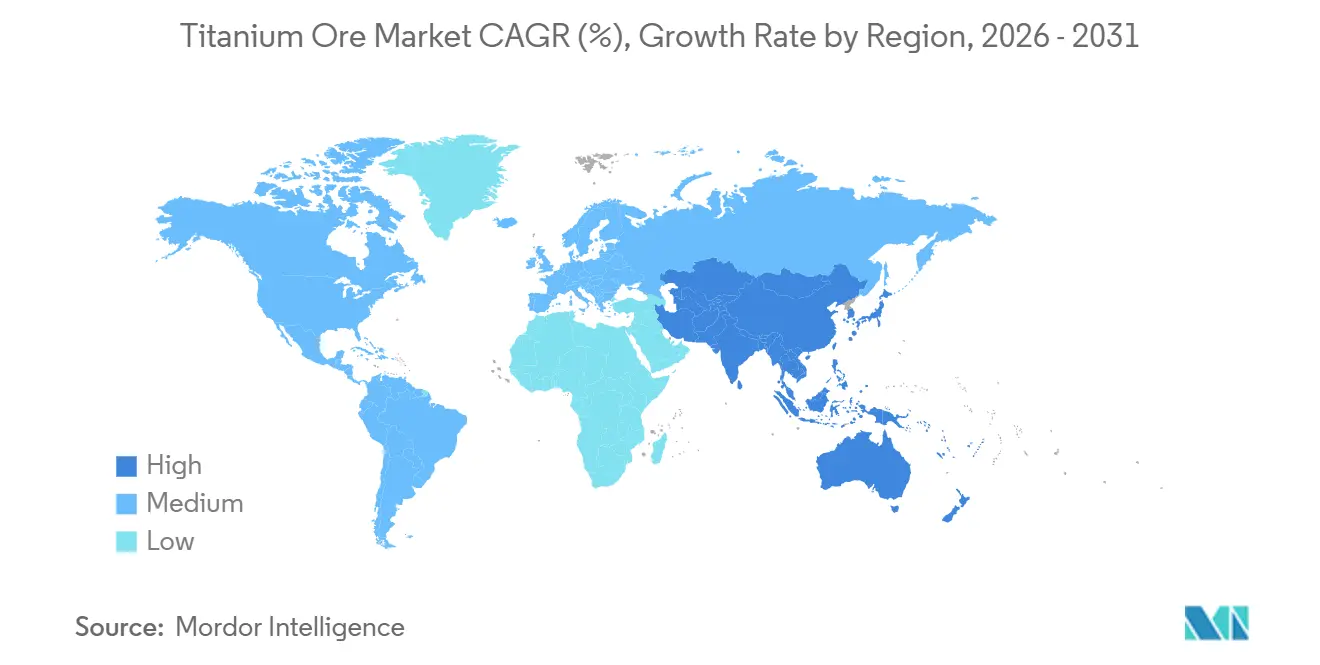
Asia-Pacific held 45.18% of the titanium ore market in 2025 and is forecast to grow at a 6.78% CAGR through 2031. China produced 3.2 million metric tons of ilmenite in 2025 and had an estimated annual titanium dioxide pigment capacity of 6 million metric tons. It imported 3.8 million gross tons of titanium mineral concentrates in the first nine months of 2025, up 5% year over year. Mozambique supplied 47% of those imports, Australia supplied 17%, and Norway supplied 7%. This combination of domestic output, pigment capacity, and imports positions the region as central to ore demand and price direction.
India held the world's third-largest ilmenite and rutile reserves at 92 million tons, but ranked fifth in ore output. It imported 75% of its titanium dioxide requirements, leaving room for domestic beneficiation and mining. Japan's titanium ore imports reached a record low in 2025, while sponge titanium exports rose from January through August 2025. North America and Europe remain major demand centers for pigment production and aerospace feedstock. The United States produced 1 million tons of titanium dioxide pigment in 2025 and was 86% net import-dependent for titanium mineral concentrates.
The United States imported USD 720 million of concentrates in 2025, compared with USD 658 million in 2024. The Critical Raw Materials Act identifies titanium as a strategic raw material and supports European supply diversification. South Africa produced 1.3 million metric tons of ilmenite in 2025. Madagascar's Vara Mada project had 904 million tons of proven and probable reserves at a 6.1% heavy mineral grade, with annual ilmenite production of 959,000 tons across sulfate, slag, and chloride grades.

Competitive Landscape
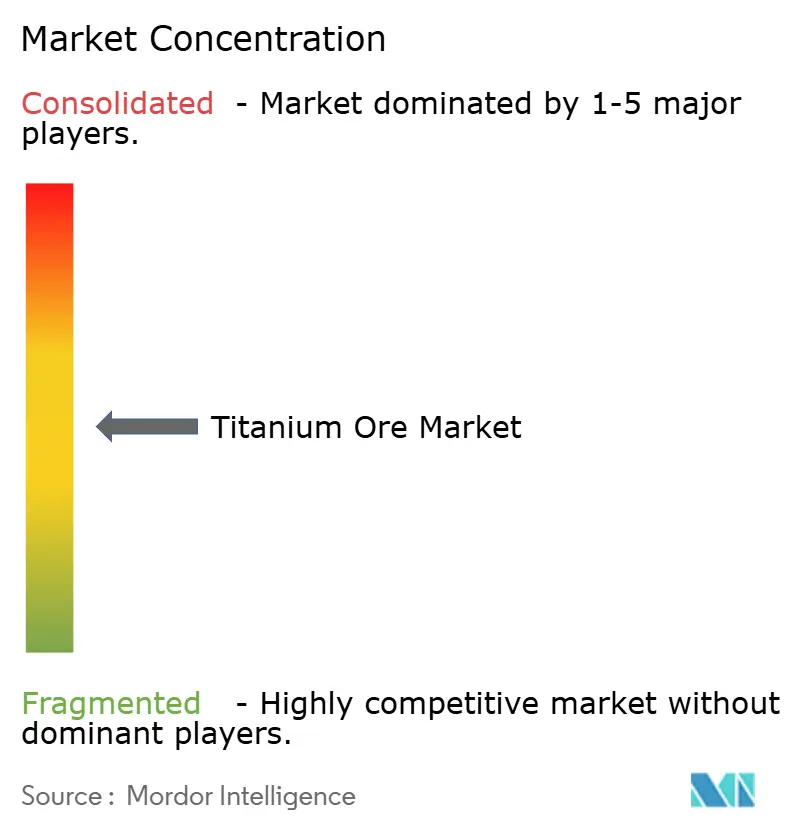
The titanium ore market is moderately fragmented. Large, low-cost mineral sands producers supply much of the non-Chinese feedstock, while Chinese miners supply a significant portion of domestic pigment requirements. Iluka Resources, Kenmare Resources, Rio Tinto, TiZir, Eramet, IREL, Energy Fuels, and Base Resources are among the notable international operators. Competition centers on titanium dioxide grade, zircon and monazite co-product revenue, logistics costs, and permitting status. Established mines benefit from proven grade credentials and the ability to deliver high-grade material under supply agreements.
Iluka Resources secured a minimum revenue of USD 240 million from rebalanced 2026 contracts covering 110,000 tons of synthetic rutile, 10,000 tons of natural rutile, 12,000 tons of HyTi, and 100,000 tons of ilmenite. This contract strategy reflects the downstream buyer's commitment to the quantities of chloride-grade feedstock. It also supports greater use of bilateral agreements over spot markets. Kenmare Resources has addressed fiscal and concession conditions affecting Moma in Mozambique, reinforcing that contractual stability remains a component of supplier competitiveness.
Chinese titanium dioxide producers are expanding their chloride-processing capacity, increasing the value of access to high-grade feedstocks. LB Group, Pangang, Lomon Billions, and Yibin Tianyuan are expanding capacity and pursuing international activities to extend their reach. IperionX advanced its Titan Project, with its June 2026 definitive feasibility study identifying annual targets of 118,658 tons of ilmenite and 24,656 tons of rutile, alongside rare earths and zircon. These developments support mine development, high-grade upgrading, and closer integration between feedstock supply and downstream processing.
Titanium Ore Industry Leaders
Rio Tinto
Tronox Holdings Plc
ILUKA RESOURCES LIMITED
Kenmare Resources plc
LB Group
- *Disclaimer: Major Players sorted in no particular order

Recent Industry Developments
- June 2026: Lomon Billions announced that its 150,000-ton-per-year chloride-process TiO2 plant in the UK will resume production in October 2026, raising the company's total chloride-process capacity from 660,000 to 810,000 tons per year and expanding its production presence into European and North American markets.
- March 2026: Rio Tinto approved a USD 473 million investment in the Zulti South project at Richards Bay Minerals in South Africa, lifting a suspension in place since January 2020. Construction began in Q1 2026, with initial commercial production of zircon, rutile, and ilmenite expected in 2028, extending the mine's operational life to 2050. China Harbour Engineering Company was appointed as the EPC contractor.


Global Titanium Ore Market Report Scope
Titanium ore is a naturally occurring rock or mineral aggregate from which titanium metal or titanium dioxide can be extracted. Because titanium bonds strongly with oxygen, it does not occur in nature as a pure metal.
The titanium ore market is segmented by type, application, end-user industry, and geography. By type, the market is segmented into ilmenite, rutile, leucoxene, and other titanium ores. By application, the market is segmented into titanium dioxide pigments, titanium metal, coating and lining, welding electrodes, and other applications. By end-user industry, the market is segmented into aerospace and defense, healthcare, automotive, chemical, construction, and other industries. The report also covers market size and forecasts for the titanium ore across 15 countries in major regions. The market sizes and forecasts are provided in terms of value (USD).
| Ilmenite |
| Rutile |
| Leucoxene |
| Other Titanium Ores |
| Titanium Dioxide Pigments |
| Titanium Metal |
| Coating and Lining |
| Welding Electrodes |
| Other Applications |
| Aerospace and Defense |
| Healthcare |
| Automotive |
| Chemical |
| Construction |
| Other Industries |
| Asia-Pacific | China |
| India | |
| Japan | |
| South Korea | |
| ASEAN Countries | |
| Rest of Asia-Pacific | |
| North America | United States |
| Canada | |
| Mexico | |
| Europe | Germany |
| United Kingdom | |
| France | |
| Italy | |
| NORDIC Countries | |
| Rest of Europe | |
| South America | Brazil |
| Argentina | |
| Rest of South America | |
| Middle East and Africa | Saudi Arabia |
| South Africa | |
| Rest of Middle East and Africa |
| By Type | Ilmenite | |
| Rutile | ||
| Leucoxene | ||
| Other Titanium Ores | ||
| By Application | Titanium Dioxide Pigments | |
| Titanium Metal | ||
| Coating and Lining | ||
| Welding Electrodes | ||
| Other Applications | ||
| By End-User Industry | Aerospace and Defense | |
| Healthcare | ||
| Automotive | ||
| Chemical | ||
| Construction | ||
| Other Industries | ||
| By Geography | Asia-Pacific | China |
| India | ||
| Japan | ||
| South Korea | ||
| ASEAN Countries | ||
| Rest of Asia-Pacific | ||
| North America | United States | |
| Canada | ||
| Mexico | ||
| Europe | Germany | |
| United Kingdom | ||
| France | ||
| Italy | ||
| NORDIC Countries | ||
| Rest of Europe | ||
| South America | Brazil | |
| Argentina | ||
| Rest of South America | ||
| Middle East and Africa | Saudi Arabia | |
| South Africa | ||
| Rest of Middle East and Africa | ||


Key Questions Answered in the Report
What is current market size of Titanium Ore Market?
The titanium ore market size was valued at USD 7.12 billion in 2025 and is estimated to grow from USD 7.56 billion in 2026 to reach USD 10.20 billion by 2031, at a CAGR of 6.18% during the forecast period (2026-2031).
Why is rutile growing faster than ilmenite?
Rutile is projected to grow at a 7.05% CAGR because chloride-process pigment and titanium metal production require higher-grade feedstock. Limited natural rutile output also supports interest in synthetic rutile as a complementary supply source.
Which application uses the most titanium ore?
Titanium dioxide pigments held a 60.52% share in 2025, supported by demand from coatings, packaging, consumer goods, and construction. Coating and lining applications also use titanium-bearing material where corrosion protection is required.
Which end-user area is growing fastest?
Aerospace and defense are projected to expand at a 7.71% CAGR through 2031 as aircraft production and defense procurement increase demand for qualified titanium feedstocks. This end-use area places particular importance on grade consistency and supply reliability.
Page last updated on:





