
Tire-Abrasion Reduction Compound Additives Market Size and Share
Market Overview
| Study Period | 2021 - 2031 |
|---|---|
| Market Size (2026) | USD 1.78 Billion |
| Market Size (2031) | USD 2.39 Billion |
| Growth Rate (2026 - 2031) | 6.07 % |
| Fastest Growing Market | Asia-Pacific |
| Largest Market | Asia-Pacific |
| Market Concentration | Medium |
Major Players *Disclaimer: Major Players sorted in no particular order Image © Mordor Intelligence. Reuse requires attribution under CC BY 4.0. | |
Tire-Abrasion Reduction Compound Additives Market Analysis by Mordor Intelligence
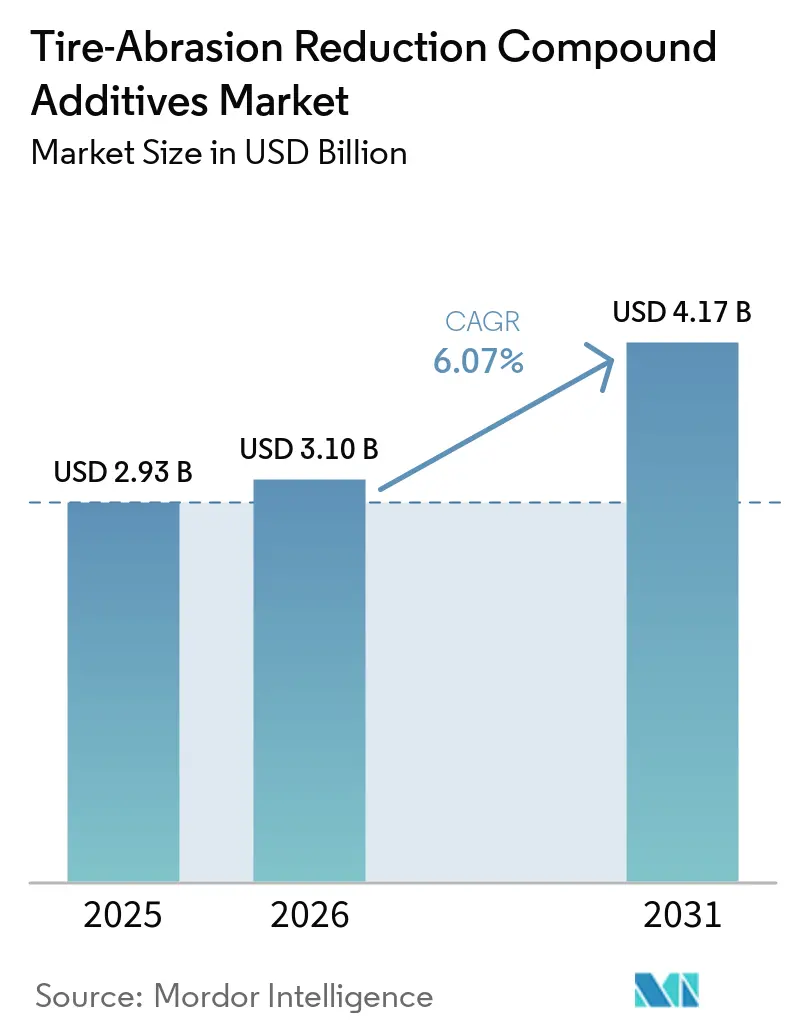
The Tire-Abrasion Reduction Compound Additives Market size is expected to grow from USD 1.69 billion in 2025 to USD 1.78 billion in 2026 and is forecast to reach USD 2.39 billion by 2031 at 6.07% CAGR over 2026-2031. Regulatory limits on tire abrasion are shifting compound design toward lower-wear tread systems, particularly in Europe. The adoption of electric vehicles is increasing demand for tread materials capable of managing higher torque and vehicle weight. Silica, matched silane coupling agents, and functionalized polymers are central to this shift, as they balance wear, rolling resistance, and wet grip. Suppliers are also developing lower-carbon silica and safer processing additives in response to material disclosure and sustainability requirements from tire manufacturers. Long qualification periods and the cost difference between advanced silica systems and carbon black remain key barriers to adoption in price-sensitive tire categories.
Key Report Takeaways
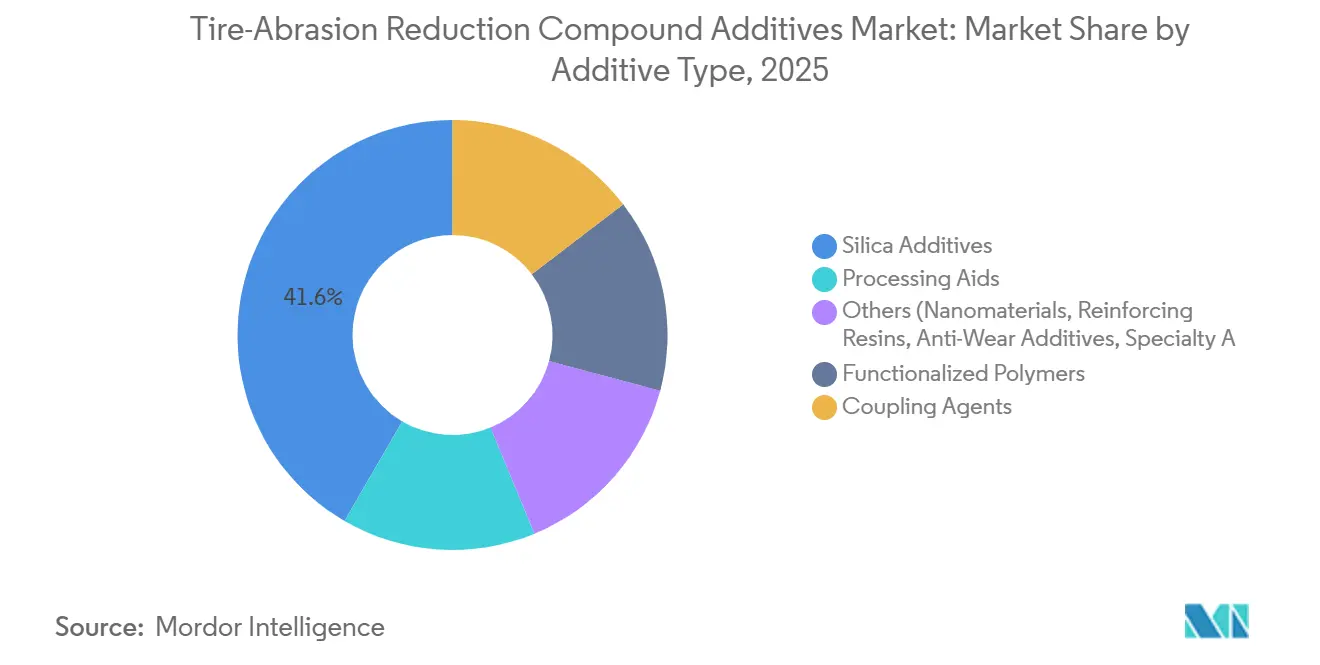
- By additive type, silica additives held 41.62% of the tire-abrasion reduction compound additives market share in 2025, while functionalized polymers are forecast to grow at a CAGR of 7.13% through 2031.
- By tire type, passenger car tires held 56.84% of the tire-abrasion reduction compound additives market share in 2025, while commercial vehicle tires are forecast to grow at a CAGR of 6.91% through 2031.
- By compound application, tread compounds accounted for 64.37% of the tire-abrasion reduction compound additives market size in 2025 and are forecast to grow at a CAGR of 6.72% through 2031.
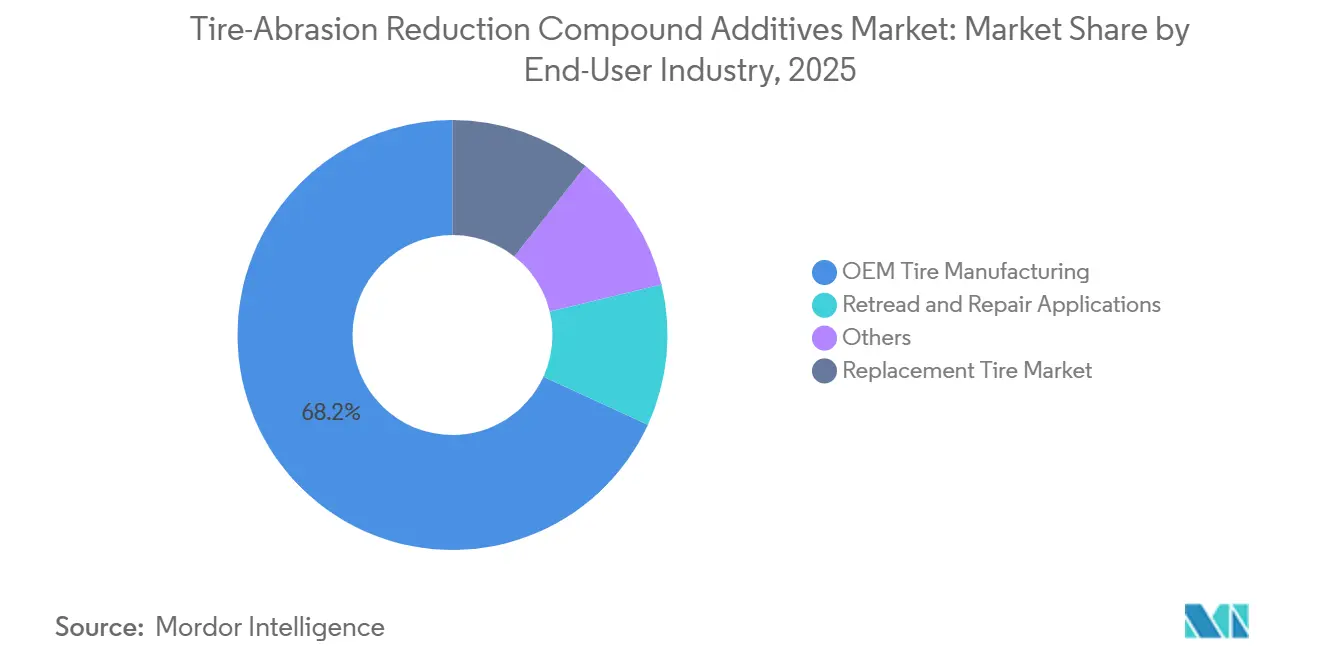
- By end-user industry, Original Equipment Manufacturer (OEM) tire manufacturing held 68.15% of the tire-abrasion reduction compound additives market share in 2025, while the replacement tire market is forecast to grow at a CAGR of 7.08% through 2031.
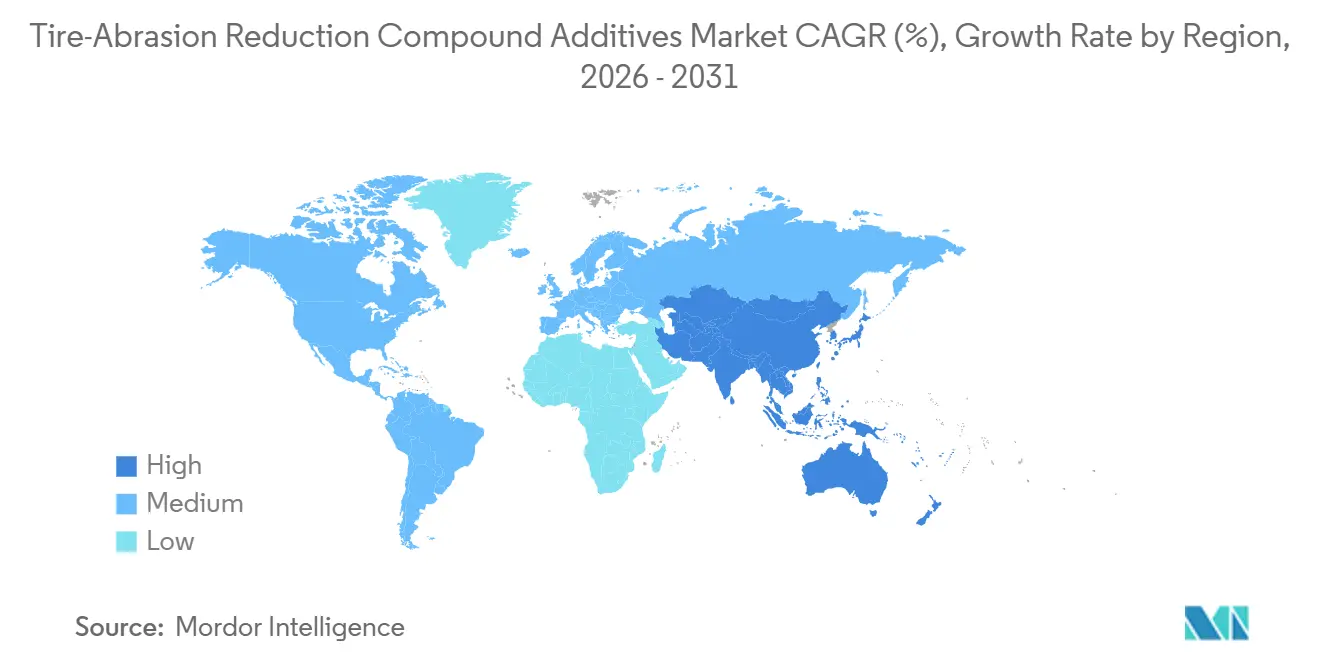
- By geography, Asia-Pacific held 49.46% of the tire-abrasion reduction compound additives market share in 2025 and is forecast to grow at a CAGR of 6.97% through 2031.
Note: Market size and forecast figures in this report are generated using Mordor Intelligence’s proprietary estimation framework, updated with the latest available data and insights as of January 2026.
Market Trends and Insights
Drivers Impact Analysis of Tire-Abrasion Reduction Compound Additives Market*
| Drivers | (~) % Impact on CAGR Forecast | Geographic Relevance | Impact Timeline |
|---|---|---|---|
| Regulatory Push for Tire Abrasion and Non-Exhaust Emission Reduction | +1.4% | Europe, with spillover into Asia-Pacific and North America | Short term (≤ 2 years) |
| Electrification-Driven Demand for High-Durability Electric Vehicle (EV) Tires | +1.1% | Global, led by China, Europe, and North America | Medium term (2-4 years) |
| Adoption of Silica-Silane Reinforcement Systems | +0.9% | Global, with China, India, and Southeast Asia as volume centers | Long term (≥ 4 years) |
| Premiumization of High-Performance and Long-Life Tires | +0.7% | Europe, North America, Japan, and South Korea | Medium term (2-4 years) |
| Formulation Digitization and Faster Compound Optimization | +0.5% | Global, with Japan, Germany, and the United States as early adopters | Long term (≥ 4 years) |
| Circular and Bio-Based Additive Development | +0.4% | Europe and Asia-Pacific | Long term (≥ 4 years) |
| Source: Mordor Intelligence | |||
Regulatory Push for Tire Abrasion and Non-Exhaust Emission Reduction
Euro 7 is reshaping additive procurement across European tire supply chains in 2026. Regulation (EU) 2024/1257 extends vehicle requirements to tire abrasion and applies to new M1 and N1 vehicle types from November 29, 2026. Limits for C1 passenger-car tires are scheduled to take effect from July 2028, followed by C2 tires in April 2030 and C3 tires in April 2032 under the United Nations Economic Commission for Europe (UNECE) framework. Tire producers, therefore, need tread formulations that reduce abrasive mass loss without sacrificing wet grip or fuel efficiency. This places greater importance on silica-rich compounds and coupling agents that improve the interaction between rubber and filler. The Allgemeiner Deutscher Automobil-Club (ADAC) added a tire-wear assessment to its revised Green New Car Assessment Program (NCAP) protocol in 2025, increasing commercial pressure before the formal limits begin to apply[1]. The tire-abrasion reduction compound additives market is also affected by UN R117 labeling requirements, where rolling resistance and wet-grip performance support the use of highly dispersible silica systems.
Electrification-Driven Demand for High-Durability Electric Vehicle (EV) Tires
Battery electric vehicles are making tire wear a more important engineering requirement for tire makers. Electric vehicles wear tires 20-30% faster than comparable internal-combustion vehicles because of instant torque, less coasting, and added battery weight. Battery electric trucks present an even greater challenge, as their traction-force contribution to tire wear is more than 120% higher than that of their diesel counterparts. Pirelli reported that 60% of its nearly 200 new Original Equipment Manufacturer (OEM) homologations in the first half of 2026 were for battery-electric or plug-in-hybrid vehicles. The company also reported that 90% of those homologations covered rim diameters of at least 19 inches, which require demanding tread designs. The tire-abrasion reduction compound additives market benefits as tire manufacturers evaluate silica, functionalized polymers, and coupling agents for electric-vehicle programs. These evaluations can lead to longer-term supply relationships once a formulation is approved for production.
Adoption of Silica-Silane Reinforcement Systems
Silica-silane systems have become a major reinforcement route in passenger-car and electric-vehicle tread compounds. Continental stated that its silica tire technology has reduced braking distances by nearly 50% while improving rolling resistance compared with earlier carbon black compounds. The tire-abrasion reduction compound additives market relies on this platform because it enables a balance among grip, energy efficiency, and wear resistance. Research on multifunctionalized solution styrene-butadiene rubber (SBR) showed a 20% improvement in wet and abrasion resistance, along with a 23% reduction in rolling resistance, compared with monofunctional systems. Toyo Tires introduced its PROXES LuKII in February 2025, featuring bio-derived silica dispersants that reduced rolling resistance by 9% and improved wet braking by 12% compared with the preceding generation. Sumitomo Rubber and Kyoto University also reported a 2025 method for three-dimensional visualization of silica and carbon black structures at fracture points, helping guide formulation changes at the material level.
Premiumization of High-Performance and Long-Life Tires
Premium and ultra-high-performance tire programs use more sophisticated silica-silane and functionalized-polymer systems than standard compounds. Pirelli reported that its high-value tire sales grew 3.5% in the first half of 2026, and these products accounted for 82% of sales, up from 80% in the first half of 2025. The tire-abrasion-reduction compound additives market benefits from this shift in mix because high-value tires must meet more demanding wear, wet-grip, and rolling-resistance targets. Once an additive supplier is approved for a flagship tire program, the formulation can remain in place through a model cycle lasting 3-4 years. LANXESS launched Aflux SD in 2025 as a sustainable, Substances of Very High Concern (SVHC)-free processing promoter for highly filled silica compounds, addressing dispersion, wear, and wet-grip requirements. Larger rim sizes also raise silica loading requirements in thinner tread compounds, making it harder to replace the use of advanced additives in premium tire designs.
Restraints Impact Analysis of Tire-Abrasion Reduction Compound Additives Market*
| Restraints | (~) % Impact on CAGR Forecast | Geographic Relevance | Impact Timeline |
|---|---|---|---|
| High Cost and Energy Intensity of Advanced Additives | -1.1% | Global, especially Asia-Pacific and Eastern Europe | Short term (≤ 2 years) |
| Substitution by Carbon Black and Conventional Rubber Chemicals | -0.9% | China, India, and the Middle-East & Africa | Medium term (2-4 years) |
| Long OEM Qualification and Reformulation Cycles | -0.7% | Global, especially Germany, the United States, and Japan | Medium term (2-4 years) |
| Variability of Bio-Based Feedstocks and Recycled Inputs | -0.5% | Europe and Asia-Pacific | Long term (≥ 4 years) |
| Source: Mordor Intelligence | |||
High Cost and Energy Intensity of Advanced Additives
The higher cost of highly dispersible precipitated silica continues to limit its use in price-sensitive tire applications. Advanced silica-silane systems carry a 40-60% cost premium over conventional carbon black grades. Silane production requires halogenated precursor chemistry and multiple reaction stages, which limit rapid cost reduction. Highly filled silica compounds also require more intensive mixing to achieve adequate dispersion, adding to energy consumption and productivity pressure for tire manufacturers. Orion cited pressure on Western tire OEM output from Asian tire imports in its 2026 guidance, a condition that tends to make material-cost decisions more conservative. In October 2025, Cabot expanded North American production of its EVOLVE circular-reinforcing carbon platform, which offers N234 performance with 30% recycled carbon black content [2]. These alternatives can narrow the cost and sustainability advantage of silica systems in commercial and industrial tire applications.
Substitution by Carbon Black and Conventional Rubber Chemicals
Carbon black remains well-suited to commercial-vehicle sidewalls, off-the-road compounds, and 2- and 3-wheeler tires. These applications often prioritize heat-build-up resistance, tear strength, and cost over low rolling resistance. The tire-abrasion reduction compound additives market, therefore, faces slower conversion in segments where existing carbon black specifications already meet OEM requirements. A 2024 Korean study found that a silica-based blending route reduced PM2.5 generation by 60% and PM10 generation by 67% compared with conventional carbon-black-filled natural rubber and butadiene rubber compounds. Even so, price remains the primary purchasing criterion in many commodity-tier tires. Talc-based processing aids also face increased regulatory scrutiny following the International Agency for Research on Cancer's 2024 classification of talc as probably carcinogenic to humans, supporting the case for Substances of Very High Concern (SVHC)-free alternatives. Suppliers of processing aids and coupling agents are most exposed when a tire manufacturer can continue with its current carbon black formulation without reformulation.
*Our forecasts treat driver/restraint impacts as directional, not additive. The impact forecasts reflect baseline growth, mix effects, and variable interactions.
Tire-Abrasion Reduction Compound Additives Market Segment Analysis
By Additive Type:
Silica Leads While Functionalized Polymers Grow FasterSilica additives captured 41.62% of the tire-abrasion reduction compound additives market share in 2025. Their position reflects the performance of highly dispersible precipitated silica in passenger-car treads and electric-vehicle tire programs. Continental's three-decade experience has shown that silica compounds deliver nearly 50% shorter braking distances and improved rolling resistance compared with older carbon black approaches. Functionalized polymers are projected to grow at a 7.13% CAGR through 2031, making them the fastest-growing additive type. Their amine and alkoxysilyl groups enhance interactions between rubber chains and silica surfaces, supporting higher silica loading while reducing filler-filler interactions that can compromise compound properties.
Coupling agents remain necessary because they help transfer the reinforcing benefit of silica into the rubber network. Momentive presented NXT and NRX silane platforms at Tire Technology Expo 2026 for reinforcement at lower mixing temperatures and for heavy-duty natural-rubber applications. Processing aids, reinforcing resins, nanomaterials, and anti-wear additives represent smaller-value categories but play an important supporting role. LANXESS introduced Aflux SD for silica dispersion, while Arkema launched Luperox NeatCure granules in October 2025 to enable safer, more efficient curing. The tire-abrasion reduction compound additives market is also moving away from certain incumbent accelerators due to toxicological concerns, increasing the value of bio-based dispersants, alternative accelerators, and specialty coupling agents in new formulations.

By Tire Type:
Passenger Cars Hold the Largest Position While Commercial Vehicles AdvancePassenger-car tires held 56.84% of the tire-abrasion reduction compound additives market share in 2025. This segment combines high tire production numbers with the widespread use of silica-silane compounds in premium and mainstream radial tires. Passenger electric vehicles raise the additive intensity of tread compounds because added mass and torque increase wear requirements. Commercial-vehicle tires are projected to grow at a CAGR of 6.91% through 2031. Battery electric trucks require more abrasion-resistant compounds because their axle loads and torque profiles are more demanding than those of diesel vehicles. The tire-abrasion reduction compound additives market, therefore, has a path to growth in truck and bus radial applications as electric truck fleets expand.
Off-the-road tires constitute a distinct technical niche that employs nano-carbon-reinforced resins and specialty anti-wear additives for mining and construction operations. Their lower output keeps them a smaller segment, but extended wear life remains important for equipment operators. Two-wheeler and three-wheeler tires are concentrated in India and Southeast Asia and have historically used carbon black-heavy formulations. Premium tire producers are beginning to test silica-based tread compounds in this category, creating a longer-term upgrade path. OEM specifications for electric commercial vehicles are also likely to influence the replacement channel over time, as replacement compounders may need to adopt similar formulations to maintain wear, grip, and rolling resistance performance. This pull-through supports demand for functionalized polymers, coupling agents, and processing aids in commercial tire compounds.
By Compound Application:
Tread Compounds Remain the Main Area of Additive DemandTread compounds accounted for 64.37% of the tire-abrasion reduction compound additives market share in 2025 and are projected to record the fastest CAGR, at 6.72%, through 2031. The tread is the contact area where wear, rolling resistance, and wet grip must be managed together, making it the main application for silica, silane coupling agents, functionalized polymers, and processing aids. Electric vehicle requirements and Euro 7 abrasion limits increase the importance of multi-additive tread designs, as conventional carbon black formulations cannot always meet the combined performance requirements without material changes.
Sidewall compounds remain largely carbon black-based because ultraviolet and ozone resistance are essential. LANXESS and Continental commercialized Vulkanox HS Scopeblue in September 2025 as a bio-circular antidegradant with a CO2 footprint more than 30% lower than conventional equivalents. Inner liner and belt or carcass applications are less additive-intensive than tread compounds, though they still use specialty coupling agents and reinforcing resins where better adhesion between rubber plies is needed. Pirelli has digitally modeled more than 1,000 tread formulations using its virtual compounder. Faster digital formulation work can shorten the time between laboratory screening and commercial tire production, benefiting the tire-abrasion reduction compound additives market when tire makers can evaluate a broader combination of ingredients more quickly.
By End-User Industry:
OEM Manufacturing Leads While Replacement Tires Grow FasterOEM tire manufacturing accounted for 68.15% of the tire-abrasion reduction compound additives market share in 2025. Long-term supply agreements, strict validation procedures, and joint development programs help sustain this position. Approved formulations can remain in a tire program for several years, providing suppliers with predictable demand after qualification. The replacement tire market is projected to grow at a CAGR of 7.08% through 2031. Faster tire replacement in electric-vehicle passenger fleets is a key driver of this growth, as consumers expect replacement tires to maintain the original tire's grip, efficiency, and durability.
Retread and repair applications are smaller in number but remain relevant in commercial vehicles, as retreading can extend casing life. Fleet operators increasingly expect retreaded tires to approach OEM performance, raising the technical requirements for tread compounds. Specialty tire manufacturers serving agriculture and aerospace contribute to a smaller share of demand for anti-wear additives. Sumitomo Rubber is investing in its Nagoya facility and a third plant in Thailand for 2026 and 2027 to support a premiumization strategy focused on replacement growth. The tire-abrasion reduction compound additives market must therefore support both direct OEM relationships and aftermarket technical service. Tire-labeling rules that increasingly cover replacement tires also encourage stronger compound performance in this channel.
Geography Analysis
APAC Tire-Abrasion Reduction Compound Additives Market
Asia-Pacific held 49.46% of the tire-abrasion reduction compound additives market share in 2025 and is projected to grow at a CAGR of 6.97% through 2031. China is the region's primary production base, with annual output exceeding 1.6 billion tires in the study period. China's tire market was valued at USD 54.65 billion in 2025, and its GB-9743 and GB-9744 standards are supporting upgrades toward silica-based tread compounds. India is another significant demand center, as premium domestic tire producers are testing silica-based specifications for 2- and 3-wheeler tires. Japan and South Korea are early adopters of digital compound development. Sumitomo Rubber reported that its AI-based material discovery work with NEC reduced the time to propose compounds by 95% compared with conventional expert-led approaches.
Europe and North America Tire-Abrasion Reduction Compound Additives Market
Europe is the second-largest region in the tire-abrasion-reduction compound-additive market. Germany's concentration of premium tire producers and specialty chemical suppliers supports the adoption of silica-intensive systems. Euro 7, REACH, the Ecodesign for Sustainable Products Regulation (ESPR), and UN R117 are increasing the importance of documented material performance and carbon intensity. Solvay opened Europe's first bio-circular silica facility in Livorno, Italy, using rice husk ash and reporting a 35% per-ton CO2 reduction. Evonik is expanding International Sustainability and Carbon Certification (ISCC) Plus-certified ULTRASIL eCO circular silica production at its site in Turkey in 2026. North America has a distinct profile, with electric vehicle platform launches increasing original equipment manufacturer (OEM) specification requirements while imports pressured Western tire output in 2025.
South America and MEA Tire-Abrasion Reduction Compound Additives Market
South America and the Middle-East & Africa accounted for the smallest regional shares in the study period. Brazil is the main South American demand center, as local producers are beginning to use highly dispersible silica in passenger-car treads. Consumer and fleet demand for fuel-efficient tires is supporting this transition. The Middle-East & Africa are mainly served through specialty additive imports. Saudi Arabia's manufacturing diversification efforts and South Africa's industrial rubber base are creating emerging demand for coupling agents and processing aids. Argentina's chemical sector and regional bio-based feedstocks provide additional support across the rest of South America. Infrastructure-related off-the-road tire demand remains significant in the Middle-East & Africa, where conventional carbon-black-based compounds continue to dominate.
Competitive Landscape
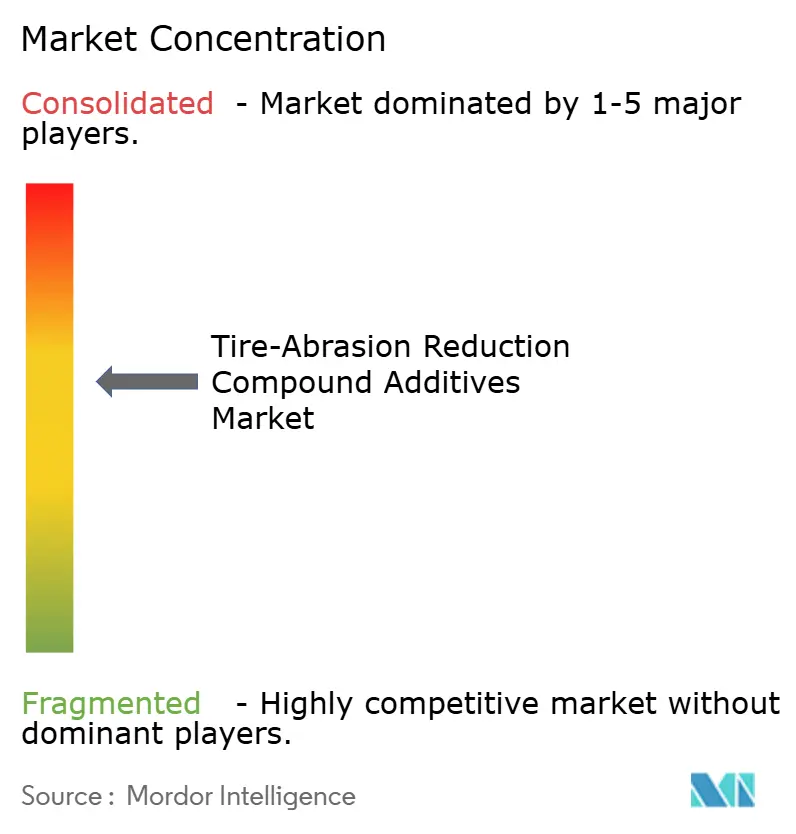
The tire-abrasion reduction compound additives market is moderately consolidated. Evonik, LANXESS, and Solvay compete in the premium segment through specialized product portfolios, global approvals, and development partnerships with major tire manufacturers. Evonik differentiates itself by offering precipitated silica and silane coupling agents within a single portfolio. Its Si 69 and Si 363 products remain reference platforms for evaluating the performance of bis(triethoxysilylpropyl)tetrasulfide (TESPT) and mercaptosilanes. In June 2026, Evonik expanded production of ULTRASIL eCO circular silica at its ISCC Plus-certified facility in Turkey, supporting tire producers that require certified circular inputs.
LANXESS supplies antidegradants, accelerators, processing aids, and other rubber chemicals through its Rhein Chemie range. In March 2026, the company introduced Vulkanox 4060, a REACH-registered 6PPD alternative, at Tire Technology Expo. It also introduced the Rhenodiv BO-3900 Pearls Cool batch-off agent and promoted Aflux SD for silica dispersion. Solvay competes through highly dispersible and bio-circular silica technologies. Its Livorno facility provides a commercial route for silica derived from rice husk ash in Europe. These suppliers benefit from qualification barriers that make it difficult to change approved tire formulations.
A second group of competitors includes Birla Carbon, Cabot, Orion Engineered Carbons, QUECHEN, Madhu Silica, QEMETICA, Tokuyama, and Tosoh. These companies compete on the basis of regional supply, capacity, cost efficiency, and circular product development. In November 2025, Flexsys announced a viable 6PPD alternative, creating a potential reformulation opportunity once approvals are secured across markets. Momentive is targeting the heavy-duty tire segment with NRX silane, which addresses rolling resistance and wear in natural-rubber compounds. As digital formulation becomes more common, supplier data must also be integrated into tire-maker simulation tools.
Tire-Abrasion Reduction Compound Additives Industry Leaders
-
Evonik Industries AG
-
Solvay
-
QEMETICA
-
Cabot Corporation
-
Wacker Chemie AG
- *Disclaimer: Major Players sorted in no particular order
Tire-Abrasion Reduction Compound Additives Market Companies Covered in this Report
- Arkema
- BASF
- Birla Carbon
- Cabot Corporation
- Eastman Chemical Company
- Evonik Industries AG
- J.M. Huber Corporation
- LANXESS
- Madhu Silica Pvt. Ltd.
- Orion Engineered Carbons GmbH
- QEMETICA
- QUECHEN
- Shin-Etsu Chemical Co., Ltd.
- Solvay
- Sumitomo Chemical Co., Ltd.
- Tokuyama Corporation
- Tosoh Corporation
- Wacker Chemie AG
Recent Industry Developments in Tire-Abrasion Reduction Compound Additives Market
- March 2026: At Tire Technology Expo 2026 in Hannover, LANXESS introduced Vulkanox 4060 (CCPD), the first REACH-registered alternative to 6PPD, with commercial production scheduled for mid-2026. The company also introduced the Rhenodiv BO-3900 Pearls Cool sustainable batch-off agent and the SVHC-free Aflux SD silica dispersion promoter, reinforcing its position across multiple additive compliance categories.
- October 2025: At the K Show in Düsseldorf, Arkema launched Luperox NeatCure, a new generation of formulated organic peroxide granules designed for faster, safer curing of elastomers and polymers with full SVHC regulatory compliance. The company cited tightening regulatory requirements as the primary design driver.
Global Tire-Abrasion Reduction Compound Additives Market Report Scope
Tire abrasion-reduction compound additives are specialized chemical agents incorporated into rubber polymers to reduce tread wear, decrease microplastic particle generation, and optimize the balance among low rolling resistance, wet grip, and long lifespan. Key additives include silane coupling agents, hydrocarbon and functionalized resins, and bio-based reinforcing fillers.
The tire-abrasion reduction compound additives market is segmented by additive type, tire type, compound application, end-user industry, and geography. By additive type, the market is segmented into silica additives, functionalized polymers, coupling agents, processing aids, and others (nanomaterials, reinforcing resins, anti-wear additives, specialty additives). By tire type, the market is segmented into passenger car tires, commercial vehicle tires, off-the-road tires, two- and three-wheeler tires, and others. By compound application, the market is segmented into tread compounds, sidewall compounds, inner liner compounds, belt and carcass compounds, and others (bead compounds). By end-user industry, the market is segmented into OEM tire manufacturing, replacement tire market, retread and repair applications, and others. The report also covers market size and forecasts for tire-abrasion reduction compound additives across 16 countries in major regions. The market sizes and forecasts are provided in terms of value (USD).
Segmentation Overview
| Silica Additives |
| Functionalized Polymers |
| Coupling Agents |
| Processing Aids |
| Others (Nanomaterials, Reinforcing Resins, Anti-Wear Additives, Specialty Additives) |
| Passenger Car Tires |
| Commercial Vehicle Tires |
| Off-the-Road Tires |
| Two- and Three-Wheeler Tires |
| Others |
| Tread Compounds |
| Sidewall Compounds |
| Inner Liner Compounds |
| Belt and Carcass Compounds |
| Others (Bead Compounds) |
| OEM Tire Manufacturing |
| Replacement Tire Market |
| Retread and Repair Applications |
| Others |
| Asia-Pacific | China |
| India | |
| Japan | |
| South Korea | |
| Rest of Asia-Pacific | |
| North America | United States |
| Canada | |
| Mexico | |
| Europe | Germany |
| United Kingdom | |
| France | |
| Italy | |
| Rest of Europe | |
| South America | Brazil |
| Argentina | |
| Rest of South America | |
| Middle-East and Africa | Saudi Arabia |
| South Africa | |
| Rest of Middle-East and Africa |
| By Additive Type | Silica Additives | |
| Functionalized Polymers | ||
| Coupling Agents | ||
| Processing Aids | ||
| Others (Nanomaterials, Reinforcing Resins, Anti-Wear Additives, Specialty Additives) | ||
| By Tire Type | Passenger Car Tires | |
| Commercial Vehicle Tires | ||
| Off-the-Road Tires | ||
| Two- and Three-Wheeler Tires | ||
| Others | ||
| By Compound Application | Tread Compounds | |
| Sidewall Compounds | ||
| Inner Liner Compounds | ||
| Belt and Carcass Compounds | ||
| Others (Bead Compounds) | ||
| By End-User Industry | OEM Tire Manufacturing | |
| Replacement Tire Market | ||
| Retread and Repair Applications | ||
| Others | ||
| By Geography | Asia-Pacific | China |
| India | ||
| Japan | ||
| South Korea | ||
| Rest of Asia-Pacific | ||
| North America | United States | |
| Canada | ||
| Mexico | ||
| Europe | Germany | |
| United Kingdom | ||
| France | ||
| Italy | ||
| Rest of Europe | ||
| South America | Brazil | |
| Argentina | ||
| Rest of South America | ||
| Middle-East and Africa | Saudi Arabia | |
| South Africa | ||
| Rest of Middle-East and Africa | ||
Key Questions Answered in the Report
What is current market size of Tire-Abrasion Reduction Compound Additives Market?
The Tire-Abrasion Reduction Compound Additives Market size is expected to grow from USD 1.69 billion in 2025 to USD 1.78 billion in 2026 and is forecast to reach USD 2.39 billion by 2031 at 6.07% CAGR over 2026-2031.
Which additive type held the largest share in 2025?
Silica held 41.62% in 2025 because highly dispersible silica supports lower rolling resistance and stronger wet-grip performance in tread compounds. Functionalized polymers are forecast to grow at 7.13% through 2031 because they improve rubber-filler interaction and support higher silica loading.
Which tire category is growing fast for these additives?
Commercial-vehicle tires are projected to grow at a CAGR of 6.91% through 2031, supported by battery electric truck requirements. The tire-abrasion-reduction compound additives market addresses the higher torque and axle-load conditions that make truck tread wear harder to control.
Why are tread compounds important in tire abrasion reduction?
Tread compounds held 64.37% in 2025 and are projected to grow at a CAGR of 6.72% because they control road contact, wear, wet grip, and rolling resistance.