
Time-of-Flight Industrial Camera Market Size and Share
Market Overview
| Study Period | 2020 - 2031 |
|---|---|
| Market Size (2026) | USD 1.06 Billion |
| Market Size (2031) | USD 1.89 Billion |
| Growth Rate (2026 - 2031) | 12.23 % |
| Fastest Growing Market | Asia-Pacific |
| Largest Market | Asia-Pacific |
| Market Concentration | Low |
Major Players *Disclaimer: Major Players sorted in no particular order Image © Mordor Intelligence. Reuse requires attribution under CC BY 4.0. | |
Time-of-Flight Industrial Camera Market Analysis by Mordor Intelligence
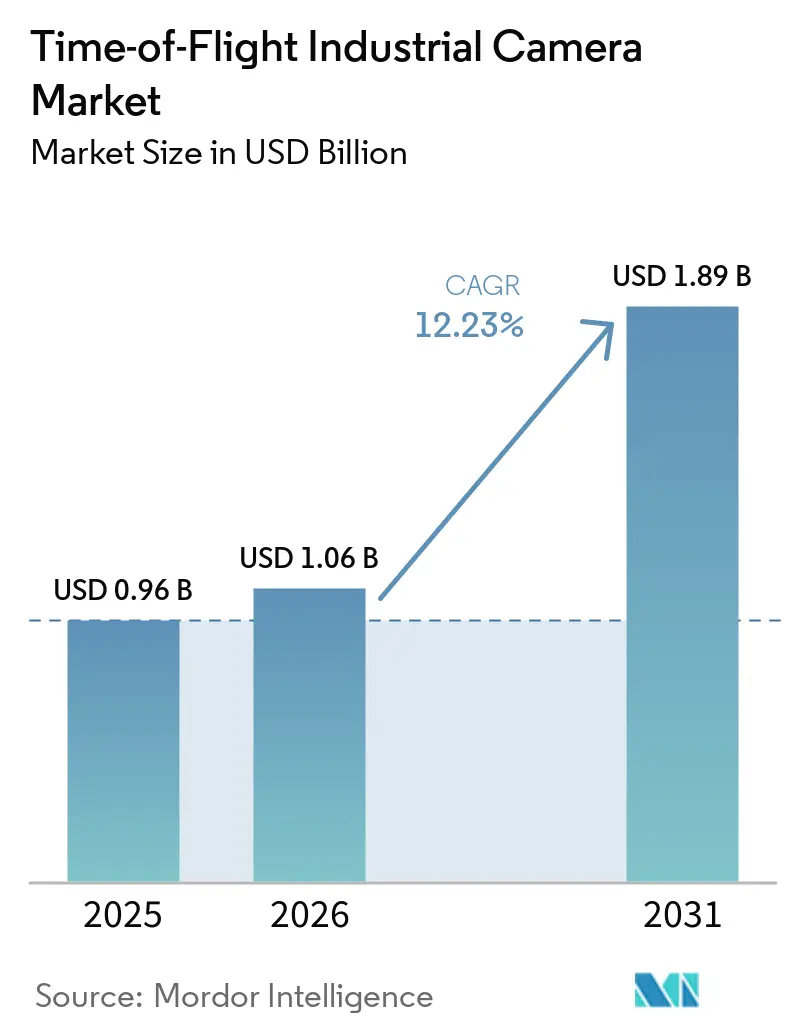
The Time-of-flight industrial camera market size is projected to expand from USD 0.96 billion in 2025 to USD 1.06 billion in 2026, and to USD 1.89 billion by 2031, registering a CAGR of 12.23% between 2026 and 2031. Demand is being driven by the broader adoption of three-dimensional perception in warehouse automation, assembly inspection, and collaborative manufacturing. Time-of-flight depth sensing is now specified for autonomous mobile robot fleets, parcel dimensioning equipment, and bin-picking cells. Buyers are increasingly assessing cameras as part of a complete perception system rather than as an isolated hardware component. This shift favors suppliers that can combine depth data, software tools, and dependable integration support. The Time-of-flight industrial camera market also has opportunities where faster commissioning and lower system latency matter as much as image quality.
Key Report Takeaways
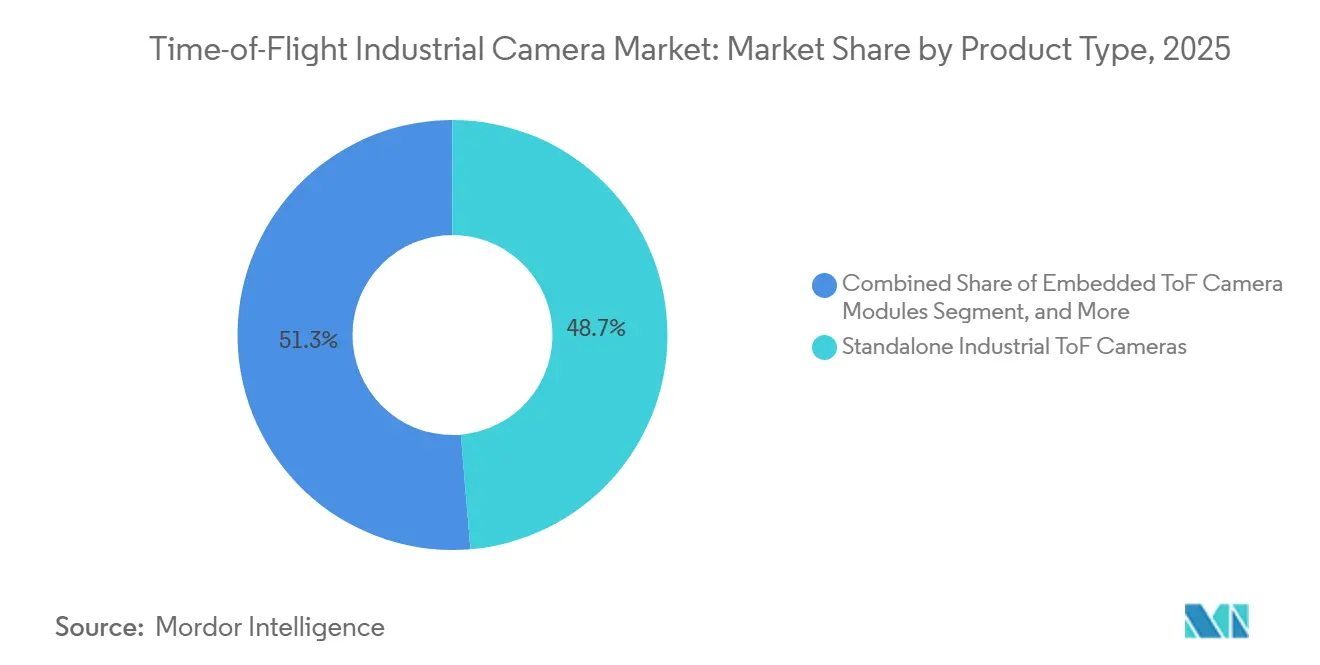
- By product type, standalone industrial ToF cameras held 48.62% of the Time-of-flight industrial camera market share in 2025, while ToF camera systems and bundled vision solutions are projected to expand at a 14.36% CAGR through 2031.
- By technology, indirect ToF held 61.47% revenue share in 2025, while direct ToF is projected to expand at a 14.82% CAGR through 2031.
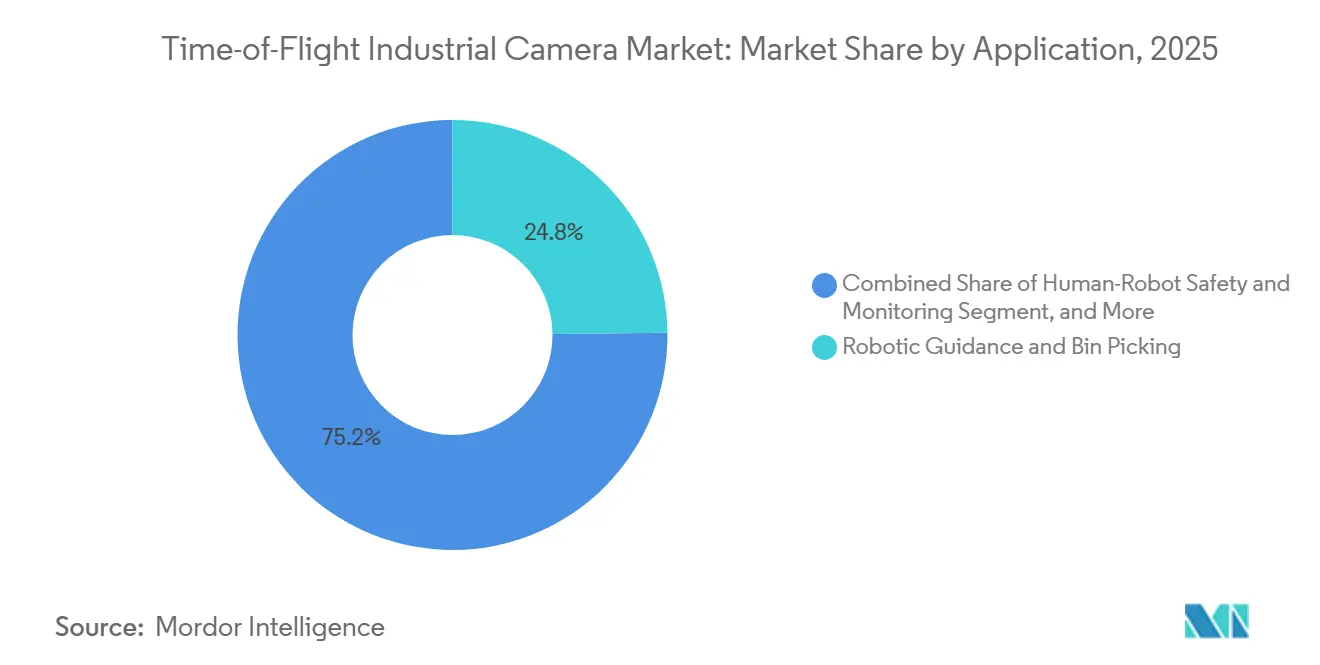
- By application, robotic guidance and bin picking accounted for 24.83% revenue share in 2025, while autonomous mobile robot navigation and obstacle avoidance are projected to expand at a 15.67% CAGR through 2031.
- By end-user industry, automotive accounted for 22.76% of revenue in 2025, while logistics, warehousing, and e-commerce are projected to expand at a 15.21% CAGR through 2031.
- By geography, Asia-Pacific accounted for 41.58% of revenue in 2025 and is projected to expand at a 14.28% CAGR through 2031.
Note: Market size and forecast figures in this report are generated using Mordor Intelligence’s proprietary estimation framework, updated with the latest available data and insights as of January 2026.
Market Trends and Insights
Drivers Impact Analysis of Time-of-Flight Industrial Camera Market*
| Driver | (~) % Impact on CAGR Forecast | Geographic Relevance | Impact Timeline |
|---|---|---|---|
| Warehouse Automation and Autonomous Mobile Robots | +4.8% | Global, with North America, Asia-Pacific, and Europe as core demand centers | Short term (≤ 2 years) |
| Industry 4.0 Adoption and Machine Vision Modernization | +3.5% | Global, with Europe and Asia-Pacific leading adoption and North America advancing through reshoring | Medium term (2-4 years) |
| Real-Time 3D Inspection and Dimensioning Demand | +2.4% | Global, with automotive hubs in Germany, Japan, and the United States | Short term (≤ 2 years) |
| Edge AI Processing in Industrial Cameras | +1.9% | Global, with Asia-Pacific as a core region and spillover to North America and Europe | Medium term (2-4 years) |
| Outdoor-Capable Robot Perception | +1.1% | North America and Europe, especially construction, outdoor logistics, and agriculture | Long term (≥ 4 years) |
| GigE Vision, GenICam, and ROS Standardization | +0.7% | Global, with faster adoption in Europe and North America | Me |
| Source: Mordor Intelligence | |||
Expansion of Warehouse Automation and Autonomous Mobile Robots
Warehouse automation is a central driver of demand for the Time-of-flight industrial camera market. Autonomous mobile robots need reliable depth information for obstacle avoidance, path planning, and movement around workers. ToF cameras are well-suited to close-range sensing because they rapidly generate three-dimensional occupancy data. This capability is useful in warehouses where lighting varies across aisles, loading areas, and storage zones. Each fleet expansion may require additional depth-sensing hardware, linking camera demand to equipment deployment. The Time-of-flight industrial camera market, therefore, benefits when logistics operators standardize perception hardware across larger robot fleets.
Industry 4.0 Adoption and Machine Vision Modernization
Manufacturers are updating inspection processes as older two-dimensional systems reach replacement cycles. A move from 2D inspection to depth-aware inspection often changes the workflow rather than simply replacing a camera. Production lines may require cameras, illumination, processing capacity, and software licenses simultaneously. This makes the purchase decision broader than a hardware selection. Established vendors are responding by pairing ToF sensing with software development kits and integration ecosystems. The Time-of-flight industrial camera market gains when modernization programs treat machine vision as a connected production system.
Demand for Real-Time 3D Inspection and Dimensioning
Parcel dimensioning has become important for operators that need accurate measurements for dimensional weight billing. Automated systems must capture dimensions while parcels move through conveyor environments. ToF cameras can acquire a full depth image quickly, which supports in-motion measurement. Automotive plants also use depth data for gap-and-flush checks, body-panel control, and guidance in welding cells. These use cases place importance on throughput, repeatability, and calibration. The Time-of-flight industrial camera market is supported when measurement accuracy has a direct operational or commercial consequence.
Growth of Edge AI Processing in Industrial Cameras
Edge processing is changing how industrial camera systems are designed. Robot control applications cannot depend on delays created by sending visual data to remote computing resources. On-camera processing can turn depth data into a local response for inspection or navigation. This reduces the need to send raw point clouds to a separate host computer. Suppliers are integrating processors that support several cameras in a single industrial installation. The Time-of-flight industrial camera market benefits as edge AI makes depth sensing easier to apply in time-sensitive workflows.
Restraints Impact Analysis of Time-of-Flight Industrial Camera Market*
| Restraint | (~) % Impact on CAGR Forecast | Geographic Relevance | Impact Timeline |
|---|---|---|---|
| Integration and Calibration Cost | -2.2% | Global, with greater pressure in SME-heavy markets in South America, Southeast Asia, and Africa | Medium term (2-4 years) |
| Ambient-Light and Multipath-Interference Limits | -1.4% | Outdoor deployment regions, the Middle East, Asia-Pacific outdoor logistics, and Southern Europe | Long term (≥ 4 years) |
| Lower-Cost Stereo and Structured-Light Alternatives | -0.9% | Asia-Pacific price-sensitive segments, South America, and Africa | Medium term (2-4 years) |
| Interference and Eye-Safety Constraints in Dense Multi-Camera Deployments | -0.6% | Europe and North America, especially regulated industrial and collaborative robot environments | Long term (≥ 4 years) |
| Source: Mordor Intelligence | |||
High Integration and Calibration Cost
A working machine-vision system requires more than installing a depth camera. Integrators must align the camera with robot coordinates and tune it for lighting and reflective surfaces. They must also account for drift in depth calibration as operating conditions change. These requirements can extend implementation timelines in smaller manufacturing sites. Brownfield facilities can face added mechanical and software work when existing conveyors and racking need custom interfaces. Pre-calibrated cameras and on-camera depth processing can reduce this burden for the Time-of-flight industrial camera market.
Ambient-Light and Multipath-Interference Limits
Indirect ToF systems can degrade performance when bright sunlight interferes with the infrared measurement signal. Reflective surfaces and enclosed metal areas can also produce multipath interference. These conditions matter in outdoor logistics, conveyor tunnels, and palletized storage aisles. Sony has incorporated ambient-light-reduction features into its iToF sensor design, although performance choices can affect frame rate and power consumption. Direct ToF systems can offer stronger background-light rejection, but cost and resolution remain relevant selection factors. The Time-of-flight industrial camera market must continue to address these physical limits in applications operating outside controlled indoor lighting.[1]Sony Semiconductor Solutions Corporation, “SPAD ToF Depth Sensor IMX556 and iToF Image Sensor IMX570,” Sony Semiconductor Solutions, sony-semicon.com.
*Our forecasts treat driver/restraint impacts as directional, not additive. The impact forecasts reflect baseline growth, mix effects, and variable interactions.
Time-of-Flight Industrial Camera Market Segment Analysis
By Product Type:
Standalone Cameras Lead While Bundled Systems Shorten DeploymentStandalone industrial ToF cameras held 48.62% of the Time-of-flight industrial camera market share in 2025. System integrators have favored modular designs that let them select camera hardware, illumination, computing, and software separately. This approach gives users flexibility when they have established technical preferences. It also lets an integrator tune the system for a specific working distance or object type. Embedded ToF modules serve a different need in compact robot applications. They fit collaborative robot end effectors, wrist-mounted perception equipment, and automated guided vehicle sensor clusters. These uses have strict limits on space, weight, and power. The Time-of-flight industrial camera market continues to depend on both modular and embedded hardware choices.
ToF camera systems and bundled vision solutions are projected to expand at a 14.36% CAGR from 2026 to 2031. Mid-sized manufacturers often place more value on commissioning speed than on the flexibility of separate components. Bundled systems can deliver calibrated depth, confidence, and intensity data through a defined interface. This reduces the number of decisions required during installation. IDS Imaging placed its Nion 3D ToF camera into series production in August 2026. The product combines an onsemi Hyperlux ID AF0130 sensor with on-chip processing and an IP67 housing. It provides 1.2 MP depth resolution at 30 fps and operates across a 0.3 to 7.5 meter range.



By Technology:
iToF Holds the Installed Base While dToF AdvancesIndirect ToF commanded 61.47% of revenue in 2025. Its installed base reflects its use in indoor mobile robotics, bin picking, and logistics platforms. iToF systems use continuous-wave phase measurement to create dense depth maps. Current cameras cover working distances that suit close-range industrial handling tasks. Sony DepthSense and Infineon REAL3 sensor families support this type of deployment. Their operating profile is aligned with indoor environments where lighting can be controlled. The Time-of-flight industrial camera market size for iToF remains supported by broad compatibility with existing industrial designs.
Direct ToF is projected to expand at a 14.82% CAGR from 2026 to 2031. SPAD arrays measure the arrival time of photons from short laser pulses. This approach is relevant for long-range and high-ambient-light tasks. STMicroelectronics began mass production of the VL53L9 in July 2026. The module offers 2,268 resolution zones at 100 fps across a 5-centimeter to 9-meter sensing range. It produces output intended for edge processing in robotics and industrial automation. Research on SPAD array design also focuses on reducing die area and power requirements.
By Application:
Bin Picking Provides Revenue While AMR Navigation ExpandsRobotic guidance and bin picking accounted for 24.83% of application revenue in 2025. The use case addresses unstructured parts that are difficult to locate with conventional two-dimensional imaging. Depth data helps a robot determine the position and orientation of items before picking them up. Automotive and electronics assembly have used these capabilities for demanding handling tasks. Food, beverage, and general manufacturing sites are also adopting them for a broader range of object shapes. Reflective surfaces and varied geometries still create requirements for better sensor performance. The Time-of-flight industrial camera market has a durable role in applications where spatial information is necessary for robotic action.
Autonomous mobile robot navigation and obstacle avoidance are projected to expand at a 15.67% CAGR from 2026 to 2031. An AMR requires close-range perception to move safely through changing warehouse settings. Camera demand can therefore rise with the number of robots rather than only with the number of facilities. Logistics dimensioning, weighing, and scanning also use snapshot depth capture while the conveyor is moving. Inspection and quality control uses include gap-and-flush checks, weld-bead geometry measurements, and large-panel warpage measurements. Safety monitoring and inventory measurement add further use cases across industrial storage and healthcare logistics. The Time-of-flight industrial camera market serves applications that need both depth accuracy and quick response times.
By End-User Industry:
Automotive Leads Current Revenue While Logistics Has Faster MomentumAutomotive held 22.76% of revenue in 2025. The sector uses ToF cameras for body-shop inspection, paint-shop volume measurement, and collaborative production cells. These applications have established demanding requirements for throughput and repeatability. SICK’s safeVisionary2 created a reference point for safety-focused 3D ToF sensing in collaborative operations. The product was presented as the first 3D ToF camera with Performance Level C safety certification. Automotive continues to influence the performance specifications expected by other users. The Time-of-flight industrial camera market share in the automotive sector is supported by its broad range of inspection and guidance tasks.
Logistics, warehousing, and e-commerce are projected to expand at a 15.21% CAGR from 2026 to 2031. Fulfillment facilities need depth sensing for navigation, parcel dimensioning, and material movement. DIM billing makes dependable parcel dimensions important for revenue assurance. Electronics and semiconductor producers use depth sensing for substrate inspection and component placement verification. Food, beverage, and consumer goods producers use it for palletizing guidance and fill-level monitoring. Metals, machinery, and general manufacturing users are applying it to weld inspection and large-part positioning. Healthcare and life sciences remain smaller but use people monitoring and fall detection in robot-assisted care settings.
Geography Analysis
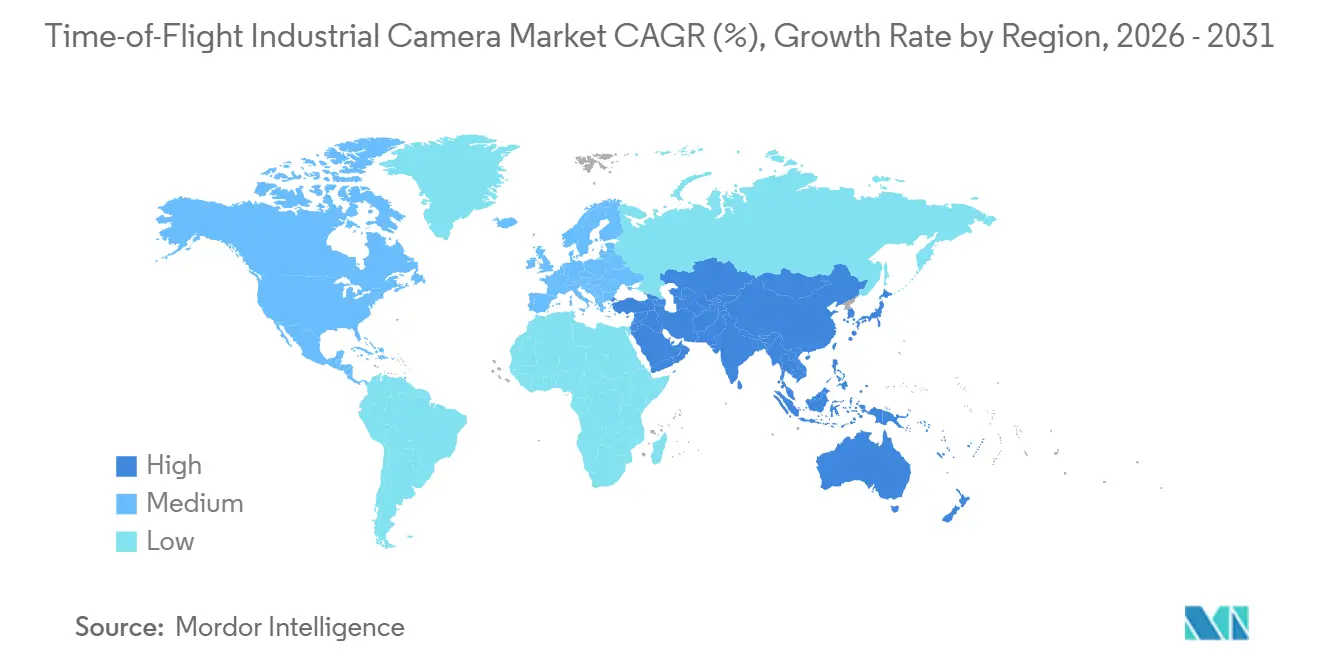
APAC Time-of-Flight Industrial Camera Market
Asia-Pacific held 41.58% of the Time-of-flight industrial camera market share in 2025 and is projected to expand at a 14.28% CAGR through 2031. China supports demand through electronics, electric vehicle battery, and semiconductor factory activity. Depth sensing is used in automated handling, inspection, and intralogistics systems in these settings. Japan contributes through precision equipment and its machine-vision integration base. South Korean semiconductor and display operations also require demanding inspection processes. India is driving demand through electronics manufacturing, semiconductor activity, and mobile device assembly. Regional suppliers are building camera, sensor, software, and robotics capabilities within the same value chain. Goertek Microelectronics offers full-stack 3D ToF solutions for palletizing and depalletizing in logistics, e-commerce, food, and daily-chemicals applications.
North America and Europe Time-of-Flight Industrial Camera Market
North America is the second-largest region in the Time-of-flight industrial camera market. New manufacturing investment is supporting purchases of automation and machine-vision equipment. Logistics providers and e-commerce fulfillment operators deploy depth sensing for AMR navigation and parcel measurement. These buyers can install multiple systems within a single facility. Europe draws demand from German automotive and machinery producers. Safety requirements for collaborative robot environments also support demand for certified systems. GigE Vision 3.0 added RoCEv2 support for lower-latency image transfer in multi-camera environments.[2]European Machine Vision Association, “GenICam Standardization Philosophy,” European Machine Vision Association, emva.org.
MEA and South America Time-of-Flight Industrial Camera Market
South America remains an emerging area, with Brazil and Argentina as key demand locations. Automotive assembly and domestic e-commerce logistics create the clearest application base. Uneven factory digitalization and limited integration capacity can slow adoption. The Middle East is adding smart warehouse infrastructure in the United Arab Emirates and Saudi Arabia. These investments support autonomous material handling and related perception hardware. Africa is still in the early stages of adoption, with South Africa and Egypt as more active industrial hubs. Price sensitivity in many African applications favors lower-cost stereo and two-dimensional alternatives.

Competitive Landscape
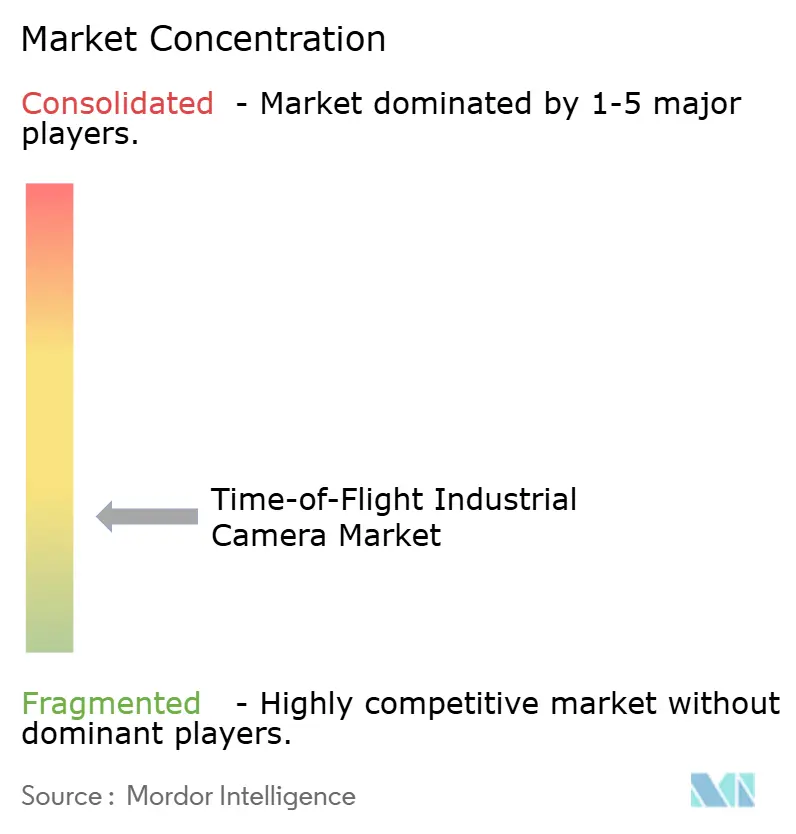
The Time-of-flight industrial camera market is fragmented across sensor designers, camera manufacturers, system integrators, and full-stack vision suppliers. Relevant suppliers include pmdtechnologies, ESPROS Photonics, Sony Semiconductor Solutions, onsemi, STMicroelectronics, Infineon Technologies, IDS Imaging, SICK, Cognex, KEYENCE, Mech-Mind Robotics, Hikrobot, Orbbec, Domi Sensor Technology, and Goertek Microelectronics. No participant controls silicon supply, camera hardware, and software integration across all major verticals. European suppliers compete through design depth, integration support, and safety-certified architectures. Chinese suppliers compete in standard logistics and AMR deployments, where bundled offerings can be cost-competitive.
Partnerships are an important competitive mechanism in the Time-of-flight industrial camera market. Orbbec and Basler announced a global technology partnership at LogiMAT 2026 in March 2026. The arrangement combines Orbbec’s depth-sensing capability and manufacturing with Basler’s camera ecosystem and pylon SDK. Their first related product, Basler Stereo mini, was introduced for navigation, obstacle detection, and logistics automation.[3]Orbbec, “Orbbec and Basler Announce Industrial 3D Vision Partnership at LogiMAT 2026,” Orbbec News, orbbec.com.
SICK launched its Nova platform in August 2026 to apply deep learning to 3D height data. The system supports defect classification that does not rely on color or contrast information. STMicroelectronics expanded its dToF position through the VL53L9 module in July 2026. Suppliers also compete on interoperability, calibration tools, functional safety documentation, and compliance with IEC 60825-1 eye safety requirements.
Time-of-Flight Industrial Camera Industry Leaders
Basler AG
Orbbec Inc.
SICK AG
Teledyne Vision Solutions
LUCID Vision Labs, Inc.
- *Disclaimer: Major Players sorted in no particular order
Time-of-Flight Industrial Camera Market Companies Covered in this Report
- Basler AG
- LUCID Vision Labs, Inc.
- Orbbec Inc.
- Pmdtechnologies gmbh
- IFM Electronic GmbH
- Teledyne Vision Solutions
- IDS Imaging Development Systems GmbH
- Allied Vision Technologies GmbH
- SICK AG
- Baumer Holding AG
- Cognex Corporation
- KEYENCE CORPORATION
- Hikrobot Co., Ltd.
- Mech-Mind Robotics Technologies Co., Ltd.
- Semiconductor Components Industries, LLC
- Photoneo s. r. o.
- STMicroelectronics
- ESPROS Photonics Corporation
- Domi Sensor Technology Co., Ltd.
- Goertek Microelectronics Inc.
- TOPPAN INC.
- BECOM Systems GmbH
- MESA Imaging AG
- Nerian Vision GmbH

Recent Industry Developments in Time-of-Flight Industrial Camera Market
- August 2026: SICK AG launched the Nova machine vision platform with AI-powered 3D quality inspection, combining deep learning algorithms with height-data analysis. The system performs color-and-contrast-independent defect classification using AI anomaly heatmaps, extending 3D ToF inspection into applications that previously required separate 2D and 3D systems, and is applicable across automotive, logistics, and consumer goods manufacturing lines.
- August 2026: IDS Imaging Development Systems GmbH announced that its Nion industrial 3D ToF camera entered series production. The camera combines a 1.2 MP indirect ToF sensor from onsemi's Hyperlux ID family AF0130, integrated on-chip depth processing, and IP67-rated housing, delivering temporally stable depth data at 30 fps over a 0.3 to 7.5 meter range via PoE, designed to lower the integration threshold for 3D vision in logistics, automation, and robotics.
- July 2026: STMicroelectronics began mass production of the VL53L9, the first direct ToF 3D LiDAR all-in-one module in its FlightSense portfolio. The device offers 2,268 resolution zones at 100 fps, a sensing range of 5 centimeters to 9 meters, and AI-ready output data for edge MCUs, targeting robotics, industrial automation, and inventory monitoring applications.
- June 2026: Visteon Corporation introduced D6Sigma, an edge AI product line for industrial automation developed with Qualcomm Technologies. Built on Qualcomm Dragonwing IQ9 Series processors, the system converts multiple camera streams into real-time actionable events for quality, uptime, and safety monitoring, illustrating the convergence of automotive-electronics integration expertise and industrial machine-vision hardware.


Global Time-of-Flight Industrial Camera Market Report Scope
The Time-of-Flight (ToF) Industrial Camera Market comprises industrial imaging systems, camera modules, and bundled vision solutions that use ToF technology to capture three-dimensional depth information by measuring the travel time of emitted light between a camera and objects or surfaces. The market includes standalone industrial ToF cameras, integrated ToF camera systems and vision solutions, and embedded ToF camera modules based on direct ToF (dToF), indirect ToF (iToF), or hybrid ToF technologies.
The Time-of-Flight Industrial Camera Market Report is Segmented by Product Type (Standalone Industrial ToF Cameras, ToF Camera Systems and Bundled Vision Solutions, and Embedded ToF Camera Modules), Technology (Direct ToF (dToF), Indirect ToF (iToF), and Hybrid ToF Systems), Application (Robotic Guidance and Bin Picking, Autonomous Mobile Robot Navigation and Obstacle Avoidance, Logistics Dimensioning, Weighing, and Scanning, Inspection, Measurement, and Quality Control, Human-Robot Safety and Monitoring, Inventory, Fill-Level, and Volume Measurement, and Other Applications), End-User Industry (Automotive, Electronics and Semiconductor, Food, Beverage, and Consumer Goods, Logistics, Warehousing, and E-Commerce, Metals, Machinery, and General Manufacturing, Healthcare and Life Sciences Facilities, and Other End-User Industries), and Geography (North America, South America, Europe, Asia-Pacific, and Middle East and Africa). The Market Forecasts are Provided in Terms of Value (USD).
| Standalone Industrial ToF Cameras |
| Embedded ToF Camera Modules |
| ToF Camera Systems and Bundled Vision Solutions |
| Direct ToF (dToF) |
| Indirect ToF (iToF) |
| Hybrid ToF |
| Robotic Guidance and Bin Picking |
| Autonomous Mobile Robot Navigation and Obstacle Avoidance |
| Logistics Dimensioning, Weighing, and Scanning |
| Inspection, Measurement, and Quality Control |
| Human-Robot Safety and Monitoring |
| Inventory, Fill-Level, and Volume Measurement |
| Other Applications |
| Automotive |
| Electronics and Semiconductor |
| Food, Beverage, and Consumer Goods |
| Logistics, Warehousing, and E-Commerce |
| Metals, Machinery, and General Manufacturing |
| Healthcare and Life Sciences Facilities |
| Other End-User Industries |
| North America | United States |
| Canada | |
| Mexico | |
| South America | Brazil |
| Argentina | |
| Rest of South America | |
| Europe | Germany |
| United Kingdom | |
| France | |
| Italy | |
| Spain | |
| Rest of Europe | |
| Asia-Pacific | China |
| Japan | |
| India | |
| South Korea | |
| Rest of Asia-Pacific | |
| Middle East | United Arab Emirates |
| Saudi Arabia | |
| Rest of Middle East | |
| Africa | South Africa |
| Egypt | |
| Rest of Africa |
| By Product Type | Standalone Industrial ToF Cameras | |
| Embedded ToF Camera Modules | ||
| ToF Camera Systems and Bundled Vision Solutions | ||
| By Technology | Direct ToF (dToF) | |
| Indirect ToF (iToF) | ||
| Hybrid ToF | ||
| By Application | Robotic Guidance and Bin Picking | |
| Autonomous Mobile Robot Navigation and Obstacle Avoidance | ||
| Logistics Dimensioning, Weighing, and Scanning | ||
| Inspection, Measurement, and Quality Control | ||
| Human-Robot Safety and Monitoring | ||
| Inventory, Fill-Level, and Volume Measurement | ||
| Other Applications | ||
| By End-User Industry | Automotive | |
| Electronics and Semiconductor | ||
| Food, Beverage, and Consumer Goods | ||
| Logistics, Warehousing, and E-Commerce | ||
| Metals, Machinery, and General Manufacturing | ||
| Healthcare and Life Sciences Facilities | ||
| Other End-User Industries | ||
| By Geography | North America | United States |
| Canada | ||
| Mexico | ||
| South America | Brazil | |
| Argentina | ||
| Rest of South America | ||
| Europe | Germany | |
| United Kingdom | ||
| France | ||
| Italy | ||
| Spain | ||
| Rest of Europe | ||
| Asia-Pacific | China | |
| Japan | ||
| India | ||
| South Korea | ||
| Rest of Asia-Pacific | ||
| Middle East | United Arab Emirates | |
| Saudi Arabia | ||
| Rest of Middle East | ||
| Africa | South Africa | |
| Egypt | ||
| Rest of Africa | ||


Key Questions Answered in the Report
What is the size of the Time-of-flight industrial camera market?
The Time-of-flight industrial camera market size is projected at USD 1.06 billion in 2026 and is forecast to reach USD 1.89 billion by 2031, at a 12.23% CAGR.
What is driving demand for time-of-flight industrial cameras?
Warehouse automation, AMR deployments, three-dimensional inspection, parcel dimensioning, and edge AI processing are supporting demand.
Which product type led revenue in 2025?
Standalone industrial ToF cameras led product revenue with a 48.62% share in 2025.
Which technology is expected to expand fastest?
Direct ToF is projected to expand at a 14.82% CAGR from 2026 to 2031 as outdoor and long-range sensing needs increase.
Which application has the highest projected CAGR?
Autonomous mobile robot navigation and obstacle avoidance is projected to expand at a 15.67% CAGR through 2031.
Which region led demand in 2025?
Asia-Pacific led revenue with a 41.58% share in 2025 and is projected to expand at a 14.28% CAGR through 2031.
Page last updated on:





