
Tile Adhesive Market Size and Share
Market Overview
| Study Period | 2021 - 2031 |
|---|---|
| Market Size (2026) | USD 6.18 Billion |
| Market Size (2031) | USD 8.52 Billion |
| Growth Rate (2026 - 2031) | 6.63 % |
| Fastest Growing Market | Asia-Pacific |
| Largest Market | Asia-Pacific |
| Market Concentration | Medium |
Major Players *Disclaimer: Major Players sorted in no particular order Image © Mordor Intelligence. Reuse requires attribution under CC BY 4.0. | |
Tile Adhesive Market Analysis by Mordor Intelligence
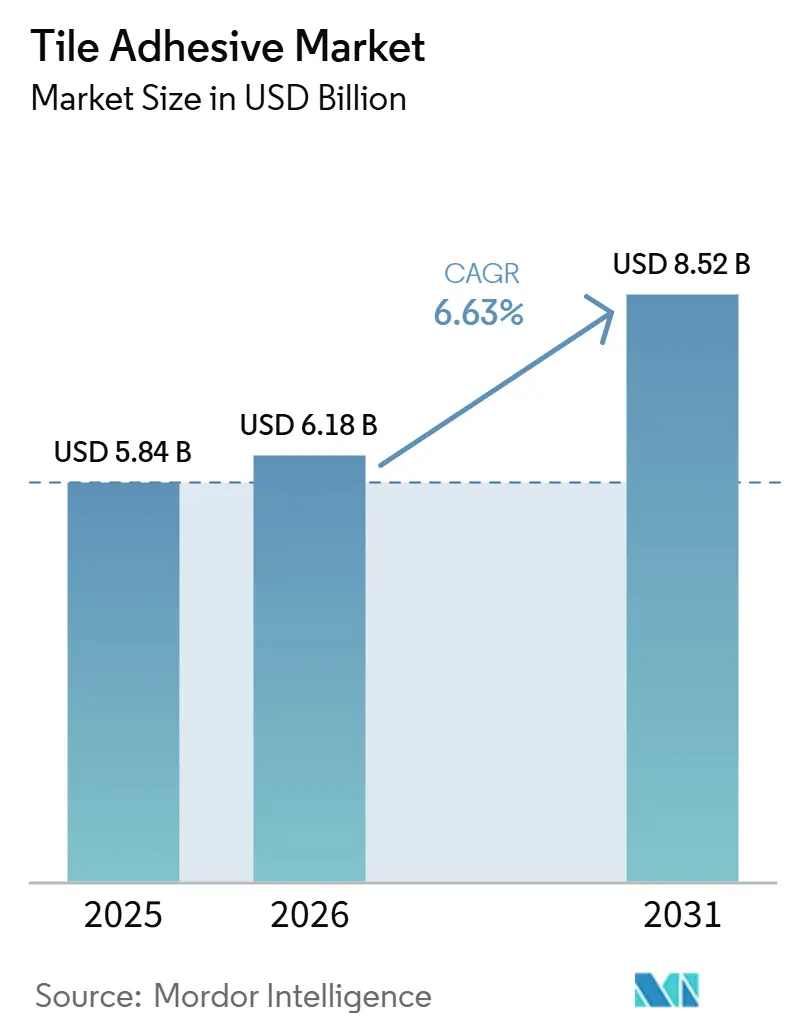
The Tile Adhesive Market size is projected to be USD 5.84 billion in 2025, USD 6.18 billion in 2026, and reach USD 8.52 billion by 2031, and is expected to grow at a CAGR of 6.63% from 2026 to 2031. Growth in the tile adhesive market is driven by sustained housing activity in developing economies and a broad renovation cycle across mature markets. The market is also being reshaped by a shift away from sand-cement mortar beds toward ready-mix and polymer-modified systems, as larger tile formats require better slip resistance, longer open time, and stronger deformation performance. Large panels exceeding 120 cm have become standard in many premium residential and commercial projects, raising expectations for adhesive performance and increasing the value of higher-grade formulations. This shift is reducing demand for commodity-grade products and favors manufacturers that can respond quickly to changes in substrates, performance standards, and compliance demands under EN 12004 classes such as S1 and S2. The market also faces pressure from swings in input costs and reformulation cycles linked to the adoption of Portland composite cement, which is shifting competitive advantage toward players with stronger polymer chemistry, broader R&D capacity, and distributed production networks.
Key Report Takeaways
- By product type, cementitious adhesives led with 42.62% share in 2025, while reaction resin adhesives are projected to record the fastest growth at a 7.52% CAGR through 2031.
- By application, floor tiling accounted for 40.08% of the tile adhesive market in 2025, while exterior applications are projected to grow the fastest, at a 7.28% CAGR through 2031.
- By end-user industry, residential accounted for 45.77% of demand in 2025, while the commercial is forecast to expand at the fastest CAGR of 6.98% through 2031.
- By geography, Asia-Pacific held 47.31% of the tile adhesive market share in 2025 and is forecast to grow at a CAGR of 7.46% through 2031.
Note: Market size and forecast figures in this report are generated using Mordor Intelligence’s proprietary estimation framework, updated with the latest available data and insights as of January 2026.
Market Trends and Insights
Drivers Impact Analysis of Tile Adhesive Market*
| Drivers | (~) % Impact on CAGR Forecast | Geographic Relevance | Impact Timeline |
|---|---|---|---|
| Growing Adoption of Large-Format Tiles | +1.8% | Global, concentrated in North America, Europe, and premium APAC segments | Medium term (2-4 years) |
| Rising Renovation and Remodeling Activities | +1.6% | North America and Europe core, with spillover to MEA and South America | Medium term (2-4 years) |
| Increasing Preference for High-Performance Adhesives | +1.2% | Europe, North America, Japan, South Korea | Long term (≥ 4 years) |
| Growth in Residential Construction | +1.5% | APAC core, especially India, Vietnam, and Indonesia, with spillover to MEA | Short term (≤ 2 years) |
| Rising Demand for Waterproofing Solutions | +0.8% | Global, concentrated in Southeast Asia and the Middle East | Medium term (2-4 years) |
| Source: Mordor Intelligence | |||
Growing Adoption of Large-Format Tiles
Large-format porcelain and vitrified tiles are reshaping adhesive specifications across the tile adhesive market. Larger tiles require polymer-modified cementitious adhesives or reaction resin systems that meet S2 deformation requirements, as standard cementitious products can fail when substrates move or expand under heat. This shift increases adhesive value per square meter, as larger tiles require fuller coverage and double bonding, particularly on exterior facades where installation conditions are more demanding. LATICRETE's August 2025 launch of MULTIMAX 1 reflects this trend. The move toward larger panels is also reducing demand for basic formulations designed for smaller tiles and simpler installation methods. European testing and classification requirements under EN 12004 reinforce this trend, as reformulated systems must pass more stringent performance checks before commercial rollout[1].
Rising Renovation and Remodeling Activities
Renovation has become as important as new construction in several mature regions of the tile adhesive market. This demand often leans toward higher-specification products because retrofit work commonly involves underfloor heating, moisture-laden slabs, irregular tile sizes, and existing substrates that leave little room for low-performance materials. In Europe, Italy's Superbonus 110% program extended support for renovation activity through 2027, which continued to support demand for water-based tile adhesives in residential envelopes. In North America, remodeling growth expectations for 2026 remain supportive for categories tied to tile replacement, waterproofing, and upgraded installation systems. Renovation work also tends to command better pricing than standard new-build applications, which improves margins for suppliers with broader premium portfolios. That dynamic keeps the tile adhesive market linked not only to new housing cycles, but also to replacement demand in aging building stock.
Increasing Preference for High-Performance Adhesives
The shift toward polymer-modified, low-VOC, and eco-certified products is moving from a premium preference to a baseline requirement in parts of the tile adhesive market. Sustainability frameworks such as LEED v4.1 and BREEAM 2018 are tightening indoor air quality expectations, which is reducing the room for solvent-based systems in commercial interiors. WACKER's March 2025 release showed that standard Vinyl Acetate-Ethylene (VAE) copolymers do not meet C2 class tensile requirements in CEM II tile adhesive systems after water immersion, while specialty terpolymers can restore the needed performance. This underscores the importance of proprietary polymer access, as performance, sustainability, and compliance are now converging rather than functioning as separate product features. Manufacturers that can document low-emission performance and reformulate faster are better positioned to retain premium specifications in Europe and North America. This is creating a gap between vertically integrated manufacturers and mid-tier formulators in the tile adhesive market.
Growth in Residential Construction
Residential construction remains the largest volume segment of the tile adhesive market. In the United States, the National Association of Home Builders (NAHB) projects 940,000 single-family housing starts in 2026, with a further increase expected in 2027, which supports both new installation demand and follow-on renovation work. South and Southeast Asia continue to anchor volume demand because urbanization, apartment construction, and wet-area tile usage remain structurally high across many large cities. Even in slower European housing markets, parts of the residential cycle are stabilizing, and DIW Berlin expects nominal and real growth in German residential construction in 2026 after a weaker period. Residential activity supports the throughput of cementitious and polymer-modified products in bathrooms, kitchens, balconies, and living spaces. That steady volume base keeps the tile adhesive market resilient even when commercial or industrial order patterns move unevenly.
Restraints Impact Analysis of Tile Adhesive Market*
| Restraints | (~) % Impact on CAGR Forecast | Geographic Relevance | Impact Timeline |
|---|---|---|---|
| Volatility in Cement and Raw Material Prices | -0.8% | Global, most acute in APAC and Europe, where the input cost pass-through is limited | Medium term (2-4 years) |
| Competition from Conventional Adhesives | -0.6% | APAC, South America, and MEA, especially in price-sensitive informal construction markets | Short term (≤ 2 years) |
| Price Sensitivity in the Construction Sector | -0.4% | APAC, South America, and MEA | Short term (≤ 2 years) |
| Source: Mordor Intelligence | |||
Volatility in Cement and Raw Material Prices
Input cost volatility is a structural restraint for the tile adhesive market, as cement and polymer modifiers account for a large share of formulation costs. In the United Kingdom, cement prices declined over the May 2025 to May 2026 period, but the same government dataset recorded overall building material inflation of 5.4% year over year, indicating that relief in one input did not offset broader cost pressure[2]. In the United States, the Producer Price Index for cement manufacturing rose from 352 in January 2026 to 355 in April 2026, reflecting a firm cost environment for formulators. These fluctuations are significant because many customers in the tile adhesive market resist frequent price adjustments, particularly in commodity and contractor-led channels. Margin pressure is strongest among mid-tier suppliers that lack backward integration or long-term supply agreements. This pressure intensifies when reformulation needs arise simultaneously, as resources must then be divided between cost control and compliance work.
Competition from Conventional Adhesives
Conventional sand-cement bedding mortar continues to limit penetration in several price-sensitive segments of the tile adhesive market. In these settings, low labor costs keep thick-bed installation commercially viable, even where bond strength, consistency, and long-term performance are weaker than those of ready-mix systems. This dynamic is reinforced by the scale of the informal construction sector, where technical differentiation alone does not change buying behavior without installer training and distributor support. Low adhesive penetration also reduces the revenue available for market education, slowing the transition away from traditional methods. This is particularly relevant in Tier 2 and Tier 3 cities across parts of Asia and Sub-Saharan Africa, where future construction volumes are significant but product upgrading remains uneven. In markets without performance standards comparable to those of the American National Standards Institute (ANSI) A118 series, the tile adhesive market receives less regulatory support for moving away from conventional mortar beds.
*Our forecasts treat driver/restraint impacts as directional, not additive. The impact forecasts reflect baseline growth, mix effects, and variable interactions.
Tile Adhesive Market Segment Analysis
By Product Type:
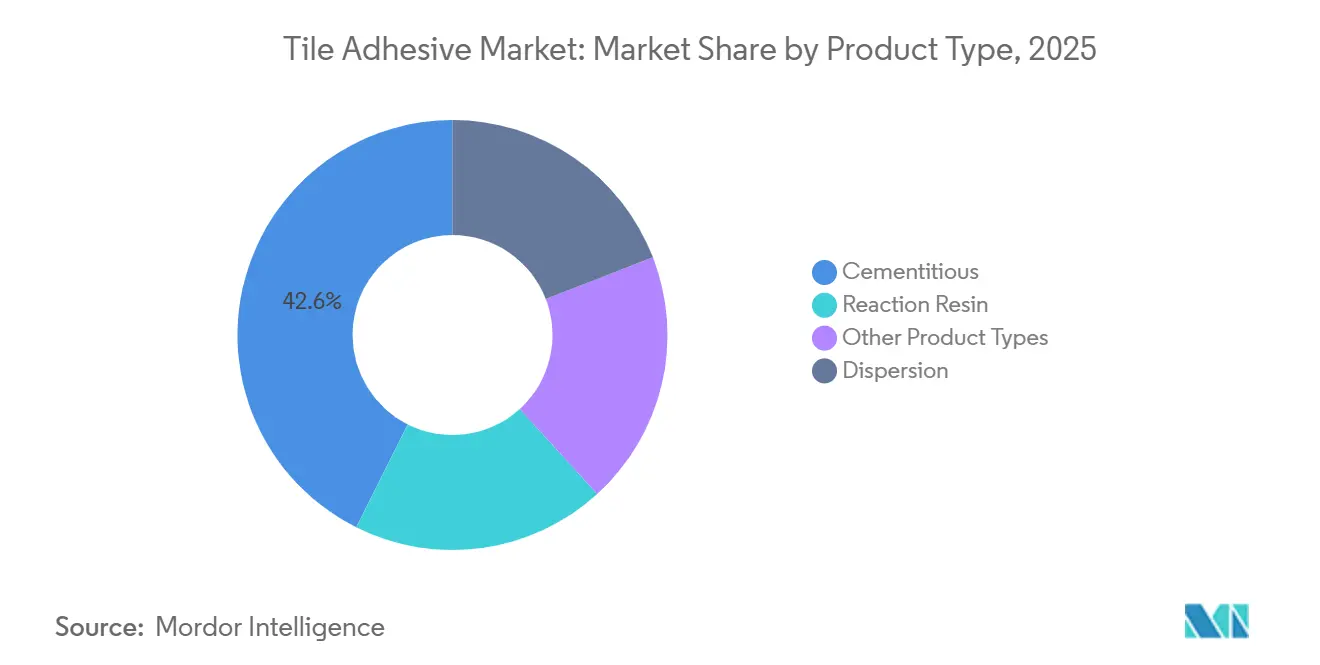
Reaction Resin Gains as Cementitious Anchors VolumeCementitious adhesives held 42.62% of the tile adhesive market share in 2025, while reaction resin adhesives are projected to expand at a 7.52% CAGR through 2031. Cementitious products remain the core volume base because they are cost-effective, easy to prepare, and compatible with common substrates such as concrete, gypsum board, and masonry. Their role is strongest in residential construction and mid-range commercial work, where installation speed and familiar handling matter as much as performance. This gives them a stable position in the tile adhesive market even as technical requirements rise in premium settings. Reaction resin systems, most of which are epoxy-based, are gaining ground as more installations require chemical resistance, zero water absorption, and mechanical strength under harsh operating conditions.
These formulations are gaining acceptance in food processing plants, hospital operating theaters, industrial floors, and swimming pool surrounds, where standard cementitious options are less reliable over time. Growth in the tile adhesive market is no longer driven solely by square meterage, but also by stricter performance demands in specialized environments. Dispersion adhesives continue to hold a narrower role in interior wall tile work, especially in bathrooms and kitchens, where a ready-to-use format, lower dust, and lower shrinkage appeal to professional installers. Regulatory tightening in Europe is making product registration more demanding for advanced resin systems, which favors players with in-house toxicology screening and stronger development infrastructure. The product mix remains balanced between volume-led cementitious demand and value-led growth in reaction resins, with dispersion products filling targeted interior niches across the tile adhesive market.
Cementitious products benefit from broad familiarity among installers, which helps them remain relevant in mainstream channels where specification discipline is less formal. Their price accessibility matters in emerging markets, where the tile adhesive industry still competes with conventional mortar methods in many local projects. Polymer modification is enabling cementitious systems to serve more demanding tiles and substrates than previously possible, raising their performance ceiling. This blurs the distinction between basic and premium categories and keeps reformulation activity active within the tile adhesive market. Product strategy is shifting from single-product selling toward performance ladders that move customers from entry-grade products to premium systems over time.

By Application:
Floor Tiling Leads as Exterior Projects AccelerateFloor tiling accounted for 40.08% of the application mix in 2025, while exterior applications are forecast to grow at the fastest rate, at a 7.28% CAGR through 2031. Floor tiling remains the largest use case because tile is a standard flooring choice in residential bathrooms, kitchens, commercial lobbies, and retail spaces. It serves both new construction and renovation, giving it a broader demand base than more specialized installation categories. This keeps floor systems at the center of the tile adhesive market in both developed and developing regions. Exterior applications are growing faster because building envelopes, ventilated facades, terraces, and outdoor leisure areas require adhesives with frost resistance, UV stability, and crack-bridging performance.
These requirements raise the technical threshold for suppliers, as exterior installations are exposed to thermal movement, weathering, and long-term durability demands. LATICRETE's March 2026 update to the 170 Sound and Crack Isolation Mat system illustrates how innovation is increasingly focused on accommodating movement and on large-format floor installations with tighter seams and easier handling. Wall tiling continues to hold a complementary role, especially in wet areas and facade cladding, where lighter dispersion or polymer-modified cementitious systems remain practical. Interior decorative uses are growing steadily as spending on visible finishes rises across middle-income households and commercial refurbishments. Other applications, such as pool interiors, engineered stone surfacing, and countertops, remain smaller in volume but carry higher value because adhesive chemistry must more precisely match thermal expansion, moisture exposure, and substrate sensitivity.
Floor tiling is less exposed to specification complexity than exterior or facade work, but it is evolving with larger tile sizes and more demanding substrate conditions. Even the largest application category is moving beyond basic mortar replacement toward higher-value installation systems. The tile adhesive market for exterior applications is projected to grow faster because these projects require better deformation handling and stronger long-term adhesion. Growth is coming from both volume continuity in floors and capability expansion in outdoor use cases, keeping application-level demand diversified rather than concentrated in a single construction pattern.
By End-User Industry:
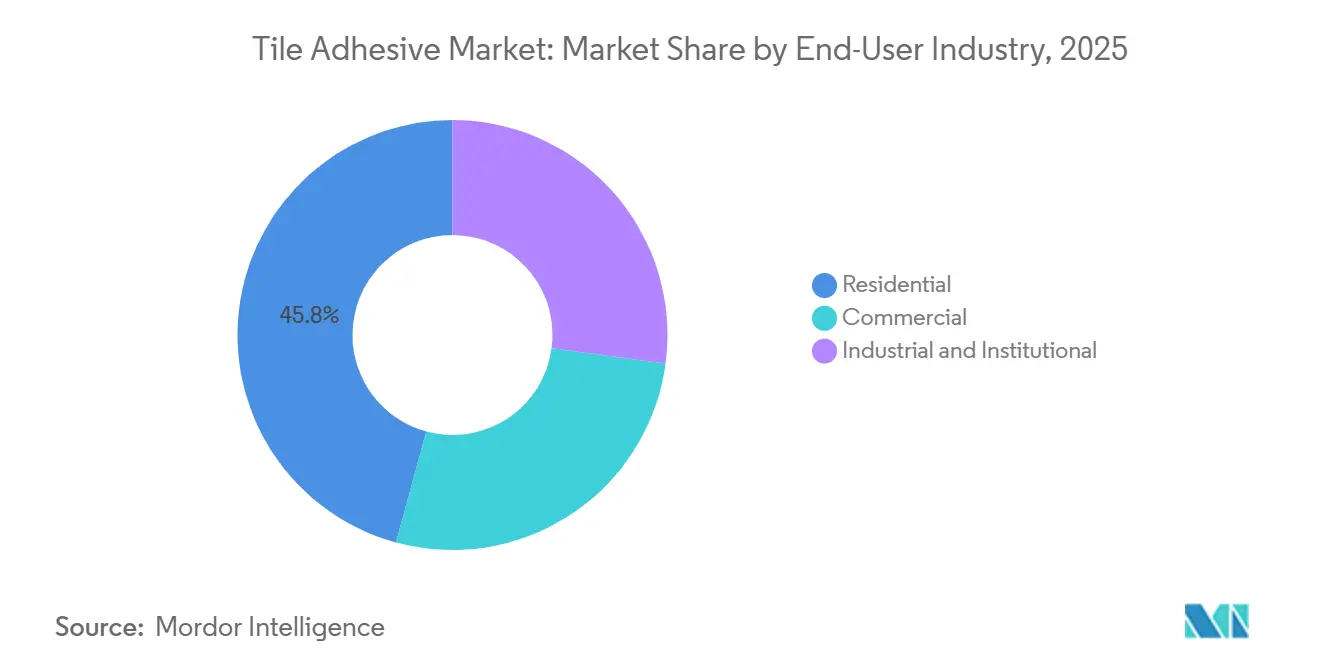
Residential Leads, Commercial Construction Fuels GrowthResidential construction accounted for 45.77% of total demand in 2025, while commercial construction is projected to record the fastest CAGR of 6.98% through 2031. Residential projects remain the largest outlet because housing activity across India, Vietnam, Indonesia, Brazil, North America, and Europe sustains broad tile usage in kitchens, bathrooms, and living spaces. This end-user base provides the tile adhesive market with consistent throughput even when large commercial projects pause or shift in timing. Residential volume also supports the scale economics behind cementitious and polymer-modified products sold through dealer and contractor networks. Commercial construction is growing faster as retail, hospitality, healthcare, and logistics facilities use tile in spaces where durability, hygiene, and appearance are key requirements.
Commercial projects increasingly specify Class C2 or higher systems that meet the more stringent tensile adhesion requirements of EN 12004, thereby increasing revenue per kilogram relative to standard residential-grade products. This pricing premium improves mix quality even when total project volumes are smaller than mass housing demand. Industrial and institutional uses remain smaller in overall share but provide steady demand where only reaction resin or high-performance cementitious systems are technically acceptable. These projects include food processing plants, pharmaceutical facilities, transit hubs, and other environments where moisture, chemicals, or heavy use leave little room for failure. The result is a tile adhesive market that still relies on residential-scale production while increasingly deriving value from commercial and institutional requirements.
The residential segment also remains central because it is tied to both new homes and the replacement cycle in aging housing stock. In many countries, bathroom upgrades, kitchen remodeling, balcony repairs, and wet-area waterproofing sustain adhesive demand even when headline housing output slows. This gives the tile adhesive market an important layer of replacement demand that softens pure construction cyclicality. Commercial construction imposes a higher specification burden and a greater need for documentation, warranties, and technical approvals, making supplier capability, not only price, a more decisive factor in winning larger bids.
Geography Analysis
APAC Tile Adhesive Market
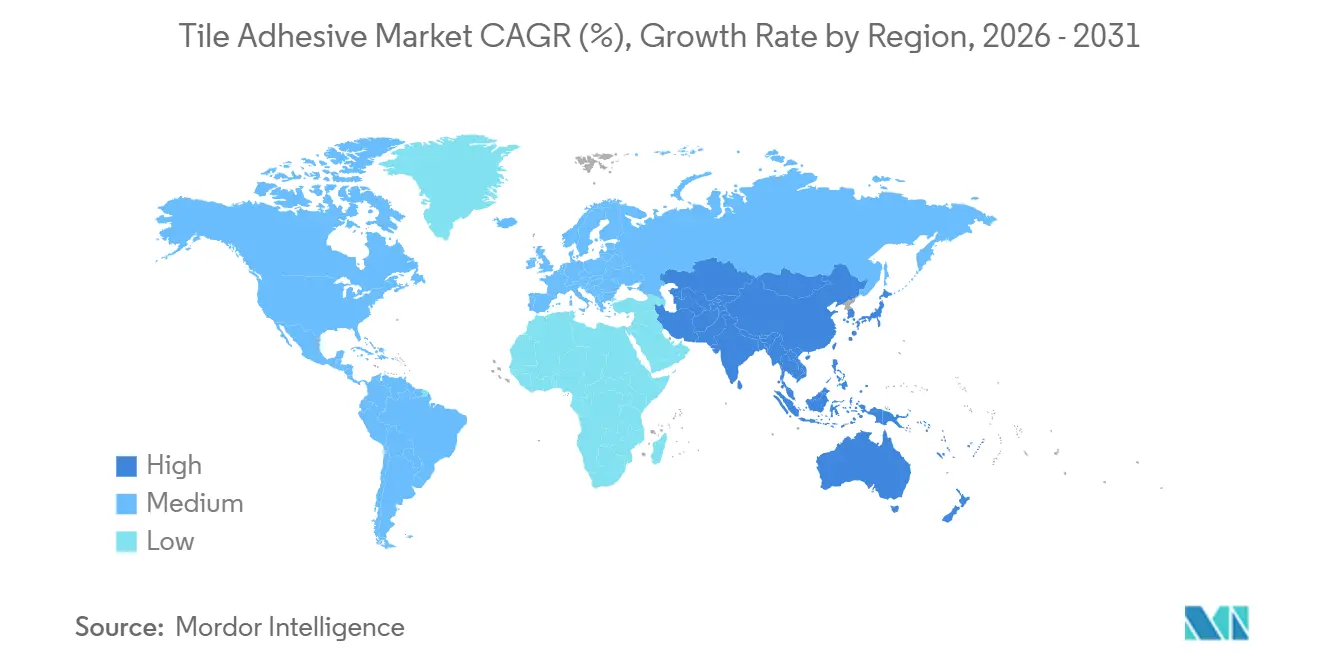
Asia-Pacific held 47.31% of the tile adhesive market share in 2025 and is forecast to record the fastest CAGR of 7.46% through 2031. The region leads due to its large existing construction base and an extensive pipeline of housing, mixed-use development, and urban renewal projects. China remains the single largest contributor, although property-sector deleveraging has slowed its growth compared with earlier years. Urban renewal programs and large-scale development projects continue to support adhesive demand across residential and commercial segments. The region also benefits from simultaneous growth in cost-sensitive volume demand and premium specification, providing the tile adhesive market with multiple avenues for expansion.
South Asia Tile Adhesive Market
South Asia is attracting greater manufacturing investment as multinationals prepare for a prolonged construction cycle across the region. Sika's February 2026 opening of a new plant in Narayanganj, Bangladesh, which includes high-performance tile adhesive capacity, reflects how suppliers are positioning production closer to future growth centers. Localized production improves responsiveness, reduces freight costs, and supports product adaptation for regional climate and substrate conditions. Asia-Pacific also spans a wide range of contractor maturity levels, meaning the tile adhesive market can grow through both formal specification channels and gradual conversion from conventional mortar methods. This breadth keeps the region central to both volume and value growth.
North America and Europe Tile Adhesive Market
North America and Europe together account for a large share of global value, but their demand patterns differ. In North America, the NAHB expected 940,000 single-family housing starts in 2026, and remodeling activity remains supportive, favoring premium installation systems such as crack-isolation layers and large-format solutions. In Europe, demand is more closely tied to renovation cycles, specification requirements, and sustainability documentation, which strengthens the position of high-performance, low-emission products. Italy's Superbonus 110% program, extended through 2027, continues to support renovation-linked adhesive demand in residential construction. Germany also shows signs of stabilization in residential construction following a weaker period, which should support a gradual demand recovery.
MEA and South America Tile Adhesive Market
South America, the Middle East, and Africa remain smaller in value but offer growth potential for the tile adhesive market. Brazil and Argentina anchor South American demand, and Sika's February 2026 dry mortar investment in Argentina positions production closer to domestic construction demand. In the Middle East, large infrastructure and hospitality projects continue to favor higher-specification adhesives for facades, stone installations, and weather-exposed surfaces. In Sub-Saharan Africa, Sika's new Tanzania plant reflects confidence in multi-year construction growth driven by urbanization and infrastructure investment.
Competitive Landscape
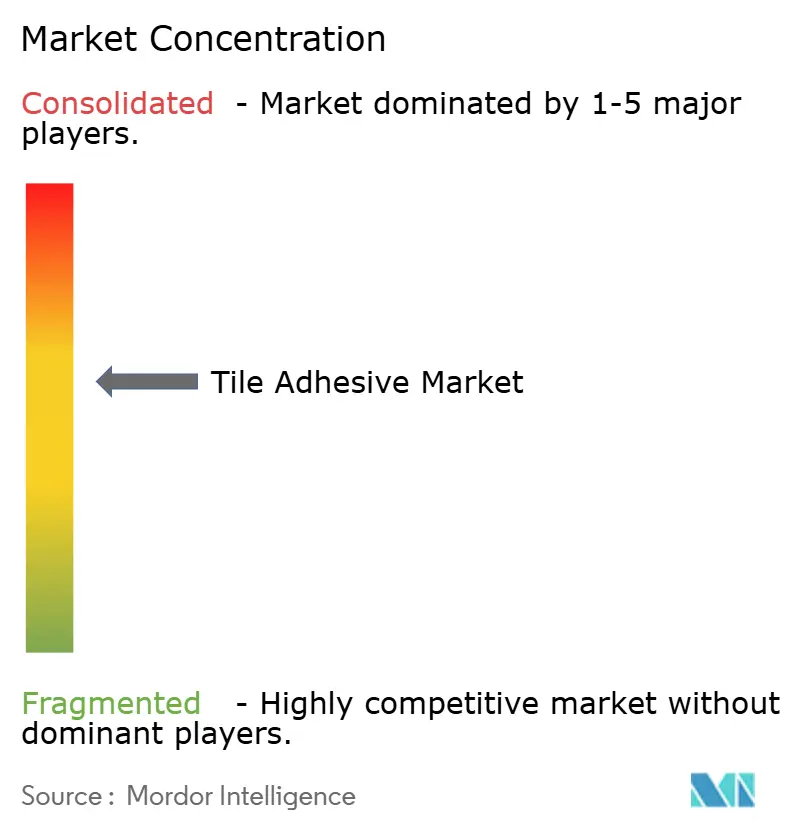
The tile adhesive market is moderately consolidated. Major players, including Sika AG, Mapei S.p.A., Saint-Gobain Weber, Henkel AG, LATICRETE International, Ardex GmbH, and H.B. Fuller, compete on performance, certification, and distribution depth, while a larger set of regional producers competes on price in commodity cementitious categories. This creates a split structure where premium segments reward technology and technical service, while mainstream segments depend heavily on cost position. The tile adhesive market does not function as a single competitive field, since leadership in specification channels does not always translate into dominance in local mass-market volume. Companies that manage both ends of this structure without compromising product quality or channel presence hold stronger competitive positions.
Sika is targeting local-currency sales growth of 1% to 4% in 2026 under its Fast Forward program, supported by continued expansion of its manufacturing base. In February 2026, the company opened five new facilities across the United States, Argentina, Colombia, Bangladesh, and Tanzania. Mapei invested more than EUR 213 million (USD 242.86 million) in tangible fixed assets during 2024 and announced an additional manufacturing expansion in Belgium in 2026. These actions reflect that plant density, local service capability, and supply proximity remain decisive factors in a product category where long-distance transportation is costly. The tile adhesive market favors companies that can scale regionally rather than rely on a single export hub.
Technology differentiation is a key dividing line between tier-one suppliers and smaller challengers. LATICRETE's MULTIMAX 1 is positioned as the first high-performance premixed tile adhesive mortar for gauged porcelain tile panels and large-and-heavy tile installations. WACKER's work on specialty terpolymers for CEM II tile adhesive compliance illustrates how polymer science shapes product competitiveness alongside price and brand recognition. Manufacturers that can reformulate faster, document performance clearly, and support installers with system-level guidance are better positioned in the market. Companies that cannot meet these technical and compliance requirements face margin compression in entry-level segments and risk exclusion from premium specifications.
Tile Adhesive Industry Leaders
-
Mapei S.p.A.
-
Sika AG
-
Arkema
-
Henkel AG and Co. KGaA
-
LATICRETE International, Inc.
- *Disclaimer: Major Players sorted in no particular order
Tile Adhesive Market Companies Covered in this Report
- Ardex GmbH
- Arkema
- Bostik
- Butech Building Technology SAU
- Cemi-Cola Port, SL.
- Fosroc International Limited
- H.B. Fuller Company
- Henkel AG and Co. KGaA
- ISOLERA GMBH
- LATICRETE International, Inc.
- Mapei S.p.A.
- Pidilite Industries Limited
- Saint-Gobain Weber
- Schomburg GmbH and Co. KG
- Sika AG
- Terraco Group
Recent Industry Developments in Tile Adhesive Market
- February 2026: Sika AG opened 5 new manufacturing facilities across Florida (USA), Puerto Tirol, Argentina (dry mortar), Cali, Colombia (mortars, tile adhesives, and acrylic coatings), Narayanganj, Bangladesh (concrete admixtures, mortar, and high-performance tile adhesive), and Mwanza, Tanzania (mortar and concrete admixtures), expanding its production presence across 4 continents simultaneously.
- November 2025: LATICRETE Europe published its first Environmental Product Declarations (EPDs) covering 79 ceramic tile adhesive products, all verified by ICMQ and published with EPD Italy under EN 15804 A2, making LATICRETE one of the first companies in its peer group to achieve product-level EPD disclosure at scale for the European market.
Global Tile Adhesive Market Report Scope
Tile adhesives are polymer-modified bonding agents used to secure tiles to surfaces such as walls, floors, and countertops. Unlike traditional cement, they provide flexibility, water resistance, and faster setting times.
The tile adhesive market is segmented by product type, application, end-use industry, and geography. By product type, the market is segmented into cementitious, dispersion, reaction resin, and other product types. By application, the market is segmented into floor tiling, wall tiling, interior applications, exterior applications, and other applications. By end-use industry, the market is segmented into residential, commercial, industrial, and institutional. The report also covers market size and forecasts for tile adhesive across 16 countries in major regions. The market sizes and forecasts are provided in terms of value (USD).
Segmentation Overview
| Cementitious |
| Dispersion |
| Reaction Resin |
| Other Product Types |
| Floor Tiling |
| Wall Tiling |
| Interior Applications |
| Exterior Applications |
| Other Applications |
| Residential |
| Commercial |
| Industrial and Institutional |
| Asia-Pacific | China |
| India | |
| Japan | |
| South Korea | |
| Rest of Asia-Pacific | |
| North America | United States |
| Canada | |
| Mexico | |
| Europe | Germany |
| United Kingdom | |
| France | |
| Italy | |
| Russia | |
| Rest of Europe | |
| South America | Brazil |
| Argentina | |
| Rest of South America | |
| Middle-East and Africa | Saudi Arabia |
| South Africa | |
| Rest of Middle-East and Africa |
| By Product Type | Cementitious | |
| Dispersion | ||
| Reaction Resin | ||
| Other Product Types | ||
| By Application | Floor Tiling | |
| Wall Tiling | ||
| Interior Applications | ||
| Exterior Applications | ||
| Other Applications | ||
| By End-User Industry | Residential | |
| Commercial | ||
| Industrial and Institutional | ||
| By Geography | Asia-Pacific | China |
| India | ||
| Japan | ||
| South Korea | ||
| Rest of Asia-Pacific | ||
| North America | United States | |
| Canada | ||
| Mexico | ||
| Europe | Germany | |
| United Kingdom | ||
| France | ||
| Italy | ||
| Russia | ||
| Rest of Europe | ||
| South America | Brazil | |
| Argentina | ||
| Rest of South America | ||
| Middle-East and Africa | Saudi Arabia | |
| South Africa | ||
| Rest of Middle-East and Africa | ||
Key Questions Answered in the Report
What is current market size of Tile Adhesive Market?
The Tile Adhesive Market size is projected to be USD 5.84 billion in 2025, USD 6.18 billion in 2026, and reach USD 8.52 billion by 2031, growing at a CAGR of 6.63% from 2026 to 2031.
Why are large-format tiles important for adhesive suppliers?
Large-format tiles require higher-performance products with better deformation handling, coverage, and bond reliability. This raises adhesive value per square meter and favors premium formulations.
Which product type drives current demand, and which is growing fastest?
Cementitious adhesives led with a 42.62% share in 2025, as they remain the volume base in mainstream construction. Reaction resin adhesives are growing at the fastest 7.52% CAGR through 2031.
Which application area offers the best growth outlook?
Exterior applications have the strongest growth outlook with a 7.28% CAGR through 2031. Weather exposure, facade use, and movement-related performance needs are driving up specification requirements in this area.