
Thermal Gap Fillers Market Size and Share
Market Overview
| Study Period | 2021 - 2031 |
|---|---|
| Market Size (2026) | USD 2.97 Billion |
| Market Size (2031) | USD 4.37 Billion |
| Growth Rate (2026 - 2031) | 8.04 % |
| Fastest Growing Market | Asia-Pacific |
| Largest Market | Asia-Pacific |
| Market Concentration | Medium |
Major Players *Disclaimer: Major Players sorted in no particular order Image © Mordor Intelligence. Reuse requires attribution under CC BY 4.0. | |
Thermal Gap Fillers Market Analysis by Mordor Intelligence
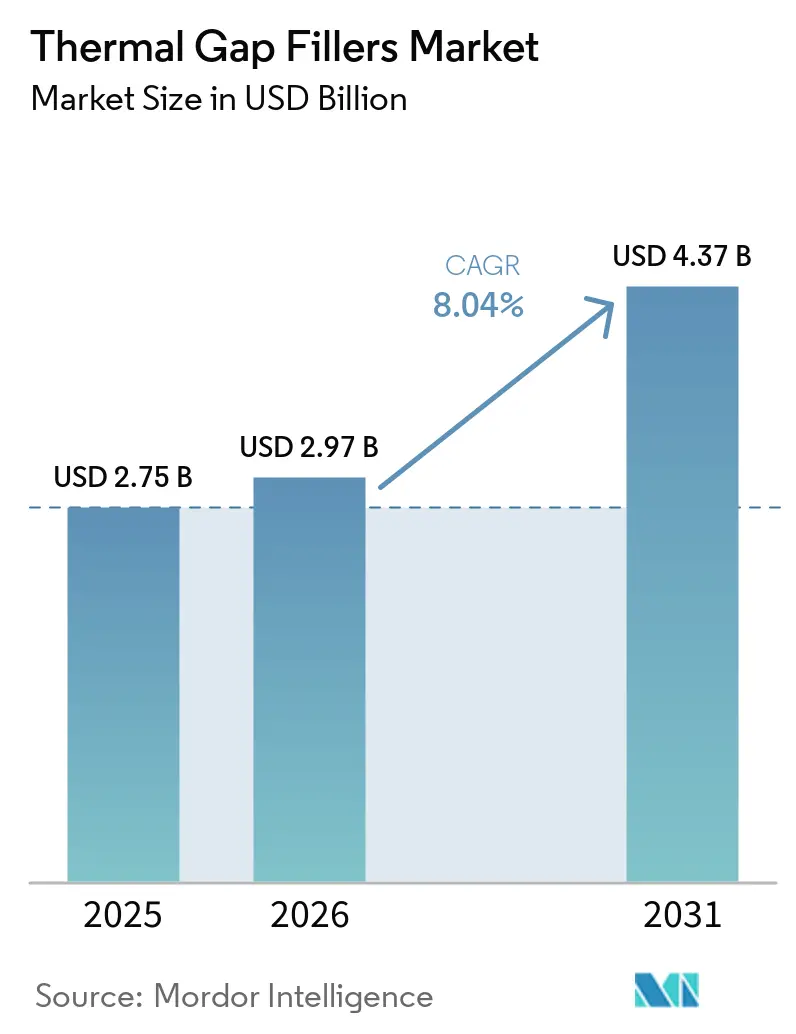
The Thermal Gap Fillers Market size was valued at USD 2.75 billion in 2025 and is estimated to grow from USD 2.97 billion in 2026 to reach USD 4.37 billion by 2031, at a CAGR of 8.04% during the forecast period (2026-2031). Electric vehicle battery packs, artificial intelligence server infrastructure, and fifth-generation mobile network base stations are increasing the thermal interface area that requires gap fillers. Thermal resistance at material interfaces affects safety, performance, and product life, so material selection has become an engineering decision. Suppliers are developing higher-conductivity and cure-in-place formulations to support more demanding designs and faster assembly. The thermal gap fillers market also benefits from demand across several end uses, which reduces reliance on any single application and creates opportunities for suppliers that can adapt products to varied operating conditions, production requirements, qualification standards, and the thermal performance needs of changing equipment designs across increasingly compact, higher-power systems that use more tightly constrained interfaces in a broad range of diverse electrified and connected products across global industrial supply chains. Cost volatility and lengthy qualification processes remain material constraints because a formulation change can delay a program ramp and cause customers to favor qualified suppliers with consistent production capabilities.
Key Report Takeaways
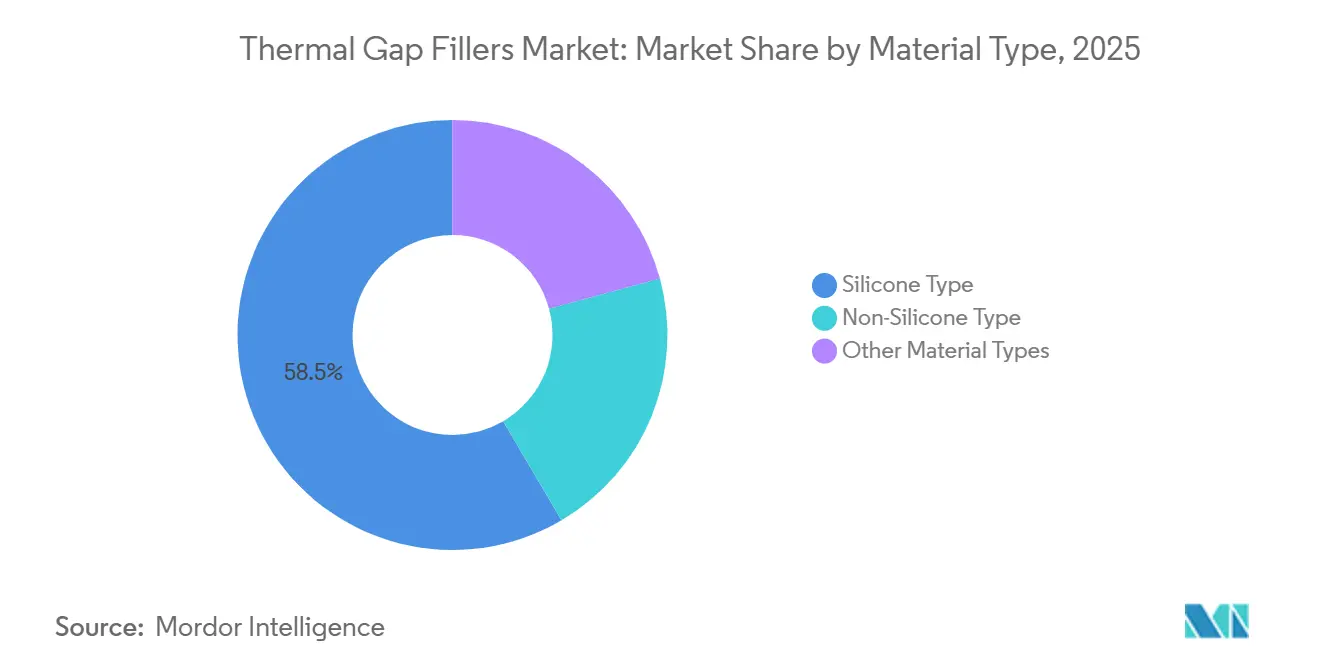
- By material type, silicone type held 58.47% of the thermal gap fillers market share in 2025, while non-silicone type is projected to advance at a 9.23% CAGR through 2031.
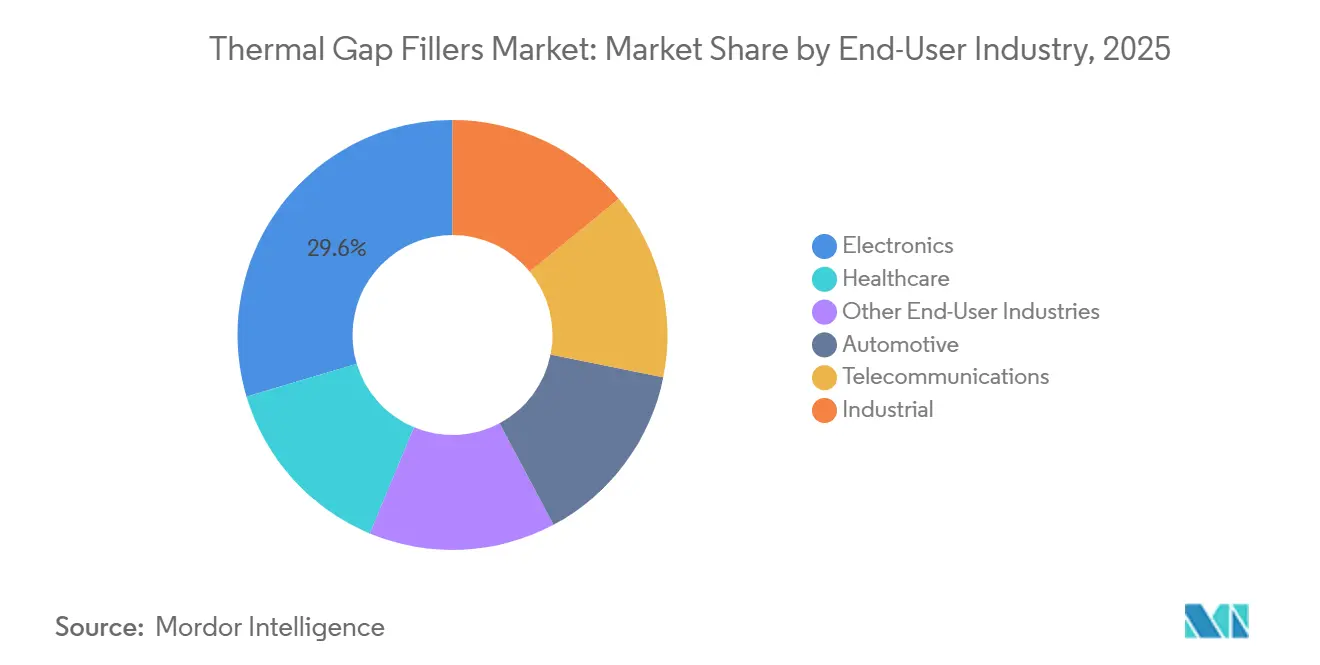
- By end-user industry, electronics held 29.63% of the thermal gap fillers market share in 2025, while healthcare is projected to advance at an 8.67% CAGR through 2031.
- By geography, Asia-Pacific held 42.19% of the thermal gap fillers market share in 2025 and is projected to advance at a 9.08% CAGR through 2031.
Note: Market size and forecast figures in this report are generated using Mordor Intelligence’s proprietary estimation framework, updated with the latest available data and insights as of January 2026.
Market Trends and Insights
Drivers Impact Analysis of Thermal Gap Fillers Market*
| Driver | (~) % Impact on CAGR Forecast | Geographic Relevance | Impact Timeline |
|---|---|---|---|
| EV Battery and Power-Electronics Thermal Load Growth | +2.5% | Global, strongest pull in APAC (China, South Korea) and Europe (Germany, Nordic Countries) | Long term (≥ 4 years) |
| AI Data Centers and High-Performance Computing Power Density | +2.1% | Global, concentrated in North America, APAC (China, Singapore, Japan) | Medium term (2-4 years) |
| 5G Radio and Telecom Infrastructure Heat Dissipation | +1.4% | APAC, Middle-East and Africa, North America | Medium term (2-4 years) |
| Electronics Miniaturization and High Component Density | +1.1% | Global, APAC core (Japan, South Korea), North America | Short term (≤ 2 years) |
| Automated Dispensing and Cure-in-Place Assembly Adoption | +0.6% | Global, early adoption in APAC and North America | Short term (≤ 2 years) |
| Source: Mordor Intelligence | |||
EV Battery and Power-Electronics Thermal Load Growth
The thermal gap fillers market gains from the move from modular electric vehicle battery packs to cell-to-pack and cell-to-chassis designs. In a modular battery pack, the material fills gaps between cell groups and a module-level cooling plate, creating several smaller interfaces. In cell-to-pack designs, it bridges the cell array directly to the chassis cooling structure, which requires greater dispensing volumes and more uniform bondlines across complex surfaces. This layout also reduces the tolerance for weak coverage because uneven interfaces can produce localized temperature differences across the battery pack. Battery enclosures also need materials that transfer heat and help contain thermal runaway, which raises formulation requirements beyond standard gap filler chemistry. In May 2026, Henkel AG & Co. KGaA launched Bergquist TGF 2030APS, a silicone-free two-component gap filler with 1.7 W/(m·K) conductivity and dispensing rates above 40 cm³/s for cell-to-pack battery assembly[1]. Inverters, on-board chargers, and direct-current-to-direct-current converters using silicon carbide and gallium nitride devices also require materials rated at 4-6+ W/(m·K) to sustain rated power during continuous load cycles and avoid excessive junction temperatures.
AI Data Centers and High-Performance Computing Power Density
The thermal gap fillers market is affected by artificial intelligence server racks increasing in power density faster than conventional qualification cycles can accommodate. This favors suppliers with prequalified formulations that offer high thermal conductivity, repeatable dispensing behavior, and resistance to pump-out during frequent thermal cycling. NVIDIA introduced liquid cooling for artificial intelligence factories, with coolant operating at up to 45 °C, shifting the critical interface toward the chip-to-cold-plate contact[2]. Artificial intelligence accelerator hotspots can operate 10-30 °C above nearby package temperatures, while future processors can have die-level heat flux from 1-2 W/mm² and local hotspots above 2-3 W/mm². These conditions create narrower thermal resistance budgets for materials used around processors, cold plates, optical modules, and related supporting hardware. In October 2025, Henkel AG & Co. KGaA commercialized Loctite TCF 14001, a two-part silicone liquid gap filler with 14.5 W/(m·K) thermal conductivity for 800G and 1.6T optical transceivers in artificial intelligence data center infrastructure. Direct-to-chip liquid cooling redirects demand toward tightly controlled chip-to-cold-plate interfaces, where defects can limit sustained computing performance and increase the cost of qualification failures.
5G Radio and Telecom Infrastructure Heat Dissipation
The thermal gap fillers market benefits from fifth-generation active antenna units and massive multiple-input multiple-output remote radio units that generate heat levels unsuitable for passive air cooling. Dispensable materials, therefore, support the contact between radio-frequency power amplifiers and aluminum housings across base-station formats. The materials must also avoid dielectric losses or conductive paths that could affect signal integrity in sealed antenna units operating at millimeter-wave frequencies. Telecom equipment must maintain stable thermal resistance through freeze-thaw conditions, ultraviolet exposure, and condensation across 10-15-year operating lives. This durability requirement has historically supported the use of silicone formulations, which can maintain performance in outdoor equipment. Small-cell densification adds demand because these units operate in constrained enclosures without forced-air circulation, even though their material content is lower than that of macro-cell installations. The thermal gap fillers market could also benefit as sixth-generation pre-commercial trials move into sub-terahertz frequencies, which will require more localized heat management per unit area and greater control over thermal resistance in sealed equipment.
Electronics Miniaturization and High Component Density
The thermal gap fillers market is supported by package-on-package stacking, chiplet integration, and high-bandwidth memory interfaces that are reducing the space available for thermal paths. These designs require controlled viscosity, thin bondlines, and filler particle sizes suited to sub-millimeter gaps. A graphics processing unit chiplet placed 0.5 mm from a high-bandwidth memory stack can develop uneven thermal resistance when the material has inadequate low-shear viscosity, affecting sustained throughput and component life. Research published in 2025 found that boron nitride nanoflake composites achieved in-plane thermal conductivity above 10 W/(m·K) at 49.5% boron nitride loading by mass while retaining tensile strength above 4.9 MPa and elongation at break above 98%. This combination suggests that flexible materials can reach higher conductivity without giving up the mechanical properties required at closely spaced interfaces. Consumer devices also require gap pads below 0.3 mm with conductivity above 3 W/(m·K) as smartphone processor power budgets increase faster than available thermal mass. These specifications make filler orientation during dispensing more important and can require equipment upgrades at manufacturing sites.
Restraints Impact Analysis of Thermal Gap Fillers Market*
| Restraint | (~) % Impact on CAGR Forecast | Geographic Relevance | Impact Timeline |
|---|---|---|---|
| High-Conductivity Filler and Specialty-Polymer Cost Volatility | -1.5% | Global, upstream exposure concentrated in APAC and MEA | Long term (≥ 4 years) |
| Qualification Cycles and Process-Window Risk | -1.0% | Global, particularly North America and Europe | Long term (≥ 4 years) |
| Silicone Outgassing, Oil Bleed, and Contamination Concerns | -0.6% | Global, heightened in North America, Europe, and Japan | Medium term (2-4 years) |
| Source: Mordor Intelligence | |||
High-Conductivity Filler and Specialty-Polymer Cost Volatility
The thermal gap fillers market faces cost pressure because premium products with 4-10+ W/(m·K) conductivity use high-purity hexagonal boron nitride, aluminum nitride, and synthetic graphite. These fillers cost 5x-10x more than conventional alumina or silica fillers used in standard products. Cell-to-pack battery designs can require gap filler coverage across 2-3 m² per vehicle platform, which increases cost exposure for battery manufacturers and creates pressure to consider lower-conductivity alternatives. The effect is especially material in automotive programs, where bill-of-material discipline is a central operating measure. Fluorinated and polyurethane carrier systems add another layer of volatility because their feedstocks respond to energy costs and trade policy affecting concentrated Asian and Middle Eastern supply chains. Research published by the Royal Society of Chemistry reported an 89% yield for surfactant-assisted liquid exfoliation of hexagonal boron nitride nanosheets and thermal conductivity gains of up to 73% in silicone oil matrices. These costs limit the use of conductivity above 6 W/(m·K) mainly to automotive original equipment manufacturers, data center operators, and defense electronics programs where the cost of thermal failure is greater than the material premium.
Qualification Cycles and Process-Window Risk
The thermal gap fillers market is constrained by automotive-grade qualification, which includes material characterization, thermal cycling from −40 °C to 150 °C across more than 1,000 cycles, humidity-freeze testing, vibration testing, and oil-bleed assessment. The process routinely takes 12-24 months from submission to production approval. A supplier change or polymer reformulation can restart qualification when it follows a supply disruption or a compliance-driven change, which can delay program volumes for more than one product cycle. Medical applications also require evidence that thermal performance, electrical insulation, and biocompatibility remain adequate under the Food and Drug Administration 510(k) pathway and International Electrotechnical Commission 60601-1 standards. Production conditions add risk because dispensable materials must maintain a consistent pot life across the temperature and humidity range of the assembly line, while storage stability must prevent filler sedimentation. Suppliers can be contractually required to correct yield losses where premature gelling, sedimentation, or inconsistent flow affects a customer’s process. Full process revalidation can then add months to program schedules and make customers reluctant to change an approved formulation.
*Our forecasts treat driver/restraint impacts as directional, not additive. The impact forecasts reflect baseline growth, mix effects, and variable interactions.
Thermal Gap Fillers Market Segment Analysis
By Material Type:
Silicone Type Holds Majority, While Non-Silicone Sets the Growth PaceSilicone type held 58.47% of global revenue in 2025. The thermal gap fillers market size for silicone type was supported by automotive, industrial, and computing uses because of long thermal-cycling histories, original equipment manufacturer approvals, and process validation records, making switching difficult. Its operating range from −40 °C to 150 °C, compatibility with robotic dispensing above 40 cm³/s, and broad substrate adhesion support its continued use. In July 2026, Henkel AG & Co. KGaA launched Bergquist Gap Filler TGF 6500LVO, a low-volatile silicone product with 6.5 W/(m·K) conductivity for advanced driver-assistance systems, electronic control units, and on-board charger assembly lines. The formulation does not contain D4, D5, or D6 siloxanes.
Non-silicone type is projected to advance at a 9.23% CAGR through 2031. It is used in autonomous vehicle cameras, advanced driver-assistance systems, radar, precision medical instruments, and optical electronics, where siloxane migration can affect adhesive bonds, lenses, and radio-frequency circuit junctions. In March 2025, Henkel AG & Co. KGaA launched Bergquist Liqui Form TLF 6500 CGel-SF, a one-part silicone-free curable gel with 6.5 W/(m·K) conductivity. Restrictions under the European Union Registration, Evaluation, Authorization and Restriction of Chemicals (REACH) framework for D4, D5, and D6 cyclic siloxanes are accelerating reformulation for European programs. Other material types, including phase-change materials and graphite-based pads, support energy-storage systems where passive thermal buffering is important.

By End-User Industry:
Electronics Anchors Revenue as Healthcare Accelerates FastestElectronics held 29.63% of global revenue in 2025. The thermal gap fillers market size for electronics was sustained by computing equipment, consumer devices, power supplies, and advanced semiconductor packaging. Standard electronics applications continued to use products rated at 1-2 W/(m·K). Artificial intelligence computing hardware and dense graphics processing unit accelerators increased demand for formulations at 10-14.5 W/(m·K), reflecting a wider performance range within electronics. The automotive industry also provided a durable demand as electric powertrains, advanced driver-assistance systems computing, and centralized system-on-chip controllers expanded the number and importance of thermal interfaces in each vehicle.
Healthcare is projected to advance at an 8.67% CAGR through 2031. Compact medical imaging systems, wearable biosignal monitors, and robotic surgical equipment require thermal management like high-end consumer electronics. Medical-grade products must meet Food and Drug Administration 510(k) and International Electrotechnical Commission 60601-1 requirements while limiting siloxane migration that could affect optical sensors or implantable assemblies. This overlap allows non-silicone materials qualified for automotive sensors to move through incremental qualification for Class II medical devices. Telecommunications drive demand as fifth-generation active antenna units and small-cell deployments increase heat dissipation needs.
Geography Analysis
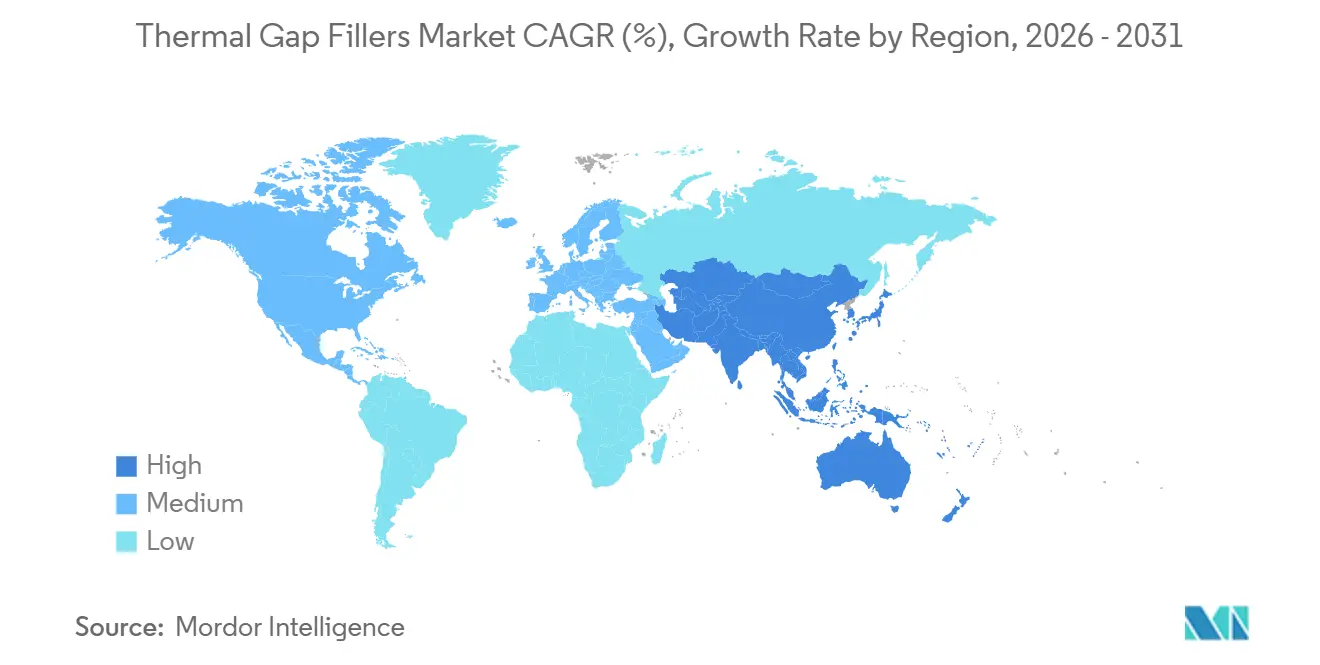
APAC Thermal Gap Fillers Market
Asia-Pacific held 42.19% of global revenue in 2025 and is projected to advance at a 9.08% CAGR through 2031. The thermal gap fillers market share in Asia-Pacific was supported by China’s electric vehicle powertrain output and electronics assembly activity. South Korea added demand through semiconductor packaging and high-bandwidth memory production, where stack-level interfaces create new application points below 1 mm. Japan’s specialty silicone supply chain serves domestic automotive manufacturers and regional export markets. India and the Association of Southeast Asian Nations countries are gaining demand as electronics and electric vehicle assembly shift from higher-cost production locations.
APAC and North America Thermal Gap Fillers Market
The thermal gap fillers market in Asia-Pacific also benefits when material suppliers locate production near assembly hubs. Qualifying a product for one cell-to-pack battery platform can extend volumes across 3-5 vehicle model lines, which creates an incentive for local technical support. North America drives demand through the concentration of hyperscale artificial intelligence data center projects. It also supports electric vehicle qualification activity as manufacturers localize supply chains for domestic-content requirements. Regional material development and qualification capabilities serve electric vehicle, defense, and advanced computing programs at the same time.
EMEA and South America Thermal Gap Fillers Market
Europe includes Germany, France, the United Kingdom, Italy, and the Nordic Countries as primary demand centers. Automotive manufacturers and Tier 1 suppliers in the region maintain demanding documentation requirements for thermal cycling, oil bleed, and volatile siloxane analysis. European Union restrictions on D4, D5, and D6 cyclic siloxanes favor low-volatile and compliant reformulations. South America remain a developing area, with demand linked to electric vehicle adoption and electronics manufacturing in Brazil and Argentina. The Middle-East and Africa demand is supported by fifth-generation network deployment and data center construction for sovereign artificial intelligence programs. These areas have a smaller base but are expected to gain momentum through 2031.
Competitive Landscape
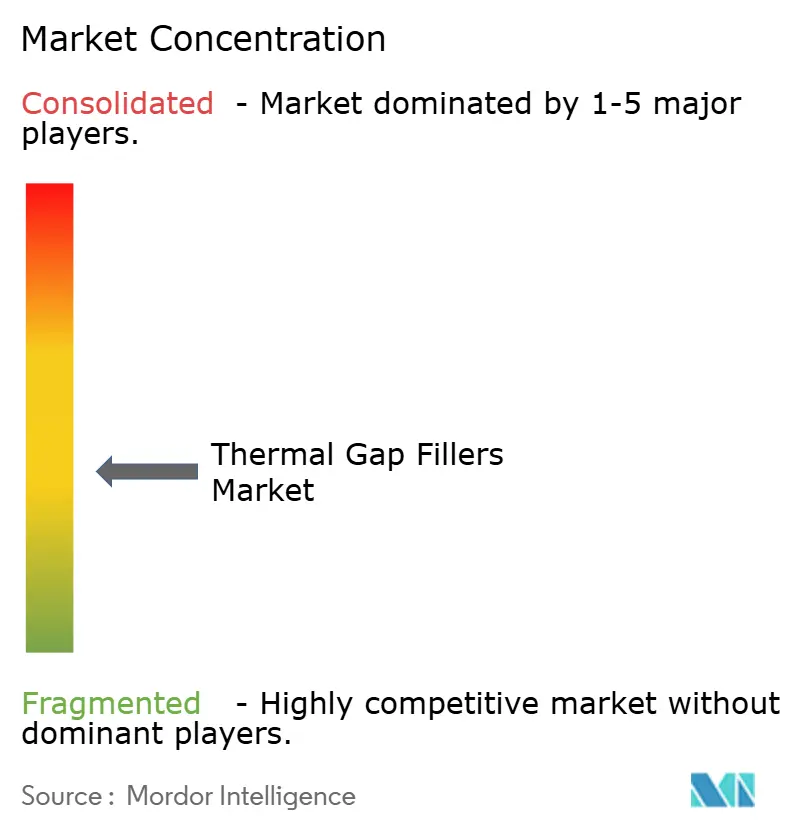
The thermal gap fillers market is moderately concentrated, with the top five players including Henkel AG & Co. KGaA, 3M, Parker Hannifin Corp., Dow, and Shin-Etsu Chemical Co., Ltd. These suppliers raised conductivity through successive product tiers at 2, 4, 6.5, 10, and 14.5 W/(m·K). They also developed cure-in-place and single-component products to reduce customer assembly time. These approaches linked materials development to customer production needs and helped suppliers retain approved positions.
Henkel AG & Co. KGaA launched Bergquist Gap Filler TGF 6500LVO in July 2026 with 6.5 W/(m·K) conductivity for automotive electronic assemblies. It also commercialized Loctite TCF 14001 in October 2025 with 14.5 W/(m·K) conductivity for artificial intelligence data center optical transceivers. These launches show how suppliers invest in materials before higher-performance specifications become widespread. The thermal gap fillers market, therefore, rewards companies that can maintain consistent materials across qualified production sites. It also favors suppliers that combine materials engineering with practical support for automated assembly processes.
Silicone-free formulations above 5 W/(m·K) offer opportunities in optical and medical applications. Dual-function barrier and gap-filler materials could also support cell-to-pack electric vehicle enclosures. Ultra-thin pads below 0.3 mm are relevant to wearable and implantable medical electronics. Boyd, Electrolube, and Elkem ASA compete where regional sales coverage and application support are important. KCC Corporation and Momentive operate in both silicone materials and finished-product supply, which can support cost management and reformulation flexibility.
Thermal Gap Fillers Industry Leaders
-
Henkel AG & Co. KGaA
-
3M
-
PARKER HANNIFIN CORP
-
Dow
-
Shin-Etsu Chemical Co., Ltd.
- *Disclaimer: Major Players sorted in no particular order
Thermal Gap Fillers Market Companies Covered in this Report
- 3M
- Boyd
- Dow
- DuPont
- Electrolube
- Elkem ASA
- Fuji Polymer Industries Co., Ltd.
- Henkel AG & Co. KGaA
- Honeywell International Inc.
- KCC Corporation
- Momentive
- PARKER HANNIFIN CORP
- Rogers Corporation
- Saint-Gobain
- Shin-Etsu Chemical Co., Ltd.
- Wacker Chemie AG
Recent Industry Developments in Thermal Gap Fillers Market
- July 2026: Henkel AG & Co. KGaA launched Bergquist Gap Filler TGF 6500LVO, a two-component low-volatile silicone gap filler with 6.5 W/(m·K) thermal conductivity, targeting Advanced Driver-Assistance Systems (ADAS), Electronic Control Units (ECUs), and Electric Vehicle (EV) power-conversion components. The launch expands Henkel’s high-performance thermal interface material portfolio for automotive electronics, supporting demand for advanced thermal gap fillers.
- December 2025: Henkel AG & Co. KGaA introduced Bergquist TGF 10000, a liquid silicone gap filler delivering 10 W/(m·K) thermal conductivity for automotive domain controllers, ADAS, and high-power computing applications. Its high thermal performance addresses increasing heat-management requirements in power-dense electronic systems, supporting the adoption of advanced thermal gap filler materials.
Global Thermal Gap Fillers Market Report Scope
Thermal gap fillers are thermally conductive materials used to bridge air gaps and surface irregularities between heat-generating components and heat dissipation systems. They improve thermal transfer by reducing interfacial resistance, helping maintain suitable operating temperatures, and supporting the reliability of heat-sensitive devices and equipment.
The Thermal Gap Fillers Market is segmented by material type, end-user industry, and geography. By material type, the market is segmented into silicone type, non-silicone type, and other material types. By end-user industry, the market is segmented into electronics, automotive, telecommunications, industrial, healthcare, and other end-user industries. The report also covers the market size and forecasts for thermal gap fillers in 15 countries across major regions. For each segment, the market sizing and forecasts have been done on the basis of value (USD).
Segmentation Overview
| Silicone Type |
| Non-Silicone Type |
| Other Material Types |
| Electronics |
| Automotive |
| Telecommunications |
| Industrial |
| Healthcare |
| Other End-User Industries |
| Asia-Pacific | China |
| India | |
| Japan | |
| South Korea | |
| ASEAN Countries | |
| Rest of Asia-Pacific | |
| North America | United States |
| Canada | |
| Mexico | |
| Europe | Germany |
| United Kingdom | |
| France | |
| Italy | |
| NORDIC Countries | |
| Rest of Europe | |
| South America | Brazil |
| Argentina | |
| Rest of South America | |
| Middle-East and Africa | Saudi Arabia |
| South Africa | |
| Rest of Middle-East and Africa |
| By Material Type | Silicone Type | |
| Non-Silicone Type | ||
| Other Material Types | ||
| By End-User Industry | Electronics | |
| Automotive | ||
| Telecommunications | ||
| Industrial | ||
| Healthcare | ||
| Other End-User Industries | ||
| By Geography | Asia-Pacific | China |
| India | ||
| Japan | ||
| South Korea | ||
| ASEAN Countries | ||
| Rest of Asia-Pacific | ||
| North America | United States | |
| Canada | ||
| Mexico | ||
| Europe | Germany | |
| United Kingdom | ||
| France | ||
| Italy | ||
| NORDIC Countries | ||
| Rest of Europe | ||
| South America | Brazil | |
| Argentina | ||
| Rest of South America | ||
| Middle-East and Africa | Saudi Arabia | |
| South Africa | ||
| Rest of Middle-East and Africa | ||
Key Questions Answered in the Report
What is the size of the thermal gap fillers market?
The thermal gap fillers market stands at USD 2.97 billion in 2026 and is projected to reach USD 4.37 billion by 2031.
What is driving demand for thermal gap fillers?
The thermal gap fillers market is supported by electric vehicle battery packs, artificial intelligence servers, fifth-generation network equipment, and denser electronic designs.
Which material type led the demand in 2025?
Silicone type held 58.47% of revenue in 2025 because it has a long qualification history, a broad operating range, and compatibility with automated dispensing.
Which end-user industry is expected to grow fastest through 2031?
Healthcare is projected to advance at an 8.67% CAGR through 2031, supported by compact medical devices and requirements for low-migration materials.