
Thailand Pet Nutraceuticals Market Size and Share
Market Overview
| Study Period | 2021 - 2031 |
|---|---|
| Forecast Data Period | 2026 - 2031 |
| Base Year Market Size (2025) | USD 48 Million |
| Market Size (2026) | USD 52.51 Million |
| Market Size (2031) | USD 81.81 Million |
| Growth Rate (2026 - 2031) | 9.27 % |
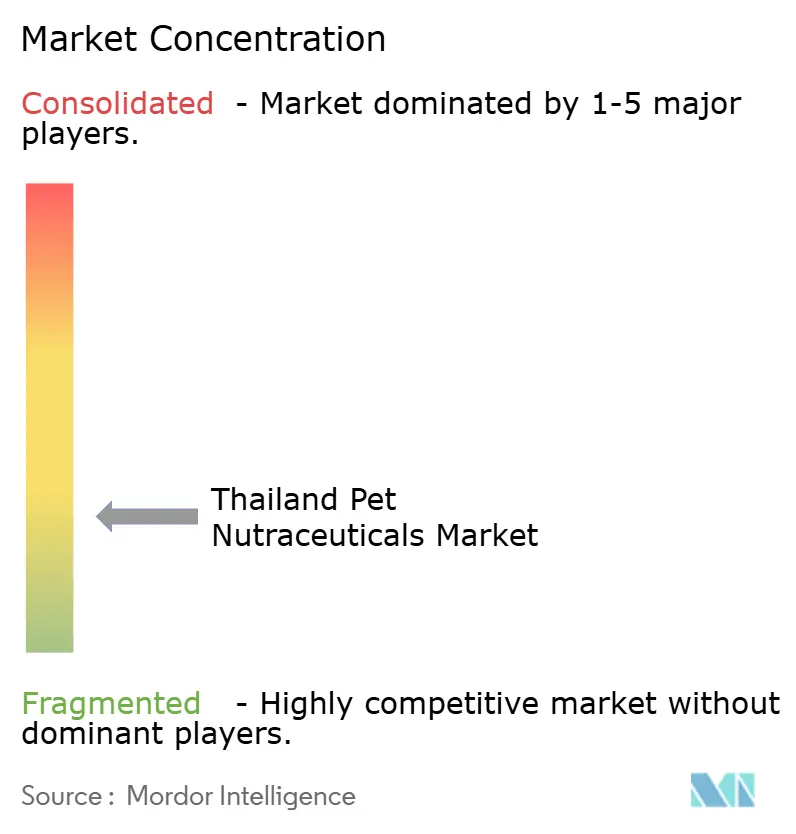
| Market Concentration | Low |
Major Players *Disclaimer: Major Players sorted in no particular order Image © Mordor Intelligence. Reuse requires attribution under CC BY 4.0. | |
Thailand Pet Nutraceuticals Market Analysis by Mordor Intelligence
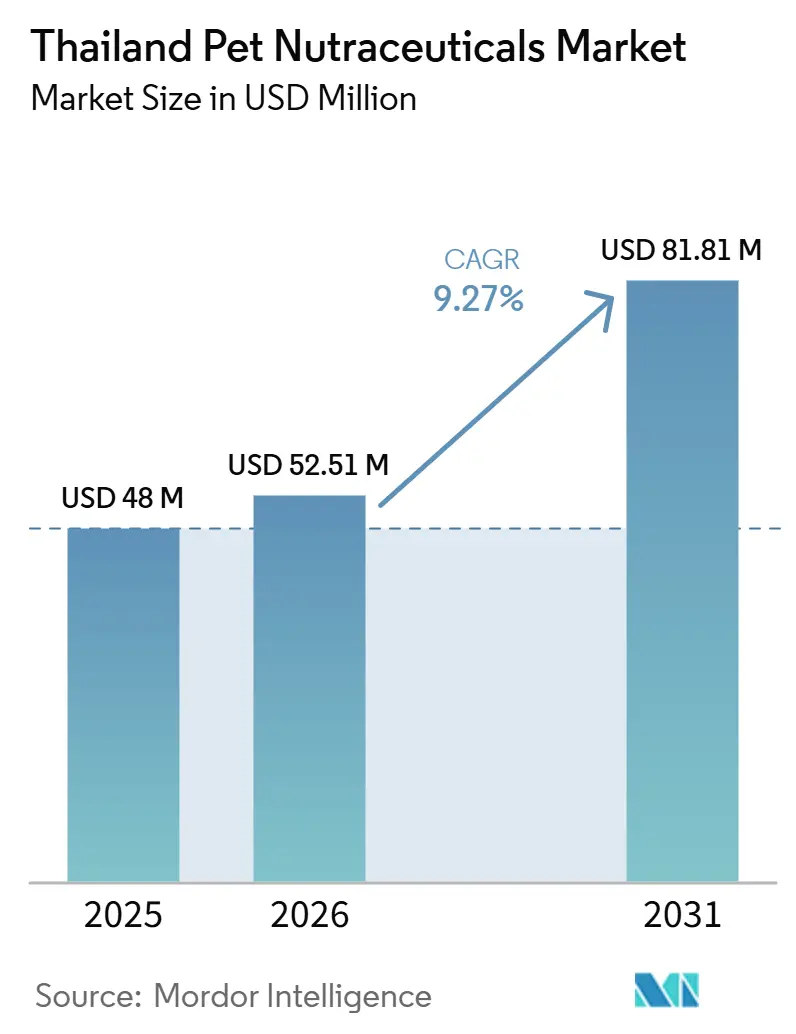
The Thailand pet nutraceuticals market size was valued at USD 48 million in 2025 and is estimated to grow from USD 52.5 million in 2026 to reach USD 81.8 million by 2031, at a CAGR of 9.27% during the forecast period 2026-2031. According to Kasikorn Research Center, Thailand had 1.94 million domesticated cats and 3.45 million pet dogs by 2025, providing the Thailand pet nutraceuticals market with a larger spending base. Spending patterns are shifting from general feeding toward preventive care, and that change is helping supplements move from occasional purchases to more regular household spending. According to the Department of Livestock Development Thailand Statistica, Thai pet owners spent THB 50,500 (USD 1,385) per pet in 2025, up 23% from the prior year, and a meaningful part of that increase is tied to health products[1]. The main near-term limit is still affordability outside Bangkok and other major cities, where premium products remain out of reach for a large part of the pet-owning population.
Key Report Takeaways
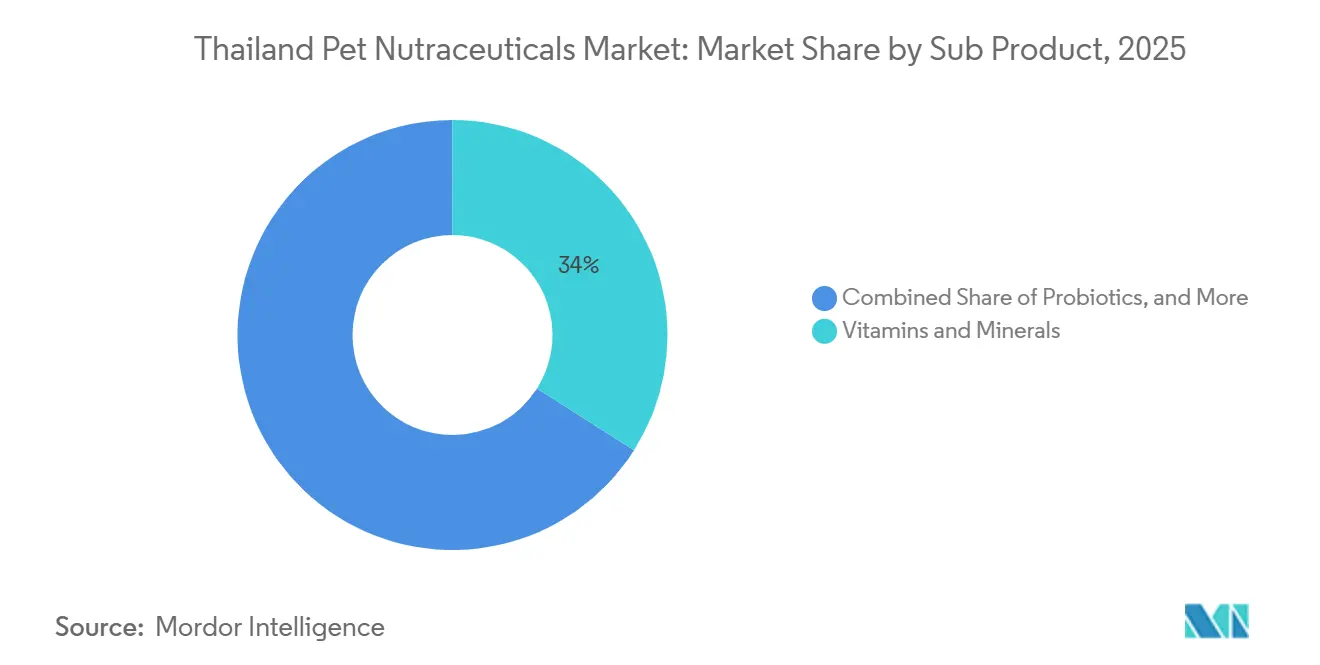
- By sub-product, vitamins and minerals led with 34.0% of the Thailand pet nutraceuticals market size in 2025, while probiotics are the fastest-growing, forecast to expand at an 11.8% CAGR through 2026 to 2031.
- By pet type, dogs accounted for the largest share of the Thailand pet nutraceuticals market share in 2025, at 58.0% of the market size, while cats recorded the fastest-growing pet type, with the highest projected CAGR of 10.5% through 2026 to 2031.
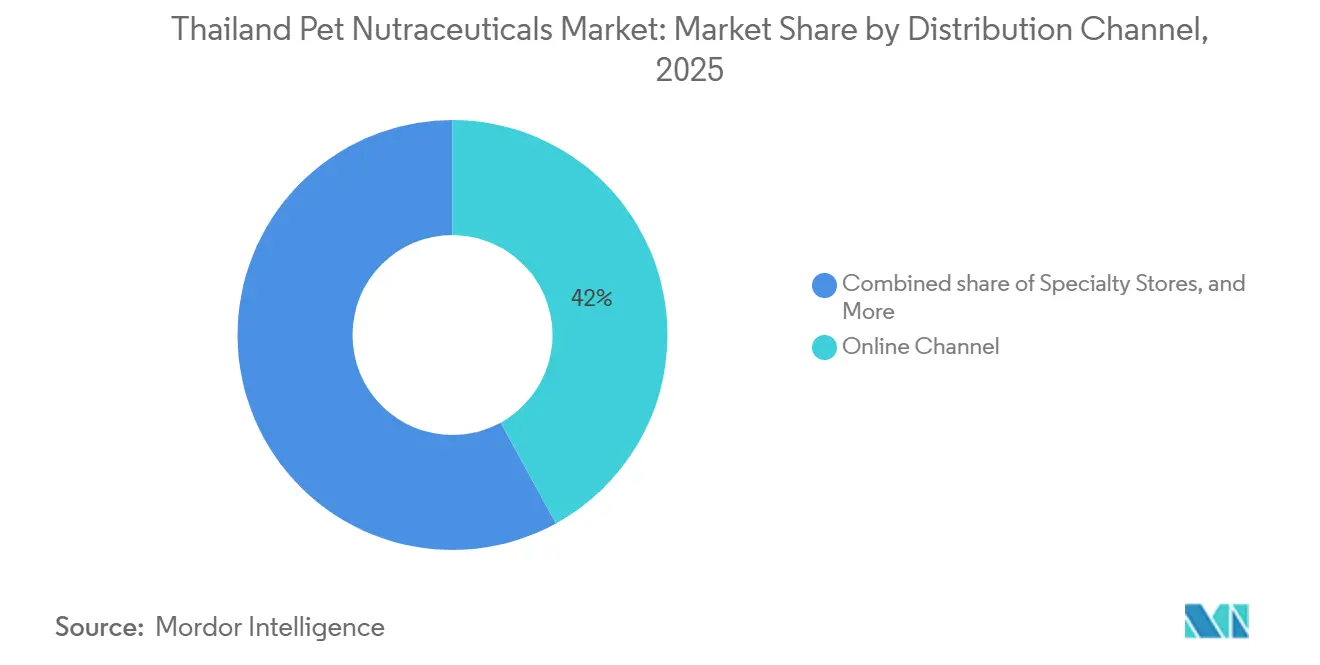
- By distribution channel, online channel accounted for the largest channel 42.0% of Thailand pet nutraceuticals market share in 2025, while online channel is also the fastest-growing, advancing at a 11.4% CAGR through 2026 to 2031.
Note: Market size and forecast figures in this report are generated using Mordor Intelligence’s proprietary estimation framework, updated with the latest available data and insights as of January 2026.
Thailand Pet Nutraceuticals Market Trends and Insights
Drivers Impact Analysis*
| Driver | (~) % Impact on CAGR Forecast | Geographic Relevance | Impact Timeline |
|---|---|---|---|
| Pet Humanization and Preventive Wellness Buying | +2.0% | Thailand-wide, concentrated in Bangkok Metropolitan Region | Short term (≤ 2 years) |
| Rising Use of Daily Vitamins and Supplements | +1.8% | Bangkok, Chiang Mai, Eastern Seaboard urban clusters | Short term (≤ 2 years) |
| Premiumization Toward Science-Backed Functional Nutrition | +1.5% | Urban Thailand, with spillover to secondary cities | Medium term (2-4 years) |
| Omni-Channel Access and E-Commerce Convenience | +1.3% | National, concentrated in digitally connected urban areas | Short term (≤ 2 years) |
| Expanding Veterinary Guidance for Preventive Care | +1.0% | Bangkok and surrounding provinces, with gradual rural expansion | Medium term (2-4 years) |
| Under-Served Senior Pet Health and Mobility Needs | +0.8% | Bangkok and urban secondary markets | Long term (≥ 4 years) |
| Source: Mordor Intelligence | |||
Pet Humanization and Preventive Wellness Buying
Pet humanization has become one of the clearest drivers of the Thailand pet nutraceuticals market. According to Thai Pet Product Industry Association, Thai pet owners spent THB 50,500 (USD 1,385) per pet in 2025, up 23% from the prior year, and are moving toward preventive care rather than only treating illness after it occurs. The Thai Pet Product Industry Association said in 2025 that owners are increasingly buying health products to help prevent disease, which supports more repeat buying than symptom-led purchases. Bangkok, where pet ownership is high among households, these behaviors are already visible and are likely to spread outward through the Thailand pet nutraceuticals market over the medium term. The growing awareness of age-related health issues in companion animals is driving demand for supplements that support joint health, mobility, digestion, and immune function. Pet owners are focusing on enhancing their pets' quality of life and extending their healthy lifespans.
Rising Use of Daily Vitamins and Supplements
Routine supplement use is becoming more common in Thailand's pet nutraceutical market as owners shift from occasional use to everyday care. Veterinarian-recommended domestic brands are nowadays available in clinics and pet shops, positioning daily vitamins and supplements as standard care rather than optional additions. VetSynova launched its AA Amino Acids supplement at Pet Expo Thailand in May 2024, linking the product to rising malnutrition-related pet hospitalizations, which reinforced a practical health message for the launch. This clinic-led visibility supports repeat demand among dog and cat owners in the Thailand pet nutraceuticals market. As this purchasing habit strengthens, basic vitamins and supportive formulations are expected to continue broadening the buyer base, even before more advanced categories fully scale.
Premiumization Toward Science-Backed Functional Nutrition
The Thailand pet nutraceuticals market is benefiting from growing interest in formulations with clear functional benefits and scientific backing. Nearly half of Thai pet owners use supplements for their companion animals, with demand increasing for products supporting gut health, joint mobility, and immune function. Probiotics and omega-3 formats are gaining traction because their benefits are easier to communicate through outcome-based use cases than general wellness products. ADM strengthened the scientific foundation in this area by publishing a canine clinical trial in the Journal of Animal Science in October 2024, demonstrating positive microbiome outcomes from daily BPL1 supplementation. As more suppliers and finished goods brands incorporate clinical evidence into their product positioning, the Thailand pet nutraceuticals market is likely to continue favoring premium products over low-differentiation supplements.
Omni-Channel Access and E-Commerce Convenience
According to the United States Department of Agriculture, Digital commerce gives the Thailand pet nutraceuticals market a strong route to both discovery and repeat purchase. The USDA estimated Thailand’s pet food e-commerce segment at USD 600 million in 2025, up 20% year over year, and the same infrastructure supports online supplement buying. Shopee, Lazada, and TikTok Shop have become important touchpoints because premium products need space for explanations, reviews, and trial offers[2]. Quick-commerce services in Bangkok also remove waiting time, which matters for replenishment products that owners want delivered quickly. The result is that the Thailand pet nutraceuticals market can convert digital trial into recurring revenue more easily than many other pet product categories.
Restraints Impact Analysis*
| Restraint | (~) % Impact on CAGR Forecast | Geographic Relevance | Impact Timeline |
|---|---|---|---|
| Price Sensitivity Versus Premium Formulation Costs | -1.8% | Thailand-wide, most acute outside Bangkok | Short term (≤ 2 years) |
| Limited Category Awareness Outside Urban Pet Owners | -1.5% | Rural Thailand and secondary-tier cities | Medium term (2-4 years) |
| Product Claims Scrutiny and Compliance Complexity | -1.0% | National, with foreign importers most affected | Medium term (2-4 years) |
| Fragmented Retail Visibility for Specialist Nutraceuticals | -0.8% | Secondary cities and modern trade outlets | Long term (≥ 4 years) |
| Source: Mordor Intelligence | |||
Price Sensitivity Versus Premium Formulation Costs
Price remains the clearest restraint on wider adoption in the Thailand pet nutraceuticals market. The Thai Pet Product Industry Association anticipated in 2025 that 80% to 90% of Thai pet owners had not yet shifted to premium pet products, with purchasing power identified as the main barrier[3]. This is most visible outside Bangkok, where premium supplements compete against lower household spending and weaker exposure to specialist veterinary products. Imported brands face additional costs from registration, local representation, and compliance requirements, which further raise retail prices. That keeps the Thailand pet nutraceuticals market growing, but it also slows penetration into the larger mass segment.
Limited Category Awareness Outside Urban Pet Owners
Awareness is still uneven across Thailand's pet nutraceuticals market, which limits natural demand outside large cities. Bangkok Business News reported in 2024 that 60% of Thai households still fed their pets human food, indicating how far many consumers remain from premium preventive care habits. The draft also points to weaker awareness in more specialized cat categories, especially brain-health and neurological support products. That means the Thailand pet nutraceuticals market still depends heavily on education through clinics, sampling, and Thai-language digital content to reach new households. Until that education broadens, growth outside urban centers will remain slower than the category’s potential suggests.
*Our forecasts treat driver/restraint impacts as directional, not additive. The impact forecasts reflect baseline growth, mix effects, and variable interactions.
Segment Analysis
By Sub Product: Probiotics Lead a Microbiome-Centered Product Upgrade
Vitamins and minerals accounted for largest sub product 34.0% of Thailand's pet nutraceuticals market share in 2025, while probiotics are projected to grow at a 11.8% CAGR through 2031. The largest segment remains daily micronutrient support because veterinarians already use it as part of standard wellness routines, and owners understand the need with little explanation. Probiotics are growing faster because digestive health and immunity are easier to connect with visible pet outcomes, giving the category a stronger premium appeal. The Thailand pet nutraceuticals market is therefore shifting from broad supplementation toward more focused functional use, rather than replacing the older vitamin base all at once.
Clinical support is strengthening the probiotic case and making the category harder to dismiss as a short-lived premium trend. Omega-3 fatty acids continue to benefit from owner awareness around skin, coat, and joint support, while proteins and peptides are finding space in recovery and performance use cases. Milk bioactives and herbal products remain smaller categories, and the Thailand pet nutraceuticals industry still favors established ingredient groups because the local compliance framework makes newer formats slower to scale.

By Pet Type: Rising Cat Ownership Reconfigures Addressable Demand
Dogs held the largest segment, 58.0% of the Thailand pet nutraceuticals market share in 2025, supported by Thailand’s large dog ownership base of 3.45 million dogs projected for 2025 by the United States Department of Agriculture. Dogs remain central to demand because joint support, omega-3, protein, and recovery products fit well with their age profile and activity needs. The dog segment is still large enough to anchor the Thailand pet nutraceuticals market, but slower expansion in broader dog nutrition increases the need for value growth through add-on health products. That makes nutraceutical upselling more important within the established dog owner base than simple volume expansion alone.
Cats are the fastest-growing pet type with a projected CAGR of 10.5% from 2026 to 2031, and cat ownership grew at 28% annually between 2021 and 2024 to reach 1.94 million cats by 2025 by the United States Department of Agriculture. The Thailand pet nutraceuticals industry is therefore gaining a second engine of demand through feline probiotics, taurine products, and age-support formulas. Other pets remain small, but they show that ownership is diversifying beyond the traditional dog-led base.
By Distribution Channel: Online Dominance Masks Specialty Store Value
The online channel accounted for the largest share of the Thailand pet nutraceuticals market in 2025, at 42% of the market, and is projected to expand at a 11.4% CAGR through 2031. Digital channels are particularly effective for premium supplements, as brands can explain ingredients, collect reviews, and drive repeat purchases within the same environment. This digital momentum also directly supports sales of supplements in Thailand's pet food e-commerce segment. Online platforms help overcome shelf-space constraints that often slow the discovery of specialist products, benefiting the Thailand pet nutraceuticals market through a broader channel mix.
Specialty stores and veterinary clinics still hold strategic value because they provide trust at the point of first purchase. VetSynova’s VFcore brand distributes through veterinary hospitals and specialty pet shops, which supports clinical credibility and pricing discipline for recommendation-led categories. Supermarkets and hypermarkets mainly support simpler vitamin products, while convenience stores are better suited to trial packs such as sachets and lickable gels. The Thailand pet nutraceuticals industry is therefore not purely online, because physical specialist channels continue to shape what owners are willing to try and repurchase.
Geography Analysis
Bangkok and the greater metropolitan region remained the main demand center for Thailand's pet nutraceuticals market in 2025, as high-income pet owners, a dense veterinary infrastructure, and stronger digital adoption are concentrated there. According to the United States Department of Agriculture, in 2025 pet ownership reached 37% of households in Bangkok, making the city the country’s clearest early-adoption zone for preventive pet health products. National regulation also supports this hub position, as the Department of Livestock Development applies human-grade Good Manufacturing Practice (GMP) and Hazard Analysis and Critical Control Points (HACCP) standards, while Thailand’s health product import control system became fully digital in June 2025.
Secondary cities such as Chiang Mai, Phuket, and the Eastern Seaboard are becoming increasingly important to Thailand's pet nutraceuticals market as income, clinic access, and logistics improve. Thailand had 3,500 pet hospitals in 2024, and 600 to 700 new animal hospitals and clinics opened in 2023, which widened the map for preventive care discussions beyond the capital. Thailand Post partnered with Chulalongkorn University’s Faculty of Veterinary Science and the Bangkok Animal Hospital in June 2025 to deliver pet medication nationwide, which helps veterinary-linked products reach more households.The Eastern Seaboard also gained strategic weight after Nestlé opened its PURINA PetCare facility in Rayong in 2024, strengthening local supply for premium pet nutrition.
Rural Thailand and lower-tier provinces still represent the least developed part of the Thailand pet nutraceuticals market. Pet ownership continues to be prevalent in many rural areas; however, spending on premium preventive-care products is typically lower compared to major urban centers. This is due to more price-sensitive household budgets and limited access to specialized veterinary services. Additionally, awareness of nutraceutical products remains in the early stages of development outside large cities, which hinders adoption and keeps demand primarily concentrated in metropolitan and secondary urban markets.
Competitive Landscape
The Thailand pet nutraceuticals market is fragmented, with Nestlé S.A., Mars, Incorporated, Hill’s Pet Nutrition, Inc. (Colgate-Palmolive), Virbac S.A., and Zoetis Inc. That structure shows that no single player controls the category and that competitive strength still depends on a mix of veterinary trust, functional formulation, and channel placement. The Thailand pet nutraceuticals market also remains young enough for domestic specialists to challenge global brands in specific therapeutic or preventive niches. As a result, leadership is still being shaped by who can combine product credibility with steady access to clinics, specialty retail, and digital repeat purchase channels.
The increasing premiumization of pet care in Thailand is a significant competitive factor. Pet owners are increasingly seeking targeted nutraceutical products that address joint health, digestive wellness, skin and coat care, immune support, and age-related conditions. This trend creates opportunities for companies to differentiate themselves through scientifically validated formulations and condition-specific product portfolios. Brands that focus on clinical validation, veterinarian education programs, and transparent ingredient sourcing are likely to enhance consumer confidence and foster long-term loyalty in a market where awareness of preventive pet healthcare is expanding.
Distribution strategies are also becoming critical to market success. While veterinary clinics remain a trusted channel for therapeutic and preventive recommendations, online platforms and specialty pet retailers are gaining prominence as consumers prioritize convenience and a broader product selection. Companies adopting omnichannel sales approaches, utilizing digital marketing, and offering subscription or repeat-purchase programs can improve customer retention and brand visibility. With e-commerce penetration growing and pet humanization trends continuing, firms with strong digital engagement capabilities are projected to secure a competitive edge in Thailand’s evolving pet nutraceuticals market.
Thailand Pet Nutraceuticals Industry Leaders
-
Nestlé S.A.
-
Mars, Incorporated
-
Virbac S.A.
-
Zoetis Inc.
-
Hill's Pet Nutrition, Inc. (Colgate-Palmolive)
- *Disclaimer: Major Players sorted in no particular order
Recent Industry Developments
- January 2026: Virbac launched URSOLYX Soft Chews for Cats, the first feline-specific muscle support supplement in the company's global portfolio including Thailand. The product follows the successful 2025 canine version, with early efficacy study results showing 82% improvement in mobilit by week 8. The launch expands Virbac's nutraceutical footprint across companion animals and deepens its engagement in the Australian veterinary supplement channel.
- July 2025: Thailand Post Company Limited partnered with Chulalongkorn University's Faculty of Veterinary Science and the Bangkok Animal Hospital to launch a nationwide pet medication delivery service under the "P'Post delivers medicine, Chula Vets deliver love" campaign, resolving long waiting times and geographic access gaps in veterinary care and creating a logistics infrastructure directly applicable to supplement prescription delivery.
- May 2024: Nestlé introduced the expansion of its two Purina pet food factories in Rayong in 2024 to increase domestic and export capacity. This expansion is part of a broader investment plan to meet surging demand for premium pet food including nutraceuticals across the domestic market.
Thailand Pet Nutraceuticals Market Report Scope
Pet nutraceuticals are products administered to animals, including dogs, cats, birds, and horses, to offer health benefits that extend beyond basic nutrition. The Thailand pet nutraceuticals market report is segmented by sub product (milk bioactives, omega-3 fatty acids, probiotics, proteins and peptides, vitamins and minerals, and other nutraceuticals), by pets (cats, dogs, and other pets), and by distribution channel (convenience stores, online channel, and more). The market forecasts are provided in terms of Value (USD) and Volume (Metric Tons).
| Vitamins and Minerals |
| Probiotics |
| Omega-3 Fatty Acids |
| Proteins and Peptides |
| Milk Bioactives |
| Other Nutraceuticals |
| Dogs |
| Cats |
| Other Pets |
| Convenience Stores |
| Online Channel |
| Specialty Stores |
| Supermarkets/Hypermarkets |
| Other Channels |
| By Sub Product | Vitamins and Minerals |
| Probiotics | |
| Omega-3 Fatty Acids | |
| Proteins and Peptides | |
| Milk Bioactives | |
| Other Nutraceuticals | |
| By Pet Type | Dogs |
| Cats | |
| Other Pets | |
| By Distribution Channel | Convenience Stores |
| Online Channel | |
| Specialty Stores | |
| Supermarkets/Hypermarkets | |
| Other Channels |
Key Questions Answered in the Report
What is the projected growth path for pet nutraceuticals in Thailand through 2031?
The Thailand pet nutraceuticals market is projected to rise from USD 52.50 million in 2026 to USD 81.80 million by 2031 at a 9.27% CAGR.
Which product type leads sales, and which one is growing fastest?
Vitamins and minerals led with a 34.0% share in 2025, while probiotics are projected to grow fastest at an 11.8% CAGR through 2031.
Why are Thai pet owners spending more on supplements?
Spending is shifting toward preventive care, supported by pet humanization, stronger veterinary guidance, and wider digital access to premium products.
Which pet category creates the strongest future opportunity?
Cats offer the strongest growth opportunity, as the segment is forecast to grow at a 10.5% CAGR through 2026 to 2031.