
Testing Equipment and Services Market Size and Share
Market Overview
| Study Period | 2020 - 2031 |
|---|---|
| Market Size (2026) | USD 224.49 Billion |
| Market Size (2031) | USD 285.72 Billion |
| Growth Rate (2026 - 2031) | 4.94 % |
| Fastest Growing Market | Asia-Pacific |
| Largest Market | Asia-Pacific |
| Market Concentration | Medium |
Major Players *Disclaimer: Major Players sorted in no particular order Image © Mordor Intelligence. Reuse requires attribution under CC BY 4.0. | |
Testing Equipment and Services Market Analysis by Mordor Intelligence
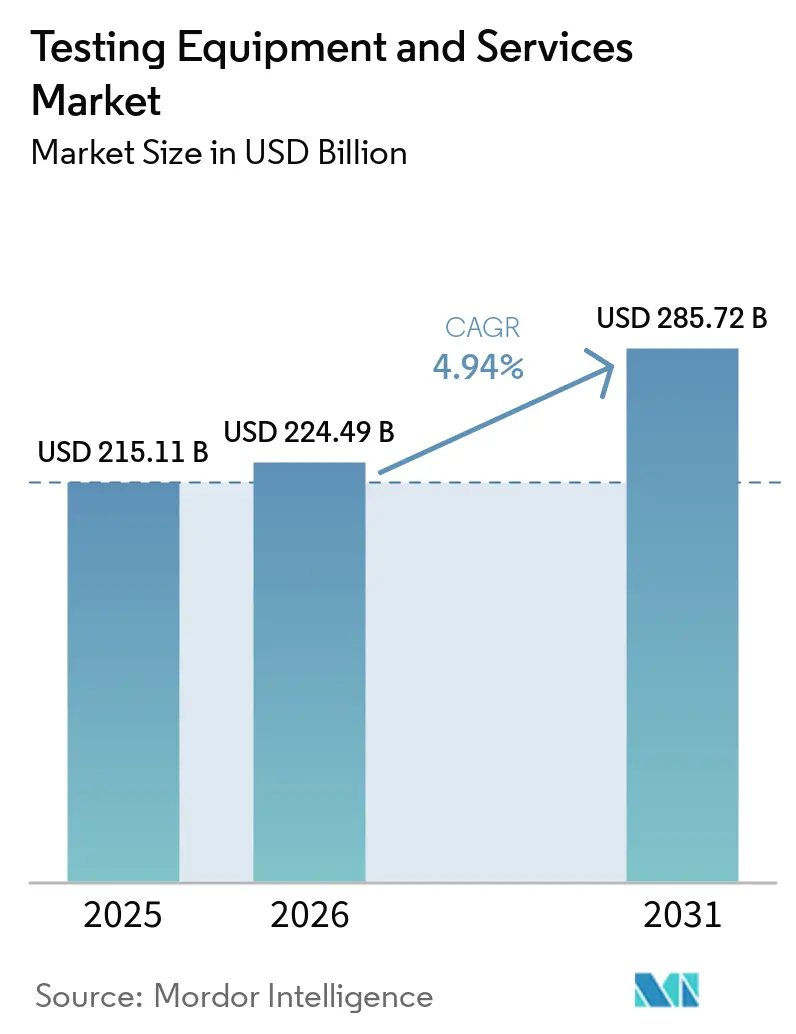
The testing equipment and services market size was valued at USD 215.11 billion in 2025 and estimated to grow from USD 224.49 billion in 2026 to reach USD 285.72 billion by 2031, at a CAGR of 4.94% during the forecast period (2026-2031). Conformity assessment remains a necessary operating expense across manufacturing, energy, electronics, aerospace, and consumer goods supply chains because regulators and buyers require documented quality and safety performance. The testing equipment and services market is supported by both in-house equipment purchases for production control and outsourced service contracts for complex compliance work. Product safety requirements, expanding semiconductor output, and wider use of non-destructive evaluation are shaping demand. More automated production raises the cost of undetected defects and increases the need for frequent inspection. This environment favors providers that can combine accredited laboratories, field capabilities, and reliable digital records.
Key Report Takeaways
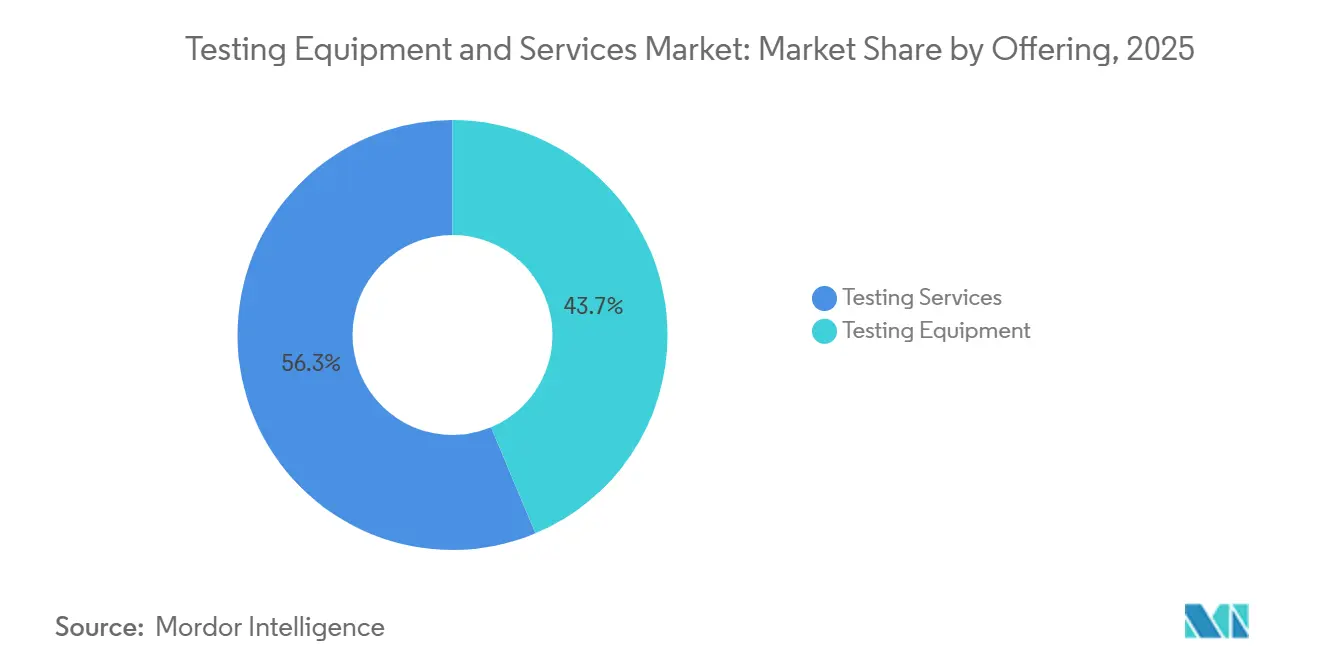
- By offering, testing services held 56.31% of the testing equipment and services market revenue share in 2025 and is projected to expand at a 5.34% CAGR through 2031.
- By equipment type, electrical and electronic testing equipment accounted for 23.67% of revenue in 2025, while optical and imaging testing equipment is projected to record the highest CAGR of 5.89% through 2031.
- By service type, laboratory testing captured 63.78% of revenue in 2025, while on-site testing is projected to grow at a 5.81% CAGR through 2031 in the testing equipment and services market.
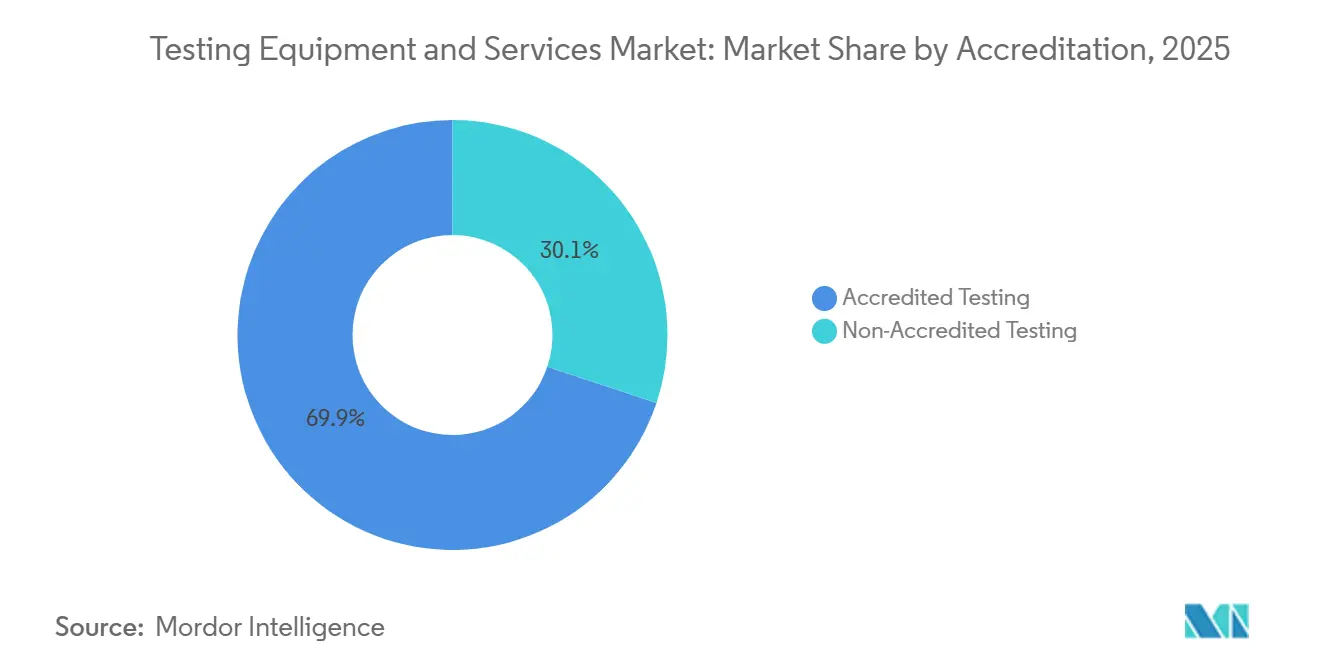
- By accreditation, accredited testing accounted for 69.87% of revenue in 2025 and is projected to grow at a 5.48% CAGR through 2031.
- By end-user industry, manufacturing and industrial users accounted for 23.76% of revenue in 2025, while electronics and semiconductor users are projected to grow at a 5.93% CAGR through 2031.
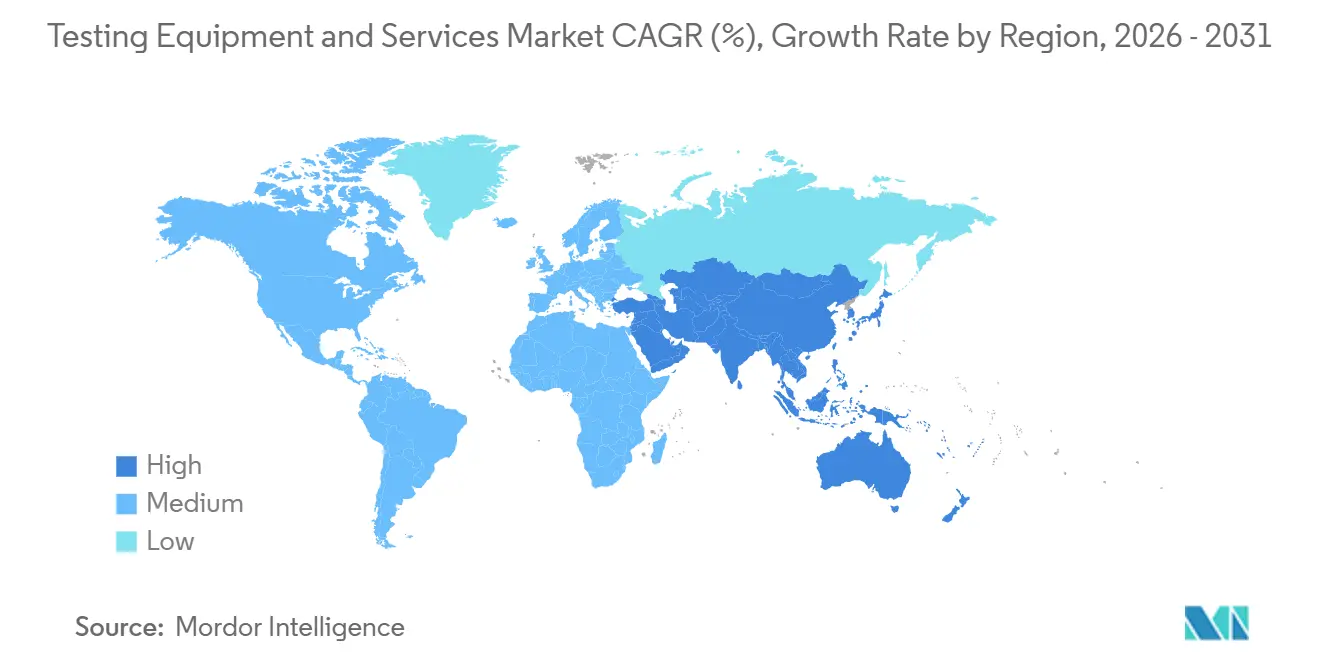
- By geography, Asia-Pacific held 33.20% of revenue in 2025 and is projected to expand at a 5.68% CAGR through 2031 in the testing equipment and services market.
Note: Market size and forecast figures in this report are generated using Mordor Intelligence’s proprietary estimation framework, updated with the latest available data and insights as of January 2026.
Market Trends and Insights
Drivers Impact Analysis of Testing Equipment and Services Market*
| DRIVER | (~) % IMPACT ON CAGR FORECAST | GEOGRAPHIC RELEVANCE | IMPACT TIMELINE |
|---|---|---|---|
| Increasing Product Quality and Safety Regulations | +1.3% | Global, concentrated in North America, Europe, and Asia-Pacific manufacturing hubs | Long term (≥ 4 years) |
| Expansion of Electronics, Semiconductor, and EV Industries | +1.1% | Asia-Pacific core, with spillover to North America and Europe through fab localization | Medium term (2-4 years) |
| Growth of Advanced Manufacturing and Industrial Automation | +0.9% | Global, concentrated in Germany, the United States, China, Japan, and South Korea | Long term (≥ 4 years) |
| Rising Adoption of Non-Destructive Testing Technologies | +0.6% | Global, with strong demand in North America, Europe, and petrochemical-focused Middle East and Africa | Medium term (2-4 years) |
| Increasing Outsourcing of Testing Activities | +0.4% | Global, with the fastest uptake in Asia-Pacific and South America | Short term (≤ 2 years) |
| Growing Focus on Product Reliability and Lifecycle Testing | +0.3% | North America and Europe | Medium term (2-4 years) |
| Source: Mordor Intelligence | |||
Increasing Product Quality and Safety Regulations
Mandatory safety rules are making testing a condition of market access rather than a discretionary quality step. The EU AI Act, enacted in 2024, introduced conformity assessment requirements for AI-enabled systems. Those requirements affect electronics manufacturers, automotive suppliers, and industrial equipment producers before they release products. DEKRA became the first accredited certification body for biometric AI systems under the EU AI Act in 2025, showing how new rules can create specialized validation work. Digital product passport requirements under the EU Ecodesign Regulation framework also extend assessment from functional safety to material traceability. ISO/IEC 17025 supports laboratory competence requirements across geographies and strengthens buyer preference for certified providers.
Expansion of Electronics, Semiconductor, and EV Industries
The testing equipment and services market benefits from higher test intensity as semiconductor devices become more complex. The testing equipment and services market also requires suppliers to maintain current capabilities as device architectures evolve. Global semiconductor equipment billings reached USD 135.1 billion in 2025, up 15% from the prior year. Test equipment billings rose 55% as AI accelerator and high-bandwidth memory requirements increased testing precision.[1] Migration to 3-nanometer nodes and heterogeneous chiplet packaging requires wafer-level defect detection beyond the capability of older platforms. Electric vehicle programs also require battery-pack integrity, charging compliance, electromagnetic compatibility, and functional safety testing. Keysight Technologies and the CATARC New Energy Vehicle Inspection Center established a joint charging-test laboratory in May 2026 for China’s National Standard 2024 and combined charging system frameworks.
Growth of Advanced Manufacturing and Industrial Automation
Industrial automation moves quality assurance from periodic certification toward continuous production control. Robotic cells, AI-enabled visual inspection, and collaborative robots broaden equipment demand to include in-process sensors, machine-vision tools, and data-logging platforms. These systems feed quality data into manufacturing execution systems and make testing part of daily operating routines. Illinois Tool Works reported 6% organic growth in its Test and Measurement and Electronics segment in the first quarter of 2026. The segment then reported double-digit organic growth in the second quarter of 2026, indicating faster demand for automation-related testing products. This setting supports remote monitoring and asset-health subscriptions alongside periodic laboratory services.
Rising Adoption of Non-Destructive Testing Technologies
Non-destructive testing is becoming part of predictive asset management across oil and gas, aerospace, and power generation. The ASNT Foundation reported growing use of AI-enabled defect detection, digital twins, and cloud analytics in its 2025 economic impact report.[2] Inspection data increasingly supports operational decisions instead of serving only as a compliance record. The testing equipment and services market, therefore, includes more demand for equipment, software, and recurring analysis services. The testing equipment and services market connects these tools to inspection records that support ongoing asset management decisions. NTT Group, 1Finity, and Mitsubishi Chemical validated a physical AI- and remote robotic-inspection workflow at a Japanese industrial facility in 2026. The work used IOWN advanced photonic networking and 60 GHz wireless connectivity, demonstrating remote inspection methods that can reduce field-service constraints.
Restraints Impact Analysis of Testing Equipment and Services Market*
| RESTRAINT | (~) % IMPACT ON CAGR FORECAST | GEOGRAPHIC RELEVANCE | IMPACT TIMELINE |
|---|---|---|---|
| High Initial Investment and Maintenance Costs | -1.5% | Global, most acute in South America, Africa, and Southeast Asia | Long term (≥ 4 years) |
| Short Technology Lifecycles and Rapid Equipment Obsolescence | -0.9% | Global, concentrated in electronics and semiconductor-intensive economies | Medium term (2-4 years) |
| Shortage of Skilled Testing Professionals | -0.6% | Global, most severe in North America and Europe where accreditation requirements are strict | Medium term (2-4 years) |
| Fragmented and Competitive Testing Services Landscape | -0.3% | Global, more pronounced in Asia-Pacific and South America | Short term (≤ 2 years) |
| Source: Mordor Intelligence | |||
High Initial Investment and Maintenance Costs
Capital costs limit laboratory operators' entry and expansion, especially in price-sensitive economies. Environmental simulation chambers and semiconductor automated test equipment can require six- to seven-figure unit investments. Annual maintenance, calibration, and software licensing can represent 15-25% of the purchase price each year. This burden concentrates advanced capacity within established markets and large TIC networks. Mid-sized manufacturers in South America, Africa, and parts of Southeast Asia may find it difficult to upgrade internal facilities to recognized international standards. The resulting cost base can constrain reinvestment even when manufacturers need more capable testing capacity.
Short Technology Lifecycles and Rapid Equipment Obsolescence
Electronics and semiconductor testing have short product cycles, which can conflict with equipment depreciation periods. AI accelerators, high-bandwidth memory stacks, and chiplet assemblies require platforms that can be incompatible with older hardware. Equipment owners can therefore face capital expenditure before existing assets are fully depreciated. This condition is especially difficult for independent laboratories with a diverse customer base. Large networks can spread refresh costs across more clients and locations. The testing equipment and services market faces an ongoing need for equipment replacement, as clients expect service providers to test current device generations.
*Our forecasts treat driver/restraint impacts as directional, not additive. The impact forecasts reflect baseline growth, mix effects, and variable interactions.
Testing Equipment and Services Market Segment Analysis
By Offering:
Services Support Outsourced ValidationTesting services held 56.31% of the testing equipment and services market share in 2025 and are projected to grow at a 5.34% CAGR through 2031. Manufacturers are increasingly using external providers when formal conformity outcomes require accredited third-party participation. Outsourced laboratories can handle changing rules across several jurisdictions without requiring every manufacturer to maintain specialized internal capacity. This model is particularly useful for companies that have limited testing volumes or sell products across several regulated markets. Laboratory testing is a major source of TIC revenue because many assessments require controlled conditions and calibrated instruments. The services segment also benefits when clients need independent records for regulators, customers, or cross-border distribution.
Testing equipment remains important for in-process control and for service providers seeking technical differentiation. Equipment ownership allows manufacturers to identify production issues before products reach an external laboratory. Original equipment manufacturers are adding AI-enabled instrumentation, digital connectivity modules, and software subscriptions to their platforms. These additions can improve traceability and support recurring revenue for equipment suppliers. They also help hardware vendors respond as service spending takes a larger role in the testing equipment and services market. The offering split reflects a practical balance between internal quality control and outsourced work that requires external credibility.
By Equipment Type:
Electronics Leads While Optical and Imaging ExpandsElectrical and electronic testing equipment accounted for 23.67% of the testing equipment and services market size in 2025. Semiconductor fabrication, consumer electronics production, and electric vehicle battery validation support demand for this equipment. Device complexity increases the need for tools that measure performance, connectivity, safety, and reliability. Semiconductor producers require finer defect detection as they move to smaller nodes and advanced packaging. Electric vehicle programs add test requirements across battery integrity, charging, electromagnetic compatibility, and functional safety. These applications place electrical and electronic equipment at the center of equipment demand.
Optical and imaging testing equipment is projected to grow at a 5.89% CAGR through 2031. Machine vision is becoming more common in automated factories, while CT imaging supports 3D verification of aerospace and automotive components. Mechanical equipment remains necessary for structural safety certification. Environmental equipment supports reliability testing for electronics in demanding automotive and industrial conditions. Non-destructive testing equipment is progressing with phased-array ultrasonics and digital radiography. Chemical and analytical, safety and compliance, and material testing systems continue to serve separate technical needs across the testing equipment and services market.
By Service Type:
Laboratory Testing Remains Central While On-Site Testing GrowsLaboratory testing held 63.78% of revenue in 2025, making it the largest service type. Controlled conditions and calibrated instrumentation are essential for many regulatory submissions. Laboratories can perform repeatable assessment programs that support product certification and formal conformity decisions. This work is central to industries where safety, material performance, and electrical reliability require documented evidence. The laboratory model also supports specialized equipment that may not be economical to transport to a customer site. These conditions preserve the role of fixed laboratory networks in the testing equipment and services market.
On-site testing is projected to expand at a 5.81% CAGR through 2031 as asset owners seek faster results and less operational disruption. The approach is useful when equipment shutdowns or sample transport would be expensive. Remote-assisted inspection and drone-supported field work can reduce the field-service premium for routine monitoring. These methods can support infrastructure operators and manufacturers that require frequent observations. They also expand the range of work that can be completed near the asset. Laboratory and field services, therefore, address different operating needs rather than replacing each other.
By Accreditation:
Recognized Credentials Support Provider SelectionAccredited testing held 69.87% of revenue in 2025 and is projected to grow at a 5.48% CAGR through 2031. The leading position shows that buyers value recognized certification marks when products enter regulated supply chains. ISO/IEC 17025 is a core framework for testing and calibration laboratory competence.[3] Manufacturers and public authorities increasingly specify accreditation in procurement and regulatory submission requirements. The testing equipment and services revenue share held by accredited work reflects this need for consistent methods and credible results. Providers with credentials recognized by national bodies can reduce duplicate testing for international clients.
Non-accredited testing still supports internal monitoring and applications where enforcement requirements are lower. It can offer a lower-cost option for companies seeking routine production information rather than formal certification. Its position is under pressure as trade standards become more consistent and e-commerce platforms require testing documentation from cross-border sellers. Larger TIC providers can leverage their accreditation portfolios to support multiple countries within a single program. This capability favors organizations that maintain broad laboratory and inspection networks. Accreditation therefore functions as both a customer requirement and a barrier to entry for new service providers.
By End-Use Industry:
Manufacturing Leads and Electronics and Semiconductors AdvanceManufacturing and industrial users accounted for 23.76% of revenue in 2025. These users buy both production-line equipment and outsourced laboratory and inspection services. Automotive supply chains require strict quality processes, while aerospace components require extensive validation. Production digitalization also raises the amount and value of quality data collected during manufacturing. Manufacturers must manage product consistency while maintaining throughput and meeting customer specifications. This broad set of requirements keeps industrial users at the center of the testing equipment and services market. The testing equipment and services market serves these users through both installed tools and independently delivered technical services.
Electronics and semiconductor users are projected to expand at a 5.93% CAGR through 2031. More complex devices increase test intensity per unit and require a wider range of test types. Semiconductor plants need updated tools as processing nodes and packaging architectures change. Aerospace and defense demand follows FAA and EASA airworthiness certification cycles. Energy and power applications are creating demand for testing solar inverters, battery energy storage systems, and wind turbine drivetrains. Pharmaceuticals, biotechnology, food and beverage, chemicals and materials, oil and gas, and construction also provide continuing laboratory and field-service work.
Geography Analysis
APAC Testing Equipment and Services Market
Asia-Pacific held 33.20% of the testing equipment and services market share in 2025 and is projected to grow at a 5.68% CAGR through 2031. China supports regional demand through semiconductor manufacturing capacity and its domestic electric vehicle supply chain. Both activities require intensive testing across components, systems, and production processes. South Korea’s semiconductor and display sectors provide consistent demand for testing equipment. India is becoming an important demand center as Production Linked Incentive programs support investment in electronics and pharmaceutical manufacturing. This growth creates demand for outsourced laboratory work that local and international TIC providers seek to serve.
North America and Europe Testing Equipment and Services Market
TÜV SÜD inaugurated a SGD 100 million regional hub in Singapore in 2026, equal to USD 75 million at the 2024 average exchange rate. The hub illustrates ASEAN's role as both a service base and a regional compliance center.[4] Federal regulation, defense and aerospace requirements, and the expansion of semiconductor capacity under the CHIPS and Science Act support North America. SGS completed its acquisition of Applied Technical Services in January 2026. The transaction delivered 80% of SGS’s goal to more than double North American sales by 2027. Element Materials Technology received U.S. Nationally Recognized Testing Laboratory recognition for hazardous-location certification in March 2026, the first UK-based facility to receive that status.
EMEA and South America Testing Equipment and Services Market
Europe is supported by Germany, the United Kingdom, and France, where automotive, aerospace, and industrial production sustain demand for testing. DEKRA reported EUR 4.4 billion (USD USD 4.8 billion) in revenue in 2025, and grew 3.4% during a difficult European automotive period.[5] TÜV Rheinland invested EUR 87.2 million (USD 100.82 million) in laboratory expansion and digitalization in 2025, including facilities in Taicang and Shenzhen. South America is attracting formal TIC investment, as shown by Intertek’s February 2026 acquisition of QTEST, a Colombian electrical testing and certification provider. Middle East and Africa activity is concentrated in extractive-industry inspection, product import certification, and renewable-energy certification linked to national industrial agendas.
Competitive Landscape
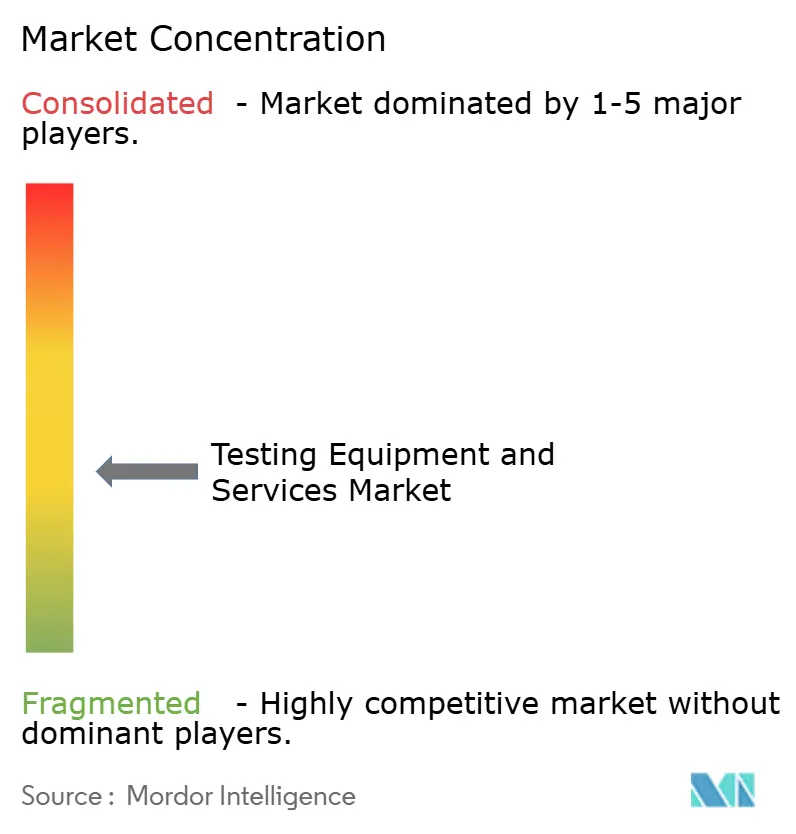
The testing equipment and services market is fragmented, with global TIC providers competing alongside specialized equipment manufacturers and regional laboratories. SGS, Bureau Veritas, Intertek, TÜV SÜD, TÜV Rheinland, and DEKRA compete with equipment companies including Keysight Technologies, Rohde and Schwarz, and Yokogawa Electric Corporation. Element Materials Technology, Eurofins Scientific, and UL LLC are among the service specialists active in the field. Large providers compete through geographic coverage, multi-jurisdictional accreditation, and digital inspection platforms. Their networks can reduce turnaround time and improve traceability for clients that operate across borders. Fragmentation allows specialists to retain positions in focused technical applications and single-industry niches.
SGS reported CHF 6,945 million in sales in 2025, equal to USD 7.7 billion at the 2025 average exchange rate. The company reported 5.6% organic growth and CHF 841 million in free cash flow, equal to USD 934 million at the 2025 average exchange rate. Bureau Veritas reported 6.5% organic revenue growth in fiscal year 2025 and a 16.3% margin. Its data center commissioning activity grew 30% organically, showing how AI infrastructure investment can create work for TIC networks. Consolidation remains an important strategy because acquisitions can add accreditation, technical capabilities, or regional access. Intertek’s 2026 strategic review considered separating its Testing and Assurance division from its Energy and Infrastructure division to improve capital allocation and focus.
Technology adoption is becoming a clearer differentiator in the testing equipment and services market. The testing equipment and services market rewards providers that can apply new methods while preserving reliable certification processes. Element Materials Technology launched blockchain-verified reports in January 2026, using QR-based authentication in its Connected Technologies and Mobility business. DEKRA’s biometric AI certification under the EU AI Act also placed it early in an emerging standards area. SGS acquired Granite River Labs Services in March 2026 to strengthen high-speed wired data connectivity testing across 9 laboratories in Asia, Europe, and the United States. Providers are also pursuing remote monitoring, digital inspection services, and AI-assurance work as standards develop. These moves show that scale alone is not sufficient when customers require new forms of validation and data handling.
Testing Equipment and Services Industry Leaders
-
Keysight Technologies, Inc.
-
Rohde and Schwarz GmbH and Co. KG
-
National Instruments Corporation
-
SGS SA
-
MTS Systems Corporation
- *Disclaimer: Major Players sorted in no particular order
Testing Equipment and Services Market Companies Covered in this Report
- Keysight Technologies, Inc.
- Rohde and Schwarz GmbH and Co. KG
- National Instruments Corporation
- SGS SA
- MTS Systems Corporation
- Fluke Corporation
- Anritsu Corporation
- Yokogawa Electric Corporation
- Mitutoyo Corporation
- Illinois Tool Works Inc.
- Tektronix, Inc.
- Bureau Veritas SA
- Intertek Group plc
- TÜV SÜD AG
- TÜV Rheinland AG
- Eurofins Scientific SE
- UL LLC
- Applus Services, S.A.
- Element Materials Technology Group Limited
- DEKRA SE
Recent Industry Developments in Testing Equipment and Services Market
- July 2026: Eurofins Scientific reached an agreement with Element Materials Technology to acquire its Life Sciences Testing Services business in North America for an enterprise value of USD 400 million, pending regulatory approvals expected in Q4 2026. The deal expands Eurofins' North American laboratory network in regions where it was historically underrepresented, supporting its biopharmaceutical and life sciences testing strategy.
- July 2026: TÜV SÜD acquired SustainCERT, a digital carbon verification provider, integrating voluntary carbon market verification and corporate value-chain emission monitoring into its Sustainability Business Unit. The acquisition positions TÜV SÜD to serve corporate clients navigating increasingly stringent climate disclosure requirements.
- June 2026: Keysight Technologies completed its acquisition of VPIphotonics, adding system-level photonic simulation to its design automation portfolio. The acquisition addresses growing demand for silicon photonics and co-packaged optics testing in AI data center infrastructure markets.
- March 2026: SGS acquired Granite River Labs Services (GRL), a Silicon Valley-based provider of high-speed wired data connectivity validation across 9 specialized laboratories in Asia, Europe, and the United States, strengthening SGS's Digital Trust and Connectivity position and scaling its AI-enabling digital infrastructure testing capabilities under Strategy 27.
Global Testing Equipment and Services Market Report Scope
The Testing Equipment and Services Market comprises instruments, systems, software, and specialized services that organizations use to assess, measure, verify, and validate the performance, quality, reliability, safety, and regulatory compliance of products, materials, components, and systems. It supports laboratory-based and field-testing activities across industries, including manufacturing, automotive, aerospace, electronics, healthcare, construction, and energy. The market includes testing devices, analytical equipment, monitoring systems, and related services, such as inspection, calibration, certification, validation, quality assurance, and technical consulting. These solutions enable organizations to meet regulatory requirements, adhere to industry standards, maintain product quality, identify defects, mitigate operational risks, and support product development and commercialization.
The Testing Equipment and Services Market Report is Segmented by Offerings (Testing Equipment, and Testing Services), Equipment Type (Electrical and Electronic Testing Equipment, Mechanical Testing Equipment, Material Testing Equipment, Environmental Testing Equipment, Non-Destructive Testing (NDT) Equipment, Optical and Imaging Testing Equipment, Chemical and Analytical Testing Equipment, Safety and Compliance Testing Equipment, and Other Testing Equipment Types), Service Type (Laboratory Testing, and On-Site Testing), Accreditation (Accredited Testing, and Non-Accredited Testing), End-user Industry (Manufacturing and Industrial, Aerospace and Defense, Automotive and Transportation, Oil and Gas, Pharmaceuticals and Biotechnology, Chemicals and Materials, Electronics and Semiconductor, Energy and Power, Food and Beverage, Construction and Infrastructure, and Other End-User Industries), and Geography (North America, South America, Europe, Asia-Pacific, and Middle East and Africa). The Market Sizes and Forecasts are Provided in Terms of Value in (USD).
Segmentation Overview
| Testing Equipment |
| Testing Services |
| Electrical and Electronic Testing Equipment |
| Mechanical Testing Equipment |
| Material Testing Equipment |
| Environmental Testing Equipment |
| Non-Destructive Testing (NDT) Equipment |
| Optical and Imaging Testing Equipment |
| Chemical and Analytical Testing Equipment |
| Safety and Compliance Testing Equipment |
| Other Testing Equipment Types |
| Laboratory Testing |
| On-Site Testing |
| Accredited Testing |
| Non-Accredited Testing |
| Industrial Manufacturing |
| Aerospace and Defense |
| Automotive and Transportation |
| Oil and Gas |
| Pharmaceuticals and Biotechnology |
| Chemicals and Materials |
| Electronics and Semiconductor |
| Energy and Power |
| Food and Beverage |
| Construction and Infrastructure |
| Other End-User Industries |
| North America | United States | |
| Canada | ||
| Mexico | ||
| South America | Brazil | |
| Argentina | ||
| Rest of South America | ||
| Europe | Germany | |
| United Kingdom | ||
| France | ||
| Italy | ||
| Spain | ||
| Rest of Europe | ||
| Asia-Pacific | China | |
| Japan | ||
| India | ||
| South Korea | ||
| ASEAN | ||
| Rest of Asia-Pacific | ||
| Middle East and Africa | Middle East | Saudi Arabia |
| United Arab Emirates | ||
| Turkey | ||
| Rest of the Middle East | ||
| Africa | South Africa | |
| Nigeria | ||
| Rest of Africa | ||
| By Offering | Testing Equipment | ||
| Testing Services | |||
| By Equipment Type | Electrical and Electronic Testing Equipment | ||
| Mechanical Testing Equipment | |||
| Material Testing Equipment | |||
| Environmental Testing Equipment | |||
| Non-Destructive Testing (NDT) Equipment | |||
| Optical and Imaging Testing Equipment | |||
| Chemical and Analytical Testing Equipment | |||
| Safety and Compliance Testing Equipment | |||
| Other Testing Equipment Types | |||
| By Service Type | Laboratory Testing | ||
| On-Site Testing | |||
| By Accreditation | Accredited Testing | ||
| Non-Accredited Testing | |||
| By End-user Industry | Industrial Manufacturing | ||
| Aerospace and Defense | |||
| Automotive and Transportation | |||
| Oil and Gas | |||
| Pharmaceuticals and Biotechnology | |||
| Chemicals and Materials | |||
| Electronics and Semiconductor | |||
| Energy and Power | |||
| Food and Beverage | |||
| Construction and Infrastructure | |||
| Other End-User Industries | |||
| By Geography | North America | United States | |
| Canada | |||
| Mexico | |||
| South America | Brazil | ||
| Argentina | |||
| Rest of South America | |||
| Europe | Germany | ||
| United Kingdom | |||
| France | |||
| Italy | |||
| Spain | |||
| Rest of Europe | |||
| Asia-Pacific | China | ||
| Japan | |||
| India | |||
| South Korea | |||
| ASEAN | |||
| Rest of Asia-Pacific | |||
| Middle East and Africa | Middle East | Saudi Arabia | |
| United Arab Emirates | |||
| Turkey | |||
| Rest of the Middle East | |||
| Africa | South Africa | ||
| Nigeria | |||
| Rest of Africa | |||
Key Questions Answered in the Report
What is the testing equipment and services market size?
The testing equipment and services market size was valued at USD 215.11 billion in 2025 and estimated to grow from USD 224.49 billion in 2026 to reach USD 285.72 billion by 2031, at a CAGR of 4.94% during the forecast period (2026-2031).
What is driving demand for testing equipment and services?
The testing equipment and services market is supported by safety regulations, semiconductor and electric vehicle production, industrial automation, and non-destructive testing adoption. These drivers increase both recurring service needs and purchases of specialized equipment.
Which offering leads revenue?
Testing services led with 56.31% of revenue in 2025 and are projected to grow at a 5.34% CAGR through 2031. Outsourced providers help manufacturers manage accredited work and requirements across several jurisdictions.
Which equipment category is growing fastest?
Optical and imaging testing equipment is projected to grow at a 5.89% CAGR through 2031, supported by machine vision and CT imaging. These systems support automated inspection and 3D component verification in industrial supply chains.
Which region is expected to grow fastest?
Asia-Pacific held 33.20% of revenue in 2025 and is projected to grow at a 5.68% CAGR through 2031. Semiconductor capacity, electronics assembly, and electric vehicle production support the regional outlook.
Why is laboratory accreditation important?
Accredited testing held 69.87% of revenue in 2025 because recognized credentials support formal conformity decisions and regulatory submissions. The testing equipment and services market depends on consistent methods and credible results for regulated product flows.