
Tenofovir Disoproxil Fumarate Market Size and Share
Market Overview
| Study Period | 2020 - 2031 |
|---|---|
| Market Size (2026) | USD 4.53 Billion |
| Market Size (2031) | USD 5.95 Billion |
| Growth Rate (2026 - 2031) | 5.61 % |
| Fastest Growing Market | Asia-Pacific |
| Largest Market | North America |
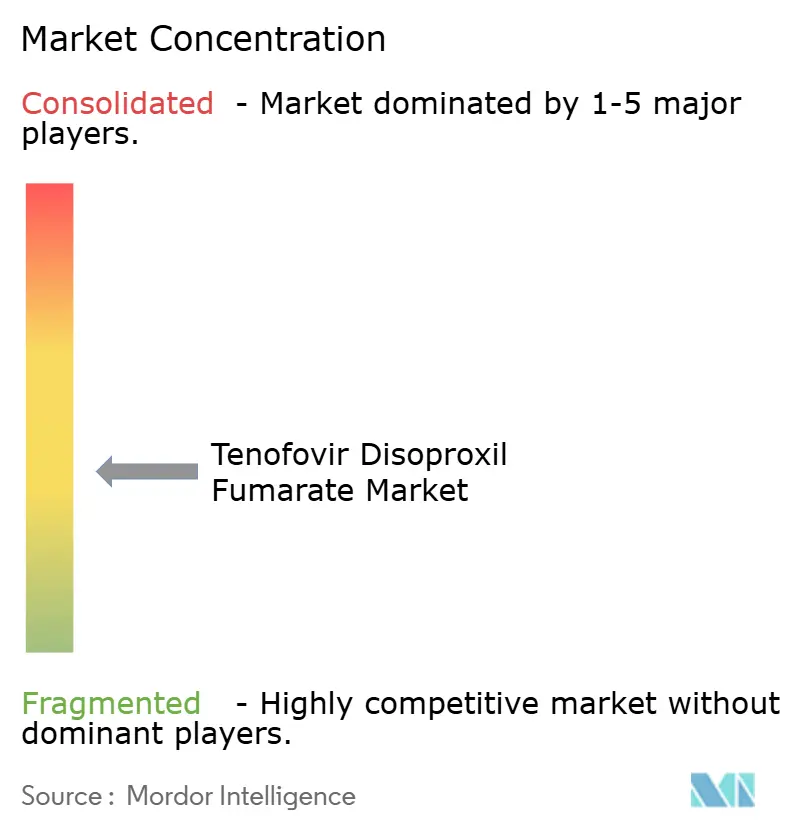
| Market Concentration | Medium |
Major Players *Disclaimer: Major Players sorted in no particular order Image © Mordor Intelligence. Reuse requires attribution under CC BY 4.0. | |
Tenofovir Disoproxil Fumarate Market Analysis by Mordor Intelligence
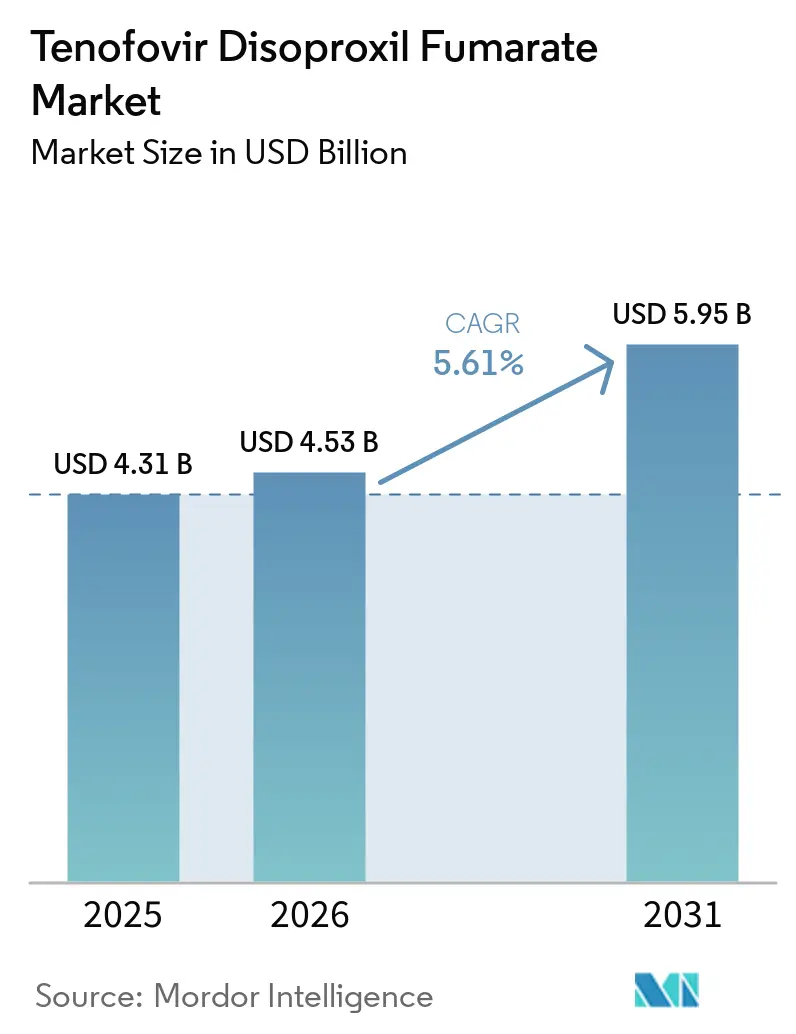
The Tenofovir Disoproxil Fumarate Market size is projected to be USD 4.31 billion in 2025, USD 4.53 billion in 2026, and reach USD 5.95 billion by 2031, growing at a CAGR of 5.61% from 2026 to 2031.
The tenofovir disoproxil fumarate market remains tied to long-term HIV treatment programs and the continued need for hepatitis B care. At the end of 2025, 32.1 million people were receiving antiretroviral therapy, while 41.0 million people were living with HIV, supporting recurring treatment demand. WHO-recommended first-line regimens continue to include tenofovir-containing combinations, particularly tenofovir, lamivudine, and dolutegravir combinations. Public tenders, donor programs, and national treatment protocols, therefore, remain central to the tenofovir disoproxil fumarate market. Competition increasingly depends on regulatory qualification, reliable supply, and the ability to serve institutional channels at low prices.
Key Report Takeaways
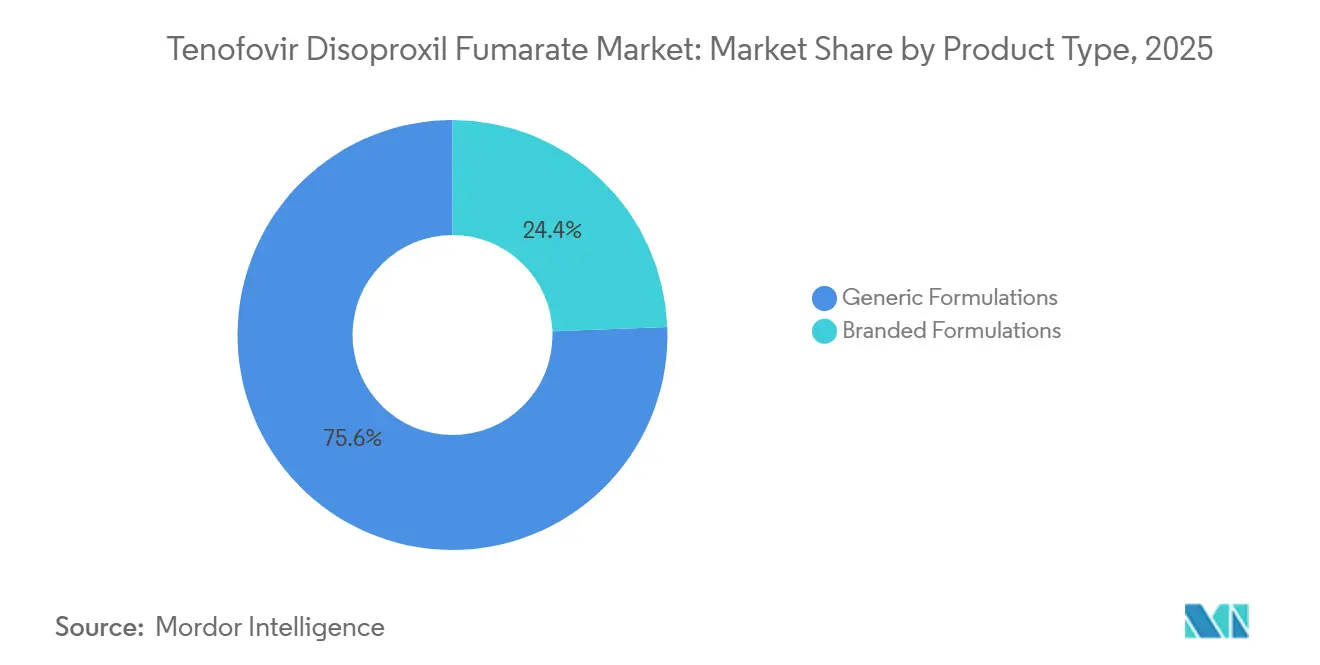
- By product type, generic formulations held 75.61% of the tenofovir disoproxil fumarate market share in 2025 and are projected to grow at a 5.91% CAGR through 2031.
- By indication, HIV treatment accounted for 48.47% of the tenofovir disoproxil fumarate market size in 2025, while HIV pre-exposure prophylaxis is forecast to grow at a 9.28% CAGR through 2031.
- By patient population, HIV-positive adults held 57.58% share in 2025, while HIV-positive adolescents are projected to expand at an 8.06% CAGR through 2031.
- By dose frequency, once-daily dosing accounted for 84.73 share in 2025 and is forecast to advance at a 6.14% CAGR through 2031.
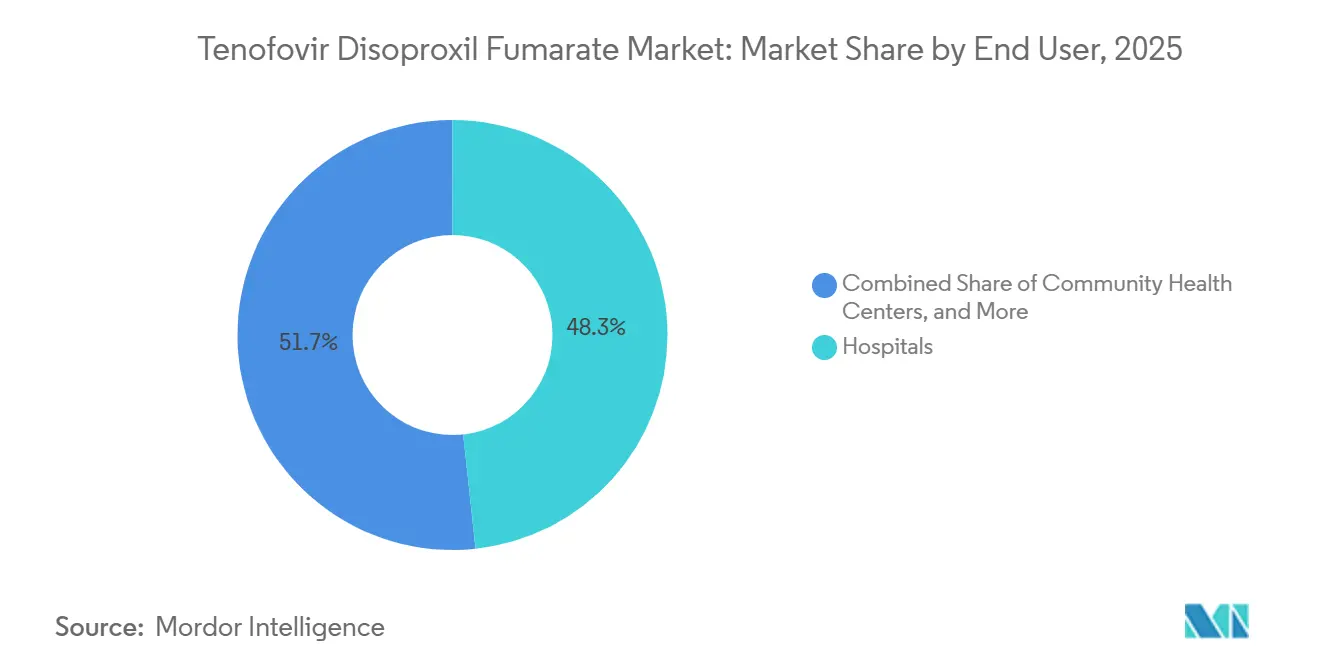
- By end user, hospitals held 48.26% share in 2025, while community health centers are expected to grow at an 8.11% CAGR through 2031.
- By distribution channel, hospital pharmacies accounted for 38.24% share in 2025, while online pharmacies are projected to grow at a 9.96% CAGR through 2031.
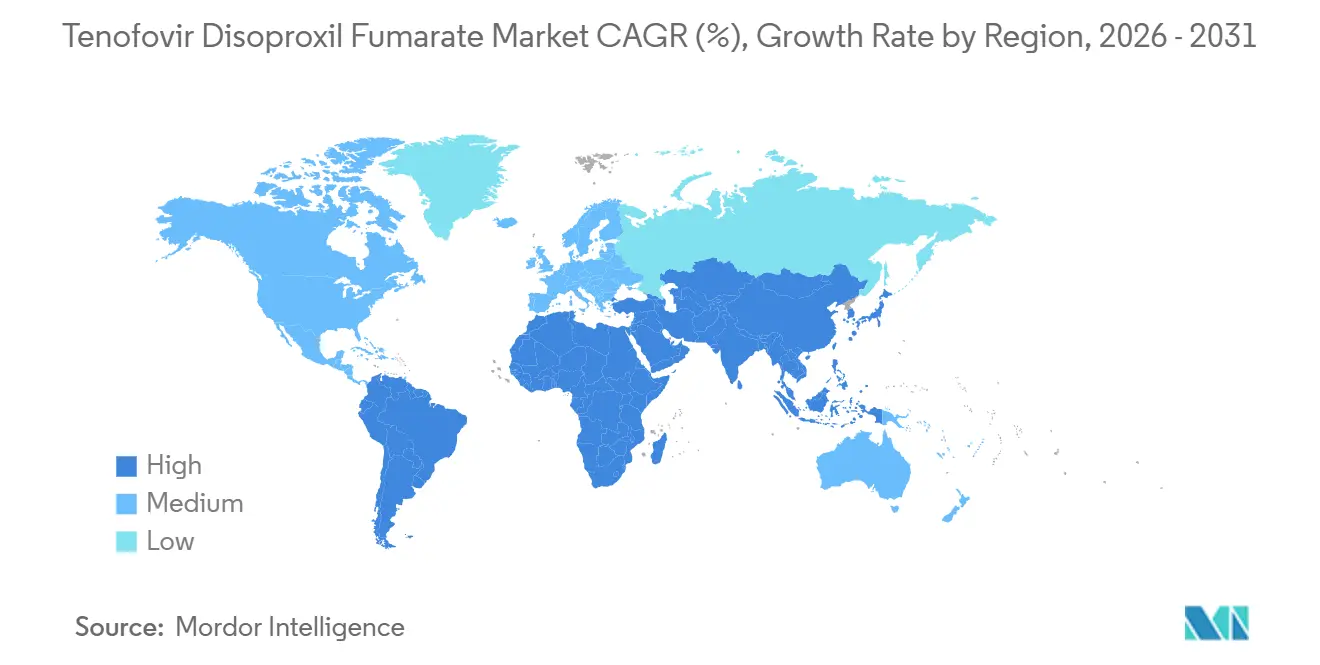
- By region, North America accounted for 41.85% share in 2025, while the Asia-Pacific region is projected to grow at an 7.56% CAGR through 2031.
Note: Market size and forecast figures in this report are generated using Mordor Intelligence’s proprietary estimation framework, updated with the latest available data and insights as of January 2026.
Market Trends and Insights
Drivers Impact Analysis of Tenofovir Disoproxil Fumarate Market*
| Driver | (~) % Impact on CAGR Forecast | Geographic Relevance | Impact Timeline |
|---|---|---|---|
| Persistent HIV Treatment Demand | +1.8% | Global; concentrated in Sub-Saharan Africa, South Asia, Southeast Asia | Long term (≥ 4 years) |
| Chronic Hepatitis B Treatment Expansion | +0.8% | Asia-Pacific (China, India, Southeast Asia); Sub-Saharan Africa | Long term (≥ 4 years) |
| Public Procurement and Donor-Funded Antiretroviral Programs | +0.9% | Sub-Saharan Africa, Southeast Asia, Latin America | Medium term (2–4 years) |
| HIV Pre-Exposure Prophylaxis Adoption | +0.7% | North America, Western Europe, East/Southern Africa | Medium term (2–4 years) |
| Fixed-Dose Combination Procurement Alignment | +0.6% | Global; PEPFAR and Global Fund-supported countries | Long term (≥ 4 years) |
| India-Centered API and Formulation Export Hubs | +0.5% | Global; origin in India, destinations across Africa, SE Asia, Latin America | Long term (≥ 4 years) |
| Source: Mordor Intelligence | |||
Persistent HIV Treatment Demand
The tenofovir disoproxil fumarate market benefits from the continuing expansion of antiretroviral treatment coverage. By the end of 2025, 32.1 million people were accessing ART, compared with 7.6 million in 2010[1]. WHO treatment recommendations support tenofovir-containing first-line regimens for adults and adolescents. This keeps medicine purchasing linked to the number of people enrolled in treatment programs. The 4.9 million people who knew their status but were not on treatment represent a continuing treatment-access gap. Multi-year procurement arrangements can give qualified manufacturers clearer volume visibility than short-term purchases.
Hepatitis B Treatment Expansion
Chronic hepatitis B adds a second long-duration source of demand for the tenofovir disoproxil fumarate market. Treatment coverage remained limited, with an estimated 2.2% of people with chronic hepatitis B receiving treatment in 2025. Updated 2025 clinical guidance broadened the treatment discussion for several patient groups. EASL continued to recognize TDF as a preferred first-line nucleos(t)ide analogue in pregnancy, HIV coinfection, and hepatocellular carcinoma settings. China, Southeast Asia, and Sub-Saharan Africa have substantial unmet diagnosis and treatment needs. Wider surveillance and treatment access can increase demand for qualified oral formulations.
Public Procurement and Donor Programs
Government tenders and donor-backed purchasing remain important for the tenofovir disoproxil fumarate market. TDF-containing fixed-dose combinations are purchased through national programs and multilateral procurement channels. The Global Fund reference pricing framework reflects the use of large-volume contracts for antiretroviral medicines. These contracts reward manufacturers that can meet quality, delivery, and pricing requirements. Fixed-dose combinations are purchased as complete regimens rather than as separate components. This makes TDF demand dependent on treatment protocol volumes and can limit short-term substitution of an individual component.
HIV Pre-Exposure Prophylaxis Adoption
Pre-exposure prophylaxis is expanding the prevention role of the tenofovir disoproxil fumarate market. The United States PrEP use reached 644,170 people in 2025, which was 10% higher than in 2024. Global oral PrEP initiations exceeded 8 million by late 2024, and more than 75% of recipients were in the WHO African Region. Oral TDF and emtricitabine remain an established prevention option in many programs. Injectable and longer-acting prevention products could reduce oral PrEP use in higher-income settings over time. Cost and access barriers may slow their use in the lower-income settings that account for much of TDF volume.
Restraints Impact Analysis of Tenofovir Disoproxil Fumarate Market*
| Restraint | (~) % Impact on CAGR Forecast | Geographic Relevance | Impact Timeline |
|---|---|---|---|
| Generic Price Compression After Patent Expiry | -1.2% | Global; most acute in North America and Europe | Short term (≤ 2 years) |
| Substitution Toward Tenofovir Alafenamide | -0.9% | North America, Western Europe, Japan, Australia | Medium term (2–4 years) |
| Concentrated Tender Supply and Single-Source Exposure | -0.5% | Sub-Saharan Africa, South/Southeast Asia | Medium term (2–4 years) |
| Renal and Bone Monitoring Requirements | -0.4% | Global; most clinically significant in older and comorbid patient populations | Long term (≥ 4 years) |
| Source: Mordor Intelligence | |||
Generic Price Compression After Patent Expiry
Generic price competition limits revenue expansion in the tenofovir disoproxil fumarate market even when treatment volumes increase. Large institutional buyers use competitive tenders to seek lower medicine prices. Lower prices favor producers with integrated active ingredient and finished-dose operations. Smaller suppliers can face difficulty maintaining margins when they lack comparable scale. Procurement agencies continue to use supplier qualification processes to reduce single-source risk. The result is pressure for manufacturers to combine price discipline with dependable supply.
Substitution Toward Tenofovir Alafenamide
Tenofovir alafenamide can constrain the tenofovir disoproxil fumarate market in selected higher-income treatment settings. A 2025 meta-analysis found better renal markers with TAF-containing regimens than with TDF-containing regimens. These safety considerations can influence treatment choices for patients with renal or bone health concerns. TDF nevertheless retains clinical relevance in pregnancy and HIV coinfection under 2025 EASL guidance. Public programs also weigh affordability and established procurement systems when selecting regimens. The shift toward TAF is therefore more pronounced in particular care settings than across the full global treatment base.
*Our forecasts treat driver/restraint impacts as directional, not additive. The impact forecasts reflect baseline growth, mix effects, and variable interactions.
Tenofovir Disoproxil Fumarate Market Segment Analysis
By Product Type:
Generics Lead Through Integrated SupplyGeneric formulations held 75.61% of the tenofovir disoproxil fumarate market share in 2025. They are also the fastest-growing product type, with a projected 5.91% CAGR through 2031. Their position reflects post-patent competition and broad acceptance of qualified generic products. WHO prequalification remains an important requirement for many multilateral procurement channels. The United States FDA approvals also support access to regulated purchasing programs. These requirements favor manufacturers with stable quality systems and established documentation.
Branded products retain a role in some higher-income private-pay channels. Gilead’s Viread and Truvada remain relevant reference products in these settings. The branded portfolio has faced continuing share pressure as generic products become more widely available. Manufacturers with control overactive ingredients and finished doses can better manage cost pressure. The February 2026 reconfirmation of Styrax Pharma’s TDF API prequalification illustrates the continuing supplier qualification cycle. The tenofovir disoproxil fumarate industry, therefore, places lasting value on regulatory compliance and integrated manufacturing.
By Indication:
HIV Treatment Holds Volume While PrEP Grows FasterHIV treatment represented 48.47% of the tenofovir disoproxil fumarate market size in 2025. Lifelong ART use gives this indication a recurring base of medicine demand. TDF-containing regimens remain widely used within first-line treatment programs. Program enrollment increases the number of patients requiring ongoing medicine supply. Treatment demand is especially important in countries using TLD as a national protocol. Public procurement planning, therefore, remains closely connected to patient coverage targets.
HIV pre-exposure prophylaxis is expected to grow at a 9.28% CAGR through 2031. Its growth reflects broader use of oral prevention services across Africa, Europe, and North America. Chronic hepatitis B remains under-treated despite substantial clinical need. Broader treatment criteria can increase the number of people diagnosed who become eligible for care[2]. TDF also has a protected role in some HIV and hepatitis B coinfection settings. The tenofovir disoproxil fumarate market consequently serves treatment and prevention needs that develop at different rates.
By Patient Population:
Adults Set the Base and Adolescents Add GrowthHIV-positive adults held 57.58% of the patient population segment in 2025. This share reflects the global age profile of people living with HIV. Adult treatment programs are the core source of established ART volume. Long-term treatment needs create regular procurement requirements for national health systems. Adult patients can also develop comorbidities as they age. Providers may therefore consider treatment safety and monitoring needs when selecting regimens.
HIV-positive adolescents are forecast to grow at an 8.06% CAGR through 2031. Lower treatment initiation thresholds support earlier access for younger people. Children exposed to HIV at birth who survived perinatal infection are also entering adolescence. This creates demand for age-appropriate dosing and formulations. Dispersible tablets and lower-strength products require dedicated development and quality work. The tenofovir disoproxil fumarate industry rewards suppliers with the regulatory capacity to support these formulations.
By Dose Frequency:
Once-Daily Regimens Remain the StandardOnce-daily dosing accounted for 84.73% of the tenofovir disoproxil fumarate market size in 2025. It is projected to be the fastest-growing frequency segment at a 6.14% CAGR through 2031. TLD and other WHO-recommended TDF-containing combinations are formulated for once-daily use. A simpler daily regimen can support adherence in routine care. It also gives planners a clear basis for estimating tablet needs. This supports inventory planning across national distribution systems.
Once-daily fixed-dose combinations reduce the need to manage separate components. They can also simplify dispensing at hospitals and community sites. Twice-daily dosing remains relevant for some legacy regimens and specific pediatric protocols. Its role can diminish where once-daily combinations obtain national registration. Regulatory harmonization can support the broader availability of qualified once-daily products. The tenofovir disoproxil fumarate market retains a strong connection to this established dosing format.
By End User:
Hospitals Lead While Community Centers ExpandHospitals held 48.26% of the end-user segment in 2025. Their position reflects the historic role of tertiary-care units in HIV and hepatitis B care. Hospitals often manage treatment initiation, complex cases, and medicine dispensing. They also participate in institutional procurement systems. Specialty clinics remain important in higher-income settings for patients with comorbidities. These care settings require suppliers to meet controlled distribution and reporting expectations.
Community health centers are expected to grow at an 8.11% CAGR through 2031. Differentiated service delivery policies have moved stable ART patients toward community collection points. This model is prominent across parts of Sub-Saharan Africa. It can reduce the need for repeated hospital visits. It also shifts distribution needs from hospital pharmacies to broader national networks. The tenofovir disoproxil fumarate market must therefore serve both centralized and decentralized care models.

By Distribution Channel:
Institutional Purchasing Retains Its RoleHospital pharmacies held 38.24% of the distribution channel segment in 2025. They remain closely linked to hospital-based treatment centers and national ART programs. Institutional demand is commonly supplied through controlled procurement and dispensing systems. Government and NGO procurement operates through high-volume contracts. These channels prioritize price, qualification, and delivery reliability. They differ from retail channels that serve individual private-pay transactions.
Online pharmacies are projected to grow at a 9.96% CAGR through 2031. Telehealth-linked prescriptions and multi-month dispensing support this channel’s development. Discreet home delivery can be important where stigma affects clinic attendance. Digital distribution also requires prescription checks and product traceability. The U.S. Drug Supply Chain Security Act provides a framework for pharmaceutical supply-chain security. The tenofovir disoproxil fumarate market can benefit from where digital channels meet these compliance requirements.
Geography Analysis
North America Tenofovir Disoproxil Fumarate Market
North America held 41.85% of the tenofovir disoproxil fumarate market share in 2025. The region combines generic and branded PrEP purchasing with broad insurance coverage. U.S. The United States PrEP use reached 644,170 people in 2025. The 10% increase was the smallest growth rate in 5 years. Access gaps remained among Black, Hispanic, and Southern populations. Online pharmacies and telehealth services are expanding alongside institutional dispensing. Canada and Mexico add demand through national HIV programs and public purchasing.
Europe and South America Tenofovir Disoproxil Fumarate Market
Europe remained the second-largest regional position for the tenofovir disoproxil fumarate market. Germany, the United Kingdom, France, Italy, and Spain are major revenue contributors. Safety monitoring expectations can favor companies with established post-approval systems. TDF use for hepatitis B differs across national settings. South America adds demand through sovereign medicine purchasing. Brazil centrally procures TLD and other TDF-based combinations for its national HIV program. This supports an ongoing public-sector demand base across the region.
APAC and MEA Tenofovir Disoproxil Fumarate Market
Asia-Pacific is forecast to grow at a 7.56% CAGR through 2031. In 2024, 1 in 4 new global HIV infections occurred in the Asia-Pacific region, while 69% of people living with HIV were on treatment. India combines substantial domestic need with a major pharmaceutical manufacturing role. China’s chronic hepatitis B burden supports continuing demand for nucleos(t)ide analog treatment. Sub-Saharan Africa remains central to TDF-based ART procurement through PEPFAR and Global Fund channels. South Africa and Gulf Cooperation Council countries are additional regional demand corridors. African manufacturing development can gradually reduce reliance on imported supplies.
Competitive Landscape
The tenofovir disoproxil fumarate market is fragmented at the finished-formulation level. Supply is more concentrated among procurement-qualified active ingredient and export producers. Macleods Pharmaceuticals, Laurus Labs, Aurobindo Pharma, Hetero Labs, and Cipla form part of the global generic supply base. Their competitive position depends on regulatory approvals across multiple markets. Integration from active ingredients to finished doses can strengthen their cost position. Chinese producers, including Zhejiang Huahai and Shanghai Desano, remain important upstream suppliers. Teva, Sandoz, and Viatris participate in regulated Western markets where compliance capabilities carry added importance.
Laurus Labs is diversifying beyond its established antiretroviral base. Its Affordable Medicines revenue reached INR 4,733 crore in FY2025-26, up 18% year over year. The company received a 532-acre land allotment in Andhra Pradesh for a manufacturing complex. In July 2026, Aurobindo signed a royalty-free voluntary license with MSD for investigational alimatravir in 129 low- and middle-income countries. These actions use established manufacturing and regulatory capabilities in future HIV product opportunities. Product development, local partnerships, and digital-compatible pack formats remain relevant areas of competition.
Gilead received U.S. FDA approval for Bixlenvo in August 2026. The NRTI-free regimen illustrates innovation in higher-income HIV treatment settings. Gilead also sought approval for an investigational once-weekly oral Yeztugo formulation in 2026. These alternatives may affect future oral TDF use in some markets. Their price and access profile can differ from donor-funded generic procurement. A market concentration score of 7 reflects substantial concentration among qualified generic suppliers, while several manufacturers remain active across formulations and regions.
Tenofovir Disoproxil Fumarate Industry Leaders
-
Aurobindo Pharma Limited
-
Cipla Limited
-
Hetero Labs Limited
-
Laurus Labs Limited
-
Macleods Pharmaceuticals Limited
- *Disclaimer: Major Players sorted in no particular order
Tenofovir Disoproxil Fumarate Market Companies Covered in this Report
- Anhui Biochem Pharmaceutical Co., Ltd.
- Aurobindo Pharma
- Cipla
- Dr. Reddy’s Laboratories Limited
- Emcure Pharmaceuticals Limited
- Gilead Sciences
- Hetero Labs Limited
- Laurus Labs Limited
- Lupin
- Macleods Pharmaceuticals Limited
- Qilu Pharmaceutical Co., Ltd.
- Sandoz Group AG
- Shanghai Desano Chemical Pharmaceutical Co., Ltd.
- Strides Pharma Science
- Sun Pharmaceuticals Industries
- Teva Pharmaceutical Industries
- Torrent Pharmaceuticals Limited
- Viatris
- Zhejiang Huahai Pharmaceutical Co., Ltd.
- Zydus Lifesciences Limited
Recent Industry Developments in Tenofovir Disoproxil Fumarate Market
- August 2026: The United States FDA approved Gilead Sciences' Bixlenvo (bictegravir 75 mg/lenacapavir 50 mg), the first NRTI-backbone-free once-daily single-tablet HIV treatment regimen, targeting virologically suppressed adults on complex regimens or those unable to tolerate standard one-pill options. The approval signals an accelerating shift away from TDF-backbone therapies in high-income HIV treatment markets and reflects Gilead's USD 32 billion planned United States investment to advance its next-generation HIV pipeline.
- July 2026: Aurobindo Pharma Limited entered into a royalty-free voluntary licensing agreement with MSD to manufacture and supply generic alimatravir, an investigational once-monthly oral HIV prevention medicine, across 129 low- and middle-income countries. The agreement, executed before Phase 3 trial completion, is a first in HIV prevention voluntary licensing.
Global Tenofovir Disoproxil Fumarate Market Report Scope
As per the scope of the report, tenofovir disoproxil fumarate (TDF) is a prescription antiviral medicine indicated for the treatment of HIV and chronic hepatitis B virus (HBV) infections. It is a modified, readily absorbed prodrug of tenofovir, a nucleotide analog, which converts to its active form within the body.
The tenofovir disoproxil fumarate market is segmented by product type, indication, patient population, dose frequency, end user, distribution channel, and geography. By product type, the market is segmented into branded formulations and generic formulations. By indication, the market is segmented into HIV treatment, HIV pre-exposure prophylaxis, chronic hepatitis B treatment, and HIV and hepatitis B coinfection treatment. By patient population, the market is segmented into HIV-positive adults, HIV-positive adolescents, HIV-exposed newborns and infants, chronic hepatitis B adults, and chronic hepatitis B adolescents and children. By dose frequency, the market is segmented into once-daily and twice-daily. By end user, the market is segmented into hospitals, specialty clinics, community health centers, and other end users. By distribution channel, the market is segmented into hospital pharmacies, retail pharmacies, online pharmacies, and government and NGO procurement.
By geography, the market is segmented as North America, Europe, Asia-Pacific, the Middle East and Africa, and South America. The market report also covers the estimated market sizes and trends for 17 countries across major regions globally. The report offers the value (in USD) for the above segments.
Segmentation Overview
| Branded Formulations |
| Generic Formulations |
| HIV Treatment |
| HIV Pre-Exposure Prophylaxis |
| Chronic Hepatitis B Treatment |
| HIV and Hepatitis B Coinfection Treatment |
| HIV-Positive Adults |
| HIV-Positive Adolescents |
| HIV-Exposed Newborns and Infants |
| Chronic Hepatitis B Adults |
| Chronic Hepatitis B Adolescents and Children |
| Once-Daily |
| Twice-Daily |
| Hospitals |
| Specialty Clinics |
| Community Health Centers |
| Other End Users |
| Hospital Pharmacies |
| Retail Pharmacies |
| Online Pharmacies |
| Government and NGO Procurement |
| North America | United States |
| Canada | |
| Mexico | |
| Europe | Germany |
| United Kingdom | |
| France | |
| Italy | |
| Spain | |
| Rest of Europe | |
| Asia-Pacific | China |
| Japan | |
| India | |
| Australia | |
| South Korea | |
| Rest of Asia-Pacific | |
| Middle East and Africa | GCC |
| South Africa | |
| Rest of Middle East and Africa | |
| South America | Brazil |
| Argentina | |
| Rest of South America |
| By Product Type | Branded Formulations | |
| Generic Formulations | ||
| By Indication | HIV Treatment | |
| HIV Pre-Exposure Prophylaxis | ||
| Chronic Hepatitis B Treatment | ||
| HIV and Hepatitis B Coinfection Treatment | ||
| By Patient Population | HIV-Positive Adults | |
| HIV-Positive Adolescents | ||
| HIV-Exposed Newborns and Infants | ||
| Chronic Hepatitis B Adults | ||
| Chronic Hepatitis B Adolescents and Children | ||
| By Dose Frequency | Once-Daily | |
| Twice-Daily | ||
| By End User | Hospitals | |
| Specialty Clinics | ||
| Community Health Centers | ||
| Other End Users | ||
| By Distribution Channel | Hospital Pharmacies | |
| Retail Pharmacies | ||
| Online Pharmacies | ||
| Government and NGO Procurement | ||
| By Geography | North America | United States |
| Canada | ||
| Mexico | ||
| Europe | Germany | |
| United Kingdom | ||
| France | ||
| Italy | ||
| Spain | ||
| Rest of Europe | ||
| Asia-Pacific | China | |
| Japan | ||
| India | ||
| Australia | ||
| South Korea | ||
| Rest of Asia-Pacific | ||
| Middle East and Africa | GCC | |
| South Africa | ||
| Rest of Middle East and Africa | ||
| South America | Brazil | |
| Argentina | ||
| Rest of South America | ||
Key Questions Answered in the Report
What is the projected value of tenofovir disoproxil fumarate by 2031?
The forecast value is USD 5.95 billion by 2031, from USD 4.53 billion in 2026, at a 5.61% CAGR between 2026 to 2031..
Which product type leads tenofovir disoproxil fumarate sales?
Generic formulations led with 75.61% share in 2025 and are projected to grow at a 5.91% CAGR through 2031.
Why is TDF still used in HIV treatment programs?
TDF remains part of WHO-recommended first-line combinations and is supported by large public treatment programs.
Which use of TDF is growing fastest?
HIV pre-exposure prophylaxis is the fastest-growing indication, with a projected CAGR of 9.28% through 2031.
Which region is expanding fastest for TDF?
Asia-Pacific is projected to grow at a 7.56% CAGR through 2031, supported by continuing HIV treatment gaps and hepatitis B demand.
What limits TDF revenue growth?
Generic price competition and selected substitution toward TAF constrain revenue growth, even as treatment volumes expand.