
Telecom Network Modernization Decision-Maker Survey Market Size and Share
Market Overview
| Study Period | 2020 - 2031 |
|---|---|
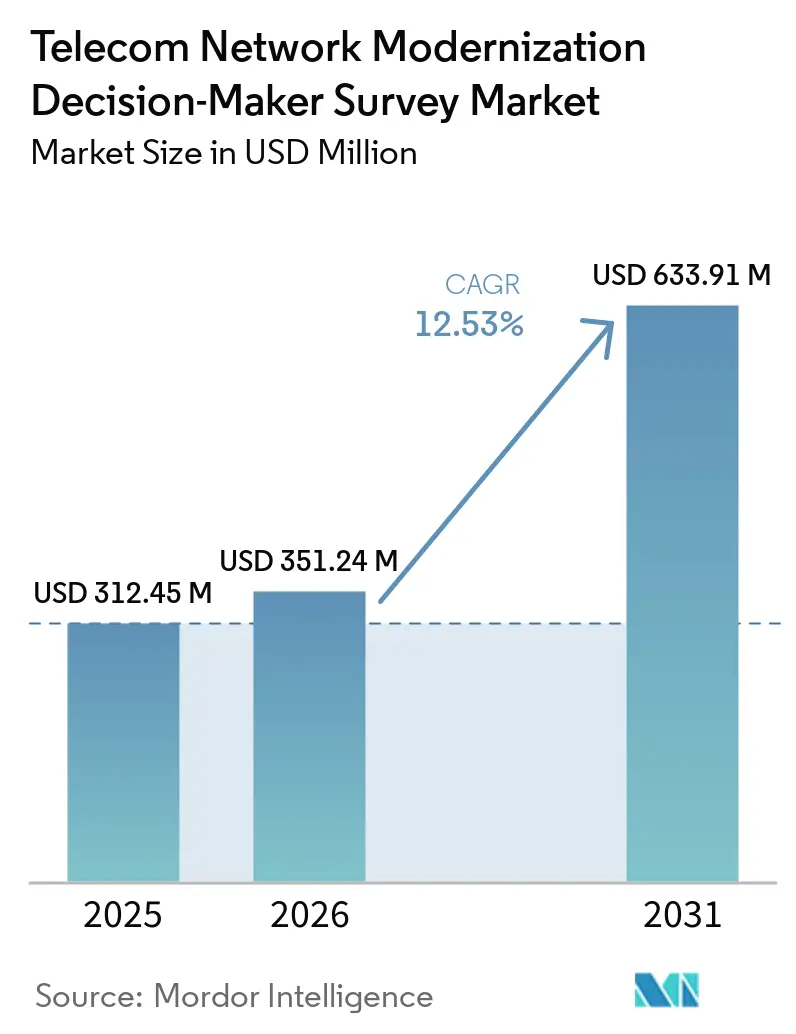
| Market Size (2026) | USD 351.24 Million |
| Market Size (2031) | USD 633.91 Million |
| Growth Rate (2026 - 2031) | 12.53 % |
| Fastest Growing Market | Asia-Pacific |
| Largest Market | North America |
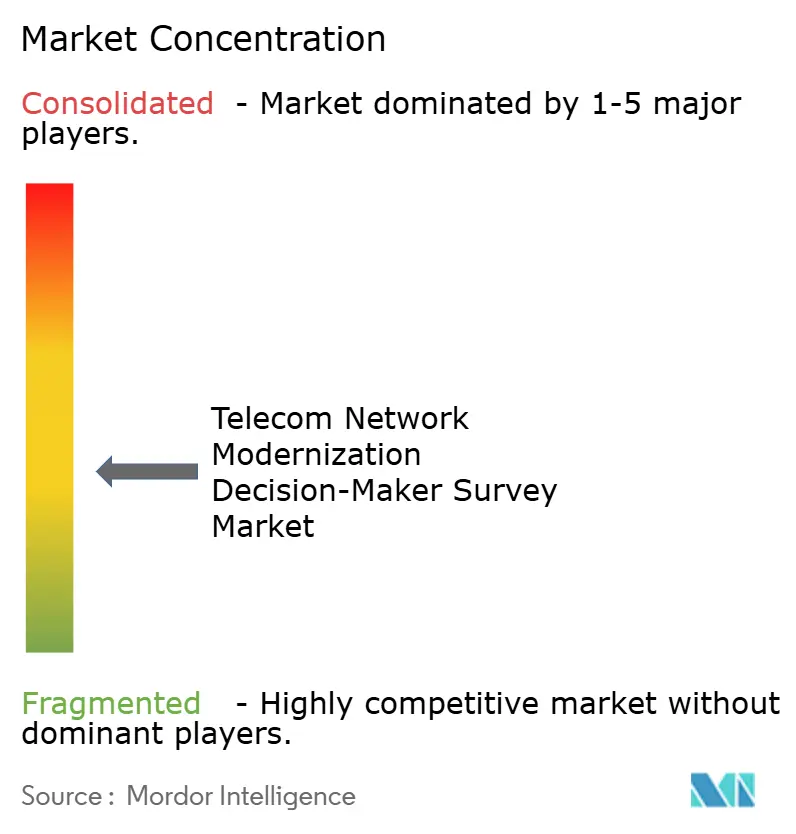
| Market Concentration | Medium |
Major Players *Disclaimer: Major Players sorted in no particular order Image © Mordor Intelligence. Reuse requires attribution under CC BY 4.0. | |
Telecom Network Modernization Decision-Maker Survey Market Analysis by Mordor Intelligence
The Telecom Network Modernization Decision-Maker Survey Market size was valued at USD 312.45 million in 2025 and is estimated to grow from USD 351.24 million in 2026 to reach USD 633.91 million by 2031, at a CAGR of 12.53% during the forecast period (2026-2031). The Telecom Network Modernization Decision-Maker Survey Market covers survey design, panel recruitment, data weighting, benchmarking, and advisory work used to understand modernization budgets and vendor choices. Demand is widening as 5G Standalone deployment moves into execution and operators make more detailed investment decisions. GSA reported 95 commercial 5G Standalone launches and 35 operators investing in 5G-Advanced as of March 2026, creating more vendor-selection events for research buyers to track. Software, orchestration, open interfaces, and artificial intelligence have broadened the range of questions buyers need answered. The Telecom Network Modernization Decision-Maker Survey Market also benefits when clients replace periodic reports with current peer comparisons during procurement cycles.
Key Report Takeaways
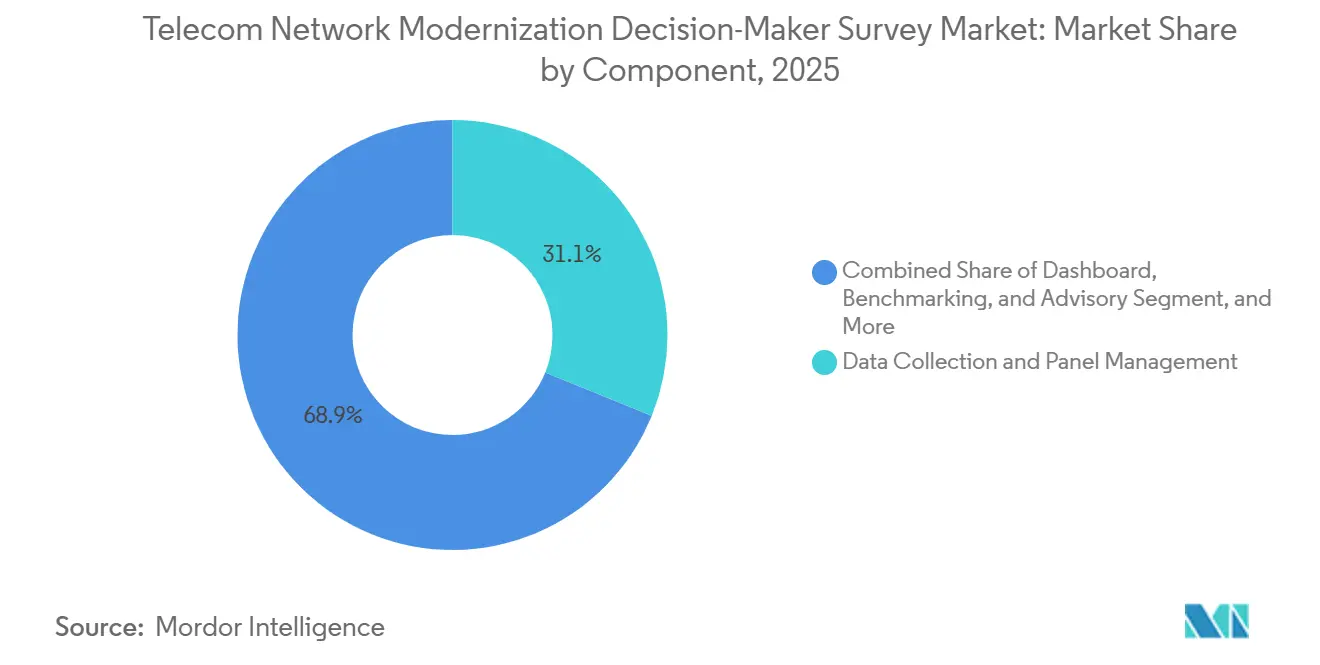
- By component, Data Collection and Panel Management held 31.12% of the Telecom Network Modernization Decision-Maker Survey Market share in 2025, while Dashboard, Benchmarking, and Advisory Outputs are forecast to grow at a 12.61% CAGR through 2031.
- By network domain, Radio Access Network held 38.14% of the Telecom Network Modernization Decision-Maker Survey Market share in 2025, while OSS/BSS and Service Orchestration is forecast to grow at a 12.73% CAGR through 2031.
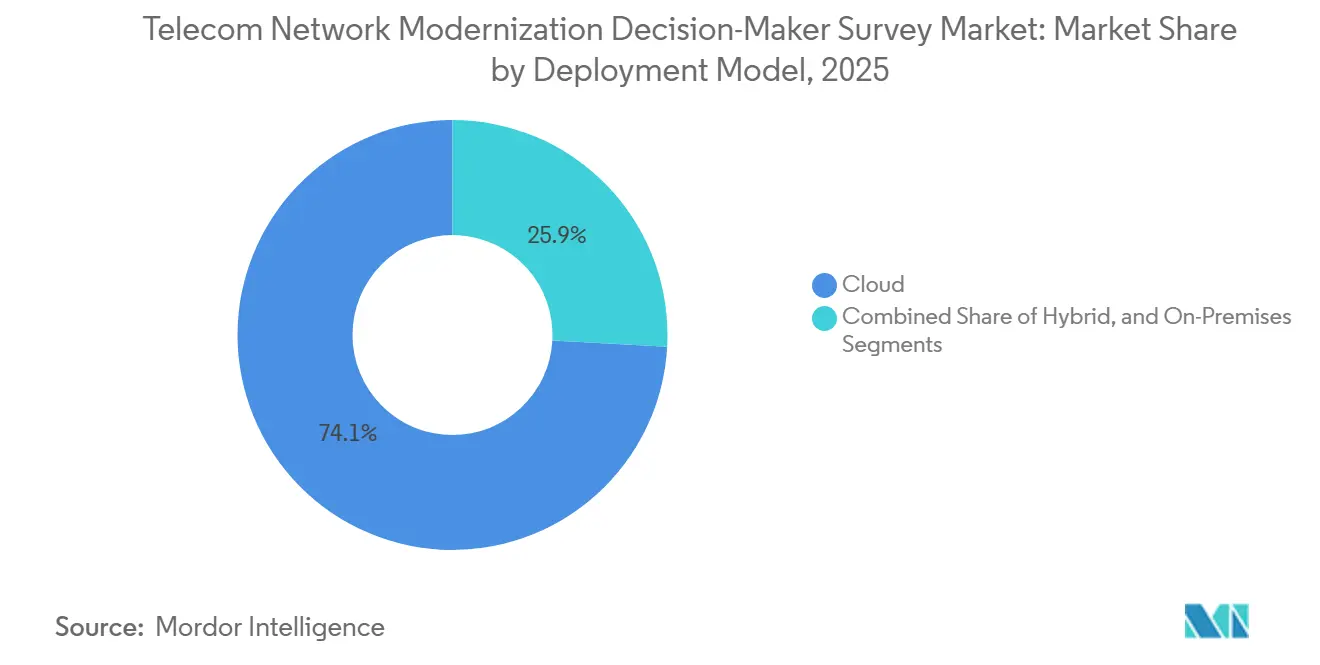
- By deployment model, Cloud accounted for 74.13% of the Telecom Network Modernization Decision-Maker Survey Market share in 2025, while Hybrid is forecast to grow at a 12.81% CAGR through 2031.
- By organization type, Tier-1 Mobile Network Operators held 45.11% of the Telecom Network Modernization Decision-Maker Survey Market share in 2025, while Private Network Owners are forecast to grow at a 12.92% CAGR through 2031.
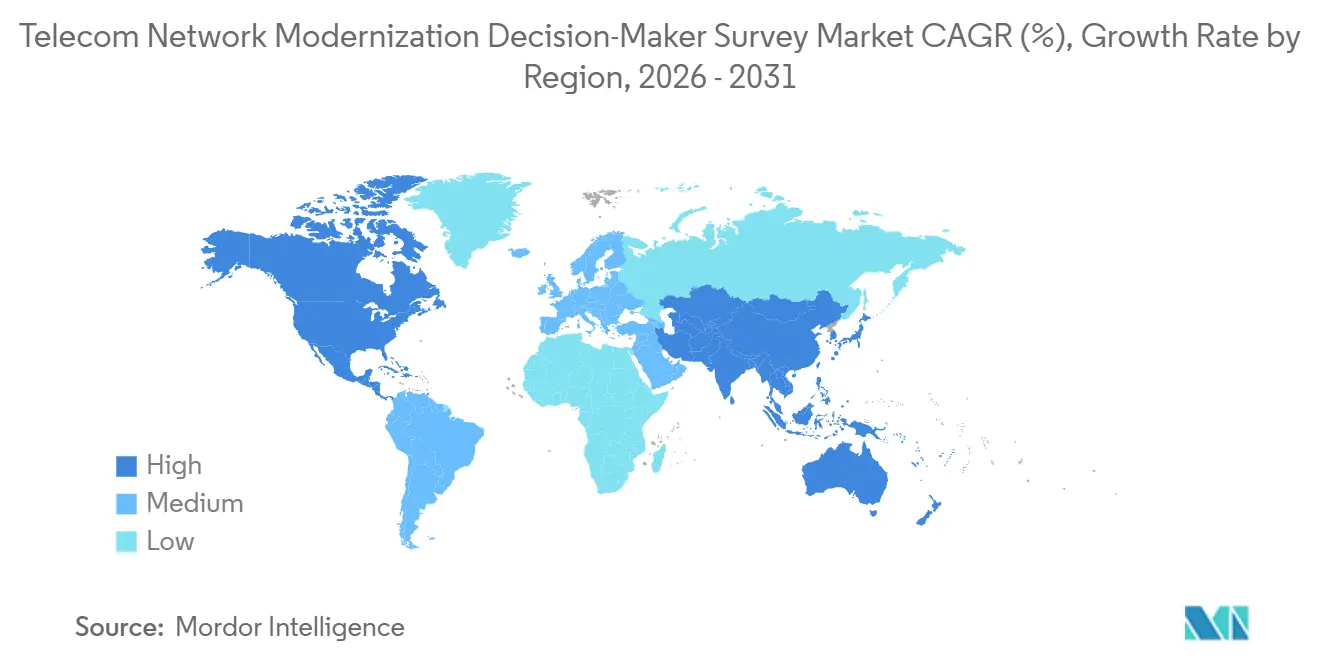
- By geography, North America held 34.12% of the Telecom Network Modernization Decision-Maker Survey Market share in 2025, while Asia-Pacific is forecast to grow at a 13.14% CAGR through 2031.
Note: Market size and forecast figures in this report are generated using Mordor Intelligence’s proprietary estimation framework, updated with the latest available data and insights as of January 2026.
Market Trends and Insights
Drivers Impact Analysis of Telecom Network Modernization Decision-Maker Survey Market*
| Driver | (~) % Impact on CAGR Forecast | Geographic Relevance | Impact Timeline |
|---|---|---|---|
| 5G Standalone and 5G-Advanced Investment Decisions | +3.1% | Global, with concentrated activity in North America, Europe, the Middle East, and Northeast Asia | Short term (≤ 2 years) |
| Multi-Vendor Network Complexity and Operating Cost Reduction | +2.5% | Global, strongest in North America and Europe, the Middle East, and Africa | Medium term (2-4 years) |
| Cloud-Native Core and Edge Modernization | +2.0% | Global, with early adoption in Europe, the Middle East, Africa, Asia-Pacific, and North America | Medium term (2-4 years) |
| AI-Enabled Closed-Loop Network Operations | +1.7% | Global, with early activity in Spain, Germany, Japan, and South Korea | Medium term (2-4 years) |
| Open RAN and Supplier Diversification Mandates | +1.3% | North America, United Kingdom, Japan, India, Asia-Pacific, Europe, the Middle East, and Africa | Long term (≥ 4 years) |
| AI RAN and Real-Time Network Data Requirements | +1.0% | North America, Japan, South Korea, and China | Long term (≥ 4 years) |
| Source: Mordor Intelligence | |||
5G Standalone and 5G-Advanced Investment Decisions
Commercial 5G Standalone activity supports the Telecom Network Modernization Decision-Maker Survey Market, as each program introduces new technology and supplier questions. GSA recorded 392 commercial 5G launches worldwide by March 2026, including 95 5G Standalone launches and 35 operators investing in 5G-Advanced. Buyers need to understand how peers sequence core upgrades, automation, spectrum use, and vendor evaluations. AT&T announced a USD 250 billion, 5-year U.S. infrastructure investment plan in March 2026 covering fiber, 5G, and AI-enabled operations. This spending creates a continuing flow of procurement decisions that survey providers can track. Current panels must distinguish a formal launch from subsequent core migration, operational use, and contracted supplier work.
Multi-Vendor Network Complexity and Operating Cost Reduction
Multi-vendor networks create research demand around sourcing, interfaces, operating costs, and accountability across network domains. Operators must weigh supplier diversity against the effort required to integrate equipment, software, and management systems.[1] AT&T reported more than USD 1 billion in annualized operating cost savings from AI deployment, reinforcing the need for evidence on automation choices. Research must connect RAN, core, OSS/BSS, and operational priorities rather than consider each decision separately. Repeated interviews with senior respondents can show whether a strategy remains stable after implementation issues emerge. The Telecom Network Modernization Decision-Maker Survey Market is most useful when it distinguishes stated plans from operating models supported by performance evidence.
Cloud-Native Core and Edge Modernization
Cloud-native core and edge programs are creating architectural milestones that research buyers can compare across regions and operator types. O2 Telefónica moved production-scale 5G Core functions to AWS Outposts in its own data center during March 2026, using Nokia technology.[2] NTT DOCOMO also launched a commercial 5G Core on AWS in a hybrid configuration during March 2026. Cloud location, operational control, automation, and supplier roles are therefore important primary research topics. United Kingdom security requirements have added data sovereignty and security expectations to telecommunications supplier assessments. Research should track actual deployment choices, including where data is processed and whether a design is commercial or still under validation.
AI-Enabled Closed-Loop Network Operations
AI-enabled operations are expanding the range of people, suppliers, and decisions that modernization research must cover. Telefónica ended 2025 with 12 verified Level 4 use cases under its Autonomous Network Journey program.[3] China Mobile, GSMA, and Huawei launched OpenAN at MWC Shanghai in June 2026 to support collaboration between operations and management agents. NEC demonstrated in February 2026 that agentic AI could manage a 5G Core User Plane Function from design through operational monitoring. These developments bring hyperscalers and software specialists into evaluation frameworks once centered on equipment suppliers. Surveys must distinguish trials and controlled use cases from operating processes used at scale.[4]
Restraints Impact Analysis of Telecom Network Modernization Decision-Maker Survey Market*
| Restraint | (~) % Impact on CAGR Forecast | Geographic Relevance | Impact Timeline |
|---|---|---|---|
| Legacy OSS/BSS Technical Debt and Migration Risk | -2.8% | Global, most acute in North America and Europe | Medium term (2-4 years) |
| Interoperability and Integration Complexity | -2.2% | Global, with Asia-Pacific and Europe, the Middle East, and Africa brownfield networks exposed | Medium term (2-4 years) |
| Cybersecurity, Data Sovereignty, and AI Governance Exposure | -1.7% | North America and Europe, with growing relevance in the Middle East | Short term (≤ 2 years) |
| Shortage of Cloud-Native Telecom Skills | -1.4% | Global, most acute in Asia-Pacific emerging markets and South America | Long term (≥ 4 years) |
| Source: Mordor Intelligence | |||
Legacy OSS/BSS Technical Debt and Migration Risk
Legacy OSS/BSS environments slow modernization decisions because operator teams must manage fragmented systems and costly migrations. The constraint can make it harder for respondents to identify a firm's priorities across multiple technology programs. Ericsson and IDC reported that OSS/BSS-related capital expenditure could reach USD 211 billion between 2025 and 2028, and 66% of respondents cited a need for additional data-system investment. This pressure can produce responses that reflect unresolved budget conflicts rather than committed technology choices. It also complicates survey interpretation when interest in a capability depends on a delayed data or integration project. Research must separate planned architectural changes from decisions deferred due to migration risk.
Interoperability and Integration Complexity
Interoperability issues slow modernization when legacy virtualized functions and cloud-native functions must operate together for long periods. This coexistence means research programs often need to track 2 technology paths within the same operator. Open RAN progress also differs across markets, and maturity levels affect how respondents describe their status. GSA documented a growing set of commercial 5G deployments, but a commercial launch alone does not establish that every network function is integrated. A respondent may use the term "cloud-native core" to describe a limited migration rather than a full replacement of network functions. The Telecom Network Modernization Decision-Maker Survey Market depends on detailed definitions, validation by senior respondents, and consistent follow-up questions.
*Our forecasts treat driver/restraint impacts as directional, not additive. The impact forecasts reflect baseline growth, mix effects, and variable interactions.
Telecom Network Modernization Decision-Maker Survey Market Segment Analysis
By Component:
Panel Management Leads While Benchmarking Analytics Expand Service ValueData Collection and Panel Management held 31.12% of the Telecom Network Modernization Decision-Maker Survey Market share in 2025, reflecting its role in obtaining responses from relevant senior decision-makers. A reliable panel requires suitable respondent seniority, broad organization coverage, and careful validation of individual responses. These factors remain important because a Tier-1 operator technology leader can provide materially different evidence from that of an anonymous online participant. Survey Design and questionnaire programming remain closely connected to panel management because questions must reflect evolving choices across suppliers and network domains. The Telecom Network Modernization Decision-Maker Survey Market depends on this work to ensure that findings describe actual decision processes rather than broad technology interest.
Dashboard, Benchmarking, and Advisory Outputs are forecast to grow at a 12.61% CAGR through 2031, the fastest rate among components. Clients increasingly require peer comparisons for use in procurement, investment planning, and supplier discussions. Current dashboards can provide repeated views of a defined group of operators, rather than isolated results from periodic reports. Data Processing, Weighting, and Tabulation also become more important when research includes differing operator sizes, geographies, and maturity levels. The Telecom Network Modernization Decision-Maker Survey Market can serve this need by applying transparent methods and presenting comparable outputs without overstating the limited evidence from respondents.

By Network Domain:
RAN Anchors Demand While OSS/BSS Orchestration AdvancesRadio Access Network held 38.14% of the Telecom Network Modernization Decision-Maker Survey Market share in 2025. RAN programs generate a wide range of decisions involving antenna configurations, Open Fronthaul compliance, radio platforms, and AI-RAN roadmaps. These choices remain central to many 5G investment plans because they affect coverage, capacity, and supplier relationships. Ericsson stated that it targeted 160 Open-RAN-proven radio models by the end of 2026, reflecting the continuing importance of compatible RAN options. The Telecom Network Modernization Decision-Maker Survey Market can help clients compare which RAN requirements have entered formal procurement criteria and which remain exploratory.
OSS/BSS and Service Orchestration are forecast to grow at a 12.73% CAGR through 2031, making it the fastest-growing network domain. Operators need service management and orchestration capabilities as 5G Standalone and AI-related use cases increase the pace of operational decisions. The move to 5G Standalone also shapes Core Network programs, while transport decisions respond to growing data-center connectivity needs. KDDI committed JPY 1.2 trillion (USD 7.44 billion) over 3 fiscal years to its Power-to-Connect 2028 plan, covering low-latency transport, AI data center infrastructure, and satellite ground stations. Edge, private wireless, and non-terrestrial network activity adds enterprise users to the set of modernization decision-makers that research programs must address.
By Deployment Model:
Cloud Leads While Hybrid Addresses Sovereignty RequirementsCloud accounted for 74.13% of the market share in the Telecom Network Modernization Decision-Maker Survey Market Share in 2025. Cloud-based platforms support centralized panel management, automated weighting, and the distribution of dashboards to teams across multiple locations. This model can reduce infrastructure barriers for providers running multinational research programs. It also allows client users to access results through connected tools during procurement cycles. The Telecom Network Modernization Decision-Maker Survey Market uses cloud delivery to provide timely information, while data controls remain essential for sensitive respondent and operator information.
Hybrid deployment is forecast to grow at a 12.81% CAGR through 2031, the fastest rate among deployment models. Regulated clients may retain operator-identifying information or strategic position data inside sovereign environments while using cloud tools for other functions. Deutsche Telekom and Palo Alto Networks launched a data-sovereign cyber defense service in 2025 that stored and processed customer and system data exclusively in Europe. This approach shows why some research clients need control over the location and handling of sensitive information. On-premises deployments remain relevant for telecom groups that maintain controlled internal research operations, even though cloud flexibility is expected to remain influential.
By Organization Type:
Tier-1 Operators Anchor Volume While Private Network Owners ExpandTier-1 Mobile Network Operators held 45.11% of the Telecom Network Modernization Decision-Maker Survey Market share in 2025. Their modernization programs involve many decision-makers, from senior architecture leaders to teams selecting operational tools. This breadth creates substantial demand for research on RAN, core networks, OSS/BSS, automation, and supplier strategies. Tier-2 and Tier-3 operators also face 5G Standalone and cloud-native choices, but they may have fewer internal resources to evaluate them. The Telecom Network Modernization Decision-Maker Survey Market is useful to these operators because it provides comparable evidence relevant to their scale and operating conditions.
Private Network Owners are forecast to grow at a 12.92% CAGR through 2031, the fastest rate among organization types. GSA identified 2,003 organizations deploying private mobile networks in 88 countries by the end of the first quarter of 2026. This population includes decision-makers whose needs differ from traditional mobile network operators because they evaluate industrial, enterprise, and site-specific network outcomes. Manufacturing and education were among the sectors with documented private-network references in GSA reporting. Research providers must adapt their panels and questions to this broader group rather than applying an MNO-only framework.
Geography Analysis
North America Telecom Network Modernization Decision-Maker Survey Market
North America held 34.12% of the Telecom Network Modernization Decision-Maker Survey Market share in 2025. The region has a high concentration of well-funded Tier-1 operators with active modernization plans. AT&T announced a USD 250 billion, 5-year investment plan in March 2026 for fiber, 5G, and AI-enabled operations. These programs create decisions across architecture, suppliers, software, and operating models. North American survey demand is therefore supported by the depth of operator spending and the need to compare progress against peers.
APAC Telecom Network Modernization Decision-Maker Survey Market
Asia-Pacific is forecast to grow at a 13.14% CAGR through 2031, the fastest regional rate. Japan, South Korea, India, and China each contribute different investment patterns and decision contexts. NTT DOCOMO targeted JPY 857 billion (USD 5.37 billion) in capital expenditure for FY2026 and began commercial deployment of Ericsson's next-generation RAN Compute platform in July 2026. KDDI committed JPY 1.2 trillion (USD 7.44 billion) across 3 fiscal years for low-latency transport, AI data centers, and satellite ground stations. The Telecom Network Modernization Decision-Maker Survey Market needs country-specific panels in this region because technology deployment, language, and vendor conditions vary substantially.
EMEA and South America Telecom Network Modernization Decision-Maker Survey Market
Europe held a significant share in 2025, with research demand shaped by supplier diversification, consolidation, and data sovereignty. MasOrange signed a 6-year agreement with Ericsson in February 2026 to consolidate 4 IMS platforms and 2 legacy 5G cores into a unified 5G Standalone architecture. The United Kingdom retained a 35% Open RAN traffic target for 2030 and updated its telecommunications security code in 2026. South America, the Middle East, and Africa are smaller but expanding areas for procurement activity. Ericsson and e& UAE agreed in 2025 to modernize the operator's 5G Core with cloud-native technologies.
Competitive Landscape
The Telecom Network Modernization Decision-Maker Survey Market is moderately fragmented. Telecom infrastructure vendors, independent research specialists, and survey analytics providers compete for operator and enterprise research assignments. Vendors can use established operator relationships to offer benchmarking that supports customer engagement and internal product planning. Independent providers compete through panel quality, research design, sector knowledge, and the perceived neutrality of their analysis. The Telecom Network Modernization Decision-Maker Survey Market has an opening in private-network research, as traditional programs have often focused on mobile network operators.
Technology is changing the basis of competition in the Telecom Network Modernization Decision-Maker Survey Market. Providers are moving toward dashboards with more frequent updates, controlled response weighting, and connections to client decision tools. TM Forum’s autonomous networks work provides standardized definitions that operators can use when comparing autonomy progress. Faster platforms can reduce the time needed to recruit, validate, and analyze responses, but speed does not replace careful respondent verification. Providers that combine current delivery with clear methodology are better placed to retain clients that need dependable evidence during active procurement.
Company actions show how network suppliers are shaping the subjects that survey programs must cover. Ericsson signed a multi-year framework agreement with SoftBank in March 2026 to deploy next-generation core network solutions, accelerate 5G Standalone, and support AI-driven operations. Nokia expanded its SoftBank partnership in November 2025 with advanced 4G and 5G radio equipment and AI-powered network management. Samsung became Rakuten Mobile’s nationwide 5G Open RAN radio provider in 2025 following testing and validation. These actions increase demand for research that separates formal commitments from operational adoption and measurable outcomes.
Telecom Network Modernization Decision-Maker Survey Industry Leaders
-
Huawei Technologies Co., Ltd.
-
Telefonaktiebolaget LM Ericsson
-
Nokia Corporation
-
ZTE Corporation
-
Cisco Systems, Inc.
- *Disclaimer: Major Players sorted in no particular order
Telecom Network Modernization Decision-Maker Survey Market Companies Covered in this Report
- Huawei Technologies Co., Ltd.
- Telefonaktiebolaget LM Ericsson
- Nokia Corporation
- ZTE Corporation
- Samsung Electronics Co., Ltd.
- Cisco Systems, Inc.
- Ciena Corporation
- NEC Corporation
- Fujitsu Limited
- Juniper Networks, Inc.
- ADTRAN Holdings, Inc.
- Ribbon Communications Inc.
- Aviat Networks, Inc.
- Airspan Networks Inc.
- Mavenir Systems, Inc.
- Parallel Wireless, Inc.
- Baicells Technologies Co., Ltd.
- Sercomm Corporation
- Cambium Networks Corporation
- DZS Inc.
- HFCL Limited
- Radisys Corporation
- Ekinops S.A.
- Ribbon Communications Inc.
- Sterlite Technologies Limited
Recent Industry Developments in Telecom Network Modernization Decision-Maker Survey Market
- July 2026: NTT DOCOMO confirmed FY2026 capital expenditure of JPY 857 billion (USD 5.37 billion), with commercial deployment of Ericsson's next-generation RAN Compute platform beginning in July 2026, and DOCOMO simultaneously advancing AI-native network capabilities connecting commercial 5G with distributed GPU resources through the IOWN All-Photonics Network.
- June 2026: OpenAN, an open-source project for autonomous network agent interoperability, was launched at MWC Shanghai 2026 by China Mobile, the GSMA, and Huawei within the Linux Foundation Networking community. The project targets commercial-scale Level 4 autonomous network deployment, establishing new open-source governance standards for AI-driven operations.
- March 2026: Ericsson signed a multi-year framework agreement with SoftBank Corp. in Japan to deploy next-generation core network solutions, accelerate 5G SA adoption, and enable AI-driven operations, an agreement covering cloud-native orchestration, advanced automation, and energy efficiency improvements.
- March 2026: NTT DOCOMO launched commercial 5G Core network services on AWS, becoming the first telecom provider in Asia-Pacific to run a 5G Core in a hybrid on-premises and cloud environment. Agentic AI automation reduced deployment time by approximately 80%, in collaboration with NEC Corporation.
Global Telecom Network Modernization Decision-Maker Survey Market Report Scope
The telecom network modernization decision-maker survey market refers to the specialized market research, data analytics, and advisory solutions designed to capture and analyze the strategic intentions, technology preferences, and procurement behaviors of executives responsible for telecommunications infrastructure upgrades. This market encompasses the end-to-end survey lifecycle, including questionnaire design, targeted panel management, data processing, and the delivery of interactive benchmarking dashboards and advisory reports. Focused specifically on critical network domains such as the radio access network, core network, transport, and OSS/BSS systems, these survey solutions cater to mobile network operators, fixed operators, and private network owners. By providing granular insights into vendor selection criteria, budget allocations, and deployment timelines for technologies like 5G, cloud-native core, and edge computing, these services enable telecom equipment vendors, software providers, and investors to align their product strategies and sales motions with the actual needs of network operators modernizing their infrastructure.
The Telecom Network Modernization Decision-Maker Survey Market Report is Segmented by Component (Survey Design and Questionnaire Programming, Data Collection and Panel Management, Data Processing, Weighting, and Tabulation, and Dashboard, Benchmarking, and Advisory Outputs), Network Domain (Radio Access Network, Core Network, Transport and Optical Network, OSS/BSS and Service Orchestration, and Edge, Private Wireless, and Non-Terrestrial Networks), Deployment Model (On-Premises, Cloud, and Hybrid), Organization Type (Tier-1 Mobile Network Operators, Tier-2 and Tier-3 Mobile Network Operators, Fixed and Converged Operators, Neutral Host Providers, and Private Network Owners), and Geography (North America, South America, Europe, Asia-Pacific, Middle East, and Africa). The Market Forecasts are Provided in Terms of Value (USD).
Segmentation Overview
| Survey Design and Questionnaire Programming |
| Data Collection and Panel Management |
| Data Processing, Weighting, and Tabulation |
| Dashboard, Benchmarking, and Advisory Outputs |
| Radio Access Network |
| Core Network |
| Transport and Optical Network |
| OSS/BSS and Service Orchestration |
| Edge, Private Wireless, and Non-Terrestrial Networks |
| On-Premises |
| Cloud |
| Hybrid |
| Tier-1 Mobile Network Operators |
| Tier-2 and Tier-3 Mobile Network Operators |
| Fixed and Converged Operators |
| Neutral Host Providers |
| Private Network Owners |
| North America | United States |
| Canada | |
| Mexico | |
| South America | Brazil |
| Argentina | |
| Chile | |
| Rest of South America | |
| Europe | Germany |
| United Kingdom | |
| France | |
| Italy | |
| Spain | |
| Rest of Europe | |
| Asia-Pacific | China |
| Japan | |
| India | |
| South Korea | |
| Australia | |
| Rest of Asia-Pacific | |
| Middle East | United Arab Emirates |
| Saudi Arabia | |
| Qatar | |
| Rest of Middle East | |
| Africa | South Africa |
| Egypt | |
| Nigeria | |
| Rest of Africa |
| By Component | Survey Design and Questionnaire Programming | |
| Data Collection and Panel Management | ||
| Data Processing, Weighting, and Tabulation | ||
| Dashboard, Benchmarking, and Advisory Outputs | ||
| By Network Domain | Radio Access Network | |
| Core Network | ||
| Transport and Optical Network | ||
| OSS/BSS and Service Orchestration | ||
| Edge, Private Wireless, and Non-Terrestrial Networks | ||
| By Deployment Model | On-Premises | |
| Cloud | ||
| Hybrid | ||
| By Organization Type | Tier-1 Mobile Network Operators | |
| Tier-2 and Tier-3 Mobile Network Operators | ||
| Fixed and Converged Operators | ||
| Neutral Host Providers | ||
| Private Network Owners | ||
| By Geography | North America | United States |
| Canada | ||
| Mexico | ||
| South America | Brazil | |
| Argentina | ||
| Chile | ||
| Rest of South America | ||
| Europe | Germany | |
| United Kingdom | ||
| France | ||
| Italy | ||
| Spain | ||
| Rest of Europe | ||
| Asia-Pacific | China | |
| Japan | ||
| India | ||
| South Korea | ||
| Australia | ||
| Rest of Asia-Pacific | ||
| Middle East | United Arab Emirates | |
| Saudi Arabia | ||
| Qatar | ||
| Rest of Middle East | ||
| Africa | South Africa | |
| Egypt | ||
| Nigeria | ||
| Rest of Africa | ||
Key Questions Answered in the Report
How large is the Telecom Network Modernization Decision-Maker Survey Market?
The Telecom Network Modernization Decision-Maker Survey Market was valued at USD 312.45 million in 2025 and is estimated at USD 351.24 million in 2026.
What is driving demand for telecom modernization decision-maker surveys?
Commercial 5G Standalone launches, cloud-native core programs, AI operations, and supplier evaluations are expanding the need for current operator and enterprise intelligence.
Which network domain leads research demand?
Radio Access Network held 38.14% share in 2025, while OSS/BSS and Service Orchestration is forecast to grow at a 12.73% CAGR through 2031.
Why are private network owners important to research providers?
Private Network Owners is forecast to grow at a 12.92% CAGR, and GSA identified 2,003 organizations deploying private mobile networks by the first quarter of 2026.
Which region is expanding fastest?
Asia-Pacific is forecast to grow at a 13.14% CAGR through 2031, supported by activity in Japan, South Korea, India, and China.
What constrains survey-based modernization intelligence?
Legacy OSS/BSS systems, integration complexity, cybersecurity needs, sovereignty requirements, and limited cloud-native skills can delay clear operator decisions.