
Telecom Network Experience Intelligence For Investors Market Size and Share
Market Overview
| Study Period | 2020 - 2031 |
|---|---|
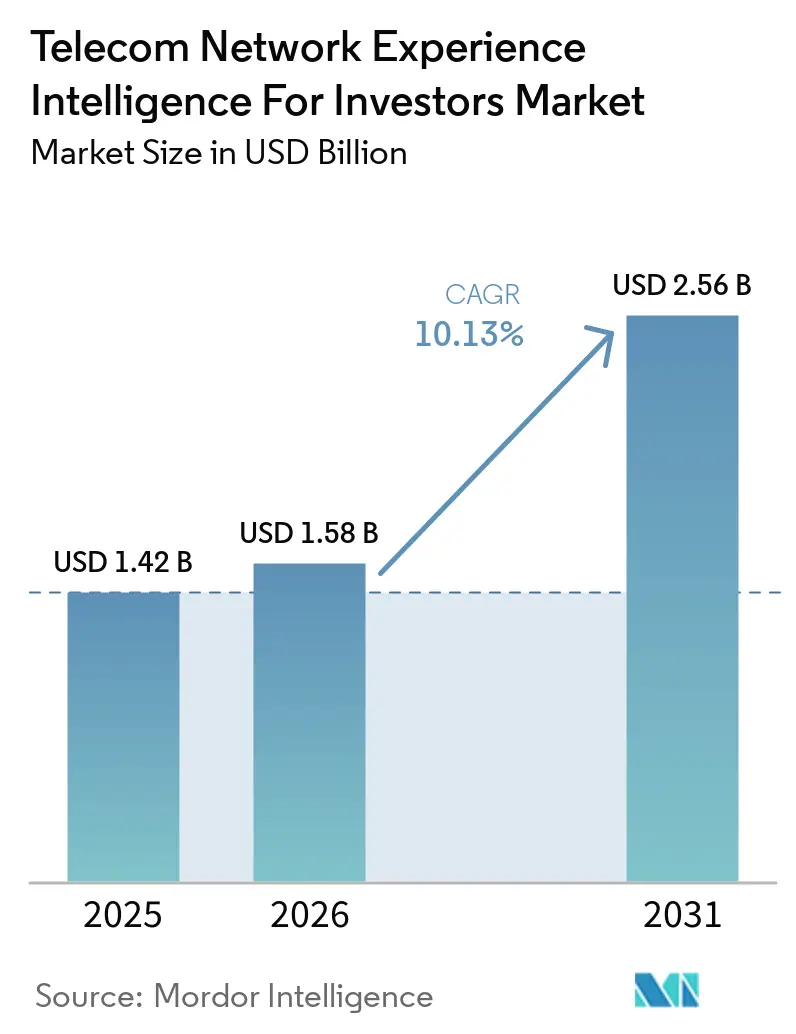
| Market Size (2026) | USD 1.58 Billion |
| Market Size (2031) | USD 2.56 Billion |
| Growth Rate (2026 - 2031) | 10.13 % |
| Fastest Growing Market | Middle East |
| Largest Market | North America |
| Market Concentration | Low |
Major Players *Disclaimer: Major Players sorted in no particular order Image © Mordor Intelligence. Reuse requires attribution under CC BY 4.0. | |
Telecom Network Experience Intelligence For Investors Market Analysis by Mordor Intelligence
The telecom network experience intelligence for investors market size is projected to expand from USD 1.42 billion in 2025 and USD 1.58 billion in 2026 to USD 2.56 billion by 2031, registering a CAGR of 10.13% between 2026 to 2031. Commercial 5G standalone deployments are making service-level commitments more specific, especially when operators sell differentiated network slices to enterprises. AI-based assurance tools are also moving from observation toward automated remediation, which increases the value of usable telemetry and reliable data governance. The telecom network experience intelligence for investors market serves network operators that need to assure services and financial users that need independently verified performance information for due diligence and covenant monitoring. Legacy data silos, skills shortages, and data sovereignty rules slow deployment, although they also create room for cloud-native platforms that can simplify integration and hybrid operating models.
Key Report Takeaways
- By component, software held 33.42% of the telecom network experience intelligence for investors market share in 2025, while services are projected to expand at a 10.44% CAGR through 2031.
- By deployment mode, cloud-based deployment held 23.76% in 2025 and is expected to expand at a 10.68% CAGR through 2031.
- By solution function, network experience benchmarking held 22.27% in 2025, while customer experience and churn analytics is projected to expand at a 10.59% CAGR through 2031.
- By network domain, radio access network held 30.16% in 2025, while core network is expected to expand at a 10.43% CAGR through 2031.
- By connectivity technology, 2G, 3G, 4G, and 5G held 25.62% in 2025, while 5G standalone and network slicing is projected to expand at a 10.86% CAGR through 2031.
- By end user, mobile network operators held 44.38% in 2025, while infrastructure investors, lenders, and equity analysts are expected to expand at a 10.83% CAGR through 2031.
- By organization size, large enterprises and tier-1 operators held 34.22% in 2025, while small and medium-sized operators and enterprises are projected to expand at a 10.39% CAGR through 2031.
- By geography, North America held 31.77% in 2025, while the Middle East is expected to expand at a 10.56% CAGR through 2031.
Note: Market size and forecast figures in this report are generated using Mordor Intelligence’s proprietary estimation framework, updated with the latest available data and insights as of January 2026.
Global Telecom Network Experience Intelligence For Investors Market Trends and Insights
Drivers Impact Table*
| Driver | (~) % Impact on CAGR Forecast | Geographic Relevance | Impact Timeline |
|---|---|---|---|
| 5G Standalone and Network Slicing Assurance Demand | +2.5% | Global, with core gains in Asia-Pacific, the Middle East, and Europe | Long term (≥ 4 years) |
| AI-Driven Predictive Assurance and Closed-Loop Automation | +2.2% | Global | Medium term (2-4 years) |
| Multi-Vendor, Multi-Domain Network Complexity | +1.8% | Global, most acute in North America and Europe | Medium term (2-4 years) |
| Enterprise SLA Evidence for Private Networks and Edge Services | +1.5% | North America and Europe, with spillover to Asia-Pacific | Medium term (2-4 years) |
| Rising Value of Crowdsourced and Real-World Experience Data | +1.2% | Global | Short term (≤ 2 years) |
| Experience-Led Network Investment and Churn Reduction | +1.1% | North America, Europe, and high-ARPU Asia-Pacific markets | Short term (≤ 2 years) |
| Source: Mordor Intelligence | |||
5G Standalone and Network Slicing Assurance Demand
Commercial 5G standalone services make network slicing a sellable enterprise service rather than a technical capability. Operators therefore need auditable records that show whether each slice meets its promised service level. A 2025 operator survey found that 26% of operators had deployed or begun testing network slicing, indicating that much of the related assurance demand remains ahead. 3GPP identifies assurance closed control loops as a mechanism for managing multiple slice service-level agreements.[1] NETSCOUT offers per-slice service-level audit trails, reflecting the need to use monitoring as support for differentiated service pricing.[2] This need supports wider adoption in the telecom network experience intelligence for investors market because service quality evidence can serve both operating teams and financial reviewers.
AI-Driven Predictive Assurance and Closed-Loop Automation
AI-enabled assurance is changing network operations from issue detection to automated correction. Nokia and Google Cloud announced in June 2026 that multiple Gemini-powered AI agents would be embedded in Nokia Assurance Center, and Nokia said the deployment can significantly reduce problem-solving time. ETSI describes network digital twins and closed-loop automation as steps toward higher levels of autonomous networks.[3] As basic anomaly detection becomes more common, vendors depend more on the quality, continuity, and governance of their multi-vendor telemetry data. Platforms with longer operational histories can use that information to improve model training and workflow reliability. This makes data stewardship an important competitive factor in the telecom network experience intelligence for investors market.
Multi-Vendor, Multi-Domain Network Complexity
Operators use equipment and software from several suppliers across radio, core, transport, and customer-facing systems. This creates inconsistent key performance indicator definitions and makes it difficult to produce a unified view of service quality. RADCOM found that a majority of surveyed network leaders viewed legacy OSS and BSS integration as the main barrier to advancing AIOps, while over half reported siloed data systems and identified data quality as a challenge. HCLTech also described how independently developed siloed systems make end-to-end visibility difficult without major integration work. Interoperability standards can help, but adoption differs across operator tiers. The telecom network experience intelligence for investors market benefits when platforms can normalize diverse network data into information that operations teams and investment users can interpret.
Enterprise SLA Evidence for Private Networks and Edge Services
Private-network providers and enterprises need contractual evidence that a service met its agreed performance level. This changes assurance from a back-office monitoring activity into a way to protect service revenue and customer relationships. A commissioned industry survey identified service-level-agreement-based network slices as the leading operator monetization priority, ahead of multi-tenant enterprise services and standalone private networks. Mycom OSI introduced SLA Guardian in March 2026 to validate service commitments across mobile, Wi-Fi, satellite, and SD-WAN environments in real time. 3GPP also includes service-level monitoring for non-public networks in its guidance. These requirements support demand for the telecom network experience intelligence for investors market where platforms can provide verifiable proof instead of a service promise alone.
Restraints Impact Analysis*
| Restraint | (~) % Impact on CAGR Forecast | Geographic Relevance | Impact Timeline |
|---|---|---|---|
| Legacy OSS Data Silos and Inconsistent KPI Semantics | -1.8% | Global, most severe in multi-vendor 4G and 5G coexistence markets | Long term (≥ 4 years) |
| High Integration and Migration Costs | -1.5% | Global, most acute for tier-2 and tier-3 operators | Medium term (2-4 years) |
| Scarcity of Telecom-AIOps and Network-Data Engineering Skills | -1.2% | Global, most acute in Africa and South America | Long term (≥ 4 years) |
| Data Sovereignty, Privacy, and Cybersecurity Constraints | -1.1% | Europe and Asia-Pacific | Medium term (2-4 years) |
| Source: Mordor Intelligence | |||
Legacy OSS Data Silos and Inconsistent KPI Semantics
Legacy OSS architectures were designed for static networks and narrower supplier environments. They often cannot provide the unified, real-time service view that AI-based assurance systems require. Separate data models need ongoing transformation before operators can apply cross-domain analytics. Telefónica’s modernization work illustrates this operating challenge. These conditions lengthen sales cycles, raise customer acquisition costs, and increase professional-services work. They can delay the software-scale economics expected by vendors in the telecom network experience intelligence for investors market.
High Integration and Migration Costs
Replacing an existing assurance system requires spending on data integration, migration, testing, and process change. These costs can exceed the license fee and are especially difficult for tier-2 and tier-3 operators with competing network investment needs. Internal teams must often manage the integration work, but limited capacity can create delivery bottlenecks. Operators that delay migration accumulate technical debt, which increases the cost of later modernization. In South America and Africa, lower average revenue per user narrows the immediate pool of buyers able to fund large transformations. This cost pressure slows new platform adoption even where long-term assurance needs are clear.
*Our forecasts treat driver/restraint impacts as directional, not additive. The impact forecasts reflect baseline growth, mix effects, and variable interactions.
Segment Analysis
By Component: Services Reflect a Move From Platform Ownership to Outcomes
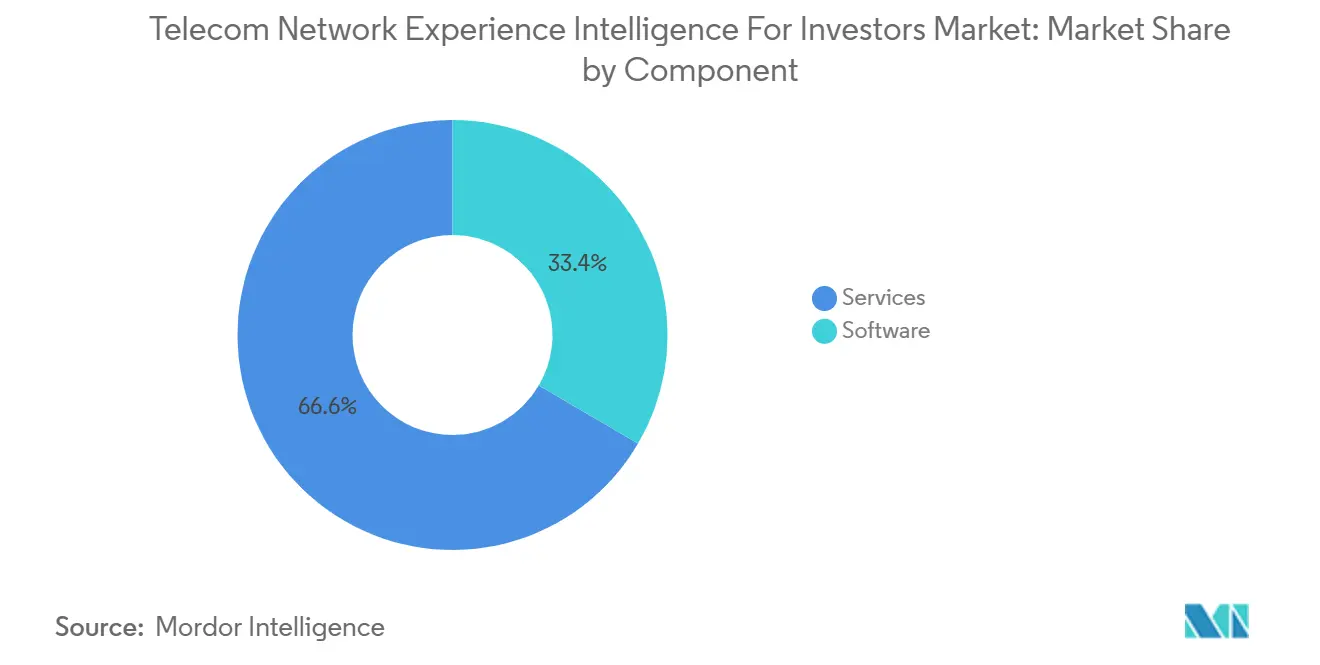
Software held 33.42% of the telecom network experience intelligence for investors market share in 2025, showing that operators still use licensed platforms to build internal assurance capabilities. Services are expected to expand at a CAGR of 10.44% from 2026 to 2031. Operators increasingly need specialist support to configure AI-driven assurance systems at scale. RADCOM reported that a significant share of network leaders cited a shortage of AIOps talent as a challenge. The skills gap converts a need for operational continuity into demand for managed assurance services.
Amdocs, Accenture, and IBM offer managed assurance arrangements that extend beyond basic monitoring. These arrangements increasingly focus on service-level results rather than access to a software platform. This can increase revenue per customer when suppliers can demonstrate measured business outcomes. It also reduces reliance on contract lock-in because vendors must show continuing value. The telecom network experience intelligence for investors industry is therefore seeing services demand tied to the shortage of operational skills rather than to a simple replacement of software.
By Deployment Mode: Cloud Extends Its Lead in Assurance Architecture
Cloud-based deployment held 23.76% in 2025 and is expected to expand at a CAGR of 10.68% from 2026 to 2031. This combination of current leadership and fastest expansion makes cloud-native assurance the preferred architecture for new deployments. Nokia introduced Autonomous Network Fabric in June 2025 using Vertex AI and BigQuery for AI-supported operations. The design also retained selected on-premises processing for jurisdictions with data residency limits.
On-premises systems remain important where national security or data localization rules require local processing. Hybrid configurations offer a practical option for operators that need cloud capabilities while retaining sensitive data controls. RADCOM ACE is available as a cloud-native function for public and private cloud settings, including 5G core environments. This broadens the potential use of cloud architecture among enterprise and government private-network operators. In the telecom network experience intelligence for investors market, fully on-premises deployment is likely to remain concentrated among operators subject to explicit local processing requirements.
By Solution Function: Churn Analytics Gains on Benchmarking Tools
Network experience benchmarking held 22.27% in 2025 because it supports regulatory reporting, competitive marketing, and capital expenditure planning. Customer experience and churn analytics is projected to expand at a CAGR of 10.59% from 2026 to 2031. Operators are linking real-time signal quality with subscriber behavior models. Opensignal’s Network Experience Suite connects network performance with local subscriber switching behavior in near real time. This allows operators to respond to early churn signals before they are visible in periodic reports.
Service and quality-of-experience assurance, together with performance, fault, and event analytics, remains the operating base for more advanced analytics. Operators generally need these functions before they can add customer retention models. This sequence creates an upgrade path within existing customer accounts. An ITU workshop in May 2026 highlighted the movement toward new measurement methods for quality-of-service and quality-of-experience benchmarking. Continued standards change creates replacement demand and raises entry requirements for suppliers in the telecom network experience intelligence for investors market.
By Network Domain: RAN Remains Central While Core Intelligence Accelerates
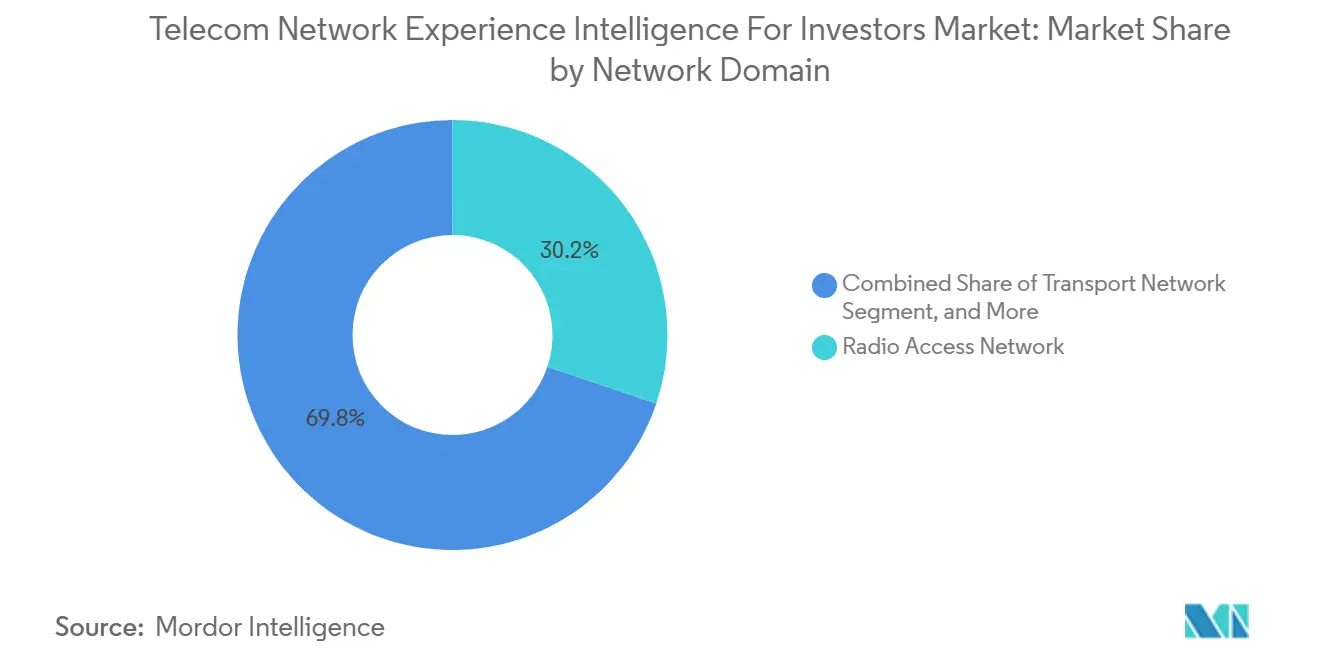
The radio access network held 30.16% in 2025 because it is the most visible network layer for subscriber experience and produces extensive telemetry. Core network intelligence is expected to expand at a CAGR of 10.43% from 2026 to 2031. 5G standalone services depend on cloud-native core functions such as session management, user plane, and network data analytics. These functions support per-slice commitments that older core architectures cannot provide. This creates a clear operational need for assurance focused on the core.
Transport network and fixed access and broadband network functions remain smaller, but they have a direct effect on radio performance. Operators need cross-domain visibility because a transport issue can limit the service quality measured at the radio layer. EXFO deployed EXFO Context at Vodafone Germany in June 2025 as a knowledge-graph-based semantic digital twin for service impact analysis. The deployment demonstrates how intelligence is extending across fixed, transport, and mobile domains. This capability differentiates suppliers competing for tier-1 operator contracts in the telecom network experience intelligence for investors market.

By Connectivity Technology: 5G Standalone Changes Assurance Economics
The combined 2G, 3G, 4G, and 5G segment held 25.62% in 2025 because commercial networks continue to carry traffic across several generations. 5G standalone and network slicing is projected to expand at a CAGR of 10.86% from 2026 to 2031. Operators in the Gulf Cooperation Council, East Asia, and major European cities are developing slice-based enterprise catalogs. These offers require dedicated, per-slice assurance systems. The telecom network experience intelligence for investors market therefore must support both established multi-generation traffic and newer 5G standalone services.
Other connectivity technologies include fixed wireless access, satellite links, and emerging non-terrestrial connections. These technologies raise the need for assurance as private networks combine several access methods. The scope of intelligence is expanding from cellular monitoring to multi-access service analysis. Zain’s expansion to 94 cities in Saudi Arabia and its investment in AI-based network automation show the infrastructure work supporting this demand in the Middle East. Financial users will increasingly need per-slice service evidence instead of relying only on average throughput measures.
By End User: Investor Demand Positions Assurance as Financial Infrastructure
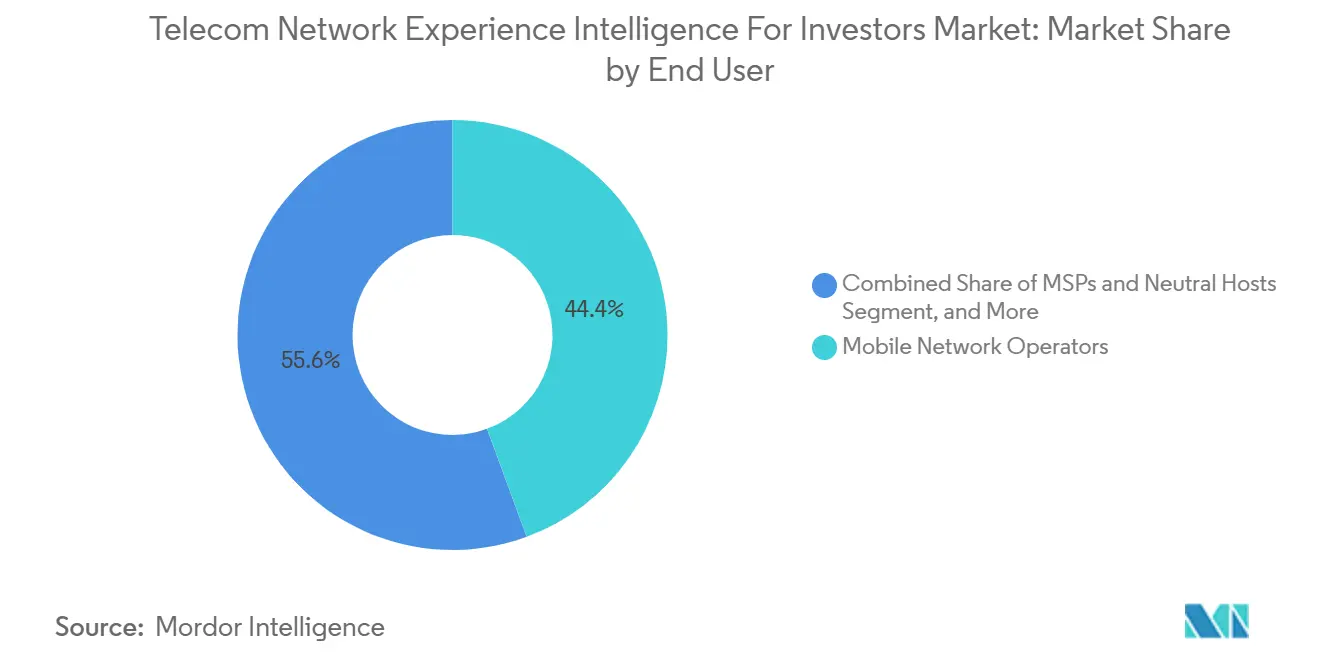
Mobile network operators held 44.38% in 2025 because they are the main buyers of network intelligence platforms and the primary source of operational data. Infrastructure investors, lenders, and equity analysts are expected to expand at a CAGR of 10.83% from 2026 to 2031. These users require standardized and independently verified network-quality evidence for valuation work and covenant monitoring. ANATEL extended technical cooperation agreements with Opensignal and Ookla for 24 months in 2024. The agreements support an authoritative data layer that investors can use for independent quality assessment.
Fixed-line operators and internet service providers focus on broadband experience parity. Mobile virtual network operators need benchmarking against host networks, while managed service providers need evidence of delivery to enterprise clients. Regulators establish benchmarking requirements that operators must document publicly. Investors can then use these measures as quality indicators. The telecom network experience intelligence for investors industry must increasingly provide investment-grade reporting as a standard capability rather than as a custom add-on.
By Organization Size: SaaS Platforms Help Smaller Operators Close the Gap
Large enterprises and tier-1 operators held 34.22% in 2025 because they can fund full assurance platforms and face wider regulatory reporting requirements. Small and medium-sized operators and enterprises are projected to expand at a CAGR of 10.39% from 2026 to 2031. Cloud-native and SaaS delivery reduces the capital and operating burden of deploying advanced network intelligence. Infovista introduced VistaOne in March 2026 with modular, open-API architecture and agentic AI capabilities. Such designs help smaller operators access capabilities without the customization cost of older enterprise platforms.
MVNOs, neutral hosts, and private-network operators are important buyers in this segment. They often have demanding service commitments but limited internal data engineering resources. Packaged SaaS offerings can give them credible assurance without a custom build. Suppliers built around large and highly customized contracts may face margin pressure as this buyer group expands. Modular platforms with common technology and tailored packaging are better placed to serve both large and smaller organizations. This is a material opportunity for the telecom network experience intelligence for investors market.
Geography Analysis
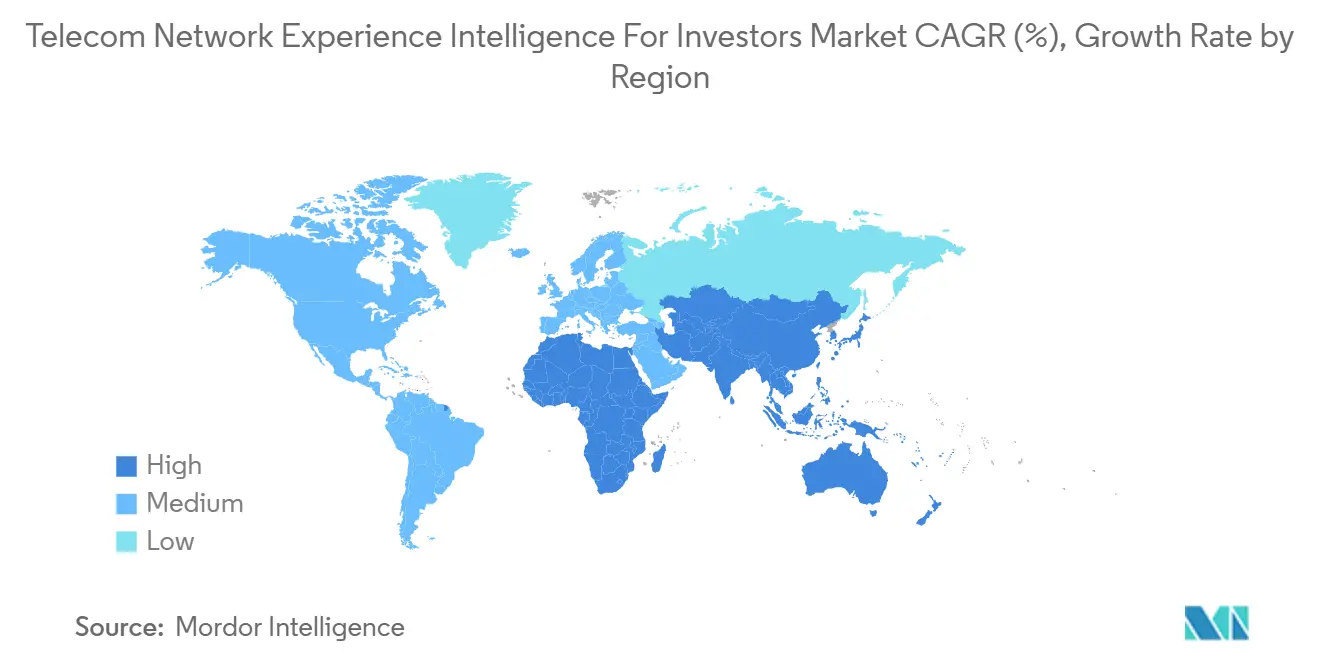
North America held 31.77% in 2025, supported by advanced 5G commercialization and a strong institutional investor base. U.S. operators use independent quality benchmarks in due diligence and infrastructure review processes. Competition among AT&T, T-Mobile, and Verizon encourages investment in systems that generate defensible quality evidence. Opensignal reported on these operators in its July 2026 U.S. mobile network experience study. Canada has demand for managed assurance services, while Mexico is moving from reactive monitoring toward predictive intelligence.
Europe is the second-largest cluster, with Germany, the United Kingdom, France, and the Nordic countries supporting mature benchmarking and quality-reporting demand. EXFO Context at Vodafone Germany supports zero-touch automation across mobile and fixed operations. Asia-Pacific has the highest operator count and acts as a testing ground for new autonomous-network capabilities. Nokia conducted autonomous-network trials with NTT DOCOMO at DTW26 in 2026. India’s proposed 5G slicing quality framework points to compliance-led demand for performance evidence before wider commercial service launches.
The Middle East is expected to expand at a CAGR of 10.56% from 2026 to 2031, making it the fastest-growing geographic area in the telecom network experience intelligence for investors market. Gulf Cooperation Council operators are advancing 5G standalone programs, while sovereign wealth investors need verified evidence for telecommunications infrastructure reviews. Ooredoo signed a February 2026 framework agreement with Polystar for mobile and fixed broadband analytics across networks with 5G standalone investment. South America and Africa remain smaller markets, although Brazil’s quality framework and deployment activity in South Africa and Egypt support demand. High integration costs and limited AIOps skills continue to limit wider adoption across Africa and South America.
Competitive Landscape
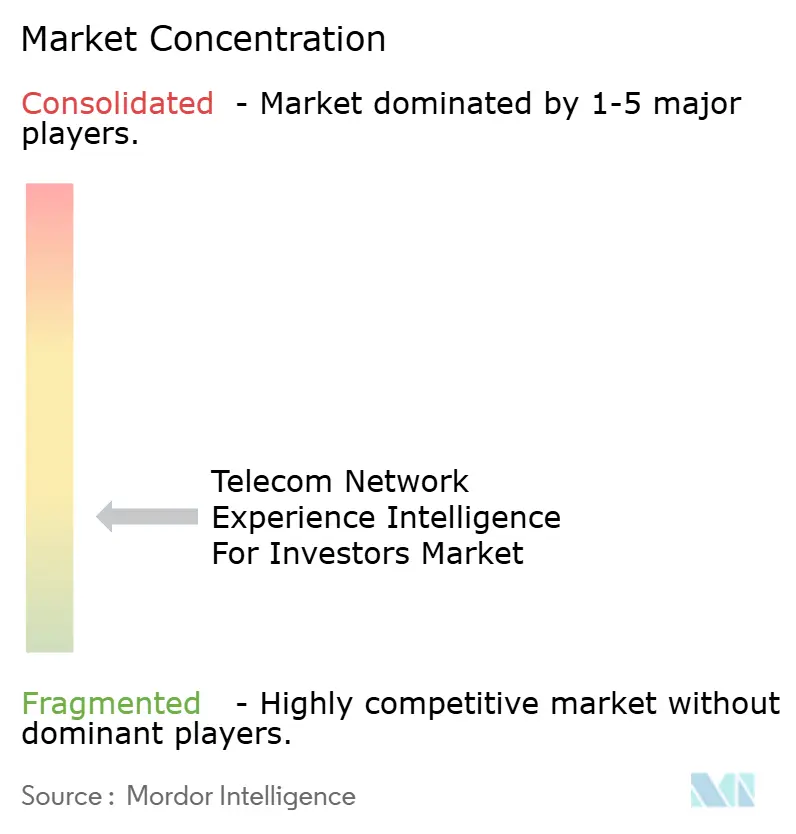
The telecom network experience intelligence for investors market is moderately fragmented, and no supplier holds a decisive position across all network domains. Competitive differentiation is moving away from feature novelty and toward integration coverage, standards alignment, and data governance. RADCOM, NETSCOUT, Mycom OSI, Infovista, and VIAVI Solutions compete through detailed domain telemetry and assurance capabilities. Nokia and Ericsson use their equipment positions to influence the underlying data layer. Amdocs, IBM, and Oracle compete through established carrier software relationships and integration capabilities.
VIAVI put NITRO AIOps live at TDC NET in January 2026 using TM Forum ODA framework interfaces. The move shows that standards-aligned architecture is important for European and enterprise-focused opportunities. Nokia and Google Cloud expanded their partnership in June 2026 to include AI agents in Nokia Assurance Center. Infovista launched VistaOne in March 2026 to bring network and customer experience intelligence into a common data fabric. These moves show a broad industry effort to make automation, data integration, and customer experience analysis work together.
Opportunity areas include investor-ready reporting for investment committees and infrastructure credit analysis. Smaller operators, MVNOs, neutral hosts, and private networks also need lower-cost platforms that can meet service obligations. Multi-access intelligence across 5G, fixed broadband, Wi-Fi, and satellite is another area that remains incomplete at scale. Opensignal and Ookla are extending their role from regulatory reference points toward financial audiences. This could give independently measured benchmarks a larger role in credit analysis and equity valuation. The telecom network experience intelligence for investors market remains open to suppliers that can combine operational depth with reporting that financial users can rely on.
Telecom Network Experience Intelligence For Investors Industry Leaders
-
Cisco Systems, Inc.
-
Telefonaktiebolaget LM Ericsson
-
Nokia Corporation
-
Infovista SAS
-
Opensignal, Inc.
- *Disclaimer: Major Players sorted in no particular order
Recent Industry Developments
- August 2026: RADCOM announced a multi-year contract with CETIN Networks to deploy end-to-end AI-driven service assurance across CETIN's mobile network in Slovakia, replacing the legacy provider and consolidating visibility on a cloud-native platform directly supporting the operator's 5G SA rollout and Voice over New Radio transition.
- June 2026: Nokia and Google Cloud announced an expanded partnership embedding several Gemini-powered AI agents within the Nokia Assurance Center. Nokia disclosed that the deployment can substantially reduce network problem-solving times; a certified SaaS starter pack is scheduled for the Google Cloud Marketplace in September 2026, with additional agents released through 2027.
- June 2026: Nokia presented upgrades to its autonomous networks portfolio at DTW26 in Copenhagen, including MantaRay SMO enhancements with Non-Real-Time RIC functionality enabling multi-vendor RAN automation, anomaly detection, and dynamic network slicing, with active AutoPilot trials alongside NTT DOCOMO.
- June 2026: VIAVI Solutions introduced AI Experts, the first addition to its NITRO AI portfolio, providing product-specific AI intelligence for wireless test, validation, and observability across the OneAdvisor 800 Wireless, TM500, and TeraVM platforms.
Global Telecom Network Experience Intelligence For Investors Market Report Scope
Telecom Network Experience Intelligence for Investors Market refers to independent data, analytics, and advisory solutions that assess telecom network quality, customer experience, competitive position, and investment potential. These solutions combine QoE and QoS metrics such as coverage, speed, latency, reliability, availability, and subscriber behavior with market share, switching, financial, and operational intelligence
The Telecom Network Experience Intelligence for Investors Market Report is Segmented by Component (Software, and Services), Deployment Mode (Cloud-Based, On-Premises, and Hybrid), Solution Function (Network Experience Benchmarking, Service and QoE Assurance, Performance, Fault, and Event Analytics, and Customer Experience and Churn Analytics) Network Domain (Radio Access Network, Core Network, Transport Network, and Fixed Access and Broadband Network), Connectivity Technology (2G, 3G, 4G, and 5G, and 5G Standalone and Network Slicing), End User (Mobile Network Operators, Fixed-Line Operators and Internet Service Providers, MVNOs and MVNEs, Managed Service Providers and Neutral Hosts, Private Network Operators and Enterprises, Telecom Regulators and Public Authorities, and Infrastructure Investors, Lenders, and Equity Analysts), Organization Size (Large Enterprises and Tier-1 Operators, and Small and Medium-Sized Operators and Enterprises), and Geography (North America, South America, Europe, Asia-Pacific, Middle East, and Africa). The Market Forecasts Are Provided in Terms of Value (USD).
| Software |
| Services |
| Cloud-Based |
| On-Premises |
| Hybrid |
| Network Experience Benchmarking |
| Service and QoE Assurance |
| Performance, Fault, and Event Analytics |
| Customer Experience and Churn Analytics |
| Other Solution Functions |
| Radio Access Network |
| Core Network |
| Transport Network |
| Fixed Access and Broadband Network |
| Other Network Domains |
| 2G, 3G, 4G, and 5G |
| 5G Standalone and Network Slicing |
| Other Connectivity Technologies |
| Mobile Network Operators |
| Fixed-Line Operators and Internet Service Providers |
| MVNOs and MVNEs |
| Managed Service Providers and Neutral Hosts |
| Private Network Operators and Enterprises |
| Telecom Regulators and Public Authorities |
| Infrastructure Investors, Lenders, and Equity Analysts |
| Large Enterprises and Tier-1 Operators |
| Small and Medium-Sized Operators and Enterprises |
| North America | United States |
| Canada | |
| Mexico | |
| South America | Brazil |
| Argentina | |
| Rest of South America | |
| Europe | Germany |
| United Kingdom | |
| France | |
| Italy | |
| Spain | |
| Russia | |
| Rest of Europe | |
| Asia-Pacific | China |
| Japan | |
| India | |
| South Korea | |
| Australia | |
| Rest of Asia-Pacific | |
| Middle East | Saudi Arabia |
| United Arab Emirates | |
| Turkey | |
| Rest of Middle East | |
| Africa | South Africa |
| Egypt | |
| Rest of Africa |
| By Component | Software | |
| Services | ||
| By Deployment Mode | Cloud-Based | |
| On-Premises | ||
| Hybrid | ||
| By Solution Function | Network Experience Benchmarking | |
| Service and QoE Assurance | ||
| Performance, Fault, and Event Analytics | ||
| Customer Experience and Churn Analytics | ||
| Other Solution Functions | ||
| By Network Domain | Radio Access Network | |
| Core Network | ||
| Transport Network | ||
| Fixed Access and Broadband Network | ||
| Other Network Domains | ||
| By Connectivity Technology | 2G, 3G, 4G, and 5G | |
| 5G Standalone and Network Slicing | ||
| Other Connectivity Technologies | ||
| By End User | Mobile Network Operators | |
| Fixed-Line Operators and Internet Service Providers | ||
| MVNOs and MVNEs | ||
| Managed Service Providers and Neutral Hosts | ||
| Private Network Operators and Enterprises | ||
| Telecom Regulators and Public Authorities | ||
| Infrastructure Investors, Lenders, and Equity Analysts | ||
| By Organization Size | Large Enterprises and Tier-1 Operators | |
| Small and Medium-Sized Operators and Enterprises | ||
| By Geography | North America | United States |
| Canada | ||
| Mexico | ||
| South America | Brazil | |
| Argentina | ||
| Rest of South America | ||
| Europe | Germany | |
| United Kingdom | ||
| France | ||
| Italy | ||
| Spain | ||
| Russia | ||
| Rest of Europe | ||
| Asia-Pacific | China | |
| Japan | ||
| India | ||
| South Korea | ||
| Australia | ||
| Rest of Asia-Pacific | ||
| Middle East | Saudi Arabia | |
| United Arab Emirates | ||
| Turkey | ||
| Rest of Middle East | ||
| Africa | South Africa | |
| Egypt | ||
| Rest of Africa | ||
Key Questions Answered in the Report
What is the size of the telecom network experience intelligence for investors market?
The market is valued at USD 1.58 billion in 2026 and is projected to reach USD 2.56 billion by 2031 at a 10.13% CAGR.
What is driving demand for network experience intelligence platforms?
5G standalone services, network slicing, AI-enabled assurance, multi-vendor integration needs, and enterprise service-level commitments are supporting adoption.
Which deployment model is expanding fastest?
Cloud-based deployment is expected to expand at a 10.68% CAGR through 2031, while holding 23.76% in 2025.
Which users are expected to adopt these platforms most quickly?
Infrastructure investors, lenders, and equity analysts are projected to expand at a 10.83% CAGR through 2031 as they seek verified quality data.
Which network domain has the largest share?
The radio access network held 30.16% in 2025 because it has a direct effect on subscriber experience and produces substantial performance data.
What is limiting adoption of advanced assurance systems?
Legacy OSS silos, high migration costs, scarce AIOps talent, and data sovereignty requirements can delay platform deployment.