
Telecom Infrastructure Valuation Services Market Size and Share
Market Overview
| Study Period | 2020 - 2031 |
|---|---|
| Market Size (2026) | USD 1.87 Billion |
| Market Size (2031) | USD 2.61 Billion |
| Growth Rate (2026 - 2031) | 6.92 % |
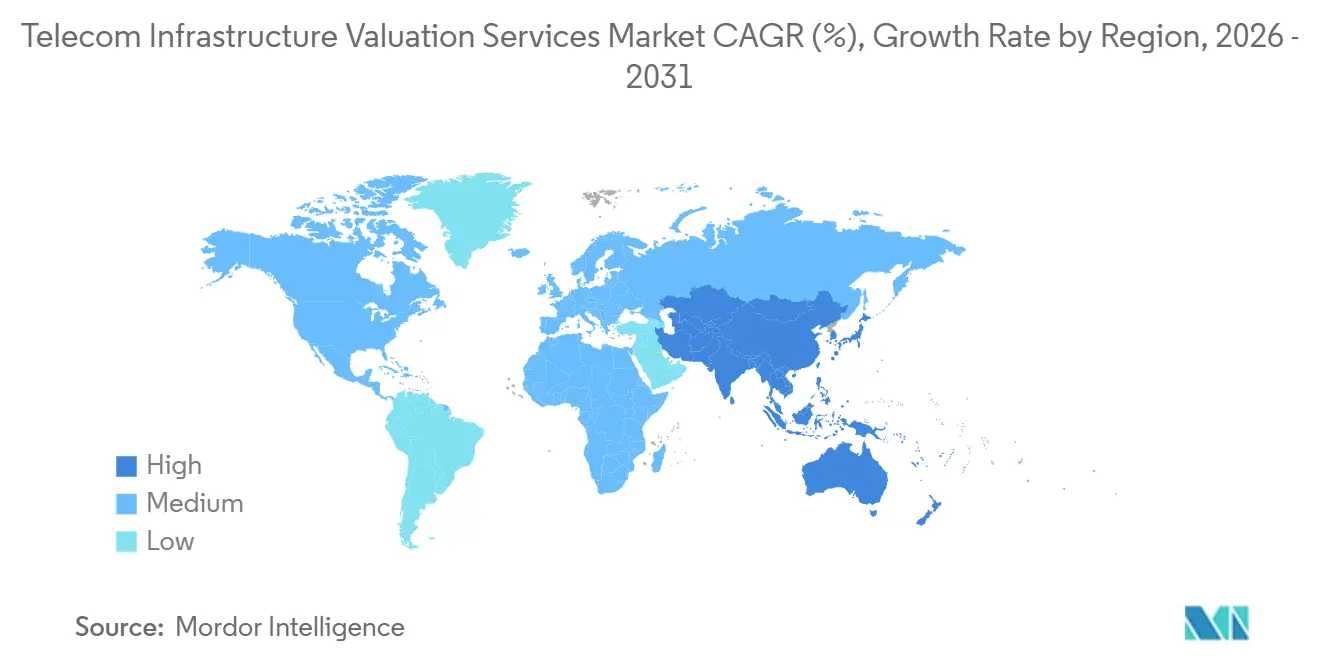
| Fastest Growing Market | Africa |
| Largest Market | North America |
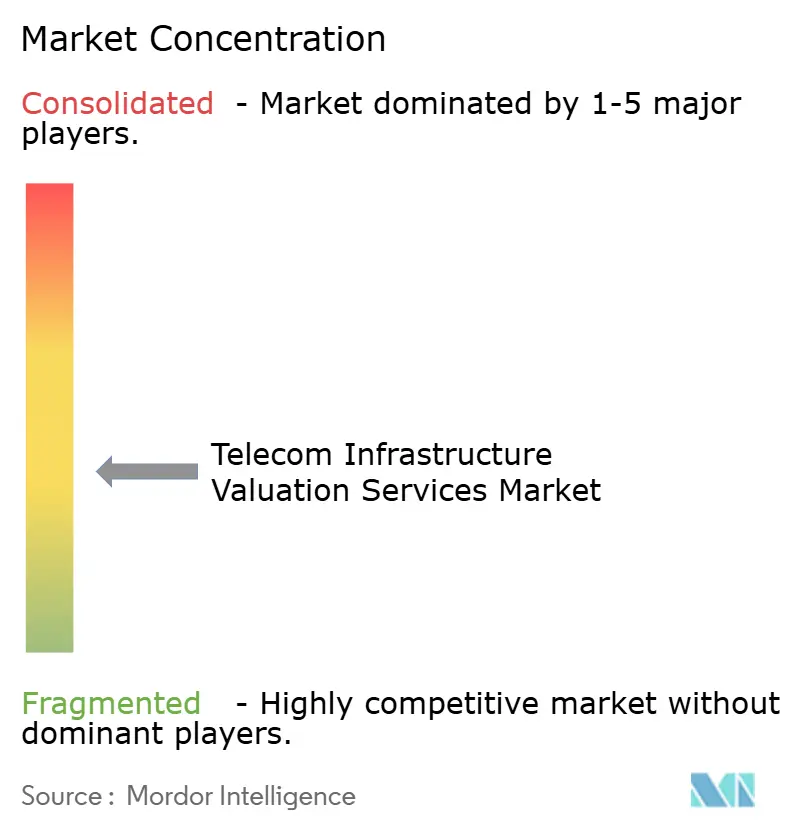
| Market Concentration | Medium |
Major Players *Disclaimer: Major Players sorted in no particular order Image © Mordor Intelligence. Reuse requires attribution under CC BY 4.0. | |
Telecom Infrastructure Valuation Services Market Analysis by Mordor Intelligence
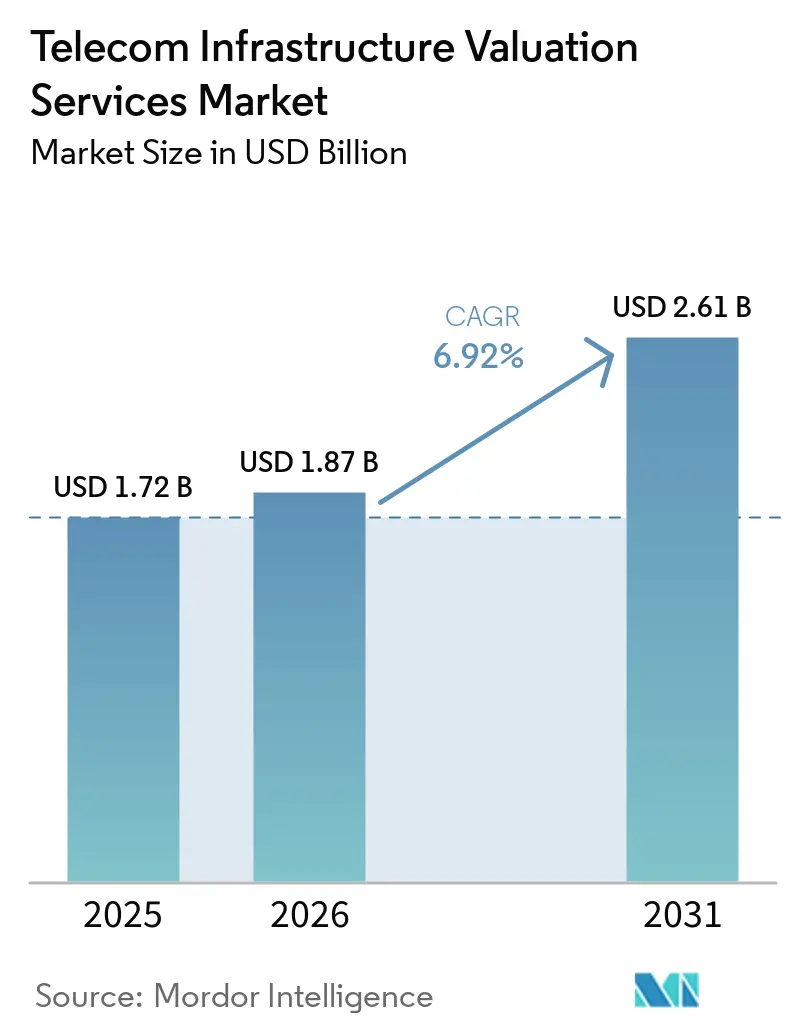
The telecom infrastructure valuation services market size was valued at USD 1.72 billion in 2025 and estimated to expand from USD 1.87 billion in 2026 to reach USD 2.61 billion by 2031, at a CAGR of 6.92% during the forecast period 2026-2031. Transaction activity supports demand because tower carve-outs, spectrum renewals, and debt refinancing require independent assessments of asset values before capital can be committed, assets can be transferred, or financing terms can be established. Valuation work also supports lender covenants, financial reporting under IFRS and U.S. GAAP, and regulatory processes, which gives assignments a recurring role after an initial transaction has closed and requires the underlying evidence to withstand review by several parties. The telecom infrastructure valuation services market is being shaped by larger and more varied asset portfolios, which combine towers, fiber, small cells, rooftops, distributed antenna systems, and edge facilities with different operating and revenue characteristics. Digital-twin and geospatial tools can shorten site review work and widen the scope of technical diligence for each transaction by connecting physical records, site conditions, contractual information, equipment information, network dependencies, and financial evidence in a more consistent review process. Limited visibility into private deals and changes in discount rates continue to make comparable analysis and long-term asset valuation more difficult, particularly where portfolio data is inconsistent, transaction terms are not disclosed, asset histories are incomplete, or comparable market evidence is limited.
Key Report Takeaways
- By service type, Asset Appraisal and Fair-Value Opinion Services held 25.44% of the telecom infrastructure valuation services market share in 2025, while Spectrum and License Valuation Services is projected to expand at a CAGR of 7.13% through 2031.
- By asset type, Macro Towers accounted for 33.36% share in 2025, while Small Cells and Distributed Antenna Systems is projected to expand at a CAGR of 7.22% through 2031.
- By client type, TowerCos and Neutral-Host Providers held 28.17% share in 2025, while Infrastructure Funds and Private Equity Investors is projected to expand at a CAGR of 7.16% through 2031.
- By engagement purpose, Acquisitions, Divestitures, and Carve-Outs held 30.48% share in 2025, while Financing, Refinancing, and Recapitalization is projected to expand at a CAGR of 7.33% through 2031.
- By geography, North America held 32.47% share in 2025, while Africa is projected to expand at a CAGR of 7.47% through 2031.
Note: Market size and forecast figures in this report are generated using Mordor Intelligence’s proprietary estimation framework, updated with the latest available data and insights as of January 2026.
Market Trends and Insights
Drivers Impact Table of Telecom Infrastructure Valuation Services Market*
| Driver | (~) % Impact on CAGR Forecast | Geographic Relevance | Impact Timeline |
|---|---|---|---|
| 5G and 5G-Advanced Infrastructure Densification | +2.1% | Global, concentrated in Asia-Pacific, North America, and Europe | Medium term (2-4 years) |
| Mobile Infrastructure M&A and Asset-Monetization Activity | +1.7% | Global, with highest deal velocity in Asia-Pacific, Europe, and North America | Short term (≤ 2 years) |
| Rising Complexity of Multi-Asset Network Portfolios | +1.2% | Global, with emphasis on North America and Europe | Medium term (2-4 years) |
| Public Funding and Rural Coverage Programs | +0.8% | North America, Europe, and Africa | Medium term (2-4 years) |
| Digital-Twin and Geospatial Data Adoption in Asset Underwriting | +0.6% | Global | Long term (≥ 4 years) |
| Revaluation Demand from Energy, Lease, and Co-Location Volatility | +0.4% | North America and Europe | Short term (≤ 2 years) |
| Source: Mordor Intelligence | |||
5G and 5G-Advanced Infrastructure Densification
Network densification creates a recurring need to update asset registers, support financing, and prepare fair-value opinions. The United States had an extensive deployment of macrocell sites and indoor small-cell nodes in operation at the end of 2025.[1] GSA reported that hundreds of operators had launched 5G networks globally as of April 2026, representing growth since March 2025. Each site addition can bring new radio equipment, backhaul links, lease records, and technical specifications that need to be reflected in an asset record. Shared sites now accommodate more frequencies and technologies, so defensible valuation work requires stronger radio-frequency engineering inputs. This shift increases the value of advisers who can connect site-level technical evidence with financial assumptions across the telecom infrastructure valuation services market.
Mobile Infrastructure M&A and Asset-Monetization Activity
Tower sales, carve-outs, and sale-leaseback transactions create work across technical diligence, fairness opinions, and purchase price allocation. KKR announced a significant preferred equity investment in Vertical Bridge in April 2026, and the release valued the operator in the multibillion-dollar range. Macquarie Asset Management agreed in April 2026 to acquire IHS Towers' South American operations, including a substantial portfolio of sites in Brazil and Colombia. These transactions require a view of physical assets, tenancy, contracts, local operating conditions, reported asset records, site access, maintenance requirements, network dependencies, and the assumptions used to translate operating evidence into expected cash flows before investors and lenders commit capital. Post-acquisition reporting requirements can create further work when buyers allocate transaction value across acquired towers, small cells, fiber, spectrum rights, and related contractual assets. The telecom infrastructure valuation services market, therefore, benefits from the full transaction cycle rather than only the point at which a deal is announced.
Rising Complexity of Multi-Asset Network Portfolios
TowerCos increasingly manage macro towers, rooftops, small cells, fiber backhaul, and edge computing nodes within integrated portfolios. Each asset class has different cash flows, depreciation schedules, technology refresh periods, residual-value assumptions, maintenance needs, and exposure to tenant renewal decisions. The Wireless Infrastructure Association reported that its commissioned analysis found that DISH Network contract defaults could require tower companies to increase lease costs substantially to offset lost revenue. A tenant event of this kind can change the income profile used in a site valuation and can make portfolio-level review more important. Technical diligence is consequently becoming a defined service need instead of a secondary transaction task. Firms serving the telecom infrastructure valuation services market need evidence that links asset records with lease terms, operating exposure, financial models, and the assumptions that connect each asset class to its expected cash flow.
Public Funding and Rural Coverage Programs
Public broadband programs create valuation work that is less dependent on commercial acquisition activity. The Federal Communications Commission's Rural Digital Opportunity Fund can provide substantial funding over a multiyear period, and its guidance issued in 2025 established progressive deployment milestones for recipients. The Italia densification plan had expanded next-generation mobile coverage across hundreds of white-area sites by 2026, with INWIT reporting the completion of the stated objective. GSMA reported significant planned African operator network investment through 2030. Funding mechanisms require documentation of network readiness, asset costs, deployment progress, and the relationship between funded assets and stated coverage obligations. These programs give the telecom infrastructure valuation services market a demand channel tied to deployment milestones, audit requirements, and funding conditions.
Restraints Impact Analysis of Telecom Infrastructure Valuation Services Market*
| Restraint | (~) % Impact on CAGR Forecast | Geographic Relevance | Impact Timeline |
|---|---|---|---|
| Limited Disclosure of Private Tower and Fiber Transactions | -1.5% | Global, most acute in markets with concentrated TowerCo ownership | Long term (≥ 4 years) |
| Interest-Rate and Discount-Rate Sensitivity of Long-Lived Assets | -1.2% | Global, most severe in high-leverage markets in North America and Europe | Short term (≤ 2 years) |
| Inconsistent Asset Data Across MNO and TowerCo Portfolios | -0.7% | Global | Medium term (2-4 years) |
| Permitting, Zoning, and Site-Access Uncertainty | -0.4% | Asia-Pacific, Africa, and South America | Medium term (2-4 years) |
| Source: Mordor Intelligence | |||
Limited Disclosure of Private Tower and Fiber Transactions
Many tower assets are held by infrastructure funds, and the details of private transactions do not enter public registries. This reduces the availability of comparable sales data, especially where few similar assets have changed hands publicly or where portfolios have different tenancy, lease, and site-condition profiles. Advisers then rely more heavily on proprietary transaction databases, income evidence, and records collected from prior engagements. That reliance can favor established firms with longer records of transactions and sector-specific asset information. When regulators require auditable values for merger clearance or financial reporting, practitioners may use income-based methods with a wider range of assumptions around revenue, discount rates, lease terms, and residual value. The telecom infrastructure valuation services market faces a continuing need for transparent data because limited comparables raise review time and professional exposure for contested opinions.
Interest-Rate and Discount-Rate Sensitivity of Long-Lived Assets
Tower and fiber assets often have economic lives of 20 to 30 years, making discounted cash flow results sensitive to discount-rate changes. BEREC reported in 2025 that national regulatory authority WACC values across European Union member states had declined after central-bank easing, while long-term inflation uncertainty remained relevant to infrastructure assumptions.[2] A change in the assumed rate can alter the present value of long-term cash flows without a change in the physical network, its tenants, or its expected service role. Higher uncertainty can require more scenario testing and clearer support for terminal-value assumptions, especially when cash flows extend across several technology cycles. Lenders and investors may also review these inputs more closely when leverage is significant or financing is being refinanced. This sensitivity can slow decisions in the telecom infrastructure valuation services market even when the underlying asset base remains operationally stable.
*Our forecasts treat driver/restraint impacts as directional, not additive. The impact forecasts reflect baseline growth, mix effects, and variable interactions.
Telecom Infrastructure Valuation Services Market Segment Analysis
By Service Type:
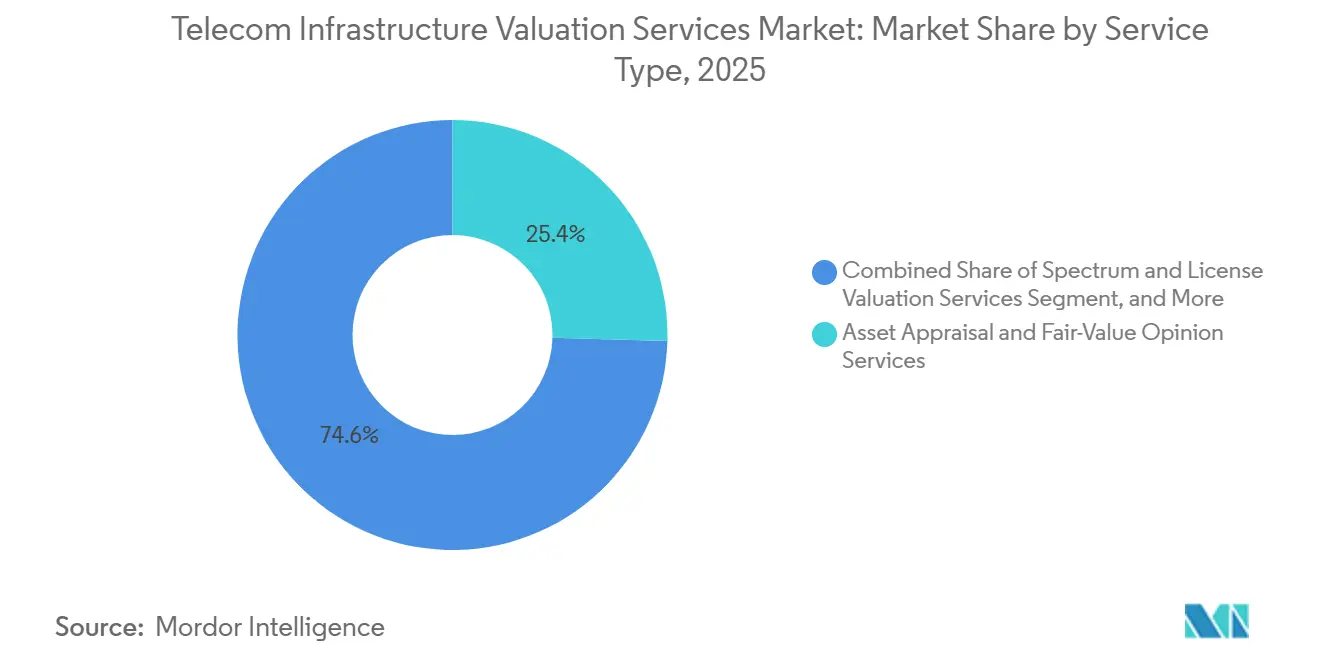
Asset Appraisal Supports a Broader Advisory RoleAsset Appraisal and Fair-Value Opinion Services held 25.44% of the telecom infrastructure valuation services market share in 2025. Recurring financial reporting under IFRS and U.S. GAAP supports demand for periodic independent opinions when infrastructure assets are carried at revalued amounts, creating repeat work within the telecom infrastructure valuation services market. Transaction and M&A Valuation Advisory also benefits from continued portfolio sales and acquisitions. Technical, Commercial, and Financial Due Diligence has become more important where asset records can affect purchase price discussions.
Spectrum and License Valuation Services is projected to expand at a CAGR of 7.13% through 2031. GSMA stated that close to 1,000 individual spectrum license renewals were expected across 110 countries between 2025 and 2030.[3] Renewals require specialized economic work because reserve prices and annual license fees depend on local market conditions, the available spectrum bands, regulatory choices, and the treatment of existing network obligations. Transaction teams also need a clear view of spectrum rights when those rights affect the commercial value of a network portfolio. Lease optimization advisory and regulatory economics consulting remain smaller service areas, but they extend the scope of work available to advisers. The telecom infrastructure valuation services industry is thus supported by both recurring reporting assignments and event-led specialist mandates.

By Asset Type:
Macro Towers Lead While Small Cells and DAS AdvanceMacro Towers accounted for 33.36% of the telecom infrastructure valuation services market size in 2025. They are the main assets considered in many TowerCo transactions and are common collateral in tower-backed debt structures within the telecom infrastructure valuation services market. Their established lease patterns and physical characteristics provide a familiar basis for valuation, although tenant concentration and renewal assumptions remain important. Rooftop sites also have strategic value in dense urban locations where zoning limits greenfield construction.
Small Cells and Distributed Antenna Systems is projected to expand at a CAGR of 7.22% through 2031. Small Cell Forum projected strong growth in global small-cell deployments, with annual shipments expected to reach several million units. These assets operate in varied settings, including stadiums, campuses, street poles, indoor locations, and enterprise sites, so they require methods that account for different deployment, access, operating, and revenue conditions. Their physical scale can be smaller than a macro tower, but the review often involves more varied documentation across a portfolio. Fiber backhaul and transport networks are also increasingly reviewed as separate assets because their commercial role differs from that of a tower. The telecom infrastructure valuation services market is adapting to these asset types through broader technical review and more detailed asset-level evidence.
By Client Type:
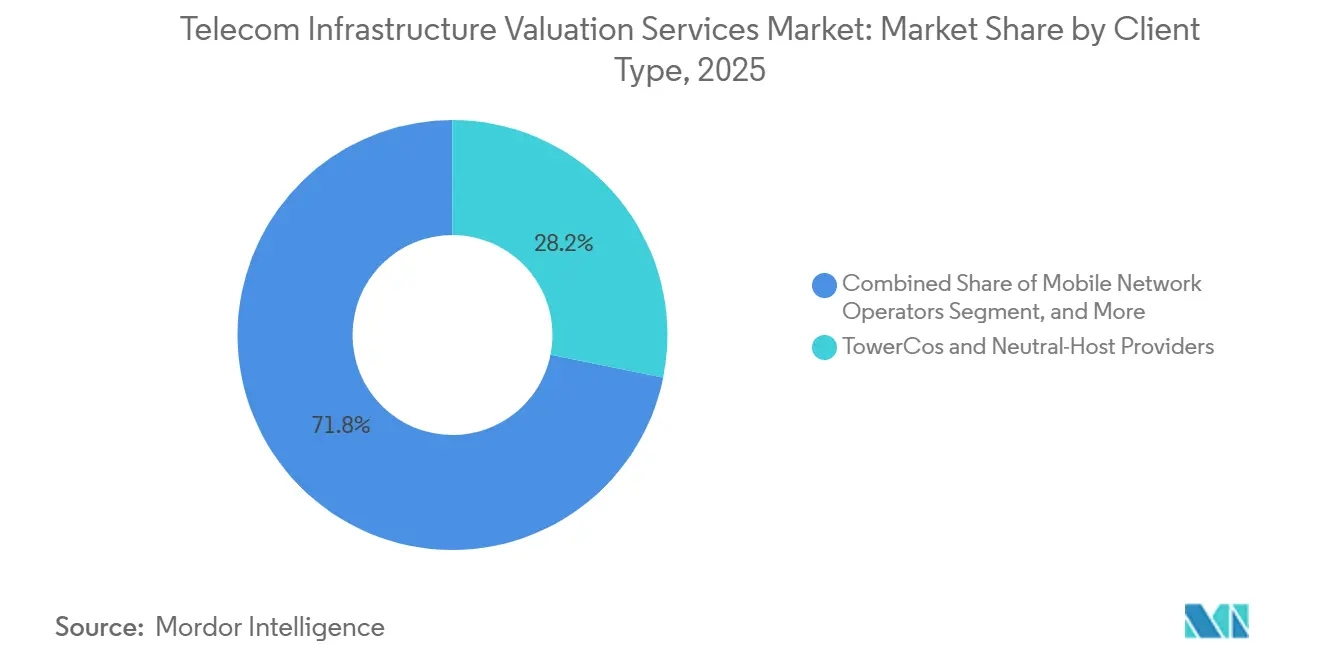
TowerCos Lead Demand While Funds Expand Their RoleTowerCos and Neutral-Host Providers held 28.17% share of the telecom infrastructure valuation services market in 2025. Their work includes acquisition reviews, debt covenant support, annual financial reporting, periodic assessments of sites under management, and asset-level documentation for the telecom infrastructure valuation services market. Mobile Network Operators form another major client group because tower carve-outs require a detailed separation of physical assets, leases, and operating responsibilities. TELUS announced that La Caisse would acquire a significant minority interest in Terrion through a transaction that valued the company at several billion US dollars.
Infrastructure Funds and Private Equity Investors are projected to expand at a CAGR of 7.16% through 2031. Their investment decisions require independent asset verification that can be used by both investors and lenders, including evidence on sites, leases, tenants, contracts, and local operating conditions. The Vertical Bridge transaction illustrates the scale of fund-backed capital entering the sector and the need for detailed site, tenancy, and contract review. European funds also require periodic portfolio valuation under the Alternative Investment Fund Managers Directive. This client mix gives the telecom infrastructure valuation services market demand from asset owners, operators, and capital providers, rather than from a single type of network participant.
By Engagement Purpose:
Carve-Outs Lead While Refinancing Gains PaceAcquisitions, Divestitures, and Carve-Outs held 30.48% share in 2025. These engagements can begin before signing and continue through closing, purchase price allocation, financial reporting, and further asset assessment in the telecom infrastructure valuation services market. Tele2 and GCI finalized their Baltic Tower Company transaction, covering a substantial portfolio of tower and rooftop assets across Estonia, Latvia, and Lithuania. The transaction highlights why cross-border asset reviews require local market evidence alongside portfolio-level financial analysis.
Financing, Refinancing, and recapitalization are projected to expand at a CAGR of 7.33% through 2031. Tower operators and infrastructure funds use independent valuations to establish loan-to-value ratios in tower-backed financing structures and to support lender review of the cash flows underlying the assets. Financial Reporting and Tax Compliance provides a more stable base of recurring work because portfolio values must be reviewed at reporting dates, and changes in financial assumptions need to be documented. Insurance replacement-cost appraisals and dispute-resolution support are smaller purposes, yet they add resilience to the engagement mix. The telecom infrastructure valuation services industry serves both transaction-led assignments and recurring compliance needs.
Geography Analysis
North America Telecom Infrastructure Valuation Services Market
North America held 32.47% share in 2025. The United States recorded substantial wireless infrastructure investment and maintained a large macrocell site base. Vertical Bridge's acquisition of Verizon towers was followed by a KKR investment, supporting continued asset review needs across the telecom infrastructure valuation services market. ATN International also announced the sale of southwestern U.S. towers to Everest Infrastructure Partners for a substantial value. Canada added activity through the formation of Terrion and the proposed sale of SBA Communications' Canadian tower business.
Europe Telecom Infrastructure Valuation Services Market
Europe has a stable base of mobile network operator carve-outs and regulatory spectrum work. The Baltic Tower Company transaction created a cross-border portfolio that needed consistent asset review across three national markets. Stonepeak agreed in December 2025 to acquire TeleTower from Bitė Group in Lithuania and Latvia. BEREC's 2025 WACC work showed that regulatory valuation assumptions remain important across the European Union.
APAC and Africa Telecom Infrastructure Valuation Services Market
Asia-Pacific has a large asset base, supported by China Tower’s significant capital expenditure and plans to develop AI-ready digital infrastructure. Africa is projected to expand at a CAGR of 7.47% through 2031. GSMA reported significant planned network investment by African operators through 2030, supporting a future pipeline as assets are built and financed. Network investment in these regions requires assets to be documented as they are funded, constructed, operated, and transferred. These regional conditions keep the telecom infrastructure valuation services market tied to network buildouts, portfolio transactions, and asset data verification.
Competitive Landscape
The telecom infrastructure valuation services market is moderately fragmented. Large multidisciplinary advisory firms such as Kroll, KPMG, EY-Parthenon, and PwC compete through cross-border capabilities, broader asset knowledge, regulatory experience, and their ability to coordinate teams across multiple legal and operating jurisdictions. Specialized firms such as SteelTree Partners, Summit Ridge Group, and Analysys Mason focus on tower appraisals, spectrum economics, and technical diligence, where clients may require a more focused understanding of wireless networks, site records, and technical inputs. CostQuest Associates and GP Valuation and Advisory Services use methods built around telecom-specific factors, including tenancy ratios, escalation clauses, technology refresh cycles, lease structures, and the way these factors affect site-level cash flow assumptions. The variation in mandate types allows both large firms and focused specialists to compete for work.
Firms with proprietary transaction records can support valuations where public data is limited. This advantage is significant when a client needs evidence on lease structures, tenancy, asset condition, and local market assumptions. Providers that combine technical-commercial work across fiber and tower assets can address assignments involving several asset classes. The telecom infrastructure valuation services market therefore rewards service models that combine technical evidence with financial assessment.
Digital-twin-supported diligence is an opportunity for firms reviewing large portfolios with dispersed sites. Small-cell and DAS portfolios also require methods that address different sites, customer arrangements, and deployment conditions. Macquarie's planned South American acquisition and the Baltic Tower Company transaction are examples of strategic moves that require multi-country asset assessment. KKR's investment in Vertical Bridge is another example of capital entering a large private tower platform. These conditions leave room for specialists that can produce reliable appraisal outputs from complex asset data, explain the financial effects of lease and operational assumptions, and prepare work that can be reviewed by investors, lenders, auditors, and regulators.
Telecom Infrastructure Valuation Services Industry Leaders
-
CBRE Group, Inc.
-
Kroll, LLC
-
PricewaterhouseCoopers International Limited
-
Ernst & Young
-
Deloitte Touche Tohmatsu Limited
- *Disclaimer: Major Players sorted in no particular order
Telecom Infrastructure Valuation Services Market Companies Covered in this Report
- Altman Solon
- Analysys Mason Limited
- American Appraisal Associates, LLC
- CBRE Group, Inc.
- CostQuest Associates, Inc.
- Deloitte Touche Tohmatsu Limited
- EY-Parthenon
- GP Valuation and Advisory Services
- KPMG International Limited
- Kroll, LLC
- Lender Consulting Services, Inc.
- Mercer Capital Management, Inc.
- Meksist Information Technologies
- Parcus Group
- PricewaterhouseCoopers International Limited
- Signal Strength Advisors
- SteelTree Partners
- Summit Ridge Group, LLC
- Tower Capital Advisors, LLC
- Valtech Valuation
Recent Industry Developments in Telecom Infrastructure Valuation Services Market
- July 2026: GSMA published its 5G in Africa 2026 report, confirming USD 76 billion in planned African operator network capital expenditure through 2030 to support a projected quadrupling of data consumption by the end of the decade. Each tranche funded through sovereign development finance mechanisms requires independent technical appraisals as a drawdown condition.
- May 2026: INWIT confirmed that the NRRP-backed Italia 5G Densification Plan had brought 5G connectivity to 973 white-area sites by May 31, 2026. Asset cost verification was conducted under European Union cohesion-fund accounting requirements.
- April 2026: KKR announced a USD 1.5 billion preferred equity investment in Vertical Bridge REIT, LLC, valuing the largest private U.S. tower operator at USD 10 billion to USD 15 billion. The transaction followed Vertical Bridge's USD 3.3 billion acquisition of 6,339 Verizon towers and required extensive third-party asset valuation work for investor and lender diligence.
- February 2026: ATN International announced the sale of 214 southwestern U.S. towers to Everest Infrastructure Partners for up to USD 297 million in an all-cash transaction. The sale generated appraisal and technical diligence work across a geographically concentrated rural tower portfolio.
Global Telecom Infrastructure Valuation Services Market Report Scope
Telecom Infrastructure Valuation Services Market refers to professional advisory services that determine the economic and financial value of telecommunications infrastructure assets and businesses. It covers valuations of fiber-optic networks, mobile towers, small cells, data centers, spectrum-related assets, submarine cables, fixed-line networks, and other digital infrastructure.
The Telecom Infrastructure Valuation Services Market Report is Segmented by Service Type (Asset Appraisal and Fair-Value Opinion Services, Transaction and M&A Valuation Advisory, Technical, Commercial, and Financial Due Diligence, Spectrum and License Valuation Services, and Other Service Types), Asset Type (Macro Towers, Rooftop Sites, Small Cells and Distributed Antenna Systems, and Fiber Backhaul and Transport Networks), Client (Mobile Network Operators, TowerCos and Neutral-Host Providers, and Infrastructure Funds and Private Equity Investors), Engagement Purpose (Acquisitions, Divestitures, and Carve-Outs, Financing, Refinancing, and Recapitalization, Financial Reporting and Tax Compliance, and Other Engagement Purposes), and Geography (North America, South America, Europe, Asia-Pacific, Middle East, Africa). The Market Forecasts are Provided in Terms of Value (USD).
| Asset Appraisal and Fair-Value Opinion Services |
| Transaction and M&A Valuation Advisory |
| Technical, Commercial, and Financial Due Diligence |
| Spectrum and License Valuation Services |
| Other Service Types |
| Macro Towers |
| Rooftop Sites |
| Small Cells and Distributed Antenna Systems |
| Fiber Backhaul and Transport Networks |
| Mobile Network Operators |
| TowerCos and Neutral-Host Providers |
| Infrastructure Funds and Private Equity Investors |
| Acquisitions, Divestitures, and Carve-Outs |
| Financing, Refinancing, and Recapitalization |
| Financial Reporting and Tax Compliance |
| Other Engagement Purposes |
| North America | United States |
| Canada | |
| Mexico | |
| South America | Brazil |
| Rest of South America | |
| Europe | Germany |
| United Kingdom | |
| France | |
| Italy | |
| Rest of Europe | |
| Asia-Pacific | China |
| India | |
| Japan | |
| South Korea | |
| Rest of Asia-Pacific | |
| Middle East | Saudi Arabia |
| United Arab Emirates | |
| Turkey | |
| Rest of Middle East | |
| Africa | South Africa |
| Nigeria | |
| Egypt | |
| Rest of Africa |
| By Service Type | Asset Appraisal and Fair-Value Opinion Services | |
| Transaction and M&A Valuation Advisory | ||
| Technical, Commercial, and Financial Due Diligence | ||
| Spectrum and License Valuation Services | ||
| Other Service Types | ||
| By Asset Type | Macro Towers | |
| Rooftop Sites | ||
| Small Cells and Distributed Antenna Systems | ||
| Fiber Backhaul and Transport Networks | ||
| By Client Type | Mobile Network Operators | |
| TowerCos and Neutral-Host Providers | ||
| Infrastructure Funds and Private Equity Investors | ||
| By Engagement Purpose | Acquisitions, Divestitures, and Carve-Outs | |
| Financing, Refinancing, and Recapitalization | ||
| Financial Reporting and Tax Compliance | ||
| Other Engagement Purposes | ||
| By Geography | North America | United States |
| Canada | ||
| Mexico | ||
| South America | Brazil | |
| Rest of South America | ||
| Europe | Germany | |
| United Kingdom | ||
| France | ||
| Italy | ||
| Rest of Europe | ||
| Asia-Pacific | China | |
| India | ||
| Japan | ||
| South Korea | ||
| Rest of Asia-Pacific | ||
| Middle East | Saudi Arabia | |
| United Arab Emirates | ||
| Turkey | ||
| Rest of Middle East | ||
| Africa | South Africa | |
| Nigeria | ||
| Egypt | ||
| Rest of Africa | ||
Key Questions Answered in the Report
What is the size of the telecom infrastructure valuation services market?
The telecom infrastructure valuation services market was valued at USD 1.72 billion in 2025 and is estimated at USD 1.87 billion in 2026. It is forecast to reach USD 2.61 billion by 2031 at a CAGR of 6.92%.
What is driving demand for telecom infrastructure valuation services?
Tower carve-outs, spectrum renewals, refinancing, financial reporting, and public network funding programs are key sources of demand.
Which service type has the largest share?
Asset Appraisal and Fair-Value Opinion Services held the largest share at 25.44% in 2025.
Which telecom asset type is expanding fastest?
Small Cells and Distributed Antenna Systems is projected to expand at a CAGR of 7.22% through 2031.
Which client group is projected to expand fastest?
Infrastructure Funds and Private Equity Investors is projected to expand at a CAGR of 7.16% through 2031.
Which region is projected to expand fastest?
Africa is projected to expand at a CAGR of 7.47% through 2031, supported by planned operator network investment.