
Telecom Fraud Management Software Market Size and Share
Market Overview
| Study Period | 2020 - 2031 |
|---|---|
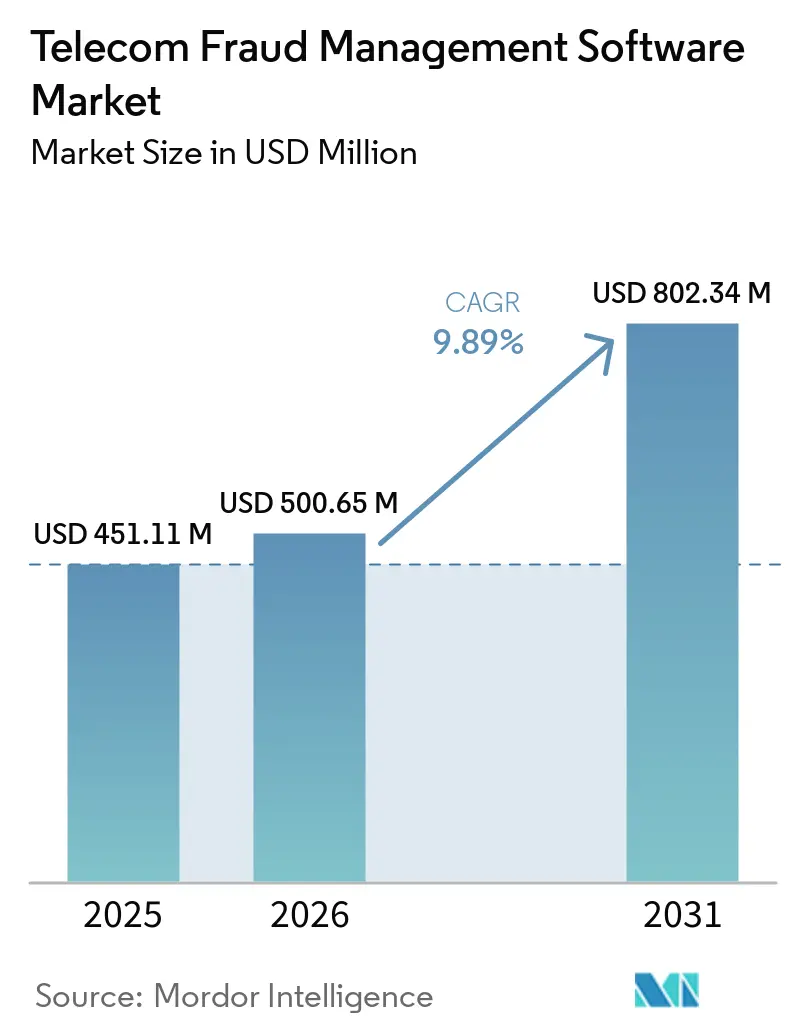
| Market Size (2026) | USD 500.65 Million |
| Market Size (2031) | USD 802.34 Million |
| Growth Rate (2026 - 2031) | 9.89 % |
| Fastest Growing Market | Asia-Pacific |
| Largest Market | Europe |
| Market Concentration | Medium |
Major Players *Disclaimer: Major Players sorted in no particular order Image © Mordor Intelligence. Reuse requires attribution under CC BY 4.0. | |
Telecom Fraud Management Software Market Analysis by Mordor Intelligence
The Telecom Fraud Management Software Market size is projected to expand from USD 451.11 million in 2025 and USD 500.65 million in 2026 to USD 802.34 million by 2031, registering a CAGR of 9.89% between 2026 to 2031. Rising fraud losses are making real-time detection a core operating requirement for communications service providers. Operators are replacing isolated rules engines with platforms that combine analytics, investigation workflows, identity signals, and network data. This shift favors providers with direct access to call-detail records, signaling events, and subscriber activity. Regulatory obligations also encourage investment, particularly where reporting, data protection, and network-resilience duties overlap. Cloud delivery and managed operations are widening access for smaller carriers, while data localization and legacy system integration continue to slow some projects.
Key Report Takeaways
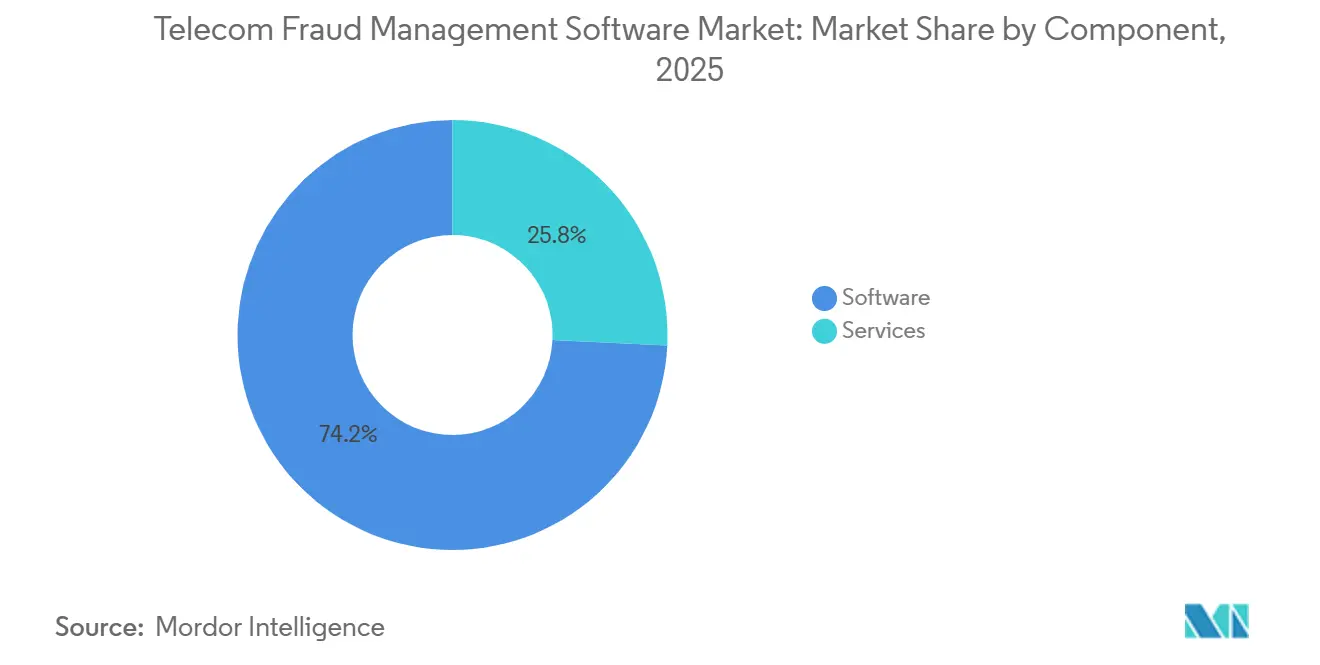
- By component, software held 74.22% revenue share in 2025, while services are projected to expand at an 11.54% CAGR through 2031 in the telecom fraud management software market.
- By deployment mode, on-premises solutions accounted for 47.88% revenue share in 2025, while cloud-native deployments are projected to expand at an 11.47% CAGR through 2031.
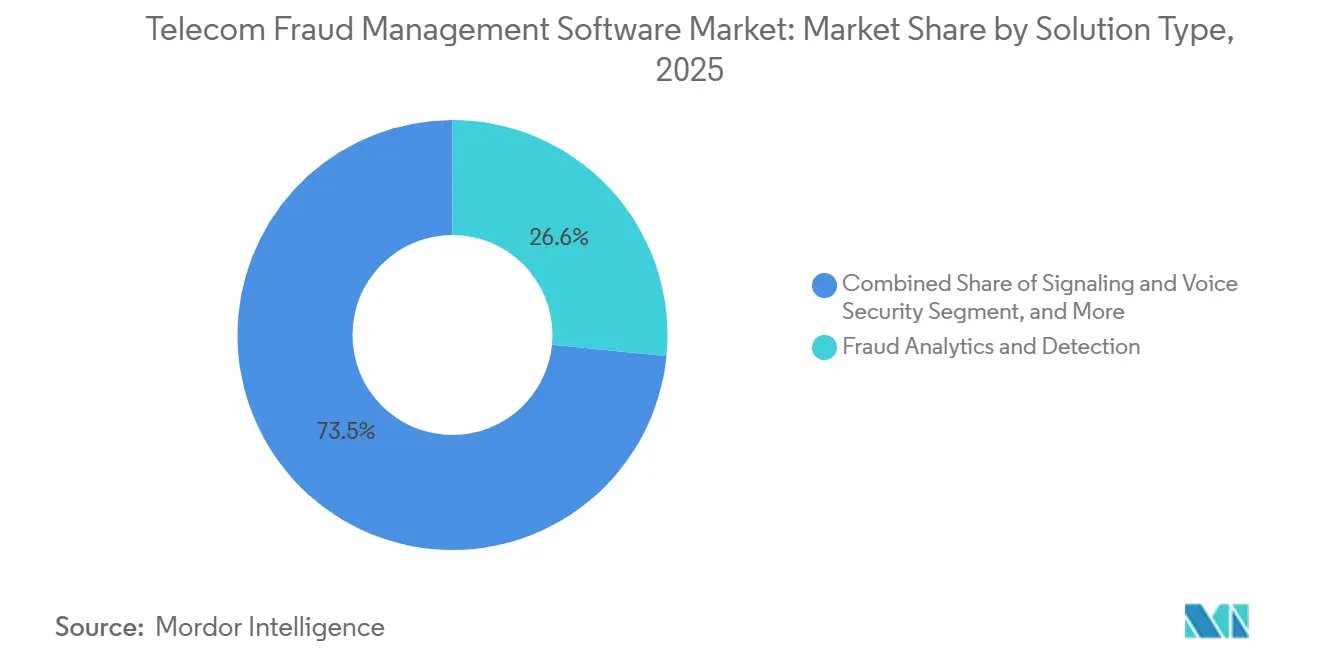
- By solution type, fraud analytics and detection held 26.55% revenue share in 2025, while identity, authentication, and subscription risk is projected to expand at an 11.76% CAGR through 2031.
- By fraud type, roaming fraud and SIM cloning accounted for 27.88% revenue share in 2025 and are projected to expand at a 10.98% CAGR through 2031 in the telecom fraud management software market.
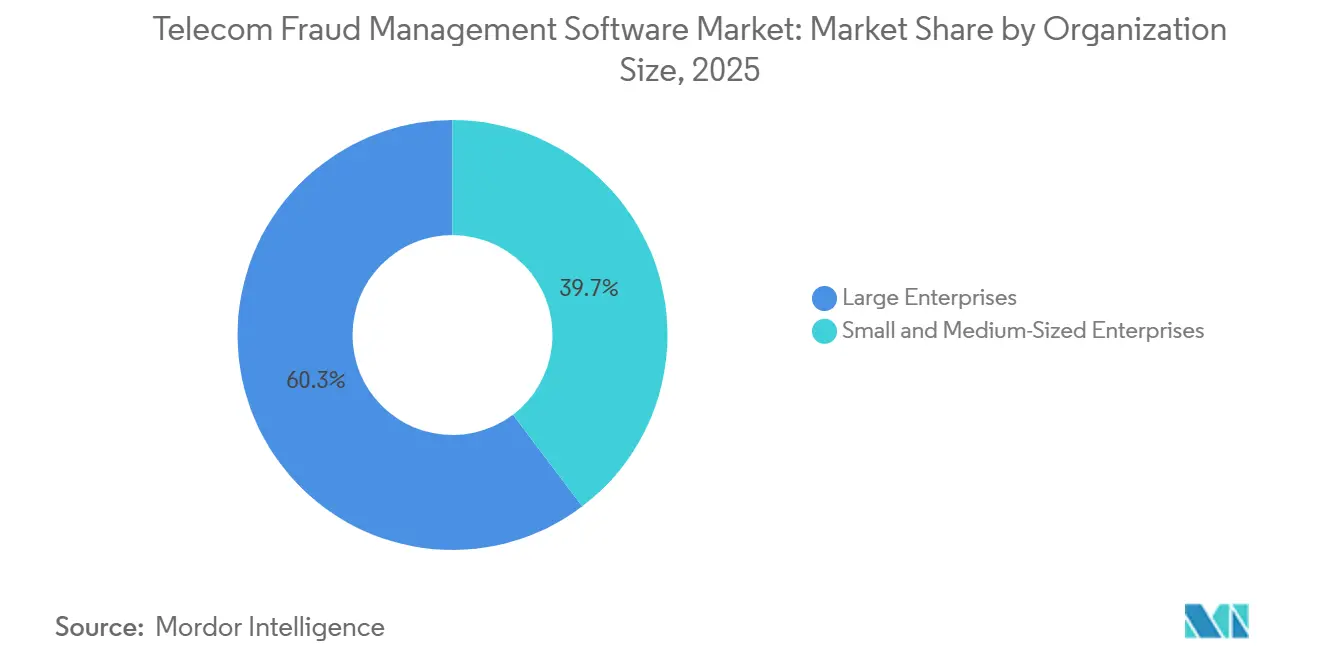
- By organization size, large enterprises held 60.32% revenue share in 2025, while small and medium-sized enterprises are projected to expand at a 10.78% CAGR through 2031.
- By geography, Europe held 27.89% revenue share in 2025, while Asia-Pacific is projected to expand at an 11.02% CAGR through 2031 in the telecom fraud management software market.
Note: Market size and forecast figures in this report are generated using Mordor Intelligence’s proprietary estimation framework, updated with the latest available data and insights as of January 2026.
Market Trends and Insights
Drivers Impact Analysis of Telecom Fraud Management Software Market*
| DRIVER | (~) % IMPACT ON CAGR FORECAST | GEOGRAPHIC RELEVANCE | IMPACT TIMELINE |
|---|---|---|---|
| AI and Machine Learning for Real-Time Fraud Detection | +2.8% | Global | Short term (≤2 years) |
| 5G, VoLTE, IoT, and eSIM Connectivity Growth | +2.2% | Asia-Pacific and Europe, with spillover to the Middle East and Africa | Medium term (2–4 years) |
| Escalating IRSF, Wangiri, Bypass, and Messaging Fraud | +1.9% | Global, with elevated relevance in Europe, Africa, and South Asia | Short term (≤2 years) |
| Digital Identity, Mobile Money, and Carrier Billing Expansion | +1.5% | Africa, Asia-Pacific, and South America | Medium term (2–4 years) |
| Cloud-Native and Managed Fraud Operations | +1.1% | North America and Europe, with spillover to the Asia-Pacific | Medium term (2–4 years) |
| Cross-Network Intelligence for Interconnect and Roaming Risk | +0.8% | Global, with elevated relevance in Europe and the Asia-Pacific | Long term (≥4 years) |
| Source: Mordor Intelligence | |||
AI and Machine Learning Adoption for Real-Time Fraud Detection
The telecom fraud management software market is benefiting from the widening gap between AI-enabled attacks and legacy rules-based defenses. A 2025 survey by TNS found that 75% of telecom operators used machine learning or AI for fraud detection, up from 38% in 2023, while 53% described themselves as AI beginners. This indicates broad but immature adoption, so operators that begin with narrow automation projects can later require more capable models, orchestration, and analyst support. A 2025 PLOS ONE study reported 93.28% accuracy, 92.08% F1 score, and 94.53% AUC for a graph-attention approach evaluated on telecom fraud data.[1] These results support procuring platforms that learn from relationships across call records and network activity rather than relying solely on static thresholds.
Growth of 5G, VoLTE, IoT, and eSIM Connectivity
The telecom fraud management software market is being shaped by networks that generate more real-time events and introduce new identity and signaling risks. The GLF Fraud Report 2025 stated that 95% of surveyed carriers reported stable or declining traditional voice fraud volumes, but projected up to USD 8 billion in data roaming losses by 2028 due to IoT-related risks. VoLTE requires coordination between SIP signaling and IP Multimedia Subsystem components so that configuration weaknesses can create pathways for interception and service disruption. The ITU-T approved Recommendation X.1456 in April 2025 to provide security guidance for digital financial service applications that use USSD and SIM toolkit mechanisms.[2] The specification work around eSIM, IoT, and digital payments reinforces demand for controls that inspect network, identity, and transaction signals together.
Escalating IRSF, Wangiri, Bypass, and Messaging Fraud
The telecom fraud management software market continues to gain traction amid losses tied to international revenue-share fraud, Wangiri calls, bypass traffic, and messaging attacks. The GLF Fraud Report 2025 found that 67% of global carriers reported high volumes of IRSF. Fraudsters can rotate number ranges across jurisdictions, while AB Handshake documented Wangiri activity in which bots submit revenue-share numbers via enterprise forms, triggering automated callbacks. LATRO stated that bypass fraud can reduce termination revenue by 60-80% in affected corridors. The same GLF report found that 35% of operators experienced increased messaging fraud volumes in 2025. Operators therefore have a stronger case for unified tools that coordinate voice, SMS, signaling, and identity controls.
Expansion of Digital Identity, Mobile Money, and Carrier Billing
The telecom fraud management software market is expanding beyond network abuse, as carriers now support identity checks and payment-related activities. GSMA research found that 90.38% of surveyed mobile-money providers reported identity fraud, followed by social engineering at 88.46% and SIM swap fraud at 78.85%.[3] Carrier billing can create exposure when an advertisement or application initiates a charge without clear subscriber intent. In September 2025, BT/EE, Three, Virgin Media O2, and Vodafone commercially launched KYC Match through the GSMA Open Gateway initiative, allowing businesses to compare customer-provided details with operator records without receiving personally identifiable information. ATIS guidance published in 2025 described how operators can issue and verify credentials for telephone-number ownership and enterprise caller authentication.[4] These developments make identity-integrated fraud platforms more relevant to both network operations and digital-service teams.
Restraints Impact Analysis of Telecom Fraud Management Software Market*
| RESTRAINT | (~) % IMPACT ON CAGR FORECAST | GEOGRAPHIC RELEVANCE | IMPACT TIMELINE |
|---|---|---|---|
| Data Privacy, Localization, and Cross-Border Transfer Restrictions | -1.4% | European Union and North America, with spillover to the Asia-Pacific | Medium term (2-4 years) |
| Integration Complexity and Legacy OSS/BSS Dependence | -1.1% | Global, with elevated relevance in South America and Africa | Long term (≥ 4 years) |
| Adversarial Adaptation and Model Drift Across New Fraud Vectors | -0.7% | Global | Short term (≤ 2 years) |
| Fraud-Prevention Friction, False Positives, and Customer Experience Risk | -0.5% | Global | Short term (≤ 2 years) |
| Source: Mordor Intelligence | |||
Data Privacy, Data Localization, and Cross-Border Transfer Restrictions
Data sovereignty can delay deployments of telecom fraud management software because effective detection often depends on detailed metadata. Connect Europe stated in its 2024 submission to the European Data Protection Board that the ePrivacy framework provides limited legal certainty regarding fraud-prevention processing and that practices differ across EU member states. This uncertainty complicates cross-border interconnect cases and cloud deployments that process subscriber call records through external providers. The EU e-Evidence Regulation takes effect in 2026 and establishes preservation-request response times of up to 8 hours. India, Indonesia, and South Korea also have domestic requirements that may restrict the movement of subscriber information. Vendors must offer regional processing options and controls that support compliance without leaving critical fraud signals unexamined.
Integration Complexity and Legacy OSS/BSS Dependence
Integration with legacy OSS and BSS systems remains a constraint for the Telecom Fraud Management Software Market. Older billing, customer management, and provisioning systems were not designed to process high-velocity 5G, IoT, signaling, and identity events simultaneously. LATRO noted that fraudsters can exploit gaps between modern service layers and legacy operational systems. Hybrid layers can introduce a delay between alert generation and the action required to stop losses. Migration to event-driven and API-based architecture is underway, but the transition can take several years. This lengthens sales cycles and raises implementation costs, especially where network-modernization budgets are limited.
*Our forecasts treat driver/restraint impacts as directional, not additive. The impact forecasts reflect baseline growth, mix effects, and variable interactions.
Telecom Fraud Management Software Market Segment Analysis
By Component:
Software Retains the Largest Position While Services Gain Strategic RelevanceSoftware is expected to hold 74.22% of the 2025 telecom fraud management software market share, reflecting demand for platforms that combine analytics, case management, workflow automation, and real-time rules. The software layer also includes specialized signaling decoders and trained models that generic IT services lack. Long-running deployments can create switching costs, as operators tune models using historical call-detail records and local operating patterns. Subex has integrated generative AI into HyperSense, demonstrating how suppliers are adding reasoning capabilities to established software platforms. These features help teams assess alerts using telecom-specific context.
Services are projected to expand at an 11.54% CAGR through 2031. Managed detection, triage, and remediation services address shortages of fraud specialists, particularly among regional carriers. The CFCA survey cited by TNS reported an average dedicated fraud team size of 40.5 employees across carriers and 15 employees among smaller providers. This staffing gap makes Fraud-as-a-Service arrangements relevant in the Telecom Fraud Management Software Market, especially where operators cannot sustain full in-house teams. NIS2 increases management responsibility for security incidents and supports interest in specialist service partners.
By Deployment Mode:
On-Premises Systems Lead While Cloud Use ExpandsOn-premises systems are expected to account for 47.88% of the telecom fraud management software market size in 2025. Operators continue to prefer these systems when they need direct access to signaling planes, charging systems, and sensitive subscriber metadata. Tier 1 carriers in Europe often favor local infrastructure because it reduces cross-border data-transfer complexity. Existing infrastructure investments also support the continued use of on-premises platforms. Operators can tailor these systems to live network operations and established assurance processes.
Cloud-native deployments are projected to expand at an 11.47% CAGR through 2031. Consumption-based pricing can lower entry costs for small and medium-sized operators that cannot fund extensive local infrastructure. A 2025 journal study reported that cloud-native microservices can support horizontal scaling and real-time anomaly detection for telecom fraud workloads. Hybrid and edge arrangements are emerging, in which operators require low-latency network analysis alongside centralized analytics. Providers serving the Telecom Fraud Management Software Market can reduce transition burdens by offering connectors across charging systems and cloud analytics.
By Solution Type:
Fraud Analytics Leads While Identity Risk AcceleratesFraud analytics and detection are expected to account for 26.55% of the telecom fraud management software market in 2025. This solution type remains foundational because investigation, orchestration, and remediation depend on identifying unusual activity. Providers are replacing static correlation tools with graph analytics, behavioral monitoring, and models that adapt to changing fraud patterns. These capabilities process call-detail records, signaling events, and subscriber behavior. The segment’s scale underscores the need for a single analytical layer to support multiple fraud categories.
Identity, authentication, and subscription risk are projected to expand at an 11.76% CAGR through 2031. This growth reflects SIM swaps, eSIM provisioning abuse, subscription fraud, and account takeovers. TNS cited CFCA findings that reported USD 4.73 billion in account-takeover losses during 2025. GSMA reported that Scam Signal reduced scam victims by up to 41% and fraud losses by 44% when financial-sector authentication integrated network signals. In the Telecom Fraud Management Software Market, revenue-share, interconnect, roaming-protection, signaling-security, and case-management tools serve different operational teams.

By Fraud Type:
Roaming Fraud and SIM Cloning Lead in Scale and GrowthRoaming fraud and SIM cloning are expected to account for 27.88% of revenue in 2025 and are projected to grow at a 10.98% CAGR through 2031 in the telecom fraud management software market. The category remains prominent because cross-carrier traffic creates complex attribution challenges across multi-hop interconnect routes. This combination reflects the risks of remote eSIM provisioning and the continued financial incentives within roaming interconnect. GSMA described a 1,055% increase in SIM-swap cases in the United Kingdom during 2025. This trend illustrates the pressure on identity continuity as physical and digital SIM models operate together.
International revenue share fraud remains a persistent operational threat. The GLF Fraud Report 2025 found that 67% of carriers reported high IRSF volumes. AB Handshake reported that inbound Wangiri attacks in Q1 2026 included 2 million events each from Turkmenistan and Burkina Faso. SIM-box and bypass fraud remain material in Asia-Pacific and Africa, while subscription fraud involving real or stolen identities caused USD 5.31 billion in losses in 2025. Platforms that connect onboarding, usage, and network events can help operators address the subscriber lifecycle.
By Organization Size:
Large Enterprises Dominate While SMEs Adopt Flexible Delivery ModelsLarge enterprises are expected to account for 60.32% of revenue in 2025 in the telecom fraud management software market. Tier 1 operators have the resources to operate dedicated teams and maintain full-stack fraud platforms. TNS cited a CFCA survey finding that 100% of large carriers used a fraud management system with some automation, while 97% maintained dedicated fraud teams. Their next investments are likely to focus on AI enhancements, the federation of network signals, investigative support, and advanced identity controls. Large operators also require deep integration with network and assurance systems.
Small and medium-sized enterprises are projected to expand at a 10.78% CAGR through 2031. Cloud delivery and managed services reduce the need for extensive on-site technology teams in the Telecom Fraud Management Software Market. Smaller carriers that operate legacy time-division multiplexing networks can remain exposed to established IRSF and bypass tactics. Subex introduced FraudZap in June 2025 as a modular platform designed for cloud, on-premises, and as-a-service delivery. South America, Africa, and Southeast Asia have regional operators that can benefit from this lower-complexity approach.
Geography Analysis
Europe Telecom Fraud Management Software Market
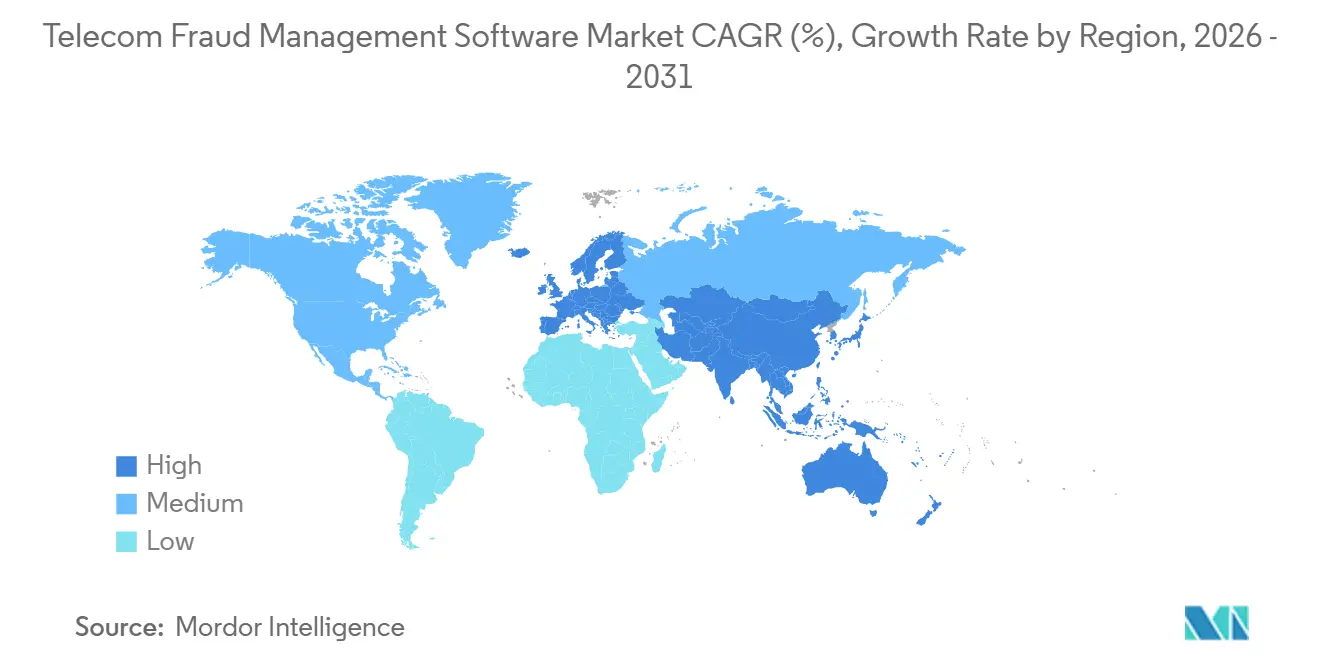
Europe is expected to hold 27.89% of the telecom fraud management software market share in 2025. The region faces substantial roaming and interconnect exposure across dense networks of national operators. NIS2 classifies telecommunications as an essential sector and mandates risk management, incident reporting, and accountability. In September 2025, UK operators BT/EE, Three, Virgin Media O2, and Vodafone are expected to launch KYC Match and Age Verify APIs under GSMA Open Gateway. Future spending is likely to focus on analytics, managed services, and compliance integration.
APAC Telecom Fraud Management Software Market
Asia-Pacific is projected to expand at an 11.02% CAGR through 2031. This part of the Telecom Fraud Management Software Market combines large subscriber bases with rapid 5G rollout, mobile money adoption, eSIM adoption, and carrier billing. In 2025, GSMA is expected to document Open Gateway activity in Indonesia, Sri Lanka, and Australia. Australian operators are expected to use Scam Signal for real-time blocking, while Indonesian operators are expected to deploy Number Verify, SIM Swap, and Device Location interfaces for financial-fraud controls. India has high transaction and SIM-authentication exposure, while South Korea has advanced 5G and mobile-payment activity. These conditions are increasing demand for identity, signaling, and real-time analytics platforms.
The Americas and Africa Telecom Fraud Management Software Market
North America remains a stable demand area, supported by caller-authentication requirements under the Federal Communications Commission’s STIR/SHAKEN framework. The U.S. Federal Trade Commission reported USD 12.5 billion in consumer fraud losses during 2024, up 25% from 2023. South America continues to face SIM-box and bypass exposure, while managed services can offer a practical option where operator budgets are constrained. Africa remains a longer-term opportunity due to high mobile money activity and the risk of wholesale bypass.
Competitive Landscape
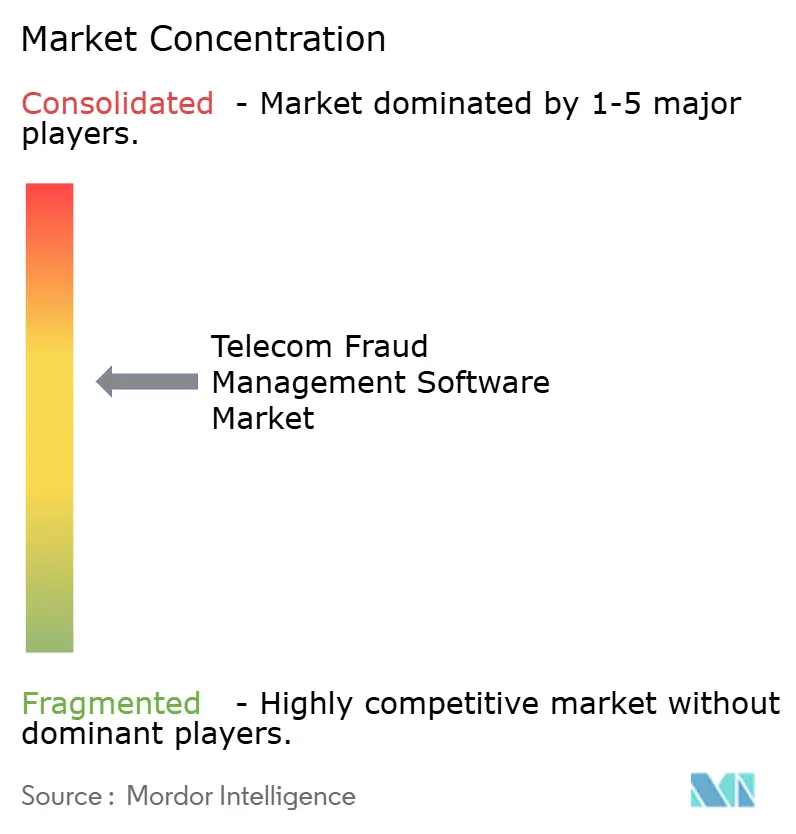
The telecom fraud management software market is moderately consolidated among telecom-focused suppliers. Subex, Mobileum, Enea, Neural Technologies, and TEOCO have established experience in signaling, call-detail records, and operator workflows. Their domain knowledge remains important when customers require direct integration with HLR, HSS, charging, and network-security systems. IBM, SAS Institute, and Oracle compete in analytics and case management, while telecom-focused providers maintain an advantage in real-time signaling and CDR processing. Competition is shifting toward models that investigate cases, explain alert context, and recommend actions.
The telecom fraud management software market also faces competition from infrastructure providers that are moving closer to the application layer. Network-exposure functions and Open Gateway APIs create a path to fraud prevention by using information close to the core network. This trend underscores the importance of supplier capabilities that connect network data to service operations. It also increases the importance of practical integration across existing operator workflows.
GSMA Open Gateway APIs are becoming shared infrastructure for SIM Swap, KYC Match, and Scam Signal use cases. This development may make raw access to selected identity signals less distinctive within the telecom fraud management software market. In December 2025, Subex is expected to secure a 5-year deal with a large integrated energy and telecommunications provider, covering consulting, training, managed services, long-term support, and its fraud platform. In Q1 2026, Enea is expected to secure a 5-year messaging-security agreement with a global CPaaS provider, covering its Adaptive Messaging Firewall and threat-intelligence services. These examples show that suppliers are pairing products with operational delivery and intelligence services.
Telecom Fraud Management Software Industry Leaders
-
Amdocs Limited
-
Subex Limited
-
Mobileum Inc.
-
Nokia Corporation
-
Oracle Corporation
- *Disclaimer: Major Players sorted in no particular order
Telecom Fraud Management Software Market Companies Covered in this Report
- Amdocs Limited
- Subex Limited
- Mobileum Inc.
- Nokia Corporation
- Telefonaktiebolaget LM Ericsson
- Oracle Corporation
- IBM Corporation
- SAS Institute Inc.
- Fair Isaac Corporation
- Tata Consultancy Services Limited
- Tech Mahindra Limited
- HCL Technologies Limited
- Huawei Technologies Co., Ltd.
- Syniverse Technologies, LLC
- Enea AB
- Araxxe S.A.
- TEOCO Corporation
- Neural Technologies Limited
Recent Industry Developments in Telecom Fraud Management Software Market
- May 2026: Openmind Networks launched its Campaign Detection and LLM-based Analysis module as part of the OpenProtectAI fraud prevention suite, achieving 99.9% accuracy in field trials using Gemini across multiple jurisdictions and projecting protection of up to EUR 35 million (USD 38.5 million) in annual AIT and smishing losses for one Tier 1 operator. The module marks a step change from message-level to campaign-level detection by applying vector database technology and large language model analysis to identify coordinated fraud at the campaign level.
- May 2026: Subex secured a 5-year contract worth USD 1.93 million with a leading North African telecom operator to modernize its revenue assurance and fraud management operations using the HyperSense platform, which combines modular data management, analytics, process automation, and AI-driven intelligence. The engagement expands Subex’s footprint on the African continent, adding advanced AI and machine-learning-driven fraud management, workflow automation, and enhanced analytics to an operator’s operational infrastructure.
- February 2026: Amdocs introduced aOS, an agentic operating system purpose-built for telecommunications, on February 3, 2026, embedding intelligence directly into BSS and OSS operations through prebuilt telecom-specific agent libraries and a Cognitive Core that supports multiple large language models. The platform is underpinned by strategic partnerships with NVIDIA, Microsoft, Google, and AWS, and is positioned to operationalize AI-native fraud and risk workflows across Amdocs’ global operator customer base, which generated USD 4.53 billion in fiscal 2025 revenues.
- February 2026: Subex secured its first North American deployment of FraudZap™, partnering with a North American AI and data transformation specialist to deliver subscription and handset fraud-risk assessment services to telecom operators in the region. The deal validates the platform’s modular, near-zero-deployment design as a viable entry point for operators that require rapid fraud control without multi-year implementation timelines.
Global Telecom Fraud Management Software Market Report Scope
The Telecom Fraud Management Software Market Report is Segmented by Component (Software and Services), Deployment Mode (Cloud, On-Premises, and Hybrid and Edge), Solution Type (Fraud Analytics and Detection, Identity, Authentication, and Subscription Risk, Revenue Share, Interconnect, and Roaming Protection, Signaling and Voice Security, Case Management, Investigation, and Workflow, and Revenue Assurance and Fraud Orchestration), Fraud Type (International Revenue Share Fraud, SIM Box and Bypass Fraud, Wangiri and Missed-Call Fraud, Roaming Fraud and SIM Cloning, Subscription, Identity, and Account-Takeover Fraud and Other Fraud Type), Organization Size (Large Enterprises, and SMEs), and Geography (North America, South America, Europe, Asia-Pacific, Middle East and Africa). The Market Forecasts are Provided in Terms of Value (USD).
Segmentation Overview
| Software |
| Services |
| Cloud |
| On-Premises |
| Hybrid and Edge |
| Fraud Analytics and Detection |
| Identity, Authentication, and Subscription Risk |
| Revenue Share, Interconnect, and Roaming Protection |
| Signaling and Voice Security |
| Case Management, Investigation, and Workflow |
| Revenue Assurance and Fraud Orchestration |
| International Revenue Share Fraud |
| Wangiri and Missed-Call Fraud |
| SIM Box and Bypass Fraud |
| Roaming Fraud and SIM Cloning |
| Subscription, Identity, and Account-Takeover Fraud |
| Other Frauds Type |
| Large Enterprises |
| Small and Medium-Sized Enterprises |
| North America | United States |
| Canada | |
| Mexico | |
| South America | Brazil |
| Argentina | |
| Rest of South America | |
| Europe | United Kingdom |
| Germany | |
| France | |
| Italy | |
| Rest of Europe | |
| Asia-Pacific | China |
| India | |
| Japan | |
| South Korea | |
| Rest of Asia-Pacific | |
| Middle East | Saudi Arabia |
| United Arab Emirates | |
| Rest of Middle East | |
| Africa | South Africa |
| Nigeria | |
| Rest of Africa |
| By Component | Software | |
| Services | ||
| By Deployment Mode | Cloud | |
| On-Premises | ||
| Hybrid and Edge | ||
| By Solution Type | Fraud Analytics and Detection | |
| Identity, Authentication, and Subscription Risk | ||
| Revenue Share, Interconnect, and Roaming Protection | ||
| Signaling and Voice Security | ||
| Case Management, Investigation, and Workflow | ||
| Revenue Assurance and Fraud Orchestration | ||
| By Fraud Type | International Revenue Share Fraud | |
| Wangiri and Missed-Call Fraud | ||
| SIM Box and Bypass Fraud | ||
| Roaming Fraud and SIM Cloning | ||
| Subscription, Identity, and Account-Takeover Fraud | ||
| Other Frauds Type | ||
| By Organization Size | Large Enterprises | |
| Small and Medium-Sized Enterprises | ||
| By Geography | North America | United States |
| Canada | ||
| Mexico | ||
| South America | Brazil | |
| Argentina | ||
| Rest of South America | ||
| Europe | United Kingdom | |
| Germany | ||
| France | ||
| Italy | ||
| Rest of Europe | ||
| Asia-Pacific | China | |
| India | ||
| Japan | ||
| South Korea | ||
| Rest of Asia-Pacific | ||
| Middle East | Saudi Arabia | |
| United Arab Emirates | ||
| Rest of Middle East | ||
| Africa | South Africa | |
| Nigeria | ||
| Rest of Africa | ||
Key Questions Answered in the Report
What is the size of the Telecom Fraud Management Software Market?
The telecom fraud management software market size is USD 500.65 million in 2026 and is forecast to reach USD 802.34 million by 2031 at a 9.89% CAGR.
Which component has the largest revenue position?
Software led with 74.22% revenue share in 2025 because operators require integrated analytics, rules, case management, and workflow tools.
Which deployment model is expanding fastest?
In the telecom fraud management software market, cloud-native deployment is projected to expand at an 11.47% CAGR through 2031, supported by lower entry costs and managed delivery options.
Which fraud solution is projected to expand fastest?
Within the telecom fraud management software market, identity, authentication, and subscription risk are projected to expand at an 11.76% CAGR through 2031 as SIM swaps, eSIM risks, and account takeovers increase.
Which region is projected to expand fastest?
Asia-Pacific is projected to expand at an 11.02% CAGR through 2031, supported by 5G, mobile money, eSIM adoption, and digital identity use.
Why are managed fraud operations becoming more important?
Managed services can help smaller operators in the Telecom Fraud Management Software Market access specialized detection and investigation capabilities without maintaining large in-house fraud teams.