
Telecentric Machine Vision Lens Market Size and Share
Market Overview
| Study Period | 2020 - 2031 |
|---|---|
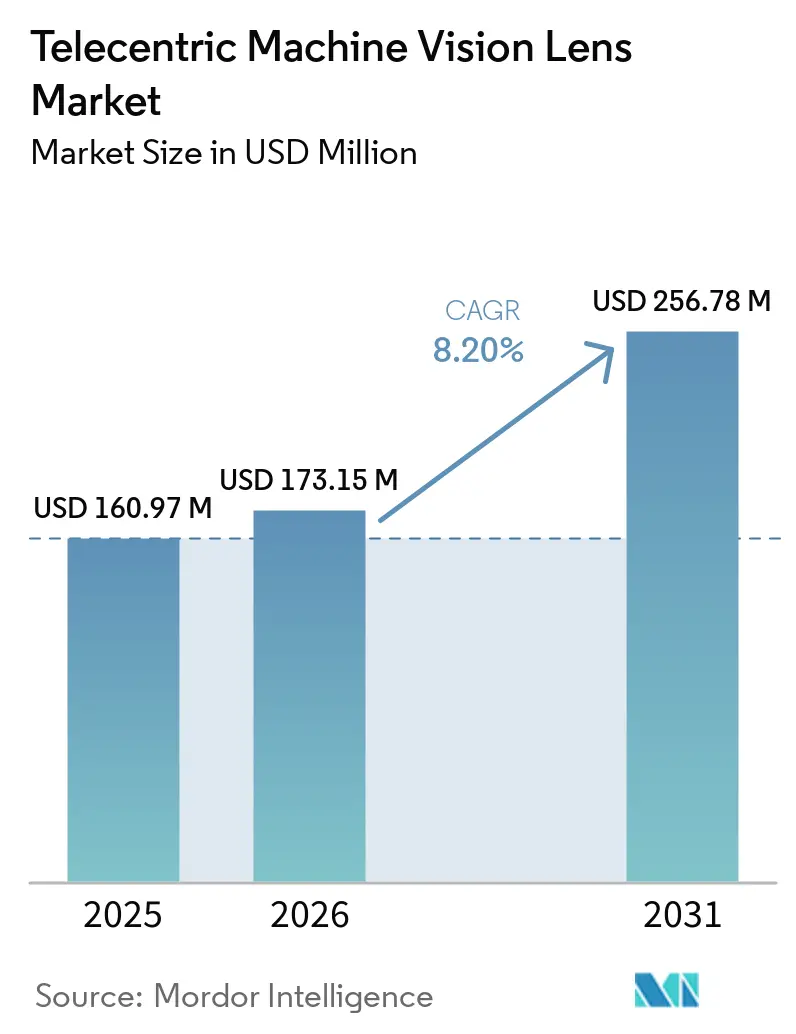
| Market Size (2026) | USD 173.15 Million |
| Market Size (2031) | USD 256.78 Million |
| Growth Rate (2026 - 2031) | 8.20 % |
| Fastest Growing Market | Asia-Pacific |
| Largest Market | Asia-Pacific |
| Market Concentration | Medium |
Major Players *Disclaimer: Major Players sorted in no particular order Image © Mordor Intelligence. Reuse requires attribution under CC BY 4.0. | |
Telecentric Machine Vision Lens Market Analysis by Mordor Intelligence
The telecentric machine vision lens market size is estimated at USD 173.15 million in 2026 and is forecast to reach USD 256.782 million by 2031, at a CAGR of 8.20% during the forecast period 2026-2031. Precision manufacturers are moving from sample checks to continuous inline inspection, which increases the need for reliable dimensional measurement at each critical production step. Telecentric optics maintain magnification across changes in object depth, making them well-suited to applications where small positioning errors can affect quality decisions. Semiconductor fabrication, EV battery production, and medical device manufacturing are important demand settings because each relies on repeatable inspection results. The move from 2/3-inch sensors to 1.1-inch and 4/3-inch sensors requires lenses with larger apertures, which adds design complexity and can raise average selling prices. Suppliers are also responding with software-controlled focus and application-specific products, while lengthy customer qualification cycles and integration costs remain material limits on adoption.
Key Report Takeaways
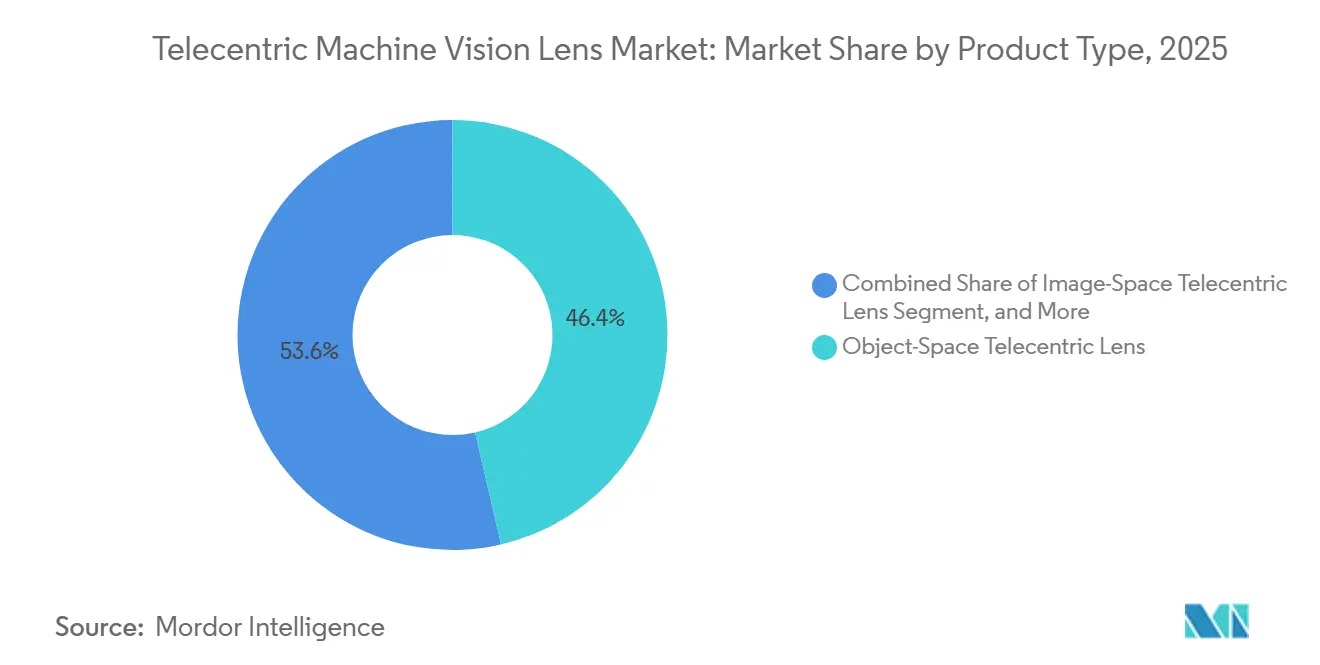
- By product type, object-space telecentric lenses held 46.37% of the telecentric machine vision lens market share in 2025, while bi-telecentric lenses are projected to expand at a 10.14% CAGR through 2031.
- By magnification type, fixed-magnification lenses held 72.43% of the telecentric machine vision lens market share in 2025, while variable-magnification lenses are projected to expand at a 11.27% CAGR through 2031.
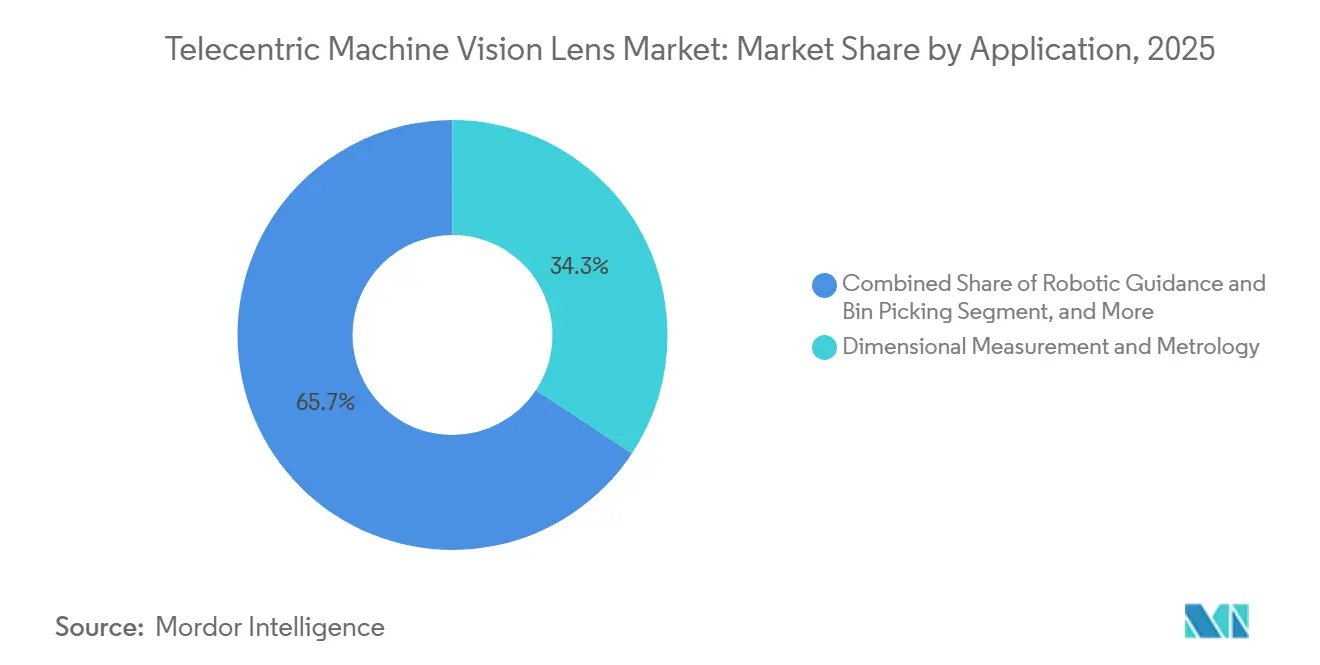
- By application, dimensional measurement and metrology accounted for 34.28% of the telecentric machine vision lens market size in 2025, while robotic guidance and bin picking are projected to advance at a 10.83% CAGR through 2031.
- By end-user industry, semiconductor and electronics held 25.17% of the telecentric machine vision lens market share in 2025, while automotive and electric vehicles are projected to expand at a 10.21% CAGR through 2031.
- By geography, Asia-Pacific accounted for 39.26% of the telecentric machine vision lens market in 2025 and is projected to grow at a 10.57% CAGR through 2031.
Note: Market size and forecast figures in this report are generated using Mordor Intelligence’s proprietary estimation framework, updated with the latest available data and insights as of January 2026.
Market Trends and Insights
Drivers Impact Analysis of Telecentric Machine Vision Lens Market*
| Driver | (~) % Impact on CAGR Forecast | Geographic Relevance | Impact Timeline |
|---|---|---|---|
| Rising Automated Dimensional Inspection in Electronics and Semiconductors | +2.5% | Global, concentrated in Asia-Pacific, China, South Korea, Taiwan, and Japan | Short term (≤ 2 years) |
| Expansion of Smart Factory and Inline Quality Control | +1.8% | Global, with early intensity in North America and Asia-Pacific | Medium term (2-4 years) |
| Higher Resolution Sensors and AI-Assisted Vision | +1.4% | Global | Medium term (2-4 years) |
| Demand for Error-Free Measurement in EV Battery and Medical Device Production | +1.1% | Asia-Pacific, North America, and Europe | Medium term (2-4 years) |
| Coaxial Illumination and Large-Format Line-Scan Integration | +0.7% | Asia-Pacific core, with use in North America and Europe | Long term (≥ 4 years) |
| Qualification of Telecentric Optics for Multi-Height, High-Mix Production Lines | +0.5% | Global | Long term (≥ 4 years) |
| Source: Mordor Intelligence | |||
Rising Automated Dimensional Inspection in Electronics and Semiconductors
Advanced semiconductor production requires inspection systems that maintain positional consistency across the image field. Telecentric designs address this need by limiting magnification variation when the inspected surface changes position. Samsung engineers reported that AI-enhanced optical inspection could improve defect capture by up to 20% or reduce scanning electron microscope review budgets by 89% for 2 nm and 1.4 nm technology nodes. These results depend on stable input images, because the detection system must distinguish process defects from image variation. M52 guides specifying scanning surface inspection systems for silicon wafers across defined technology generations.[1]SEMI, “M05200 - SEMI M52 - Guide for Specifying Scanning Surface Inspection Systems for Silicon Wafers for the 130 nm to 11 nm Technology Generations,” SEMI, store-us.semi.org. As inspection points increase along a fabrication line, demand for telecentric machine vision lenses can outstrip the volume of finished wafers.
Expansion of Smart Factory and Inline Quality Control
Factory systems increasingly combine telecentric imaging for measurement with AI models for complex defect recognition. This division allows the optical system to supply consistent measurements while the software evaluates less predictable defect patterns. In 2026, Siemens described autonomous machine vision as enabling continuous inline inspection and real-time feedback into production processes. Plant systems can link inspection outcomes to manufacturing execution systems or enterprise resource planning records for part-level traceability. A move to full inline coverage requires more inspection stations than a sample-based quality process. That requirement supports additional demand for lenses, even when the design of an individual station remains unchanged.
Higher Resolution Sensors and AI-Assisted Vision
The telecentric machine vision lens market is influenced by the progression to smaller pixel pitches and larger image sensors. Lens designers must retain low distortion and useful resolution as camera systems collect more image detail. A 2026 study reported 98.4% accuracy for a lightweight Vision Transformer model in classifying semiconductor wafer defect maps. The study also reported up to 2.8% higher precision than deep convolutional networks for complex mixed-defect patterns. Stable, distortion-free images remain important because software performance depends on the quality of the optical input. CBC's Computar division introduced its LensConnect Telecentric series with motorized, software-controlled focus for recipe-based inspection workflows.
Demand for Error-Free Measurement in EV Battery and Medical Device Production
Battery cell production requires measurement of electrode foils, weld seams, and housing features during high-volume assembly. BMW described its Woodruff, South Carolina battery plant as using AI, digital twins, real-time weld inspection, and end-of-line checks before shipment. Such inspection arrangements place value on optics capable of documenting consistent dimensional results. The FDA's Quality Management System Regulation became effective on February 2, 2026, and incorporates ISO 13485:2016 by reference. The regulation increases the importance of inspection documentation for medical device manufacturers. The telecentric machine vision lens market therefore benefits where manufacturers need auditable measurement records alongside production quality controls.
Restraints Impact Analysis of Telecentric Machine Vision Lens Market*
| Restraint | (~) % Impact on CAGR Forecast | Geographic Relevance | Impact Timeline |
|---|---|---|---|
| High Initial Cost Versus Standard Machine Vision Lenses | -1.8% | Global, most acute in price-sensitive small and medium-sized enterprise segments in South and Southeast Asia | Short term (≤ 2 years) |
| Complex Optical-Mechanical Integration and Skilled Calibration | -1.2% | Global, most pronounced in emerging markets with limited optical engineering talent | Medium term (2-4 years) |
| Long Working Distance and Field-of-View Tradeoffs in Compact Cells | -0.8% | Global, concentrated in compact automation cells across automotive and electronics | Medium term (2-4 years) |
| Low-Volume Customization and Long OEM Qualification Cycles | -0.6% | Global, primarily affecting specialized industrial segments | Long term (≥ 4 years) |
| Source: Mordor Intelligence | |||
High Initial Cost Versus Standard Machine Vision Lenses
Telecentric lenses carry a price premium of 3x-10x over equivalent-aperture fixed-focal-length designs. Larger optical elements, precise air-gap assembly, tighter mechanical tolerances, and lower production volumes contribute to that premium. The lens is also part of a broader system that can require paired coaxial illumination and a compatible camera sensor. This raises the initial investment for small and medium-sized manufacturers that can accept some measurement imprecision. Cost sensitivity is particularly relevant in Southeast Asia and South America, where lower-priced alternatives can meet less demanding inspection tasks. Opto Engineering states that its CORE PLUS series reduces system length by up to 45% compared with conventional telecentric designs, thereby lowering integration requirements in compact cells.
Complex Optical-Mechanical Integration and Skilled Calibration
A telecentric lens must be aligned with the application-specific optical axis, working distance, and object plane. This process can require specialist engineering resources that are less available outside large original equipment manufacturers and specialist integrators. Changeovers become more difficult where production systems inspect objects of varying height. A 2025 Applied Optics paper described the design challenge of achieving distortion below 0.18% across a magnification range of -0.4x to -0.6x in a double-telecentric zoom system. The work required control of paraxial aberration and separate correction at each magnification setting. Suppliers can reduce setup barriers through pre-aligned mounts, embedded calibration support, and software-guided commissioning, but these measures do not remove the underlying skills requirement.
*Our forecasts treat driver/restraint impacts as directional, not additive. The impact forecasts reflect baseline growth, mix effects, and variable interactions.
Telecentric Machine Vision Lens Market Segment Analysis
By Product Type:
Bi-Telecentric Architecture Gains Ground in High-Accuracy ApplicationsObject-space telecentric lenses accounted for 46.37% of the telecentric machine vision lens market in 2025. Their position reflected their wide use in dimensional gauging and automated optical inspection systems, where object-side telecentricity met the measurement requirements in established production environments. These lenses reduce changes in the apparent size of an object as it moves within the allowed depth range. Image-space telecentric lenses occupied a smaller but stable role, with camera-side magnification consistency as the central requirement for the installed camera configuration. Their use remained relevant when sensor placement and image formation required greater control.
Bi-telecentric lenses are projected to expand at a 10.14% CAGR through 2031. The architecture controls magnification on both the object and image sides. A study of double-telecentric zoom systems achieved distortion below 0.18% across the tested magnification range. VICO Imaging presented its COOLENS bi-telecentric matrix lens for lithium-ion battery weld inspection in 2024.[2]VICO Imaging, “Vision Stuttgart 2024: Experience VICO Imaging's Cutting-Edge Solutions for Li-ion Battery and PCBA Inspections,” VICO Imaging, vicoimaging.com. Partially telecentric lenses remained a niche option for cost-sensitive inspection tasks where full telecentricity was not required.



By Magnification Type:
Fixed Designs Remain Established While Variable Options Support Mixed-Part LinesFixed-magnification lenses accounted for 72.43% of the telecentric machine vision lens market in 2025. Their simpler mechanical construction, lower cost, and repeatable performance suited single-product and low-variety production lines with established inspection routines. Semiconductor and electronics producers often validate an optical configuration during tool qualification. Those validation practices can discourage substitution during the equipment's operating life, even when newer optical designs become available. Fixed designs remain compatible with many established automated optical inspection and gauging systems.
Variable magnification lenses are projected to expand at an 11.27% CAGR through 2031. Automotive and consumer electronics facilities use them when a single inspection station handles parts of different sizes. A 2025 study demonstrated modulation transfer function values above 0.28 at a 50 lp/mm Nyquist frequency across the continuously adjustable magnification range of a double-telecentric system. Opto Engineering's TCZRS zoom series uses a bipolar stepper motor and an incremental magnetic encoder. The system provides bi-telecentricity and repeatability at 4 programmable magnification settings.
By Application:
Dimensional Metrology Supports Revenue While Robotic Vision AdvancesDimensional measurement and metrology accounted for 34.28% of the telecentric machine vision lens market size in 2025. This application includes precision gauging for automotive components, electronic connectors, pharmaceutical tablet geometry, and semiconductor die placement in tightly controlled production processes. Telecentric imaging provides a stable scale for these measurement tasks. Automated optical inspection and defect detection represent another major use, as manufacturers expand inline checks in semiconductor back-end packaging and printed circuit board assembly. These applications require consistent imaging when systems identify small placement, surface, or dimensional defects.
Robotic guidance and bin picking are projected to advance at a 10.83% CAGR through 2031. Traditional bin-picking systems often use structured-light or time-of-flight cameras to create three-dimensional point clouds. Telecentric optics can complement these systems by enabling two-dimensional pose measurement prior to gripping. This arrangement uses three-dimensional imaging for location and telecentric imaging for a stable reference measurement. Optical character recognition and code reading remain a smaller, stable application in pharmaceutical tracking and food packaging.
By End-User Industry:
Semiconductor Leadership Continues as EV Requirements IncreaseSemiconductor and electronics accounted for 25.17% of the telecentric machine vision lens market in 2025. Fabrication plants and outsourced semiconductor assembly and test facilities use inspection stations for advanced packaging, wafer edge checks, die-bond alignment, and related process verification. M52 guides the specification of scanning surface inspection systems for silicon wafers. SEMI Process upgrades can add inspection stages and support recurring procurement of precision optics. This customer group also values documented optical performance during equipment qualification.
Automotive and electric vehicles are projected to expand at a 10.21% CAGR through 2031. Battery cell, module, and pack production requires checks at several points in the manufacturing process. GM developed the BVSeal inspection system to identify leaks in EV battery trays during production. Medical devices, pharmaceuticals, healthcare, and life sciences also require well-documented inspection accuracy. Food and beverage, logistics and packaging, energy and power, and industrial manufacturing create a wider recurring demand base across routine production inspection activities.
Geography Analysis
APAC Telecentric Machine Vision Lens Market
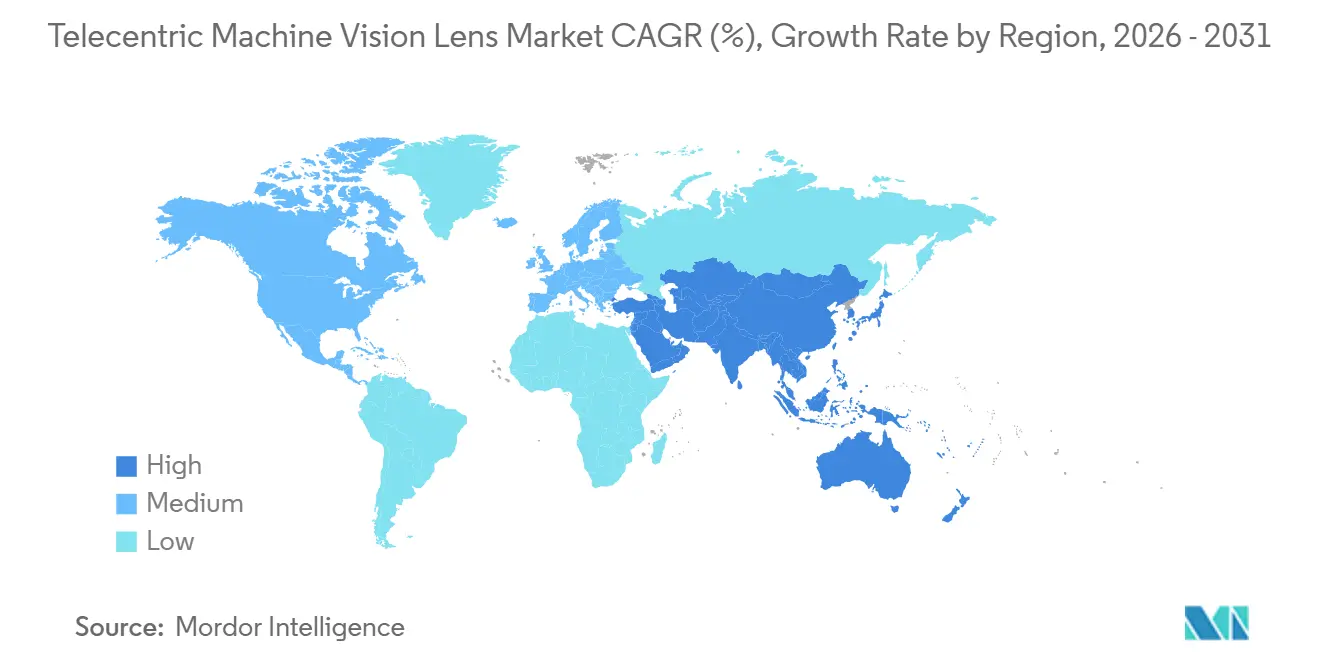
Asia-Pacific held 39.26% of the telecentric machine vision lens market share in 2025 and is projected to expand at a 10.57% CAGR through 2031. China, Japan, South Korea, and Taiwan provide the region's main demand base through semiconductor, display panel, and electronics manufacturing. Chinese camera and system manufacturers increasingly use telecentric optics from both domestic and international suppliers. This reflects quality requirements that are increasingly aligned with global production standards. Japan supports demand through specialists such as VS Technology, Moritex, KOWA, and Myutron. Japanese suppliers are also developing lenses for larger, high-resolution sensor formats.
North America and Europe Telecentric Machine Vision Lens Market
North America holds a significant position because semiconductor construction requires precision inspection across wafer and substrate processes. TSMC, Samsung, and Intel have announced capacity investments that support this inspection requirement. EV battery plants also use arrays of machine vision cameras for cell, module, and pack inspection. Aerospace and medical device manufacturing add demand for accurate measurement systems. Europe remains established through Germany's automotive and machine-building base. The VDMA reported that the European machine vision market contracted by 2% in 2025, while growth in 2026 was projected at 3%.
MEA and South America Telecentric Machine Vision Lens Market
South America, the Middle East, and Africa remain smaller parts of the telecentric machine vision lens market. Brazil's automotive assembly and agri-industrial food processing activities support early demand in South America. Electronics assembly and healthcare manufacturing contribute to adoption in the United Arab Emirates and Saudi Arabia. South Africa's automotive component base and Egypt's electronics assembly sector lead activity in Africa. Limited local optical engineering capacity remains a practical challenge for integration and calibration. This constraint can limit adoption even where capital investment is available.

Competitive Landscape
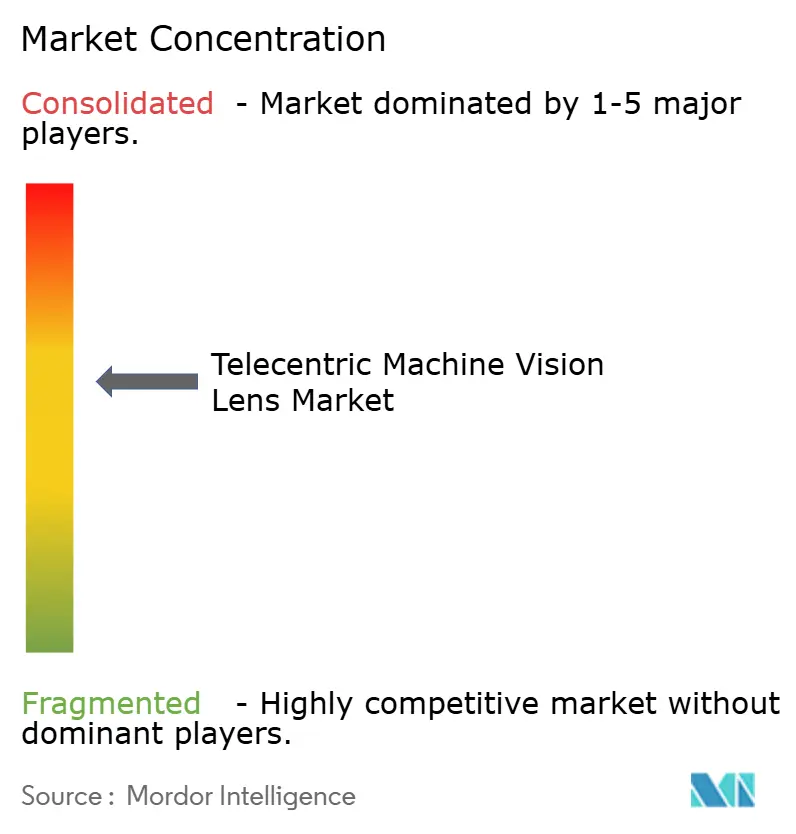
The telecentric machine vision lens market is moderately fragmented, with no single supplier leading across all product types, magnification ranges, and applications. European specialists, particularly in Germany and Italy, focus on high-precision designs for semiconductor and medical applications. Japanese manufacturers focus on compact, fixed-magnification products for electronic inspection and precision gauging. United States optics houses and distributors often add customized integration support for North American original equipment manufacturers. Chinese suppliers compete more strongly in standard-magnification tiers where price has greater weight in purchasing decisions. The top players' combined share was not provided, so a concentration score cannot be assigned using the stated share-based method.
Suppliers are expanding compatibility with 1.1-inch and 4/3-inch sensor formats as customers adopt higher-resolution cameras. They are also adding active components, including liquid lenses and motorized focus controls, to support software-managed inspection recipes. Sill Optics introduced a 2x magnifying telecentric lens with an integrated liquid lens that enables at least 6 mm of automated focus adjustment for 12-20 megapixel sensors.[3]Sill Optics, “2x Magnifying Telecentric Lens with Integrated Liquid Lens,” Sill Optics, silloptics.de. CBC's Computar brand released LensConnect Telecentric products with software-controlled focus and aperture adjustment through an application programming interface. These strategies position the lens as part of an integrated inspection system rather than as a passive optical component.
JENOPTIK reported EUR 230.4 million (USD 251.1 million) in Semiconductor and Advanced Manufacturing revenue for the first half of 2026. The company reported a 10.2% year-over-year increase and an 85.3% increase in order intake for that business. JENOPTIK also announced the expansion of optics manufacturing capacity at its Jena campus, with renovation beginning in summer 2026. Smaller suppliers such as Avantier, Canrill Optics, and Myutron compete through faster custom design cycles for low-volume applications. The telecentric machine vision lens market offers space for suppliers that can pair application-specific optical design with documented calibration and integration support.
Telecentric Machine Vision Lens Industry Leaders
Opto Engineering S.p.A.
Edmund Optics, Inc.
Sill Optics GmbH & Co. KG
VS Technology Corporation
Moritex Corporation
- *Disclaimer: Major Players sorted in no particular order
Telecentric Machine Vision Lens Market Companies Covered in this Report
- Opto Engineering S.p.A.
- Edmund Optics, Inc.
- Sill Optics GmbH & Co. KG
- VS Technology Corporation
- Moritex Corporation
- KOWA Company, Ltd.
- CBC Co., Ltd.
- JENOPTIK Optical Systems GmbH
- Nikon Instruments
- Jos. Schneider Optische Werke GmbH
- Shanghai Optics Inc.
- Thorlabs, Inc.
- Ricoh Industrial Solutions Inc.
- Computar
- Navitar, Inc.
- Avantier, Inc.
- Canrill Optics Co., Ltd.
- Myutron Inc.
- Tamron Co., Ltd.
- KYOCERA Corporation

Recent Industry Developments in Telecentric Machine Vision Lens Market
- August 2026: JENOPTIK AG reported H1 2026 Semiconductor and Advanced Manufacturing revenue of EUR 230.4 million (USD 251.1 million), a 10.2% year-over-year increase. Group order intake increased 53.0% to EUR 723.4 million (USD 788.5 million). The company confirmed planned expansion of optics manufacturing capacity at its Jena site, directly supporting semiconductor equipment inspection lens production.
- August 2026: JENOPTIK confirmed planned expansion of optics manufacturing capacity at its Jena site. Renovation was scheduled to begin in summer 2026, directly supporting semiconductor equipment inspection lens production.
- February 2026: The US Food and Drug Administration's Quality Management System Regulation became effective on February 2, 2026. The regulation incorporates ISO 13485:2016 by reference and makes internal inspection records visible to FDA review.
- January 2026: JENOPTIK, together with its subsidiaries SwissOptic and TRIOPTICS, presented at SPIE Photonics West 2026. The company showcased optical solutions for semiconductor equipment, laser technologies, life sciences, and advanced manufacturing, reinforcing its focus on precision optics applications.


Global Telecentric Machine Vision Lens Market Report Scope
The Telecentric Machine Vision Lens Market comprises specialized optical lenses for industrial machine vision systems that deliver high-precision imaging with minimal perspective distortion and consistent magnification, enabling accurate inspection and measurement of manufactured components. The market includes object-space telecentric lenses, image-space telecentric lenses, bi-telecentric lenses, and partially telecentric lenses, available in fixed- and variable-magnification configurations.
The Telecentric Machine Vision Lens Market Report is Segmented by Product Type (Object-Space Telecentric Lens, Image-Space Telecentric Lens, Bi-Telecentric Lens, and Partially Telecentric Lens), Magnification Type (Fixed Magnification, and Variable Magnification), Application (Dimensional Measurement and Metrology, Automated Optical Inspection and Defect Detection, Robotic Guidance and Bin Picking, Optical Character Recognition and Code Reading, and Other Applications), End-User Industry (Semiconductor and Electronics, Automotive and Electric Vehicle, Medical Devices, Pharmaceutical, Healthcare, and Life Sciences, Food and Beverage, Logistics, Packaging, and Consumer Goods, Energy and Power, Industrial Manufacturing, and Other End-User Industries), and Geography (North America, South America, Europe, Asia-Pacific, Middle East, and Africa). The Market Forecasts are Provided in Terms of Value (USD).
| Object-Space Telecentric Lens |
| Image-Space Telecentric Lens |
| Bi-Telecentric Lens |
| Partially Telecentric Lens |
| Fixed Magnification |
| Variable Magnification |
| Dimensional Measurement and Metrology |
| Automated Optical Inspection and Defect Detection |
| Robotic Guidance and Bin Picking |
| Optical Character Recognition and Code Reading |
| Other Applications |
| Semiconductor and Electronics |
| Automotive and Electric Vehicle |
| Medical Devices, Pharmaceutical, Healthcare, and Life Sciences |
| Food and Beverage |
| Logistics, Packaging, and Consumer Goods |
| Energy and Power |
| Industrial Manufacturing |
| Other End-User Industries |
| North America | United States |
| Canada | |
| Mexico | |
| South America | Brazil |
| Argentina | |
| Rest of South America | |
| Europe | Germany |
| United Kingdom | |
| France | |
| Italy | |
| Spain | |
| Rest of Europe | |
| Asia-Pacific | China |
| Japan | |
| India | |
| South Korea | |
| Rest of Asia-Pacific | |
| Middle East | United Arab Emirates |
| Saudi Arabia | |
| Rest of Middle East | |
| Africa | South Africa |
| Egypt | |
| Rest of Africa |
| By Product Type | Object-Space Telecentric Lens | |
| Image-Space Telecentric Lens | ||
| Bi-Telecentric Lens | ||
| Partially Telecentric Lens | ||
| By Magnification Type | Fixed Magnification | |
| Variable Magnification | ||
| By Application | Dimensional Measurement and Metrology | |
| Automated Optical Inspection and Defect Detection | ||
| Robotic Guidance and Bin Picking | ||
| Optical Character Recognition and Code Reading | ||
| Other Applications | ||
| By End-User Industry | Semiconductor and Electronics | |
| Automotive and Electric Vehicle | ||
| Medical Devices, Pharmaceutical, Healthcare, and Life Sciences | ||
| Food and Beverage | ||
| Logistics, Packaging, and Consumer Goods | ||
| Energy and Power | ||
| Industrial Manufacturing | ||
| Other End-User Industries | ||
| By Geography | North America | United States |
| Canada | ||
| Mexico | ||
| South America | Brazil | |
| Argentina | ||
| Rest of South America | ||
| Europe | Germany | |
| United Kingdom | ||
| France | ||
| Italy | ||
| Spain | ||
| Rest of Europe | ||
| Asia-Pacific | China | |
| Japan | ||
| India | ||
| South Korea | ||
| Rest of Asia-Pacific | ||
| Middle East | United Arab Emirates | |
| Saudi Arabia | ||
| Rest of Middle East | ||
| Africa | South Africa | |
| Egypt | ||
| Rest of Africa | ||


Key Questions Answered in the Report
What is the 2026 size of the telecentric machine vision lens market?
The telecentric machine vision lens market size is USD 173.15 million in 2026 and is forecast to reach USD 256.782 million by 2031 at an 8.20% CAGR. Demand is supported by precision inspection requirements in semiconductor, EV battery, and medical device production.
Which product type led telecentric machine vision lens demand?
Object-space telecentric lenses led with a 46.37% share in 2025 because they are widely used for established dimensional gauging and automated optical inspection tasks. Bi-telecentric lenses are projected to record the fastest product growth at a 10.14% CAGR through 2031.
Why are telecentric lenses used in semiconductor inspection?
They help preserve magnification consistency during dimensional measurement, wafer inspection, packaging checks, and die-bond alignment. This consistency is useful when an inspection system needs stable images for accurate defect identification and process verification.
Which end-user application is expected to expand fastest?
Robotic guidance and bin picking are projected to advance at a 10.83% CAGR through 2031. These systems can pair three-dimensional location data with telecentric two-dimensional pose measurement before a robot grips or handles a component.
Which end-user sector has the largest use of telecentric lenses?
Semiconductor and electronics held a 25.17% share in 2025, supported by advanced packaging, wafer edge verification, and die-bond alignment. Qualification requirements and additional inspection stages can support recurring demand for precision optics.
Which region is expected to lead demand through 2031?
Asia-Pacific held 39.26% in 2025 and is projected to expand at a 10.57% CAGR through 2031. Semiconductor, display-panel, and electronics manufacturing in China, Japan, South Korea, and Taiwan provide the region's largest demand base.
Page last updated on:





